
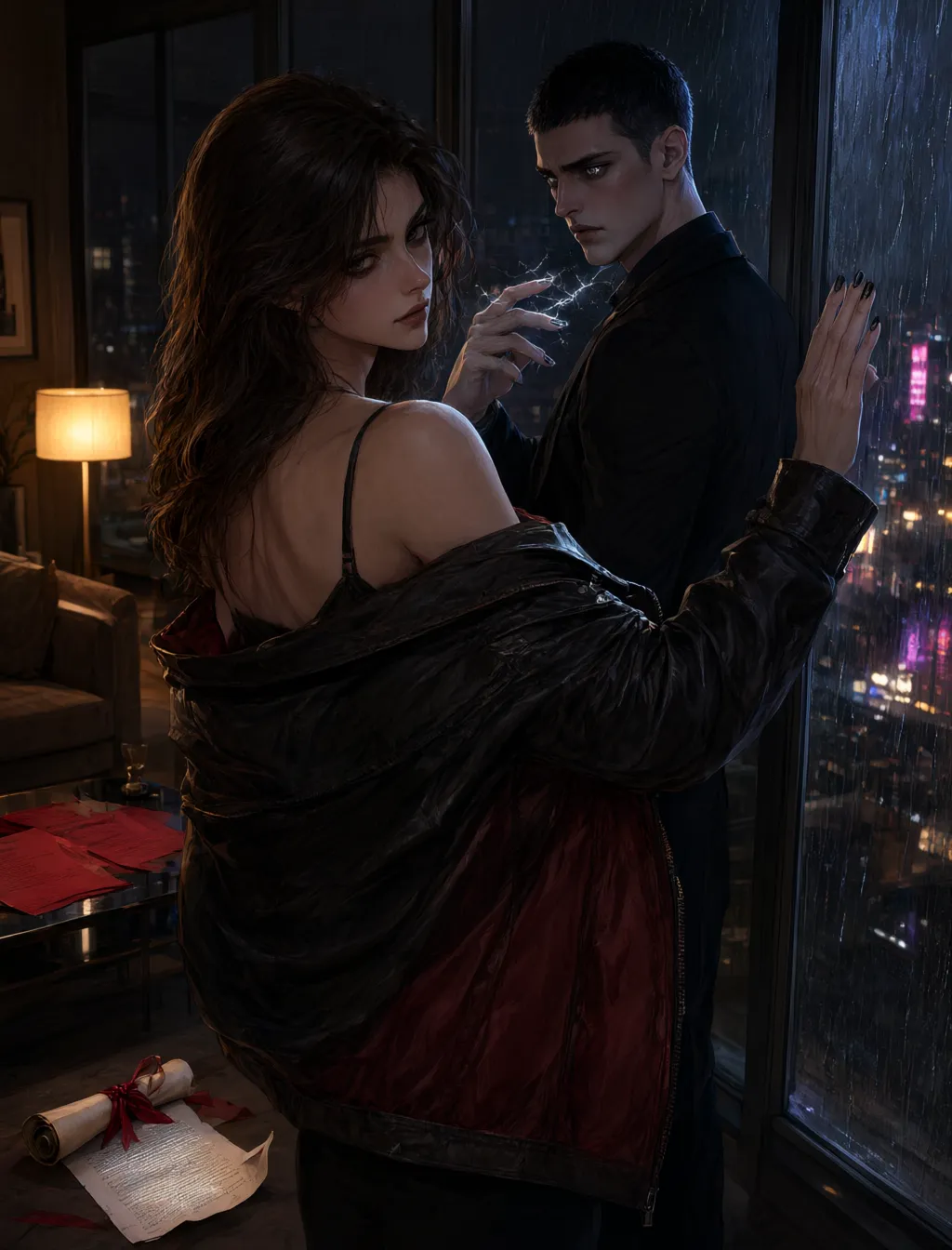
Mia’s hand trembled only after she put the pen down. The contract on the table glimmered, the text shifting like smoke under the dim light. The man—Veyr—watched her with tarnished-silver eyes that didn’t blink. A static charge raised the hairs on her arms. When he reached to take the paper, his fingers passed through the wood first, then solidified, and a jolt of cold electricity shot up her spine.
She snatched her hand back, cradling it against her chest. The cold lingered, a phantom brand in her bones. The ink on the page—her signature, a frantic scrawl of black—stopped shimmering and settled, ordinary and damning. Veyr lifted the contract. The paper made no sound.
“It is done,” he said. His voice wasn’t loud. It was a vibration in the air between them, in the dust motes caught in the lamplight.
“What happens now?” Her own voice sounded thin, a child’s in the cavernous quiet of the forgotten library stack.
He didn’t answer immediately. He studied the document, his sharp features impassive. The single bare bulb above them hummed, a dying insect. Mia watched his hands. They were pale, elegant. They had just passed through solid oak.
“Now,” Veyr said, folding the contract once with a precise, final crease, “I exist in your world. And you belong in mine.” The paper vanished between his fingers, gone between one blink and the next. “The terms are active.”
A wave of dizziness hit her. She gripped the edge of the heavy library table, the wood gritty under her ink-stained fingers. The air tasted of ozone and decay. “You said you’d save my life. You haven’t done anything.”
“I have.” He tilted his head, that predatory angle. “The event that would have killed you in seventy-two hours has been… rerouted. The payment is your awareness. Your access.” He took a step closer. He didn’t seem to move through the space so much as the space reconfigured to bring him nearer. The scent of old books and storm-charge intensified. “You will see the seams, Mia Reyes. You will feel the current. And you will learn not to touch it.”
Her leather jacket felt too heavy, a useless hide. “And you? When do you… appear?”
“When the contract demands. When I choose.” His silver eyes held hers. “There is no schedule. There is only the agreement.”
He reached out again. This time, his fingers—solid, cold—brushed a strand of dark hair from her forehead. The touch was brief, impersonal. Every nerve in her body fired a warning. She didn’t flinch. She held perfectly still, her breath locked in her throat.
“The first lesson,” he murmured, his low voice curling into her ear. “The trembling starts after. The fear is a luxury of survivors.” He withdrew. The static in the air snapped, leaving a vacuum of silence. “I will see you when the city shows you its teeth.”
Then he was simply not there. The space where he’d stood was empty, just shadows and dust. The bare bulb flickered once, twice, and steadied. Mia was alone with the towering shelves and the dry, sweet rot of forgotten paper. Her hand still throbbed with cold. She looked down at it, turning it over in the weak light. For a second, just a flash behind her eyes, she saw not her skin but a lattice of shimmering, impossible geometry, a blueprint of light and shadow pulsing just beneath the surface. She blinked. It was gone. Her hand was just her hand. Stained with ink. Shaking.
The contract was still on the table. The paper was blank.
Mia stared. She’d seen him fold it. She’d watched it vanish between his pale fingers. Yet here it lay, flat and empty in the pool of weak yellow light from the bare bulb. The frantic scrawl of her signature was gone. The shifting, smoke-like text was gone. It was just a sheet of heavy, cream-colored paper, slightly worn at the edges.
She reached for it. Her hand, still shaking, hovered an inch above the surface. No static charge. No cold. She pressed her fingertips to it. It felt like paper. Dry. Ordinary. She flipped it over. The other side was blank too.
A sound escaped her—a choked half-laugh that died in the dusty air. Was this the joke? Sign away your life and get a souvenir? She picked it up. It was lighter than it should have been. She brought it closer to her face, squinting. In the right angle of light, she could see the faintest impression in the fiber, a ghost of where her pen had pressed down. A phantom signature. But no ink.
Her thumb found the corner of the page. The edge was sharp enough to slice. She tested it against the pad of her thumb, not quite pressing. A thin, white line appeared on her skin. She could draw blood with this. She almost wanted to.
“It’s not for you anymore.”
Mia dropped the paper. It fluttered back to the table, landing face-up. Blank. She hadn’t heard him return. He was just there, leaning against a shelf three feet away, his tailored black suit blending into the shadow. His tarnished-silver eyes watched her, unblinking.
“You said it was done.” Her voice was raw.
“It is. The agreement resides elsewhere now. That…” He nodded toward the table. “That is a window. A point of contact. It will remain blank until a term requires acknowledgment.”
“A point of contact,” she repeated. The words felt stupid in her mouth.
He pushed off the shelf. He didn’t walk toward her. The distance between them simply dissolved, and then he was on the other side of the table, looking down at the empty page. “You will keep it. Somewhere safe. When writing appears, you will read it.”
“Or what?”
He looked up at her. The predatory tilt of his head. “The terms are not negotiable, Mia. They are conditions of reality. Ignoring them is like ignoring gravity. The consequence is the fall.”
He reached out. Not for the paper. For her. His cold fingers closed around her wrist, the one stained with ink. His touch was absolute. Her pulse hammered against the cage of his grip. He turned her hand over, exposing her palm to the light. The ink was a smudged, blue-black galaxy across her skin.
“This is yours,” he said, his thumb tracing a line through the stain. A shiver, electric and unwanted, shot up her arm. “The mark of your choice. It will fade from the paper. It will not fade from you.” He released her. The cold lingered, a bracelet of frost. “Keep the window safe. I will know if it is destroyed.”
Then he was gone again. The air didn’t snap this time. It just settled, heavier. Mia stood, clutching her inked hand to her chest. She looked at the blank contract. A window. A point of contact.
She folded it once, mimicking his precise crease, and shoved it into the inner pocket of her leather jacket. It lay against her ribs, a flat, silent weight. She turned off the single bulb, plunging the forgotten stack into a darkness that now felt different. Not empty. Watching.
The darkness in the library stack was a solid thing, a pressure against her skin. Mia turned her back on it and walked out, her boots scuffing on the worn stone steps leading up to the main library floor. The ordinary fluorescents overhead buzzed, harsh and sterile after the single bulb’s hum. She kept her inked hand tucked into her jacket, the cold from his grip a permanent echo around her wrist.
The night air outside hit her like a slap. It was cool, damp with the promise of rain, and it should have felt like freedom. It didn’t. The city stretched before her—the wet gleam of asphalt under streetlights, the distant groan of a bus, the glow of a bodega sign down the block. Normal. Entirely normal. And yet.
She saw the seam.
It was a hairline fracture in the air above the storm drain across the street, a shimmer of wrongness like heat haze off pavement, but cold. It pulsed, a slow, sick rhythm that made her teeth ache. She blinked, hard. It didn’t vanish. It hung there, a tear in the world’s fabric, and from its edges dripped motes of darkness that dissolved before they hit the ground. The contract in her inner pocket felt suddenly heavier, a lodestone pulling her gaze toward the rupture.
“Don’t touch it,” she whispered to herself, his words in her mouth. Her heart was a frantic drum against her ribs. She forced her eyes away, focusing on the cracked sidewalk under her feet. One step. Then another. The weight of being watched settled between her shoulder blades, a gaze that came from the shadows between buildings, from the dark mouths of alleys, from the very air.
She walked faster. Her leather jacket, usually a comfort, felt like a target. Every passing car’s headlight was a searchlight. Every figure in a window was a sentinel. She cut through a narrow park, its path lined with skeletal trees. The playground equipment was a hulking, rusted silhouette. In the center of the sandbox, the air coalesced. Not into Veyr. Into a shape—a dense knot of shadow that swirled like ink in water. It had no features, no intent she could name, but it was turned toward her. Watching. Assessing. A current of frigid air snaked out from it, brushing her ankle. She froze.
The shadow-shape held for three of her hammering heartbeats. Then it unraveled, dissipating into the night like smoke. The cold touch lingered. Mia realized she’d stopped breathing. She sucked in a ragged gasp. The city wasn’t just hiding the truth. It was saturated with it. Every shadow was a potential pupil. Every silence a held breath.
She reached her apartment building, a narrow brick wedge squeezed between two taller structures. Her fingers, stained blue-black, fumbled with the keys. The lobby was dim, smelling of lemon cleaner and mildew. The elevator light was out. She took the stairs, her footsteps echoing too loud in the concrete stairwell. On the third-floor landing, the flickering fluorescent tube strobed. In each burst of darkness, she saw the afterimage of that shimmering seam over the storm drain, etched on her vision.
Her apartment door closed behind her with a definitive click. She leaned against it, the wood solid and real against her spine. Safe. The word was a lie. The quiet here was different from the library’s. It was the quiet of a held breath, of something waiting just outside the frequency of hearing. She shrugged off her jacket, letting it fall to the floor. The folded contract slid out of the inner pocket and lay on the scuffed hardwood, a pale rectangle in the dark room.
She didn’t pick it up. She walked to the kitchen, turned on the faucet, and thrust her hands under the cold water. She scrubbed at the ink stain on her palm, the soap foaming blue. She scrubbed until her skin was raw and pink. The stain remained. A galaxy of choice, permanent. She turned off the water. Dripping, she looked at her reflection in the dark window over the sink. Her own dark eyes stared back, wide and unfamiliar. Behind her, in the gloom of the studio apartment, the blank contract on the floor seemed to drink the faint light from the street.
A dry, rustling whisper filled the silence. Not a sound from the city. A sound from the paper. Mia turned, slow. Words were bleeding onto the page, forming from the center out in a deep, iridescent black that wasn’t quite ink. They spelled a single sentence, stark and clear across the cream-colored surface.
Sleep well, Mia Reyes. The city dreams of you.