
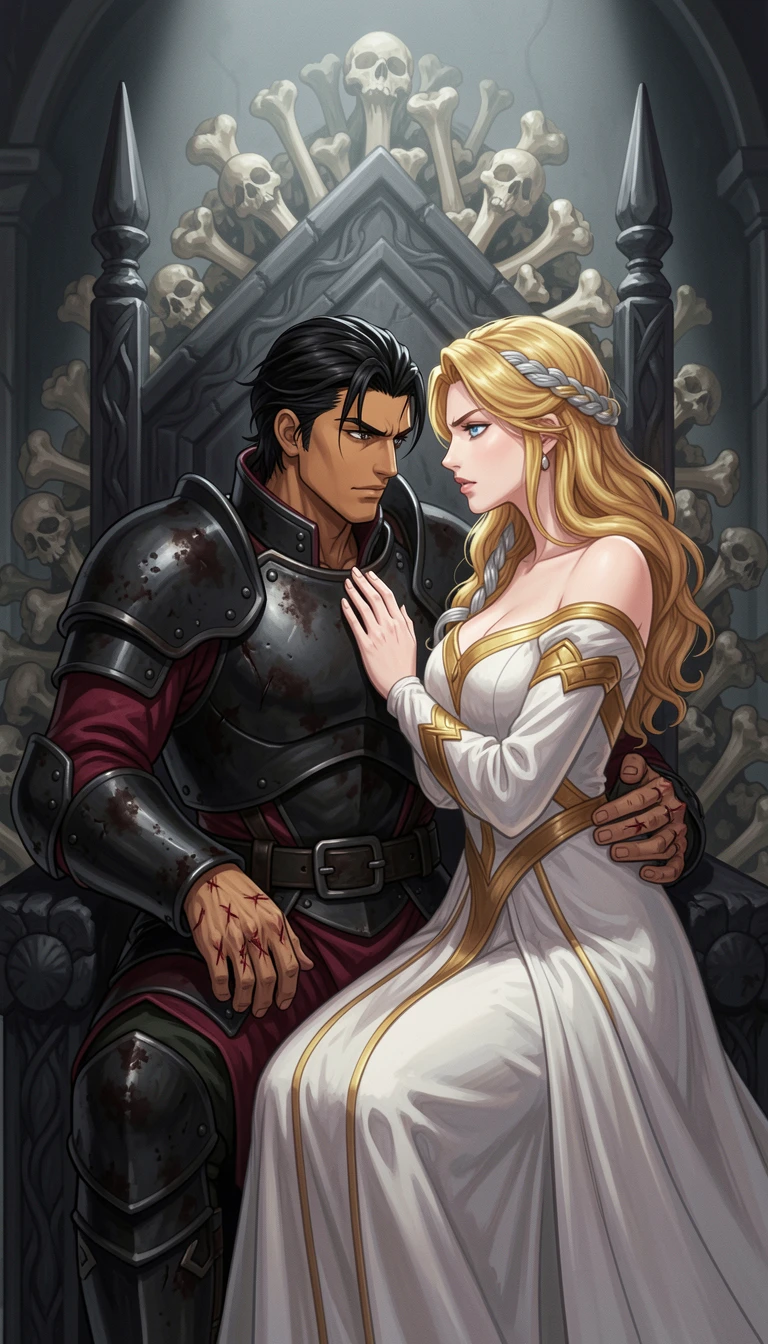
The obsidian throne drank the morning light and gave back nothing. Damien Cross sat where he always sat, spine against the black stone, one boot heel hooked on the dais step below him, and the unsealed letter lay across the throne's left arm where Seraphina had set it an hour ago, its broken wax seal catching the thin blade of sun that came down through the high windows and cutting a red fleck across his knuckles. He had read it twice. He had not yet decided what to do with the second reading.
The doors at the far end of the hall groaned open. Black iron cavalry stood in two still rows outside, and the sound of their silence carried further than any shout. Kael Thorne came through first, his spear across his back, his scarred plate catching the same light as the throne and throwing it back duller, older. His hand rested on the shoulder of the boy beside him—not gripping, not guiding, just present, the way a man rests a hand on a horse he has decided not to break.
Aldric Aurora walked like a man who had not slept. His golden hair was flat on one side where it had pressed against a pillow, his white and silver tunic was creased at the shoulder, and his dark blue eyes—deeper water, not winter sky, the sister's eyes were the winter—moved once across the room and then fixed on the letter on the throne's arm and did not move again. He had the look of a boy who had spent the night rehearsing a face and was already losing the argument with it.
Lily came half a step behind him. She had changed into a different gown—white still, gold thread at the cuffs, shoulders bare the way the court of the Kingdom of Light required of its unmarried daughters when they stood before foreign kings—and her braid was redone, the silver thread tighter than yesterday, as if she had pulled it hard enough to hurt. Her pale blue eyes went to her brother, then to the letter, then to Damien. She did not look at the floor. That was the first thing he noticed about her this morning. Yesterday she had looked at the floor twice. Today she had decided not to.
Gaby Chen stood three steps behind her, close enough to be seen and far enough to be silent, and her green eyes were wide and fixed on the throne the way a bird fixes on a snake. She had not smiled since the executions. Damien noted that. He noted most things.
"Bring him to the foot," Damien said. His voice did not carry. It never did. The room leaned toward it anyway.
Kael walked the boy forward. Their boots struck the black stone in the same rhythm—the general's heavy, the prince's trying to be—and stopped at the lowest step of the dais, where the obsidian went from floor to throne in a single unbroken sweep. Kael's hand lifted from Aldric's shoulder and fell to his side, and Aldric stood alone at the foot of the steps with his sister at his right and nothing behind him but the long cold room.
Damien let him stand there. He had learned a long time ago that the first minute of a man's fear was the only honest minute he would ever give you, and it was worth more than the next hour of his words. Aldric's jaw was set. His hands were at his sides, fingers slightly spread, the way a man holds his hands when he is afraid they will do something he did not tell them to. His eyes had not left the letter. He had recognized the fold. Damien watched him recognize it—the small flinch at the corner of the mouth, the way the boy's throat moved once—and filed it away.
"You slept," Damien said.
"Yes."
"On the bed, or on the floor?"
Aldric's eyes came off the letter for the first time. He did not understand the question. That was the point of it. Damien watched him try to find the trap and fail to find it, and then watched him answer honestly because he could not think of a lie fast enough.
"The bed."
"Then you took the room," Damien said. "Good. That is one decision made. There are more."
He reached down with two fingers—the middle and the fore, the two that had been broken and reset wrong at nineteen and had never straightened since—and lifted the letter off the throne's arm. The paper was heavier than it looked. Lily's hand had pressed hard enough to emboss the back. He held it out into the air between them, at the height of his own chest, and did not offer it to anyone in particular.
"This letter is what your sister wrote for your father," he said. "It tells the events of last night. All of them. It tells him what she saw in this room, and it tells him what you did in it, and it tells him what you did not do."
Aldric's face did not move. His hands did. The fingers spread a fraction wider, then closed into loose fists, then opened again. Lily, beside him, had gone very still—still the way a sword is still, not the way a deer is.
"She wrote it honestly," Damien said. "I read it before it left. I read everything that leaves this palace. You will want to know whether she spared you, and I will not tell you. You will find out in a moment."
He turned the letter in his fingers—once, slowly, so the broken seal faced the boy—and then extended it, not to Aldric, but to the woman standing at the left edge of the dais. Seraphina Vale stepped forward out of the shadow of the throne's high back. She had been there the whole time; she was always there the whole time. Her copper eyes moved from Damien's face to the letter to the boy and back, and she took the paper with the same economy she did everything, no wasted motion, no wasted glance.
"Seraphina will bring it to him," Damien said. "He will read it standing where he stands. You will watch him read it, Princess, because you wrote it, and because what happens to his face while he reads it is the only part of this morning that I have not already seen."
Lily's chin lifted a degree. Her voice, when it came, held the careful court formality she had been raised into, and underneath it the shake she had not yet learned to hide. "May I ask what you intend to do with the letter after he has read it."
"You may ask," Damien said. "I will not answer. You will learn what I intend when I intend it, and not before. That is the arrangement you agreed to when you walked through those doors, whether you knew it or not."
He saw the anger come up her throat and stop at her teeth. He watched her swallow it. That was the second thing he noticed about her this morning, and it was the more interesting of the two: she was learning, in real time, on the floor of his throne room, how to hold a thing she could not spend. Yesterday she had spent it. Yesterday she had thrown the word "monster" at him and watched it land nowhere. Today she was keeping it. Today she was putting it somewhere he could not see.
Good, he thought. He did not say it. He tilted his head instead, the small tilt, the wolf deciding, and let the silence stretch until the boy at the foot of the dais could not stand it anymore.
"What do you want me to do," Aldric said. It came out fast, too fast, the words running together the way they had run together in the throne room yesterday when he had tried to refuse the spear. "If you want me to read it, give it to me. If you want me to—"
"I want you to stand there," Damien said, "and I want you to be quiet, and I want you to remember that the last time you spoke in this room without being asked, a man died on the floor in front of your sister, and you were the reason."
The boy's mouth closed. His face went pale, then red, then pale again, and his hands stopped moving entirely. Damien watched the shame move through him like weather and did not soften anything to accommodate it. Shame was useful. Shame was the only tool he had ever found that worked on men who were not yet afraid enough to be honest.
He looked past the boy, then, to the girl. Not Lily—the other one. Gaby Chen had not moved since she came through the doors, but her hands had. They were clasped in front of her, and the knuckles had gone white, and she was watching her princess with an expression that Damien recognized because he had worn it himself, once, before he had cut the part of himself out that wore it. Devotion. The kind that would walk into a fire and not ask why. The kind that could be used.
He filed that away too. He filed everything. That was how the empire had been built—not on the cavalry, not on the executions, but on the small visible things that people did when they thought no one was watching, and on the fact that he was always watching.
"Seraphina," he said.
"Your Majesty."
"The letter."
Seraphina crossed the dais in four steps and took the paper from his two scarred fingers. The transfer was quick—she had done this ten thousand times, she did not fumble, she did not ask—and then she turned, and the letter went with her, out of his hand and into the air between the throne and the boy, and it was no longer his to withhold. It was moving now. It would arrive. There was nothing left in the room that could stop it.
Damien watched it go. He watched the boy's eyes track it across the floor like a man watching a blade come down. He watched Lily's hand move—half an inch, no more, toward her brother's sleeve, and then stop, and then fall back to her side, because she had remembered where she was and who was watching. He watched Gaby Chen's white knuckles and the small involuntary step she took forward before she caught herself and stepped back.
And he watched his own hand, resting now on the arm of the throne where the letter had lain, the two scarred fingers still curved the way they had curved around the paper. The seal was broken. It had been broken before it reached him. He had noticed that when Seraphina first set it down, and he had not asked, because he did not need to ask—he knew the shape of his own spymaster's work, and he knew that the letter had been opened once before it ever reached the throne, and he knew that the woman who wrote it did not know that yet.
He would tell her later. Or he would not. That was a decision for a different hour.
For now he sat back into the black stone and let the room do what it was going to do, and he watched the boy's face, and he waited for the paper to reach him, and he thought—without any particular heat, the way he thought about most things—about what he would do with the princess while her brother read what she had written. That was the question the morning had left open. He had not answered it yet. He intended to enjoy answering it.
Seraphina stopped one step in front of Aldric and held the letter out. The boy did not take it. His hands stayed at his sides. He looked at the paper, then past it, at the man on the throne, and his face was doing something complicated—fear and pride and the last thin thread of the boy he had been yesterday morning, all of it fighting for the same square inch of skin.
"Take it," Seraphina said. Her voice was flat. She was not interested in his hesitation. She had seen better men hesitate and she had watched what happened to them.
Aldric took it.
His fingers closed on the fold—the fold he had recognized from across the room, the fold he knew the way a man knows his own handwriting—and he did not open it. Not yet. He stood there holding it, and the room held its breath around him, and Damien Cross watched from the throne and did not blink.
"Read it," Damien said.
"Seraphina," Damien said. "Bring the princess."
Seraphina's copper eyes flicked to him once—a question she did not ask, because she never asked, because she had learned the shape of him the way a sailor learns a coastline and knew which rocks were there for a reason. She crossed the dais in three steps and stopped at Lily's left shoulder. She did not take the princess by the arm. She did not need to. She simply stood there, waiting, and the waiting was the order.
Lily looked at her brother. Aldric's hands were around the letter and his face was already half-turned toward the paper, and for one second—Damien caught it, the way he caught everything, the way he had built an empire on the things people did when they thought no one was looking—she let her mask slip and her mouth went soft and afraid. Then she closed it. Then she walked.
She came up the dais steps the way she had been taught to walk in her father's hall—spine straight, chin level, the white and gold gown moving around her ankles like water—and every step was a lie she was telling her own legs. Damien watched her feet. He always watched the feet. A man's face could lie for an hour; his feet gave him up in three steps. Hers were steady. Hers were the steadiest thing about her, and he found that more interesting than her eyes.
She stopped at the last step below the throne. She was close enough now that he could smell her—the oil in her hair, something clean and floral that the Kingdom of Light probably thought was subtle, and under it the salt of a body that had not slept well. She had not been crying this morning. He would have known. He had listened to her cry last night through a door and had catalogued the sound the way he catalogued everything, and this morning her eyes were dry and the skin under them was tight and pale, and she had decided not to give him that again.
He lifted one hand off the arm of the throne and opened it toward his own lap. Palm up. Fingers loose. An invitation that was not an invitation, because a thing that could not be refused was not a thing that had been offered.
"Sit," he said.
The room heard it. Kael heard it, standing at the foot of the dais with his hand at his side and his spear across his back, and his weathered face did not move, because Kael had seen his emperor do worse things to better people and had long ago decided where he stood on the matter. Gaby Chen heard it, three steps behind where her princess had been, and her green eyes went wide and her mouth opened and closed like a fish on a dock, and she took half a step forward and stopped, because there was nowhere to go and no one to stop and she was twenty-one years old and had never in her life been in a room where the wrong word killed you. Seraphina heard it and did not react at all, which was its own kind of reaction, the kind that said she had expected this and had already decided she would not interfere.
And Aldric heard it. The boy's head came up off the letter—the letter he had not yet opened—and his dark blue eyes went from the throne to his sister to the hand the emperor held out, and something moved across his face that Damien recognized. Rage. Real rage, the kind that came before the fear got to it and strangled it. The boy's knuckles went white on the fold of the paper. His jaw worked. For one clean second, Damien thought the prince might actually do something—might actually throw himself up the dais steps and die on Kael's spear, which would have been the first interesting thing the Kingdom of Light had done in eleven years.
He did not. He stood there with the letter in his fists and the rage draining out of his face and the fear coming back in, and he watched his sister climb the last step and turn and lower herself onto the emperor's lap.
Lily did it. That was the thing Damien would remember about this morning, later, when he thought about it—that she did it. She did not make him drag her. She did not faint, or weep, or spit, or do any of the things the daughters of the Kingdom of Light were supposed to do when a monster put his hand out. She turned her back on the room and sat down on the black stone of his thigh with her spine straight and her hands folded in her own lap, and she weighed nothing, and she was trembling, and she did not let it show anywhere but in the fine muscles along her shoulders that he could feel through the thin white cloth.
He let his hand settle on her hip. Not gripping. Just there—the same way Kael's hand had rested on her brother's shoulder, present and unhurried, the weight of a decision already made. Through the gown he could feel the shape of her, the small hard bone of her hip, the heat of her. She had gone very still. She was holding her breath, and he could feel that too, the way her ribs had stopped moving under his forearm.
"Breathe," he said, low, into the side of her hair, pitched for her ear and no one else's. "You will need the air."
She breathed. It came out of her in a small, controlled measure, and her ribs started moving again, and her hands stayed folded in her lap, and her eyes stayed fixed on her brother at the foot of the dais. She was watching him. That was the arrangement. Damien had told her to watch him read, and she was watching him, and she was doing it from the emperor's lap with the emperor's hand on her hip, and the room was watching her do it, and there was no version of this morning where she got to be anywhere else.
"Read, boy," Damien said. "And decide."
Aldric did not move. The letter hung in his hands like something he had forgotten how to use.
"Decide what," he said. His voice cracked on the second word. He was eighteen years old and he had watched two men die yesterday and had wept in front of a general, and now his sister was sitting on a warlord's lap and he was being asked to decide something and did not know what the something was, and Damien could see all of it in him—the boy was transparent as glass, and glass was the easiest thing in the world to cut with.
"Whether the letter goes to your father," Damien said, "or whether you do."
He said it the way he said everything, without heat, without hurry, letting each word find its own place in the room. On his lap, Lily had gone rigid again. He felt her thighs tighten against his own, felt her spine come up half an inch, felt the small involuntary press of her body away from him that she caught and corrected before it became a flinch. Good. She understood what he had just said. He had wanted her to understand it. That was the point of saying it in front of her.
"I don't—" Aldric started.
"You will read your sister's letter," Damien said, "and you will see what she wrote about you. And then you will choose. You will ride home to your father and stand in his hall and tell him with your own mouth what happened in this room yesterday—what you did, and what you did not do, and what your sister had to watch—or you will send the letter in your place and let the paper do the telling. One of you goes to your father. Not both. The letter, or the son. Choose."
He watched the boy's face come apart. It was not a loud coming-apart. It was quiet, the way the boy's failures were always quiet—the mouth opening and closing, the eyes going from the letter to the throne to his sister's face and back, the breath starting to come too fast through the nose. He was trying to find the trick. He was trying to find the angle where one of the two choices was not a knife. There was no such angle. Damien had built the choice so there wasn't. That was the craft of it.
And while the boy stood there trying to find the trick, Damien moved his hand.
He did it slowly. He did it the way he did everything—without hurry, because hurry was for men who were not certain of the outcome. His palm slid from Lily's hip to the small of her back, where the gown was thin and the skin beneath it was warm, and his fingers spread and settled there, and he drew her back against his chest. Not hard. He did not need hard. He needed her to feel the shape of him behind her, the plate and the heat and the size, and he needed her to understand that she was sitting in a room full of her enemies and the only thing between her and all of them was the man whose lap she was on.
She made a sound. It was very small. It was not a word. It went into the air between them and died there before anyone else could hear it, and Damien heard it, and he tilted his head the way he tilted it when something amused him.
"Your brother is going to read now," he said, into her hair. "You are going to sit here and watch his face while he does it. That is what you are for this morning. Do you understand what you are for this morning?"
She did not answer. Her throat moved. He could feel the swallow through the back of her neck where his chin rested.
"Answer me," he said. Still quiet. Still the same low register, the register that did not need to rise because the whole room had already leaned in to hear it.
"Yes," she said. It came out flat. It came out with the court formality she had been raised into, and underneath it the shake, and underneath the shake something harder that he had not heard in her before—something that had been forged in the last eighteen hours, in a throne room and a corridor and a room where she had written a letter she knew he would read. "I understand what I am for this morning."
"Good girl," he said.
He said it because it was true and because he wanted to see what it did to her, and it did something—he felt it, the small sharp intake of breath, the way her folded hands tightened against each other in her lap—and he filed that away too, the way he filed everything, the small visible things that people did when they thought no one was watching. She was not thinking no one was watching. She knew exactly who was watching. And still her body had answered him before her mind could stop it, and that was the most useful thing he had learned about her all morning.
He let his hand move again. Up her back, slow, the heel of his palm dragging the cloth of the gown over her spine, over the ridges of it, over the small knob at the base of her neck that he found with his thumb and pressed, just enough. She went still. Every muscle in her back locked, one after another, the way a horse locks when it feels the saddle tighten. He kept his thumb there, at the base of her skull, and let the rest of his fingers lie loose across the back of her neck, and he did not move them, and he did not let go, and he watched her brother over her shoulder.
"Aldric," he said.
The boy's head came up. His eyes found his sister first—found her sitting on the emperor's lap with the emperor's hand at the back of her neck—and Damien watched the boy's face do something he had not seen it do yet. Not rage this time. Not shame. Something older and worse, something that had been under the other two all along: the face of a boy who had spent his whole life behind his sister and had just understood, all at once, what it cost her to stand in front of him.
"Open the letter," Damien said.
Aldric's thumb went under the fold. It took him a long time. His hands were not steady, and the paper was stiff, and the broken seal caught on the edge of his nail and he had to work it loose, and through all of it Damien sat on the throne with the princess on his lap and his hand at the back of her neck and watched the boy's fingers fumble with the thing his sister had written about him.
Lily watched too. She could not do anything else. Her brother was six feet away and she was on a stranger's lap and the letter was opening, and the room was silent enough that Damien could hear the paper crease, and he could feel, through his palm and his thumb and the length of her back pressed to his chest, the way her breathing had gone shallow and quick and the way she was fighting it, fighting to keep it even, fighting to keep her face a face and not a wound.
He leaned down and put his mouth near her ear, close enough that his breath moved the fine gold hairs at her temple, and he said the thing he had been holding since the doors opened.
"Watch him," he said. "This is the part I brought you up here to see."
The boy's thumb was still under the fold when Damien moved his hand.
Aldric's thumb came out from under the fold. The paper opened in his hands with a sound like a held breath let go, and he read.
Damien watched his face instead of the letter. He had read the letter already — Seraphina had brought it to him before the doors opened, and he had read it twice, and he knew every line of it, knew the place where Lily's pen had pressed hard enough to score the page, knew the place where the ink had been blotted because her hand had shaken. The boy was reading his sister's handwriting for the first time. That was the thing worth watching. Not the words. The face reading them.
It took four breaths. Damien counted them, the way he counted things. On the first breath the boy's eyes moved fast, skimming, looking for himself. On the second he slowed down. On the third his mouth came open. On the fourth he stopped breathing altogether, and his eyes went to the bottom of the page and stayed there, and his jaw worked once, twice, and then went still.
"She wrote it all," Aldric said. Not to Damien. To the paper. "She wrote — she wrote what I did."
"She wrote what you did," Damien agreed. "And what you did not do. Those are two different things, and she wrote both."
The boy looked up. His eyes were wet but the tears were not falling yet, and Damien could see him fighting them back the way a man fights a current — with everything, and losing anyway. "You made her write this. You put her in a room with your — your spymaster, and you made her write it."
"I did not make her write anything," Damien said. "I told her to write the truth. The truth was the hardest thing I could have asked her for, and she gave it to me without flinching, and you are holding the proof of it in your hands. Look at your sister, boy."
Aldric looked. Damien felt the weight of the look land on them both — the boy's eyes going from the letter to the throne, taking in the whole shape of it, his sister on the emperor's lap with the emperor's hand at the back of her neck. Something moved through the boy's face that Damien recognized. He had seen it on men about to charge a line they knew would kill them. He had seen it on his own face once, in a mirror, when he was seventeen and his father was still breathing.
"She's not a — she's not a chair," Aldric said. His voice had gone low. It was the first time all morning the boy had sounded like anything but a boy. "Get your hands off her."
Damien tilted his head.
"There it is," he said, almost gently. "I wondered how long it would take you."
He did not move his hand. He moved it the other way — slid it from the back of her neck around to the front, slow, palm flat against the warm skin of her throat, where he could feel her pulse going under his thumb like something trapped under ice. She made no sound. Her whole body had gone quiet in the particular way a body goes quiet when it is deciding something, and Damien felt the decision happening in her before she made it. He kept his thumb on her pulse and his eyes on her brother and let the room watch.
"You want me to take my hands off her," he said. "Then come up here and take them off. That is the arrangement. That has been the arrangement since the doors opened. Nobody in this room is holding her but me, and nobody in this room is going to stop me but you, and you are standing at the foot of my dais with a letter in your hands and tears in your eyes, and I am still waiting."
Aldric took one step. Just one. His boot rang on the black stone, and then he stopped, and Damien watched him understand — watched the boy's eyes go past him, to the two black-armored shapes at the base of the throne, to Kael Thorne standing with his spear across his back and his arms folded and his face absolutely empty, to the doors, to the gallery, to the hundred pairs of eyes in the room. The boy understood that one step was all he had. He understood that the second step would end him before he reached the third. Damien could see the arithmetic going through him, and he could see the exact moment the boy lost it, the way a man loses a card game he did not know he was playing.
"Sit down, Aldric," Lily said.
The room went very still. Damien felt the words go through his own chest before they reached the boy — she had spoken from his lap, from under his hand, with his thumb on her pulse, and her voice had come out steady. Not loud. Steady. The court voice, the one she had been raised into, laid over the shake like a hand laid over a wound.
"Sit down," she said again. "And read the rest. I wrote it for Father. I did not write it for you to make a scene over."
Damien looked down at her. From this angle he could see the line of her jaw, the small muscle jumping in it, the way her lashes had gone wet and her eyes had not. She was not looking at him. She was looking at her brother, holding him in place with the only thing she had left, which was the fact that he loved her and would do what she said. Damien had not expected that. He had expected her to beg. He had built the morning around the expectation that she would beg, and she had not, and now she was doing something better — she was spending herself to keep her brother from dying stupidly at the foot of a throne, and she was doing it from the emperor's lap, and she was doing it without breaking.
The thing in his chest moved again. He did not have a name for it. He had cut out the part of himself that would have had a name for it, years ago, with his father's blood still on his hands. But it moved. He noted that it moved, the way he noted everything, and he set the note aside for later.
Aldric sat down. Not on the floor — on the lowest step of the dais, which was as close to obedience as the boy could get without kneeling, and Damien allowed it. The boy put the letter on his knees and read the rest of it with his jaw clenched and his hands shaking, and when he finished he folded it along the creases, carefully, the way you fold something you intend to keep.
"Now," Damien said. "You have read it. You know what she wrote. You know what your father will do when he reads it — he will know his son could not kill a bound man, and he will know his daughter watched, and he will know I sent him the truth instead of a lie, which will frighten him more than any lie could. That is the letter. Now you choose. The letter goes to your father, or you do. One of you. Not both."
"And if I go," Aldric said, "what happens to her?"
Damien felt Lily's pulse jump under his thumb. He let it jump. He did not answer for a moment — long enough for the question to sit in the room and get heavy, long enough for the boy to hear the shape of his own asking. Then he said, "That depends on what you decide, and on what your father does, and on a great many things you are not going to be told. You are not negotiating. You are choosing. Those are different things, and you have not yet learned the difference, and this morning is the lesson."
He moved his hand.
Down. From her throat, slow, the heel of his palm dragging over the hollow at the base of her neck, over the fine white cloth of the gown, over the small hard ridge of her collarbone. She stopped breathing. He felt it — the ribs going still under his forearm again, the whole cage of her locking. He did not stop. He brought his hand down the center of her chest, over the gown, over the thin warm cloth and the shape of her underneath it, and he let his palm settle flat over her sternum, over her heart, where he could feel it going like a bird against the bars.
"He will make a choice," Damien said, into her hair, pitched low, for her ear alone. "And so will you, shortly after. It will be an important point in your life, and it could decide where you end up in this life, so I suggest you think carefully."
She did not move. She did not answer. But he felt her heart under his palm — fast, hard, honest — and he felt the way her spine had not bent, not one degree, not even now. She was sitting on the lap of the man who had killed two men in front of her yesterday and made her brother weep in front of a general, and she was holding her spine straight, and her heart was going like a bird against the bars, and she had not begged. Not once. Not in the corridor, not in the writing room, not here.
He wanted her to beg. He had wanted it since the doors opened. He had built the morning around it, and she had refused him at every turn, and the refusal was doing something to him that he did not care to examine.
He kept his hand where it was. Under his palm, through the cloth, he could feel the shape of her — the small swell of her breast under the heel of his hand, the hard point of it pressed against his palm, the heat of her coming up through the gown like heat coming up through stone. She was not cold. Whatever she was doing with her face, her body had not been consulted, and her body was answering him, and he knew it, and she knew he knew it, and that was its own kind of leverage, better than any letter.
"Aldric," he said, without looking away from her hair. "You have until the noon bell. When it rings, you will stand in this room and say the word, and the word will be letter or son, and there will be no third word. Go back to your tower. Eat something. Think about what you are willing to become."
The boy stood. He looked at his sister for a long moment — long enough that Damien could see the boy deciding something too, something he was not going to say out loud — and then he turned and walked the length of the hall with the letter still in his hand, and the doors closed behind him, and the sound of them went through the room like a nail driven home.
Damien let the silence sit. He was good at silence. He had learned it the year he killed his father, when the whole court had stood in a ring around him and watched him do it and said nothing, and he had understood then that silence was the most expensive thing you could spend, and he had been spending it ever since.
Then he moved his hand again.
Up this time. Over the swell of her breast, slow, palm dragging the cloth, and he found the hard point of her through the gown with the heel of his hand and pressed, just enough, and she made a sound — small, involuntary, gone before it reached the air — and her hands, which had been folded in her lap all morning, came up and closed around his wrist.
Not to pull him away. He waited for the pull. It did not come. Her fingers closed around his wrist and held, and her grip was not strong enough to stop him and she had to know it, and she held anyway, and her thumb found the scarred ridge of his knuckles and pressed there, hard, like she was reading him with her hands the way a blind man reads a face.
"You said you would not beg," he said, into her hair.
"I have not begged."
"No. You have not." He turned his hand under hers, slow, until her palm was against his palm, and he closed his fingers around her fingers, and he held her hand against her own chest, and he felt her heart going through both their hands at once. "That is the most interesting thing about you, Princess. You have not begged, and you are not going to, and I am going to find out what you will do instead."
She turned her head. Just slightly. Just enough that he could see the edge of her profile — the wet lashes, the set mouth, the one tear that had finally gotten loose and was tracking down the side of her nose and would not be acknowledged. She did not wipe it. She looked at him out of the corner of her pale blue eye, and her voice, when it came, was the court voice, and underneath the court voice there was something that had teeth.
"Then find out," she said.
Damien tilted his head. He held her hand against her chest and looked at her for a long moment, and the thing in his chest moved again, and this time he let it move, because there was no one in the room who could see it and no one in the room who would ever know, and because he had just decided something about her that he had not decided about anyone in eleven years.
He was going to keep her.
Not as a hostage. Not as a bargaining piece. As the thing he was going to find out — the one question he had not yet answered, the one door in his own house he had not opened, the one refusal that had not yet broken and that he was going to spend as long as it took to understand. He had spent eleven years cutting out every part of himself that could be reached, and she had put her hand on his wrist and pressed his knuckles like she was reading a language, and he had felt it, and he had not cut it out, and he was not going to.
"Seraphina," he said.
She was there before he finished the name. She was always there. She came up the side of the dais with her hands loose at her sides and her copper eyes moving over the two of them — over the emperor's hand holding the princess's hand against the princess's own chest, over the tear on the princess's face, over the whole arrangement — and her face did not change, because her face never changed, because she had seen him do worse things than this and had never once flinched.
"Take her to the west rooms," Damien said. "Not the guest wing. The west rooms. She is not a guest."
Seraphina's eyes flicked to him. Just once. Just long enough for him to see her note the difference, and to see her decide not to ask about it, and to see her file it away the way she filed everything. "Understood."
"And bring me the map of the River Senn," he said. "The one with the ford marked. I want to look at it before the noon bell."
"Yes, my lord."
He let go of Lily's hand. He did it slowly, finger by finger, and when the last one came loose she did not move — did not pull away, did not stand, did not do anything but sit there on his thigh with her hands back in her lap and her spine still straight and the tear still on her face. He looked at her for one more moment. Then he put his hand flat on her back, between her shoulder blades, and pushed — gently, just enough — and she stood, and the room stood with her, the way a room stands when a thing is finished.
She walked down the dais steps without looking back. Seraphina fell in beside her, half a step behind, and the two of them crossed the long black floor toward the doors, and the whole hall watched them go, and Damien watched them go too, from the throne, with his hand still open in the air where her back had been.
At the doors, she stopped. She did not turn around. She stood with her hand on the black iron of the door and her head down, and for a moment Damien thought she was going to say something — thought she was going to turn and look at him, thought she was going to give him the last word, thought she was going to do the thing he had been waiting all morning for her to do.
She did not turn. She put her shoulder to the door and went out into the corridor, and the doors closed behind her, and the sound of them was the same sound they had made behind her brother, and Damien sat alone on the obsidian throne with the whole court watching him and the thing in his chest still moving, and he did not cut it out.
He looked at his own hand. The one that had been on her chest. The knuckles were scarred and the palm was empty and he could still feel the shape of her heart against it, going like a bird against the bars.
He closed his hand into a fist.
"Kael," he said.
The general came up the steps. He came slowly, the way he did everything, with his spear across his back and his red-tinged eyes flat, and he stopped at the emperor's shoulder and looked out over the empty hall with him, and he did not say anything, because Kael never said anything until it was worth saying.
"The boy in the tower," Damien said. "What did you make of him."
"He is not a coward," Kael said. "He is a boy who has never been taught the difference between killing and murder. There is a difference. He does not know it yet."
"Will he learn it."
"That depends on who teaches him."
Damien looked at the doors. They were closed, and the corridor beyond them was empty, and somewhere in the west rooms of his palace the princess of the Kingdom of Light was being installed in a room that was not a guest room, and she did not yet know what that meant, and he did.
"I will teach him," he said. "After the noon bell. Bring him to me when he has chosen."
Kael said nothing. He turned and went back down the steps, and his boots rang on the black stone, and the court began to breathe again, the way a court breathes when it has watched something it will talk about for a year. Damien sat on the throne and looked at his fist and did not open it.
On the arm of the throne, where Seraphina had set it before the doors opened, lay the letter. Lily's letter. He picked it up and read it again — the scored lines, the blotted ink, the place where her hand had shaken — and this time he read it the way he had not read it the first time, looking for her in it, looking for the thing that had put its hand on his wrist and pressed his knuckles like a language.
He found it in the last line. I have not written a lie, Father. I have written what I saw. I do not know what you will do with it. I know what I am going to do.
He folded the letter along its creases, the way the boy had folded it, and he tucked it into the crimson collar of his tunic, against his chest, over the place where the thing was still moving.
Then he stood, and the court stood with him, and he walked down the dais steps and out through the doors his princess had just gone through, and the noon bell was still two hours away, and he had a map to look at, and he had a question to answer, and he was going to answer it slowly.
The maps room sat in the north spine of the palace, three floors above the throne hall, where the black stone gave way to something older—the bones of a fortress that had stood on this hill before there was an empire to put a palace on top of it. Damien took the stairs two at a time. His boots woke echoes in the stairwell that belonged to no one else; the servants had learned to be elsewhere when he climbed, the way mice learn a cat's hour.
The door was iron, unbarred, and it swung inward on hinges that had been greased that morning because Seraphina greased them every morning. Inside, the room was cold. It was always cold. The walls were hung floor to ceiling with skins of vellum stretched on frames, and the frames were hung with maps, and the maps were the only thing in the Black Rose Empire that Damien Cross had ever admitted he did not own outright—because land changed, and rivers moved, and a map was a lie you agreed to believe until the next survey proved you wrong.
He crossed to the long table under the high window and put both palms flat on the River Senn.
The Senn ran from the Teeth—the mountains that walled his eastern border—down through the green country and into the Kingdom of Light, where it widened and slowed and became the thing the Light called their western artery and the thing he called a road. The ford was marked in red ink at a bend where the banks went shallow. He had crossed it eleven years ago with three hundred riders and no supply line and had come back with a kingdom's worth of border towns and a general who had not yet learned to smile. He had crossed it again four years ago and burned the bridges behind him on purpose, so that the Light would understand the crossing was not a raid. It was a fact.
Now the Light had sent him a princess and a boy and a letter, and the letter was against his chest, and he stood over the map and looked at the ford and did not see it.
He saw her hand closing around his wrist. He saw her thumb finding the scars on his knuckles and pressing, hard, like she was reading a language. He saw the one tear that had gotten loose and had not been wiped. He saw the spine that had not bent, not one degree, not even with his palm flat over her heart and her body answering him through the cloth.
He straightened off the table and rolled his shoulders once, and the plate moved over the tunic with a sound like a gate closing.
"You can come in," he said, without turning.
The door had not opened. It opened now. Seraphina Vale stepped through it and closed it behind her with two fingers, and crossed the cold floor without hurrying, and stopped at the far end of the table with her hands loose at her sides and her copper eyes moving over him the way they always moved over him—reading, cataloguing, deciding which of the things she saw was worth saying out loud.
"You sent for me," she said.
"I did."
"You could have sent for me in the throne hall. You did not. That means you want the room."
"That means I want the room," he agreed.
He turned back to the map and put one scarred finger on the ford and drew it south, along the river, to the place where the Senn bent west into the green country and the Light's own roads began. Then he drew it further, past the bend, past the first of the Light's border towns—the one with the name he had never bothered to learn, because he had burned it twice—and stopped at a dot on the paper that was the capital.
"The boy leaves at the noon bell," he said. "Or he does not. Either way, I want eyes on the road."
Seraphina came around the table and stood at his shoulder and looked down at the map with him. She did not ask which road. She did not ask which boy. She had been his spymaster for nine years and she had learned, in the first year, that the questions that got answered were the questions that were worth the answer, and the rest were noise.
"How many," she said.
"Four riders. Two on the road ahead of him, two behind. He is not to see them. He is not to hear them. If he stops to piss, I want to know which tree."
"He will not see them," Seraphina said. It was not a boast. It was a weather report.
"He rides south along the Senn road," Damien said, and his finger traced it, "and he will reach the Light's first garrison in three days if he does not stop, and four if he does. I want to know the hour he reaches it. I want to know who comes out to meet him. I want to know whether they salute him or whether they take his horse."
"You think the father will have him arrested."
"I think the father will have him read the letter in front of his court," Damien said, "and I think the boy will stand there and tell them what he did not do, and I think the court will decide whether that is a prince or a coward before the father does. I want to know which way the court decides. That is the thing that tells me whether the Light is a kingdom or a corpse."
Seraphina's eyes moved from the map to his face. She held them there a moment longer than she needed to, which was her way of asking a question she would not put into words. Then she looked back down at the paper.
"And if he does not ride south," she said. "If he rides east."
Damien did not answer immediately. He looked at the eastern edge of the map, where the Senn came down out of the Teeth and the Teeth ran north into country no one had ever bothered to name, because there was nothing in it but rock and cold and a few clans that killed each other for sport. A boy who had wept in front of a general and then sat down on the lowest step of a dais and folded a letter along its creases might ride east. A boy who had looked at his sister on the emperor's lap and said get your hands off her might ride east. A boy who had understood, in one clean second, that he had spent his whole life behind his sister and had just learned what it cost her—that boy might not go home at all.
"If he rides east," Damien said, "then he is more interesting than I gave him credit for, and I want to know where he stops. And I want to know what he does when he stops."
"Understood."
"One more thing." He straightened off the table and turned to face her fully, and the cold light from the high window came down across his shoulders and made the etched demons on his plate look like they were moving. "The riders are not to touch him. Not to speak to him. Not to help him if he falls off his horse in a river. If he dies on the road, he dies on the road, and you bring me the body and the horse and the letter, and you bring me the name of the man who killed him, and then you bring me the man."
Seraphina's mouth did something that was not quite a smile. "You want him to reach the Light."
"I want him to have the choice," Damien said. "I do not care which choice he makes. I care that he makes it with his own hands, in front of his own father, on his own feet. A boy who is carried home is a boy who was never tested. A boy who walks home is a boy who has decided something, and a boy who has decided something is a boy I can use."
"And if he decides against you."
"Then I have learned something about him," Damien said, "which is more than his father ever learned, and I have lost nothing but a horse."
He crossed to the window and looked down through the narrow slit of it at the courtyard below. The black iron cavalry were drilling in the cold—two hundred of them, in ranks, the horses breathing steam, the spears coming down in unison with a sound like a single hammer striking a single anvil. Kael Thorne stood at the head of them with his arms folded and his face empty, and the drill went on around him the way weather goes on around a mountain.
"The princess," Damien said, still looking down. "Where is she."
"The west rooms. She has not eaten. She asked for water and a basin and a mirror, and she has been sitting at the window since I left her, doing nothing that I could see."
"She is thinking."
"She is thinking," Seraphina agreed. "She is also crying, but she is doing it in a way that does not leave marks on her face. I checked."
Damien watched the cavalry drill for a moment longer. The spears came down. The horses breathed. Somewhere below, a farrier was hammering a shoe, and the sound of it carried up through the stone like a heartbeat in a wall.
"At the noon bell," he said, "I want her in the throne hall. Not the west rooms. The throne hall. Bring her yourself."
"In front of the court."
Seraphina did not move. She stood at the table with her hands at her sides and her scarred temple catching the light, and she looked at his back the way she had looked at it for nine years—without fear, without flattery, without any of the small softnesses that other people brought into a room with him.
"You are going to do this in front of them," she said. "The whole hall. The whole court. The envoys from the free cities are still here. They will write home."
"Let them write."
"They will write that the Demon Emperor has taken the princess of the Light onto his lap in open court and put his hand on her heart."
"Yes," Damien said. "They will."
He turned from the window. The cold light fell across his face and did nothing to warm it, and his storm-grey eyes were flat and patient, and he looked at his spymaster the way he looked at a map—as a thing that was useful and true and did not need to be liked.
"The Light sent me a girl to command me to stop," he said. "They sent her with a boy and a letter and a ceremonial dagger she does not know how to use. They sent her to a man who has not been commanded by anyone in eleven years. And she walked into my hall and did not look at the floor, and she did not beg, and she put her hand on my wrist and pressed my knuckles like she was reading a language, and I am going to find out what the language says. I am going to find out in front of the whole court, so that the whole court learns what I already know, which is that the Light has nothing to send me but its children, and that I am going to keep them."
Seraphina's copper eyes did not move. "You are going to keep her."
"I am going to keep her."
"As what."
Damien looked at the map on the table. The Senn ran down out of the Teeth and bent west into the green country, and the ford was marked in red, and the capital of the Light was a dot he had never bothered to name. He had spent eleven years cutting out every part of himself that could be reached, and he had built an empire on the small visible things that people did when they thought no one was watching, and he had just watched a princess of the Light sit down on his lap with her spine straight and her heart going like a bird against the bars, and he had not cut it out.
"As the question," he said. "The one I have not answered. The one I am going to spend as long as it takes to answer."
He picked up the map of the Senn—the whole skin of it, four feet across, heavier than a child—and rolled it, and slid it into the leather case that hung from the wall beside the window, and buckled the case shut.
"Noon bell," he said. "The throne hall. Bring her yourself, and bring her in the gown she wore this morning, and do not let her change it. I want the court to see her the way she was when she sat down on me."
"Yes, my lord."
"And Seraphina."
She stopped at the door with her hand on the iron.
"The letter," he said. "The one she wrote. You opened it before it reached me."
Seraphina did not turn around. "I did."
"I know. I am not asking. I am telling you that I know, so that you know I know, and so that the next time you open something of hers before it reaches me, you will bring me both the letter and the reason."
"There will not be a next time."
"There will be a next time," Damien said. "You are my spymaster. There is always a next time. Just bring me the reason."
Seraphina opened the door and went out, and the door closed behind her, and the maps room was cold and quiet and full of the bones of an older fortress. Damien stood at the window with the leather case in his hand and looked down at the courtyard, where the black iron cavalry were still drilling and the spears were still coming down and Kael Thorne was still standing at the head of them with his arms folded and his face empty, and the noon bell was still an hour and a half away, and somewhere in the west rooms of his palace the princess of the Kingdom of Light was sitting at a window, crying in a way that did not leave marks, and thinking.
He wondered what she was thinking.
He would find out at the noon bell. He would find out in front of the whole court, with her in the gown she had worn when she sat down on him, and he would find out slowly, because he had spent eleven years learning that the slow answer was the only answer worth having, and because the thing in his chest was still moving, and he had not cut it out, and he was not going to.
He put the map case under his arm and went down the stairs to the throne hall to wait.