
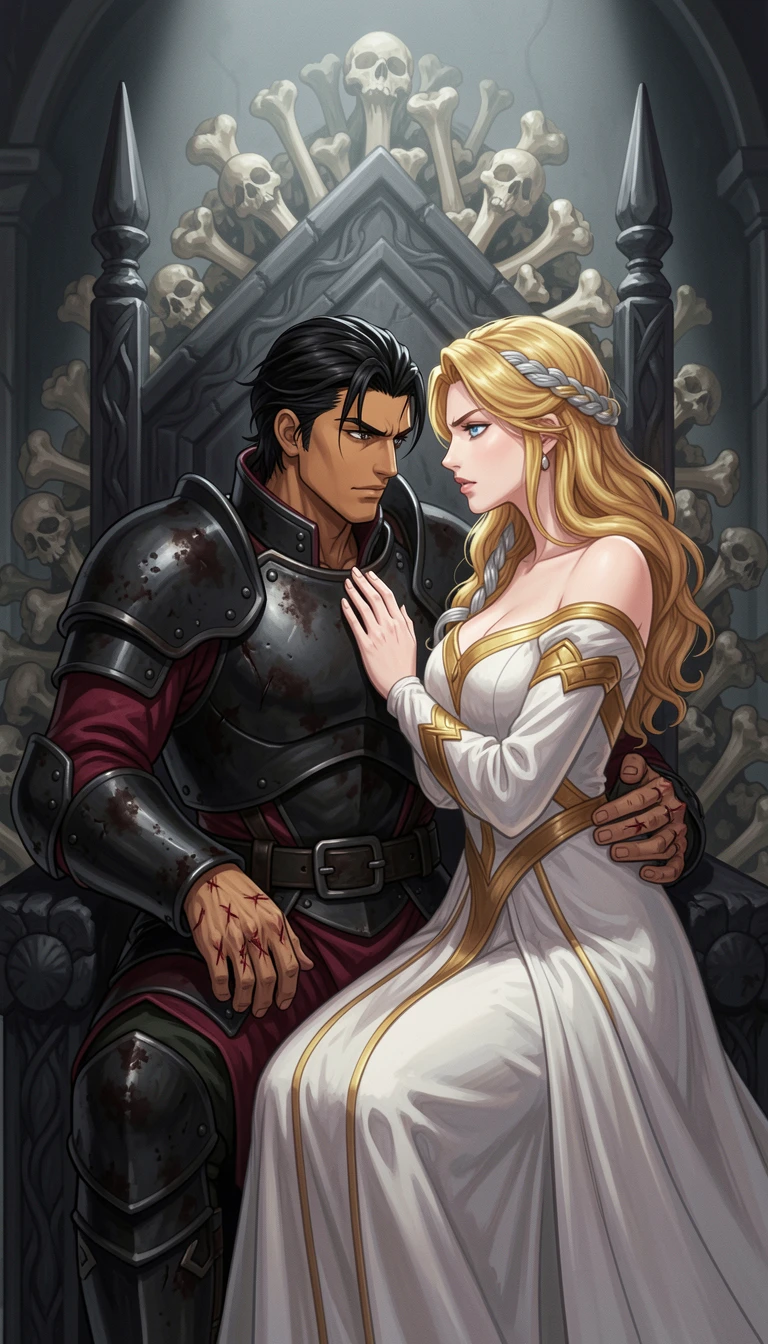
Aldric had counted the bars of the iron lattice forty-one times. He knew because he had started over twice, and the second count had come out different from the first, and he had not trusted either of them, and so he had started a third time and lost his place at nineteen and sat with his back against the headboard and his boots hanging off the edge of the bed and his hands very still on his thighs, because still hands were the only thing he had left that obeyed him.
The wine sat on the table where the servant had left it. Dark glass, a finger of red inside, the surface flat as a held breath. He had not touched it. He had decided, somewhere in the first hour, that touching it would mean he had accepted the room, and accepting the room would mean he had accepted what had happened in the throne room, and he was not ready to accept that. So the wine sat, and the light through the lattice moved across the floor in slow stripes, and the tower made its small sounds — stone settling, wind finding a gap somewhere above, the far-off clatter of a guard's kit in the stairwell below.
His knuckles still hurt. He kept looking at them. They were the knuckles of a boy who had held a spear and dropped it, and the skin was unbroken, and there was no blood on them, and that was the whole problem. Kael Thorne's hands had been bloody to the wrist. Aldric's hands were clean. He had washed them twice in the basin by the window and they were still clean, and he had scrubbed them until the water went cold and they were still clean, and he understood now that they would be clean for the rest of his life, and that this was the thing he would carry instead of a scar.
The door opened without a knock.
Aldric's whole body went rigid before his mind caught up — spine straight, hands flat on his knees, chin up, the posture his father had drilled into him in the practice yard since he was six years old. You are a prince before you are a man, and a prince does not flinch. His father had never stood in a room where a man could kill him. His father had never had to test the rule.
Kael Thorne filled the doorway. The lamplight from the corridor behind him threw his shadow long across the striped floor, and the shadow had a spear in it. He was not wearing a helm. His iron-grey hair was cropped to the skull, and his face was the face of a man who had stopped counting the dead somewhere around the second war, and his eyes — grey, with something red moving under the grey, like coals under ash — found Aldric and did not leave him.
He was carrying a chair.
He brought it in one-handed, the way a man carries a chair he has carried a thousand times, and set it down on the stone across from the bed. The legs scraped. The sound was small and ugly and it went straight down Aldric's spine and lodged there. Kael sat. He did not ask permission. He did not look at the wine. He rested his forearms on his thighs and let his hands hang, and those hands were the size of dinner plates and crosshatched with old scars, and Aldric could not stop looking at them.
"Your sister wrote to your father tonight," Kael said.
The words landed in Aldric's chest like a fist. His hands curled into fists on his knees before he could stop them — the nails biting into his own palms, the tendons standing up along the backs of his fingers — and he saw Kael's eyes drop to them and stay there, and he could not unclench them, could not make his body obey, and the shame of that was worse than the shame of anything that had happened in the throne room.
"She told him the truth," Kael went on. His voice was low and flat and unhurried, the voice of a man reading a supply manifest. "That you dropped the spear. That you wept. That you are a guest here." He let the word sit. Guest. "The question is what you want him to believe when he reads it."
Aldric's mouth was dry. He had not realized how dry until he tried to speak and nothing came out but a scrape of air. He swallowed. The wine was right there on the table, three feet from his hand, and he did not reach for it, because reaching for it would have been a confession.
"She would not lie to him," he said. His voice cracked on lie, and he hated it, hated the crack, hated that Kael had heard it.
"No," Kael agreed. "She would not. She is the kind of woman who thinks the truth is a shield. It is not. It is a window, and your father will look through it and see exactly what my emperor wants him to see." He leaned forward. The red gem inlaid in his breastplate caught the lamplight and threw a small hot point of color across the stone between them, and Aldric's eyes went to it the way a moth goes to a flame, helpless, stupid. "But that is not why I came up here."
"Then why did you come?"
It came out sharper than Aldric intended. He heard it land and he braced for the blow — for the backhand, for the spear butt across the jaw, for whatever a man like Kael Thorne did to a boy who spoke to him in that tone. Kael did not move. He looked at Aldric for a long moment, and something crossed his face that Aldric could not read, and then he sat back in the chair and the wood creaked under him.
"Because I watched you drop that spear," Kael said. "And I have been trying to work out, since, whether you dropped it because you are a coward, or because you are a boy who has never been taught the difference between killing a man and murdering one. Those are two different things, and they have two different answers, and I need to know which one you are before I report to my emperor."
Aldric's jaw tightened. His father's voice was in his head again — a prince does not flinch — and under it, older, smaller, his sister's voice from a summer years ago, when he had cried over a dead hawk he had found in the garden and she had knelt in the grass beside him and told him it was all right to be sad, that being sad was not the same as being weak. He had believed her then. He did not know if he believed her now.
"I am not a coward," he said.
"That is not an answer. That is a denial." Kael's grey eyes did not blink. "A coward would have said the same thing. A coward would have said it louder."
The heat came up Aldric's neck and into his face and he could not stop it, could not push it down, and he knew Kael could see it, knew the old man was reading it the way a farmer reads weather. His hands were still fists. He forced them open, one finger at a time, and laid them flat on his thighs, and the effort of it was enormous, and he suspected Kael knew that too.
"The man in the throne room," Aldric said. "The prisoner."
"What about him."
"What was he?"
Kael's head tilted a fraction. It was the only movement he made. "An envoy from the free cities. He came to my emperor with a letter and a knife in his sleeve. The knife was for the throne. The letter was for the court. He was not a good man, and he was not an innocent, and he died the way he lived — with a lie in his mouth." He paused. "Does that change it?"
Aldric looked at the floor. The stripes of light had moved again. The wine had not moved at all.
"No," he said, and it came out quiet, and true, and he hated how true it was. "It does not change it."
"Good," Kael said. "That is the first honest thing you have said to me." He stood, and the chair scraped back, and for a moment Aldric thought he was leaving — thought the interrogation was over, thought he had passed some test he had not been told he was taking — and then Kael walked to the window and stood looking out through the lattice at the dark, and the spear across his back caught the lamplight along its shaft, a long black line against the bars of the window, and Aldric understood that the old man was not done with him at all.
"I have killed more men than you have met," Kael said, to the window. "I do not say that to frighten you. I say it because it is the only qualification I have, and because it means I know the shape of the thing you are carrying, and I know it does not get lighter. It gets heavier. Every year. Every face you remember. The first one is the worst, and the first one is the one you never forget, and if you had killed that man tonight you would have spent the rest of your life with his face behind your eyes every time you closed them." He turned. "You did not kill him. That is not the same as being unable to."
"I could not," Aldric said. "My hand would not —"
"Your hand would not because your head would not let it. That is not cowardice. That is a man who has not yet decided what he is willing to become." Kael crossed back to the chair and sat again, and this time he did not lean forward; he sat back, and looked at Aldric the way a man looks at a colt he is thinking of buying. "But you are in a room with a man who has decided, and you are going to have to decide too, and you are going to have to decide soon, because the emperor does not keep guests who are of no use to him, and right now the only use you have is the fact that your sister loves you."
The words went in like a knife between the ribs, clean and cold and deep, and Aldric felt his breath stop in his chest. The only use you have. He had spent his whole life being the second child, the spare, the boy in the shadow of a sister who was better than him at everything — at riding, at statecraft, at the careful dance of a court that he had never been able to learn because he had never been able to keep his mouth shut long enough to watch. He had come on this delegation to prove he was not the spare. He had come to earn a reputation. And he had stood in a throne room and dropped a spear and wept in front of the most feared man in the known world, and now a general was sitting across from him explaining, patiently, that the only thing keeping him alive was the fact that his sister loved him.
His eyes burned. He would not let them spill. He would not. He set his jaw and stared at the red gem in Kael's breastplate and did not blink, and the burn receded, slowly, the way a tide goes out, leaving the sand raw behind it.
"What do you want me to say," he said. His voice was low and steady and he did not recognize it as his own.
"I do not want you to say anything," Kael said. "I want you to answer a question honestly. That is all. I have been asking men questions for thirty years and most of them lie, and I can tell when they lie, and I have no patience left for it. So." He leaned forward again, and the chair creaked, and the red gem caught the light and held it. "Your sister is in a room down the corridor from my emperor, writing a letter that will decide whether your kingdom goes to war, and she is doing it with her spine straight and her hands steady, because that is the kind of woman she is. You are in a tower with a bottle of wine you have not touched and a guard on your door and no weapon and no allies and no way out." He stopped. His grey eyes, red-tinged, unblinking, held Aldric's the way a hand holds a wrist. "But you are no coward, are you, boy?"
The room went silent.
The wind found its gap above the stairwell and made its small sound, and the lamplight in the corridor flickered once against the bars of the lattice, and the wine sat on the table with its surface flat and dark and unbroken, and Aldric Aurora sat on the edge of the bed with his hands flat on his thighs and his jaw set and his eyes dry and his heart going like a hammer against the inside of his ribs, and did not answer.
Kael did not fill the silence. He let it stretch until it had weight, until Aldric could feel it pressing on his eardrums, and then he said, "You are going to answer me, boy. Not tonight, maybe. But you are going to answer me. And when you do, I will know whether you are worth the trouble of keeping alive."
He stood. The chair scraped back and the sound went through the stone and up the walls. He did not leave, though. He crossed to the window and stood with his back to Aldric, looking out through the iron lattice at the black sweep of the mountains, and the spear across his back caught the lamplight along its length, and Aldric watched the old man's shoulders, the way they did not move, the way his breathing was slow and even like a man asleep.
"Who is he," Aldric said.
It came out before he had decided to say it. His voice was low and it did not crack this time, and he was grateful for that, and he hated that he was grateful.
Kael did not turn. "Which he."
"Him." Aldric's hands were flat on his thighs and he kept them there. "The emperor. Damien Cross. Who is he — what is he, that he can do what he did in that room and then walk out and have wine ordered for the boy who failed him."
Kael was quiet for a long moment. When he spoke, his voice was the same flat, unhurried thing it had been all night, but there was something underneath it now, something Aldric could not name, and it made the hair on his forearms stand up.
"He is the man who killed his own father," Kael said. "He was seventeen. He did it with his hands, because he did not have a blade, and because the old emperor had decided his son was too soft to rule and had sent two men to his chambers to correct the mistake. Damien killed the two men first. Then he walked into the throne room with their blood on him and he took the crown off his father's head while the old man was still sitting on the throne, and then he killed him too, and he sat down on the seat himself, and he has been sitting on it for eleven years."
Aldric's mouth had gone dry again. He did not reach for the wine.
"That is not the answer to your question," Kael said. "That is the history. The answer is simpler. He is capable of being what he is because he decided, once, a long time ago, that he would rather be feared than loved, and he has never once changed his mind. Not for a woman. Not for a friend. Not for his own blood. He made the choice and he made it all the way, and there is no part of him left that remembers how to make it any other way." He turned then, and his grey eyes found Aldric across the room, and the red under the grey was very still. "That is the whole of it. There is no secret. There is no curse. There is a man who chose, and then kept choosing, every day, for eleven years, until the choosing had worn grooves in him so deep he could not climb out of them if he wanted to."
Aldric looked at his own hands. Clean. Unbroken. The knuckles of a boy who had held a spear and dropped it.
"And why can I not be like him," he said.
It came out small. He heard it land and he wanted to take it back, wanted to swallow it whole, but it was out now, in the room, and Kael had heard it, and the old man was looking at him with an expression Aldric still could not read.
"Say that again," Kael said.
"Why can I not be like him." Louder this time. His jaw was tight and his eyes were dry and his heart was going like a hammer and he did not care anymore. "He was seventeen. I am eighteen. He killed two men and his own father and took a throne, and I could not put a spear through a man who was already kneeling. He decided and he kept deciding and now he has an empire, and I have a tower room and a bottle of wine I am too proud to drink and a sister down the corridor who is the only reason anyone in this castle knows my name. So tell me. Tell me what he has that I do not."
Kael crossed the room. He did not hurry. He stopped in front of Aldric, close enough that Aldric had to tip his head back to keep his eyes on the old man's face, and the spear across Kael's back put its shadow across the bed, across Aldric's hands, across the clean unbroken knuckles.
"You want the answer to be that he is stronger than you," Kael said. "You want it to be that he was born with something you were not. That is the lie every weak man tells himself, because it lets him stay weak and call it fate." He leaned down, and his voice dropped, and it was the first time all night that Aldric had heard anything in it that sounded like feeling. "He is not stronger than you. He is emptier than you. He cut out the part of himself that flinched, and he cut it out with a dull knife and no mercy, and he has never grown it back, and that is why he can do what he does. You still have yours. You dropped the spear because the part of you that flinches is still alive in there, and it is screaming, and it will keep screaming, and that is the difference between you and him."
"Then I should cut it out."
"No." The word was flat and hard and it stopped Aldric's breath. "No. You should not. Because the day you cut it out is the day you become a thing that sits on a throne and orders wine for a weeping boy because it has forgotten what weeping is, and you will not know you have lost anything, and that is the horror of it. He does not know what he gave up. He cannot. He cut out the part of him that would have known."
Kael straightened. He looked at Aldric the way a man looks at a wound he is deciding whether to stitch, and then he did something Aldric had not expected: he sat back down. Not on the chair. On the edge of the bed, beside him, close enough that Aldric could smell the oil on the blackened plate, the iron and the leather and the faint cold mineral smell of the spear across the old man's back.
"You asked me who he is," Kael said. "I told you the history. You asked me why he is capable of being the demon. I told you he chose. But you did not ask the question you actually wanted to ask, so I will ask it for you." He rested his forearms on his knees and looked at the floor between his boots. "You want to know if he was ever like you. If there was a night when he sat in a room with a man who had killed more people than he had met, and asked why he could not be harder than he was."
Aldric did not answer. He did not need to. The old man had already read it off him.
"He was," Kael said. "I was there. It was a tent on the Senn plain, and he was seventeen, and he had just done the thing I told you about, and he was not sitting on a throne. He was sitting on a camp cot with his father's blood dried to his wrists and he was shaking so hard he could not hold a cup, and he asked me the same question you just asked. He said, Why can I not stop feeling this. Why does it not go quiet. " Kael's voice did not change. That was the worst of it — the flatness, the way he said it like he was reading off a ledger. "I told him the same thing I am telling you. That the feeling was the last thing he had that was his own. And he looked at me, and he said, Then I will give it away. And he did. It took him four years, and he did it the way he does everything, which is completely, and there is not one grain of it left."
Aldric's hands had gone cold. He looked at them, flat on his thighs, and he thought about a seventeen-year-old with a dead father's blood on his wrists, shaking on a camp cot, and he could not make the picture fit the man who had sat on the obsidian throne and tilted his head at Lily like a wolf deciding whether to play. The two faces would not lie down on top of each other. One of them had to be a lie, and he did not know which.
"You are still waiting for me to tell you that he is not human," Kael said. "That is what the Kingdom of Light teaches. That the Demon Emperor is a monster, a thing from under the mountains, something you can hate without it costing you anything. It is a comfortable story. I have watched three delegations come into that throne room believing it. They all left in pieces." He turned his head and looked at Aldric directly, and the grey eyes with the red under them were very close. "He is human. That is the part you cannot stand. He is a man who was made the way men are made, one choice at a time, and every one of those choices was available to you. That is what makes him frightening. Not the empire. The fact that the road to it starts in a room like this one."
Aldric swallowed. His throat was dry and the swallow hurt.
"Then the road starts here," he said. "Tonight. In this tower."
"It started the moment you walked into that throne room," Kael said. "It started the moment you were born the second child of a king who had already decided which of his children mattered. Do not flatter yourself that this is a fresh beginning. You have been walking it your whole life. You just did not know the road was there until tonight, when a man put a spear in your hand and asked you to find out where it went."
The wind found its gap above the stairwell again. The lamp in the corridor guttered and steadied. Somewhere below, in the stone guts of the tower, a door opened and closed, and the sound came up through the floor and into Aldric's heels.
"What happens if I choose the other road," he said. "The one where I do not cut it out. Where I stay —" he searched for the word and could not find a good one, so he used the old man's — "soft."
"You will lose things," Kael said. "You will lose this kingdom, most likely. You will watch your sister do what you cannot and you will hate her for it and love her for it in the same breath, and you will never tell her either one. You will be the man who was in the room when the world turned and did nothing, and there will be a version of you, somewhere behind your eyes, that will ask that question every night for the rest of your life." He stood. The bed creaked as his weight came off it. "And you will be alive. And you will still know what weeping is. And when your sister needs a brother instead of a blade, you will be able to be one."
He crossed to the door. His hand was on the iron ring when Aldric spoke again.
"You said he ordered the wine," Aldric said. "Why. If he is what you say he is. If there is nothing left in him that remembers mercy. Why does a man with no mercy order wine for the boy who failed him."
Kael stopped. He did not turn around. The spear across his back was a black line down the middle of him, and the lamplight from the corridor came through the open door and laid his shadow across the floor all the way to Aldric's boots.
"Because you are worth more to him alive and comfortable than dead and cold," Kael said. "That is the answer, and it is the whole answer, and you should hold onto it. Do not go looking for a softer one. The moment you start looking for the mercy in him is the moment you stop watching his hands." He pulled the door open. The corridor light was yellow and thin and it made the black plate look wet. "Drink the wine, boy. Sleep. Tomorrow he will send for you, and you will want to have your wits about you when he does."
He stepped through and pulled the door shut, and the bolt went home on the outside with a sound like a knuckle cracking, and Aldric was alone.
He sat on the edge of the bed for a long time without moving. The lamp on the table burned down and the wick began to spit. The wine sat where it had sat all night, dark and flat and unbroken, and he looked at it and he thought about the man who had ordered it, and he thought about a seventeen-year-old on a camp cot with his father's blood on his wrists, and he thought about his sister down the corridor with a pen in her hand and a spine like a sword.
Then he stood, and he crossed to the table, and he picked up the bottle by the neck. It was heavier than he expected. The glass was cool. He stood there holding it, and the wick spat again, and the shadows on the wall leaned and straightened, and he did not drink.
He set the bottle back down. He turned it so the label faced the wall.
Then he crossed to the window and stood where Kael had stood and looked out through the iron lattice at the black sweep of the mountains, and he put his hands flat on the cold stone sill, and he did not know yet what he was going to be, but he knew one thing, and it was the only thing he knew, and it was enough to hold him upright until morning: he had not drunk the wine.