
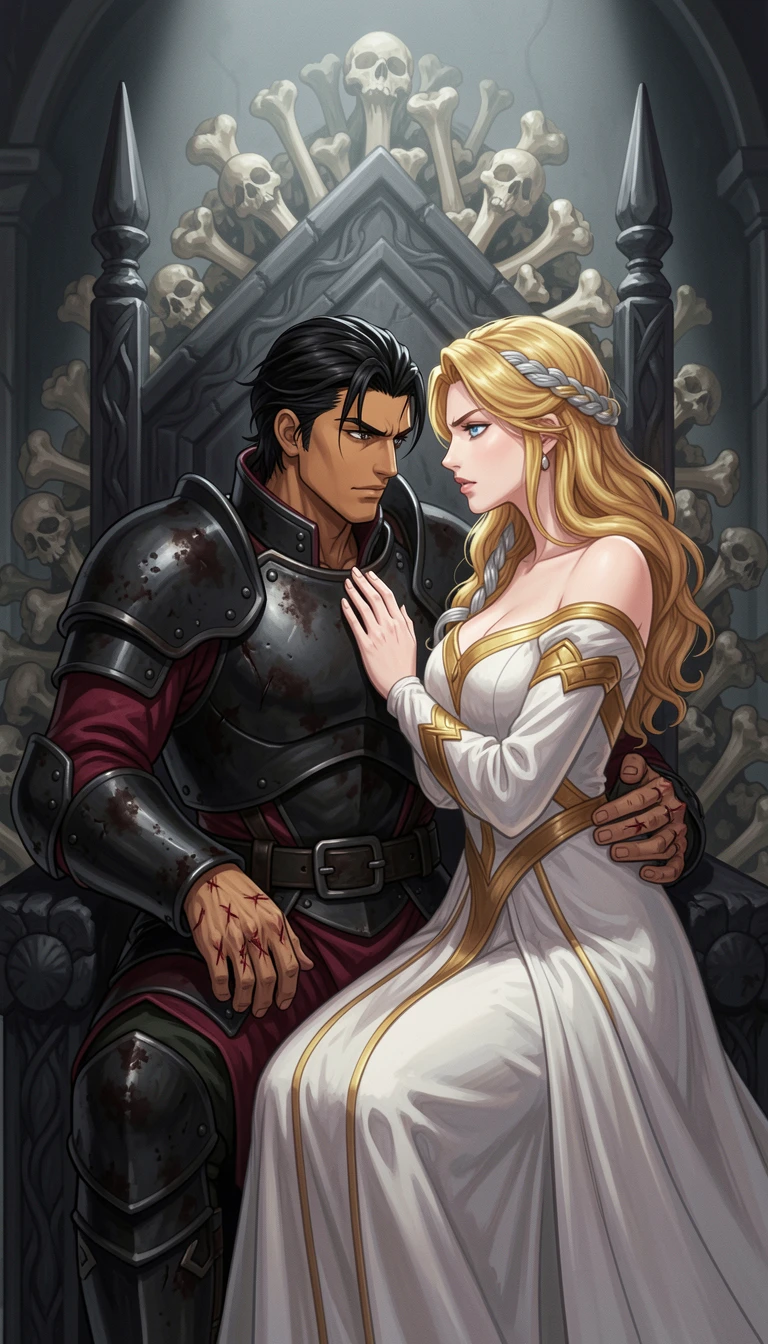
The throne room had gone quiet in the way a forest goes quiet before something with teeth moves through it.
Damien Cross sat the obsidian throne with one boot planted on the dais step and his forearm resting along the arm of it, watching the girl from the Kingdom of Light lose her sentence. She had been doing well. Better than most. The formal address had come out of her clean — the titles, the lineage, the tedious little chain of courtesies her kingdom believed were the mortar of the world. She had spoken of peace and borders and the sanctity of sovereign lines. She had not once looked at the blood on the floor.
Then she had reached the part she had rehearsed in a carriage, and the carriage had not prepared her for the room.
"The Kingdom of Light therefore demands—" Her voice caught. Not a stumble. A fracture, thin as a hairline in glass. She heard it. He watched her hear it. Her chin lifted a fraction, the way a rider lifts when the horse shies, and she forced the word out anyway. "—demands that the Black Rose Empire cease its expansion at the River Senn and withdraw its forces from the occupied territories within one turn of the moon."
Nobody moved. The basalt drank the torchlight and gave nothing back. Somewhere behind her, one of her own people — the boy, probably, the brother with the eager face — shifted his weight and made the floor creak. Damien let the creak finish. He let the whole sentence sit there in the cold like a coin dropped on stone.
Then he stood up.
The armor scraped. That was the only sound in the world for a moment — blackened steel dragging over itself, plate settling, the high collar of the crimson tunic creaking as he straightened to his full height on the dais. The court below did not breathe. They had learned that years ago, the ones who had survived the learning. Kael Thorne stood at the foot of the dais with his hands folded over the butt of the black iron spear, and did not so much as blink.
Damien came down the steps. Slowly. He was not a man who hurried, and the room was built to make his slowness expensive — every step rang off the polished stone and came back off the far wall, doubled, tripled, until it sounded like more than one man descending.
He stopped a breath away from her.
She was smaller up close than she had looked from the throne. The white and gold of the gown was a mistake in this room — it made her the brightest thing in it, a lit candle carried into a cellar full of gunpowder, and she knew it, and she had worn it anyway, because her kingdom had told her to be seen. The silver thread in her braid caught the torchlight. Her shoulders were bare. He could see the fine hairs on her forearms stand up in the cold.
She smelled like lavender soap and horse.
He smelled like a battlefield. That was the thing he watched land on her — the smoke in the wool of his underlayer, the iron, the old blood that no amount of scrubbing ever fully left a man's hands. It reached her nose at this distance and her nostrils flared and her weight rocked back a half-inch before she caught it and planted herself again. Good. She caught it.
He lifted his scarred hand and put his thumb under her chin.
The knuckles were a wreck — old breaks, old splits, the skin gone pale and tight over the bone from years of putting his fist through men before he had ever owned a single soldier. He tilted her face up. Gently. That was the cruelty of it; everyone in the room had come expecting a shove, and instead he handled her like something he intended to keep.
Winter-blue eyes met storm-grey.
He held them. He did not blink, and he did not let her look away, and he felt the small muscle under his thumb jump — the tremor she was spending every ounce of her training to hide. Her jaw was clenched so hard he could feel the tension running up into her temples. Her hands, down at her sides, had curled into fists. The ceremonial dagger at her hip was six inches from his ribs and she had not once reached for it, and he filed that away, because it told him more about her than the entire rehearsed speech had.
"Your kingdom," he said, "sent a lamb to bargain with a demon."
His voice was low. It did not carry past her. It didn't need to. The room could read it off the shape of his mouth.
Her breath came out through her nose, hard. "I am not a lamb."
"No?" His thumb moved along the line of her jaw, unhurried, tracing it the way a man traces the edge of a blade he is thinking about buying. "You walked into my hall wearing your kingdom's colors and read me a list of demands written by men who have never stood where you are standing. That is not the behavior of a wolf."
She swallowed. He felt it travel under his thumb.
"It is the behavior of someone who was told the demon would listen," she said. Her voice shook on demon and steadied on the rest. "And that he was, at minimum, a rational one."
Something moved in his chest at that. Not amusement, exactly. Closer to the feeling a man gets when a dog he expected to cower shows him its teeth.
He tilted his head. Just slightly. The way he did when something interested him and he had not yet decided whether it would live long enough to keep interesting him.
"Rational," he repeated, tasting the word. "Your father's scribes wrote that into the instructions, did they? Appeal to his reason. He is a monster, but a calculating one. " He watched her face. "They did not write down what to do if he was neither."
Her chin tried to move under his hand and could not. He liked that. He liked that a great deal.
"The Kingdom of Light does not send its eldest daughter into a monster's house on the strength of a rumor," she said. "We send her because we believe there is still a floor beneath the world, and that even you must stand on it."
"And if I have burned the floor?"
"Then you are standing on nothing," she said, "and so is everyone behind me, and that is a problem for both of us."
Behind her, the boy made a sound — a small, aborted intake of breath, the sound of a younger brother who had just watched his sister insult the most dangerous man in the known world. Damien did not look at him. He kept his eyes on hers and let the silence do its work, let her hear her own words come back off the basalt and realize what she had said.
She did not take it back.
He released her chin. Slowly. Let his thumb drag the last inch across her skin before it left her, and watched the flush climb her throat in the half-second after — not fear, this time. Something less useful to her. He noted it and set it aside.
Then he turned her.
His hand closed over her shoulder — not hard, not a shove, just a hand, and the whole court watched the Emperor of the Black Rose put his palm on the bare shoulder of the princess of the Kingdom of Light and turn her like a chess piece he had decided to promote. She went stiff under his grip. She went anyway. He walked her up the dais steps, one, two, three, past the arm of the throne, and planted her at its side, facing the room.
He sat back down. The armor scraped. The throne took his weight and the sound of it echoed off the far wall.
From here, she was a pale gold line against the black of the seat, and every man in the hall could see exactly what she was now: not an envoy. Not a negotiator. A thing the Emperor had decided to keep next to him, where the whole empire could look at her and understand the shape of the answer her kingdom was going to get.
He let them look.
She did not move. To her credit. Her hands were still fists at her sides, and he could see the tendons in her wrists standing out, and she was breathing through her nose in a slow, counted rhythm that he recognized — the rhythm of a person who has been taught to breathe through fear by someone who had never actually been afraid. He wondered who had taught her. He wondered if they were still alive.
Below the dais, Kael Thorne had not moved either. The old general's eyes — that grey with the red bleeding through it, the color of a man who had watched too many fires — tracked from the princess to his emperor and back. He said nothing. He never said anything until he had something worth the air.
Damien rested his forearm on the arm of the throne, close enough that his sleeve brushed the white of her gown, and spoke past her to the room.
"Bring in the wastes."
The words landed in the cold air like stones dropped into a well. He felt her turn her head — a fraction, involuntary, the first thing she had done all night without deciding to do it — and he did not give her the courtesy of looking back.
"The ones who came to my court and bowed their heads," he said, "and then tried to put a knife in my back while they were down there. Bring them in."
Kael Thorne turned on his heel. The movement was economical — the movement of a man who had done this ten thousand times and had stopped being interested in it around the four thousandth. His boots rang off the basalt as he strode for the great doors at the far end of the hall, and the court's attention swung with him like a field of wheat turning in a wind, every face in the room following the black plate and the spear and the red gemstone at his shoulder.
Lily Aurora stood at the Emperor's side with her fists closed and her breath counted and her kingdom's demands still hanging in the cold air where she had left them, unanswered.
She was about to find out what he did to people who came to his court the way she had.
He did not watch Kael go. He had watched Kael go ten thousand times. Instead he watched the hall, the way the black iron cavalry along the walls had not shifted their weight, the way the lesser lords on the floor had all found something to do with their hands — a cup, a hem, a ring — because a man who does not know where to put his hands is a man who is afraid of them. He catalogued the room the way he catalogued everything: who was breathing too fast, who had gone the color of old candle wax, who had turned just enough to get a clear line of sight to the doors. He knew their names. He knew what each of them had done to earn the right to stand on that floor, and what each of them would do if the doors opened and the wrong man walked through. That was the ledger he kept, and it was always open.
Beside him, she was doing the arithmetic.
He could feel it without looking at her — the small, furious industry of a mind trying to catch up to a room it had misjudged. Her breath had changed. The counted rhythm had broken and reset, broken and reset, and he let her have the silence to do the work in, because the work was the point. A lamb that is merely frightened is a lamb. A lamb that is frightened and thinking is something else, and he had not yet decided which one he was keeping.
"You are going to make me watch," she said.
It was not a question, which he appreciated. Questions were for people who still believed the answer would be kind.
"You are going to stand exactly where you are standing," he said, "and you are going to keep your eyes open. If you close them, someone in this hall will tell me. And then we will do it again tomorrow, and the day after, until you have learned to look at what your kingdom's letters cost."
"That is not—" She stopped herself. He heard the stop, the small hard swallow of a sentence she had decided not to finish. When she spoke again her voice had gone lower, and steadier, and something in it had sharpened the way a blade sharpens when it is turned edge-on to the light. "That is not justice."
"No," he agreed. "It is arithmetic. You came here with a number in your head — the number of men your father believes I will lose if I keep pushing west. You came to make me look at that number. I am going to make you look at mine."
He turned his head, then. Slowly. Just enough to put her in the corner of his eye, the way a man checks the edge of a fire he has built and does not intend to tend.
She was looking straight ahead, at the doors, at the empty stretch of basalt between the dais and the threshold where the light did not reach. Her jaw was set. Her hands were still fists. But her eyes — winter-blue, wide, the color of a morning that has not yet decided whether it will be cruel — were not on the doors at all. They were on the floor, on the dark patch of stone near the foot of the dais that had been scrubbed and scrubbed and never quite come clean. She had seen it when she walked in. He had watched her see it and choose not to look at it, and now she was looking at it, and he understood that the rehearsal in the carriage had not included a stain on the floor.
"You have been told I am a monster," he said.
"I have been told you are a man who has forgotten the difference between a throne and a butcher's block."
"And yet you came."
"Someone had to."
He let that sit. Somewhere down the hall a torch guttered and spat, and the shadow of the great doors swung and settled, and the cold off the basalt came up through the soles of his boots the way it always did, the way he had stopped noticing years ago and had started noticing again tonight because he was watching her notice it. Her shoulders had gone tight against the chill. The fine hairs on her arms were standing. She had not once reached for the fur-lined cloak her people had surely packed for her, because reaching for it would have meant admitting the room was winning.
He filed that away too.
"The men coming through those doors," he said, "were not soldiers. I want you to understand that before you see them, because I do not want you to spend the next hour telling yourself a comfortable story about the fortunes of war." He rested his scarred hand flat on the arm of the throne, the knuckles pale against the black stone. "They were envoys. Two of them. From the free cities on the eastern shore — cities that had already signed terms with me, already taken my coin, already sent their sons to ride under my banner. They came to this hall and they knelt where you are standing, and they said the words, and they kissed the ring, and then one of them tried to put a fishing knife into the side of my neck while the other held my sleeve."
He watched her take it in. The color did not leave her face the way it left most faces. It went tighter instead, gathered itself, the way a knot pulls when it is drawn.
"They failed," she said.
"They failed."
"Because you are still alive."
"Because Kael Thorne has been standing at the foot of this dais for eleven years and has not once looked away from the hands of a kneeling man." He let the corner of his mouth move, not quite a smile. "The knife went into his forearm instead. He did not drop the spear. He has never dropped the spear."
Her eyes came off the stain on the floor and found his, and for a moment there was no fear in them at all, only a flat, cold attention that he recognized because he had seen it in his own mirror once, a long time ago, before the mirror had stopped being useful to him.
"And now you will kill them," she said.
"Now I will kill them."
"In front of me."
"In front of everyone," he said. "In front of the free cities, who have a man in this hall tonight and will write home about it. In front of your brother, who has been trying to decide for the last quarter hour whether he should have spoken up when you insulted me, and who will spend the rest of his life remembering that he did not." He let his gaze drift, unhurried, down the hall to where the boy stood among the Kingdom of Light's retinue with his jaw working and his hands opening and closing at his sides. "In front of your escort. In front of the girl with the braid who keeps looking at the doors as if she expects them to open onto a garden."
Lily's head turned, just slightly, following his look — and he watched her find Gaby in the crowd, and he watched the girl see the princess look at her and straighten, and smile, a small, encouraging, utterly misplaced smile, the smile of someone who has never once in her life watched a man be killed and does not believe she is about to. Lily turned back to the front. Her throat moved.
"She is twenty-one," she said, very quietly, as if to herself.
"She is," he said. "And she will be twenty-two, if she is lucky and if she keeps her mouth shut in my hall. That is the arithmetic, princess. You brought her here. You brought all of them here. You did the sums in a warm room with your father and his scribes and you decided the number was acceptable."
"You do not know what I decided."
"No," he said. "I know what your father decided. I am curious to find out whether you agreed with him, or whether you were simply the only one of his children he could spare."
He felt her go still beside him. Not the stillness of a woman holding her breath. The stillness of a woman who had just heard a thing she had been refusing to hear for a very long time, and had heard it from the last mouth in the world she would have chosen. He did not look at her. He had learned, in the years since he had stopped being able to feel most things, that the moment a person is most naked is the moment they believe no one is watching, and he did not intend to spend that moment on her face. He intended to spend it on the doors.
They were opening.
The sound came first — the groan of iron hinges older than the empire, dragged back by men on the far side, and then the cold air off the corridor came through in a long slow breath that moved the torch flames sideways and made every cloak in the hall stir at once. The light out there was grey and flat. It did not reach the dais. It stopped somewhere in the middle of the floor, a line of dimness the court had all unconsciously stepped back from, and beyond it the corridor ran away into a dark that the torches did not bother to fight.
Boots in that dark. Slow. Measured. More than two sets. The chains came after the footsteps — a dry, dragging, rhythmic sound, links over stone, and the sound of it went through the hall and took the last of the whispering with it. The court had gone to stone. The black iron cavalry along the walls had not moved, but every one of them had found the haft of his weapon, the way a man's hand finds a doorframe in the dark.
Beside him, Lily Aurora did not close her eyes.
He watched her not close them. He watched her fists open, slowly, deliberately, one finger at a time, and settle flat against the white of her gown, the way a person sets down a thing they have been told they will need to pick up again. Her breath had stopped being counted. It had gone shallow and fast and she had stopped trying to hide it, and that, he decided, was the first honest thing she had done since she walked into his hall.
"Look at them," he said. "That is all I am asking of you tonight. Look at them, and then go back to your rooms and write your father a letter, and tell him what you saw."
"And what will I see?"
The first of them came out of the dark into the grey light, and the chains went taut, and the man's bare feet found the basalt and stopped.
"You will see the floor you told me I was standing on," Damien said. "And you will decide, for yourself, whether you are still standing on it too."
The man in chains was not a man anymore. He was a bundle of rags and ribs and a face that had been worked over until it stopped resembling anything a mother would recognize. He came into the grey light on bare feet that left smears on the basalt, and the chain between his wrists ran back into the dark to where the second one shuffled, and the sound of it — links dragging over stone, slow, patient — was the only thing in the hall louder than the torches.
He stopped at the line of dimness. He did not look up. He had learned not to look up somewhere in the last few days, and the lesson had stuck, and he stood there with his ruined face turned toward the floor like a man waiting for the weather to decide.
Kael Thorne's boot came down on the back of his knee.
The man went down. Knees first, then palms, then his forehead nearly to the stone, and the chain clashed and went slack, and the sound of it bounced off the far wall and came back and settled. The court watched. The black iron cavalry along the walls watched. The boy from the Kingdom of Light watched with his mouth slightly open, and the girl with the braid watched with her hands pressed flat against her thighs, and somewhere in the retinue a woman was breathing through her mouth.
Damien did not watch any of them.
He reached sideways.
His hand closed around Lily Aurora's upper arm — the bare skin above the white sleeve, warm under his palm, and he felt the small, involuntary flinch travel up into her shoulder the instant he touched her. He pulled. Not hard. Just enough. She came a half-step toward the throne, off her planted feet, and her free hand came up and caught the arm of the seat to keep from stumbling, and he kept her there, close, hip against the black stone, near enough that the crimson of his sleeve and the white of her gown touched and stayed touching.
She did not fight him. He had expected her to. He had been ready for the elbow, the twist, the sharp little wrench of a woman who had been taught to break a hold — and instead she went stiff and still and let him move her, and he understood, with a small cold satisfaction, that she had already done the arithmetic of the room and found that the sum of resistance was worse than the sum of compliance.
He leaned down.
His mouth came to her ear. The silver thread in her braid brushed his jaw. She smelled like lavender soap and horse and, underneath that, the sharp mineral tang of fear she was working very hard to keep out of her skin.
"Make sure you remember what you see," he said.
His voice was low. It did not carry past the two of them. It was the voice he used when he wanted a thing to go into a person and stay there, and he felt her go very still against his hand, the way a bird goes still in a fist.
"This is who I am," he said. "I am the demon that will do whatever it takes to be able to make the world I desire. No king or kingdom is safe. No one will order me around. The only choice is to bow to me or death."
He let the last of it come slower, and quieter, and put it directly into her ear the way a man puts a nail into a board.
"And most importantly — no one who betrays me will be spared. Regardless of who or what they are."
He held her there a moment longer than the words needed. He let her hear his breathing, the slow even draw and release of a man who was not excited, not angry, not anything — just present, and patient, and certain. He wanted her to know that this was not a performance. He wanted her to know that his heart had not moved a single beat faster since the doors opened.
Then he straightened, and lifted his scarred hand off her arm, and let it fall to the arm of the throne, and looked past her down the dais at Kael Thorne.
He did not speak. He did not have to. He lifted two fingers off the black stone — a small, unhurried motion, the kind a man makes to wave a servant past — and let them fall.
Kael Thorne had been waiting for that hand for eleven years.
He stepped off the dais. The black plate rang once against the basalt and then went quiet, and he crossed the grey light with the spear coming off his back in one long, practiced motion that had no flourish in it at all. The shaft cleared his shoulder. His grip found its place on the iron — the same grip, the same place, ten thousand times — and he brought the butt of it down and planted it beside the kneeling man's head with a sound like a door closing.
The man in chains looked up.
He had been told not to, and he looked up anyway, because a man who is about to die will always look up, and his ruined face found Kael's grey-and-red eyes and held them, and something moved across it that was not quite fear. It was closer to relief. He had been waiting for this for a long time, and it had finally arrived, and there was a kind of peace in the arrival that Damien recognized from a hundred other faces on a hundred other floors.
Beside him, Lily Aurora made a sound.
It was small. It was not a word. It was the sound a person makes when the body understands a thing before the mind has finished agreeing to it, and Damien heard it and did not turn his head. He kept his eyes on the floor, on the kneeling man, on the spear, on the exact angle of Kael's wrists, because he wanted to be looking at the thing itself when it happened, not at her.
But he kept his hand where it was. On the arm of the throne, close enough that the back of it brushed the white of her gown, close enough that she could not move without touching him, close enough that she would feel the stillness of him through the fabric and know that whatever happened next, he was not going to flinch.
Kael Thorne lifted the spear.
He did it the way he did everything — without hurry, without ceremony, without any of the theater that lesser men brought to killing. The iron came up over his shoulder and hung there a moment, and the torchlight ran down the black shaft and found the point, and the point was very bright and very still.
The hall had stopped breathing. Every man in it had found something to hold. The lesser lords on the floor had gone the color of old wax. The black iron cavalry along the walls had not moved, but every one of them had his eyes fixed on the same place, and their stillness had a weight to it that pressed down on the room like a hand.
Lily Aurora did not close her eyes.
He felt her not close them. He felt the small tremor that ran through the arm he was not touching, the way her weight shifted a fraction toward him and then caught itself and came back. He felt her breath stop and hold and stop and hold, and he felt the exact moment she understood that this was going to happen, that it was not a threat, that it was not a negotiation, that it was a thing that was going to occur in front of her and there was nothing in the world she could do about it.
He had wanted her to feel that. He had wanted her to feel it standing next to him, with his sleeve against her gown, with his breathing in her ear still fresh, with the words he had put into her head still ringing there like a struck bell. He had wanted her to understand, all the way down, that the man who had just told her he would do whatever it took was not lying, and that the floor she had told him he was standing on was made of exactly this.
Kael Thorne drove the spear down.
It went through the top of the kneeling man's skull.
The sound was not the sound people expected. It was not a crack. It was a wet, dense, final thing — the sound of iron finding its way through bone and then through what was under the bone — and the man's body did not fall. It stayed kneeling. It stayed upright on its knees with the spear standing out of the top of its head like a mast, and the chain between its wrists went slack and the hands opened and the ruined face went still, and for a moment the whole hall looked at a man who was dead and had not yet been told.
Then Kael Thorne put his boot against the shoulder and pushed, and the body came off the spear and went down onto the basalt, and the sound of it was the sound of a sack of grain hitting a floor, and the blood came out across the stone in a slow dark fan that reached the edge of the grey light and stopped.
Nobody screamed.
That was the thing about the Black Rose court. Nobody ever screamed. They had all learned, the ones who had survived the learning, that a scream in this hall was a thing the Emperor remembered, and that a man the Emperor remembered was a man the Emperor would get around to.
The second prisoner was already being brought forward. The chain went taut again and the dark gave up its other shape — a smaller man, older, with a grey beard and hands that had been broken and set and broken again — and he came into the grey light and saw what was on the floor and stopped walking, and the guards behind him put their shoulders into him and moved him anyway.
Beside the throne, Lily Aurora was looking at it.
She was looking at all of it. The body. The spear. The blood. The second man being walked toward the same place. She had not turned her head. She had not closed her eyes. She had not reached for the dagger at her hip, and she had not reached for his arm, and she had not done any of the things a woman in her position might have done to save herself from what she was watching. She was standing exactly where he had put her, with her fists open and flat against her gown, and she was taking it in the way a person takes in a wound — slowly, and all at once, and without any of the mercy of looking away.
He turned his head. Just enough.
Her face was pale, and her jaw was set, and her eyes — winter-blue, wide, the color of a morning that had decided to be cruel after all — were wet at the lower lid and not spilling. She had not let them spill. He watched her not let them spill, and he felt something move in his chest that he had not felt in a long time, and he did not name it, and he did not let it reach his face.
"You watched," he said.
"You told me to."
"I tell a great many people a great many things." He let his gaze go back to the floor, to the second man being forced down onto his knees beside the first, to Kael Thorne pulling the spear free with a wet drag and resetting his grip. "Most of them do not."
She did not answer. Her throat moved. The wet at her lower lid held.
"You are going to write your father a letter tonight," he said. "You are going to tell him what you saw. You are going to tell him that the envoys from the free cities came to my hall and knelt and kissed the ring and tried to put a knife in my neck, and that I put them on the floor in front of his daughter, and that I did it without raising my voice." He watched Kael plant the spear beside the second man's head. "And you are going to tell him that the next letter he sends me had better be a letter of surrender, or the next thing he sends me will be his other child."
She turned her head then. Slowly. All the way. And looked at him — not past him, not through him, but at him, with those wet winter eyes and that set jaw, and he saw the thing he had been waiting all night to see: not fear. Not yet. Something underneath the fear, something that had been in her the whole time and had only just now found its way to the surface.
She was still standing on the floor.
He had told her she would have to decide whether she was still standing on it too. He watched her decide. He watched her decide to keep standing on it, with the blood spreading across the stone six feet from her hem and the second man kneeling in it, and he felt the corner of his mouth move — not a smile, not quite, something older and colder than a smile — because a lamb that decides to keep standing is no longer a lamb.
He lifted two fingers off the arm of the throne.
Kael Thorne brought the spear up.
The spear hung at the top of its arc, and Damien watched her instead of it.
She had not closed her eyes. That was the thing he kept coming back to, the way a tongue returns to a chipped tooth. The wet at her lower lid had not spilled. Her hands were flat against the white of her gown and they had not moved, and the tendons in her wrists stood up like cords under the skin, and she was watching the iron come down the way a person watches weather — with no expectation that watching would change it.
The smile arrived before he decided to let it.
It was not the smile he used on envoys. It was colder than that, and quieter, and it lived only at one corner of his mouth, and he felt it settle there the way a blade settles into a sheath it was made for. He did not look away from her. He did not blink. He let her see it, because that was the point — because a man who smiles at a thing like this is a man who has already decided what the thing is for.
Then he lifted his hand off the arm of the throne.
Two fingers. The same two he had lifted a moment ago, and the same small, unhurried fall of them — but this time the gesture went sideways, off the dais, across the grey light, and pointed. Not at Kael. Past him. Into the knot of white and silver standing at the back of the hall where the Kingdom of Light had been told to wait and had been waiting very quietly ever since.
"Kael."
The old general stopped the spear where it was. Mid-arc. The iron hung over the second prisoner's skull and did not come down, and Kael Thorne's grey-red eyes came up the dais and found his emperor's face, and he did not ask the question. He never asked the question. He simply stood there with the spear in the air and his weight already shifting, reading the room the way he had read ten thousand rooms.
"Let the boy from the Kingdom do it."
The hall did not gasp. The hall had learned better. But something moved through it — a ripple, a settling, the sound of forty men remembering at once that they were standing in a room where the rules could be rewritten in a single sentence and there was no appeal. Damien heard it and did not turn his head. He kept his eyes on the back of the hall, on the white and silver, on the lean young shape standing at the front of the retinue with his jaw working.
"He wants to earn his credit," Damien said. "Give him the opportunity."
Beside him, Lily Aurora went rigid.
He felt it travel through the arm he was not touching — the whole line of her, shoulder to wrist, going stiff as a drawn bowstring. Her breath stopped. It did not resume for a long count. And then it came back wrong: shallow, fast, the counted rhythm shattered past any hope of repair, and he heard the small wet click in her throat as she swallowed and could not get the swallow all the way down.
"No."
It came out of her before the court had finished absorbing the first sentence. Quiet. Almost polite. The word of a woman who had been raised never to raise her voice in a room, and who had just heard the floor fall out from under everything she had been taught about how the world worked.
"No," she said again, and this time it had an edge on it, and she turned her head all the way and looked at him, and he saw the wet at her lower lid finally break and run, one thin line down the side of her nose, and she did not wipe it. "He is eighteen."
"He is eighteen," Damien agreed.
"He has never—" She stopped. He watched her choose the words and discard them, one after another, the way a woman sorts coins in a purse she is afraid to open. "He is a boy. He came here because our father told him it would make him a man. He has never held a blade outside a training yard. He has never seen a man die."
"He has now."
Her jaw worked. The line of wet reached her chin and hung there and did not fall.
Down on the floor, Kael Thorne had let the spear come down — not into the prisoner, but to the side, the butt of it finding the basalt with a sound like a door being closed very gently. He did not look at the princess. He looked at his emperor, and his face was the face of a man who had been given an order he did not understand and intended to carry it out anyway, because understanding was not in his job.
The second prisoner knelt in the blood of the first and did not move. He had heard the sentence. He had understood it faster than anyone in the room, because a man who is about to die learns to listen, and he had heard his death get handed to a child and he was kneeling very still with his grey beard against his chest, waiting to find out what a child would do with it.
Damien looked past the kneeling man, past Kael, past the grey light, to the back of the hall.
"Aldric Aurora."
The name landed like a stone in still water. He watched the boy flinch — a whole-body flinch, shoulders up, chin down, the way a horse flinches at a hand it did not see coming. Beside the boy, one of the Kingdom's own guards put a hand on his shoulder, and the boy shook it off, and the guard's hand hung in the air a moment before it fell.
"Come here."
Nobody in the retinue moved. The girl with the braid — Gaby, the princess had called her, the one who had smiled at the doors — had gone the color of old paper, and her hands were pressed flat against her thighs, and she was looking at the princess with an expression that had finally, at last, stopped being encouraging. The Kingdom's guards stood like men who had been told to hold a line and had just been told the line was gone. Only the boy moved.
He came forward.
His boots were too loud on the basalt. He was trying to walk the way he had been taught — spine straight, chin up, the walk of a prince entering a room — and it was not working, because his legs were not listening to him, and every step came down a fraction too hard and rang a fraction too bright, and the whole court heard a boy trying to be a man and failing at it in real time.
He stopped at the line of grey light. He did not step past it. He stood there with the white and silver of his kingdom on his back and his hands at his sides and his dark blue eyes going from the body on the floor to the kneeling man to the spear to the dais, and back again, and again, faster each time.
Damien let him stand there. He let the silence work on the boy the way it had worked on his sister, and he watched the boy's face do everything a face could do — the working jaw, the flare of the nostrils, the quick wet blink — and he watched the boy's hands, because the hands were the only part of a man that could not lie about what he was about to do.
The hands were shaking.
"You are the eldest son of the Kingdom of Light," Damien said. "Or the only son. Which is it?"
The boy's mouth opened. Nothing came out. He closed it. He swallowed, and his throat moved all the way down, and when he spoke his voice had cracked in the middle of the first word and he had to start over.
"The only."
"The only son." Damien tilted his head. Slowly. The way he did when something interested him. "And your father sent you here with your sister to watch her read me a list of demands. Did he tell you why?"
"To—" The boy's eyes went to his sister, up on the dais, beside the throne, standing in a place no envoy had ever stood, and something crossed his face that Damien recognized — the particular wound of a younger brother looking up at an older sister who had been given the thing he wanted. "To learn."
"To learn." Damien tasted it. "Then learn."
He lifted the two fingers again and pointed at the kneeling man.
"That is a man who came to my court and knelt and kissed the ring and put a knife in my general's arm. He is going to die tonight. That is already decided. The only thing left in the world that has not been decided is who does it." He let his hand fall back to the arm of the throne. "Your father sent you here to earn a reputation. I am offering you one. Take the spear."
The boy did not move.
For a long moment the hall held its breath around him, and Damien watched him stand there in the grey light with his hands shaking and his mouth half open, and he watched the boy look at the spear in Kael Thorne's grip the way a man looks at a cliff edge. Kael had not moved. The spear was there, offered, held out at an angle that made it easy to take and impossible to pretend he had not been asked.
Up on the dais, Lily Aurora made a sound.
It was not a word. It was the sound a person makes when they have run out of the words that would stop a thing, and it went through the hall and found her brother, and Damien watched the boy hear it — watched the boy's head turn toward the dais, toward his sister, toward the one person in the world who had always been the one who knew what to do — and he watched the boy look at her face.
Her face was wet. Both lines now. She had stopped hiding it. She was standing beside the Emperor of the Black Rose with tears running down her chin and her fists open and flat against her gown, and she was looking at her little brother with an expression Damien had not seen on her all night: not defiance, not fear, not the cold flat attention of a woman doing arithmetic. Something rawer than that. Something that had no plan in it at all.
She shook her head. Once. Small.
Damien saw the boy see it. He saw the boy understand it — the whole weight of it, the thing his sister was telling him without a single word, the thing that said no, do not, this is not the way, this is not what we came here for. And he saw the boy's jaw set.
And he saw the boy take a step forward anyway.
He crossed the grey light. His boots came down on the bloodied stone and left prints in it and he did not look down. He walked to Kael Thorne and stopped in front of him and stood there a moment, chest heaving, hands shaking, and then he reached out and took the spear.
He almost dropped it. Damien watched the iron dip and the boy's arms jerk to catch it, watched him get both hands around the shaft and plant his feet and haul the thing upright with a strength he did not have and a will he did have, and the point of it wavered in the torchlight like a candle in a draft. Kael Thorne stepped back and folded his arms and watched, and his face did not change, and something in the set of his shoulders said he had already decided how this was going to go.
"I don't—" The boy's voice came out high and broke and he stopped and started again, lower, forcing it down into his chest. "I don't know how."
"Kael will show you," Damien said. "Kael has shown a great many men how."
Kael Thorne moved before the boy could answer. He crossed the bloodied stone in three strides and came to a stop at Aldric's shoulder, close enough that the boy flinched at the sudden heat of him, and he did not take the spear back. He put one huge hand over the boy's hands on the shaft — not to steady the iron, but to move it. He walked the point down, slow, until it hung level with the kneeling man's throat, and the old general's voice came low and flat and close to the boy's ear, meant for no one else in the room.
"Two hands. Wide. You do not stab down, you drive forward. Down is a butcher. Forward is a soldier. When it goes in, do not pull back. Push. If you pull, he lives long enough to scream, and you will hear it for the rest of your life. Do you understand me, boy?"
The boy nodded without looking at him. His knuckles had gone white around the iron and his breath was coming in fast shallow pulls through his nose, and Kael Thorne stepped back and folded his arms again and said nothing more, because there was nothing more to say, and the room had gone so quiet that Damien could hear the torches guttering in their brackets along the far wall.
On the dais, Lily Aurora had stopped breathing again. He felt it the way he felt weather through stone — the stillness beside him, the whole length of her gone rigid, her hands still flat on the white of her gown as if she had forgotten they were hers to move. She was watching her brother the way a woman watches a horse run toward a cliff, and there was nothing left in her face but the watching.
Damien settled back into the throne. The blackened steel creaked under his weight and he let it. He had not taken his eyes off the boy since the spear changed hands, and he did not intend to, because the boy was the only thing in the hall that had not yet decided what it was, and Damien had spent his whole life watching men decide.
"Whenever you are ready," he said. "There is no hurry. He has been kneeling there for some time. He is not going anywhere."
The boy's head came up at that. Dark blue eyes, wet at the rims, and something in them that Damien recognized from a long time ago — the look of a man who has just understood that the thing he was told would make him a man is going to cost him something he did not agree to spend. The boy looked at the prisoner. The prisoner looked back at him, and the prisoner's grey beard moved as his jaw worked, and then the prisoner did something no one in the hall expected.
He smiled.
"Go on, lad," the old man said. His voice was dry and even and he did not lift his head. "Better you than the big one. You'll do it quick. He won't."
Kael Thorne's face did not change. Damien watched him take that in and file it away without a flicker, and he understood — the prisoner knew Kael. Knew what Kael was. Knew that the general's mercy, if it could be called that, was a longer and more careful thing than any boy's first kill. The old man had chosen the boy on purpose. Damien filed that too.
Aldric Aurora lifted the spear.
He got it up off the stone and his arms shook with the weight of it and his whole body leaned back to counterbalance the iron, and for a moment Damien thought he was going to do it — thought the boy had found whatever it was that men find in the last second, the thing that lets them close their eyes and push. The point came level with the prisoner's chest. It wavered. It stayed.
And then the boy's eyes went to his sister.
Damien watched it happen. He watched the boy's head turn, just slightly, just enough, and find her up on the dais beside the throne — and he watched the two of them look at each other across the length of the hall with a spear hanging between them, and he understood that whatever happened next in this room was going to be decided in that look, not in the boy's hands.
Lily Aurora did not shake her head this time. She did not move at all. She stood with the tears dry on her chin and her eyes fixed on her brother and her mouth closed, and Damien watched her choose — watched her make the choice not to tell him anything, not to save him, not to take it back — and he felt the corner of his mouth move again, the cold thing settling into the groove it liked.
She was learning. That was the interesting part. She was learning that a brother who took the spear could not be talked out of it without being made small in front of forty men, and she was learning that the only way to let him keep what he had just claimed was to let him finish it. She was doing the arithmetic in real time, and she was getting it right, and it was costing her.
The boy turned back to the prisoner.
He set his feet. He brought the spear back, just a hand's width, the way Kael had told him — forward, not down — and the point found the old man's chest and rested there, and the prisoner closed his eyes and did not flinch, and the whole hall leaned in.
And then Aldric Aurora dropped the spear.
It hit the stone with a clang that went through the room like a bell, and the boy was on his knees in the blood before anyone had finished hearing it, and his hands were over his face, and he was making a sound that Damien had heard in a hundred courts and a thousand camps — the sound of a boy who has just found the edge of himself and looked over it and could not go.
Kael Thorne did not move. He stood with his arms folded and his grey-red eyes on the boy and his face the same as it had been all night, and he waited, because he was a soldier and he had seen this before, and he knew that the emperor would decide what happened next.
Damien looked at the boy on the floor. Then he looked at the prisoner, still kneeling, still alive, eyes open again and watching the dais now with the flat patience of a man who had expected to die and had not, and who understood that the not-dying was going to be worse.
Then he turned his head, slowly, and looked at Lily Aurora.
She had not moved. Her hands were still flat on the white of her gown. But her chin had come up, and she was looking at him now instead of at her brother, and there was something in her face that had not been there an hour ago — something that had stopped being fear and had not yet become anything he had a name for.
"He could not do it," Damien said. Quietly. To her, and only to her. "Your father sent him here to earn a reputation. He has one now. The whole court will remember the night the prince of the Kingdom of Light knelt in a traitor's blood and wept." He tilted his head. "Was that the plan?"
Her jaw worked. She did not answer.
"No," he said. "I did not think so."
He lifted the two fingers one last time and let them fall, and Kael Thorne unfolded his arms and stepped forward and took up the spear from the stone where the boy had dropped it, and the old general did not look at the prince on his knees, and he did not look at the princess on the dais, and he did not need to. He walked to the prisoner and set the point against the man's chest and drove it forward in one motion, the way he had done ten thousand times, and the prisoner made a small sound and then no sound at all, and the hall watched the second body join the first on the basalt.
Kael pulled the spear free and wiped it on the dead man's tunic and stepped back and stood at rest, and the whole thing had taken less time than it took to draw a breath, and Damien watched the boy on the floor hear it happen — watched the boy's shoulders jerk at the sound, watched him lift his head from his hands and look at the body and understand that it was done, and that he had not done it, and that both of those things were going to live in him forever.
"Get him up," Damien said.
Two of the black iron guards came forward and hauled the prince to his feet. He came up loose and shaking, his fine white and silver tunic smeared dark at the knees, and he did not look at the bodies and he did not look at his sister and he did not look at the emperor. He looked at the floor. The guards held him upright between them and waited for orders.
Damien let the silence stretch. He let the boy stand there in it, held up by other men's hands, and he let the whole court look at him, and he let the princess look at him, because that was the point — the point had never been the prisoner, the prisoner had been dead the moment he touched Kael's arm. The point was the girl beside him, and the boy on the floor, and the thing that had just been done to both of them in front of everyone who mattered.
"Take him to the east tower," Damien said at last. "A room with a window. He will want to see the sky for a while." He watched the boy's head come up, just slightly, at that — the small animal hope of a man who has been told he is not going to be killed tonight. "He is not a prisoner. He is a guest. The Kingdom of Light does not send guests to my court to be harmed." He paused. "But he will not leave the tower until I say so."
The guards turned the boy toward the doors. He went with them, and he did not fight, and he did not speak, and at the threshold he stopped — one step short of the dark beyond — and turned his head back over his shoulder, and looked at his sister.
Damien watched the look pass between them. He watched the boy's mouth open and close without a sound, and he watched the princess hold her brother's eyes and not move and not speak, and then the guards took him through the doors and the doors closed and the boy was gone.
The hall was very quiet. Two bodies on the stone, and a spear at rest, and forty men standing in torchlight trying not to be the next thing the emperor looked at. Damien let them stand. He let the quiet do its work for a long moment, and then he turned his head, unhurried, and looked at the girl standing beside his throne with her brother's blood on her kingdom's honor and nothing left in her hands.
"You did not beg," he said. "For him, or for the prisoner, or for anything. You stood there and watched and did not say a word. I have had queens on their knees in this hall before the first body fell." He tilted his head, slow, the wolf deciding. "Why?"
Lily Aurora looked at him. Her eyes were the pale blue of a winter morning and they were dry now, and her hands had finally come off the white of her gown and were hanging at her sides, and when she spoke her voice was low and steady and had something under it that had not been there when she walked into the room.
"Because you would have enjoyed it," she said.
He did not laugh. He did not smile, either, or move, or give her anything at all to hold onto — and that was its own kind of answer, the way a door that does not open is an answer. He simply looked at her the way he had looked at the bodies on the floor, and let the quiet stretch until the torches had to fill it.
Then he said, "Very good."
It landed on her wrong. He watched it land — watched the small confusion cross her face before she could stop it, the way a woman looks when she has braced for the blow and been handed a compliment instead. She had expected him to punish the answer. She had not yet understood that the answer was the punishment, and that he had just told her, in two words, that she had passed a test she had not known she was taking.
"You are understanding," he said. "This is who I am. This is who your father thought he could command from his throne and safety."
He turned his head away from her and let his voice come up off the dais, pitched to the hall, unhurried, the way a man speaks to a room he owns.
"Where is my Spymaster?"
For a moment nothing moved. Then one of the shadows along the left wall came loose from the rest and walked forward — black leather and silver buckles, a braid on one side and a sleek curtain of black on the other, a thin scar running from temple to jaw. She had been standing in the torchfall the whole time. Nobody in the hall had noticed her until she decided to be noticed, and Damien watched several of the Kingdom's men flinch when they realized how close to them she had been standing.
Seraphina Vale stopped at the foot of the dais and did not bow. She never bowed. She put her copper eyes on the princess and then on him, and waited.
"The princess is tired," Damien said. "Take her to her room. She has a letter to write."
"To her father."
Seraphina's gaze slid to Lily and stayed there a moment, weighing her the way a jeweler weighs a stone he has not decided to buy, and Damien watched the princess hold that look without flinching. Good. Another thing filed. Then Seraphina turned and started for the side door without a word of instruction, because she did not need one — she had heard the whole sentence the first time, and she was already three steps ahead of anyone else in the room, the way she always was.
"Princess," Damien said.
Lily Aurora stopped mid-step. She had not been given leave to go, and she had not been given leave to stay, and he let her stand there in the gap between the two and feel it, her back half turned to him, the silver thread in her braid catching the torchlight.
"You will write it in your own hand," he said. "You will not soften it. You will not leave out the floor, or the boy, or the spear, or the sound it made. You will tell your father exactly what happened in this hall tonight, and you will tell him that the next letter he sends me will be a letter of surrender, or the next thing he sends me will be his other child." He paused. "And you will tell him that his daughter watched both of them die and did not close her eyes, and that I know it, and that he should think very carefully about what that means."
She turned her head just enough to find him in the corner of her eye. The wet was gone from her face. Something else had taken its place, and he did not name it, and he did not need to.
"And if I refuse to write it?"
"Then your brother writes it," he said. "From the tower. In his own hand, which I am told shakes. I do not think you would enjoy the version he would produce."
She held his eye a moment longer than she had to. Then she turned and followed Seraphina, and her white and gold went out through the side door into the dark of the corridor, and the door closed behind her, and the hall was left with two bodies and forty men and the smell of what had just been done in it.
Damien let them stand in that smell for a while. He let them look at the floor. He let them do the arithmetic he had made them do, and then he stood up off the throne, and the armor scraped, and the whole hall came to attention the way a field comes to attention when the wind changes.
"Clear the floor," he said.
It happened fast. The black iron guards moved in and the bodies went out and the sand went down and the sand went dark and the sand was swept, and by the time the last of the lesser lords had been permitted to file out of the hall, the basalt looked exactly as it had looked when the princess walked in — scrubbed, black, and lying. Damien watched them do it from the top of the dais. He watched the free cities' man in the back of the room watch it too, and he watched the man's face do the thing faces did when a man realized he was going to be the one to carry the story home. Good. Let him carry it.
Kael Thorne came up the dais with the spear across his back and stopped at his emperor's shoulder, and stood there with his arms folded and his grey-red eyes on the doors.
"The boy," Kael said.
"What about him."
"He will not sleep tonight. He will hear the sound for a week. Maybe longer."
"I know."
"You want him broken."
"I want him useful," Damien said. "A broken prince is a hostage. A useful one is a lever. There is a difference, and the difference is whether he ever picks up a blade again." He looked at the doors the boy had gone through. "He will. He will want to. That is the thing about the ones who drop it — they spend the rest of their lives trying to prove they would not have dropped it the second time."
Kael was quiet a moment. "And the sister."
Damien did not answer that one. He turned and walked the length of the dais and down the steps and across the scrubbed floor, and Kael fell in behind him without being told, and the two of them went out through the great doors into the corridor where the torches did not fight the dark. The cold of the corridor came up through the soles of his boots and he noticed it the way he had noticed it earlier — because he was still thinking about the girl's shoulders, and the fine hairs on her arms, and the fact that she had stood in a cold room for an hour and never once reached for the cloak her people had packed for her.
She would reach for it tonight. In her room, alone, with the letter half-written and the ink going dry on the nib. He knew that the way he knew the weight of a spear before he lifted it.
He stopped at the mouth of the east corridor and turned his head.
"Send a servant to the tower," he said. "Wine. The good red, not the swill the garrison drinks. Bread, cold meat, whatever the kitchens have that does not look like a prisoner's ration. He is a guest. I want him treated like one."
Kael grunted. "You want him comfortable."
"I want him comfortable enough to talk," Damien said. "A boy in a cold room with a hard bed will spend the night hating me. A boy in a warm room with a full belly will spend the night thinking about his sister, and about what his father will do when the letter comes back, and about whether there is a way out of the tower that does not end with him on the floor of my hall. That is a more useful boy. That is a boy who will tell me things."
"And if he tells you nothing."
"Then he is still a boy in my tower with a window, and his father still knows it."
He left Kael at the corridor mouth and walked on alone, past the guards who straightened as he passed, past the tapestries that had been hung over the old bloodstains in the walls, past the doors of rooms where men he had killed had once slept. The palace was quiet at this hour. It was always quiet at this hour. The quiet was the one thing in the Black Rose Empire that had never once tried to lie to him.
He did not go to his own chambers. He went to the small room off the west gallery — the one with the map table and the single lamp and no chair, because he did not sit in that room, he only stood in it — and he stood in it for a while with his scarred hands flat on the edge of the table and his eyes on the River Senn and the free cities and the little white-and-gold pin that marked the Kingdom of Light's capital, and he thought about the princess the way he thought about a position on a board.
She had not begged. She had not reached for the dagger. She had stood at his side with her brother's blood on her kingdom's honor and watched both men die and then told him, to his face, that he would have enjoyed her begging — which was the first true thing anyone had said to him in that hall in a very long time.
He moved the pin a quarter inch west. Not because he intended to march on it. Because he wanted to see how it looked.
When he came back down the gallery an hour later, the corridor outside the princess's room was lit and the door was shut and Seraphina was standing against the wall beside it with her arms folded and her copper eyes on the dark at the end of the hall. She did not turn her head when he stopped.
"She is writing," Seraphina said.
"How long."
"An hour. She has written four lines and crossed out three. She is crying, but quietly, and she has not stopped working." A pause. "She asked for water and then did not drink it. She asked for a second candle and then did not light it. She is doing the thing they all do — buying time with small requests."
"She is not buying time," Damien said. "She is deciding what to leave out."
Seraphina turned her head at that, just enough to put him in the corner of her eye. "And what will she leave out?"
"Nothing," he said. "She is smarter than her father. She has already worked out that I will read the letter before it leaves this palace, and that a letter with a lie in it is worth less than a letter with the truth in it, and that the truth is the only currency she has left." He looked at the closed door. Light came under it, thin and steady. "She will write it straight. And then she will hate herself for writing it straight, and she will hate me more, and that is exactly where I want her."
He stood there a moment longer than he needed to. He listened to the small sounds on the other side of the door — the scratch of the nib, the pause, the scratch again — and he did not knock and he did not open it and he did not announce himself, because the princess did not need to know he was standing in her corridor. She needed to believe she was alone with her letter. A woman alone with a letter writes a truer thing than a woman who knows she is being watched, and he wanted the true version. He wanted her father to read his own daughter's hand and understand, all the way down, what kind of man had taken his children.
He turned and walked on.
Behind him, Seraphina stayed at the door, and the light under it stayed lit, and somewhere down the corridor a guard changed his weight from one foot to the other and the leather of his boots creaked once and went still.