
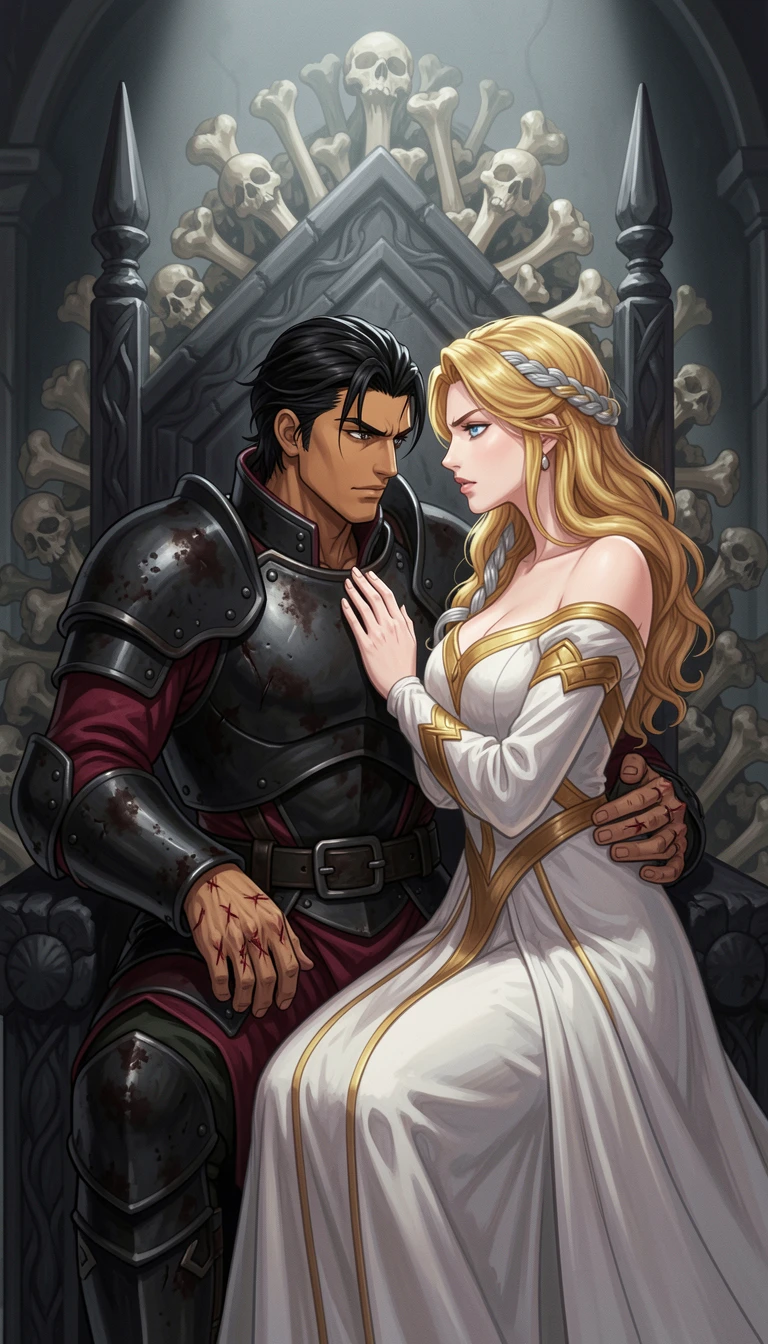
The noon bell took its time.
Damien heard the first stroke from the maps room, where the light came in cold and slanted and laid the shadows of the iron lattice across the floor like a cage he had built for himself and forgotten to leave. He did not move. He let the first stroke die, and the second, and the third, and by the fourth he was already on the stairs, the map case under his arm and Lily's letter folded flat against his chest, the paper warm now where his body had been heating it for an hour and a half. He had read it four times. He had read it the way a man reads a bill of sale for something he has not yet decided to buy.
The stairs came down into the back of the throne hall behind the dais, and he took them slowly, and the sound of the hall reached him before the hall did — the low animal murmur of a court that had been told to be present and had not been told why. Torchlight. Incense. The heat of too many bodies packed under a stone ceiling that had been built to hold a mountain up and was now holding the weight of every noble house in the Black Rose Empire and their cousins and their grudges. He came around the dais and the murmur died.
The obsidian throne was where he had left it. It was always where he had left it. It had been cut from a single block of stone dragged out of the Kaln wastes by four thousand men, two hundred of whom had died doing it, and it had never been polished because he liked the way it still held the marks of the chisels. He sat down. The stone took his weight without complaint. He set the map case against the arm of the throne and folded his hands and looked out over the floor of his hall, and the hall looked back, and no one spoke.
Kael Thorne stood at the foot of the dais with his arms folded and his face empty, the black iron spear across his back, the red gemstone in his pauldron catching the torchlight every time he breathed. He had been standing there for eleven years. He did not look at Damien. He did not need to.
Seraphina came through the main doors at the far end of the hall, and the doors were iron and twelve feet high and they made a sound like a sentence being handed down when they closed behind her. She was in fitted black leather with the silver buckles polished to a mirror, her hair braided on one side and falling sleek on the other, the scar from her temple to her jaw pale against the olive of her skin. She walked the length of the hall alone. Halfway down she stopped and turned and stood to one side, and then the doors opened again.
Lily Aurora came in.
She was in the white and gold gown. He had told Seraphina to bring her in the white and gold gown and Seraphina had brought her in the white and gold gown, and the gown bared her shoulders, and her shoulders were the color of the inside of a shell, and her hair was braided with silver thread and laid over one shoulder like something she had decided to carry rather than let anyone else carry for her. Her spine was a straight line. Her chin was level. Her eyes were the pale blue of a winter morning, and they found him on the throne across forty feet of stone floor and they did not leave him.
She had been crying an hour ago. He knew that because Seraphina had told him, and because he could see the places where she had pressed the heel of her hand against her face and then stopped, and because the crying had not left a single mark on her that a court could read. She had cried in a way that did not leave marks. He had thought about that for an hour and a half and he was still thinking about it.
She walked the floor. The court watched her walk it. The envoys from the free cities stood in a knot near the eastern pillars with their hands folded and their faces carefully empty, and the man among them who reported to masters Damien had not yet identified watched her the way a man watches a door he expects to open onto something he can sell. Damien noted him and filed him and did not look at him again.
She reached the foot of the dais. She stopped. She did not bow.
Damien rose.
He rose the way he did everything, without hurry, and the room remembered how to breathe only after he was standing, and he came down the two steps of the dais and he took her wrist. Her wrist was small. Her pulse was under his thumb and it was going fast, and he held it there for a moment, feeling it, letting her feel him feeling it, and then he turned and drew her up the steps and sat back down on the obsidian throne and brought her down onto his lap in front of every noble house in the Black Rose Empire.
She did not resist. Her body went where he put it. But her spine stayed straight even sitting, and her hands stayed at her sides, and her chin stayed level, and he understood that she had decided, somewhere between the west rooms and the doors of this hall, that she would not give him the small victory of her flinching. He respected that. He respected it the way he respected a blade that had been sharpened by someone who knew what they were doing.
His scarred hand settled on her thigh.
The gown was thin. He could feel the heat of her leg through it, and the shape of the muscle under the fabric, and the small involuntary tightening that ran through her when his palm made contact. His knuckles were scarred across the ridges from the years before the army, when he had broken men with his hands because he had not yet had anything better, and he laid those knuckles flat against the top of her thigh and let her feel the roughness of them through the silk. She did not move. Her breathing changed. That was all.
He leaned his head down toward her ear, and his voice was low enough that only she would hear it, and the court saw only the emperor bending his head to the princess of the Kingdom of Light like a man whispering something tender.
"You wrote the truth," he said.
Her breath stopped for half a beat. He felt it in the thigh under his hand.
"Now the court learns what choice your brother will make," he said, "as I learn your choice."
He let his finger begin to move. Just one finger, the index, tracing a slow line up the inside of her thigh from the hem of the gown, a fraction of an inch at a time, and the silk of the gown slid with it, and the court could not see what his hand was doing under the fabric and every person in the hall knew exactly what his hand was doing under the fabric, and Lily Aurora sat on the lap of the Demon Emperor with her spine straight and her eyes on the far doors and her jaw set and her pulse hammering under his thumb.
He could feel her getting wet.
Not much. Not yet. But the heat under his palm had changed, and the silk had changed, and the small muscles in her thigh were doing something they had not been doing a minute ago, and her hands, which had been flat at her sides, had curled into fists against the arms of the throne. She was fighting it. He liked that she was fighting it. He would have been disappointed if she had not.
"Your father's envoys," he said against her ear, still low, still only for her, "are dead. Your brother's spear is on the floor of this hall. Your letter is on its way west. And you are sitting on my lap in front of my court in the gown you wore when you first put your weight on me, and every lord in this room is deciding what that means for their own daughters."
Her throat moved. She swallowed. She did not speak.
"Good," he said. "Keep not speaking. It's the best thing you've done since you walked in."
The main doors opened again.
Two of the black iron cavalry came through with a boy between them. Aldric Aurora was in the white and silver of the Kingdom of Light, and the white and silver was rumpled from a night in the east tower, and his golden hair was tousled and uncombed and his dark blue eyes were red-rimmed and his jaw had a bruise on it that had not been there when he left this hall. He walked between the two cavalrymen with his hands loose at his sides and his shoulders squared, and he was trying, Damien could see, to walk like a man who had not spent the night deciding whether to drink a bottle of wine.
He had not drunk it. Kael had told Damien that at dawn, in three words, and had not offered an opinion, and Damien had not asked for one.
The boy reached the foot of the dais and looked up. He saw his sister on the emperor's lap. His face did something that Damien watched with interest — the mouth opening, the eyes going wide, the hands starting to come up — and then the boy caught it, and closed it, and put his hands back down at his sides, and stood there with his jaw working and his eyes wet and his spine, Damien noted, still straight. The same spine. The same blood. The same stupid, stubborn, straight spine.
Lily had gone very still on his lap. Every muscle in her body had locked. The wet heat under his palm had not gone away. The two things were happening in her at once and she did not know which one to spend, and Damien felt the whole war of it through the silk of her gown and the skin of her thigh, and he kept his finger moving, slow, unhurried, and he turned his face to the boy.
"Aldric Aurora," he said. His voice carried now. The hall heard it. "You were given until the noon bell."
The bell had stopped ringing a quarter of an hour ago. The boy knew it. The hall knew it. Nobody said anything.
"You have three choices," Damien said. "You can ride home to your father with your sister's letter in your saddlebag and tell him what you saw in this hall. You can stay in the east tower as my guest and learn what a court looks like when it belongs to a man who has never lost one. Or you can pick up the spear you dropped and finish what you started."
He let that sit.
"You will not be given a fourth."
The boy's mouth opened. Closed. Opened again. His sister's eyes were on him from the throne, and the whole hall was watching him, and the two cavalrymen behind him had not moved a muscle, and Damien's finger was still climbing the inside of Lily Aurora's thigh under her gown, slow, patient, and the princess of the Kingdom of Light was sitting on his lap with her brother in front of her and her own body betraying her by degrees, and the emperor of the Black Rose waited.
"What have you decided, boy?"
The boy's hand went inside his coat.
Damien watched it go. He watched the white and silver fingers close on something and draw it out, and he knew what it was before it cleared the fabric — the fold of paper, the wax seal of the Kingdom of Light broken and re-pressed crooked, the letter he had read four times in the maps room with his own thumb tracking the lines of a girl's handwriting. Lily's letter. The one she had written under Seraphina's eye and his own ear against the corridor wall. The one that was supposed to be in a saddlebag already, headed west.
The boy had kept it. He had carried it up to the east tower and slept with it under his pillow and brought it back down again, and now he stood at the foot of the dais holding it up where the whole hall could see the crooked seal, and his hand was shaking, and the paper shook with it.
On Damien's lap, Lily went rigid. Not the slow lock of a body bracing. A hard stop, the way a horse stops when it sees the drop. Her thigh turned to stone under his palm and the wet heat he had been reading through the silk was suddenly the least interesting thing about her, because her whole body had just understood something her face had not caught up to yet.
"Aldric," she said.
It was the first word she had spoken in this hall. It came out level. Damien heard the work in it — the throat tightening, the breath held, the voice dragged flat by force — and he filed it, the way he filed everything she did, because the levelness cost her more than a scream would have.
"Don't."
The boy looked at her. Damien watched the two of them across the space between the dais and the floor, and it was the closest thing to a private room in a hall of four hundred people, and he did not interrupt it. He wanted to see what the boy was made of when his sister's eyes were on him. Kael had told him at dawn, in three words, and Damien had not asked for an opinion, but he was collecting one now, watching, the way he collected everything.
Aldric's jaw worked. The bruise on it went white where he clenched. He looked at his sister sitting on the emperor's lap with the emperor's scarred hand under her gown, and his eyes were wet and red-rimmed, and his mouth pulled, and for one moment Damien thought the boy was going to do the thing that would have made him worth the tower — throw the letter down, cross the floor, put his hands on the throne and die on the steps of it. Damien would have respected that. He would have had Kael kill him quickly for it.
The boy did not.
He took the letter in both hands. He tore it down the middle.
The sound was small. Paper does not make a large sound. But the hall was silent enough that every person in it heard the two halves part, and then he folded them and tore them again, and again, and the pieces came away in his fists and he kept going, tearing the strips into squares, the squares into scraps, until his hands were full of nothing but confetti and his sister's careful handwriting was a heap of white in his palms and he was standing there with his chest heaving and his eyes on the floor and his hands full of what he had just done.
He let it fall.
The pieces went down around his boots in a drift, the crooked seal in two among them, and the boy looked up at Damien with his face open and ruined and said the first honest thing he had said since he walked into this empire.
"I'm going home."
His voice cracked on the second word. He did not fix it. He let it crack.
"I'm going home and I'm going to tell my father what I saw, and I'm going to tell him the truth, and he can decide what to do with it, because I can't —" He stopped. His hands closed on nothing. "I can't do this. I can't stand in this room. I can't pick up that spear. I can't watch her sit there. I want to go home."
He looked at his sister then. Damien watched him look at her, and watched what it cost him, and watched Lily Aurora take it without moving a muscle of her face, which was itself a kind of answer, and a colder one than the boy deserved.
"I'm sorry," Aldric said to her.
Lily did not answer him. Her chin stayed level and her eyes stayed on him and she gave him nothing, and Damien understood, sitting under her, that she had just decided the boy would not get to see her break on his way out the door. She was holding it the way she had held the crying an hour ago — pressed flat, no marks, nothing a court could read. She was better at this than her brother. She had been better at it from the first day.
Damien's finger had stopped moving. He let it rest where it was, flat against the top of her thigh, and he turned his face to the boy.
"Good," he said.
The word landed in the hall like a coin dropped on stone. The court did not know what to do with it. The boy did not know what to do with it. He stood there with his hands empty and his sister's letter scattered around his boots and his face saying that was not the answer I expected.
"Guards," Damien said, and did not raise his voice, and the two black iron cavalrymen behind the boy came to attention like a single mechanism. "A horse. Provisions for the road west. He rides at once."
He looked down at the boy from the throne, and his voice stayed level, and it was the levelness that made it cruel.
"You will not be escorted. You will not be slowed. You will ride the whole way home with what you did in this hall sitting in your saddle in front of you, and when you reach your father's gate you will tell him what you saw, and you will tell him what you did not do, and you will tell him what your sister is." He let that settle. "I look forward to the answer from your father."
Aldric's mouth opened. Damien watched him reach for something — a demand, a plea, a last word for his sister — and watched him find nothing in his hands but the scraps of her letter, and the boy closed his mouth and turned and walked.
He walked the length of the hall between the two cavalrymen with his back straight and his shoulders squared and his hands loose at his sides, the way he had walked in, and the court watched him go, and he did not look back at the throne. Not once. Not at his sister. Damien watched for it and it did not come, and he decided the boy was a coward and also that the boy knew it now, which was more than most men ever managed, and that the Kingdom of Light was going to receive a prince who had learned something in the Black Rose and would never be able to say what.
The iron doors closed behind him.
Damien sat for a moment with the sound of it still in the stone, and then he moved.
He took his hand off Lily's thigh — deliberately, slowly, letting her feel the absence — and he stood, and he set her on her feet beside the throne the way a man sets down a glass he has finished with, and he looked out over the floor of his hall at every noble house in the Black Rose Empire and their cousins and their grudges and their daughters.
"The audience is finished," he said.
That was all. He did not need more. The hall came apart like a tide going out — the courtiers bowing and turning and flowing toward the doors, the envoys from the free cities folding into their knot and moving with the rest, the man who reported to masters Damien had not yet identified going out among them with his face carefully empty and his hands folded, and Damien watched him go and added one more line to a ledger he kept in his head. The doors opened and closed and opened and closed, and the murmur rose and fell and faded, and the torches guttered in the draft, and the great cold room emptied by degrees until there was nothing left in it but the obsidian throne and the drift of torn paper on the floor and three people.
Damien. Lily Aurora, standing beside the throne where he had set her down. And the girl.
Gaby Chen had come in with the court and had not left with it. She stood at the edge of the floor near the eastern pillars with her blond braid down her back and her green eyes wide and her hands knotted together in front of her, and she had clearly understood that she was not being sent out and did not know what that meant, and she was looking at her princess the way a dog looks at a door that has just been shut.
Damien let her stay. He had a use for a witness.
He turned to Lily.
She was standing very straight beside the throne in the gown that bared her shoulders, and her hair was braided with silver thread over one shoulder, and her eyes were the pale blue of a winter morning, and she had just watched her brother tear up her letter and ride away and leave her in this room, and she had not made a sound. He looked at her for a long moment. He looked at the place on her thigh where his hand had been. He looked at her fists, still closed, still held at her sides.
"Your brother has decided," he said.
She did not answer.
"Your father will decide." He took a step toward her. The torn paper whispered under his boot. "And what about you, Princess?"
He stopped close enough that she had to lift her chin to keep her eyes on his, and he let her do it, and he looked down at her with his head tilted slightly, the way he looked at things that amused him.
"What are you going to do?"
Her throat moved. She swallowed. She held his eyes.
"Will I break you," Damien said, "or will you give yourself to me with your free will?"
He did not move. He did not touch her. He stood there with his hands at his sides and his storm-grey eyes on her face and the question hanging in the cold air of the emptied hall between them, and beside the throne the girl Gaby Chen had stopped breathing, and the drift of Lily's torn letter lay scattered across the floor at the foot of the dais like something the empire had already eaten and was done with.
Lily Aurora looked up at him, and did not answer yet, and he watched her decide whether she was going to.
She was going to answer him. He watched her gather it, the way she gathered everything — the chin coming up half an inch, the shoulders squaring under the bared silk, the hands at her sides closing tighter until the knuckles went pale against the white and gold of the gown. She was going to open her mouth and give him a word, and Damien found himself waiting for it with an interest he had not felt in a room since he was nineteen years old and standing over his father's body with his own hands still shaking.
Then the girl made a sound.
It was small. A caught breath, a half-step on the flagstones, the kind of noise a person makes when they have just realized they are standing in a room they were not supposed to be in. Gaby Chen had moved. One step toward her princess, one hand lifting off the knot of her fingers, and her face was doing something that Damien had not seen in this hall in eleven years — it was doing pity, open and unguarded, aimed at the woman on the dais floor, and it had no idea it was being watched.
Damien turned his head and looked at her.
He looked at her the way he looked at a man who had spoken out of turn in his court. He did not speak. He did not need to. The girl felt it land — he watched her feel it land — and her hand stopped in the air and her face went from pity to something colder and more useful, and she stepped back to the pillar and folded her hands again and dropped her eyes to the floor like a servant caught in a doorway.
"Your attendant stays," Damien said.
Lily's jaw moved. It was the first crack in the flatness, and it was small, and he caught it.
"She has nothing to do with this."
"She has everything to do with this." He did not look away from Lily. "She came with you. She watched your brother fail to kill a man. She watched him tear up your letter and walk out of my hall, and she is going to watch what happens next, because I want you to understand something, Princess, and I want you to understand it with a witness in the room."
He took the last step. There was no distance between them now. He could smell her — the soap from the west rooms, the clean wool of the gown, and under it the faint salt of a body that had been holding itself rigid for hours. Her breath had gone shallow. He heard it. He did not move his hands.
"I asked you a question," he said. "I am going to ask it once more, and then I am going to stop asking, and what happens after that will not be a question."
Her eyes were wet. She was not letting them spill. He watched her hold the water back the way a man holds a door shut against a weight on the other side, and he watched her decide — he could see her deciding, the way he could see a general deciding whether to commit cavalry — and then she did the thing he had been waiting for since the throne room on the first day.
She answered him.
"Neither."
The word came out low and steady and it cost her everything she had to keep it that way, and Damien felt the corner of his mouth move before he stopped it.
"Neither," he repeated. "You are standing in my hall, in my empire, with your brother on the road west and your father three weeks from an answer, and you are telling me neither."
"I am telling you that you have not earned the first and you will not be given the second." Her chin was up. Her voice was shaking now, on the last word, and she let it shake, and he understood that she had decided the shaking was cheaper than the silence. "You have my brother. You have my letter. You have my father's fear. You do not have me, and you will not, because a man who takes what he wants by breaking it has never once in his life been given anything worth keeping."
Silence. The torches moved in the draft. Somewhere far off in the palace a door closed, and the sound came down the corridor and died against the obsidian.
Damien looked at her for a long time. He looked at the wet eyes and the steady chin and the fists at her sides and the place on her thigh where his hand had been, and he felt the thing in his chest that he had felt on the first day and had not been able to name — the thing that had made him keep her instead of sending her home in a box with her brother. He still could not name it. He was not going to try. But he knew what it was not. It was not mercy. He had cut that out of himself with his father's blood on his hands, and it had not grown back.
"Good," he said.
He said it the way he had said it to the boy, and this time the word landed differently, because this time he meant it. He meant it the way a man means it when he finds a blade that holds an edge.
He turned away from her. He walked to the throne and sat down on it, and he let the cold of the obsidian come up through the plate and the tunic and into his spine, and he looked out across the empty hall at the two women standing in the drift of torn paper.
"You will not be confined to the west rooms," he said. "You will be given the run of the palace, within the walls. You will be watched. You will be given a horse and a guard and the freedom of the grounds, because I want you to see what you are refusing, Princess, and I want you to see it every day until you stop telling me neither."
He let that sit.
"Your attendant will sleep in the room beside yours. She will not be harmed. She will not be used. She is a witness, not a hostage, and I want you to understand the difference, because the difference is the only thing I am giving you for free."
Lily's hands had opened. He watched them open — the fingers loosening, the blood coming back into the knuckles — and he watched her not understand what he had just done, and he watched her decide not to ask.
"Seraphina," Damien said, and did not raise his voice.
She was already there. She had come in through the side door at some point during the audience and had been standing in the shadow of the western pillar with her copper eyes on the room and her hand resting on the hilt at her hip, and she stepped out now and crossed the floor without hurrying, and the torn paper did not move under her boots because she walked around it.
"Take the Princess and her attendant to the west rooms. Have the seamstress sent up. She will need riding clothes." He looked at Lily. "You will not wear the gown again. I am done looking at it."
Lily's mouth opened.
"You will not argue," Damien said. "You will go. You will eat. You will sleep. In the morning you will ride with me to the Senn, because I want you to see the river your father sent you to take from me, and I want you to see it with your own eyes, and then I want you to write your father a second letter, and this one you will write knowing exactly what you are writing about."
He leaned back against the throne. The blackened steel of his armor ground against the obsidian, and the sound was small and final in the great cold room.
"Go," he said.
Seraphina moved. She put a hand on Lily's elbow — light, precise, the way she did everything — and turned her toward the side door, and Gaby Chen followed a step behind with her braid down her back and her green eyes still wide and her hands knotted in front of her, and the three of them went out through the shadow of the western pillar and into the corridor, and the door closed behind them, and Damien sat alone in his hall with the torn letter on the floor and the smell of the girl still in the air where she had stood.
He sat there for a long time.
Then he reached inside the crimson tunic, against his chest, and took out the other letter — the one he had read four times in the maps room, the one with the crooked seal, the one the boy had not known he was carrying a copy of because Damien had had Seraphina copy it before it ever went into the boy's coat. He unfolded it and read the last line again in the torchlight, the line he had been reading all day.
I know what I am going to do.
He folded it. He put it back against his chest. He looked at the drift of paper on the floor — the real letter, the one the boy had torn, the one that was supposed to be in a saddlebag headed west — and he thought about the fact that the boy had kept it, and carried it up to the tower, and brought it back down, and torn it in front of four hundred people rather than let it go.
The boy had not been able to send it. The boy had not been able to keep it. The boy had torn it, which was neither, and Damien had watched him do it and had said good, and he had meant that too, because a man who tears up the thing he cannot decide is a man who has told you exactly how much he is worth.
He stood up.
He walked down the steps of the dais and across the floor, and he stopped in the middle of the drift of torn paper, and he crouched, and he picked up one piece at random — a square of it, four lines of a girl's handwriting, the words and I have not written a lie cut off at the fold — and he turned it over in his scarred fingers and looked at it, and then he let it fall back onto the floor with the rest.
He would have the whole hall swept in the morning. He would have the scraps burned. He would not have a single word of that letter left in the Black Rose by the time the sun came up, because the letter was already in his chest and in Seraphina's ledger and in the boy's memory, and three copies were enough.
He walked out through the side door and into the corridor, and the torches guttered behind him, and the great hall stood empty with the throne on its dais and the torn letter on the floor and the cold coming down off the black stone walls, and somewhere above him in the west rooms a girl in a white and gold gown was being told to take it off.
The imperial chambers took up the top of the west tower, and Damien climbed to them the long way, through the servants' stair, past the door where the seamstress kept her bolts of cloth and the door where the quartermaster kept his ledgers, because he wanted the walk. He wanted the stone under his boots and the cold coming off the walls and the whole vertical distance of his own palace between him and the hall. His hand had not stopped remembering the heat of her thigh. He turned that over the way he turned over a map — the shape of it, the small involuntary tightening, the way the silk had gone warm under his palm while her face stayed flat and cold as the winter she had in her eyes. She had told him neither. He had been turning the word over since she said it. Neither. He had taken cities with less spine than that.
The chamber door was iron and unguarded, because he had killed the last man who thought he needed a guard on it. He went in and shut it behind him and stood in the dark a moment, letting his eyes adjust, and then he crossed to the window and looked out over the city that had his name on it.
Black Rose spread below the tower, down the shoulder of the mountain and into the valley, and at this hour it was a grid of torchlight and forge-light and the low red glow of the smelter district, and beyond it the black line of the river Senn, and beyond that the dark where the Kingdom of Light began. He could see the cavalry barracks from here, the long low building with its rows of stalls and its drilling yard, and he could see the shape of the yard even in the dark because he had walked it ten thousand times. The black iron cavalry did not sleep the way other armies slept. There was always a horse being walked, always a smith working, always some boy from some conquered village learning which end of a spear went into a man. He looked at it a while. Then he pulled the crimson tunic over his head and dropped it on the chair and went to the basin and washed his hands and his face and the back of his neck, and the water was cold and it did nothing for him.
He sat down on the edge of the bed with his forearms on his knees and his scarred knuckles hanging between them, and he looked at the wall, and he waited.
He did not have to wait long.
Seraphina came in without knocking — she had never knocked, not in eleven years — and shut the door behind her with her heel and stood there in the dark of the doorway with her copper eyes catching the last of the window-light. She had changed out of the leather with the polished buckles and into the plain black she wore when she was working and did not want to be looked at, and her hair was still braided on one side and loose on the other, and the scar from her temple to her jaw was a pale line down the side of her face. She looked at him sitting on the bed with his tunic off and his hands hanging, and she read him the way she read everything, in about two seconds, and she did not pretend she hadn't.
"The Princess is in the west rooms," she said. "The attendant is in the room beside hers. The seamstress has the measurements. The gown is off her."
"And?"
"And she did not cry when the seamstress took it. She stood there like a post and let the woman work and did not say a word to her or to me, and when we left she was standing at the window with her hands on the sill, looking west." Seraphina crossed the room and stopped at the foot of the bed. "She is not broken. She is not close to broken. She is doing arithmetic."
"Good," Damien said. He said it the way he had said it in the hall, and Seraphina heard the difference in it, because she always heard the difference.
She looked at him a moment longer. Then she reached up and pulled the tie out of her braid and shook her hair loose, black falling over the shoulder of the plain black shirt, and she said, flat, the way she said everything, "You want me to stay."
"I want you to stay."
She did not ask why. She had never once asked him why. She came around the foot of the bed and stood in front of him where he sat, close enough that her knees were against his, and she looked down at him with the copper eyes and the scar and the flat unsmiling face that had told him he was being an idiot more times than any living person, and she put her hand on the back of his neck and held it there.
He put his hands on her hips and pulled her down onto him.
She came down with her knees on either side of his thighs and her weight settling into his lap, and she kissed him without preamble, the way she did everything, no ceremony, mouth open, her tongue against his, and he took the back of her head in his scarred hand and held her there and kissed her back hard enough that she made a sound low in her throat. She tasted of the wine she had drunk with her supper and the cold of the corridor and underneath it the clean bitter taste that was just her. He knew that taste. He had known it for eleven years, in a hundred rooms, on a hundred nights when one or the other of them had needed something and had not wanted to say so. It was the only body in the empire he had never had to be careful with.
She pulled back far enough to look at him. Her hands were already working the buckle at her own belt.
"You're thinking about her," she said.
"Yes."
"Good." The belt came loose and she tossed it aside. "I'd have been insulted if you weren't. She's the first interesting thing to walk into that hall in five years." She got her shirt over her head and dropped it and sat back on his thighs with her breasts bare and the scar running down past her ear, and she looked at him with her head tilted, the way she looked at a problem she had already solved. "You want to fuck her. You can't yet. So you're going to fuck me and think about her, and I'm going to let you, because I've been watching you chew on that girl all day and you're no use to anyone like this."
He laughed. It was a short, ugly sound, and it was real, and it was the first time he had laughed in a month.
"Get your clothes off," he said.
She did it without hurrying, standing up off his lap to peel the black trousers down her legs, and he watched her do it — the long flat muscle of her stomach, the scar on her ribs from the knife in the alley in Vell, the way she stepped out of the trousers and kicked them aside and stood there in the dark with nothing on and let him look. She was not beautiful the way the princess was beautiful. She was a blade that had been used, and he had used her more than anyone, and she had used him back, and that was the whole of what they were to each other and it had never once been a lie.
He stood up and took her by the hips and turned her and put her on the bed on her back, and she went without resisting, watching him with those flat copper eyes, and he got out of his own trousers and came down over her and put his mouth on her throat and she put her hands in his hair and pulled.
"Harder," she said. "I'm not made of glass and I don't want to be treated like the princess."
He bit her, then, at the join of her neck and her shoulder, hard enough to leave a mark, and she made a sound that was not quite a laugh and not quite a moan, and her hips came up against his and her hand slid down between them and found his cock and closed around it and worked it once, twice, slow, feeling the length of it, the way she had done a thousand times, and he felt himself go hard in her fist and he pressed his face into her hair and breathed her in and for a moment he was not thinking about anyone.
Then she guided him and he pushed into her.
She was wet and ready — she was always ready, she came to him already wanting it, she had never in eleven years made him work for it — and he went into her in one long stroke and she took all of it and her breath came out of her in a rush and her heels dug into the backs of his thighs and she said, low and rough, "There. That's it. That's what you needed."
He fucked her like that, slow at first, long strokes that pulled almost all the way out and drove back in, and she took each one with her head tipped back and her throat bared and her hands fisted in the sheets, and the wet sound of it filled the dark room, and the bed frame worked against the stone floor. He watched her face. He always watched her face, because Seraphina's face was the one honest ledger in the empire and he had learned to read it years ago — the small crease between her brows when he found the right angle, the way her mouth went slack and then tight, the way her eyes would go unfocused and then snap back to his as if she had caught herself drifting and did not intend to. She did not perform for him. She never had. When she came, she came because he had earned it, and she let him see it happen, and that was the only gift she had ever given him that cost her anything.
He shifted his weight and got a hand under her thigh and pulled her leg up over his arm and drove in deeper, and she grunted and her nails went into his shoulder and she said, "Yes. Right there. Don't you dare stop."
"I wasn't going to."
"You were thinking about stopping." Her voice was fraying at the edges now and she did not care. "You always think about stopping when it's good. You've got some idea in your head that a man shouldn't — " and then he drove in hard and cut the sentence off and she arched under him and swore and her cunt clenched around him and he felt it the whole length of his cock and it pulled a sound out of him he did not plan to make.
He took her harder after that. He put his hand flat on her throat — light, no weight, just the palm resting there, the way he had rested his knuckles on the princess's thigh an hour ago, and Seraphina's eyes came open and found his and she smiled, actually smiled, the thin scar pulling with it, and she said, "That's her hand on your mind, isn't it. You're putting your hand on my throat because you want to put it on hers."
"Shut up."
"Make me."
He did. He fucked her through the mattress until the headboard was knocking the wall and her breath was coming in short hard bursts and her hands had gone from his shoulder to the sheets to the iron rail of the bed and back, and she was saying his name now, not the title, his name, the way she only did when she was close, and he could feel her getting tighter around him with every stroke, the wet grip of her, the drag and the slide, and he was close himself, closer than he had been in months, and he did not want it to be over yet because when it was over he would have to think again.
He pulled out.
She made a sound of pure frustration and lifted her head off the pillow and looked at him with the copper eyes gone dark. "What are you —"
"Turn over."
She turned over. She got her knees under her and her face down against the pillow and her back arched and her ass up, and she looked back at him over her shoulder with her hair in her face and said, "You're a bastard."
"I know."
He put a hand on the small of her back and pushed into her from behind, and she took him to the root and let out a long shaking breath and dropped her forehead to the pillow. This angle was deeper and he knew it and she knew it and neither of them said so. He set a rhythm — hard, even, the slap of his hips against her ass filling the room — and he watched the line of her spine and the scar on her shoulder blade and the way her hands had closed on the far edge of the mattress and were pulling, and he leaned down over her back and put his mouth against her ear and said the only tender thing he had said all day.
"You're the only one I trust."
"I know," she said into the pillow. "Fuck me harder."
He did. He fucked her until his thighs burned and the sweat ran down his back and the room had gone from cold to close, and she came first — he felt it, the long clench and release, the way her whole body went rigid and then soft under him, and she said something into the pillow that he did not catch — and then he drove in twice more and buried himself in her and came with his hand fisted in her hip and his teeth in his own lip, and it went through him in long hard pulses and he emptied into her and stayed there, bent over her back, breathing hard, until the last of it had gone.
He pulled out slow. She made a small sound and stayed where she was, face down, one leg sliding straight, and he lay down beside her on his back and stared at the ceiling and let his breath come back.
Neither of them spoke for a while. The torch in the corridor guttered through the gap under the door. Somewhere far below, a horse was being walked in the dark, and the sound of its hooves on the stone came up through the tower like a heartbeat.
"You'll take her to the Senn in the morning," Seraphina said at last, into the pillow, not a question.
"I'll take her to the Senn."
"And you'll show her the cavalry."
"I'll show her the cavalry."
Seraphina turned her head and looked at him with one copper eye past the fall of her hair. "And after the Senn?"
Damien did not answer for a moment. He lay there with his arm behind his head and his eyes on the dark ceiling and the taste of his own blood on his lip, and he thought about the town on the far bank of the river, the one that had stopped paying its tribute two seasons ago and had been waiting since for the empire to remember it. He thought about the black iron cavalry coming down the valley road in the morning light. He thought about the princess of the Kingdom of Light watching it happen with his hand between her legs, and he thought about the word neither, and about how long a woman could hold a word like that when the thing she was refusing was being done to a town in front of her.
"After the Senn," he said, "she learns what she is refusing."
Seraphina watched him a moment longer. Then she turned her face back into the pillow and said, muffled, "Wake me before dawn. I want to see her face when she sees the horses."
He lay awake a long time after she had gone quiet beside him, one hand flat on his own chest over the place where the letter was not, because he had left it on the table by the window, and he could see the edge of it in the dark, the fold of it, the crooked seal. He did not get up to read it again. He had read it four times. He knew every line of it the way he knew the ground of a battlefield he was about to fight on. He closed his eyes.
He was asleep before the second watch changed.
He woke before the bell, the way he always did, and he was out of the bed and dressed in the blackened plate before the sky over the mountains had gone from black to grey, and Seraphina was already gone — she had woken before him, the way she always did, and had left without a word, the way she always did. He went down the servants' stair with his hand on the cold wall and came out into the stable yard as the first light came over the eastern ridge and laid itself flat across the drilling ground, and the black iron cavalry were already mounted and waiting in ranks, four hundred of them, and the yard was full of the sound of horses breathing and iron shifting and no man speaking.
Kael Thorne sat his horse at the head of the column with the black iron spear across his back and the red gemstone in his pauldron catching the new light. He saw Damien come out and did not salute. He never saluted. He just looked at him with the grey-red eyes and waited.
Damien walked the line of the column the way he walked it every time before a ride — slow, looking at each man's hands on the reins, at each horse's feet, at the girths and the bit and the iron — and the men did not look back at him, because they had learned not to, and because looking at the emperor when he was inspecting you was how you ended up walking home. He reached the head of the column and stopped beside Kael's stirrup and looked up at him.
"The town across the Senn," he said. "Two seasons of unpaid tribute. How many in it?"
"Four thousand," Kael said. "Maybe five. They've taken in the refugees from the last one, so the number's soft."
"And the garrison?"
"Two hundred militia. Boys and old men. They've got the bridge mined and they know we're coming." Kael's face did not change. "They'll fight. It won't matter."
"No," Damien said. "It won't."
He turned and looked back across the yard toward the west gate, where the road came up from the palace, and he waited, and he did not have to wait long, because Seraphina came through the gate a moment later with two horses and a rider, and behind her, on a grey mare that had been chosen for its calm, came Lily Aurora in new riding clothes — dark wool, plain cut, a cloak over it, her hair braided tight against her head the way a woman braids it when she intends to ride hard, and no silver thread in it anywhere. She had dressed herself for the road. She had understood the instruction. He watched her take in the yard — the four hundred mounted men, the black plate, the spear on Kael's back, the horses standing in the cold light like something out of a story she had been told as a child and had not believed — and he watched her face do nothing at all, which was itself the most interesting thing she had done yet.
She rode up to him and stopped the grey mare a length away and looked down at him from the saddle, and her pale blue eyes were steady and her chin was level and there was no sign on her anywhere that she had spent the night in a strange room in the house of the man who had put her on his lap in front of four hundred people.
"Good morning, Princess," Damien said.
"Your Majesty."
"You slept."
"I slept."
"You're lying."
"I am," she said. "I am also here, on the horse, in the clothes, as instructed, and I am going to ask you one question before we ride, and then I will not ask you anything else today."
He looked up at her. The light was coming over the ridge and it caught the side of her face and the pale blue of her eyes and the place at her throat where the cloak clasp sat, and he felt the thing in his chest again, the thing he could not name, and he did not try.
"Ask," he said.
"Where are we going?"
He held her eyes a moment. Then he turned and swung up onto his own horse — the black stallion they brought him, the one nobody else could ride — and gathered the reins and looked down the valley road toward the river, where the light was spreading across the water and the far bank was coming out of the dark, and he answered her without looking at her.
"To see what your father sent you to stop."
He put his heels to the stallion and the column moved, four hundred horses going from stillness to walk in a single breath, and the sound of it rolled off the walls of the yard and out over the valley, and Lily Aurora rode beside him at the head of the black iron cavalry of the Black Rose Empire with her hands steady on the reins and her face giving nothing away, and the town on the far bank of the Senn was already burning in the morning light before they ever reached it, because a scout had ridden ahead in the night and the militia had panicked and set their own granaries alight, and Damien watched the smoke rise over the river and felt the princess go still in the saddle beside him, and he did not say a word.
They rode the whole morning.
By the time they came up onto the bluff above the river crossing the sun was high and the smoke had thickened and the town below was a smear of fire and running figures and the small bright flashes of the militia's useless muskets, and the black iron cavalry had fanned out along the ridge in a line four hundred long, and Kael Thorne had ridden down to the ford with two hundred of them and the rest were holding the high ground, and Damien sat his stallion on the bluff with the princess of the Kingdom of Light beside him and watched his army go into the town.
He reached over and took her reins out of her hand and looped them over his own pommel, and then he reached over and put his arm around her waist and lifted her off the grey mare and set her sideways across his own saddle in front of him, her back against his chest, her legs across his thigh, the cloak falling open, and she went rigid against him and did not fight it, and he put his mouth against her ear and said, "Watch."
She watched. He made her watch — the cavalry going down the one street, the doors coming off their hinges, the smoke rolling black and low, the militia breaking and running and being ridden down in the open field beyond the wall, the women and children herded into the square with their hands on their heads while the town burned behind them. She watched all of it with her spine pressed against his breastplate and her hands closed on his forearm where it crossed her waist, and her breath came fast and shallow, and she did not look away, and she did not cry, and she did not beg.
He slid his hand down her stomach and under the waist of the riding trousers and into her, and she was wet — slick and hot and wet, her body answering the thing her face refused, and he found her clit with two fingers and worked it slow while the town burned in front of them, and her hips moved against his hand before she could stop them, once, twice, and she made a sound low in her throat that was half a sob and half something else, and he felt her whole body fighting itself, the want and the horror in the same skin, and he kept his fingers moving, unhurried, patient, while the black iron cavalry finished the town below.
"This is what you were sent to stop," he said against her ear. "Look at it. Look at all of it. And tell me again that I have not earned you."
She did not answer. Her hand closed hard on his forearm and her head fell back against his shoulder and her breath broke, and he felt her come apart on his fingers while the smoke rose over the river and the last of the town came down, and he held her through it and did not stop until she had gone still, and then he took his hand out of her trousers and wiped his fingers on the hem of her cloak and put both hands back on the reins and turned the stallion's head for home.
Behind them the black iron cavalry came up out of the valley in column, four hundred horses and four hundred men and one general with a spear across his back, and the town on the far bank of the Senn was a column of smoke going up into a clear blue sky, and the princess of the Kingdom of Light rode home across the emperor's saddle with her cloak wet at the hem and her hands loose in her lap and her eyes open and dry and fixed on the road ahead, and she did not speak to him the whole way back, and he did not make her.