
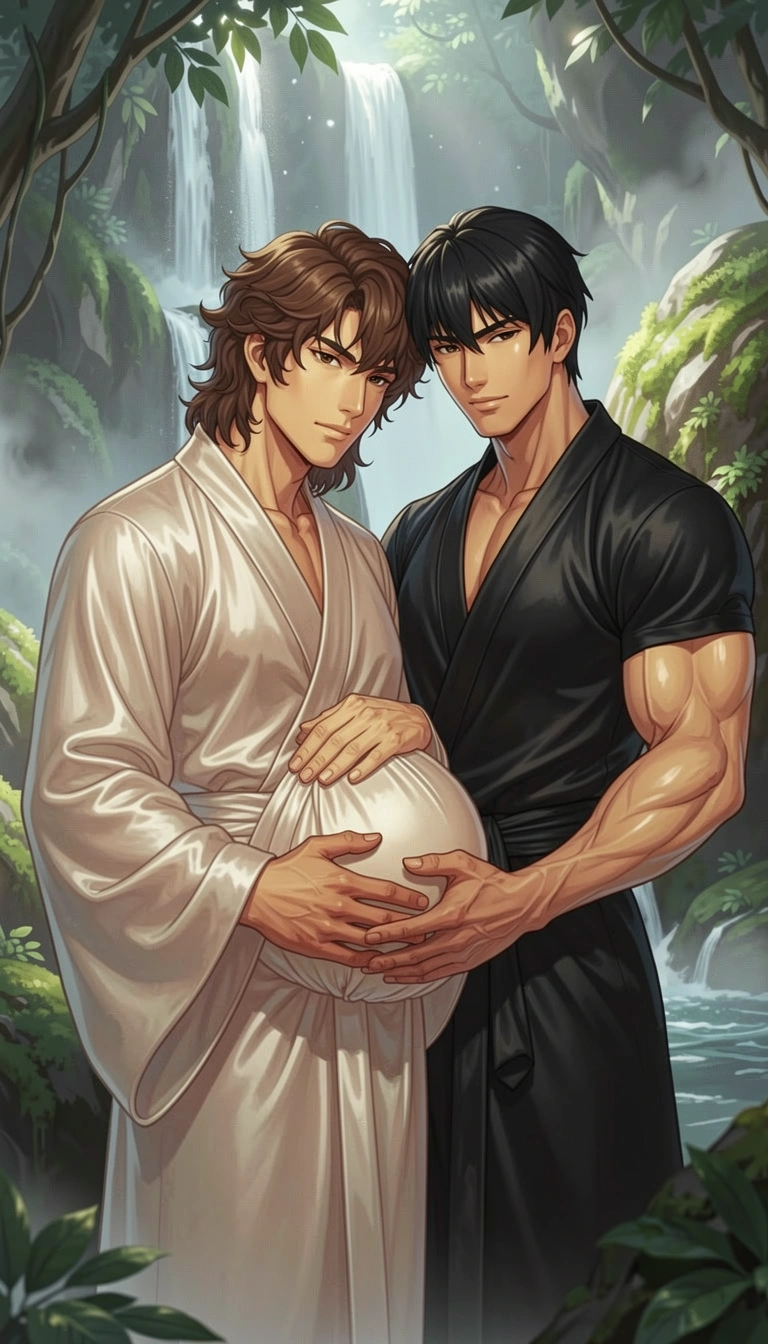
Phuwin shifted Aric to his other breast, the movement practiced now, automatic. The baby's mouth found him immediately, small fists pressing against pale skin as he suckled. The room was quiet except for that soft sound—wet and rhythmic and alive—and the distant murmur of the palace waking beyond the windows.
He stared out at the morning light. It caught the dust motes floating in the air, turned them to gold, and he watched them drift without really seeing them. His hand came up to stroke Aric's cheek, the skin impossibly soft, and the baby's eyes fluttered but never opened. Just feeding. Just surviving. Just being small and new and utterly dependent.
The sun had climbed higher by the time Aric's mouth went slack, milk dribbling down his chin. Phuwin touched the corner of the baby's lip, wiped it clean with the edge of the blanket, and felt the familiar ache in his shoulders from holding the same position too long. He shifted, adjusted the blanket over his shoulder, and stood.
The floors were cold beneath his bare feet. He hadn't bothered with slippers this morning—hadn't bothered with much, really, beyond the thin silk robe that hung loose over his frame. His body was still finding its way back to itself, still soft in places it hadn't been before the birth, still carrying the low thrum of fever that came and went like tide. The healer said it would pass. He was learning to trust that.
He walked to the door that led to the gardens, the one that opened onto the field of wildflowers his daughters had planted years ago, when Imaria was small enough to fit in the crook of his arm. The grass was wet with dew, and he lifted the hem of his robe as he stepped out, the cool air hitting his ankles, his calves, the exposed skin of his chest where Aric had been feeding.
The flowers were in bloom. Purple and white and a deep, bruised pink that reminded him of the sky just before dusk. He reached out with his free hand, let his fingers brush the petals, and felt the faint tremor of life in them—delicate, temporary, perfect. He smiled, a small thing, barely there, and kept walking.
"Look," he said to Aric, his voice low and soft, the voice he used only for his children. "The flowers remember you. They've grown while you were inside me, waiting."
Aric made a sound, a small grunt, and Phuwin laughed—a quiet exhale more than a real laugh, but it was real.
"You don't care about flowers yet. I know. You care about milk and warmth and your mother's voice." He pressed a kiss to the top of Aric's head, the fine dark hair still damp from the bath Star had insisted on. "But you will. One day you'll see them and you'll understand why I love this place."
He reached the rock at the edge of the field, the one with the flat top that had been worn smooth by years of sitting, and lowered himself carefully. The stone was cool through the silk, grounding. He adjusted Aric, brought the baby back to his chest, and let him nurse again, the rhythm settling into something almost meditative.
The moon was still visible in the pale morning sky, a ghost of itself, and the light caught his face as he looked up. His lips were wet from the kiss he'd pressed to Aric's head, and they shone faintly, and his eyes held the light the way water held reflection—broken and beautiful and deep.
He sighed and let the air fill him, then leave. The world was quiet here, away from the palace, away from the council chambers and the endless corridors and the weight of expectation that pressed down on every breath. Here, he was just a mother with her son. Here, he could breathe.
He stayed until the sun was fully up, until Aric was asleep and full, until the dew had dried on the grass and the palace bells rang for the morning meal. Then he stood, adjusted the blanket, and walked back inside.
The next day arrived too fast, a blur of hands and silk and Star's voice cutting through the fog of too-little sleep. Phuwin stood in the carriage yard with Aric in his arms, the morning air cool against his cheeks, and watched the horses stamp and blow steam into the gray light.
Imaria took Aric from him before he could protest, cradling the baby against her chest with a practiced ease that made Phuwin's heart clench. She had grown so much. Too much. The girl who had once fit in the crook of his arm was now tall enough to meet his eyes, her braid neat and her amber eyes clear, a small dagger at her hip and a newborn in her arms.
"You'll feed him in the carriage," Imaria said, not a question. "He'll be hungry by the time we reach the city."
Phuwin opened his mouth to argue, then closed it. She was right. She was always right, lately.
The carriage was large enough for all of them, cushioned in deep blue velvet, with curtains that could be drawn against the world. Ovoale was already inside, her wild curls escaping a crown of braids, bouncing on the seat with barely contained energy. Xiana sat beside her, perfectly still, her dark eyes fixed on the window as if she could already see the city they were about to enter.
Star climbed in last, her golden dress catching the light, and settled across from Phuwin with the easy grace of someone who belonged everywhere and nowhere. She caught his eye and gave a small nod. I'm here. He nodded back. I know.
The carriage lurched forward, and the palace gates swallowed them whole.
Phuwin let his head fall back against the cushion, felt the vibration of the wheels through the wood, and closed his eyes. Aric was in Imaria's arms, cooing softly, and the sound was a thread he could hold onto. His daughters' voices washed over him—Ovoale chattering about the ball, about the dresses, about the boys she hoped to see; Xiana offering quiet corrections; Imaria murmuring to Aric in a voice so like his own it made his chest ache.
The city rose around them like a living thing.
Phuwin heard it before he saw it—the rumble of carts, the calls of merchants, the distant clang of a blacksmith's hammer. He opened his eyes and pulled the curtain aside, just a crack, and watched the streets unfold. People stopped. They turned. They pointed.
"The empress!" a woman's voice called, high and sharp with surprise. "She's really here!"
More voices joined, a chorus rising like heat shimmer off stone. "With the heir—the newborn—look, look—"
Phuwin let the curtain fall. He pressed his palms together in his lap, felt the slight tremor in his fingers, and took a breath.
"They're just excited," Star said, her voice low, meant only for him. "They've waited years for a son."
He didn't answer. Couldn't. The words sat in his throat like stones.
The carriage rolled on, through streets that grew wider and cleaner, past buildings that rose higher and grander, until the wheels slowed and the driver called out to the horses. They had arrived.
The ballroom sat on a hill of grass so green it looked painted, its white stone walls catching the afternoon light like a pearl. Phuwin stepped out of the carriage and stood for a moment, taking it in. The building was elegant in a way the palace was not—smaller, softer, built for pleasure rather than power. Gardens surrounded it, winding paths lined with roses, and in the distance, he could see the silver glint of a lake.
Imaria stepped out beside him, Aric still in her arms, her long dress pooling at her feet. She had chosen it herself—a deep burgundy that matched the undertones in her skin, with gold embroidery at the cuffs and hem. She looked older than thirteen. She looked like she could rule.
Ovoale followed, her dress a cascade of dark pink and purple and white, layers of silk and cotton that floated around her like petals. She grinned at Phuwin, her round cheeks flushed, and spun once to make the fabric swirl.
"Do I look pretty, Mother?"
"You look beautiful," Phuwin said, and meant it.
Xiana came last, her dress a series of blues—pale as morning sky at the shoulders, deepening to navy at the hem. She wore it like armor, her small chin lifted, her dark eyes scanning the crowd of arriving guests with the focus of a general surveying a battlefield.
Star descended from the carriage behind them, and the sight of her made the nearby guests whisper. Her dress was gold and white, layered and thick, the fabric moving like liquid metal as she walked. She licked her lips, adjusted her sleeves, and gave Phuwin a look that said I've got you.
The hostess approached—a queen of this small kingdom, gray-haired and sharp-eyed, with a smile that looked practiced but not unkind. She bowed, low and formal, and Phuwin inclined his head in return.
"Your Imperial Majesty. We are honored beyond words."
"The honor is mine," Phuwin said, his voice steady. "Thank you for welcoming us."
He took Aric from Imaria, felt the warm weight settle against his chest, and followed the queen inside.
The ballroom was a sea of bodies and light. Chandeliers dripped with candles, their flames reflected in the polished floor and the jewels of the guests. Music swirled from a balcony where musicians played strings and flutes, and the air was thick with perfume and sweat and the excited hum of conversation.
Phuwin found a seat near the edge of the room, where he could watch and be watched, where Aric could sleep against his chest without being jostled. The queen settled beside him, asking questions about the journey, about the baby, about the health of the Emperor. He answered automatically, his eyes following his daughters as they moved through the crowd.
Ovoale found a group of children her age and was already laughing, her hands moving as she told some story. Xiana stood near the refreshment table, watching everything, saying nothing. And Imaria—
Imaria stood at the tall windows, looking out at the gardens, her profile sharp against the fading light. She looked lost in thought, her hand resting on the dagger at her hip, her braid catching the candlelight.
A boy approached her.
Phuwin saw it happen—saw the boy pause, straighten his coat, and walk toward her with the particular confidence of someone raised to believe he deserved whatever he wanted. He was young, maybe fifteen, with sandy hair and a pleasant face, and he bowed to Imaria with formal precision.
Imaria turned. She smiled. She bowed back.
Phuwin watched them speak, watched the boy's lips move, watched Imaria's eyes flicker with something he couldn't name. Then the boy extended his hand, and Imaria took it, and they walked together toward the dance floor.
The music shifted into something slower, a waltz, and the boy placed his hand on Imaria's waist with a familiarity that made Phuwin's jaw tighten. They moved well together—she was tall for her age, and he was tall for his, and their steps matched easily, as if they had danced together a hundred times before.
"Your daughter dances beautifully," the queen said.
"She learned from her father," Phuwin said. "He insisted all his daughters know how to lead and follow."
The queen laughed, a soft, pleasant sound. "A wise man."
Phuwin said nothing. His eyes stayed on Imaria, on the way she smiled at the boy, on the way her hand rested on his shoulder, on the way she tilted her head when he spoke.
He had seen that look before. He had given that look himself, years ago, to a man who had promised him the world and then asked for a son.
The dance ended, and the boy leaned in to whisper something in Imaria's ear. She laughed—a real laugh, bright and surprised—and then she said something back, and the boy's face broke into a grin that was too wide, too eager.
They left the dance floor together, the boy's hand on the small of her back, guiding her toward the staircase that led to the upper floors.
Phuwin's hand tightened on Aric's blanket.
He watched them climb the stairs, watched Imaria's burgundy dress disappear around a corner, watched the boy follow her with the hungry look of someone who had already won something he hadn't yet earned.
The queen was still talking, something about the gardens, about the lake, about the history of the ballroom. Phuwin heard none of it.
He was counting the seconds since Imaria had left the room.