
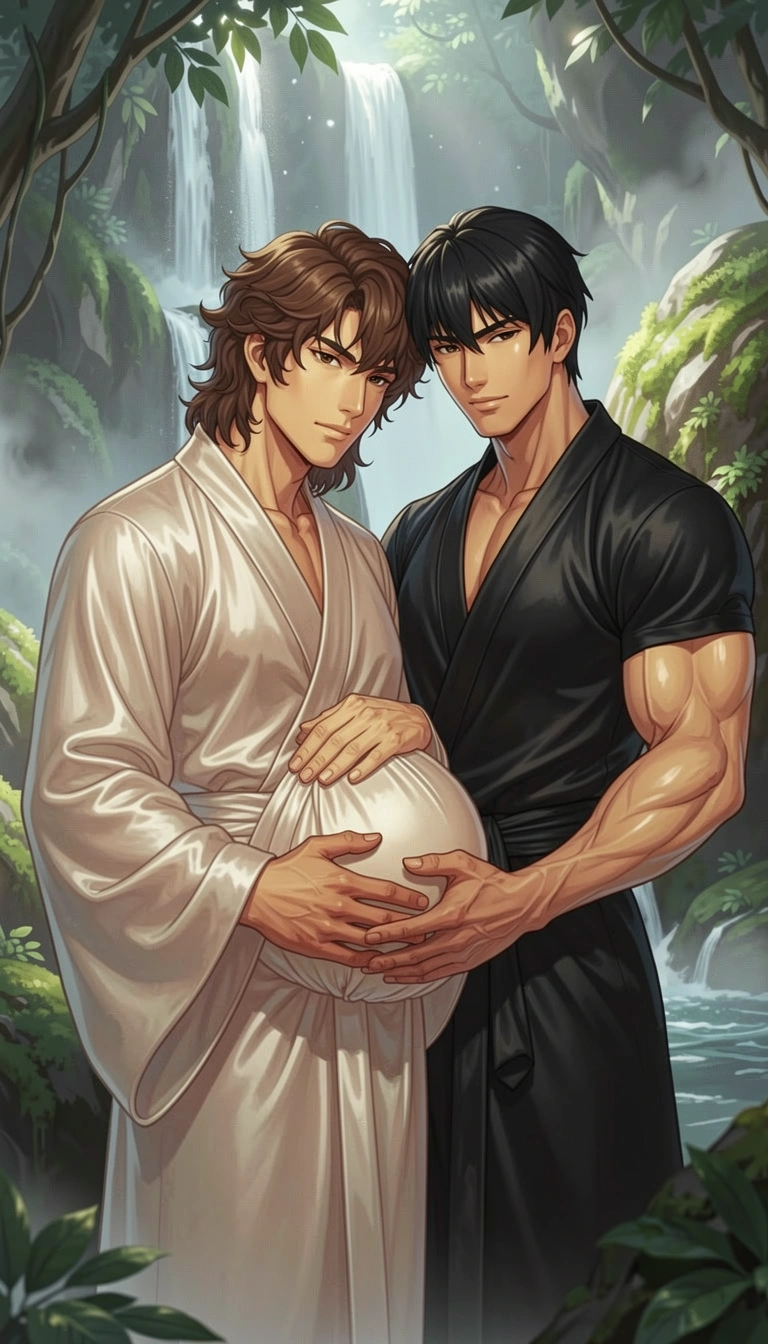
Phuwin's hand tightened on Aric's blanket.
He watched them climb the stairs, watched Imaria's burgundy dress disappear around a corner, watched the boy follow her with the hungry look of someone who had already won something he hadn't yet earned.
The queen was still talking, something about the gardens, about the lake, about the history of the ballroom. Phuwin heard none of it.
He was counting the seconds since Imaria had left the room.
He turned to Star. His voice came out steady, which surprised him. "Take him."
Star's eyes followed his gaze to the staircase. She didn't ask. Her arms reached for Aric, careful, one hand supporting his head, the other sliding beneath his swaddled body. The transfer took three seconds. Phuwin's hands were empty now, and the absence felt like falling.
"Phuwin—"
But he was already moving.
The skirt of his silk robe pooled around his feet as he crossed the ballroom floor, past the dancers, past the tables of half-eaten pastries, past the servants who bowed their heads. He gathered the fabric in his fists as he reached the stairs, hiked it up to his knees, and climbed.
His heart was a fist in his throat.
The upstairs hallway stretched long and dim, lit only by sconces每隔几步, their flames casting wobbling shadows across portraits of kings Phuwin had never met. He counted doors as he passed them. One. Two. Three. A maid carrying a stack of linens turned the corner ahead of him, saw his face, and pressed herself against the wall to let him pass.
He heard it before he saw it.
A soft sound. A gasp, cut short. Then a laugh—low, breathless, a boy's voice saying something Phuwin couldn't make out.
The fourth door on the left was open a crack. A sliver of lamplight bled into the hallway.
Phuwin's feet stopped. His hand found the wall. The silk of his robe slipped from his fingers and fell back to the floor, a whisper against stone.
Through the crack he saw Imaria's burgundy dress pooled on the floor. He saw her bare back, the curve of her spine, the way her hair had come loose from its braid and hung in a black curtain past her shoulders. He saw the boy's hands on her waist, pale against her tan skin, gripping hard enough to leave marks.
He saw the boy's hips press into her from behind. Saw her arch. Saw her mouth fall open in a sound that was half gasp, half moan.
Imaria. His Imaria. The girl whose hair he had braided this morning.
Phuwin's back hit the wall before he knew he was moving. He slid down it, the cold stone scraping through his silk robe, and landed on the floor with his knees drawn up and his hands pressed over his mouth. The world had gone quiet except for the wet sounds from the room and the high, thin ringing in his ears.
He wanted to scream her name. He wanted to burst through the door and drag her out by the arm. He wanted to ask her if this was real, if this was what she wanted, if she even understood what she was doing. He wanted to yell at the boy—the prince, the heir to this tiny kingdom, the sandy-haired son of the woman who had been talking about gardens while Phuwin's daughter was being fucked in a guest room.
But he didn't move. He stayed on the floor, hands over his mouth, and listened to his daughter moan.
Thirteen. She was thirteen.
A sound escaped him, something between a sob and a breath. He bit his own palm to stop it.
Then he got up.
His legs were unsteady. His hands were shaking. He straightened his robe, wiped his face with the back of his wrist, and walked back down the hallway. Past the portraits. Past the sconces. Past the maid, who was still waiting, still pressed against the wall, her eyes wide.
He took the stairs too fast. His foot caught on the hem of his robe and he grabbed the banister to keep from falling, the wood biting into his palm. The ballroom was still bright, still warm, still full of laughter and music and the clink of glasses. He crossed it without seeing it.
Star was standing where he had left her, near the tall windows, Aric cradled in one arm. The other arm lifted as he approached, opening, and Phuwin walked into it like a child walking into a storm. He buried his face in her shoulder. He felt her hand come up, felt her palm press against his back and rub slow circles between his shoulder blades.
"You saw," she said. Not a question.
He nodded into her shoulder. His throat was too tight for words.
"What I didn't want to," he managed. His voice cracked on the last word.
Star held him for three breaths. Then she lifted her head and looked past him, toward the queen's table. The gray-haired woman was still seated, still speaking with her advisors, still unaware.
"Your Majesty," Star said. Her voice carried across the space like a blade.
The queen looked up. Her smile faltered when she saw Star's face, when she saw Phuwin huddled against her shoulder, when she saw the empress of the empire trembling in the arms of his friend.
"Your son," Star said, "is upstairs."
The queen rose. Her chair scraped against the floor. "Is he—is someone hurt? Has he done something wrong? If he has made the Empress uncomfortable, I assure you—"
"Go find out," Star said. Her voice was flat. "You'll see for yourself."
The queen's face went pale. She looked at Phuwin, who still had his face buried in Star's shoulder, who couldn't lift his head, who couldn't meet her eyes. Then she looked at the stairs. Then she was moving, her long gray skirts gathering in her fists as she climbed, two maids falling in behind her.
Star turned Phuwin gently, guided him across the ballroom toward a door at the far end. A small sitting room. Velvet chairs. A cold fireplace. She laid Aric on the cushioned bench near the window, and the baby stirred but did not wake, his tiny mouth working in his sleep.
Star crossed to the desk against the far wall. There was a communication device there, a sleek black panel with numbered buttons. She pressed one. Then another. Then she held the receiver to her ear.
"This is Star," she said. "Connect me to the Emperor's private line."
Phuwin watched her from the chair where he had collapsed. His hands were in his lap. His fingers were twisting the fabric of his robe.
The line connected. Star's voice changed, lost its flatness, gained an edge. "Pond. Listen to me. Something has happened at the ball. Your daughter Imaria—" She paused. "I need you to send a carriage. Now. And I need you to stay calm until we get there."
A pause. Phuwin could hear Pond's voice through the receiver, muffled but unmistakably loud.
"No, she is not hurt. She is not injured. But she—Pond. Listen to me." Star's jaw tightened. "Your daughter was upstairs with the prince of this kingdom. Phuwin saw them. They were—" Another pause. "They were together. The way adults are together."
The yelling through the receiver was loud enough for Phuwin to hear now. He heard his own name. He heard a crash, like something hitting a wall.
"Pond." Star's voice was sharp. "The carriage. Send it. We will explain everything when you are here. Do not do something stupid before we arrive."
She hung up.
The room was quiet. Aric made a small sound in his sleep and settled.
Star sat down on the arm of Phuwin's chair. Her hand found his, and he let it. Her fingers were cool against his trembling ones.
"He is on his way," she said. "He'll calm down by the time we get there."
"He won't."
"No. But he'll try."
Phuwin stared at the wall. There was a painting there, a landscape of rolling hills and a river. He had never seen the place. He would never see it. He would never leave this room, he thought. He would sit here forever, in this velvet chair, in this strange kingdom, while his children grew up and made choices he could not stop them from making.
"I should have gone up sooner," he said. "I should have—"
"You went up the moment you could." Star's thumb traced a line across his knuckles. "You were nursing your newborn son. You were being polite to a queen who would not stop talking. You could not have known."
"I knew." The words came out raw. "I knew when I saw them dance. I knew when she followed him upstairs. I knew, and I sat there, and I let it happen."
"You did not let it happen. You hoped it would not happen."
"Same thing."
"It is not." Star's hand tightened on his. "And you are not going to blame yourself for this. You are going to get through the next hour, and then you are going to go home, and then you are going to figure out what to do about your daughter. But you are not going to sit here and convince yourself this is your fault."
Phuwin's breath shuddered out of him. He let his eyes close. He let his head fall back against the chair. The velvet was soft against his cheek. The room smelled like old wood and dust and the faint sweetness of the baby.
"I saw her," he whispered. "She was—she was making sounds I have never heard from her. Sounds I did not even know she could make. And he was—" His throat closed. "He was holding her like she belonged to him."
"She is thirteen."
"I know."
"She is a child."
"I know."
"And he is—" Star's jaw tightened. "I do not know how old he is, but he is old enough to know better. Old enough to know she is the daughter of the Emperor. Old enough to know this is not a game."
Phuwin opened his eyes. "Is it a game to her?"
"I do not know." Star's voice softened. "You will have to ask her."
He did not want to ask her. He wanted to pretend it had not happened. He wanted to go back to an hour ago, when Imaria was still just a girl in a burgundy dress, still just his eldest, still just the one who carried a dagger and asked questions about diplomacy and still ran to him after nightmares.
That girl was gone. He had watched her disappear up a staircase, and the girl who came back down would be someone else.
The carriage arrived twenty minutes later. Phuwin did not see the queen again. He did not know what she had found upstairs, or what she had said to her son, or whether the sandy-haired boy would be punished or celebrated for claiming what he had claimed. He did not care.
He walked to the carriage with Aric in his arms and Star at his side. The night air was cold against his face, and he realized he had left his wrap somewhere in the ballroom, but he did not go back for it.
Xiana and Ovoale were already in the carriage, their faces pale, their eyes asking questions no one had answered yet. Star climbed in after them. Then Imaria climbed in last.
Phuwin did not speak to her. He could not look at her.
The carriage ride was silent except for the clatter of wheels on stone and Aric's small, sleeping breaths. Ovoale looked between her parents with wide, frightened eyes. Xiana stared out the window, her small face hard, her thumb ring glinting in the lamplight as it passed.
Imaria sat across from Phuwin. Her burgundy dress was back in order, her hair rebraided. She looked like she always looked. But Phuwin knew. He would always know now.
He held Aric closer and stared at the dark window and did not speak to his daughter for the rest of the ride home.
The palace gates opened. The carriage stopped. Footmen opened the doors. Phuwin climbed out without looking back, carried Aric up the steps, through the hall, past the servants who bowed and the guards who saluted.
Pond was waiting in the entrance hall.
His face was a thundercloud. His hands were clenched at his sides. He looked at Phuwin first—looked at him, really looked, saw the tear tracks on his face and the set of his jaw—and then he looked at Imaria, who had just walked through the door behind Star.
"Imaria." His voice was quiet. That was somehow worse than the yelling had been. "My study. Now."
"Father, I can—"
"NOW."
Imaria's face went white. She looked at Phuwin, but he could not meet her eyes. She looked at Star, who said nothing. Then she walked toward the study, her steps slow, her shoulders curved inward.
Pond followed her. The door closed behind them with a sound like a tomb sealing.
Phuwin heard the yelling begin.
He heard Pond's voice rise and crack and shatter. He heard words he had never heard Pond use before. He heard Imaria's voice, small and defiant and breaking. He heard a crash, something thrown against a wall, and then silence.
Star took Aric from his arms. "Go," she said. "Take the girls to bed. I will handle the baby tonight."
Phuwin looked at her. His eyes were wet. "I don't know how to—"
"You don't have to know how. You just have to do it."
He took Xiana and Ovoale by the hand and led them to their rooms. He kissed their foreheads. He told them they were safe. He told them he loved them. He did not tell them what their sister had done, because he did not have the words, and because he did not want them to carry that knowledge yet.
When they were settled, he walked to the bedchamber he shared with Pond. The door was open. The room was dark except for the fire in the hearth.
Pond was sitting on the edge of the bed. His head was in his hands. His shoulders were shaking.
Phuwin closed the door behind him. He crossed the room slowly, his bare feet silent on the rugs. He sat down beside Pond. He did not say anything. He just sat there, his shoulder touching his husband's, and waited.
Pond's hand found his. Their fingers interlaced. Pond's grip was too tight, almost painful, but Phuwin did not pull away.
"I yelled at her," Pond said. His voice was hoarse. "I cursed at her. I called her—I called her things I should not have called her."
"You were angry."
"I was terrified." Pond lifted his head. His eyes were red-rimmed. His face was wet. "I walked into that room, and I saw her, and all I could think was—she is a child. She is my child. And someone touched her, and I was not there to stop it."
"You could not have stopped it." Phuwin's voice was barely a whisper. "I was there, and I could not stop it."
Pond turned to look at him. The firelight caught the lines of his face, the grief in his eyes, the set of his jaw.
"What do we do?" he asked.
Phuwin shook his head. "I do not know."
"She is not a woman. She is not ready. She is—" Pond's voice cracked. "She is my daughter. She is supposed to be my little girl."
"She still is." Phuwin's hand came up, found Pond's cheek. His thumb traced the line of his jaw. "She is still your daughter. She has just done something we did not want her to do. That does not change who she is."
"It changes how I see her."
"Then you have to learn to see her differently." Phuwin's eyes filled with tears. "Because she is going to keep growing. She is going to keep making choices we cannot control. And we can either rage against it, or we can love her through it."
Pond's hand covered Phuwin's where it rested against his cheek. His eyes closed. A tear slipped down his face and caught in the corner of his mouth.
"I love her," he said. "I love all of them. I love you. I do not know how to do this."
"Neither do I." Phuwin leaned forward. His forehead pressed against Pond's. Their breath mingled, warm and unsteady. "But we do it anyway."
Pond's hand slid down, found Phuwin's waist, pulled him closer. His other hand cupped the back of Phuwin's neck, his thumb tracing the soft skin behind his ear. The kiss started as a brush of lips, tentative, almost questioning. Then it deepened.
Phuwin let himself fall into it. He let his mouth open, let his hands find Pond's shoulders, let his fingers curl into the fabric of his tunic. The kiss was not passionate. It was desperate. It was two people holding onto each other because the world had cracked open beneath them and they needed something solid to stand on.
Pond's hand slid down Phuwin's back, over the silk of his robe, to the curve of his hip. His fingers pressed in, gripped, held. His mouth moved against Phuwin's, slower now, deeper. A soft sound escaped Phuwin's throat, and Pond swallowed it.
When they broke apart, Phuwin was crying. He had not realized when the tears started. They were running down his face, and his nose was stuffy, and his lips were wet and swollen, and he was still holding onto Pond like the man was the only thing keeping him upright.
Pond smiled at him. It was a tired smile, a sad smile, a smile that had been through too much in a single day. But it was real.
"I love you," Pond said. "I know I have said it a hundred times. I know I have failed to show it. But I love you. And I am going to spend the rest of my life proving it to you."
Phuwin laughed. It came out wet and broken, and he had to wipe his nose on his sleeve, which made him laugh harder. "You are a mess," he said.
"So are you."
"I know."
They sat there for a long moment, foreheads touching, breathing together. The fire crackled. The room settled around them, the walls holding their grief and their love and their exhaustion.
Then Aric stirred in his cradle across the room. A small sound, a tiny whimper, the beginning of a hungry cry.
Pond laughed, a real laugh this time. "He has perfect timing."
"He is your son." Phuwin pulled back, wiped his face, tried to compose himself. "He will learn to interrupt at the worst possible moments."
"I do not interrupt."
"You absolutely interrupt. You interrupted me three times yesterday."
"I was making valid points."
"You were wrong each time."
Pond leaned in and kissed him again, quick this time, a brush of lips, a promise. "I am going to check on Imaria," he said. "Before she falls asleep. We did not end well."
"Go." Phuwin touched his cheek. "I will get Aric."
Pond stood. He looked down at Phuwin for a moment, his eyes soft, his face open in a way it rarely was. Then he walked to the door and paused with his hand on the frame.
"We will be okay," he said. It was not a question.
Phuwin looked at him. The firelight caught his husband's silhouette, the broad shoulders, the strong jaw, the hands that had signed treaties and held their daughters and gripped the rail of her crib when she was born. He was not the man Phuwin had married. He was better and worse and more complicated than that. He was a man who had failed and tried again and was still trying.
"We will be okay," Phuwin said.
And he believed it.