
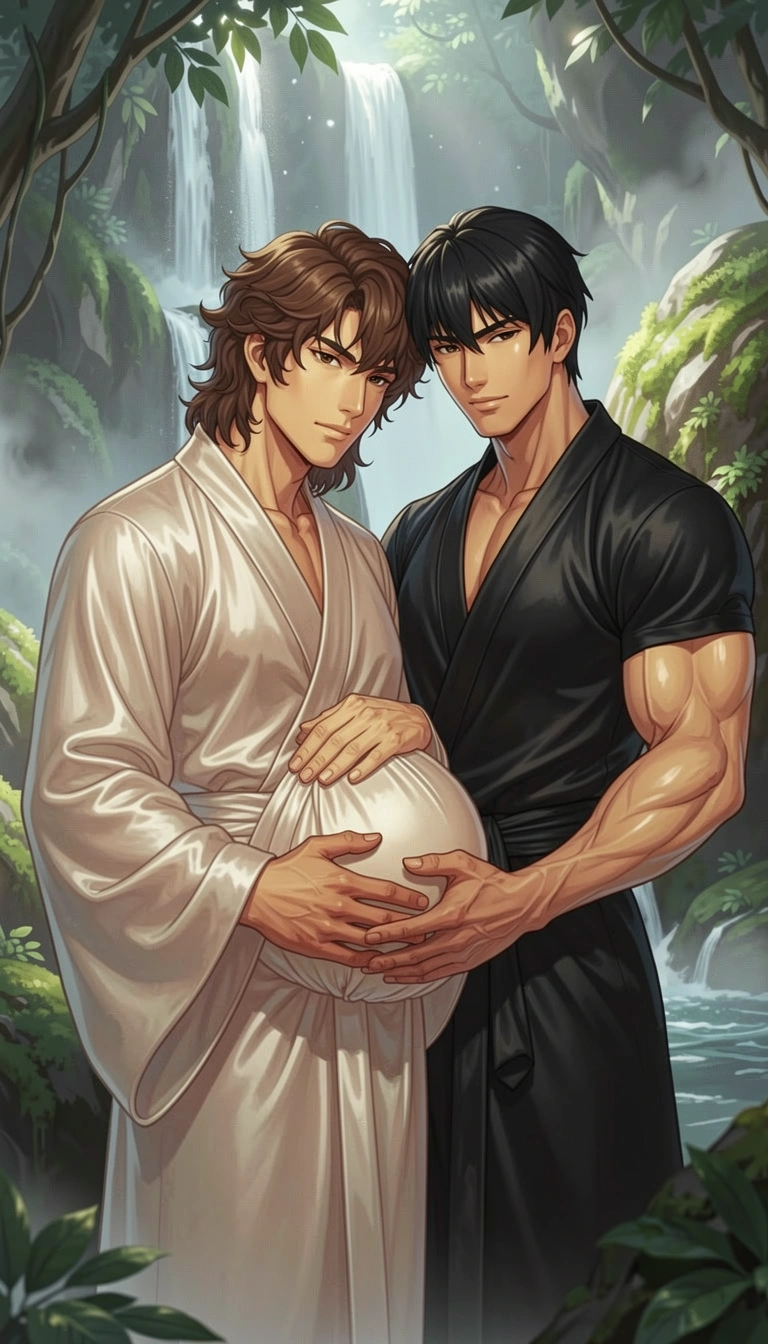
The bedchamber was dim, the heavy curtains drawn against an afternoon that had no right to be so bright. Phuwin lay propped against the crimson silk pillows, one hand resting on his stomach where the ghost of movement still flickered—a muscle twitch, a phantom kick, the echo of a life that no longer lived inside him. His palm lay flat against the empty curve, and he could not make himself move it.
The painted clouds on the ceiling had blurred hours ago. Or minutes. He could not tell anymore.
Aric stirred in the cradle beside the bed—a small sound, a rustle of linen—and Phuwin did not reach for him. The name hung in his throat like a stone. Aric. My son. The heir. He should want to hold him. He should want to feed him, to press his lips to that soft dark hair, to memorize the weight of him. Instead he stared at the ceiling, at the clouds that never moved, at the space where the healer's words still hung like smoke that would not clear.
Multiple.
The door opened without a knock.
Star stepped inside, her long silk dress gliding across the stone floor, her heels clicking once, twice, then falling silent as she crossed the threshold. She closed the door behind her with a soft click, sealing out the distant murmur of celebration that bled through the palace walls.
She took one look at him and her jaw set.
"You look terrible."
Phuwin blinked. Turned his head slowly. She was already crossing the room, already kneeling beside the bed, her hand finding his forehead before he could tell her not to.
Her palm was cool. His skin burned against it.
"You're burning up," she said, and her voice had gone flat, the way it did when she was trying not to panic. "How long have you been like this?"
"I'm fine."
"You're pale as milk, you have a fever, and you just pushed out a child. Do not tell me you are fine."
She pulled her hand back, and the absence of her cool skin against his forehead was a small grief he did not have words for. He closed his eyes.
"It's just a light fever," he said. "Postpartum. It happens."
"How long?"
A pause. He did not open his eyes.
"Since last night."
Star made a sound—low, sharp, the kind of sound a woman makes when she is counting to ten in her head. He heard the rustle of her dress as she shifted, felt the bed dip as she sat on the edge.
"I am going to tell the Emperor."
His eyes snapped open.
"No."
"Phuwin—"
"He's celebrating. The whole palace is celebrating. He is out there with our daughters and the court and—"
"And you are in here dying."
"I am not dying."
"You are very pale and you have a fever and you just had a baby and I am not going to sit here and watch you pretend to be strong while he laughs and drinks and dances with every woman who curtsies at him." She said it flatly, like a fact, like a blade. "I am older than you. I am allowed to be stubborn on your behalf."
Phuwin's throat tightened. He looked away, toward the cradle where Aric had settled again, his small chest rising and falling in the rhythm of deep sleep.
"It's just postpartum," he said, and his voice cracked. "It's normal to bleed. Normal to have a fever. But there shouldn't be—" He stopped.
"Pain?"
He did not answer.
Star was quiet for a long moment. Then she sighed, a sound that carried the weight of every battle she had ever fought and was too tired to fight this one.
"Fine. I am not going to tell him."
Phuwin let out a breath he had not known he was holding.
"But I am staying." She lifted her dress and settled properly onto the bed, the silk pooling around her like water. "Someone has to make sure you do not do anything stupid."
"I never do anything stupid."
"You married my brother."
Phuwin laughed. It came out rough, rusty, like a door that had not been opened in weeks. But it was a laugh.
"That was not stupid. That was—" He searched for the word. "Inevitable."
Star raised an eyebrow. "Inevitable? You fell into a pond."
"I was pushed."
"By him."
"By his horse."
Star snorted. "You are both hopeless. I have been saying it for ten years."
The silence that followed was not heavy. It was the kind of silence that let a man breathe, the kind that asked nothing of him. Aric turned in his cradle, one small fist pushing against the air, then settled again. The candles flickered. Somewhere far away, the celebration murmured on, a distant tide that could not reach this shore.
"Sing for me," Star said.
Phuwin turned his head. "What?"
"You sing so beautifully. I have not heard you sing in months. Sing for me."
"I am not going to sing."
"I will sing first, and you will sing with me after."
"Star—"
"I am not asking."
Phuwin looked at her. She was sitting on his bed, her silk dress wrinkled, her hair escaping its pins, her face lit by the single oil lamp. She looked like she had been through a war—and she had, in a way. She had walked through the healer's empty quarters. She had stood in the corridor and watched the crowd cheer. She had come back here, to him, when she could have stayed in the light.
"Fine," he said. "One song."
Star straightened herself on the bed. Her shoulders rolled back, her chin lifted, her hands folded in her lap. And then she began to sing.
Her voice was warm, full-bodied, the kind of voice that filled a room without effort. She sang a song he remembered from their childhood—a song their mother used to hum while she worked, a simple melody about the moon and the sea and a love that outlasted the tides. Her voice carried it like a gift, each note clean and bright, and Phuwin felt something in his chest loosen, just a little.
She finished, and the silence that followed was soft. She looked at him.
"Your turn."
"I—"
"You promised."
He sighed. The air left him in a long, slow exhale, and he closed his eyes. And then he opened his mouth and sang.
The first note came out rough, a crack in the glass. But the second found its footing. The third rose, and the fourth carried, and by the time he reached the chorus his voice was clear, full, rising like light through water. He sang the same song she had sung, but his voice made it something else—something higher, something that ached in the spaces between the notes. He sang about the moon pulling the tide. He sang about love that waited through every return and every departure. He sang until his chest burned and his throat ached and his eyes stung with tears he refused to name.
He stopped.
The silence rang.
Star stared at him. Her lips were parted, her hands frozen in her lap, her eyes bright with something that looked like wonder.
"That," she said, "is the most beautiful thing I have ever heard."
Phuwin looked away. "Stop speaking such nonsense."
"I am not speaking nonsense. You sound like—" She shook her head. "You sound like you could make the sun come out again."
"That is not how the sun works."
"I know how the sun works. I also know that voice is not something that should be hidden in a bedchamber."
Phuwin laughed, but it was softer now. Tired. "My voice is for my family. Not for the court."
"Your voice is for anyone who needs to hear it." She reached out and took his hand, her fingers cool against his burning skin. "And right now, I needed to hear it. Thank you."
The words sat in his chest like a warm stone. He did not know what to do with them, so he stayed quiet, and she stayed beside him, and the candles burned lower.
Aric stirred again, a small cry this time, and Star rose before Phuwin could move. She crossed to the cradle and lifted the baby with practiced ease, cradling him against her shoulder, her hand steady against his tiny back.
"He is beautiful," she said. "He has your mouth."
"He has his father's stubbornness."
Star smiled. "That will serve him well."
She brought Aric to the bed and placed him in Phuwin's arms. The weight of him was warm, solid, real—a small living thing that breathed and squirmed and demanded to be held. Phuwin looked down at his son's face, at the tiny nose and the dark lashes and the soft curl of his fingers, and something cracked open inside him that he had been keeping sealed.
"I am scared," he said, and the words came out before he could stop them. "I am scared all the time."
Star sat back down on the bed, closer now, her shoulder brushing his. "Tell me."
And he did. He told her about the contraction that came too early, the pain he had hidden from his daughters, the fear that had lived in his chest for weeks like a second heartbeat. He told her about the name he had chosen for a daughter who turned out to be a son. He told her about the healer's words— multiple —and the way they had lodged in his ribs like a splinter he could not pull out. He told her about the moment his water broke, the blood on the floor, the sound of Imaria's scream, the door that had closed behind Pond when he walked out.
Star listened. She did not interrupt. She did not offer solutions. She just sat beside him, her shoulder against his, her hand on his arm, and let him empty himself of every word he had been holding.
When he finished, the silence that settled between them was not empty. It was full of everything he had said, everything she had heard, everything that still needed to be said but could wait.
"You are not alone," she said finally. "You never have been."
Phuwin looked down at Aric, at the tiny hand that had curled around his finger. "I know."
"Do you?"
He did not answer.
Star shifted, reaching into her sleeve. She pulled out a small folded piece of paper, creased and worn, the edges soft from handling. She held it out to him.
"I found this in the healer's quarters. It was tucked beneath a loose stone, hidden where she must have thought no one would look."
Phuwin stared at the paper. His hand did not move to take it.
"What is it?"
"I do not know. I have not opened it. I wanted you to see it first."
The paper sat between them like a live thing. Like a question that could not be unasked.
Phuwin reached out. His fingers brushed the folded edge, slid over the crease. He did not unfold it. He held it, felt its weight, felt the shape of something hidden waiting to be known.
"I am afraid to read it," he said.
"I know." Star's voice was soft. "But you are not alone."
The candles flickered. Aric sighed in his sleep. Somewhere deep in the palace, the celebration continued—music and laughter and the clink of cups. But in this room, in this silence, Phuwin held a folded piece of paper and a sleeping son and the woman who had walked through the dark to find him.
And for the first time since the blood had hit the floor, he thought he might be able to breathe.
His thumb traced the edge of the folded paper, following the crease where the healer had pressed it flat. The paper was warm from Star's sleeve, carrying the faint scent of her perfume—jasmine and something sharper, like cedar. He did not unfold it. He held it, and the weight of it pressed against his palm like a second pulse.
"What do you think it says?" he asked.
Star was quiet for a long moment. Her hand still rested on his arm, her thumb tracing a slow circle against his sleeve. "I think she was afraid," she said. "I think she knew something she was not supposed to know, and she wrote it down because she did not trust herself to remember it. And then she hid it because she did not trust anyone else to see it."
"Or she wrote it down because she wanted someone to find it."
Star's hand stilled. "That is a darker thought."
"It is a darker possibility."
Aric shifted in his arms, his small face scrunching, then relaxing into sleep again. Phuwin looked down at him—at the dark lashes, the tiny nose, the soft curve of his cheek—and felt the paper burn against his fingers.
"Read it," Star said. "Or do not. But do not hold it like a ghost you are afraid to name."
He unfolded it.
The paper crackled, stiff with age or with the pressure of being hidden. The handwriting inside was small, cramped, the letters pressed together like the healer had been running out of space or running out of time. The ink was faded in places, blotted in others, as if the words had been written in haste or in fear.
He read it in silence.
Star watched his face. She did not ask what it said. She waited, patient as stone, her hand steady on his arm.
He read it twice. Then a third time, because the words did not make sense the first time, and they did not make sense the second time either, and he needed to be sure he had not imagined them.
"She was not wrong," he said. His voice came out flat, distant, like it belonged to someone else. "The healer. She was not wrong about—" He stopped. Swallowed. "She was not wrong about the baby being a boy. But she was not entirely right either."
Star's fingers tightened on his arm. "What do you mean?"
He handed her the paper.
She took it, her eyes scanning the cramped handwriting. He watched her face change—watched the confusion, then the dawning understanding, then the sharp intake of breath that she tried to hide and failed.
"She said 'multiple,'" Star said slowly. "She said there was uncertainty. But this—" She looked up at him. "This says she detected two heartbeats."
Phuwin closed his eyes.
"Two," he repeated. "Not one. Two."
The word hung in the air between them, strange and impossible. He had carried one child. He had pushed one child into the world. He had held one child in his arms—Aric, warm and real and breathing. And yet the healer's note said there had been two heartbeats. Two. As if his body had held a secret even he had not known.
"Where is the second?" Star asked. The question was quiet, careful, as if she was afraid of the answer.
Phuwin opened his eyes. He looked down at his empty belly, at the soft curve that was already beginning to flatten, at the ghost of movement that still flickered beneath his skin. He thought about the contraction that had come too early. The pain he had hidden. The blood on the floor.
"I do not know," he said. And the truth of it sat in his chest like a stone. "I do not know if there was a second, or if there still is, or if—" He stopped. His hand pressed against his stomach. "I do not know if I lost it."
The word sat between them. Lost. A child who had never been named. A heartbeat that had maybe stopped before anyone had heard it. A possibility that had slipped away in the blood and the pain and the chaos of that night.
Star set the paper down. She took his hand again, her fingers lacing through his, her grip firm and warm.
"We will find out," she said. "I will find out. I will find the healer, or I will find another healer, or I will tear this palace apart stone by stone until I know what happened to your body."
"And if it is gone?"
"Then you will grieve it. And you will not grieve alone."
Phuwin's eyes burned. He blinked, and a tear slipped down his cheek, hot and unexpected. He did not wipe it away. He let it fall, let it land on Aric's blanket, let it soak into the fabric like a prayer he had not known he was praying.
"I do not even know if I want another child," he said, his voice breaking. "I did not want this one—I was afraid of this one—and now I am sitting here holding a son I was terrified to love, and I do not know if there is another child somewhere inside me that I did not even know existed, and I do not know if I am supposed to hope or mourn or—"
He stopped. His shoulders shook.
Star pulled him against her, careful of Aric between them, her arm wrapping around his back. She did not shush him. She did not tell him it would be all right. She just held him, her cheek against his hair, her hand steady on his shoulder, and let him fall apart in the circle of her arms.
"You are allowed to not know," she said into his hair. "You are allowed to be confused and afraid and angry and sad all at once. You just gave birth. You nearly died. You have a son, and you may have lost another child, and your husband left you bleeding on the floor. You are allowed to not have the right words for any of this."
Phuwin laughed—a broken sound, half sob, half relief. "When did you become so wise?"
"I have always been wise. You were just too busy falling into ponds to notice."
He laughed again, and this time it was cleaner, brighter. He pulled back, wiping his eyes with the back of his hand, and looked at her. Her eyes were wet too, though she would never admit it.
"Thank you," he said. "For finding this. For staying. For—" He gestured vaguely at everything. "For being here."
"Where else would I be?" She squeezed his hand. "You are my brother's husban. You are the father of my nieces and my nephew. You are family, Phuwin. And family does not leave family to bleed alone."
The word settled into his chest like a warm ember. Family. He looked down at Aric, at the tiny hand curled around his finger. He looked at the folded paper on the bed, at the secret it carried. He looked at Star, at the woman who had walked through the dark to find him, who had sung to him, who had held him while he cried.
"I think," he said slowly, "I need to see a healer. A different one. Someone who can tell me what is happening inside my body."
Star nodded. "I will find one. Someone who can be trusted."
"And I need to tell Pond."
Star's hand stilled. "Are you sure?"
"No." He laughed, a short, hollow sound. "I am not sure of anything. But he is my husband. He is the father of my children. And if there is a chance that I am carrying another child—or if there was one that I lost—he deserves to know."
Star was quiet. Then she said, "He also deserves to know that he left you bleeding on the floor."
Phuwin flinched. "I know."
"And that he accused you of lying when you were only trying to protect yourself."
"I know."
"And that he chose the celebration over your bedside."
"I know." His voice cracked. "I know all of it. And I am still angry. I will be angry for a long time. But he is still my husband, and he is still the father of my children, and I cannot build a future on silence."
Star held his gaze. Then she nodded, slow and deliberate. "Then I will find you a healer. And when you are ready, I will stand beside you when you tell him."
Phuwin looked down at Aric, at the peaceful rise and fall of his small chest. He thought about the paper on the bed, the secret it carried, the possibility of a child he had never known he was carrying. He thought about the road ahead—long and uncertain and full of things he could not yet name.
But he was not alone.
He looked up at Star, at the woman who had walked through the dark to find him, and he smiled—a small, fragile thing, but real.
"Thank you," he said again, because the words were all he had.
And she smiled back, fierce and warm and unyielding.
"Always."