

My phone buzzed again. I could feel it through the fabric of my coat, a small vibration against my thigh, insistent and warm. Sam was talking about the new bypass they were building on the A58 — something about drainage — and I was nodding, making sounds that passed for listening, while my fingers itched to reach into my pocket.
I didn't. I kept my hands on my lap and stared at the streetlights sliding past the window.
The car turned onto our road. Terraced houses, dark windows, the faint glow of televisions behind curtains. Sam pulled up outside and killed the engine, and the silence felt loud.
"You okay?" he asked. "You've been quiet."
"Just tired." I said it too quickly. "Long journey."
He nodded, already reaching for his door handle. I followed him up the path, past the bin I'd meant to take out before I left, and into the hallway where the smell of last week's curry still lingered. The house felt smaller than when I'd left it. Or maybe I felt bigger.
Sam hung up his jacket and headed for the kitchen. "Tea?"
"I'm going to have a bath." I was already halfway up the stairs. "Long day."
He didn't argue. He never argued.
In the bathroom, I locked the door and leaned against it, my heart hammering. I pulled out my phone. Three messages from Bradley, the last one sent ten minutes ago:
You home safe?
I keep thinking about what you said on the train.
I know I shouldn't text you. But I can't stop.
I read them three times. Then I typed: Home. Safe. Going to pretend I'm fine.
Three dots appeared almost immediately. Are you? Fine?
I bit my lip. No. But I'm good at pretending.
Don't pretend with me. That was all he said, and I stared at it until the screen went dark.
I ran the bath too hot and sat in the steam, my phone balanced on the edge of the tub, watching it like it might disappear. I told myself I wouldn't reply again tonight. I told myself this was the last time. Then I picked it up and typed: Why did you keep watching? After you knew it was me.
His reply came as the water started to cool. Because you looked like you were having the best time of your life. And I wanted to be part of it.
I didn't sleep well that night. Sam's arm was heavy across my waist, his breathing steady and deep, and I lay awake staring at the ceiling, my phone face-down on the bedside table, buzzing silently with messages I couldn't bring myself to delete.
—
Day four, and I had a system. I'd check my phone in the bathroom at work, during my lunch break, in the five minutes between Sam leaving for work and me leaving for work. The texts were still casual — Ben had lost another tooth, I'd seen a fox in the garden, Sam had reorganised the tins in the cupboard and I'd pretended not to notice. But underneath the small talk, there was a current I could feel even in the pauses.
What are you doing right now? he asked on day seven. I was marking spelling tests, a stack of them beside the kettle, the house quiet except for the hum of the washing machine.
Sitting in my kitchen. Pretending I'm not waiting for your message.
And are you? Waiting?
I stared at the screen for a long time. Then I typed: Yes.
I sent it before I could stop myself, and the three dots appeared and disappeared and appeared again, like he was typing and deleting and typing again. Finally: I'm waiting too. For something I don't know how to name.
I pressed my hand over my mouth, my chest tight, and I heard myself laugh — a small, broken sound. This was dangerous. This was the most dangerous thing I'd done in years. And I didn't want to stop.
—
Day ten. The texts had started to change. The small talk was still there, but it was thinner now, a skin stretched over something bigger. We talked about our days in ways that felt like confession: the boredom of routine, the loneliness of being in a room with someone who didn't see you.
Emma asked me yesterday what I was thinking about, he wrote one night. I said nothing. But I was thinking about you.
I read it in bed, Sam already asleep beside me, his back turned, the duvet pulled high over his shoulder. I typed: Sam asked me how my weekend was. I said fine. I didn't tell him about the monitor. I didn't tell him about you.
Do you want to? Tell him?
No. I paused. Do you want to tell Emma?
No. I don't want to hurt her. But I don't want to stop this either.
I closed my eyes. The guilt was a weight in my chest, solid and physical. But it wasn't enough to make me put the phone down.
—
Day twelve. A Thursday. I was alone in the house — Sam at the pub with his work mates, a monthly thing I usually used to catch up on laundry or watch something he didn't like. But tonight I sat on the sofa, my phone in my hand, the television muted, and I told Bradley something I'd never told anyone.
It came out in fragments, between long pauses, my thumbs moving before my brain could stop them. The year I spent in New Zealand. The parties. The drugs. The dealer with the cold eyes and the bag of coke I'd traded for a favour I still couldn't say out loud without my stomach turning.
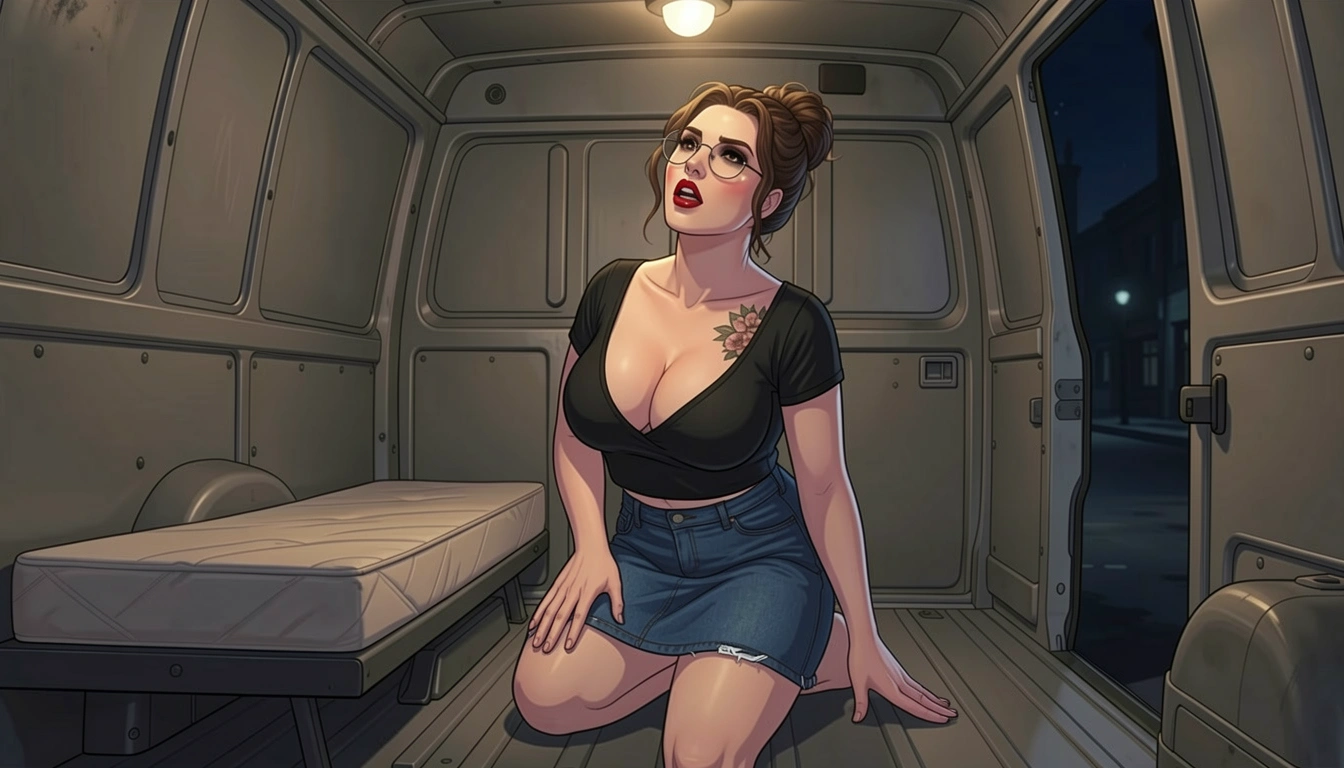
I sucked him off in the back of his van, I typed, and then I stared at the words, my pulse loud in my ears. I was twenty-two and I wanted to feel alive and I didn't know how else to get it. I'm not proud of it. I've never told anyone.
The three dots stayed for a long time. I thought I'd scared him off. I thought I'd broken whatever fragile thing we were building. Then:
Thank you for telling me.
That's all you have to say?
What else is there? You were young. You were trying to survive. That doesn't make you a bad person. It makes you human.
I felt tears prick the corners of my eyes, hot and sudden. I wiped them away with the back of my hand. You don't think less of me?
No. I think you're brave for telling me. I think you're beautiful. I think I want to know everything about you, even the parts you think are ugly.
I didn't reply. I couldn't. I just sat there, the phone glowing in my hands, and let myself feel what I'd been trying not to feel for twelve days: seen. Known. Forgiven.
—
Day eighteen. The texts had become something else entirely. There was still the surface — the jokes, the updates, the photos of Ben's latest drawing and Lily's sticky fingers. But underneath, there was a second layer, a whispered conversation that lived in the space between lines.
I can't stop thinking about what you said, he wrote late one night. About wanting to feel alive. I know that feeling.
Tell me, I wrote back.
I watched the screen, the cursor blinking, waiting for him to fill the silence with something real.
The three dots appeared. Disappeared. Appeared again. I could feel him hesitating on the other end, the words caught in his throat the way mine had been when I'd told him about the van. About the dealer. About the girl I used to be.
Then: I almost died. You know that. But what I don't say is that sometimes I think I'm still waiting to come back to life.
I read it twice. The weight of it settled in my chest, heavy and warm. I thought about the man I'd met at family dinners — the sarcastic jokes, the easy laugh, the way he'd hand Emma a cup of tea without her asking. The version of him that showed up for birthdays and barbecues. The version that got on with it.
What does that mean? Coming back to life.
I don't know. I thought I'd feel different after the cancer. Like I'd been given a second chance and I'd grab everything with both hands. But I just… went back to work. Paid the bills. Mowed the lawn. Pretended I wasn't terrified every time I coughed or my back ached or I found a new lump that turned out to be nothing.
I pressed my palm flat against my chest, feeling my heartbeat under my ribs. I thought about Sam, about the way he'd kissed me goodbye that morning — a peck, automatic, already thinking about whatever meeting he had. I thought about the version of myself that had stopped asking for more because it was easier not to.
Is that why you kept watching? I typed. Because it felt like something real?
Yes. No. I don't know. It felt like seeing someone who wasn't pretending. You were just… there. In your body. Not thinking about the washing-up or work or any of it. You were having a moment that was yours, and I got to see it, and I couldn't look away.
My face burned. Not shame — something else. Something that made my thighs press together under the duvet.
Do you ever miss it? I asked. The punk kid who went to gigs and stayed out late?
A long pause. Then: Every day. He's still in here somewhere. He just got buried under mortgage payments and school fees and the weight of being the one everyone relies on.
I know that feeling.
Do you? You always seemed so put together. The organised one. The one who remembers everyone's birthdays.
I laughed out loud, startled by the sound of it in the quiet kitchen. That's the version I let people see. The real one is messier.
Show me.
The words sat on the screen, simple and devastating. I stared at them until they blurred, my thumb hovering over the keyboard, a dozen replies crowding my throat. I could deflect. I could make a joke. I could change the subject and we'd slip back into safe territory and I'd lie awake tonight wondering what would have happened if I'd been brave.
Instead I typed: I miss the girl who climbed fences at festivals and woke up in fields she didn't remember falling asleep in. I miss the version of me who didn't know what she was playing at and didn't care. I look at her now and I don't recognise her.
I recognise you.
My eyes stung. I blinked hard, pressing the heel of my hand against them until the feeling passed. That's what scares me, I wrote. That you see me and I don't know how to be unseen now.
Don't be unseen. Not for me. Not for anyone.
I set the phone down, face-up, and stared at the ceiling. The kitchen clock ticked. The fridge hummed. Somewhere upstairs, water ran through the pipes — Sam in the bathroom, brushing his teeth before bed, probably wondering if I was coming up soon. I should go up. I should pretend I'd been watching telly. I should close this tab in my brain and lock it and throw away the key.
But my hand reached for the phone again, and I was already typing before I'd decided to.
What do you want from this? From me?
I held my breath. The three dots appeared, vanished, appeared again. I watched them like they were a live wire I couldn't stop touching.
I don't know. I don't think I'm allowed to want anything. But if I could want something — I'd want to keep talking to you. I'd want to know what you're thinking when you're not performing for anyone. I'd want to hear your voice. I'd want to be in a room with you and not have to pretend.
I let out a breath I didn't know I'd been holding. That's a lot of wanting for someone who doesn't want anything.
I know. I'm sorry.
Don't be sorry.
I paused, my thumb hovering. Then: I want those things too.
The silence that followed was different. Fuller. Like something had been spoken aloud that couldn't be unspoken. I waited, my heart hammering, but the three dots didn't come back. I checked the signal. I checked the time. I told myself he'd fallen asleep, or Emma had walked in, or he'd come to his senses and deleted the conversation.
Then my phone lit up with an incoming call.
His name on the screen. Bradley.
I stared at it. The phone buzzed in my hand, insistent and alive, and I felt the weight of every choice that had led me to this moment — the baby monitor, the train, the texts, the confessions — all of it collapsing into this single point, this decision I couldn't take back.
I answered.
"Hello?" My voice was barely a whisper, rough with swallowed tears I hadn't let myself cry.
"Hey." His voice was low, gravelly, like he'd been lying in the dark. It was different from how he sounded at family dinners — softer, unguarded. "I'm sorry. I couldn't just type it."
"It's okay." I pressed the phone harder against my ear, blocking out the kitchen, the clock, the sound of Sam moving upstairs. "I'm glad you called."
"I don't know what I'm doing." He let out a breath, half-laugh, half-sigh. "I'm a forty-year-old man hiding in his garage so his wife doesn't hear him talking to his sister-in-law. This isn't who I am."
"Me neither." I leaned forward, elbows on my knees, my free hand gripping my own hair. "I don't do things like this. I'm the safe one. The boring one. The one who organises Christmas."
"You're not boring." I heard something in his voice — a warmth, a certainty. "I've seen you, Laura. The real you. She's not boring."
I closed my eyes. His voice was doing something to me, slipping under my skin in a way texts couldn't. I could hear the shape of him in it — the dry humour, the softness underneath. I could hear the man who'd survived something terrible and was still trying to figure out what comes next.
"Tell me something," I said. "Something I don't know."
He was quiet for a moment. I heard a creak, like he'd shifted position. "I still have the scar from my port-a-cath. Right here, under my collarbone. Sometimes I trace it in the shower and remember what it felt like to be afraid all the time."
"Are you still afraid?"
"Less than I was. But more than I let on." A pause. "Tell me something."
I thought about it. The things I hadn't said. The things I'd buried so deep I'd almost forgotten they were there. "I used to write poetry. In my twenties. Bad poetry, mostly, about boys who didn't love me and cities I'd never been to. I haven't written a word in years. I don't know where she went — the girl who thought she had something to say."
"Maybe she's still there. Just waiting for something worth writing about."
I smiled, small and sad, in the dark. "Maybe."
We talked for another hour. Not about anything big — his childhood dog, the time I got stuck on a train between Glasgow and London for six hours, the best chip shop he'd ever been to in Margate. Small things, ordinary things, held up to the light like they mattered. And somehow, in the telling of them, they did.
At the end, when my voice was hoarse and the clock had crept past midnight, he said my name like it cost him something.
"Laura."
"Yeah?"
"I don't know how to stop this. I don't know if I want to."
I swallowed. "Me neither."
"But we can't…" He trailed off. "We can't keep pretending it's nothing."
"I know." I stared at the kitchen tiles, the pattern of them, the way the light caught the grout. "I don't know what we do about that."
"Can I text you tomorrow?" His voice was careful, like he was asking permission for something bigger.
"Yes."
"Goodnight, Laura."
"Goodnight, Bradley."
I hung up and sat in the dark kitchen, the phone warm in my hand, the silence louder than any sound. Upstairs, the floorboards creaked — Sam moving from the bathroom to the bedroom. I should go up. I should brush my teeth and slip into bed beside him and pretend my heart wasn't pounding, my skin wasn't electric, my whole body wasn't thrumming with the knowledge that I'd just done something I couldn't undo.
I stayed where I was for a long time, tracing the edge of the phone with my thumb, the ghost of his voice still in my ear. Then I typed a single message, not to send, just to see the words:
I think I'm falling for you.
I stared at it, my finger hovering over send, my chest tight with want and terror and something that felt dangerously like hope. Then I deleted it, one letter at a time, and set the phone face-down on the table.
I picked up the phone again. Set it down. Picked it up. The screen was dark, reflecting nothing but the faint glow of the kitchen light and my own face — tired, flushed, someone I almost didn't recognise. I pressed the home button and the lock screen appeared: a photo of Sam and me at a wedding last year, his arm around my shoulder, my smile slightly off-centre. I stared at it for a long moment, then locked the phone and placed it face-down on the table again.
The kitchen felt smaller in the dark. I could hear the fridge cycling on and off, the drip of the tap I'd been meaning to fix for months. I pushed myself up from the chair, my legs stiff, and walked to the sink. I ran the cold tap and drank straight from the stream, my hands braced on either side of the basin, the water running over my chin and down my neck.
When I looked up, my reflection in the window above the sink stared back at me — a ghost in the glass, the streetlight behind me casting my face in shadow. I wiped my mouth with the back of my hand and turned away.
Upstairs, the house had gone quiet. I climbed slowly, one hand on the banister, each step deliberate. The landing was dark, the bedroom door ajar, a sliver of light from the bedside lamp cutting across the carpet. I pushed it open and saw Sam propped against the pillows, his glasses on, his phone in his hand.
"You coming to bed?" He didn't look up. His thumb scrolled lazily, some article or social media feed I couldn't see.
"Yeah. Just needed to finish something downstairs."
He grunted, a sound that could have meant anything. I crossed to my side of the bed and sat down heavily, the mattress dipping under my weight. I pulled off my jeans, folded them, set them on the chair in the corner. My jumper followed. I was left in my vest and knickers, the air cool on my skin, and I slid under the duvet without looking at him.
"You were on the phone earlier." His voice was casual, flat. "I heard you talking."
My stomach dropped. I kept my breathing steady, my voice even. "Just Amy. She was having a crisis about work."
"At midnight?"
"She's a night owl. You know what she's like." I turned onto my side, facing away from him, pulling the duvet up to my chin. "She'll be fine. Just needed to vent."
He didn't say anything for a long moment. I felt his gaze on my back, a weight I couldn't see. Then he set his phone on the bedside table and switched off the lamp, plunging the room into darkness.
"Night," he said.
"Night."
I lay still, my eyes open in the dark, listening to his breathing slow. It took him less than five minutes to fall asleep — it always did. Sam could fall asleep anywhere, anytime, like flipping a switch. I envied him that. I envied the simplicity of a mind that could turn itself off.
I stayed awake for what felt like hours, staring at the faint outline of the window, the glow of the streetlight through the curtain. My phone was on the bedside table, face-down, and I could feel it there like a second heartbeat. I wanted to pick it up. I wanted to see if he'd messaged. I wanted to read his words again, hear his voice in my head, replay the sound of him saying my name like it meant something.
I didn't. I kept my hands under the duvet and counted my breaths until the sky began to lighten.
—
Day nineteen. I woke before my alarm, the room still grey with dawn, and I knew what I was going to do before I'd fully opened my eyes. I reached for my phone, unlocked it, and opened the thread.
I typed: I didn't sleep.
I waited. Three minutes later, the reply came.
Me neither.
I smiled, small and private, in the dark of the bedroom. Sam was still asleep beside me, his breathing deep and even, one arm thrown across the pillow. I eased out of bed, my feet finding the cold floorboards, and padded to the bathroom.
I locked the door and sat on the edge of the bath, the phone in my hands.
What kept you up? I wrote.
You know what kept me up.
I bit my lip. Tell me anyway.
A pause. Then: The sound of your voice. The way you said my name. The fact that I had to sit in my garage and pretend I was checking the tyre pressure so my wife wouldn't wonder why I was smiling at my phone.
I pressed my hand over my mouth, a laugh caught in my throat. I had to pretend I was talking to Amy.
Did it work?
Sam asked. I said it was a work crisis. He believed me.
Of course he did.
There was something in that line — not bitter, but knowing. A recognition that we were both living with people who didn't ask the right questions. I stared at it, feeling the shape of it settle between us.
Don't, I typed. Don't make me feel worse about it than I already do.
I'm not trying to. I'm just saying — I know what it's like to be in a room with someone and still feel alone.
I let that sit. It was too true, too sharp, and I didn't know what to do with it except carry it.
I need to see you, I wrote. The words came out before I could stop them, and I stared at them, my pulse hammering. Not just texts. Not just calls. I need to be in the same room as you.
The three dots appeared and stayed. I watched them, my breath held, the bathroom tiles cold under my bare feet. Then:
When?
I stared at the single word, my thumb hovering over the keyboard. When. Not if. Not maybe. When. He'd said it like it was already decided, like the only question left was logistics. The bathroom was cold against my bare feet, the silence of the house pressing in, and I felt the weight of what I was about to do settle over me like a second skin.
I typed: I don't know. I need to think. I need to figure out how.
Okay. A pause. Then: I'll wait.
Two words. Simple. Devastating. I set the phone down on the edge of the bath and pressed my palms against my eyes until I saw stars. I'll wait. As if he had all the time in the world. As if we both did.
I didn't reply. I couldn't. I stood up, splashed cold water on my face, and stared at my reflection in the mirror above the sink. The same face I'd woken up with for thirty-three years. The same brown eyes, the same tired lines around my mouth. But something had shifted behind them — a door I'd opened and couldn't close, a hunger I'd fed and now couldn't starve.My phone buzzed again. I could feel it through the fabric of my coat, a small vibration against my thigh, insistent and warm. Sam was talking about the new bypass they were building on the A58 — something about drainage — and I was nodding, making sounds that passed for listening, while my fingers itched to reach into my pocket.
I didn't. I kept my hands on my lap and stared at the streetlights sliding past the window.
The car turned onto our road. Terraced houses, dark windows, the faint glow of televisions behind curtains. Sam pulled up outside and killed the engine, and the silence felt loud.
"You okay?" he asked. "You've been quiet."
"Just tired." I said it too quickly. "Long journey."
He nodded, already reaching for his door handle. I followed him up the path, past the bin I'd meant to take out before I left, and into the hallway where the smell of last week's curry still lingered. The house felt smaller than when I'd left it. Or maybe I felt bigger.
Sam hung up his jacket and headed for the kitchen. "Tea?"
"I'm going to have a bath." I was already halfway up the stairs. "Long day."
He didn't argue. He never argued.
In the bathroom, I locked the door and leaned against it, my heart hammering. I pulled out my phone. Three messages from Bradley, the last one sent ten minutes ago:
You home safe?
I keep thinking about what you said on the train.
I know I shouldn't text you. But I can't stop.
I read them three times. Then I typed: Home. Safe. Going to pretend I'm fine.
Three dots appeared almost immediately. Are you? Fine?
I bit my lip. No. But I'm good at pretending.
Don't pretend with me. That was all he said, and I stared at it until the screen went dark.
I ran the bath too hot and sat in the steam, my phone balanced on the edge of the tub, watching it like it might disappear. I told myself I wouldn't reply again tonight. I told myself this was the last time. Then I picked it up and typed: Why did you keep watching? After you knew it was me.
His reply came as the water started to cool. Because you looked like you were having the best time of your life. And I wanted to be part of it.
I didn't sleep well that night. Sam's arm was heavy across my waist, his breathing steady and deep, and I lay awake staring at the ceiling, my phone face-down on the bedside table, buzzing silently with messages I couldn't bring myself to delete.
—
Day four, and I had a system. I'd check my phone in the bathroom at work, during my lunch break, in the five minutes between Sam leaving for work and me leaving for work. The texts were still casual — Ben had lost another tooth, I'd seen a fox in the garden, Sam had reorganised the tins in the cupboard and I'd pretended not to notice. But underneath the small talk, there was a current I could feel even in the pauses.
What are you doing right now? he asked on day seven. I was marking spelling tests, a stack of them beside the kettle, the house quiet except for the hum of the washing machine.
Sitting in my kitchen. Pretending I'm not waiting for your message.
And are you? Waiting?
I stared at the screen for a long time. Then I typed: Yes.
I sent it before I could stop myself, and the three dots appeared and disappeared and appeared again, like he was typing and deleting and typing again. Finally: I'm waiting too. For something I don't know how to name.
I pressed my hand over my mouth, my chest tight, and I heard myself laugh — a small, broken sound. This was dangerous. This was the most dangerous thing I'd done in years. And I didn't want to stop.
—
Day ten. The texts had started to change. The small talk was still there, but it was thinner now, a skin stretched over something bigger. We talked about our days in ways that felt like confession: the boredom of routine, the loneliness of being in a room with someone who didn't see you.
Emma asked me yesterday what I was thinking about, he wrote one night. I said nothing. But I was thinking about you.
I read it in bed, Sam already asleep beside me, his back turned, the duvet pulled high over his shoulder. I typed: Sam asked me how my weekend was. I said fine. I didn't tell him about the monitor. I didn't tell him about you.
Do you want to? Tell him?
No. I paused. Do you want to tell Emma?
No. I don't want to hurt her. But I don't want to stop this either.
I closed my eyes. The guilt was a weight in my chest, solid and physical. But it wasn't enough to make me put the phone down.
—
Day twelve. A Thursday. I was alone in the house — Sam at the pub with his work mates, a monthly thing I usually used to catch up on laundry or watch something he didn't like. But tonight I sat on the sofa, my phone in my hand, the television muted, and I told Bradley something I'd never told anyone.
It came out in fragments, between long pauses, my thumbs moving before my brain could stop them. The year I spent in New Zealand. The parties. The drugs. The dealer with the cold eyes and the bag of coke I'd traded for a favour I still couldn't say out loud without my stomach turning.
I sucked him off in the back of his van, I typed, and then I stared at the words, my pulse loud in my ears. I was twenty-two and I wanted to feel alive and I didn't know how else to get it. I'm not proud of it. I've never told anyone.
The three dots stayed for a long time. I thought I'd scared him off. I thought I'd broken whatever fragile thing we were building. Then:
Thank you for telling me.
That's all you have to say?
What else is there? You were young. You were trying to survive. That doesn't make you a bad person. It makes you human.
I felt tears prick the corners of my eyes, hot and sudden. I wiped them away with the back of my hand. You don't think less of me?
No. I think you're brave for telling me. I think you're beautiful. I think I want to know everything about you, even the parts you think are ugly.
I didn't reply. I couldn't. I just sat there, the phone glowing in my hands, and let myself feel what I'd been trying not to feel for twelve days: seen. Known. Forgiven.
—
Day eighteen. The texts had become something else entirely. There was still the surface — the jokes, the updates, the photos of Ben's latest drawing and Lily's sticky fingers. But underneath, there was a second layer, a whispered conversation that lived in the space between lines.
I can't stop thinking about what you said, he wrote late one night. About wanting to feel alive. I know that feeling.
Tell me, I wrote back.
I watched the screen, the cursor blinking, waiting for him to fill the silence with something real.
The three dots appeared. Disappeared. Appeared again. I could feel him hesitating on the other end, the words caught in his throat the way mine had been when I'd told him about the van. About the dealer. About the girl I used to be.
Then: I almost died. You know that. But what I don't say is that sometimes I think I'm still waiting to come back to life.
I read it twice. The weight of it settled in my chest, heavy and warm. I thought about the man I'd met at family dinners — the sarcastic jokes, the easy laugh, the way he'd hand Emma a cup of tea without her asking. The version of him that showed up for birthdays and barbecues. The version that got on with it.
What does that mean? Coming back to life.
I don't know. I thought I'd feel different after the cancer. Like I'd been given a second chance and I'd grab everything with both hands. But I just… went back to work. Paid the bills. Mowed the lawn. Pretended I wasn't terrified every time I coughed or my back ached or I found a new lump that turned out to be nothing.
I pressed my palm flat against my chest, feeling my heartbeat under my ribs. I thought about Sam, about the way he'd kissed me goodbye that morning — a peck, automatic, already thinking about whatever meeting he had. I thought about the version of myself that had stopped asking for more because it was easier not to.
Is that why you kept watching? I typed. Because it felt like something real?
Yes. No. I don't know. It felt like seeing someone who wasn't pretending. You were just… there. In your body. Not thinking about the washing-up or work or any of it. You were having a moment that was yours, and I got to see it, and I couldn't look away.
My face burned. Not shame — something else. Something that made my thighs press together under the duvet.
Do you ever miss it? I asked. The punk kid who went to gigs and stayed out late?
A long pause. Then: Every day. He's still in here somewhere. He just got buried under mortgage payments and school fees and the weight of being the one everyone relies on.
I know that feeling.
Do you? You always seemed so put together. The organised one. The one who remembers everyone's birthdays.
I laughed out loud, startled by the sound of it in the quiet kitchen. That's the version I let people see. The real one is messier.
Show me.
The words sat on the screen, simple and devastating. I stared at them until they blurred, my thumb hovering over the keyboard, a dozen replies crowding my throat. I could deflect. I could make a joke. I could change the subject and we'd slip back into safe territory and I'd lie awake tonight wondering what would have happened if I'd been brave.
Instead I typed: I miss the girl who climbed fences at festivals and woke up in fields she didn't remember falling asleep in. I miss the version of me who didn't know what she was playing at and didn't care. I look at her now and I don't recognise her.
I recognise you.
My eyes stung. I blinked hard, pressing the heel of my hand against them until the feeling passed. That's what scares me, I wrote. That you see me and I don't know how to be unseen now.
Don't be unseen. Not for me. Not for anyone.
I set the phone down, face-up, and stared at the ceiling. The kitchen clock ticked. The fridge hummed. Somewhere upstairs, water ran through the pipes — Sam in the bathroom, brushing his teeth before bed, probably wondering if I was coming up soon. I should go up. I should pretend I'd been watching telly. I should close this tab in my brain and lock it and throw away the key.
But my hand reached for the phone again, and I was already typing before I'd decided to.
What do you want from this? From me?
I held my breath. The three dots appeared, vanished, appeared again. I watched them like they were a live wire I couldn't stop touching.
I don't know. I don't think I'm allowed to want anything. But if I could want something — I'd want to keep talking to you. I'd want to know what you're thinking when you're not performing for anyone. I'd want to hear your voice. I'd want to be in a room with you and not have to pretend.
I let out a breath I didn't know I'd been holding. That's a lot of wanting for someone who doesn't want anything.
I know. I'm sorry.
Don't be sorry.
I paused, my thumb hovering. Then: I want those things too.
The silence that followed was different. Fuller. Like something had been spoken aloud that couldn't be unspoken. I waited, my heart hammering, but the three dots didn't come back. I checked the signal. I checked the time. I told myself he'd fallen asleep, or Emma had walked in, or he'd come to his senses and deleted the conversation.
Then my phone lit up with an incoming call.
His name on the screen. Bradley.
I stared at it. The phone buzzed in my hand, insistent and alive, and I felt the weight of every choice that had led me to this moment — the baby monitor, the train, the texts, the confessions — all of it collapsing into this single point, this decision I couldn't take back.
I answered.
"Hello?" My voice was barely a whisper, rough with swallowed tears I hadn't let myself cry.
"Hey." His voice was low, gravelly, like he'd been lying in the dark. It was different from how he sounded at family dinners — softer, unguarded. "I'm sorry. I couldn't just type it."
"It's okay." I pressed the phone harder against my ear, blocking out the kitchen, the clock, the sound of Sam moving upstairs. "I'm glad you called."
"I don't know what I'm doing." He let out a breath, half-laugh, half-sigh. "I'm a forty-year-old man hiding in his garage so his wife doesn't hear him talking to his sister-in-law. This isn't who I am."
"Me neither." I leaned forward, elbows on my knees, my free hand gripping my own hair. "I don't do things like this. I'm the safe one. The boring one. The one who organises Christmas."
"You're not boring." I heard something in his voice — a warmth, a certainty. "I've seen you, Laura. The real you. She's not boring."
I closed my eyes. His voice was doing something to me, slipping under my skin in a way texts couldn't. I could hear the shape of him in it — the dry humour, the softness underneath. I could hear the man who'd survived something terrible and was still trying to figure out what comes next.
"Tell me something," I said. "Something I don't know."
He was quiet for a moment. I heard a creak, like he'd shifted position. "I still have the scar from my port-a-cath. Right here, under my collarbone. Sometimes I trace it in the shower and remember what it felt like to be afraid all the time."
"Are you still afraid?"
"Less than I was. But more than I let on." A pause. "Tell me something."
I thought about it. The things I hadn't said. The things I'd buried so deep I'd almost forgotten they were there. "I used to write poetry. In my twenties. Bad poetry, mostly, about boys who didn't love me and cities I'd never been to. I haven't written a word in years. I don't know where she went — the girl who thought she had something to say."
"Maybe she's still there. Just waiting for something worth writing about."
I smiled, small and sad, in the dark. "Maybe."
We talked for another hour. Not about anything big — his childhood dog, the time I got stuck on a train between Glasgow and London for six hours, the best chip shop he'd ever been to in Margate. Small things, ordinary things, held up to the light like they mattered. And somehow, in the telling of them, they did.
At the end, when my voice was hoarse and the clock had crept past midnight, he said my name like it cost him something.
"Laura."
"Yeah?"
"I don't know how to stop this. I don't know if I want to."
I swallowed. "Me neither."
"But we can't…" He trailed off. "We can't keep pretending it's nothing."
"I know." I stared at the kitchen tiles, the pattern of them, the way the light caught the grout. "I don't know what we do about that."
"Can I text you tomorrow?" His voice was careful, like he was asking permission for something bigger.
"Yes."
"Goodnight, Laura."
"Goodnight, Bradley."
I hung up and sat in the dark kitchen, the phone warm in my hand, the silence louder than any sound. Upstairs, the floorboards creaked — Sam moving from the bathroom to the bedroom. I should go up. I should brush my teeth and slip into bed beside him and pretend my heart wasn't pounding, my skin wasn't electric, my whole body wasn't thrumming with the knowledge that I'd just done something I couldn't undo.
I stayed where I was for a long time, tracing the edge of the phone with my thumb, the ghost of his voice still in my ear. Then I typed a single message, not to send, just to see the words:
I think I'm falling for you.
I stared at it, my finger hovering over send, my chest tight with want and terror and something that felt dangerously like hope. Then I deleted it, one letter at a time, and set the phone face-down on the table.
I picked up the phone again. Set it down. Picked it up. The screen was dark, reflecting nothing but the faint glow of the kitchen light and my own face — tired, flushed, someone I almost didn't recognise. I pressed the home button and the lock screen appeared: a photo of Sam and me at a wedding last year, his arm around my shoulder, my smile slightly off-centre. I stared at it for a long moment, then locked the phone and placed it face-down on the table again.
The kitchen felt smaller in the dark. I could hear the fridge cycling on and off, the drip of the tap I'd been meaning to fix for months. I pushed myself up from the chair, my legs stiff, and walked to the sink. I ran the cold tap and drank straight from the stream, my hands braced on either side of the basin, the water running over my chin and down my neck.
When I looked up, my reflection in the window above the sink stared back at me — a ghost in the glass, the streetlight behind me casting my face in shadow. I wiped my mouth with the back of my hand and turned away.
Upstairs, the house had gone quiet. I climbed slowly, one hand on the banister, each step deliberate. The landing was dark, the bedroom door ajar, a sliver of light from the bedside lamp cutting across the carpet. I pushed it open and saw Sam propped against the pillows, his glasses on, his phone in his hand.
"You coming to bed?" He didn't look up. His thumb scrolled lazily, some article or social media feed I couldn't see.
"Yeah. Just needed to finish something downstairs."
He grunted, a sound that could have meant anything. I crossed to my side of the bed and sat down heavily, the mattress dipping under my weight. I pulled off my jeans, folded them, set them on the chair in the corner. My jumper followed. I was left in my vest and knickers, the air cool on my skin, and I slid under the duvet without looking at him.
"You were on the phone earlier." His voice was casual, flat. "I heard you talking."
My stomach dropped. I kept my breathing steady, my voice even. "Just Amy. She was having a crisis about work."
"At midnight?"
"She's a night owl. You know what she's like." I turned onto my side, facing away from him, pulling the duvet up to my chin. "She'll be fine. Just needed to vent."
He didn't say anything for a long moment. I felt his gaze on my back, a weight I couldn't see. Then he set his phone on the bedside table and switched off the lamp, plunging the room into darkness.
"Night," he said.
"Night."
I lay still, my eyes open in the dark, listening to his breathing slow. It took him less than five minutes to fall asleep — it always did. Sam could fall asleep anywhere, anytime, like flipping a switch. I envied him that. I envied the simplicity of a mind that could turn itself off.
I stayed awake for what felt like hours, staring at the faint outline of the window, the glow of the streetlight through the curtain. My phone was on the bedside table, face-down, and I could feel it there like a second heartbeat. I wanted to pick it up. I wanted to see if he'd messaged. I wanted to read his words again, hear his voice in my head, replay the sound of him saying my name like it meant something.
I didn't. I kept my hands under the duvet and counted my breaths until the sky began to lighten.
—
Day nineteen. I woke before my alarm, the room still grey with dawn, and I knew what I was going to do before I'd fully opened my eyes. I reached for my phone, unlocked it, and opened the thread.
I typed: I didn't sleep.
I waited. Three minutes later, the reply came.
Me neither.
I smiled, small and private, in the dark of the bedroom. Sam was still asleep beside me, his breathing deep and even, one arm thrown across the pillow. I eased out of bed, my feet finding the cold floorboards, and padded to the bathroom.
I locked the door and sat on the edge of the bath, the phone in my hands.
What kept you up? I wrote.
You know what kept me up.
I bit my lip. Tell me anyway.
A pause. Then: The sound of your voice. The way you said my name. The fact that I had to sit in my garage and pretend I was checking the tyre pressure so my wife wouldn't wonder why I was smiling at my phone.
I pressed my hand over my mouth, a laugh caught in my throat. I had to pretend I was talking to Amy.
Did it work?
Sam asked. I said it was a work crisis. He believed me.
Of course he did.
There was something in that line — not bitter, but knowing. A recognition that we were both living with people who didn't ask the right questions. I stared at it, feeling the shape of it settle between us.
Don't, I typed. Don't make me feel worse about it than I already do.
I'm not trying to. I'm just saying — I know what it's like to be in a room with someone and still feel alone.
I let that sit. It was too true, too sharp, and I didn't know what to do with it except carry it.
I need to see you, I wrote. The words came out before I could stop them, and I stared at them, my pulse hammering. Not just texts. Not just calls. I need to be in the same room as you.
The three dots appeared and stayed. I watched them, my breath held, the bathroom tiles cold under my bare feet. Then:
When?
I stared at the single word, my thumb hovering over the keyboard. When. Not if. Not maybe. When. He'd said it like it was already decided, like the only question left was logistics. The bathroom was cold against my bare feet, the silence of the house pressing in, and I felt the weight of what I was about to do settle over me like a second skin.
I typed: I don't know. I need to think. I need to figure out how.
Okay. A pause. Then: I'll wait.
Two words. Simple. Devastating. I set the phone down on the edge of the bath and pressed my palms against my eyes until I saw stars. I'll wait. As if he had all the time in the world. As if we both did.
I didn't reply. I couldn't. I stood up, splashed cold water on my face, and stared at my reflection in the mirror above the sink. The same face I'd woken up with for thirty-three years. The same brown eyes, the same tired lines around my mouth. But something had shifted behind them — a door I'd opened and couldn't close, a hunger I'd fed and now couldn't starve.My phone buzzed again. I could feel it through the fabric of my coat, a small vibration against my thigh, insistent and warm. Sam was talking about the new bypass they were building on the A58 — something about drainage — and I was nodding, making sounds that passed for listening, while my fingers itched to reach into my pocket.
I didn't. I kept my hands on my lap and stared at the streetlights sliding past the window.
The car turned onto our road. Terraced houses, dark windows, the faint glow of televisions behind curtains. Sam pulled up outside and killed the engine, and the silence felt loud.
"You okay?" he asked. "You've been quiet."
"Just tired." I said it too quickly. "Long journey."
He nodded, already reaching for his door handle. I followed him up the path, past the bin I'd meant to take out before I left, and into the hallway where the smell of last week's curry still lingered. The house felt smaller than when I'd left it. Or maybe I felt bigger.
Sam hung up his jacket and headed for the kitchen. "Tea?"
"I'm going to have a bath." I was already halfway up the stairs. "Long day."
He didn't argue. He never argued.
In the bathroom, I locked the door and leaned against it, my heart hammering. I pulled out my phone. Three messages from Bradley, the last one sent ten minutes ago:
You home safe?
I keep thinking about what you said on the train.
I know I shouldn't text you. But I can't stop.
I read them three times. Then I typed: Home. Safe. Going to pretend I'm fine.
Three dots appeared almost immediately. Are you? Fine?
I bit my lip. No. But I'm good at pretending.
Don't pretend with me. That was all he said, and I stared at it until the screen went dark.
I ran the bath too hot and sat in the steam, my phone balanced on the edge of the tub, watching it like it might disappear. I told myself I wouldn't reply again tonight. I told myself this was the last time. Then I picked it up and typed: Why did you keep watching? After you knew it was me.
His reply came as the water started to cool. Because you looked like you were having the best time of your life. And I wanted to be part of it.
I didn't sleep well that night. Sam's arm was heavy across my waist, his breathing steady and deep, and I lay awake staring at the ceiling, my phone face-down on the bedside table, buzzing silently with messages I couldn't bring myself to delete.
—
Day four, and I had a system. I'd check my phone in the bathroom at work, during my lunch break, in the five minutes between Sam leaving for work and me leaving for work. The texts were still casual — Ben had lost another tooth, I'd seen a fox in the garden, Sam had reorganised the tins in the cupboard and I'd pretended not to notice. But underneath the small talk, there was a current I could feel even in the pauses.
What are you doing right now? he asked on day seven. I was marking spelling tests, a stack of them beside the kettle, the house quiet except for the hum of the washing machine.
Sitting in my kitchen. Pretending I'm not waiting for your message.
And are you? Waiting?
I stared at the screen for a long time. Then I typed: Yes.
I sent it before I could stop myself, and the three dots appeared and disappeared and appeared again, like he was typing and deleting and typing again. Finally: I'm waiting too. For something I don't know how to name.
I pressed my hand over my mouth, my chest tight, and I heard myself laugh — a small, broken sound. This was dangerous. This was the most dangerous thing I'd done in years. And I didn't want to stop.
—
Day ten. The texts had started to change. The small talk was still there, but it was thinner now, a skin stretched over something bigger. We talked about our days in ways that felt like confession: the boredom of routine, the loneliness of being in a room with someone who didn't see you.
Emma asked me yesterday what I was thinking about, he wrote one night. I said nothing. But I was thinking about you.
I read it in bed, Sam already asleep beside me, his back turned, the duvet pulled high over his shoulder. I typed: Sam asked me how my weekend was. I said fine. I didn't tell him about the monitor. I didn't tell him about you.
Do you want to? Tell him?
No. I paused. Do you want to tell Emma?
No. I don't want to hurt her. But I don't want to stop this either.
I closed my eyes. The guilt was a weight in my chest, solid and physical. But it wasn't enough to make me put the phone down.
—
Day twelve. A Thursday. I was alone in the house — Sam at the pub with his work mates, a monthly thing I usually used to catch up on laundry or watch something he didn't like. But tonight I sat on the sofa, my phone in my hand, the television muted, and I told Bradley something I'd never told anyone.
It came out in fragments, between long pauses, my thumbs moving before my brain could stop them. The year I spent in New Zealand. The parties. The drugs. The dealer with the cold eyes and the bag of coke I'd traded for a favour I still couldn't say out loud without my stomach turning.
I sucked him off in the back of his van, I typed, and then I stared at the words, my pulse loud in my ears. I was twenty-two and I wanted to feel alive and I didn't know how else to get it. I'm not proud of it. I've never told anyone.
The three dots stayed for a long time. I thought I'd scared him off. I thought I'd broken whatever fragile thing we were building. Then:
Thank you for telling me.
That's all you have to say?
What else is there? You were young. You were trying to survive. That doesn't make you a bad person. It makes you human.
I felt tears prick the corners of my eyes, hot and sudden. I wiped them away with the back of my hand. You don't think less of me?
No. I think you're brave for telling me. I think you're beautiful. I think I want to know everything about you, even the parts you think are ugly.
I didn't reply. I couldn't. I just sat there, the phone glowing in my hands, and let myself feel what I'd been trying not to feel for twelve days: seen. Known. Forgiven.
—
Day eighteen. The texts had become something else entirely. There was still the surface — the jokes, the updates, the photos of Ben's latest drawing and Lily's sticky fingers. But underneath, there was a second layer, a whispered conversation that lived in the space between lines.
I can't stop thinking about what you said, he wrote late one night. About wanting to feel alive. I know that feeling.
Tell me, I wrote back.
I watched the screen, the cursor blinking, waiting for him to fill the silence with something real.
The three dots appeared. Disappeared. Appeared again. I could feel him hesitating on the other end, the words caught in his throat the way mine had been when I'd told him about the van. About the dealer. About the girl I used to be.
Then: I almost died. You know that. But what I don't say is that sometimes I think I'm still waiting to come back to life.
I read it twice. The weight of it settled in my chest, heavy and warm. I thought about the man I'd met at family dinners — the sarcastic jokes, the easy laugh, the way he'd hand Emma a cup of tea without her asking. The version of him that showed up for birthdays and barbecues. The version that got on with it.
What does that mean? Coming back to life.
I don't know. I thought I'd feel different after the cancer. Like I'd been given a second chance and I'd grab everything with both hands. But I just… went back to work. Paid the bills. Mowed the lawn. Pretended I wasn't terrified every time I coughed or my back ached or I found a new lump that turned out to be nothing.
I pressed my palm flat against my chest, feeling my heartbeat under my ribs. I thought about Sam, about the way he'd kissed me goodbye that morning — a peck, automatic, already thinking about whatever meeting he had. I thought about the version of myself that had stopped asking for more because it was easier not to.
Is that why you kept watching? I typed. Because it felt like something real?
Yes. No. I don't know. It felt like seeing someone who wasn't pretending. You were just… there. In your body. Not thinking about the washing-up or work or any of it. You were having a moment that was yours, and I got to see it, and I couldn't look away.
My face burned. Not shame — something else. Something that made my thighs press together under the duvet.
Do you ever miss it? I asked. The punk kid who went to gigs and stayed out late?
A long pause. Then: Every day. He's still in here somewhere. He just got buried under mortgage payments and school fees and the weight of being the one everyone relies on.
I know that feeling.
Do you? You always seemed so put together. The organised one. The one who remembers everyone's birthdays.
I laughed out loud, startled by the sound of it in the quiet kitchen. That's the version I let people see. The real one is messier.
Show me.
The words sat on the screen, simple and devastating. I stared at them until they blurred, my thumb hovering over the keyboard, a dozen replies crowding my throat. I could deflect. I could make a joke. I could change the subject and we'd slip back into safe territory and I'd lie awake tonight wondering what would have happened if I'd been brave.
Instead I typed: I miss the girl who climbed fences at festivals and woke up in fields she didn't remember falling asleep in. I miss the version of me who didn't know what she was playing at and didn't care. I look at her now and I don't recognise her.
I recognise you.
My eyes stung. I blinked hard, pressing the heel of my hand against them until the feeling passed. That's what scares me, I wrote. That you see me and I don't know how to be unseen now.
Don't be unseen. Not for me. Not for anyone.
I set the phone down, face-up, and stared at the ceiling. The kitchen clock ticked. The fridge hummed. Somewhere upstairs, water ran through the pipes — Sam in the bathroom, brushing his teeth before bed, probably wondering if I was coming up soon. I should go up. I should pretend I'd been watching telly. I should close this tab in my brain and lock it and throw away the key.
But my hand reached for the phone again, and I was already typing before I'd decided to.
What do you want from this? From me?
I held my breath. The three dots appeared, vanished, appeared again. I watched them like they were a live wire I couldn't stop touching.
I don't know. I don't think I'm allowed to want anything. But if I could want something — I'd want to keep talking to you. I'd want to know what you're thinking when you're not performing for anyone. I'd want to hear your voice. I'd want to be in a room with you and not have to pretend.
I let out a breath I didn't know I'd been holding. That's a lot of wanting for someone who doesn't want anything.
I know. I'm sorry.
Don't be sorry.
I paused, my thumb hovering. Then: I want those things too.
The silence that followed was different. Fuller. Like something had been spoken aloud that couldn't be unspoken. I waited, my heart hammering, but the three dots didn't come back. I checked the signal. I checked the time. I told myself he'd fallen asleep, or Emma had walked in, or he'd come to his senses and deleted the conversation.
Then my phone lit up with an incoming call.
His name on the screen. Bradley.
I stared at it. The phone buzzed in my hand, insistent and alive, and I felt the weight of every choice that had led me to this moment — the baby monitor, the train, the texts, the confessions — all of it collapsing into this single point, this decision I couldn't take back.
I answered.
"Hello?" My voice was barely a whisper, rough with swallowed tears I hadn't let myself cry.
"Hey." His voice was low, gravelly, like he'd been lying in the dark. It was different from how he sounded at family dinners — softer, unguarded. "I'm sorry. I couldn't just type it."
"It's okay." I pressed the phone harder against my ear, blocking out the kitchen, the clock, the sound of Sam moving upstairs. "I'm glad you called."
"I don't know what I'm doing." He let out a breath, half-laugh, half-sigh. "I'm a forty-year-old man hiding in his garage so his wife doesn't hear him talking to his sister-in-law. This isn't who I am."
"Me neither." I leaned forward, elbows on my knees, my free hand gripping my own hair. "I don't do things like this. I'm the safe one. The boring one. The one who organises Christmas."
"You're not boring." I heard something in his voice — a warmth, a certainty. "I've seen you, Laura. The real you. She's not boring."
I closed my eyes. His voice was doing something to me, slipping under my skin in a way texts couldn't. I could hear the shape of him in it — the dry humour, the softness underneath. I could hear the man who'd survived something terrible and was still trying to figure out what comes next.
"Tell me something," I said. "Something I don't know."
He was quiet for a moment. I heard a creak, like he'd shifted position. "I still have the scar from my port-a-cath. Right here, under my collarbone. Sometimes I trace it in the shower and remember what it felt like to be afraid all the time."
"Are you still afraid?"
"Less than I was. But more than I let on." A pause. "Tell me something."
I thought about it. The things I hadn't said. The things I'd buried so deep I'd almost forgotten they were there. "I used to write poetry. In my twenties. Bad poetry, mostly, about boys who didn't love me and cities I'd never been to. I haven't written a word in years. I don't know where she went — the girl who thought she had something to say."
"Maybe she's still there. Just waiting for something worth writing about."
I smiled, small and sad, in the dark. "Maybe."
We talked for another hour. Not about anything big — his childhood dog, the time I got stuck on a train between Glasgow and London for six hours, the best chip shop he'd ever been to in Margate. Small things, ordinary things, held up to the light like they mattered. And somehow, in the telling of them, they did.
At the end, when my voice was hoarse and the clock had crept past midnight, he said my name like it cost him something.
"Laura."
"Yeah?"
"I don't know how to stop this. I don't know if I want to."
I swallowed. "Me neither."
"But we can't…" He trailed off. "We can't keep pretending it's nothing."
"I know." I stared at the kitchen tiles, the pattern of them, the way the light caught the grout. "I don't know what we do about that."
"Can I text you tomorrow?" His voice was careful, like he was asking permission for something bigger.
"Yes."
"Goodnight, Laura."
"Goodnight, Bradley."
I hung up and sat in the dark kitchen, the phone warm in my hand, the silence louder than any sound. Upstairs, the floorboards creaked — Sam moving from the bathroom to the bedroom. I should go up. I should brush my teeth and slip into bed beside him and pretend my heart wasn't pounding, my skin wasn't electric, my whole body wasn't thrumming with the knowledge that I'd just done something I couldn't undo.
I stayed where I was for a long time, tracing the edge of the phone with my thumb, the ghost of his voice still in my ear. Then I typed a single message, not to send, just to see the words:
I think I'm falling for you.
I stared at it, my finger hovering over send, my chest tight with want and terror and something that felt dangerously like hope. Then I deleted it, one letter at a time, and set the phone face-down on the table.
I picked up the phone again. Set it down. Picked it up. The screen was dark, reflecting nothing but the faint glow of the kitchen light and my own face — tired, flushed, someone I almost didn't recognise. I pressed the home button and the lock screen appeared: a photo of Sam and me at a wedding last year, his arm around my shoulder, my smile slightly off-centre. I stared at it for a long moment, then locked the phone and placed it face-down on the table again.
The kitchen felt smaller in the dark. I could hear the fridge cycling on and off, the drip of the tap I'd been meaning to fix for months. I pushed myself up from the chair, my legs stiff, and walked to the sink. I ran the cold tap and drank straight from the stream, my hands braced on either side of the basin, the water running over my chin and down my neck.
When I looked up, my reflection in the window above the sink stared back at me — a ghost in the glass, the streetlight behind me casting my face in shadow. I wiped my mouth with the back of my hand and turned away.
Upstairs, the house had gone quiet. I climbed slowly, one hand on the banister, each step deliberate. The landing was dark, the bedroom door ajar, a sliver of light from the bedside lamp cutting across the carpet. I pushed it open and saw Sam propped against the pillows, his glasses on, his phone in his hand.
"You coming to bed?" He didn't look up. His thumb scrolled lazily, some article or social media feed I couldn't see.
"Yeah. Just needed to finish something downstairs."
He grunted, a sound that could have meant anything. I crossed to my side of the bed and sat down heavily, the mattress dipping under my weight. I pulled off my jeans, folded them, set them on the chair in the corner. My jumper followed. I was left in my vest and knickers, the air cool on my skin, and I slid under the duvet without looking at him.
"You were on the phone earlier." His voice was casual, flat. "I heard you talking."
My stomach dropped. I kept my breathing steady, my voice even. "Just Amy. She was having a crisis about work."
"At midnight?"
"She's a night owl. You know what she's like." I turned onto my side, facing away from him, pulling the duvet up to my chin. "She'll be fine. Just needed to vent."
He didn't say anything for a long moment. I felt his gaze on my back, a weight I couldn't see. Then he set his phone on the bedside table and switched off the lamp, plunging the room into darkness.
"Night," he said.
"Night."
I lay still, my eyes open in the dark, listening to his breathing slow. It took him less than five minutes to fall asleep — it always did. Sam could fall asleep anywhere, anytime, like flipping a switch. I envied him that. I envied the simplicity of a mind that could turn itself off.
I stayed awake for what felt like hours, staring at the faint outline of the window, the glow of the streetlight through the curtain. My phone was on the bedside table, face-down, and I could feel it there like a second heartbeat. I wanted to pick it up. I wanted to see if he'd messaged. I wanted to read his words again, hear his voice in my head, replay the sound of him saying my name like it meant something.
I didn't. I kept my hands under the duvet and counted my breaths until the sky began to lighten.
—
Day nineteen. I woke before my alarm, the room still grey with dawn, and I knew what I was going to do before I'd fully opened my eyes. I reached for my phone, unlocked it, and opened the thread.
I typed: I didn't sleep.
I waited. Three minutes later, the reply came.
Me neither.
I smiled, small and private, in the dark of the bedroom. Sam was still asleep beside me, his breathing deep and even, one arm thrown across the pillow. I eased out of bed, my feet finding the cold floorboards, and padded to the bathroom.
I locked the door and sat on the edge of the bath, the phone in my hands.
What kept you up? I wrote.
You know what kept me up.
I bit my lip. Tell me anyway.
A pause. Then: The sound of your voice. The way you said my name. The fact that I had to sit in my garage and pretend I was checking the tyre pressure so my wife wouldn't wonder why I was smiling at my phone.
I pressed my hand over my mouth, a laugh caught in my throat. I had to pretend I was talking to Amy.
Did it work?
Sam asked. I said it was a work crisis. He believed me.
Of course he did.
There was something in that line — not bitter, but knowing. A recognition that we were both living with people who didn't ask the right questions. I stared at it, feeling the shape of it settle between us.
Don't, I typed. Don't make me feel worse about it than I already do.
I'm not trying to. I'm just saying — I know what it's like to be in a room with someone and still feel alone.
I let that sit. It was too true, too sharp, and I didn't know what to do with it except carry it.
I need to see you, I wrote. The words came out before I could stop them, and I stared at them, my pulse hammering. Not just texts. Not just calls. I need to be in the same room as you.
The three dots appeared and stayed. I watched them, my breath held, the bathroom tiles cold under my bare feet. Then:
When?
I stared at the single word, my thumb hovering over the keyboard. When. Not if. Not maybe. When. He'd said it like it was already decided, like the only question left was logistics. The bathroom was cold against my bare feet, the silence of the house pressing in, and I felt the weight of what I was about to do settle over me like a second skin.
I typed: I don't know. I need to thinkMy phone buzzed again. I could feel it through the fabric of my coat, a small vibration against my thigh, insistent and warm. Sam was talking about the new bypass they were building on the A58 — something about drainage — and I was nodding, making sounds that passed for listening, while my fingers itched to reach into my pocket.
I didn't. I kept my hands on my lap and stared at the streetlights sliding past the window.
The car turned onto our road. Terraced houses, dark windows, the faint glow of televisions behind curtains. Sam pulled up outside and killed the engine, and the silence felt loud.
"You okay?" he asked. "You've been quiet."
"Just tired." I said it too quickly. "Long journey."
He nodded, already reaching for his door handle. I followed him up the path, past the bin I'd meant to take out before I left, and into the hallway where the smell of last week's curry still lingered. The house felt smaller than when I'd left it. Or maybe I felt bigger.
Sam hung up his jacket and headed for the kitchen. "Tea?"
"I'm going to have a bath." I was already halfway up the stairs. "Long day."
He didn't argue. He never argued.
In the bathroom, I locked the door and leaned against it, my heart hammering. I pulled out my phone. Three messages from Bradley, the last one sent ten minutes ago:
You home safe?
I keep thinking about what you said on the train.
I know I shouldn't text you. But I can't stop.
I read them three times. Then I typed: Home. Safe. Going to pretend I'm fine.
Three dots appeared almost immediately. Are you? Fine?
I bit my lip. No. But I'm good at pretending.
Don't pretend with me. That was all he said, and I stared at it until the screen went dark.
I ran the bath too hot and sat in the steam, my phone balanced on the edge of the tub, watching it like it might disappear. I told myself I wouldn't reply again tonight. I told myself this was the last time. Then I picked it up and typed: Why did you keep watching? After you knew it was me.
His reply came as the water started to cool. Because you looked like you were having the best time of your life. And I wanted to be part of it.
I didn't sleep well that night. Sam's arm was heavy across my waist, his breathing steady and deep, and I lay awake staring at the ceiling, my phone face-down on the bedside table, buzzing silently with messages I couldn't bring myself to delete.
—
Day four, and I had a system. I'd check my phone in the bathroom at work, during my lunch break, in the five minutes between Sam leaving for work and me leaving for work. The texts were still casual — Ben had lost another tooth, I'd seen a fox in the garden, Sam had reorganised the tins in the cupboard and I'd pretended not to notice. But underneath the small talk, there was a current I could feel even in the pauses.
What are you doing right now? he asked on day seven. I was marking spelling tests, a stack of them beside the kettle, the house quiet except for the hum of the washing machine.
Sitting in my kitchen. Pretending I'm not waiting for your message.
And are you? Waiting?
I stared at the screen for a long time. Then I typed: Yes.
I sent it before I could stop myself, and the three dots appeared and disappeared and appeared again, like he was typing and deleting and typing again. Finally: I'm waiting too. For something I don't know how to name.
I pressed my hand over my mouth, my chest tight, and I heard myself laugh — a small, broken sound. This was dangerous. This was the most dangerous thing I'd done in years. And I didn't want to stop.
—
Day ten. The texts had started to change. The small talk was still there, but it was thinner now, a skin stretched over something bigger. We talked about our days in ways that felt like confession: the boredom of routine, the loneliness of being in a room with someone who didn't see you.
Emma asked me yesterday what I was thinking about, he wrote one night. I said nothing. But I was thinking about you.
I read it in bed, Sam already asleep beside me, his back turned, the duvet pulled high over his shoulder. I typed: Sam asked me how my weekend was. I said fine. I didn't tell him about the monitor. I didn't tell him about you.
Do you want to? Tell him?
No. I paused. Do you want to tell Emma?
No. I don't want to hurt her. But I don't want to stop this either.
I closed my eyes. The guilt was a weight in my chest, solid and physical. But it wasn't enough to make me put the phone down.
—
Day twelve. A Thursday. I was alone in the house — Sam at the pub with his work mates, a monthly thing I usually used to catch up on laundry or watch something he didn't like. But tonight I sat on the sofa, my phone in my hand, the television muted, and I told Bradley something I'd never told anyone.
It came out in fragments, between long pauses, my thumbs moving before my brain could stop them. The year I spent in New Zealand. The parties. The drugs. The dealer with the cold eyes and the bag of coke I'd traded for a favour I still couldn't say out loud without my stomach turning.
I sucked him off in the back of his van, I typed, and then I stared at the words, my pulse loud in my ears. I was twenty-two and I wanted to feel alive and I didn't know how else to get it. I'm not proud of it. I've never told anyone.
The three dots stayed for a long time. I thought I'd scared him off. I thought I'd broken whatever fragile thing we were building. Then:
Thank you for telling me.
That's all you have to say?
What else is there? You were young. You were trying to survive. That doesn't make you a bad person. It makes you human.
I felt tears prick the corners of my eyes, hot and sudden. I wiped them away with the back of my hand. You don't think less of me?
No. I think you're brave for telling me. I think you're beautiful. I think I want to know everything about you, even the parts you think are ugly.
I didn't reply. I couldn't. I just sat there, the phone glowing in my hands, and let myself feel what I'd been trying not to feel for twelve days: seen. Known. Forgiven.
—
Day eighteen. The texts had become something else entirely. There was still the surface — the jokes, the updates, the photos of Ben's latest drawing and Lily's sticky fingers. But underneath, there was a second layer, a whispered conversation that lived in the space between lines.
I can't stop thinking about what you said, he wrote late one night. About wanting to feel alive. I know that feeling.
Tell me, I wrote back.
I watched the screen, the cursor blinking, waiting for him to fill the silence with something real.
The three dots appeared. Disappeared. Appeared again. I could feel him hesitating on the other end, the words caught in his throat the way mine had been when I'd told him about the van. About the dealer. About the girl I used to be.
Then: I almost died. You know that. But what I don't say is that sometimes I think I'm still waiting to come back to life.
I read it twice. The weight of it settled in my chest, heavy and warm. I thought about the man I'd met at family dinners — the sarcastic jokes, the easy laugh, the way he'd hand Emma a cup of tea without her asking. The version of him that showed up for birthdays and barbecues. The version that got on with it.
What does that mean? Coming back to life.
I don't know. I thought I'd feel different after the cancer. Like I'd been given a second chance and I'd grab everything with both hands. But I just… went back to work. Paid the bills. Mowed the lawn. Pretended I wasn't terrified every time I coughed or my back ached or I found a new lump that turned out to be nothing.
I pressed my palm flat against my chest, feeling my heartbeat under my ribs. I thought about Sam, about the way he'd kissed me goodbye that morning — a peck, automatic, already thinking about whatever meeting he had. I thought about the version of myself that had stopped asking for more because it was easier not to.
Is that why you kept watching? I typed. Because it felt like something real?
Yes. No. I don't know. It felt like seeing someone who wasn't pretending. You were just… there. In your body. Not thinking about the washing-up or work or any of it. You were having a moment that was yours, and I got to see it, and I couldn't look away.
My face burned. Not shame — something else. Something that made my thighs press together under the duvet.
Do you ever miss it? I asked. The punk kid who went to gigs and stayed out late?
A long pause. Then: Every day. He's still in here somewhere. He just got buried under mortgage payments and school fees and the weight of being the one everyone relies on.
I know that feeling.
Do you? You always seemed so put together. The organised one. The one who remembers everyone's birthdays.
I laughed out loud, startled by the sound of it in the quiet kitchen. That's the version I let people see. The real one is messier.
Show me.
The words sat on the screen, simple and devastating. I stared at them until they blurred, my thumb hovering over the keyboard, a dozen replies crowding my throat. I could deflect. I could make a joke. I could change the subject and we'd slip back into safe territory and I'd lie awake tonight wondering what would have happened if I'd been brave.
Instead I typed: I miss the girl who climbed fences at festivals and woke up in fields she didn't remember falling asleep in. I miss the version of me who didn't know what she was playing at and didn't care. I look at her now and I don't recognise her.
I recognise you.
My eyes stung. I blinked hard, pressing the heel of my hand against them until the feeling passed. That's what scares me, I wrote. That you see me and I don't know how to be unseen now.
Don't be unseen. Not for me. Not for anyone.
I set the phone down, face-up, and stared at the ceiling. The kitchen clock ticked. The fridge hummed. Somewhere upstairs, water ran through the pipes — Sam in the bathroom, brushing his teeth before bed, probably wondering if I was coming up soon. I should go up. I should pretend I'd been watching telly. I should close this tab in my brain and lock it and throw away the key.
But my hand reached for the phone again, and I was already typing before I'd decided to.
What do you want from this? From me?
I held my breath. The three dots appeared, vanished, appeared again. I watched them like they were a live wire I couldn't stop touching.
I don't know. I don't think I'm allowed to want anything. But if I could want something — I'd want to keep talking to you. I'd want to know what you're thinking when you're not performing for anyone. I'd want to hear your voice. I'd want to be in a room with you and not have to pretend.
I let out a breath I didn't know I'd been holding. That's a lot of wanting for someone who doesn't want anything.
I know. I'm sorry.
Don't be sorry.
I paused, my thumb hovering. Then: I want those things too.
The silence that followed was different. Fuller. Like something had been spoken aloud that couldn't be unspoken. I waited, my heart hammering, but the three dots didn't come back. I checked the signal. I checked the time. I told myself he'd fallen asleep, or Emma had walked in, or he'd come to his senses and deleted the conversation.
Then my phone lit up with an incoming call.
His name on the screen. Bradley.
I stared at it. The phone buzzed in my hand, insistent and alive, and I felt the weight of every choice that had led me to this moment — the baby monitor, the train, the texts, the confessions — all of it collapsing into this single point, this decision I couldn't take back.
I answered.
"Hello?" My voice was barely a whisper, rough with swallowed tears I hadn't let myself cry.
"Hey." His voice was low, gravelly, like he'd been lying in the dark. It was different from how he sounded at family dinners — softer, unguarded. "I'm sorry. I couldn't just type it."
"It's okay." I pressed the phone harder against my ear, blocking out the kitchen, the clock, the sound of Sam moving upstairs. "I'm glad you called."
"I don't know what I'm doing." He let out a breath, half-laugh, half-sigh. "I'm a forty-year-old man hiding in his garage so his wife doesn't hear him talking to his sister-in-law. This isn't who I am."
"Me neither." I leaned forward, elbows on my knees, my free hand gripping my own hair. "I don't do things like this. I'm the safe one. The boring one. The one who organises Christmas."
"You're not boring." I heard something in his voice — a warmth, a certainty. "I've seen you, Laura. The real you. She's not boring."
I closed my eyes. His voice was doing something to me, slipping under my skin in a way texts couldn't. I could hear the shape of him in it — the dry humour, the softness underneath. I could hear the man who'd survived something terrible and was still trying to figure out what comes next.
"Tell me something," I said. "Something I don't know."
He was quiet for a moment. I heard a creak, like he'd shifted position. "I still have the scar from my port-a-cath. Right here, under my collarbone. Sometimes I trace it in the shower and remember what it felt like to be afraid all the time."
"Are you still afraid?"
"Less than I was. But more than I let on." A pause. "Tell me something."
I thought about it. The things I hadn't said. The things I'd buried so deep I'd almost forgotten they were there. "I used to write poetry. In my twenties. Bad poetry, mostly, about boys who didn't love me and cities I'd never been to. I haven't written a word in years. I don't know where she went — the girl who thought she had something to say."
"Maybe she's still there. Just waiting for something worth writing about."
I smiled, small and sad, in the dark. "Maybe."
We talked for another hour. Not about anything big — his childhood dog, the time I got stuck on a train between Glasgow and London for six hours, the best chip shop he'd ever been to in Margate. Small things, ordinary things, held up to the light like they mattered. And somehow, in the telling of them, they did.
At the end, when my voice was hoarse and the clock had crept past midnight, he said my name like it cost him something.
"Laura."
"Yeah?"
"I don't know how to stop this. I don't know if I want to."
I swallowed. "Me neither."
"But we can't…" He trailed off. "We can't keep pretending it's nothing."
"I know." I stared at the kitchen tiles, the pattern of them, the way the light caught the grout. "I don't know what we do about that."
"Can I text you tomorrow?" His voice was careful, like he was asking permission for something bigger.
"Yes."
"Goodnight, Laura."
"Goodnight, Bradley."
I hung up and sat in the dark kitchen, the phone warm in my hand, the silence louder than any sound. Upstairs, the floorboards creaked — Sam moving from the bathroom to the bedroom. I should go up. I should brush my teeth and slip into bed beside him and pretend my heart wasn't pounding, my skin wasn't electric, my whole body wasn't thrumming with the knowledge that I'd just done something I couldn't undo.
I stayed where I was for a long time, tracing the edge of the phone with my thumb, the ghost of his voice still in my ear. Then I typed a single message, not to send, just to see the words:
I think I'm falling for you.
I stared at it, my finger hovering over send, my chest tight with want and terror and something that felt dangerously like hope. Then I deleted it, one letter at a time, and set the phone face-down on the table.
I picked up the phone again. Set it down. Picked it up. The screen was dark, reflecting nothing but the faint glow of the kitchen light and my own face — tired, flushed, someone I almost didn't recognise. I pressed the home button and the lock screen appeared: a photo of Sam and me at a wedding last year, his arm around my shoulder, my smile slightly off-centre. I stared at it for a long moment, then locked the phone and placed it face-down on the table again.
The kitchen felt smaller in the dark. I could hear the fridge cycling on and off, the drip of the tap I'd been meaning to fix for months. I pushed myself up from the chair, my legs stiff, and walked to the sink. I ran the cold tap and drank straight from the stream, my hands braced on either side of the basin, the water running over my chin and down my neck.
When I looked up, my reflection in the window above the sink stared back at me — a ghost in the glass, the streetlight behind me casting my face in shadow. I wiped my mouth with the back of my hand and turned away.
Upstairs, the house had gone quiet. I climbed slowly, one hand on the banister, each step deliberate. The landing was dark, the bedroom door ajar, a sliver of light from the bedside lamp cutting across the carpet. I pushed it open and saw Sam propped against the pillows, his glasses on, his phone in his hand.
"You coming to bed?" He didn't look up. His thumb scrolled lazily, some article or social media feed I couldn't see.
"Yeah. Just needed to finish something downstairs."
He grunted, a sound that could have meant anything. I crossed to my side of the bed and sat down heavily, the mattress dipping under my weight. I pulled off my jeans, folded them, set them on the chair in the corner. My jumper followed. I was left in my vest and knickers, the air cool on my skin, and I slid under the duvet without looking at him.
"You were on the phone earlier." His voice was casual, flat. "I heard you talking."
My stomach dropped. I kept my breathing steady, my voice even. "Just Amy. She was having a crisis about work."
"At midnight?"
"She's a night owl. You know what she's like." I turned onto my side, facing away from him, pulling the duvet up to my chin. "She'll be fine. Just needed to vent."
He didn't say anything for a long moment. I felt his gaze on my back, a weight I couldn't see. Then he set his phone on the bedside table and switched off the lamp, plunging the room into darkness.
"Night," he said.
"Night."
I lay still, my eyes open in the dark, listening to his breathing slow. It took him less than five minutes to fall asleep — it always did. Sam could fall asleep anywhere, anytime, like flipping a switch. I envied him that. I envied the simplicity of a mind that could turn itself off.
I stayed awake for what felt like hours, staring at the faint outline of the window, the glow of the streetlight through the curtain. My phone was on the bedside table, face-down, and I could feel it there like a second heartbeat. I wanted to pick it up. I wanted to see if he'd messaged. I wanted to read his words again, hear his voice in my head, replay the sound of him saying my name like it meant something.
I didn't. I kept my hands under the duvet and counted my breaths until the sky began to lighten.
—
Day nineteen. I woke before my alarm, the room still grey with dawn, and I knew what I was going to do before I'd fully opened my eyes. I reached for my phone, unlocked it, and opened the thread.
I typed: I didn't sleep.
I waited. Three minutes later, the reply came.
Me neither.
I smiled, small and private, in the dark of the bedroom. Sam was still asleep beside me, his breathing deep and even, one arm thrown across the pillow. I eased out of bed, my feet finding the cold floorboards, and padded to the bathroom.
I locked the door and sat on the edge of the bath, the phone in my hands.
What kept you up? I wrote.
You know what kept me up.
I bit my lip. Tell me anyway.
A pause. Then: The sound of your voice. The way you said my name. The fact that I had to sit in my garage and pretend I was checking the tyre pressure so my wife wouldn't wonder why I was smiling at my phone.
I pressed my hand over my mouth, a laugh caught in my throat. I had to pretend I was talking to Amy.
Did it work?
Sam asked. I said it was a work crisis. He believed me.
Of course he did.
There was something in that line — not bitter, but knowing. A recognition that we were both living with people who didn't ask the right questions. I stared at it, feeling the shape of it settle between us.
Don't, I typed. Don't make me feel worse about it than I already do.
I'm not trying to. I'm just saying — I know what it's like to be in a room with someone and still feel alone.
I let that sit. It was too true, too sharp, and I didn't know what to do with it except carry it.
I need to see you, I wrote. The words came out before I could stop them, and I stared at them, my pulse hammering. Not just texts. Not just calls. I need to be in the same room as you.
The three dots appeared and stayed. I watched them, my breath held, the bathroom tiles cold under my bare feet. Then:
When?
I stared at the single word, my thumb hovering over the keyboard. When. Not if. Not maybe. When. He'd said it like it was already decided, like the only question left was logistics. The bathroom was cold against my bare feet, the silence of the house pressing in, and I felt the weight of what I was about to do settle over me like a second skin.
I typed: I don't know. I need to think. I need to figure out how.
Okay. A pause. Then: I'll wait.
Two words. Simple. Devastating. I set the phone down on the edge of the bath and pressed my palms against my eyes until I saw stars. I'll wait. As if he had all the time in the world. As if we both did.
I didn't reply. I couldn't. I stood up, splashed cold water on my face, and stared at my reflection in the mirror above the sink. The same face I'd woken up with for thirty-three years. The same brown eyes, the same tired lines around my mouth. But something had shifted behind them — a door I'd opened and couldn't close, a hunger I'd fed and now couldn't starve.. I need to figure out how.
Okay. A pause. Then: I'll wait.
Two words. Simple. Devastating. I set the phone down on the edge of the bath and pressed my palms against my eyes until I saw stars. I'll wait. As if he had all the time in the world. As if we both did.
I didn't reply. I couldn't. I stood up, splashed cold water on my face, and stared at my reflection in the mirror above the sink. The same face I'd woken up with for thirty-three years. The same brown eyes, the same tired lines around my mouth. But something had shifted behind them — a door I'd opened and couldn't close, a hunger I'd fed and now couldn't starve.