

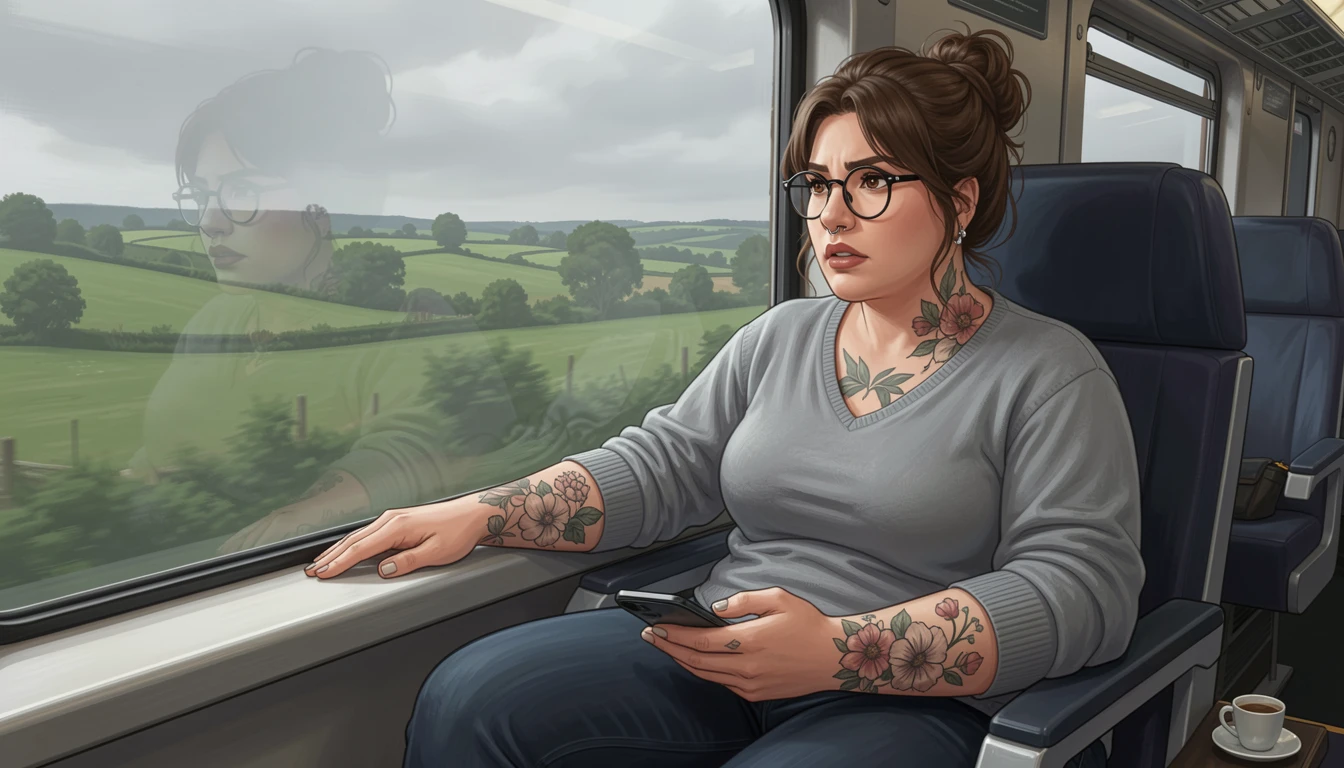
The train car smelled of stale coffee and worn upholstery, the vinyl seat warm and slightly sticky against the back of my thighs. Outside the window, rain streaked the glass, and the air vibrated with the low, steady hum of metal on tracks.
I'd been sitting here for twelve minutes. Strood to King's Cross was the first leg, then Leeds, then the slow crawl to Littleborough. Hours. I had hours of this — the grey sky, the shuddering floor, and the phone in my hand.
His message was still there. I meant what I said.
I'd read it four times this morning. Five, if I counted the time in the bathroom before Emma woke. The words hadn't changed. They still sat there, patient and warm, waiting for something I couldn't name.
I locked the phone and set it face-down on my thigh. Outside, the Kent countryside slid past — wet fields, bare trees, a church spire shrinking into the distance. I watched it go, and I thought about how fast a weekend could rewrite everything.
Three days ago, I'd stepped off this same train with a bag full of books and a vague hope that a change of scenery might shake something loose. I hadn't known what. I hadn't expected this.
The phone buzzed. My heart stopped, then started again when I saw it was just a network notification. I let out a breath I hadn't realised I was holding.
This was ridiculous. I was a thirty-three-year-old woman with a wedding ring and a mortgage and a job I didn't hate. I didn't do this — this waiting, this hoping, this obsessive checking of a screen like a teenager with a crush.
Except I was doing it. Had been doing it since Saturday night.
I picked the phone up again. Unlocked it. Stared at the message thread — his name at the top, the grey bubble below it, the words that had lodged themselves somewhere under my ribs.
I meant what I said.
I typed: What exactly did you mean?
Stared at it. Deleted it.
Typed: I can't stop thinking about what you said.
Deleted that too. Too much. Too honest.
I tried again: Thank you. For what you said. It meant a lot.
I sent it before I could change my mind.
The phone sat in my hand, warm and heavy. The train lurched around a bend, and I watched the three dots appear on the screen. He was typing.
Then they stopped.
My stomach dropped. I stared at the screen, waiting, the seconds stretching into something unbearable.
The dots started again. Stopped. Started.
Then his reply came through: You don't have to thank me. I just told you the truth.
I read it twice. Three times. My thumb hovered over the keyboard, and I could feel the heat in my cheeks, the pulse in my throat.
But why did you watch? I typed. You said it was because I looked beautiful. But there must be more to it than that.
I sent it before I could stop myself. The words felt raw, exposed — a door I'd opened without checking who was on the other side.
The train swayed, and I watched the dots appear again. This time they didn't stop.
It was luck. Pure chance. I came home early because the meeting finished before lunch. I checked the monitor out of habit — Lily had been unwell the night before, and I wanted to make sure she was okay. I saw you on the bed, and I should have turned it off. I knew I should. But I didn't.
I held my breath.
I didn't because you looked... I don't know how to say it without sounding like a creep. You looked like you were finally letting go of something. Like you were somewhere else, somewhere you wanted to be. And you were beautiful. I mean that. Not just pretty. Beautiful. In a way that made me forget I shouldn't be watching.
The words blurred. I blinked hard and read them again.
I'm not making excuses, he added. I should have turned it off. I know that. But I didn't, and I'm not sorry I saw you. I'm only sorry I couldn't look away.
I didn't know what to say to that. The train rattled on, and I pressed my free hand against my chest, felt the steady thump of my heart under my palm.
You're not a creep, I typed. Slow. Careful. You're honest. That's rare.
A pause. Then: Honest about this, maybe. Not about everything.
I frowned at the screen. What do you mean?
The dots appeared. Disappeared. I waited, the train eating up the miles between us, and I wondered what he was deciding to tell me.
Things with Emma, he wrote. They're not... I don't know how to say this without sounding like I'm blaming her. I'm not. She's a good person. She's a great mum. But we haven't been close in a long time. Not really. Not the way a marriage should be.
I read it, and something in my chest shifted. A weight I hadn't known I was carrying.
What do you mean by close? I asked. The question felt too bold, too forward, but I sent it anyway.
Physically, he wrote. Emotionally. Both. It's been years since we've had anything that felt like real intimacy. She's tired from the night shifts, and I get that. I do. But it's more than that. We've grown into different people. We share a house and kids, but we don't share much else.
The train lurched, and I pressed my phone against my thigh, staring out the window at the blur of green and grey. This was not a conversation I'd expected to have. Not with him. Not like this.
I'm sorry, I typed. That sounds hard.
It is. But I don't want you to think I'm trying to make her the villain. She's not. We just... drifted. It happens.
Did you ever try to fix it?
A long pause. Then: I tried. She tried. But trying isn't the same as wanting to, and I think somewhere along the way we both stopped wanting to. We're comfortable. That's the word, isn't it? Comfortable. Safe. The kind of marriage that looks fine on paper but feels hollow when you're actually living in it.
I read the words twice, and they settled into me like something I'd known all along but never had the language for.
I know what you mean, I wrote. The words came out before I could filter them, before I could dress them up in polite distance. Sam and I... we're the same. Comfortable. Safe. He's a good man. He is. He provides, he's reliable, he's never hurt me. But I can't remember the last time he looked at me like he wanted me. Like he saw me. Not just the wife, not just the person who organises the grocery shopping and remembers his mum's birthday. Me.
I sent it, and then I sat there, staring at the screen, my heart hammering.
I'd never said that out loud. Not to anyone. Not even to myself, not in those exact words.
His reply came quickly: I see you.
I read it. Then I read it again. The train hummed beneath me, and I pressed my lips together, blinking hard.
That's the thing, I wrote. I think you do. And I don't know what to do with that.
You don't have to do anything with it. It's just true.
The rain picked up, smearing the window into a wash of grey and green. I watched it for a long moment, the phone warm in my hand, and I thought about the distance between us. A hundred miles of track and motorway. A marriage each. A family. A secret that was growing in the space between our texts.
What happens now? I asked.
I don't know. I think we just... talk. If you want to. No pressure. No expectations. Just two people who understand each other.
That sounds dangerous.
Maybe. But so does pretending we don't feel what we feel.
I let that sit. My thumb hovered over the keyboard, and I felt the shape of the words I wanted to say — honest, reckless words that would change everything if I let them. But I held back. Not because I didn't mean them, but because I didn't know how to say them without opening a door I couldn't close.
I don't know what I feel, I wrote. And it was true, mostly. The rest was a tangle I couldn't unpick on a train, in the middle of a Sunday, with the rain beating against the glass.
That's okay, he replied. Neither do I. But I know I feel something. And I know I don't want to stop talking to you.
The train slowed as we approached a station — somewhere I didn't recognise, a blur of platform and waiting passengers. I watched them for a moment, ordinary people with ordinary Sundays, and I wondered if any of them were carrying a secret like mine.
I don't want to stop either, I typed. Then, before I could second-guess myself: But I'm scared.
Me too, he wrote. But scared doesn't mean wrong.
The train pulled away from the station, and I let the rhythm of the tracks fill the silence between his messages. I didn't know what to say to that. It was too true, too close to the bone, and I wasn't ready to admit how far I'd already fallen down this path.
Tell me something, I wrote. Something real. Not about us. About you.
A pause. Then: I nearly died six years ago. Cancer. Stage four. They caught it late, and for a while, they didn't think I'd make it.
I stared at the screen. I'd known, of course — Emma had mentioned it once, in passing, during a phone call about something else. But I'd never really thought about what it meant. What it had done to him.
I didn't know it was that bad, I wrote.
Most people don't. I don't talk about it much. But it changes you, going through something like that. Makes you realise how short life is. How much time we waste on things that don't matter.
Is that why you said what you said to me? Because life's too short to lie?
Maybe. Or maybe I just couldn't stand the thought of you not knowing. Of spending the rest of my life wondering what would have happened if I'd been brave enough to tell you the truth.
I felt something crack open in my chest. A fissure I couldn't seal.
I'm glad you did, I wrote. Even if I don't know what to do with it.
You don't have to do anything. Just... don't pretend it didn't happen.
I won't.
The miles passed. The conversation ebbed and flowed — slower now, less urgent, but still charged with something that hummed beneath every word. He told me about his job, the training programmes he ran, the satisfaction of watching someone learn something new. I told him about my classroom, the children I worked with, the quiet joy of seeing a struggling kid finally get it. We talked about music — his punk phase, my nineties indie phase, the bands we'd both loved and lost. We talked about food, about travel, about the places we'd go if we could go anywhere.
And underneath it all, the current ran. Unspoken but undeniable.
By the time the train rolled into Littleborough, the sky had darkened into a heavy grey twilight. I gathered my bag, my coat, my phone — still warm, still carrying the ghost of his last message: Safe home. I'm glad we talked.
I stepped off the train, and the cold air hit me, sharp and clean. The station was nearly empty. A handful of passengers scattered across the platform, and beyond the barrier, I could see the car park.
And there was Sam's car. The familiar silver hatchback, parked under the single working light. I could see him inside, checking his phone, not looking up.
I walked toward him, and with every step, the weight of the last few hours pressed down on me. The words I'd exchanged. The confessions. The feeling of being truly seen by someone who had no right to see me.
Sam looked up as I approached. He smiled — a small, easy smile, the kind he always gave me — and reached across to push the passenger door open.
"Hey," he said. "Good journey?"
I climbed in, the warmth of the car rushing over me. The seat was still warm from his body. The radio played something low and familiar.
"Fine," I said. "Long. But fine."
He nodded, pulled the car out of the space, and headed for home. The streets of Littleborough unfolded around us — the chip shop, the Co-op, the row of terraced houses I'd walked past a thousand times.
My phone buzzed in my pocket. I didn't check it. I didn't need to.
I already knew who it was.