
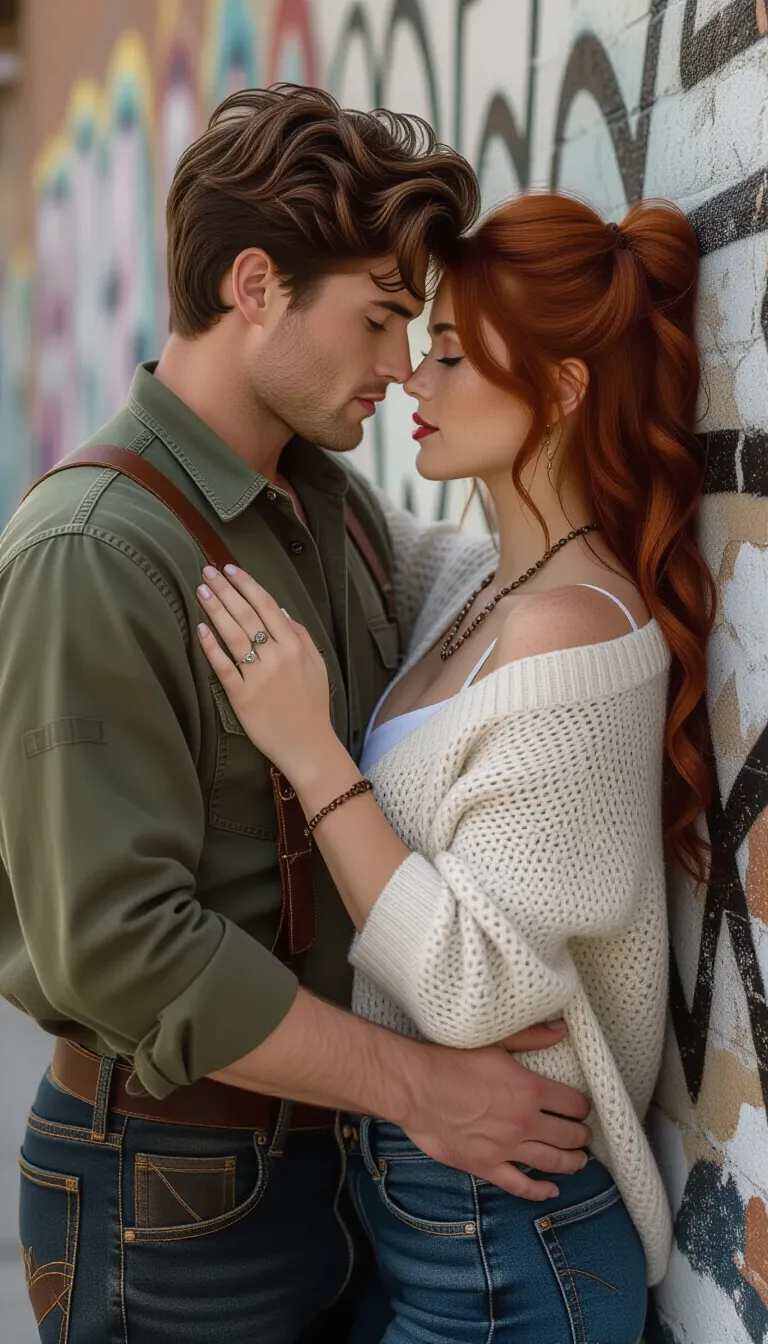
The heather grabbed at her ankles, soaking through the hem of her jeans, each step a wet tearing sound that matched the rhythm of her heart. Rain ran down the back of her neck, cold and persistent, plastering her hair to her scalp in strings she kept pushing out of her eyes. She couldn't feel her fingers anymore—just the numb grip on Declan's hand, his palm rough and warm despite the wet.
He moved ahead of her, head down, the revolver hanging loose in his other hand, barrel pointing at the earth like an afterthought. The Mourne Mountains rose around them in gray-green humps, sheep tracks disappearing into mist, the whole world reduced to wet stone and the smell of damp wool rising from the ground.
She watched his back. The way his shoulders curved forward, the way he kept checking over his shoulder—not at her, but past her, scanning for men who might be following. He'd been doing it since they left the lane, a tic she hadn't noticed before, or maybe had never let herself notice.
"Declan." Her voice came out thin, swallowed by the rain.
He stopped. Turned. His face was drawn, the lines around his mouth deeper than they'd been that morning. Water dripped from the end of his nose, from the dark auburn curls plastered to his forehead.
"We need to rest." She wasn't sure if it was true or if she just needed him to stop moving, stop scanning, stop being the man with the gun instead of the man who'd held her in the cottage.
He looked at the sky, then at the slope ahead. "There's a stone. Old one. Up there." He pointed with the revolver. "We'll stop there."
She nodded, and they climbed.
The stone appeared through the mist like something that had always been waiting—a dolmen, its capstone tilted, ancient and black with rain. Gray lichen crawled across its surface in patterns that might have been letters once. It stood alone on the hillside, facing east, as if watching for something that had never come.
Declan reached it first. He stopped beneath the overhang, one hand braced against the upright, and for a moment he just stood there, head bowed, shoulders heaving. The revolver hung at his side, forgotten.
She came up behind him, her boots slipping on the wet grass. The overhang blocked some of the rain, but not the wind, and the cold bit deeper now that she'd stopped moving. She could see the tension in his back, the way his fingers curled against the stone.
"Declan?"
He didn't answer. But she felt it—the heat of him, radiating off his drenched clothes, off his skin, a furnace in the wet. She stepped closer, close enough to see the water beading on his neck, the small tremor running through his shoulders.
She touched his arm. "Talk to me."
He turned.
And she saw it—the change she'd felt coming all day, maybe all week. His eyes weren't the careful gray of the carpenter, the man who measured twice and spoke once, who sanded wood until it was smooth as prayer. This was something older. Wilder. The storm he'd been holding back for years, pressing against the walls he'd built, and the walls were cracking.
He didn't kiss her.
He moved so fast she didn't have time to breathe—one hand catching her hip, the other still gripping the revolver, pinning her against the stone. The cold bit through her soaked blouse, but his body was hot against hers, pressed tight, and she felt the weight of every forbidden choice they'd made, every lie, every door closed, every bullet meant for them, pressing them together until there was no air between them.
His breath came hard, ragged, his forehead nearly touching hers. The rain ran down his face, dripped off his jaw. She could taste the salt of it in the air between them.
"If we die tonight," he said, his voice cracked, low, a sound she'd never heard from him before, "I want you to know I chose this. I chose you."
The words hit her like a blow. Not because they were new—he'd said them before, in the cottage, in the dark. But because of the way he said them now, with the stone at her back and the gun in his hand and the whole wet world falling around them, like he was making a confession he'd never meant to survive.
She didn't answer with words.
She pulled his mouth to hers.
The kiss was not soft. It was teeth and rain and the copper taste of old blood—her lip split against his, or maybe his against hers, she didn't know, didn't care. She kissed him like she was trying to leave a mark, to brand herself into him so that even if Billy's men found them, even if the bullet came, he would carry her mouth on his for the rest of whatever time they had.
His hand tightened on her hip, fingers digging into the wet fabric, and he made a sound against her lips—not a word, not a moan, something broken and raw, the sound a man makes when he's been holding everything inside and the dam finally gives.
She felt the revolver press against her ribs. Cold metal through wet fabric. The thing that could save them or kill them, depending on how the night went. But it was his hand holding it, and that meant it was hers too.
She broke the kiss, just enough to breathe, to look at him. His eyes were wet—rain or tears, she couldn't tell. His mouth was red, swollen, smeared with her blood or hers with his.
"Then we survive," she said, her voice shaking but steady enough. "You chose me. So survive. We both do."
He stared at her, and something in his face shifted—the storm still there, but banked, controlled. He nodded once. Then he pressed his forehead to hers and closed his eyes.
The rain kept falling. The wind moved through the heather. Somewhere down the mountain, a sheep called out, answered by another, and the sound was the only thing in the world that wasn't them.
She felt his hand loosen on her hip, and she didn't let go of him. She couldn't. Not yet.
"I love you," she said, because it was the only truth that mattered, the only one that could stand against the rain and the stone and the gun.
He opened his eyes. Gray, calm, holding her.
"I love you too."
And then he kissed her again—slower this time, softer, as if he was memorizing the shape of her mouth, as if this might be the last time he got to feel it warm and alive against his.
The revolver pressed between them, cold and hard, a reminder of what waited. But for this moment, under the ancient stone, with the rain falling around them like a curtain, they were just two people holding each other, choosing each other, refusing to let go.
She felt the question before he spoke it—a shift in his body, a tension that wasn't the storm anymore but something quieter, harder. His hand slid from her hip to her waist, then to her wrist, where his thumb found her pulse and pressed gently, as if checking she was still real.
"Siobhan." His voice was low, careful. The carpenter's voice now, not the wild thing from moments ago. "Are you sure about Belfast?"
The rain had softened to a drizzle, mist rising from the heather around them. She could see the outline of the mountains through the gray, not clear but present, a promise of something ahead. She thought about what he was really asking—not about the plan, not about the logistics of sneaking past Billy's men or finding a smuggler in the Mournes. He was asking if she was sure about him. About them. About choosing a path that might leave her bleeding on a warehouse floor before dawn.
"No," she said.
His hand stilled on her wrist.
"I'm not sure about anything," she continued, and she felt the truth of it settle in her chest like a stone dropped into still water. "I'm not sure we'll make it to Belfast. I'm not sure the smuggler will be there. I'm not sure your mother is still alive." She watched his jaw tighten, watched him take the hit without flinching. "I'm not sure we'll see the sunrise."
She reached up, touched his face. His skin was cold, wet, the stubble rough against her palm.
"But I'm sure about you."
He closed his eyes. Just that—his eyes closing, his breath slow and deliberate, like he was letting those words land somewhere deep, somewhere he'd been keeping empty for so long he'd forgotten what it felt like to fill it.
"Your father will never forgive you," he said, not opening his eyes. "Your students will learn what you did. The church—"
"I know."
"I could get you to the border. You could go south, to Dublin, your aunt's—"
"Declan."
He opened his eyes.
"Stop trying to save me from the choice I already made," she said. "I'm not a girl you need to protect. I'm a woman who's standing here, in the rain, in the mountains, with a gun in your hand and a priest's curse on my head, and I'm not leaving."
He stared at her. The gray of his eyes was the same gray as the sky, and for a long moment she couldn't read him at all—just that winter stillness, that careful blankness he wore like armor.
Then his mouth curved. Not a smile, not quite. Something smaller. Something that made her chest ache.
"You're terrifying," he said.
"Good."
He laughed—a short, broken sound, more surprise than humor. "I mean it. I've seen men twice your size fold under less. You'd stare down the devil himself if he tried to take something from you."
"I would." She didn't smile. "And I'd win."
The revolver was still in his hand, hanging at his side, but he shifted it to his left hand, and his right came up to cup her face, his thumb tracing the line of her cheekbone. "Belfast is a trap. You know that."
"I know."
"Billy wants me dead. He'll use my mother to make sure I walk into that warehouse alone. And if I don't, he'll kill her. If I do, he'll kill us both."
"Then we don't walk into the warehouse."
"What choice do we have?"
She thought about the girl in the hedgerow, the revolver in her hands, the image of her father's face as he'd watched them leave. She thought about the woman who'd fled before dawn, the one who helped because she'd lost someone and made the same choice. She thought about the smuggler in the Mournes, the one who could get them into Belfast unseen—but unseen wasn't the same as safe.
"We don't play by their rules," she said. "Billy wants you alone, at dawn, in a place he controls. So we don't give him that."
"We don't have soldiers. We don't have backup. We have five bullets and a name."
"We have each other."
He opened his mouth, then closed it. The words died before they reached air, and she saw the argument die with them—the protest, the practicality, the instinct to push her away and go alone. She'd seen that instinct in him since the first night, the way he carried his guilt like a physical weight, the way he assumed the dying was his to do solo.
She watched him let it go.
"Okay," he said. It came out quiet, almost reluctant, but there was something underneath it—surrender, maybe. Or trust. "Okay."
She kissed him again, softer this time, not desperate. Just a seal. Just a promise pressed into skin.
When she pulled back, she was shivering. The cold had settled into her bones while they stood there, and the wet clothes clung to her like a second skin, heavy and chill. She felt the exhaustion pressing in—the miles they'd walked, the fear they'd carried, the sleepless nights stacking up like stones.
"We need to keep moving," she said. "The girl said three miles east, then west to the Mournes. That's hours of walking, and we've already lost daylight."
He nodded, but he didn't move. He was looking at her, really looking, the way he had in the cottage that first night—like he was memorizing her, storing her away somewhere he could keep her safe even if the worst happened.
"What?" she said.
"Nothing." He shook his head. "Just—I never thought I'd have this. Someone who stays."
The words hit her harder than they should have. She thought about his mother, taken from him. His father, a ghost of violence and shame. His brother, a threat. His community, a cage. All those years of being alone, of carrying everything himself, of waiting for someone to choose him.
"You have me," she said. "As long as we both survive, you have me."
He pressed his lips together, nodded again, and stepped back from the dolmen. The rain had lightened to a fine mist, and the wind had shifted, carrying the smell of wet earth and something sharp—gorse, maybe, or pine. The mountains rose ahead of them, dark and patient, waiting.
"We'll follow the ridge," he said, pointing. "There's a shepherd's path—I saw it when we were climbing. It'll take us east, then we cut north toward the Mournes. The smuggler's name is McAuley. The girl said he works out of a pub in Kilbroney, near the forest."
"And if he's not there?"
"Then we find another way."
She fell into step beside him, their shoulders brushing as they walked. The heather was wet, soaking through her shoes, and every step felt heavier than the last, but she didn't stop. Couldn't stop. His mother was waiting. The warehouse was waiting. The dawn was coming, and they had to be ready.
They walked in silence for a while, the only sounds the squelch of boots on wet grass, the distant call of birds, the steady rhythm of their breathing. The mist thinned as they climbed, and she could see the valley below them, patches of green and brown, a stream glinting silver through the gray.
"Declan?"
"Aye?"
"What do you think happens after?"
He didn't answer immediately. His pace didn't slow, but she saw his hand tighten on the revolver, knuckles white against the metal.
"I don't know," he said finally. "I used to think I'd go back to the workshop. Pick up where I left off. Build things." He paused. "But Belfast is the same place it was before. My brother's still there. The walls are still up. The hatred's still breathing."
"So we leave."
He looked at her, quick and sharp.
"After," she said. "If we survive. We go somewhere else. England, maybe. Or America. Somewhere the names don't matter."
"You'd leave Ireland?"
"I'd leave anything that tried to take you from me."
He stopped walking. She stopped too, turning to face him. The mist curled around them, and for a moment the world was just them, the mountain, the sky.
"You mean that," he said. It wasn't a question.
"I do."
He looked at her for a long moment, and then he did something she hadn't seen him do before—he smiled. A real smile, small and surprised, like he'd forgotten how and was just remembering.
"I'd like that," he said. "A place with a blue door."
She laughed—a short, startled sound, because she'd almost forgotten she'd said that, in the cottage, in the dark, when the world had seemed so far away. "You remember."
"I remember everything you've said to me."
She felt the heat rise to her cheeks, and she looked down, suddenly shy, her fingers finding the edge of her soaked cardigan and twisting it. "We should keep moving."
"Aye." But he didn't move. He was still looking at her, and she could feel the weight of it, warm and steady, like a hand on her back.
She looked up. "What?"
"Nothing." He shook his head, and this time the smile stayed. "Just—I'm glad you're here."
She reached out, took his hand, laced her fingers through his. His palm was callused and warm despite the cold, and she felt something settle inside her, some anchor catching in the deep.
"I'm glad you're here too," she said.
They walked on, hand in hand, the mist thinning as they climbed higher. The mountains rose around them, ancient and indifferent, and somewhere ahead was a smuggler who might help them, and a warehouse full of men who wanted them dead, and a mother waiting to be saved or mourned.
But for this moment, with the rain finally easing and the path opening before them, they walked together, and it was enough.
The path curved around the shoulder of the mountain, and the mist parted like a curtain drawing back. Below them, the valley opened into a patchwork of green fields, stone walls, and a narrow road that wound toward a cluster of whitewashed buildings in the distance.
"Kilbroney," Declan said, his voice carrying on the thin air. "Has to be."
Siobhan followed his gaze, her hand still in his. The town looked peaceful from here—chimneys smoking, a church spire rising above the roofs, the whole scene painted in the soft gray light of a sky that couldn't decide whether to clear or close in again. But she knew better than to trust peace. She'd learned that lesson in Belfast.
"How do we find him?" she asked. "The smuggler."
"The girl said he works out of a pub. The Blackthorn, she called it." He shifted the revolver from his right hand to his left, then wiped his palm on his trousers. "We find the pub, we find McAuley."
"And if he won't help us?"
Declan was quiet for a moment. The wind picked up, carrying the smell of wet earth and something green, something growing. "Then we find someone who will."
She wanted to believe him. She wanted to believe there was always another door, another hand reaching out, another chance. But the revolver held five bullets, and the warehouse held twenty men, and the dawn was still coming whether they were ready or not.
"Let's go," she said, and started down the slope before he could answer.
The descent was steeper than it had looked from above. Her shoes slipped on the wet grass, and she had to grab at clumps of heather to keep her balance. Declan was behind her, close enough that she could hear his breathing, steady and controlled, matching her pace without rushing her.
Near the bottom, her foot caught on a hidden rock and she stumbled, her knee hitting the ground hard. A sharp pain shot up her leg, and she bit down on a cry.
"Siobhan." He was beside her in an instant, his hand on her arm, his eyes scanning her face. "Are you—"
"I'm fine." She pushed herself up, ignoring the ache in her knee. "Just a fall."
He didn't let go of her arm. His thumb traced a slow line across her sleeve, and she felt the warmth of his touch through the damp wool. "We can rest. Just for a few minutes."
"We don't have a few minutes."
"We have whatever we need." His voice was low, steady, and she heard the thing he wasn't saying: I won't let you break before we get there.
She looked at him—at the lines around his eyes, the set of his jaw, the way his hair was plastered to his forehead from the rain. He looked exhausted. He looked like a man who'd been carrying something heavy for a very long time and had finally found someone to share the weight.
"One minute," she said. "Then we keep moving."
He nodded, and they stood there in the wet grass, the town of Kilbroney spread out below them, the mountains rising behind them. The mist was clearing, and she could see the road now, a gray ribbon cutting through the green, leading toward the pub where a smuggler might be waiting.
"Declan."
"Aye?"
"What if he's not there? What if the girl was wrong, or the woman was wrong, or—"
"Then we find another way." He said it simply, like it was the most obvious thing in the world. "We've come this far. We're not stopping now."
She wanted to ask him how he could be so sure. She wanted to ask him what happened to the careful carpenter who weighed every word before he spoke, who planned every cut before he made it. But she knew the answer. The careful carpenter had died somewhere between the safe house and the mountain, replaced by a man who had nothing left to lose except her.
"One more thing," she said.
"What?"
She stepped closer, close enough that she could feel the heat of his body through the damp clothes, close enough that she could see the flecks of gold in his gray eyes that she'd never noticed before. "If we get out of this—if we actually make it—I want you to know something."
"What?"
"I'm not going to let you go."
His breath caught. She saw it—the small hitch in his chest, the way his eyes widened just a fraction before he controlled it. "Siobhan—"
"I mean it." She reached up, touched his face, her fingers cold against his skin. "Whatever happens in that warehouse, whatever happens after—you're mine. And I'm yours. And I don't care what anyone says about it."
He stared at her for a long moment, and then he kissed her. It was soft, slower than the kiss under the dolmen, a kiss that tasted like rain and promise and the faint salt of tears she wasn't sure were his or hers.
"I know," he said when he pulled back. "I've known since the butcher's shop."
She laughed, the sound catching in her throat. "The butcher's shop?"
"The first time I saw you. You walked in, and the bell rang, and you looked at me like you already knew everything I was going to say." He shook his head. "I was lost from that moment."
"You're a romantic, Declan Morrow."
"I'm a carpenter who fell in love with a schoolteacher." He took her hand again. "That's the only thing I am anymore."
They walked the rest of the way down the slope in silence, hand in hand, the town growing closer with every step. The road was empty when they reached it, just wet tarmac and the occasional car parked outside a house, and she felt exposed in a way she hadn't on the mountain. Here, there were windows. Here, there were doors that could open. Here, there were people who might recognize them for what they were: a Protestant and a Catholic, running from a war that didn't care who they loved.
The Blackthorn was at the end of the main street, a low building with a faded sign and a door that looked like it had been painted and repainted so many times the original color was anyone's guess. Smoke rose from the chimney, and she could hear voices inside, muffled but present.
"We go in together," Declan said. "We find McAuley, we talk to him, and we leave."
"And if he's not alone?"
"Then we adapt." He reached into his jacket, adjusted the revolver so it was hidden but accessible. "Stay behind me. Let me do the talking."
"Declan—"
"Please." He looked at her, and she saw the fear in his eyes—not for himself, but for her. "Just this once. Let me go first."
She wanted to argue. She wanted to tell him that she wasn't fragile, that she'd faced down her father and her priest and a man with a shotgun, that she could handle a pub full of strangers. But she saw the weight in his shoulders, the way his hand trembled slightly as he reached for the door handle, and she understood.
He needed to protect her. Not because she couldn't protect herself, but because protecting her was the only thing keeping him together.
"Okay," she said. "You go first."
He nodded, took a breath, and pushed open the door.
The pub was warm and dim, lit by a fire that crackled in the hearth and a few lamps that cast long shadows across the room. A handful of men sat at the bar, nursing pints and speaking in low voices that fell silent when they saw the strangers at the door. The barman looked up, his eyes narrowing as he took them in—their wet clothes, their tired faces, the way Declan's hand hovered near his jacket.
"Help you?" the barman said. His voice was neutral, but his hand was already moving toward something under the counter.
"We're looking for a man," Declan said. "Name of McAuley."
The barman's hand stopped. The men at the bar exchanged glances, and one of them—a stocky man with a scar running from his eye to his jaw—set down his pint and turned to face them.
"Who's asking?"
Declan met his gaze. "Someone who needs to get into Belfast. Quietly."
The scarred man studied them for a long moment, his eyes moving from Declan to Siobhan and back again. She felt the weight of his gaze, the calculation behind it, and she forced herself to stand still, to not reach for Declan's hand, to not show any weakness.
"You're not from around here," the man said.
"No."
"You're from Belfast."
Declan didn't answer. He didn't need to.
The scarred man picked up his pint, took a long drink, and set it down again. "McAuley's not here."
"When will he be back?"
"He won't." The man's eyes flickered to Siobhan again, and something in his expression shifted—not quite recognition, but close. "He left this morning. Said he had business in the south. Won't be back for a week, maybe more."
Siobhan felt the air leave her lungs. A week. They didn't have a week. They didn't have a day. The dawn was coming, and Declan's mother was waiting, and the warehouse was full of men who wanted them dead.
"Is there someone else?" Declan asked. His voice was steady, but she could hear the edge beneath it. "Someone who can get us through?"
The scarred man was quiet for a moment. Then he nodded toward the back of the pub. "There's a woman. Lives in the cottage behind the church. She knows the old roads, the ones the army doesn't watch." He picked up his pint again. "Tell her Liam sent you. She might help."
"Thank you," Declan said.
The man didn't answer. He turned back to his pint, and the other men followed suit, their conversation resuming in low murmurs as if the strangers had never been there at all.
They left the pub, the door closing behind them with a soft click. The street was still empty, the mist settling back over the town like a blanket, and Siobhan felt the weight of the moment pressing down on her.
"A woman," she said. "Another woman."
"Aye." Declan's hand found hers, squeezed once. "We find her. We ask her. And if she says no—"
"We find another way." She finished the sentence for him, and he smiled, that small surprised smile that made her heart ache.
"Exactly."
The church was at the edge of town, a stone building with a bell tower and a graveyard that sloped down toward a stream. The cottage behind it was small and whitewashed, with a blue door that made Siobhan's breath catch when she saw it.
Declan noticed too. He stared at the door for a long moment, and then he looked at her, and she saw something in his eyes that she couldn't name—hope, maybe, or the beginning of it.
"A blue door," he said.
"A blue door," she repeated.
He knocked. Three sharp raps, the sound carrying in the quiet air. They waited, and she felt her heart pounding in her chest, each second stretching into an eternity.
The door opened.
The woman standing in the doorway was older, maybe fifty, with gray-streaked hair pulled back from a face that had seen too much. Her eyes were sharp and wary, taking them in with the same calculation she'd seen in the pub, but there was something else there too—a weariness, a recognition of the kind of trouble that came knocking at blue doors.
"Liam sent us," Declan said. "He said you know the old roads."
The woman studied them for a long moment. Then she stepped aside, holding the door open.
"You'd better come in," she said. "Before someone sees you."
They crossed the threshold together, and the door closed behind them, sealing them in the warmth of a stranger's home, carrying the weight of a war that had followed them even here, even now, even to a blue door at the edge of a town that wasn't on any map.
The door closed behind them with a soft click, sealing them into the warmth of the cottage. Siobhan stepped forward, her wet shoes leaving dark prints on the flagstone floor, and her hand moved to her hair—pulling out a few pins, letting the damp strands fall loose around her shoulders. She caught the woman's eyes and held them.
"Thank you," Siobhan said, her voice steady despite the cold still clinging to her bones. "For opening the door. We didn't have many other choices."
The woman studied her, those sharp eyes moving from Siobhan's face down to her pinned-up hair—now half undone—and then to the rosary beads wrapped around her wrist. She let out a long breath, as if she had been holding it for years.
"You're Catholic," the woman said. Not a question.
"Born and raised. But that's not why I'm here."
"Then why?" The woman's gaze shifted to Declan, standing just behind Siobhan, water dripping from his hair onto the collar of his coat. "And who's he?"
Declan didn't speak. He waited. He was good at that. Good at letting others fill the silence, good at reading the room before committing to words. But his hand found the small of Siobhan's back—a touch so light she almost didn't feel it through her wet blouse, but she did feel it, and she leaned into it, let it anchor her.
"His name is Declan," she said softly. "He's Protestant. He's from Belfast. And his mother has been taken by a man named Billy Patterson. We're trying to reach her before dawn."
The woman's face didn't change, but her shoulders tightened. She folded her arms across her chest, the sleeves of her cardigan pulled taut across the fabric. "Patterson's men came through here two days ago. Looking for a girl, they said. A girl who'd seen something she shouldn't."
"We met that girl," Siobhan said. "In the hedgerow. She gave us a revolver and directions to the Mourne Mountains. She said a woman helped her."
Silence. The kettle on the stove began to whistle, a thin, rising shriek that cut through the quiet. The woman turned, took it off the flame, and poured three cups of tea without asking. She set them on the small table near the window—the blue door now visible through the glass—and motioned for them to sit.
They sat. The wooden chairs were worn smooth, and the steam from the tea rose between them like a veil.
"The girl's father was a fisherman," the woman said finally. "He found something in the lough one night. A body. Weighed down with stones. He knew better than to talk about it, but he was a drinking man, and he let it slip in the wrong pub. Patterson's men came for him the next evening."
Siobhan's chest tightened. She wrapped both hands around the mug, feeling the heat seep into her fingers, but she didn't drink. "And the girl?"
"She's alive. That's all I know. She came to me in the dark, and I gave her what I had—food, a coat, a place to sleep for one night. She left before dawn. I don't know where she went."
Declan leaned forward, his voice low. "What about the roads into Belfast? The ones the army doesn't watch."
The woman looked at him then—really looked, not the quick assessment she had given him at the door, but a long, searching gaze that seemed to peel back the layers of his quiet composure. He met her eyes, didn't flinch.
"You're her boy, aren't you?" the woman said softly. "The one from the stories. The Catholic girl's lad. They said you'd come."
Declan's jaw tightened. "Who said?"
"People who know. People who watch. There's a woman who runs a bakery on the Falls Road—she heard it from a man who works the docks. They said there's a Protestant boy who traded his own kin for a red-haired girl. They said he's got a death wish."
Siobhan's hand found Declan's under the table. She squeezed once, hard, and he squeezed back, the calluses of his palm rough against her skin.
"He's not doing any trading," Siobhan said. "He's coming to Belfast to walk into a warehouse full of men who want him dead, because they have his mother. And I'm going with him."
The woman's eyes flickered between them. She took a sip of her tea, slow and deliberate, and when she set the mug down, there was something like pity in her face. "You're young. Both of you. You don't understand what Patterson does to the people who cross him."
"We've seen enough," Declan said. His voice was flat, but there was an edge to it, a hardness that hadn't been there a moment ago. "We know what we're walking into. We just need to get there."
The woman was quiet for a long time. Then she stood, walked to a drawer near the stove, and pulled out a folded map, yellowed and worn. She spread it across the table, weighing down the corners with her mug and Declan's.
"There's a path through the hills," she said, tracing a faint line with her finger. "Not a road—a sheep track, mostly. It starts behind the old church, winds through the heather for about six miles, and comes out near a farmhouse just outside Lisburn. From there, you can catch a lift into the city. Farmers up early with milk."
Siobhan studied the map, memorizing the line of the track, the landmarks the woman pointed out. Declan leaned in beside her, his shoulder brushing hers, and she felt the heat of him even through their wet clothes.
"How long?" he asked.
"On foot, three hours. Maybe four, if the rain doesn't let up."
Three hours. It was already past midnight. If they left now, they might reach the city by four in the morning. Dawn was at six. They would have two hours to find a route to the warehouse, to confront whatever waited for them.
"We need to go," Siobhan said. She folded the map, careful along the creases, and tucked it into her jacket pocket. "Thank you. For this. For the tea. For not turning us away."
The woman stood by the stove, her hands clasped in front of her. She didn't say anything at first, but then she reached into the pocket of her cardigan and pulled out a small object—a medal, silver and tarnished, on a thin chain. She held it out to Siobhan.
"Saint Christopher," she said. "Patron saint of travelers. I was going to give it to my son, but he never came home from the marching."
Siobhan took it, the metal warm from the woman's hand. "I can't—"
"You can. You will. And you'll bring it back to me when this is over."
Siobhan looped the chain over her head, letting the medal settle against her chest, cold against her skin. She didn't know what to say, so she simply nodded, and the woman nodded back.
Declan stood first. He held out his hand to Siobhan, and she took it, rising from the chair with a creak of old wood. They walked to the blue door together, and before she opened it, Siobhan looked back at the woman, still standing by the stove, her face unreadable.
"What's your name?" Siobhan asked.
The woman shook her head. "Better if you don't know. That way, if they ask, you can't tell."
Siobhan wanted to argue, but she understood. She pushed open the door, and the night air hit them, cold and damp, the mist still clinging to the ground. The moon was hidden behind clouds, and the street was empty, the town asleep.
They stepped out into the dark, and the door closed behind them—soft, final, a seal on the warmth they were leaving behind.
Declan's hand found hers again, and they walked toward the church, following the woman's directions, the map heavy in her pocket and the saint's medal cold against her chest. The path between the old stones was slick with moss and rain, and the heather grabbed at their ankles, but they moved quickly, silently, side by side.
After a moment, Declan spoke, his voice barely above a whisper. "You spoke first."
She glanced at him, a small smile tugging at her lips despite everything. "I had to. You were staring at her like she was judgment day."
"I was watching her hands. Watching her eyes. She could have had a knife."
"She gave us tea and a medal."
"Aye." He squeezed her hand. "That's why I let you speak first. You see the good in people. I see the places they could hide a blade."
"Declan." She said his name soft, a hand on his arm pulling him to a stop. The path stretched ahead, hidden in mist and darkness, and somewhere a sheep bleated, lonely and distant. "Stop walking for a second."
He turned, and in the thin light from a hidden moon she saw his face—drawn, exhausted, the jaw tight. He'd been scanning the hills the whole time, watching for movement, for muzzle flash, for the shape of a man with a rifle silhouetted against the sky. He looked like he hadn't stopped looking since they'd left the cottage.
"I need to say something," she said. "Before we get to wherever we're going. Before we walk into whatever's waiting."
He waited. That was one of the things she loved about him—he never rushed her words, never filled the silence with his own.
"When I was a girl," she said, "I used to think love was something that happened to you. Like weather. Like rain. You didn't choose it—it just came, and you endured it, and when it passed you dried off and went back to your life." She laughed, a short broken sound. "I was wrong. It's not weather. It's a door. You walk through it, and you can't un-walk. You can't go back to the room you were in before, because you're not the same person who was standing in it."
Declan's hand found hers, his fingers cold and wet, interlacing with hers like they belonged there.
"I walked through the door," she said. "I walked through it the first time I saw you in that butcher's back room, and I've been walking ever since. I don't know what's at the end of this path. I don't know if we make it to Belfast in time. I don't know if your mother's alive, or if we'll be alive by dawn. But I know I'd rather die walking through that door with you than live my whole life in the room before it."
He didn't speak. He pulled her close, his arms wrapping around her, and she pressed her face into his chest, feeling his heart beating against her cheek, fast and steady all at once. His chin rested on top of her head, and she felt the shudder that ran through him—not a sob, not quite, but something close, something he'd been holding in for miles.
"I don't deserve you saying that," he said, his voice muffled in her hair.
"It's not about deserving. It's about choosing. And I chose."
They stood like that for a long moment, the mist curling around their ankles, the cold seeping through their wet clothes. Then she pulled back, took his hand, and started walking again, leading him forward into the dark.
The path climbed steeply, winding through heather that scratched at their legs and rocks that turned slick underfoot. She slipped once, her foot skidding on wet stone, and his hand caught her elbow, steadying her before she could fall. He didn't let go after, his palm warm against her arm even through the soaked fabric of her blouse.
"Tell me about the blue door," he said after a while.
She glanced at him. "What?"
"The one you saw. In the cottage tonight. You looked at it like you knew it. Like you'd seen it before."
She thought about it, the way the woman had opened it, the way the light had fallen across the threshold. "I don't know. Maybe I dreamed it. Maybe I imagined it."
"Or maybe it's a sign."
"I don't believe in signs."
"You believe in saints' medals."
She touched the medal at her chest, the metal warm now against her skin. "That's different. That's a woman being kind."
"Maybe the blue door is kindness too. Maybe it's the universe telling you there's a door waiting for us. On the other side of all this."
She didn't answer. She wanted to believe him. She wanted to believe there was a world where they walked through a blue door together, where they built a life, where the war didn't follow them. But the medal was cold against her chest again, and the mist was thick, and somewhere ahead of them was a warehouse full of men who wanted him dead.
They walked in silence for a while, the only sounds their breathing and the wet rustle of heather against their legs. The path crested a ridge, and for a moment the mist parted, revealing a valley below—dark fields, a scattering of lights, the distant glow of a town.
"Lisburn," Declan said. "That's where the farmhouse is. If the woman's map is right."
Siobhan studied the lights below. They looked small and fragile, like candles in a dark church. Somewhere down there was a farmer who would give them a lift into Belfast. Somewhere down there was the last stretch of road before the warehouse.
"We're going to make it," she said. She said it to herself as much as to him.
He didn't answer. His hand tightened around hers.
The path descended, winding through a copse of ash trees, their branches bare and black against the sky. The mist thickened again, and she lost sight of the valley, lost sight of everything except the ground in front of her and his hand in hers. The cold had settled into her bones, a deep ache that she tried to ignore.
"Tell me something," she said. "Something I don't know about you."
"Now?"
"Now. While we're walking. Something to hold onto."
He was quiet for a moment. She felt him thinking, felt the weight of his choices moving behind his silence.
"When I was sixteen," he said, "I stole a boat."
She laughed, surprised. "You what?"
"A rowboat. From a man who lived down the road from us. I didn't even know how to row—I just got in and pushed off from the dock and let the current take me. I was out there for hours, drifting in the lough, watching the lights of Belfast get smaller and smaller. I wasn't running from anything. I just wanted to see what it felt like to not be tied to the shore."
"What happened?"
"The current brought me back. It always does." His voice was quiet, almost lost in the sound of the wind through the trees. "My brother found me at dawn, asleep in the boat, washed up against the dock. He beat me black and blue for scaring our mother."
"I'm sorry."
"Don't be. It was worth it. For a few hours, I was free."
She squeezed his hand. "When this is over, I'm taking you to the sea. A real boat. And I'll let the current take us wherever it wants."
"And if it brings us back?"
"Then we steal another boat."
He laughed—a real laugh, low and surprised, like he'd forgotten he could make that sound. It broke through the mist, through the weight of everything ahead of them, and she felt something loosen in her chest.
They walked on, and the path began to level out, the heather giving way to grass, the grass to gravel. In the distance, she saw the shape of a farmhouse—dark windows, a barn, a tractor parked beside a stone wall.
"That's it," Declan said. "That's the farmhouse."
They stopped at the edge of the field, hidden in the shadow of a hedge. Siobhan pulled out the map, studied it by the faint light, and folded it back into her pocket. "The woman said the farmer leaves for the market at half four. We wait until we see his lights, and then we walk up to the road like we're supposed to be there."
"And if he doesn't stop?"
"Then we walk the rest of the way."
Declan looked at the farmhouse, then at the road beyond it, then at her. "You're not afraid."
"I'm terrified," she said. "I'm just better at hiding it."
"You're not hiding it. You're walking through it. That's different."
She looked at him, at the way the mist clung to his hair, at the set of his jaw, at the gray eyes that held more than he'd ever say. She stepped closer, close enough to feel the heat of him despite the cold, close enough to see the faint scar above his eyebrow that she'd never asked about.
She stepped closer, close enough that the mist curled between them like a held breath. Her hand found his chest, fingers spreading over the damp wool of his coat, feeling the steady thud of his heart beneath.
"Your scar," she said. "The one above your eyebrow. I've never asked."
He didn't look away. "Billy. The night he found out I'd been seeing you. He caught me coming home and gave me something to remember him by."
Her thumb traced the faint line without thinking, a ghost of a touch. "I'm sorry."
"Don't be." He caught her hand, pressed it flat against his chest. "I'd take a hundred more for you."
"Don't say that."
"It's true."
She looked at him, at the gray eyes that held the weight of everything he'd never said, and felt something crack open in her chest. Not fear. Not sadness. Something deeper—a recognition that this moment, right here, standing in the wet dark at the edge of a stranger's field, was the only place she wanted to be.
"I love you," she said. Not for the first time. But it felt like the first time—raw and new, like a wound that hadn't closed yet.
His hand came up to her face, cupping her jaw, his thumb brushing the corner of her mouth. "I know," he said. "I don't know what I did to deserve you. But I know."
She turned her head, pressed a kiss to his palm, and felt him shudder.
The farmhouse remained dark. The road remained empty. The mist held them in a small, suspended world where nothing existed except his hand on her face and the sound of their breathing and the faint, distant hum of a tractor engine, still miles away.
"Tell me something else," she said. "Something I can hold onto."
He thought for a moment. "When I was nine, my da took me to the docks. He was drunk—he was always drunk back then—but that day he was happy. He bought me an orange from a vendor and showed me how to peel it in one long strip. Said it was good luck if you could do it without breaking the peel."
"Could you?"
"No. I tore it in three places. He laughed and helped me finish it." His voice went quiet. "That's the only memory I have of him that doesn't hurt."
She felt the weight of that—the single good memory in a sea of silence and shame. She wanted to say something that would make it better, but there was nothing to say. So she just stood there, holding his hand, letting the mist settle around them like a blessing.
A light flickered in the farmhouse window. Then another. The murmur of a radio, faint through the walls.
"He's getting ready," Declan said. "Market."
They watched as the kitchen light came on, casting a warm rectangle onto the wet gravel. A shadow moved past the window—a man, broad-shouldered, pouring tea or buttoning a coat. Ordinary. Unaware that two fugitives were watching him from the hedge.
"We wait until he's in the truck," Siobhan said. "Then we walk up to the road like we're meant to be there."
"And if he doesn't stop?"
"Then we walk."
Declan looked at her. "You're cold. You're soaked through."
"I'll survive."
He pulled off his coat—the wool coat, already damp, but heavier than hers—and wrapped it around her shoulders. The warmth of him still clung to the lining. She pulled it tight, breathing him in: wood smoke, sweat, the faint metallic smell of rain on stone.
"You'll freeze," she said.
"I'll survive."
A smile flickered between them, small and fragile, gone before it could settle.
The tractor engine coughed to life in the barn. The kitchen light went out. The shadow moved toward the door, and they heard the scrape of boots on stone, the jingle of keys.
"Now," Siobhan said.
They stepped out of the hedge together, walking up the gravel lane toward the road. She kept her head high, her stride steady, as if she belonged here. As if she were just a woman walking to the market with her man, nothing unusual, nothing to see.
The farmer emerged from the barn, a thermos in one hand, and saw them. He stopped, squinting through the early light.
"Morning," Declan said. His voice was calm, easy, the voice of a man who had nothing to hide.
The farmer studied them. "You're up early."
"Missed the last bus into Lisburn," Declan said. "Been walking since midnight. Wondered if you might be heading that way."
The farmer's eyes moved from Declan to Siobhan, lingering on her red hair, on the coat too big for her shoulders. Something passed across his face—recognition, or suspicion, or just the caution of a man who'd lived through too many checkpoints to trust strangers.
"I'm only going as far as the market," he said.
"That'll do us," Siobhan said. "We can find our way from there."
The farmer was quiet for a long moment. Then he nodded, once, and jerked his head toward the truck. "Get in the back. Don't touch anything."
They climbed into the flatbed, settling among crates of potatoes and sacks of flour. The canvas cover was torn in places, letting in the damp air, but it was better than walking. She leaned against Declan, feeling the cold metal of the truck bed through his trousers, feeling his arm come around her shoulders.
The engine rumbled. The farmhouse receded into the mist.
"We're doing it," she said, her voice barely audible over the noise of the road. "We're really doing it."
He pressed a kiss to her hair. "Aye. We are."
The road unwound beneath them, winding through the foothills, past fields and stone walls and the occasional whitewashed cottage with smoke rising from its chimney. The mist began to thin, revealing the pale gray of dawn creeping over the horizon. She watched it come, watched the light spread across the land like a slow tide, and felt something shift in her chest—a settling, a quieting, as if the night had finally released its grip on her.
"It's beautiful," she said. "This country. Even after everything."
"Aye." His hand found hers, their fingers interlacing. "It's worth fighting for."
"Not just fighting. Living for."
He didn't answer. But his hand tightened around hers, and she felt the weight of his agreement in that small pressure, in the way he pulled her closer as the truck rounded a bend and the lights of Lisburn appeared in the valley below.
She felt the truck slow as the road narrowed, the engine dropping to a low rumble that vibrated through the metal bed beneath them. The lights of Lisburn spread out in the valley below, a scatter of orange and white against the gray dawn, and she watched them blur as the mist condensed on her lashes.
Declan's arm was still around her shoulders, his hand resting loose on her arm, and she could feel the cold of his skin through the damp fabric of his sleeve. She turned her head, just slightly, enough to see his profile against the pale sky—the line of his jaw, the shadow under his cheekbone, the small scar above his brow that she'd never asked about.
Her hand moved before she decided to move it. She reached up, her fingers finding that scar, tracing it with the pad of her thumb. A thin line, pale against his skin, the kind of scar that came from something sharp and fast.
He went still. Not the stillness of a man startled—the stillness of a man waiting to see what comes next.
"Where did you get this?" she asked. Her voice was quiet, barely audible over the rumble of the truck and the wind in the torn canvas.
He was silent for a long moment. Then: "My brother. When I was twelve."
Her thumb kept moving, slow, tracing the line from one end to the other. "What happened?"
"I broke his fishing rod. He threw a bottle at my head." He said it flat, matter-of-fact, the way a man says something he's stopped feeling. "Mam sewed it up herself. Didn't want to explain at the hospital."
She let her hand fall to his cheek, her palm resting against the stubble on his jaw. He turned into her touch, his eyes closing, and she felt the weight of him lean into her hand like a man who'd been carrying something too heavy for too long.
"You were a child," she said.
"We were all children once."
The truck hit a pothole, jostling them, and she braced herself against the side of the bed. When she looked back at him, his eyes were open, watching her with that careful gray gaze that made her feel like he was seeing past her skin, past her bones, into the place where she kept her secrets.
"What is it?" she asked.
"Nothing."
"Liar."
A ghost of a smile touched his mouth. "I was just thinking—I don't want to die in a warehouse on Dover Street."
"You won't."
"You don't know that."
"I do." She shifted, turning to face him fully, her knees brushing his. "Because I won't let you."
He looked at her for a long moment, his expression unreadable. Then he reached up and took her hand, the one still resting against his cheek, and brought it to his mouth. He pressed a kiss to her palm, slow, deliberate, his lips warm against her cold skin.
"I don't deserve you," he said.
"That's not for you to decide."
He turned her hand over, tracing the lines of her palm with his thumb. "Your father—he's going to hate me."
"He'll learn not to."
"And your mother?"
She was quiet. Her mother had been dead for seven years, buried in a cemetery in Ardoyne with a headstone that said "Beloved Wife and Mother" and a date of birth that matched no one's records because the priest had guessed. But that wasn't what he meant, and she knew it. He meant the idea of her mother—the ghost of her, the weight of her memory pressing down on every choice Siobhan made.
"She'd have liked you," Siobhan said. "She always said I needed someone who could keep up with me."
"Can I?"
"You're still here, aren't you?"
The truck slowed further, the engine dropping to an idle, and she felt the change in momentum, the shift from forward motion to stillness. They'd reached the edge of Lisburn. The road ahead was lined with terraced houses, their windows dark, their doors closed against the morning. A woman in a headscarf was sweeping her front step, and she looked up as the truck passed, her eyes tracking the flatbed with the wariness of someone who'd learned to notice strangers.
"We should get out here," Siobhan said. "Before we hit the market. Too many eyes."
Declan nodded. He tapped the cab roof twice, and the truck slowed to a stop at the side of the road. They climbed out, their boots landing on wet tarmac, and the farmer gave them a curt nod through the window before pulling away, the tailpipe chuffing exhaust into the damp air.
They stood at the roadside, alone, the town spread out before them. The warehouse was somewhere ahead—she could feel it, a weight at the edge of her awareness, like a tooth that ached when she pressed on it.
Declan slid his hand into hers. "We need a plan."
"We have a plan. We find the warehouse. We get your mother out. We survive."
"That's not a plan. That's a wish."
"It's all we've got." She squeezed his hand. "And it's enough."
He looked at her, his gray eyes searching hers, and she saw something in them that made her chest tighten—a question he was afraid to ask, a hope he didn't trust.
"What if—" he started.
"Don't."
"I have to."
"No, you don't." She stepped closer, close enough to feel the heat of him through their damp clothes. "We don't get to ask 'what if.' We don't get to plan for the worst. We get to walk forward, together, and trust that we'll find a way through."
"And if we don't?"
"Then we don't. But we'll be together."
He pulled her against him, his arms wrapping around her, his face pressing into her hair. She felt his breath shudder, felt the tension in his shoulders, the way his hands gripped her like she was the only solid thing in a world that had turned to water.
"I'm scared," he said, his voice muffled against her hair.
"I know." She held him tighter. "So am I. But we're still standing."
"Aye." He pulled back, just enough to look at her. His eyes were red-rimmed, but his jaw was set. "We're still standing."
She reached up, her fingers finding the scar above his brow again. She traced it, once, twice, a slow ritual, a promise made without words.
"When this is over," she said, "I'm going to take you somewhere. Somewhere with no checkpoints, no bombs, no priests telling us we're damned."
"Where?"
"I don't know yet. Somewhere by the sea. A place where the water's clear and the sand is white and no one knows our names."
He smiled, a real smile, the first one she'd seen since they left the cottage. "Sounds like a dream."
"It will be. When we get there."
She let her hand fall from his face, but he caught it, brought it to his lips again, kissed her knuckles one by one. Each kiss was a sentence, a declaration, a prayer she couldn't hear but felt in the trembling of his hand against hers.
"I love you," he said. "I don't say it enough. I don't show it enough. But I love you, Siobhan Connolly. And if we get out of this—"
"When."
"When we get out of this—I'm going to spend the rest of my life proving it."
She kissed him. Hard and fast and desperate, her hands fisting in his damp shirt, pulling him closer until there was no space left between them, until she couldn't tell where she ended and he began. He kissed her back the same way, his hands on her hips, his mouth open against hers, and she tasted the salt of tears or rain or both.
When they broke apart, both breathing hard, she pressed her forehead to his and said, "That's all I need. Just you. Just this."
He nodded, his breath warm against her lips. "Then let's go get my mother."
She traced the scar above his brow—the same gesture she'd made a hundred times, but it felt different now, heavier, like she was memorizing the geography of him in case she never got the chance again.
He closed his eyes. Leaned into her touch. Let himself be held by it.
"I used to hate this scar," he said, his voice barely above a whisper. "Every time I looked in the mirror, it was a reminder of what I was—a target, a fool, a man who couldn't protect himself or anyone else."
"And now?"
He opened his eyes. The gray of them caught the dawn light, and she saw something shift—a loosening, a surrender she hadn't seen before, not even in the cottage, not even in her father's house.
"Now it's where your fingers always find me. And that makes it the best thing that ever happened to my face."
She laughed, a small broken sound, and pressed her lips to his forehead, right over the scar. She felt him shiver. Felt his hands tighten on her hips.
"I wish we'd met somewhere else," he said. "Somewhere ordinary. A pub, a market, a bus stop. Somewhere that didn't have checkpoints and curfews and men with guns deciding who gets to live."
"We'd have found each other anyway." She pulled back just enough to meet his eyes. "I believe that. I believe we were always going to find each other, no matter what the world looked like."
"Aye." He smiled, soft and sad. "I believe that too."
The wind picked up, carrying the smell of wet tarmac and diesel from the town below. Somewhere in that sprawl of grey roofs was the warehouse. Somewhere in that warehouse was his mother.
She felt the weight of the revolver in her coat pocket. Five bullets. Twenty men.
"Declan."
"I know."
"We can still turn around. Find another way. Call your mother's parish, see if someone—"
"No." He shook his head, his jaw setting hard. "Billy's given us until dawn. If we don't show, he'll kill her. He'll make it slow, and he'll make sure I know it." His voice cracked on the last word, and he looked away, blinking fast. "I can't live with that. I can't live knowing I had the chance to save her and I chose my own skin."
"Then we go together."
"Siobhan—"
"Don't." She pressed a finger to his lips. "Don't you dare try to leave me behind. Don't you dare tell me it's too dangerous. I know it's dangerous. I've known since the night I walked into your shop and saw your hands shaking over a piece of wood. But I'm not leaving you. I'm not letting you face Billy Patterson alone."
He stared at her, his eyes wet, his throat working. Then he took her hand and pressed it flat against his chest, over his heart.
"You feel that?" he asked.
"Yes."
"That's yours. Every beat. Every breath. Every second I have left on this earth—it all belongs to you." He swallowed, hard. "If I die in that warehouse, I die knowing I was loved. Truly loved. By a woman who looked at me and saw something worth saving. And that's more than most men get in a lifetime."
"You're not going to die."
"Maybe. But I needed you to know—"
"I know." She kissed him again, softer this time, a slow press of lips that said everything words couldn't. "I've always known."
They stood there for a long moment, forehead to forehead, breathing the same air. The world went quiet around them—the distant traffic, the crying gulls, the hum of electricity from the town below. None of it mattered. Nothing mattered except the warmth of his skin against hers and the steady rhythm of his heart under her palm.
"We should move," he said finally, his voice rough. "Before it gets too light."
"We should." She didn't pull away.
"Siobhan."
"I know."
She stepped back, letting her hand fall from his chest. The cold air rushed in between them, and she felt the absence of him like a physical wound.
"You have the revolver," he said.
"Five bullets." She patted her coat pocket. "And I know how to use them."
"And you have me."
"Aye." She smiled, and this time it reached her eyes. "That's the best weapon I've got."
They turned together, facing the town, and began walking down the slope. The road curved ahead, lined with hedgerows and the occasional farm gate. A dog barked somewhere in the distance. A milk float rattled along a side street, its bottles clinking.
Normal sounds. Sounds of a world that hadn't ended yet.
She slipped her hand into his, and he squeezed it, a quick firm press that said I'm here.
They walked in silence for a while, past the first houses, past a church whose bells hadn't rung in years, past a graffiti-scrawled wall that read BRITS OUT in faded red paint. The streets were empty this early, the air still damp with dew, and the only sound was the slap of their boots on wet pavement.
A car turned onto the road ahead. Old Ford, beige, one headlight dimmer than the other. It slowed as it approached them, and Declan's hand tightened on hers.
"Keep walking," she murmured. "Don't look at it."
The car crawled past, the driver—a middle-aged man with a cap pulled low—studying them through the window. He didn't stop, didn't speak, just drove on, but she felt his gaze like a brand.
"Did you recognize him?" she asked, once the car was out of sight.
"No. But that doesn't mean he wasn't one of Billy's."
"He didn't stop."
"He didn't need to. He knows we're here now. And by now, so does Billy."
They walked faster, cutting through an alley between two terraced houses, emerging onto a main road lined with boarded-up shops and a pub whose sign hung at a drunken angle. A man was sweeping the pavement outside a bakery, his broom rasping against the concrete. He glanced up as they passed, nodded once, and went back to work.
"Warehouse is on Dover Street," she said, pulling the map from her pocket. "Two streets that way, then left at the gas station."
"I know Dover Street." His voice was flat. "I used to deliver lumber to a joinery there, back when things were normal."
"What kind of building is it?"
"Three stories. Red brick. Loading bay on the side. Office windows on the top floor, all blacked out." He paused. "There's a yard in the back, surrounded by a chain-link fence. If there are men watching, they'll be in the yard."
"And your mother?"
"They'll keep her inside. Maybe the office. Somewhere with a door they can lock."
She folded the map, tucked it back into her pocket. "We need a distraction."
"A distraction?"
"Something that pulls them out of the building. Gives us a chance to get in the back way."
He was quiet for a long moment. Then he said, "I could go to the front. Draw their attention."
"No."
"Siobhan—"
"I said no. We do this together, or we don't do it at all."
"Then what do you suggest?"
She stopped walking, turned to face him. The street was empty, the bakery out of sight now, and the quiet pressed in around them like a held breath.
"The girl at the farmhouse," she said. "She said the woman who left the revolver also left a message. She said there are people watching. People who've been waiting for a chance to take Billy down."
"We don't know who those people are."
"No. But we know they want the same thing we do."
"Or they want us dead."
"If they wanted us dead, we'd be dead already. They had us on the lane. In the cottage. On the road. Plenty of chances." She stepped closer, gripping his arm. "Someone's been helping us, Declan. The woman at the farmhouse. The girl in the hedgerow. The scarred man with his shotgun. They're giving us the tools to fight back."
"Or they're herding us toward a trap."
"Maybe. But we're heading into a trap either way. The only question is whether we walk in blind or with our eyes open."
He studied her face, searching for something. She let him look, let him see the fear she was holding at bay, the determination that had taken root in her chest and wouldn't let go.
"You're not afraid," he said, a statement, not a question.
"I'm terrified. I'm just too stubborn to let it stop me."
A half-smile tugged at his mouth. "That's one of the things I love about you."
"What, my stubbornness?"
"Your courage. The way you keep walking forward even when every part of you wants to run."
"I learned that from you."
He shook his head. "I'm not brave. I'm just too scared of losing you to stay still."
She reached up, her fingers finding the scar above his brow again. She traced it once, twice, a slow ritual that had become their language, their prayer, their promise.
"Then let's not stay still," she said. "Let's go find your mother."
He nodded, took her hand, and they walked on.
Dover Street emerged from between two terraces like a wound—narrow, cobbled, lined with derelict buildings whose windows stared out like blind eyes. The warehouse stood at the end, red brick and black windows, a chain-link fence surrounding a yard littered with rusted barrels and broken pallets.
She saw no movement. No guards. No patrols.
"Too quiet," she murmured.
"Aye."
They stopped at the mouth of the street, pressed against the wall of a boarded-up butcher's shop. The smell of rotting meat drifted from the doorway, mixing with petrol and damp concrete.
"We go in through the back," she said. "Find a way through the fence, circle around the loading bay."
"Then what?"
She pulled the revolver from her pocket. It was cold and heavy in her hand, a brutal weight that didn't belong in the morning light.
"Then we improvise."
He looked at the gun, then at her face. "You know how to use that?"
"I was raised by a man who taught me to defend myself. I know how to use it."
"Have you ever fired it?"
"No." She met his eyes, steady. "But I'm a fast learner."
He let out a breath, half-laugh, half-sigh. "God, I love you."
"I know." She kissed him, quick and fierce. "Now let's go save your mother."
They moved together, slipping around the corner and along the side of the warehouse, keeping low beneath the broken windows. The fence loomed ahead, chain-link topped with rusted barbed wire. She found a gap near the corner where the metal had been cut, the edges still sharp, and squeezed through, holding the wire apart for Declan to follow.
The yard was empty. The loading bay was open, a dark mouth waiting to swallow them.
She checked the revolver. Five bullets. Five chances.
She looked at Declan. He nodded once.
They stepped into the dark.
The dark swallowed them whole. Not the soft dark of a bedroom at night, but something thicker—industrial, metallic, the dark of a place where light had never been welcome. Siobhan's boots crunched on something brittle, maybe glass, maybe dried mud, and the sound echoed off walls she couldn't see.
She reached back, found Declan's hand, and squeezed once. He squeezed back. Their language now.
The loading bay opened into a larger space—she felt it in the way the air changed, the echo shifting from tight to vast. Her free hand found a wall, rough brick, and she followed it, counting steps. Ten. Fifteen. Twenty. The revolver was cold and real in her other hand, the weight of it the only anchor in the absence of sight.
"There," Declan whispered, his mouth close to her ear. "Left. Light."
She turned her head. A thin line of yellow bled through a crack in a door maybe twenty feet ahead, casting a faint stripe across a concrete floor scattered with debris. Bottles. Cigarette butts. A boot print in something dark.
They moved toward it, slow, each step placed like a negotiation. She stopped at the door, pressed her ear to the wood, and listened.
Nothing. No voices. No movement. Just the hum of a fluorescent light somewhere beyond, the buzz of a dying tube.
She looked at Declan. He nodded.
She pushed the door open, slow, the hinge singing a thin metallic note. The room beyond was an office—desk, chair, a filing cabinet with the bottom drawer hanging open. A coffee mug with something green growing inside it. A calendar on the wall from three years ago, a picture of the Belfast skyline faded to sepia.
Empty.
She stepped inside, letting out a breath she hadn't realized she was holding. Declan followed, closing the door behind them, the latch clicking into place with a sound that felt too loud.
"This is wrong," he said, his voice low. "Too easy."
"I know."
She crossed to the desk. Papers scattered across it—shipping manifests, delivery schedules, all of them stamped with a name she didn't recognize: MORROW TRANSPORT. Her blood went cold.
"Declan."
He was at her side in two steps, looking down at the papers. She watched his face change, the color draining from his cheeks, his jaw tightening until she could see the muscle jump beneath his skin.
"That's my uncle's company," he said. "My father's brother. Liam."
"Was he—"
"I don't know. I haven't spoken to him in years. He and my father had a falling out. Something about money." He picked up one of the sheets, his hand trembling. "This is from three weeks ago. Three weeks."
She touched his wrist. "It doesn't mean he's involved. Billy could have taken these. Could be using the name."
"Or my uncle's in it up to his neck." He set the paper down, his movements careful, controlled. She could see him holding himself together, the same way she'd seen him hold a piece of wood steady while he carved, every muscle locked, every breath measured. "And my mother's here because of it."
"We don't know that."
"What else am I supposed to think?" His voice cracked on the last word, and she felt it in her chest, a splinter of everything he'd been carrying since the scarred man on the lane had told him about his father.
She stepped closer, close enough to feel the heat of him, the tension radiating off his shoulders. "I don't know what to think. But I know we're not leaving without her. And I know we're not leaving without each other."
He looked at her, his eyes the color of a winter sea, and she saw the crack in his armor—the fear, the doubt, the want for something that felt impossible. She saw it, and she didn't look away.
"We keep moving," she said. "We find her. And then we get out."
He nodded, once, and she watched him rebuild himself, piece by piece, the carpenter's patience settling back into his bones. He picked up one of the shipping manifests, folded it, and tucked it into his pocket.
"Evidence," he said. "In case we make it out."
"When."
A ghost of a smile crossed his face. "When."
They moved to the door. She pressed her ear to it again, listening. Still nothing. But there was a quality to the silence now that felt different—not empty, but waiting. Holding its breath the same way she was.
She opened the door.
The corridor beyond was narrow, lined with doors on either side, each one closed. A single bare bulb hung from the ceiling at the far end, casting a sickly yellow glow that made the shadows bleed into each other. The air smelled different here—damp, chemical, with something underneath that she didn't want to name.
She stepped out, the revolver raised, and moved down the corridor. Declan followed, his hand on her shoulder, a guide in her blind spots.
First door. Locked.
Second door. Locked.
Third door. Unlocked.
She pushed it open, slow, the light from the corridor bleeding into a small room. Empty. Concrete floor, bare walls, a single drain in the center. The kind of room where you didn't want to be brought.
She closed the door and kept moving.
Fourth door. She tried the handle, and it gave, and this time she heard something—a scrape, a shuffle, the sound of a body moving against concrete.
She pushed the door open, heart slamming against her ribs, and found a woman curled in the corner.
The woman looked up, her eyes wide and empty, her wrists bound with tape. Not Declan's mother—younger, darker hair, a bruise blooming across her cheekbone. She stared at Siobhan like she was seeing a ghost.
"Who—" the woman started, her voice raw, broken.
"We're getting you out," Siobhan said. She crossed to the woman, dropping to her knees, the revolver resting on her thigh. "Where are the others?"
"Others?"
"The man who runs this place. Billy Patterson. He brought a woman here. Older. Brown hair. She's someone's mother."
The woman shook her head, tears cutting tracks through the grime on her face. "I don't know. They brought me in blind. I haven't seen anyone else. I only heard—"
"Heard what?"
"Footsteps. Above. They took someone up there this morning. I heard her screaming."
Siobhan's stomach turned. She looked at Declan, who had gone still, his face blank, the same way he went still before he swung a hammer.
"Where's the stairs?" she asked.
"End of the corridor. There's a door. It leads up."
Siobhan worked at the tape around the woman's wrists, pulling until it gave, the adhesive tearing at her skin. "There's a loading bay at the front. Go out, turn left, keep running. Don't stop until you reach the main road."
The woman nodded, scrambling to her feet. "Thank you. Thank you—"
"Go."
The woman ran.
Siobhan stood, the revolver heavy in her hand, and looked at Declan. "You ready?"
He didn't answer. He just took her hand, his fingers threading through hers, and they moved together toward the door at the end of the corridor.
The stairs were narrow, concrete, the kind that belonged in a bomb shelter. They climbed in silence, each step a countdown, each breath a prayer. The door at the top was metal, painted the same shade of industrial gray as everything else in this place.
She tried the handle. Unlocked.
She pushed it open an inch, peered through the gap.
A warehouse floor, vast and open, crates stacked high on either side forming a corridor that led to a cleared space. Fluorescent lights buzzed overhead, casting a harsh white light that made everything look flat and dead. In the center of the cleared space, a wooden chair.
And in the chair, a woman.
Declan's mother.
Siobhan recognized her from the photograph he'd shown her, the one he kept in his wallet, creased and faded from years of carrying. She was older now, thinner, her hair grayer, but it was her—the same lines around her mouth, the same shape of her eyes. Her hands were tied behind her, her head bowed, and she was still.
"Ma," Declan breathed, the word escaping him like a wound.
Siobhan held him back with one arm, the revolver still raised. "Wait. It's a trap."
She scanned the space. The crates. The shadows between them. The high windows that looked out onto nothing. Somewhere, someone was watching. She could feel it, the weight of unseen eyes.
But the woman in the chair was real. And she was still.
"If we go out there, we're exposed," Siobhan said. "Every direction, he can see us coming."
"I'm not leaving her."
"I'm not asking you to." She met his eyes, steady, the way her father had taught her. "But we don't walk into the open. We find another way."
He looked at her, and she watched the war inside him—the son who wanted to run to his mother, the man who knew better. The man who had learned, in the weeks since he'd met her, that courage wasn't the same as recklessness.
"The windows," he said. "If I can get to the catwalk, I can get above them."
"And if they see you?"
He pulled the manifest from his pocket, the one he'd taken from the office. "Then I give them this. Tell them I'm here to negotiate. Buy you time."
"Declan—"
"It's the only way." He touched her face, his thumb tracing the line of her cheekbone, soft, like he was memorizing the shape of her. "You get to my mother. You get her out. I'll find you."
"And if you don't?"
He smiled, that rare half-smile that made her heart hurt. "Then I'll carve you that bird from wherever I end up."
She kissed him. Hard. Quick. The taste of salt and fear and something sweeter underneath, something that felt like the beginning of everything she wasn't ready to lose.
"You find me," she said. "Or I'll come find you."
"I know."
He slipped away, moving low along the wall, disappearing into the shadows between the crates. She watched him go, counting his steps, counting the seconds, counting the ways this could go wrong.
Then she turned back to the door, the revolver in her hand, and waited for the right moment to move.
She closed her eyes.
The revolver was warm in her hand, the metal slick with her sweat. She could hear her own heartbeat, loud in the silence, and underneath it, the distant hum of the fluorescents, the creak of the building settling around her. Somewhere above, Declan was moving through shadows, counting on her to be ready.
Her thumb found the rosary beads wrapped around her wrist, the ones her grandmother had pressed into her palm the night before her first confession. Say a Hail Mary when you're scared, the old woman had told her. The words don't matter. The thinking of them does.
Hail Mary, full of grace, the Lord is with thee.
She didn't whisper it. She thought it, let the shape of the prayer settle in her chest like a stone dropped into still water. Blessed art thou among women, and blessed is the fruit of thy womb, Jesus.
She thought of her father, standing in the kitchen of their small house, his hands gentle as he taught her to clean a rifle. She thought of her mother's laugh, the way it filled a room like light through a window. She thought of Declan's face in the dark of her bedroom, the way he'd looked at her like she was something holy, something worth dying for.
Holy Mary, Mother of God, pray for us sinners, now and at the hour of our death.
She opened her eyes.
The door was still there. The warehouse beyond it was still waiting. Somewhere in that harsh fluorescent light, a woman sat tied to a chair, her son moving through the dark to reach her. And Siobhan was the only one who could bridge the distance between them.
She pushed the door open.
The sound was louder than she expected—metal scraping against concrete—and she froze, counting the beats of her heart, waiting for the shout, the gunshot, the end of everything.
Nothing.
She stepped through, the revolver raised, her back against the wall. The warehouse opened around her, vast and empty, the crates stacked high on either side forming a corridor that led to the cleared space where the chair sat. The woman was still there, still still, her head bowed like she'd given up on hope.
Siobhan moved low, keeping to the shadows, her footsteps soft on the concrete floor. She counted the crates as she passed them, marking distance, marking time. The fluorescent lights buzzed overhead, casting pools of harsh white light between islands of shadow.
She reached the last crate and stopped.
The cleared space was twenty feet across, maybe less. The chair sat in the exact center, perfectly positioned, perfectly exposed. If she stepped out, she would be visible from every direction. From the catwalk above, from the shadows between the crates, from the high windows that lined the walls.
It was a trap. She'd known it from the moment she saw the chair. But Declan's mother was sitting in it, and that changed everything.
She looked up, searching for the catwalk, searching for a sign of him. The metal walkway ran along the far wall, maybe thirty feet above the floor, a lattice of iron and shadow. She couldn't see him, couldn't tell if he'd made it, couldn't tell if he was still alive.
The woman in the chair lifted her head.
Siobhan's breath caught. The movement was slow, deliberate, like someone surfacing from deep water. The woman's eyes were gray, the same pale gray as Declan's, and they found Siobhan through the shadows with a clarity that made her feel seen, known, judged.
Declan's mother looked at her, and Siobhan saw the recognition in her eyes—the same recognition that must have crossed her own face when she'd first seen the photograph. So you're the one, that look said. You're the reason my son is standing in the mouth of hell.
Siobhan didn't look away. She raised her finger to her lips, a gesture of silence, of trust. And the woman—Mary, her name was Mary, Declan had told her that—gave the smallest nod.
The sound of a footstep echoed from somewhere above.
Siobhan's heart stopped. She pressed herself against the crate, the revolver aimed at the cleared space, waiting for the shooter to appear, waiting for the bullet to find her.
But no shot came. Just silence, thick and heavy, pressing down on her like a weight.
She made a decision.
The cleared space was twenty feet. She could cover it in seconds if she ran, could reach Mary's chair, could cut the ropes, could drag her to cover. But she'd be exposed the whole time, a target in the open, and if Billy's men were watching from the catwalk, she'd be dead before she crossed half the distance.
She looked at Mary again, and this time, she saw something new in the woman's eyes. Not fear. Not judgment. Something harder, something older. The look of a woman who had survived a war, who had buried a husband, who had raised a son in a city that wanted to eat him alive.
Mary's eyes moved, just slightly, toward the crate to the right of the chair.
Siobhan followed her gaze.
A shape in the shadows. A figure, crouched low, a rifle trained on the chair.
Billy Patterson.
He wasn't looking at her. He was watching the door she'd come through, waiting for Declan to walk into the open. He hadn't seen her. Not yet.
She had seconds. Maybe less.
She raised the revolver, aimed at the shape in the shadows, and pulled the trigger.
The sound was deafening, a crack that echoed off the concrete walls and filled the warehouse like thunder. The shape in the shadows jerked, stumbled, fell. The rifle clattered to the floor.
And then everything moved at once.
Mary threw herself sideways, the chair tipping, her body hitting the concrete with a sound that made Siobhan's stomach turn. Somewhere above, a door slammed open, footsteps pounding on metal. And from the catwalk, a voice—Declan's voice, raw and desperate—shouting her name.
Siobhan ran.
She crossed the cleared space in a blur, her feet pounding the concrete, the revolver still raised. She reached Mary's side, dropped to her knees, and grabbed the ropes that bound her wrists, her fingers working frantically at the knots.
"I've got you," she said, her voice shaking. "I've got you."
Mary's eyes met hers, wide and wild. "He's here. He's been here the whole time."
"I know." The first knot gave way. She moved to the second. "I know."
Footsteps above. A shout. The sound of a fight—flesh hitting flesh, a grunt, a curse.
"That's my son," Mary said, her voice breaking. "That's my boy up there."
The second knot gave way. Siobhan pulled the rope free and grabbed Mary's arm, hauling her to her feet. "We need to move. Now."
They ran together, stumbling, Mary's legs unsteady from hours of sitting bound. Siobhan half-carried her, dragging her toward the corridor of crates, toward the door, toward any way out of this place.
A gunshot rang out above them.
Siobhan stopped. She turned, looking up at the catwalk, searching for him, searching for any sign that he was still alive.
The shadows shifted. A figure appeared at the railing—Declan, blood on his face, his chest heaving, a rifle in his hands. He looked down at her, and for a moment, their eyes met across the vast, empty space between them.
"Go," he shouted. "Get her out. I'm right behind you."
She wanted to argue. She wanted to climb up there and drag him down herself. But Mary was leaning against her, barely standing, and the sound of more footsteps was coming from somewhere deeper in the warehouse, and she knew—she knew—that if she stayed, they would all die.
She ran.
The door was ahead of her, the same metal door she'd come through, and she pushed through it with Mary at her side, the revolver still in her hand, her heart pounding so hard she thought it might tear through her chest.
The corridor beyond was dark, empty, the concrete stairs leading down into shadow. She took them two at a time, Mary's hand in hers, the sound of their footsteps echoing off the narrow walls.
At the bottom, the office. The manifest still on the desk. The window that looked out onto Dover Street.
She didn't stop. She pulled Mary through the office, through the outer door, and into the gray light of evening.
The street was empty. The buildings were silent. The sky above was the color of bruises, heavy with rain that hadn't yet fallen.
She kept running, pulling Mary with her, until they reached the corner of a boarded-up shop, a place where she could stop, could breathe, could press her back against the cold brick and feel the world spin around her.
Mary was crying. Silent tears streaming down her face, her hands shaking, her breath coming in ragged gasps.
Siobhan wrapped her arms around her, pulled her close, held her the way she'd held Declan in the dark of her bedroom, the way she'd held her own mother after her father's funeral.
"We're out," she whispered. "We're out."
And then she looked back at the warehouse, at the windows dark and empty, at the door that hadn't opened yet, and she waited for Declan to appear. She counted the seconds. She counted her heartbeats. She counted the ways this could still go wrong.
The door stayed closed.