
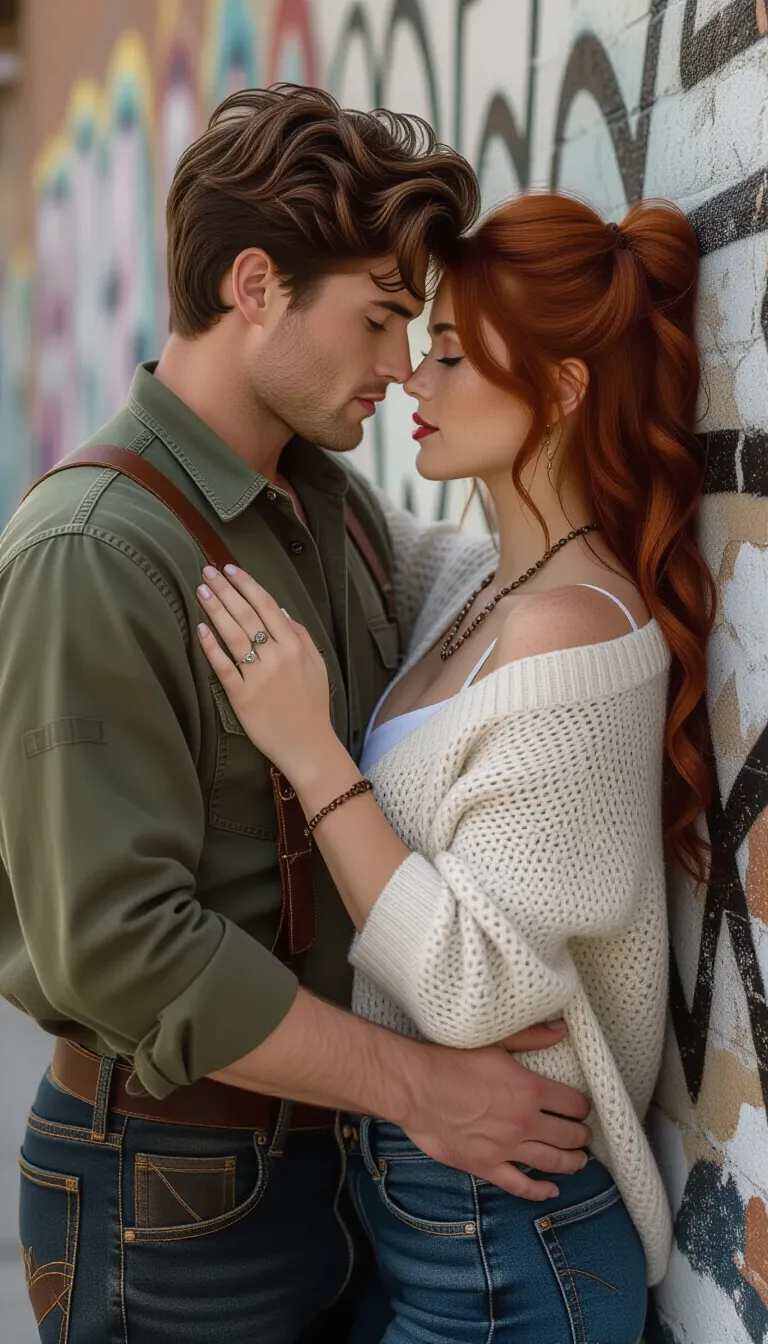
The stairwell trapped the cold too, a damp seeping through the thin soles of her shoes. She'd been standing at the first landing for what felt like hours, Mary pressed against the wall beside her, neither of them speaking. The street outside had gone quiet—no sirens, no shouts, no footsteps running. Just the distant hum of a city trying to forget what it had seen.
The warehouse door hadn't opened.
She'd counted to a hundred. Then again. Then lost track somewhere past the point where counting became prayer and prayer became a single word repeated until it lost all meaning. Declan. Declan. Declan.
"We should go," Mary whispered, her voice raw and cracked. "If he—if they—"
"No." Siobhan didn't recognize her own voice. It came from somewhere deeper than her chest, from the hollow place where hope had been before the bullet left her revolver. "He's coming."
Mary touched her arm. "Siobhan—"
A door opened somewhere below.
Siobhan's breath stopped. She turned, her hand finding the wall for balance, and listened to the sound of footsteps on concrete. Heavy. Limping. One foot dragging slightly, the other landing with deliberate weight. The sound echoed up the stairwell, and she knew that rhythm, knew the particular weight of that step, knew it the way she knew the feel of his hand on her spine in the dark.
She flew down the stairs without meaning to, her feet finding the steps through muscle memory, her hand sliding down the greasy rail. Mary called something behind her but she couldn't hear it, couldn't hear anything except the sound of his breathing getting closer—ragged, wet, alive—and then she rounded the corner and he was there.
Declan stood at the bottom of the stairwell, one hand braced against the wall, the other pressed to his side. His face was a mask of blood and exhaustion, his hair matted dark, his shirt torn at the shoulder. The rifle was gone. His jacket hung open, and she could see the dark stain spreading across his ribs.
He looked up. Their eyes met.
She didn't remember crossing the space between them. One moment she was at the top of the last flight, the next she was against him, her hands finding his face, his chest, his arms—checking, cataloging, proving he was real. He made a sound, something between a groan and a laugh, and then his arms came around her and he crushed her against the wall.
The concrete bit through her cardigan, cold and rough, but she didn't feel it. She felt only him—his heat, his weight, the way his body shook against hers. His forehead pressed to hers, his breath ragged and hot against her lips, and she felt the wetness on his cheek. Not blood. Something else.
"Declan." Her voice broke on his name. She raised her hands to his face, her thumbs tracing the lines of his jaw, the hollows beneath his eyes, the cut above his brow that still seeped red. "Declan, I—"
"I thought you were dead." He said it into her skin, his lips brushing her forehead, her temple, the corner of her mouth. "When I came down from the catwalk and you weren't there, I thought—" His voice cracked. "I thought he'd—"
"I thought you were dead," she whispered back, and he let out a sound that was half a laugh, half a sob, his whole body shuddering against hers.
"So did I." He pulled back just enough to look at her, his gray eyes dark and wet in the dim light of the stairwell. "So did I, Siobhan."
His hand found her waist. Then her hip. He pulled her closer, his fingers digging into the fabric of her skirt, his palm hot through the thin cotton. She felt the hard shape of the rosary beads at her wrist pressing between them, the small cross digging into her breastbone, and she didn't know if it was a blessing or a judgment but she didn't care.
She kissed him.
His mouth was salt and copper and the grit of the warehouse, and she tasted blood—his, someone else's, she didn't know—but she deepened the kiss anyway, her tongue finding his, her hands fisting in his hair. He groaned against her mouth and pressed her harder into the wall, his thigh sliding between hers, and she felt the desperate hunger in the way he held her, the way he kissed her, like he was trying to prove to himself that he was still alive, that she was still alive, that the bullet hadn't claimed either of them yet.
"I got your mother out," she said against his mouth, the words tumbling out between kisses. "She's upstairs. She's safe. I got her out, Declan."
He pulled back just enough to look at her, his forehead still pressed to hers, his breath coming in short, ragged gasps. "I know. I saw her at the door. She told me." His thumb traced the line of her jaw, gentle despite the urgency in his hands. "You saved her."
"We saved her."
"No." He shook his head, a single, sharp motion. "You pulled the trigger. You cut the ropes. You got her out the door while I was still up there fighting like a fool." A ghost of a smile crossed his face, barely visible in the dim light. "You saved her, Siobhan. You saved my mother."
She felt the tears then, hot and sudden, spilling down her cheeks before she could stop them. The fear she'd been holding at bay since she'd pulled the trigger rushed in to fill the space the relief had left, and she trembled against him, her hands gripping his shirt like he might disappear if she let go.
"I shot a man," she whispered. "I shot him and I don't know if he's dead and I don't—" Her voice broke. "I don't know if I care."
Declan's arms tightened around her. His lips found her forehead, her hair, the shell of her ear. "You did what you had to do. You did what I couldn't." His voice dropped, rough and low. "You saved us."
"I don't want to be the kind of person who shoots a man and doesn't care."
"You're not." His hand cradled the back of her head, his fingers threading through her hair. "You're the kind of person who saves her man's mother. You're the kind of person who faces down a gunman in a warehouse and walks out alive. You're the kind of person who—" His voice cracked again. "Who makes me believe I might survive this."
She kissed him again, softer this time, her lips barely brushing his. "You survived."
"We survived."
Behind them, footsteps on the stairs. Mary's voice, tentative and raw: "Declan?"
He pulled back from Siobhan slowly, his hands sliding down her arms until his fingers laced with hers. He didn't let go. He turned, pulling her with him, and looked up at his mother standing on the landing above them, her face streaked with tears and her hands still trembling from the ropes she'd worn.
"Mum." His voice cracked on the word. "I'm sorry. I'm so sorry I brought you into this."
Mary came down the stairs slowly, her hand trailing along the rail, her eyes fixed on her son's face. She stopped a step above them, looking at the blood on his shirt, the cut on his brow, the exhaustion written in every line of his body. Then she reached out and touched his cheek, her thumb brushing away a smear of blood.
"You came for me," she said, her voice barely above a whisper. "You and your girl. You came for me."
Declan's jaw tightened. "I should have been faster. I should have—"
"Stop." Mary's hand moved from his cheek to his shoulder, squeezing once. "You're alive. She's alive. I'm alive. That's more than we had any right to expect." She looked at Siobhan, and something shifted in her eyes—recognition, perhaps, or acceptance. "You're a brave girl."
Siobhan shook her head. "I was terrified."
"So was I." Mary's lips twitched into something that wasn't quite a smile. "Doesn't make it any less brave."
The stairwell fell silent. Somewhere above, a door opened and closed. A radio played—tinny, distant, a song she didn't recognize. The world continued outside this small, dark space, continued as if nothing had happened, as if the weight of the night hadn't settled into her bones like a second skin.
"We need to move," Declan said, his voice steadying. "Billy's men might regroup. The police might come. We need to find somewhere safe to lie low, at least until dawn."
Siobhan nodded, but she didn't let go of his hand. "Maeve's cottage? It's been burned."
"Not Maeve's." Declan's eyes met hers. "I know a place. A friend of my father's, out past Lisburn. He'll take us in, at least for a few days."
"Your father?" Mary's voice sharpened. "Declan, your father—"
"I know." He cut her off gently, his thumb tracing circles on the back of Siobhan's hand. "I know what he did. But this man isn't him. He's an old friend, a carpenter like me. He won't ask questions."
Siobhan looked at him. The blood on his face, the exhaustion in his eyes, the way he held himself like a man who'd been broken and put back together in the wrong order. She wanted to ask him about his father, about what the scarred man had told them in the lane, about the weight he was carrying that he wouldn't name. But now wasn't the time. The night wasn't over yet.
"Let's go," she said.
Declan nodded. He released her hand long enough to pull off his jacket, wincing as the movement tugged at his side. He wrapped it around his mother's shoulders, then turned back to Siobhan and held out his hand.
She took it.
They moved through the stairwell together, Declan leading, Siobhan at his side, Mary following behind. At the bottom, Declan pushed open the door and stepped out into the street. The air was cold and sharp, carrying the smell of rain and exhaust and something burning in the distance. The streetlights cast pools of yellow light on the wet pavement, and the silence was heavy, expectant, like the city was holding its breath.
Declan's hand found hers again in the dark.
"You came back," she whispered, the words slipping out before she could stop them.
He looked at her. The light caught his eyes, pale gray like the sea before a storm, and she saw something in them that made her chest ache. Not relief. Not exhaustion. Something deeper, something he'd been holding in reserve, something he'd been afraid to show until now.
"I would always come back," he said. "To you. Always."
She held his gaze, feeling the weight of the night pressing down on her, feeling the warmth of his hand in hers, feeling the future—uncertain and terrifying and possible—stretching out before them like a road she couldn't see the end of.
"Then let's go," she said. "Together."
He squeezed her hand. "Together."
They walked into the dark, the streetlights casting their shadows long and thin behind them, the warehouse door still open at their backs, the night still full of dangers they couldn't name. But for this moment, they were together, and for this moment, that was enough.
They walked two blocks before Declan stopped. His hand went to his side, pressing against the fabric of his shirt, and his breath came out in a sharp hiss that cut through the silence like broken glass.
"Declan." Siobhan was at his side before he could take another step, her hand covering his, feeling the wet warmth seeping through the cloth. "How bad?"
He didn't answer. He pulled his hand away and looked at his palm in the dim light of a distant streetlamp. Dark. Almost black in this light. "It's slowing," he said, but his voice was thin, and she heard the lie in it.
"Let me see." She tugged at the hem of his shirt, her fingers cold against his skin as she lifted the fabric. The wound was low on his ribs, a furrow carved by something that had passed close but not through—a graze, maybe, or a piece of shrapnel from the warehouse floor. It was still seeping, a slow dark pulse that traced a path down his side and disappeared into the waistband of his trousers. The skin around it was already beginning to bruise, purple and angry in the yellow light.
"Fuck." She breathed the word, not a curse but a prayer. "Declan, we need to stop the bleeding."
He shook his head. "Keep moving. If they find us on the street—"
"They won't find us if you bleed out in an alley." She was already pulling off her cardigan, the wool scratching against her arms as she bundled it against his side. "Press. Hard."
He took the cardigan from her, pressing it against the wound, and his jaw tightened. She watched the muscles in his neck go rigid, watched his eyes shutter as he rode the wave of pain. He didn't make a sound. Of course he didn't.
Mary had caught up to them, her breath ragged from the pace. She looked at the blood on Siobhan's hands, at the dark stain spreading through the cardigan Declan held against his side, and her face went pale. "We need a doctor."
"No," Declan said, the word flat and final. "No doctor. They'll ask questions. They'll report it."
"Declan—"
"No, Mum." He straightened, wincing, and met her eyes. "I've seen what happens when a Protestant boy walks into a Catholic hospital with a bullet wound. Questions follow. Names get passed. We'll be dead by morning."
Siobhan's hands were still on his arm, feeling the tremor running through him. He was cold. She could feel it—the way his skin had gone clammy, the faint shiver that moved through his shoulders every time he took a breath. The night air was cutting through his bloodied shirt, and he was losing heat faster than he could replace it.
"We need shelter," she said, her voice steadier than she felt. "Somewhere close. Somewhere I can clean this properly."
Declan's eyes met hers. For a moment, she saw something flicker in them—gratitude, maybe, or surprise that she was still here, still standing beside him, still refusing to let go. Then he nodded, a short sharp motion, and turned his head to look down the street.
"There's a church. Three blocks east. St. Peter's." He looked at Mary, then back at Siobhan. "The priest there, Father Connell, he's a friend of my father's. He won't ask questions."
"Your father's friend." Siobhan heard the edge in her own voice and didn't try to soften it. "The same father who—"
"I know." Declan's voice was quiet. "But it's close, and it's safe, and right now that's all we have."
Siobhan looked at Mary. The older woman's face was unreadable, her eyes fixed on her son with an expression that was equal parts fear and pride. She didn't speak, but she didn't argue either. That was answer enough.
"Show me the way," Siobhan said.
Declan moved, and she matched his pace, her hand still on his arm, her fingers pressing against his pulse point to make sure it was still there. He was slow now, his steps careful and deliberate, each one costing him something she could see in the set of his shoulders. The cardigan was dark against his side, and she didn't know if the bleeding had slowed or if the fabric had simply absorbed everything it could hold.
The streets were empty. The city held its breath around them, windows dark, doors locked, the silence of a place that had learned to mind its own business through long years of violence. A dog barked somewhere in the distance. A car passed two blocks over, its headlights sweeping across the walls before disappearing into the night. No one stopped them. No one looked out. Belfast had seen this before—people moving through the dark, blood on their clothes, secrets in their pockets—and Belfast knew better than to look.
The church rose out of the darkness like a ship breaking through fog. St. Peter's was old, its stone walls black with decades of soot and rain, its spire a dark finger pointing at a sky that offered no answers. A single light burned above the side door, casting a weak halo on the steps.
Declan stopped at the bottom of the steps, his hand braced against the iron railing. "Wait here."
"Like hell." Siobhan didn't let go of his arm.
He looked at her, and something in his face softened—a crack in the armor he'd worn all night. "I need to knock. He won't open the door if he sees a crowd."
Siobhan wanted to argue. She wanted to push past him and pound on the door herself, demand shelter in the name of God or country or whatever might move a priest's heart. But she saw the exhaustion in Declan's eyes, the way he was holding himself together by will alone, and she nodded.
"Two minutes," she said. "If you're not back in two minutes, I'm coming in."
His lips twitched. "I know."
He climbed the steps slowly, his hand never leaving the railing, and she watched him go, watched the way he swayed slightly with each step, watched the dark stain spreading across the bundled cardigan. Mary stood beside her, silent and still, her hands clasped in front of her like she was praying.
"He gets that from his father," Mary said suddenly, her voice low. "The stubbornness. The way he won't ask for help even when he's dying."
Siobhan didn't look at her. "He gets it from himself. He's not his father."
Mary was quiet for a long moment. Then: "No. No, he's not."
The door opened. A sliver of yellow light spilled out onto the steps, catching Declan's silhouette. There was a low murmur of voices—Declan's rough and tired, another voice older, softer, the cadence of someone who'd heard a hundred confessions and a thousand lies. Then the door opened wider, and Declan turned and gestured for them to come.
Siobhan climbed the steps with Mary close behind, and when she reached the door, she found herself face to face with a small man in a black cassock, his hair white and thinning, his eyes sharp and kind behind a pair of wire-rimmed glasses. He looked at her—at the blood on her hands, the tear in her sleeve, the exhaustion written in her face—and didn't flinch.
"You'd better come in," he said.
The rectory was small and warm, the kind of warmth that came from decades of candle wax and coal fires and human breath. Father Connell led them through a narrow hallway past a kitchen where a kettle sat on a cold stove, and into a sitting room cluttered with books and newspapers and a single armchair that had clearly been claimed by years of use. He gestured for Declan to sit, and Declan collapsed into the chair with a groan that he tried and failed to suppress.
"Let me see it," the priest said, already reaching for Declan's shirt.
Declan caught his wrist. "Father."
"I've dressed more wounds than you've cut boards, Declan Morrow. Your father and I spent the summer of '63 picking glass out of each other's arms after the march. Now let me see it."
Declan's hand fell away. Father Connell lifted the shirt, examined the wound with practiced eyes, and made a sound that was somewhere between a sigh and a grunt. "Clean graze. Missed the lung by two inches, maybe less. You were lucky."
"I don't feel lucky."
"You're alive." The priest looked at Siobhan. "There's a bathroom down the hall. Hot water, clean towels, iodine under the sink. Bring what you need."
Siobhan went. Her hands were shaking as she turned on the tap, as she waited for the water to heat, as she found the brown bottle of iodine and a stack of white towels that smelled of lavender. She caught her reflection in the mirror—hair wild, eyes too bright, a smear of Declan's blood across her cheek—and she didn't recognize herself. She looked like someone who'd walked through fire and come out the other side still burning.
She brought the supplies back to the sitting room. Father Connell had cleared a space on the low table beside the armchair, and Declan had stripped off his shirt, exposing the pale skin of his chest and the dark mess of the wound. In the warm light of the gas lamp, she could see the map of his body—the muscles built by years of lifting timber, the scars she hadn't noticed before, a thin white line across his ribs, a dark bruise blooming on his shoulder. She wanted to trace each one, learn the story of every mark.
Instead, she knelt beside him and began to clean the wound.
He hissed when the iodine touched his skin, his hand finding her shoulder and gripping hard enough to bruise. She didn't tell him to loosen his hold. She worked in silence, her movements steady and sure, wiping away the blood until she could see the true shape of the wound—a furrow maybe four inches long, deep enough to have laid the flesh open but not deep enough to have stolen him from her.
"You're good at this," Declan said, his voice tight.
"I have four younger brothers." She pressed a clean gauze pad against the wound and began to wrap the bandage around his ribs, her hands moving in practiced loops. "They're always falling out of trees or fighting with neighbors or doing something stupid that ends in blood."
"You patch them up?"
"Someone has to." She tied the bandage off, her fingers lingering on the knot. "They're too stubborn to go to a doctor."
He laughed—a short, broken sound that turned into a wince. "Sounds familiar."
She looked up at him. His face was pale, his eyes dark with exhaustion, but he was looking at her like she was the only solid thing in a world that had tilted off its axis. She wanted to hold him. She wanted to curl up against his chest and feel his heartbeat under her ear and pretend that the world outside this room didn't exist. But there was still blood under her fingernails, still a body in her memory—the man she'd shot, the way he'd fallen, the sound the gun made when she pulled the trigger. She couldn't pretend anymore.
"Declan." Her voice came out small. "I don't know who I am anymore."
He reached out and touched her face, his thumb tracing the line of her cheekbone. "You're the woman who saved my mother. The woman who walked into a warehouse full of armed men and didn't run. The woman who," his voice cracked, "shot someone to protect my family."
"That's not who I am." She felt tears burning behind her eyes. "That's not who I was supposed to be."
"It's who you had to be." He leaned forward, his forehead pressing against hers, his breath warm on her lips. "And I'm sorry. I'm sorry that I brought you into this. I'm sorry that you had to do that. I'm sorry that—"
"Stop." She closed her eyes. "Don't apologize for keeping me alive."
"I'm not apologizing for that." His hand slid into her hair, his fingers tangling in the strands that had come loose from her pins. "I'm apologizing for the cost."
She opened her eyes. He was so close she could see the flecks of darker gray in his irises, could count the lines around his eyes that she'd never noticed before. He looked older than he had a week ago. They both did.
"It's a price I'd pay again," she said. "Every time. For you."
His breath caught. She felt it—the hitch in his chest, the way his hand tightened in her hair. And then he kissed her, soft and slow and full of everything they couldn't say, and she melted into him, her hands finding his bare shoulders, her knees pressing against the edge of the armchair. He tasted of blood and salt and something darker—the exhaustion of a man who'd been running too long. She wanted to drink it down, swallow it whole, carry it for him so he didn't have to.
"I'm sorry to interrupt," Father Connell said from the doorway, his voice dry but not unkind. "But there's tea, and there's news, and I suspect you'll want both before you decide what to do next."
Siobhan pulled back, her cheeks flushing. Declan's hand stayed on her face for a moment longer before falling away.
Father Connell crossed the room with a tray—three cups of steaming tea, a plate of bread and butter, a small jar of jam. He set it on the table beside the medical supplies and lowered himself into a wooden chair that creaked under his weight. "Billy Patterson is dead."
The words landed like a stone in still water. Siobhan felt them ripple through her, felt the shock and the relief and the terror all tangled together in her chest. She looked at Declan. His face was blank, unreadable, but his hand had found hers and was holding on like a lifeline.
"How do you know?" he asked.
"The news reached me an hour ago. A friend of mine at the hospital—he calls me when there's something I need to know. They brought Billy in around midnight. Gunshot wound to the chest. He died on the table." The priest's eyes moved to Siobhan, and she felt the weight of his gaze like a hand on her shoulder. "There was a woman seen fleeing the warehouse. A redhead. The police are looking for her."
Father Connell's words hung in the air, heavy as smoke. The police were looking for her. Billy Patterson was dead. Declan's hand tightened on hers, his grip strong despite everything, but when she looked at him properly—really looked—she saw what she'd missed in the rush of the kiss and the bandaging. His face had gone the color of old paper, the skin around his mouth drawn tight, his pupils wide and dark. The hand that held hers was trembling, fine tremors running through his fingers like a wire pulled too taut.
"Declan." She said his name quietly, a warning she didn't understand until she looked down and saw the bandage she'd wrapped only minutes ago. A dark stain was spreading through the gauze, slow and inexorable, seeping from the center like ink bleeding through cloth. "Father—"
Father Connell was already moving, his cup of tea abandoned on the tray. He crossed to Declan's side in three quick strides and lifted the edge of the bandage. His face tightened. "The bleeding hasn't stopped. It's seeping through, not pumping—that's good, it's not an artery—but he's lost more blood than I thought." He looked at Siobhan. "I need you to hold pressure. Direct pressure, hard. Don't let up until I tell you."
She was on her knees beside the armchair before he finished speaking, her hands finding the bandage, pressing down with the heel of her palm. Declan gasped, his body going rigid, and she felt the heat of his blood seeping through the gauze, warm and wet against her skin. "I'm sorry," she whispered. "I'm so sorry."
"Don't," he said, his voice strained but steady. "Don't apologize." His hand covered hers, pressing down with her, adding his weight to the pressure. "You're keeping me alive."
Father Connell disappeared down the hallway, his footsteps quick and sure on the wooden floor. Siobhan counted his steps—seven, eight, nine—and then the sound of a cupboard opening, water running, something metal clinking against porcelain. She focused on Declan's face, on the gray pallor that had settled under his skin like fog rolling in over the mountains. His eyes were half-closed, his breathing shallow, and she could feel the tension in his body as he fought to stay present.
"Stay with me," she said. "Declan, stay with me."
"I'm here." His voice was barely a whisper. "I'm not going anywhere."
"You're not allowed to." She pressed harder on the bandage, and he winced, a sharp intake of breath that cut through the quiet of the rectory. "You promised. You said we survive together."
"I remember." His hand tightened on hers, his fingers cold now, the calluses rough against her skin. "I remember everything."
Father Connell returned with a metal basin full of hot water, a roll of clean white bandages, and a leather satchel that clinked with the sound of instruments. He set the basin on the table beside the armchair and opened the satchel, pulling out a curved needle, a spool of catgut, a pair of forceps. "The wound needs to be closed. It's deeper than I thought—the bullet didn't just graze him, it tore through the muscle. If we don't stitch it, he'll keep bleeding."
Siobhan's stomach turned. "Can you do it?"
"I've done it before." The priest's voice was calm, matter-of-fact, as if he were discussing the weather. "But I need you to hold him still. And I need you to keep pressure on until I tell you to move."
She nodded, not trusting her voice. Declan's eyes had drifted closed, his head lolling against the back of the armchair, and she could see the pulse beating in his throat—fast and thready, like a bird trapped in a cage. She pressed her free hand against his chest, feeling the rhythm of his heart, the rise and fall of his breathing. "Declan. Open your eyes."
He struggled to obey, his eyelids heavy, the gray of his irises dull and distant. "Tired," he said. "Just… tired."
"I know." She leaned in close, her lips brushing his ear, her voice low and fierce. "But you don't get to sleep yet. Not until Father Connell finishes. You stay awake for me. Do you hear me?"
He nodded, a small movement, but his eyes opened a little wider. "I hear you."
Father Connell had arranged his supplies on the table—the needle threaded, the forceps ready, a bottle of something dark that smelled sharp and medicinal. "This will hurt," he said, not as a warning but as a fact. "I don't have morphine. I don't have anything but whiskey and the grace of God."
"Then give him the whiskey," Siobhan said.
Father Connell reached into his satchel and pulled out a silver flask, unscrewed the cap, and pressed it into Declan's hand. "Drink. As much as you can."
Declan lifted the flask to his lips, his hand shaking, and drank. He coughed, sputtered, but kept going until the priest took the flask back. His eyes were watering, his face flushed with the burn of the alcohol, but there was a little more color in his cheeks. A little more life.
"Ready?" Father Connell asked.
Declan nodded. Siobhan moved her hands away from the bandage as the priest lifted it, revealing the wound—a dark furrow in the pale skin, the edges of the torn flesh already starting to darken with bruising. It looked worse than it had before, deeper, angrier, the blood welling up slowly from the exposed muscle.
Father Connell worked quickly, his hands steady and sure. He cleaned the wound again, poured the dark liquid over it—iodine, Siobhan realized, the smell sharp and chemical—and then he picked up the needle. "Hold him."
Siobhan moved behind the armchair, her hands finding Declan's shoulders, pressing him back against the upholstery. She could feel the tension in his muscles, the way he was bracing himself, the fine tremors running through his body. She leaned down, her cheek against his, her lips beside his ear. "I'm here. I'm right here."
The first stitch went in. Declan's whole body went rigid, a sound escaping his throat—not a scream, but something worse, a low animal noise of pure pain. His hand found hers, gripping so hard she felt the bones grind together, and she held on, held him, whispered nonsense words into his ear as Father Connell worked the needle through his flesh.
"Breathe," she said. "Breathe with me. In. Out. In. Out."
He tried. His breath hitched, stuttered, but he followed her rhythm, his chest rising and falling against her arm. She counted the stitches—one, two, three, four—each one a small eternity, each one a thread pulling him back from the edge. By the time Father Connell tied off the final knot and snipped the catgut, Declan was drenched in sweat, his shirt clinging to his chest, his face ashen.
"Done," the priest said, his voice heavy with exhaustion. He began to wrap the wound in clean bandages, his movements slower now, less urgent. "He needs rest. Real rest. And he needs fluids—water, broth, anything he can keep down. He's lost a lot of blood."
Siobhan eased her grip on Declan's shoulders, her arms aching, her hands trembling. She moved around to the front of the armchair and knelt beside him, her hands finding his face, tilting it toward her. His eyes were open, barely, the gray irises hazy but focused on her. "You did it," she said. "It's over."
"You," he said, his voice cracked and raw. "You held me."
"I'll always hold you." She pressed a kiss to his forehead, tasting salt and sweat and the sharp tang of iodine. "Always."
Father Connell gathered his supplies, his movements quiet and efficient. "There's a spare room upstairs. A bed, clean sheets. You can stay tonight—the police won't look for you here. They don't search churches." He paused at the doorway, his hand on the frame. "But you can't stay forever. Tomorrow, we'll need to figure out what comes next."
Siobhan nodded, not taking her eyes off Declan. "Thank you, Father."
"Thank me by keeping him alive." The priest's voice was soft, almost gentle. "And by keeping yourself alive too."
He left, his footsteps fading down the hallway, and they were alone in the warm light of the gas lamp. The fire had burned low in the grate, the coals glowing orange and red, casting long shadows across the walls. Siobhan could hear the clock ticking on the mantelpiece, the wind rattling the window frames, the distant sound of a car passing in the street. The world was still out there, still dangerous, still hunting them. But here, in this room, there was only the two of them.
"Can you stand?" she asked.
Declan laughed, a weak, broken sound. "I don't know. Let's find out."
She helped him rise, his arm over her shoulders, his weight heavy against her. He was taller than her, broader, and she could feel every inch of his exhaustion in the way he leaned on her, the way his steps faltered as they crossed the room. The hallway was narrow, the stairs steep, but she counted each step, each breath, each moment they moved together toward the room at the end of the landing.
The spare room was small—a single bed with a white quilt, a wooden crucifix on the wall, a window that looked out over the dark street. Siobhan lowered Declan onto the edge of the bed, and he fell back against the pillows with a groan, his eyes closing, his chest rising and falling in shallow breaths.
"Stay awake," she said, her voice sharp. "Just a little longer. Let me get you water."
His hand caught her wrist, his grip weak but insistent. "Don't go."
"I'm not going anywhere." She sat beside him on the bed, her hand finding his, threading their fingers together. "I'm right here."
He looked at her, his gray eyes dark in the dim light, and there was something in them she hadn't seen before—not fear, not desperation, but something deeper, something raw. "I thought I was going to die in that warehouse," he said, his voice barely above a whisper. "When I was on the catwalk, when I saw you running with my mother, I thought—I thought maybe that was the last time I'd see you. The last time I'd hear your voice."
"But you didn't die." She lifted his hand to her lips, pressed a kiss to his knuckles, felt the rough skin of his calluses against her mouth. "You're here. You're alive."
"Because of you." His voice cracked. "You shot a man for me. You killed someone."
The words landed like a blow. She felt them in her chest, in her stomach, in the hollow space behind her ribs where the guilt was already settling in. "I know," she said. "I know what I did."
"I didn't want this for you." His hand tightened on hers. "I didn't want you to carry this."
She looked at him—at the pale face, the dark circles under his eyes, the bandage wrapped around his ribs, the small patch of pink that was already seeping through the gauze. She thought about the man in the warehouse, the way he'd fallen, the sound the gun made when she pulled the trigger. She thought about the priest's words—the police were looking for a redheaded woman. She thought about her father, her brothers, her mother, the life she'd left behind in the narrow streets of the Falls Road.
She thought about all of it, and then she set it aside. There would be time to carry it later. There would be time to feel the weight of what she'd done. But right now, there was only this: Declan, alive, his hand in hers, his breath warm on her skin.
"I'd do it again," she said. "I'd do it a hundred times, a thousand times, if it meant keeping you alive." She leaned forward, her forehead pressing against his, her eyes closed. "I love you, Declan Morrow. And I will not let you die."
He was quiet for a long moment. She felt his breath on her lips, felt the tremble in his hand, felt the slow, steady beat of his heart under her palm. And then he spoke, his voice low and rough, barely more than a breath. "I love you too. God help me, I love you too."
She kissed him then—soft, slow, gentle, the way you kiss someone you thought you'd lost. He tasted of whiskey and blood and the salt of tears she couldn't tell were his or hers. His hand came up to cup her face, his thumb tracing the line of her cheekbone, and she leaned into his touch, into the warmth of him, into the fragile, impossible hope that they might survive this after all.
When she pulled back, his eyes were closed, his breathing evening out, the tension slowly leaving his body. She eased him down onto the pillows, pulled the quilt up to his chin, and sat beside him in the dark, watching the rise and fall of his chest, counting each breath like a prayer.
The clock on the mantelpiece ticked. The wind rattled the window. Somewhere in the city, the police were searching for a redheaded woman, and Declan's mother was waiting in a church pew, and the morning was coming—relentless, inevitable, full of questions she didn't know how to answer.
But for now, there was only this: the quiet of the room, the warmth of his hand in hers, the steady rhythm of his breathing. She pressed a kiss to his forehead, and she stayed.
The bed was narrow, the mattress thin, but when she eased herself down beside him, the springs barely shifted. She moved carefully, her body finding the space between his wounded side and the edge of the mattress, her head settling in the hollow of his shoulder like it had always belonged there. The quilt smelled of mothballs and lavender, and beneath that, the sharp tang of iodine and the copper of drying blood.
His arm came around her, slow and heavy, his hand resting on her hip. She felt the weight of it, the heat of his palm through the thin cotton of her blouse, and she let out a breath she hadn't realized she'd been holding. Her fingers found the fabric of his shirt, the one Father Connell had given him—plain white, too big in the shoulders, smelling of starch and candle wax—and she curled them into it, holding him the way a drowning person holds a rope.
"Your heart," she said. "It's racing."
"Yours too." His voice was a low rumble in his chest, vibrating against her cheek. She could feel the words more than hear them, a physical thing, a confirmation that he was still here, still alive, still breathing under her hand.
She pressed her palm flat against his sternum, counting the beats. Too fast, too hard, but steady. Steady meant alive. "Is it the wound?"
"No." His fingers found her hair, untucked it from behind her ear, let the strands fall across his chest. "It's you. It's always you."
She closed her eyes. The room was dark, the only light a thin strip of gray from the gap in the curtains—the streetlamp outside, maybe, or the moon. She could hear the wind in the eaves, the creak of old wood settling, the distant bark of a dog. Normal sounds. Safe sounds. The kind of sounds you heard in a house where no one was hunting you.
"I don't know what to do now," she said. "I don't know who I am anymore."
His hand stilled in her hair. "You're Siobhan. You're the woman who saved my mother. The woman who shot a man to keep me alive." He paused, and she felt his throat move as he swallowed. "You're the woman I love."
"But what if I don't recognize myself?" She lifted her head, propping herself on her elbow, looking down at him in the dim light. His face was all shadows and angles, the gray of his eyes barely visible, the line of his jaw sharp against the pillow. "What if I've become someone I don't want to be?"
He reached up, his hand finding her cheek, his thumb tracing the curve of her cheekbone. "Then we figure out who you are now. Together." His voice was rough, the words scraping out of him. "I don't know who I am either. I don't know what it means to be the son of a man who—" He stopped, his jaw tightening. "I don't know anything except this. You and me. Here. Alive."
She leaned down, her forehead pressing against his, her breath mixing with his. The guilt was still there, coiled in her chest like a snake, but it was quieter now, muted by his warmth, by the solid weight of his body beneath hers. "I keep thinking about his face," she whispered. "The man I shot. I barely saw it—it was dark, and I was scared, and I just—I pulled the trigger. But I keep thinking about it. What if I see him in my sleep? What if I never stop seeing him?"
"Then I'll be here." His hand slid from her cheek to the back of her neck, his fingers pressing gently into the soft hair at her nape. "Every time you wake up, I'll be here. I'll hold you until you fall asleep again. I'll hold you until you forget."
"I don't want to forget." She said it before she knew she was going to, the words rising out of her like a confession. "I want to remember. I want to remember what I did, so I never forget what I'm capable of. So I never let myself become someone who does it again."
He was quiet for a long moment. She felt his chest rise and fall beneath her, felt the slow rhythm of his breathing, felt the tension in his body as he searched for the right words. When he spoke, his voice was barely more than a breath. "That's the difference between you and them. You feel it. You carry it. They don't."
She closed her eyes. Her throat was tight, her eyes burning, the tears she'd been holding back finally spilling over. They fell onto his chest, dark spots on the white shirt, and she pressed her face into his shoulder, letting the sobs come silently, her body shaking against his.
He held her. That was all. His arm wrapped around her, his hand rubbing slow circles on her back, his cheek pressed against the top of her head. He didn't tell her it was okay, because it wasn't. He didn't tell her it would pass, because he didn't know if it would. He just held her, his body a steady warmth in the cold dark, and let her cry.
She didn't know how long she lay there. Minutes, maybe. An hour. Time had stopped meaning anything, broken into fragments of sensation—the roughness of his shirt against her cheek, the slow rhythm of his heartbeat under her ear, the smell of his skin beneath the iodine and the dust. She cried until there was nothing left, until the tears dried on her face and her breath came in slow, shuddering gasps.
When she finally lifted her head, his hand came up to wipe the wetness from her cheeks. His thumb was rough, callused, but his touch was impossibly gentle. "Better?" he asked.
She laughed, a broken sound. "I don't know. Maybe."
"Good enough." He shifted, wincing, his hand pressing against his bandaged side. "Help me move. I want to hold you properly."
She helped him turn onto his side, careful of the wound, the bandage catching the faint light from the window. He faced her, their bodies fitting together in the narrow bed, his arm sliding under her head, his leg hooking over hers. They lay chest to chest, his breath warm on her forehead, his hand resting on the curve of her waist.
"This is better," he said.
"Is it?"
"I can see you." His eyes found hers in the dark. "I can see that you're real."
She reached up, her fingers tracing the line of his jaw, the stubble rough under her fingertips. "You're the one who almost died. I should be the one checking if you're real."
"Check, then." He caught her hand, pressed it flat against his cheek, held it there. "Feel that? I'm here. I'm not going anywhere."
She let her hand rest against his face, feeling the warmth of his skin, the slight tremor in his jaw, the way his breath caught when she touched the edge of the bruise forming on his temple. "You have a cut here," she said. "Right at your hairline. I didn't see it earlier."
"Must have gotten it when I fell." He didn't pull away. "It's nothing."
She leaned in and pressed her lips to it, soft and slow, tasting salt and the faint metallic tang of drying blood. His breath hitched, and she felt his hand tighten on her waist. She kissed the corner of his eye, the bridge of his nose, the curve of his cheekbone, each kiss a small affirmation, a prayer spoken against his skin.
When she reached his mouth, he was already waiting for her. His lips parted under hers, and she felt the rush of his breath, the warmth of his tongue, the way his hand slid from her waist to the small of her back, pulling her closer. It wasn't desperate, not like the kiss in the stairwell. It was slower, deeper, a conversation they'd been having in the dark for months, a language made of touch and breath and the quiet sounds they made against each other's mouths.
She pulled back, her forehead resting against his. "I love you," she said. "I keep saying it, and I keep meaning it more than I did the last time."
"Then don't stop saying it." His thumb traced the line of her lower lip. "I want to hear it a thousand times. Ten thousand. Until I'm old and gray and deaf and I still feel it in my bones."
"I love you."
He smiled, a small thing, barely visible in the dark, but she felt it in the way his lips curved against hers. "I love you too."
She settled back against him, her head finding its place in the hollow of his shoulder, her hand resting over his heart. The quilt was pulled up to their chins, the rough wool scratching her cheek, but she didn't care. She was warm. She was safe. She was in his arms.
"What happens tomorrow?" she asked.
"We wake up." His fingers traced slow patterns on her arm. "We find my mother. We figure out where to go."
"And after that?"
"We keep waking up." He pressed a kiss to the top of her head. "Every day. Together."
She closed her eyes, letting his voice wash over her, letting the steady rhythm of his heartbeat lull her toward sleep. There were a thousand things to worry about—the police, the priest, the bodies they'd left behind, the lives they'd have to build from nothing. But they could wait. Tomorrow, she would pick up the weight of what she'd done and carry it. Tomorrow, she would be strong.
Tonight, she was just a woman in the arms of the man she loved, and that was enough.
"I'm going to fall asleep like this," she murmured. "Is that okay?"
"It's more than okay." His arms tightened around her. "Sleep. I'll watch."
"You need rest too."
"I'll rest when you're asleep." He paused. "I want to watch you breathe. I want to know you're still here."
She felt the tears prick at her eyes again, but she held them back. She was too tired to cry anymore. "You're a sentimental fool, Declan Morrow."
"I know." His voice was soft, warm, full of something that made her chest ache. "Go to sleep."
She let herself drift, her body heavy and warm, her mind finally quiet. The last thing she felt before sleep took her was his lips pressing a kiss to her hair, and the whispered words she wasn't sure she was meant to hear: "Thank you for staying alive."
She smiled against his chest, and let the darkness take her.
Declan stirred in the narrow bed, the rough wool of the blanket scraping his chin. His hand moved before his eyes opened, finding her face in the dark—his palm settling against her cheek, his thumb tracing the line of her jaw, a question asked in silence.
She was already awake. He felt it in the way her breath changed, the way her body tensed and then softened against his. Her hand came up to cover his, pressing his palm harder against her skin.
"I'm here," she whispered. "I'm still here."
His eyes opened. The room was dark, the window a rectangle of deeper black, but he could see the outline of her—the curve of her shoulder, the spill of her hair across the pillow, the way her eyes caught the faint light from somewhere. "How long was I out?"
"A few hours. Maybe more. Father Connell looked in once, but you didn't stir."
He shifted, the pain in his side a dull throb now instead of the sharp burn from before. His hand stayed on her face, his thumb moving across her cheekbone, her temple, the corner of her eye. "You didn't sleep."
"I did. A little." She paused. "I kept waking up to check if you were breathing."
"And was I?"
"Every time." Her voice cracked. "I don't know what I would have done if you weren't."
He pulled her closer, ignoring the ache in his side, the pull of the stitches. She came willingly, her face pressing into his chest, her breath warm through the thin fabric of his shirt. He held her there, his hand moving to the back of her head, his fingers threading through her hair.
"I keep thinking about it," she said, her voice muffled against his chest. "The warehouse. The man I shot. The way he fell."
"Don't."
"I can't help it. Every time I close my eyes, I see him."
He was quiet for a long moment. His hand moved down her back, slow, steady, a rhythm meant to calm. "What do you see?"
"The way he looked at me before he fell. Surprised. Like he didn't believe I'd actually pull the trigger."
"You saved my mother."
"I killed a man."
"You saved my mother," he repeated. "And you saved me. If you hadn't fired, Billy would have put a bullet through my back while I was on that catwalk."
She was quiet. He felt her fingers curl into his shirt, gripping the fabric like it was the only thing keeping her tethered.
"I don't feel guilty," she said, and her voice was small, broken, afraid. "I should feel guilty. I killed a man, and I don't feel guilty. What does that make me?"
He pulled back, just enough to look at her. His hands framed her face, tilting her chin so she had to meet his eyes. "It makes you someone who did what she had to do to survive. It makes you someone who saved the people she loves. Guilt comes later, if it comes at all. But don't you dare think that makes you a monster."
"Declan—"
"I've killed men too." The words came out flat, quiet, a confession spoken to the dark. "In the warehouse. Billy Patterson was the third man I've put in the ground. The first was a British soldier who pulled me over at a checkpoint and recognized my face from a wanted poster. The second was a loyalist gunman who tried to shoot my uncle in a pub on the Shankill."
She stared at him, her breath caught, her hands still gripping his shirt.
"I don't feel guilty either," he said. "I feel tired. I feel like I've spent my whole life running and fighting and bleeding, and I'm tired of it. But I don't feel guilty. And I don't think that makes me a monster. I think it makes me a man who's done what he had to do to keep breathing."
"How do you live with it?"
"One day at a time." His thumb traced the curve of her cheek. "One breath at a time. I hold onto the things that matter—my mother, the smell of sawdust, the way the light falls through the workshop window in the afternoon. And I hold onto you."
Her eyes were wet, but she didn't cry. She blinked, and the tears slid down her cheeks, silent and slow, and she let them fall without wiping them away.
"I don't know who I am anymore," she said. "I used to know. I was a teacher. A daughter. A good Catholic girl who went to Mass every Sunday and never said a bad word about anyone. And now I've shot a man and run from the police and lain in a bed with a Protestant who I love more than I thought it was possible to love anyone."
"You're still her," he said. "You're still Siobhan Connolly, the woman who corrects my grammar and smells like chalk dust and makes me believe that the world might be worth saving. You've just... found out what you're capable of. That's all."
"What if I don't like what I'm capable of?"
"Then you change. You choose to be something else. But you don't get to pretend the violence didn't happen. You carry it. You learn from it. And you let it make you gentler, not harder."
She was quiet for a long time. Her hand found his, their fingers interlacing in the dark, her grip tight and desperate.
"I love you," she said. "I love you so much it scares me."
"I know." He lifted her hand to his mouth and pressed a kiss to her knuckles. "I love you too. And it scares me too."
"What if we don't make it?"
"Then we don't make it. But we make it together, or not at all."
She let out a breath, a sound that was half a laugh and half a sob. "You and your grand declarations."
"You started it."
"I did." She shifted, her body pressing closer to his, her leg hooking over his hip. "I did start it. That first night in the butcher's, when I walked into that back room and saw you standing there, I knew I was going to love you. I knew it was going to destroy me, and I didn't care."
"You didn't show it."
"I was terrified." She laughed, a quiet, broken sound. "I was so terrified of how much I wanted you that I couldn't breathe. I kept thinking, 'This is wrong. This is a sin. This is going to get us both killed.' And then you looked at me, and I thought, 'I don't care. Let it be wrong. Let it be a sin. Let it kill me. At least I'll have had this.'"
He kissed her then, slow and deep, his hand cupping the back of her head, his fingers tangled in her hair. She made a sound against his mouth, a soft whimper that traveled through his chest and settled somewhere deep in his bones. He kissed her like he was memorizing the shape of her lips, the taste of her tongue, the way her breath caught when he bit down gently on her lower lip.
"I want to marry you," he said when he pulled back, his forehead pressed to hers. "I want to find a priest who doesn't care about the difference between Protestant and Catholic, and I want to stand in front of him and promise to love you for the rest of my life. And then I want to take you somewhere far away from Belfast, somewhere the Troubles can't find us, and I want to build you a house with my own hands."
She stared at him. "You're serious."
"I've never been more serious about anything."
"Declan, we're fugitives. We don't have papers. We don't have money. We don't have—"
"I don't care." His hand found her face again, his thumb brushing the tears from her cheeks. "I don't care about any of that. I care about you. I care about waking up next to you every morning and falling asleep next to you every night. I care about watching you smile and hearing you laugh and holding you when the world gets too heavy."
She closed her eyes, her breath shuddering. "You're going to make me cry again."
"Then cry. I'll catch every tear."
She did cry, then, quiet sobs that shook her shoulders, her face pressed into his neck, her tears warm against his skin. He held her through it, his hand moving in slow circles on her back, his lips pressing gentle kisses to her hair. He didn't tell her it was okay, because it wasn't. He didn't tell her everything would be fine, because he didn't know if it would be. He just held her, and let her fall apart in his arms, and trusted that she would find her way back to whole.
When the tears finally slowed, she pulled back, her eyes red, her nose running, her face a mess of grief and love and exhaustion. She laughed, a wet, broken sound, and wiped her face with the back of her hand.
"I'm a disaster," she said.
"You're my disaster."
She smiled, a real smile, small and fragile and beautiful. "That's the worst line you've ever said."
"I know. I'm a carpenter, not a poet."
"You read Yeats."
"Quietly. By candlelight. When no one's watching."
She laughed, and the sound was lighter, cleaner, like she was letting go of something heavy. She leaned in and kissed him, soft and sweet, a kiss that tasted of salt and hope and the beginning of something new.
"I love you, Declan Morrow."
"I love you too, Siobhan Connolly."
She settled back against him, her head finding its place in the hollow of his shoulder, her hand resting over his heart. The room was quiet except for the sound of their breathing, the distant creak of the old building settling around them, the faint whisper of wind through the cracks in the window frame.
"What happens tomorrow?" she asked again.
"We find my mother. We find a priest. We find a way out of this city."
"And if we can't?"
"Then we stay here. We build a life in this room. We learn to live on bread and prayer and the sound of each other's voices."
She smiled against his chest. "You're a romantic fool."
"I'm a romantic fool who loves you." He pressed a kiss to the top of her head. "Now sleep. We'll face tomorrow when it comes."
"You'll watch?"
"I'll watch."
She closed her eyes, her grip on his shirt loosening as her body relaxed into sleep. He watched her, the rise and fall of her chest, the flutter of her eyelids, the way her lips parted slightly with each breath. She was alive. She was in his arms. And for now, that was enough.
Outside, the first gray light of dawn began to seep through the curtains, casting long shadows across the room. But inside, in the narrow bed, wrapped in each other, they were safe.
The knock shattered the quiet like a stone through glass.
Declan's eyes flew open. His hand found the revolver under the pillow before his brain caught up, the cold metal grounding him in the present. Beside him, Siobhan jerked awake, her fingers digging into his chest.
"Stay here," he whispered, already swinging his legs over the edge of the bed.
"Declan—"
"Stay."
He crossed the room in three strides, pressing himself against the wall beside the window. The curtains were thin, threadbare linen that let the gray dawn light filter through in pale rectangles. He parted them with two fingers, just enough to see.
A car sat in the street below. Black. Unmarked. The engine still running, exhaust pluming into the cold morning air.
And on the doorstep, already turning to leave, a man in a dark coat. Declan's breath caught. He knew that walk, the slight drag of the left foot, the way the man carried his weight like he was always expecting a fight.
Uncle Liam.
The knock came again, harder this time. Three sharp blows that echoed through the small rectory like gunshots.
"Declan." Siobhan was behind him now, her hand on his bare back. "Who is it?"
"My uncle." He let the curtain fall. "Liam."
"The one whose company was on the papers."
"Aye." He turned, reaching for his trousers. "The same."
She was already pulling on her dress, her movements quick and certain. "What does he want?"
"I don't know." He fastened his belt, his fingers working automatically. "But he wouldn't come here unless it was important."
"Or dangerous."
He met her eyes. She was right, and they both knew it. Liam Morrow had built his transport company on the back of the Troubles, moving goods that no one asked about, for people who paid in cash and silence. If he was here, in a Catholic rectory, at dawn, it meant something had shifted.
"Stay behind me," Declan said.
"No."
"Siobhan—"
"I said no." She stepped past him, her hand closing around the door handle. "If he's here for you, he's here for me too. We're in this together, remember?"
He wanted to argue. He wanted to push her behind him and shield her from whatever was waiting on the other side of that door. But she was already pulling it open, standing in the frame with her chin lifted and her eyes hard.
Liam Morrow stood on the threshold, a dark silhouette against the gray morning. He was older than Declan remembered, his face lined and weathered, his hair shot through with silver. But his eyes were the same pale gray as Declan's, sharp and watchful, missing nothing.
"Declan." His gaze flicked to Siobhan, then back. "You need to come with me."
"Why?" Declan moved to stand beside Siobhan, his shoulder brushing hers. "What's happened?"
"Your mother's gone."
The words landed like a punch to the chest. Declan felt the air leave his lungs, felt Siobhan's hand find his, felt the world tilt and settle.
"Gone where?" he managed.
"I don't know." Liam's jaw tightened. "She left the church an hour ago. Said she had to see someone. Wouldn't tell me who."
"And you let her go?"
"I didn't let her do anything. She's your mother, Declan. You know what she's like when she's made up her mind."
He did. Mary Morrow had a stubborn streak that ran deeper than any river in Ireland, a will that had survived a husband's secrets and a son's disappearance and the endless gray weight of the Troubles. If she'd decided to go, no force on earth could have stopped her.
"Where would she go?" Siobhan asked, her voice steady. "Who would she need to see?"
Liam's eyes shifted to her, measuring. "I was hoping you might know."
Declan felt the question like a splinter under his skin. His mother had been tied to a chair in Billy Patterson's warehouse less than twelve hours ago. She'd watched her son fight for his life, watched a girl she barely knew pull a trigger to save her. And now she was gone.
"She wouldn't go to the police," he said slowly, working through it. "She doesn't trust them."
"She wouldn't go to the church," Siobhan added. "Father Connell is already hiding us. She wouldn't put him at more risk."
"Then where?" Declan's hand tightened on Siobhan's. "Who does she know that she'd trust enough to go alone?"
Liam shifted his weight, the floorboards creaking under him. "There's something you should know. About your father."
Declan's chest went cold. "What about him?"
"He wasn't just a soldier." Liam's voice dropped, low and careful. "He was an informant. For the British."
The words hung in the air between them, heavy and terrible. Declan felt Siobhan's grip tighten on his hand, felt the ground shift beneath his feet. His father. The man who'd taught him to read, who'd shown him how to hold a hammer, who'd read Yeats aloud by the fire on winter nights. An informant.
"That's not—" His voice cracked. "That can't be true."
"It is." Liam's face was unreadable. "I found the files after he died. Letters. Payments. Names." He paused. "Your mother knows. She's always known."
The room felt smaller, the walls pressing in. Declan's father had been a ghost all his life, a man of silences and shadows, of words left unsaid. But this—this was a different kind of ghost entirely.
"Why are you telling me this now?" Declan asked, his voice barely above a whisper.
"Because the men who killed him? They weren't the IRA." Liam met his eyes, steady and unflinching. "They were loyalists. Your own people. Someone found out what he was, and they sent word to the right people, and your father died in an alley with a bullet in his skull."
"And you let me believe it was the IRA all these years."
"I was protecting you."
"From what?"
"From the truth."
Siobhan stepped forward, her body a wall between Declan and his uncle. "Why are you here, Liam? Really?"
Liam's eyes flickered, something shifting in their depths. "Because your father—Declan's father—had a contact. Someone he trusted. Someone who might still be alive." He reached into his coat and pulled out a folded piece of paper, creased and yellowed with age. "This is an address. In Derry. Your mother went there."
Declan took the paper, his fingers brushing against his uncle's. The address was written in his father's hand, the familiar slant of the letters, the way the 'g' looped back on itself. He'd seen that handwriting a thousand times, on shopping lists and birthday cards and the margins of books. Seeing it now, on a paper that held the key to his mother's disappearance, felt like a wound reopening.
"Who lives there?" he asked.
"A woman. She was your father's contact. She knows things—about the network, about who's safe and who's not. If anyone can help you get out of Belfast, it's her."
"And you trust her?"
"I trust that your father trusted her. That's all I have."
Declan stared at the address, the paper trembling in his hand. His mother was out there, somewhere, walking into a city that hated her, to meet a woman she'd never met, to find a way to save her son.
"We need to go," Siobhan said, her voice quiet but firm. "We need to find her before something happens."
"You can't go now," Liam said. "The streets are crawling with Patterson's men. They know you killed Billy, and they want blood."
"Then we wait?" Declan's voice rose, the anger breaking through. "We sit here while my mother walks into God knows what?"
"No." Liam reached into his coat again, pulling out a set of keys. "There's a car around the corner. Blue Ford. Engine's good, tank's full. I'll draw them off, give you a head start."
"Why?" Siobhan asked, the question sharp. "Why are you helping us?"
Liam's gaze was heavy, older than his years. "Because I watched my brother die in an alley, and I did nothing. Because I've spent twenty years carrying that guilt, and I'm tired of carrying it." He looked at Declan. "You're the only family I have left. I won't let you die the same way."
Declan felt something crack in his chest, a wall he didn't know he'd built. He stepped forward and pulled his uncle into a rough embrace, feeling the older man's surprise, then the slow relaxation of his shoulders.
"Thank you," Declan said, his voice muffled against Liam's coat.
"Don't thank me yet." Liam pulled back, his eyes wet. "Thank me when you're both out of this city and safe."
He turned to leave, then paused, his hand on the doorframe. "Declan. Your father loved you. More than you'll ever know. Everything he did, he did to protect you."
And then he was gone, the door closing behind him, the sound of his footsteps fading down the stairs.
Declan stood in the silence, the address burning in his hand. He felt Siobhan's arms wrap around him from behind, her cheek pressing against his bare back.
"We're going to find her," she said. "We're going to get out of this."
He turned, pulling her into his arms, burying his face in her hair. She smelled of sleep and lavender and the faint copper of old blood, and she was solid and real and alive.
"I love you," he said, the words scraping out of him. "I love you, Siobhan."
She tilted her head up, her green eyes meeting his gray ones. "I love you too, Declan Morrow. Now let's go find your mother."
He kissed her, quick and hard, a promise and a prayer. Then he let her go, reaching for his shirt, his boots, the revolver that had saved her life.
Outside, the gray dawn was breaking over Belfast, the city stirring to life around them. Somewhere in the streets, Patterson's men were hunting. Somewhere in Derry, his mother was walking into the unknown. And somewhere in the space between heartbeats, Declan Morrow chose to believe that love was stronger than the Troubles, that hope could survive the gunfire, that two people holding onto each other might just be enough.
They slipped out the back of the rectory, through the garden, over the wall. The blue Ford was where Liam had promised, tucked between a baker's van and a pile of rubbish. Declan slid into the driver's seat, Siobhan beside him, the address on the dashboard between them.
The engine turned over with a low growl. He pulled out onto the street, the city unfolding around them, gray and beautiful and dangerous.
"Derry," Siobhan said, her hand finding his on the gearshift. "We're going to Derry."
"We're going to find her," he said, gripping her fingers. "We're going to find her, and then we're going to find a way out of this country."
"And then?"
He glanced at her, the morning light catching the red in her hair, the freckles scattered across her nose, the quiet strength in her eyes.
"And then we build a life," he said. "Together."
She smiled, small and fragile and beautiful, and squeezed his hand.
The city fell away behind them as they drove north, toward the border, toward Derry, toward whatever waited for them on the other side of the dawn.
The road north unfurled through the morning gray, fields of wet green stretching to the horizon. Declan kept the Ford at exactly the speed limit, his knuckles white on the wheel, every mirror checked twice.
"What do you know about this woman?" he asked, his voice flat. Controlled.
"Her name is Margaret. She worked with my father during the hunger strikes. He said she's clever and she's careful."
"And she lives in Derry."
"She has a flat on the Creggan estate. Near the border."
The name of the estate settled between them like a stone. Catholic. Republican. A place where a Protestant voice would draw attention, where a man with a Belfast accent might be questioned before he was helped.
"I need to do the talking when we get there," Siobhan said.
"No."
"Declan—"
"She's meeting my mother. I'm not letting you walk into something blind."
"And I'm not letting you walk into the Creggan with that accent and that face." She turned in her seat, her eyes steady on him. "You look like a Prod from the Shankill. You sound like one. There are men in Derry who would shoot you for crossing the street wrong."
His jaw tightened. He knew she was right. He hated that she was right.
"Then we go in together," he said. "We find this Margaret, and we don't leave until I see my mother's face."
The landscape shifted as they crossed the border—no checkpoint, no fanfare, just a sign welcoming them to the Republic and a subtle change in the quality of light. The checkpoint north of Newry that had nearly caught them felt a lifetime ago, but the fear sat in Declan's chest, patient and familiar.
"What do we do if she's not there?" Siobhan asked quietly.
"She'll be there."
"But if she's not."
He didn't answer. The silence stretched, filled with the hum of the engine, the slap of wet tires on tarmac.
"Then we keep looking," he said finally. "We find someone who knows where she went. We follow the trail."
"And if the trail leads to Patterson's men?"
"Then we finish what we started."
Siobhan reached across and placed her hand on his thigh. Her palm was warm, grounding. He let out a breath he hadn't realized he was holding.
"I'm not losing you," she said. "Not after finding you."
"You won't."
"You can't promise that."
He glanced at her, his gray eyes meeting her green ones. "I can promise I'll try. I can promise I'll fight. I can promise that every breath I take from now until the day I die, I'll spend trying to get back to you."
Her hand tightened on his thigh. She looked away, out the window at the passing fields, but not before he saw the glint of tears in her eyes.
"That's not a small thing," she said, her voice rough.
"It's not a small thing. It's everything."
They drove in silence for a while, the road curving through small towns with shuttered shops and empty streets. In one village, a group of children kicked a football in a wet playground, their laughter carrying through the rain. In another, an old man sat on a bench outside a pub, watching the road with the careful patience of someone who'd seen too much to be surprised by anything.
"What happens after?" Siobhan asked.
"After Derry?"
"After we find your mother. After we get out."
Declan thought about it. He'd been running so long he'd stopped imagining what standing still might feel like.
"I don't know," he admitted. "I've never thought past survival."
"Think now."
He took a breath, the question settling into him like a seed. "A place by the sea. Somewhere quiet. I could build things—furniture, cabinets. There's always work for a carpenter."
"Where?"
"Donegal, maybe. Or the west coast. Somewhere the Troubles can't reach."
"They reach everywhere."
"Some places slower than others."
She was quiet, her hand tracing idle patterns on his thigh. "I'd like to see the sea," she said. "Every day. Wake up and hear the waves."
"We could have a garden. Grow vegetables. Keep chickens."
She laughed, a small surprised sound. "You want to keep chickens?"
"I want to keep you. The chickens are negotiable."
She leaned over and kissed his cheek, quick and warm. "I love you, Declan Morrow. Even if you do have ridiculous ideas about poultry."
"I'll take that as a yes."
"Take it as a maybe. I'll need to see the quality of the chicken coop before I commit."
He smiled, the first real smile in what felt like years. It cracked the tension in his chest, let in a sliver of light.
Ahead, the road curved through the foothills of the Sperrins, the mountains rising dark against the gray sky. A signpost read DERRY — 28 MILES.
"We need a plan," Siobhan said, her voice shifting back to business. "Something more specific than 'find Margaret and hope for the best.'"
"You know the city?"
"I've been twice. Once for a cousin's wedding, once for a funeral." She paused. "I know the Creggan is rough. High unemployment, lots of surveillance. The Brits watch the estate like hawks."
"So we need to be invisible."
"We need to not be there longer than we have to. Find Margaret, get your mother, leave."
"And if my mother isn't there?"
Siobhan was quiet for a long moment. "Then we find out where she went. We follow the trail. We don't stop until we find her or we find proof she's gone."
The word hung between them. Gone. It could mean so many things in this country. Disappeared. Arrested. Dead.
"I won't leave her," Declan said. "Not after everything she sacrificed to keep me safe."
"I know." Siobhan's voice was soft. "I wouldn't ask you to."
They passed through another village, the houses growing closer together, the signs becoming bilingual—English and Irish standing side by side. The border was behind them now, but the weight of it followed, the knowledge that they'd crossed into a country that might offer them safety or might swallow them whole.
"We need money," Siobhan said. "For petrol. For food. For bribes, if it comes to that."
"I have some. A few hundred pounds Liam gave me."
"That won't last long."
"It'll get us to Derry. After that, I'll figure something out."
"You can't just 'figure something out'—"
"Siobhan." He cut her off, not sharp, but firm. "I've been surviving in Belfast for fifteen years. I know how to find money when I need it. Trust me."
She held his gaze, then nodded. "I trust you."
The road climbed, the mountains closing in on either side. Rain began to fall, light at first, then heavier, the wipers struggling to keep the windscreen clear. Declan slowed, the visibility dropping to a few hundred yards.
"There's a lay-by up ahead," Siobhan said, studying the map. "We could pull over, wait for it to ease."
"We don't have time to wait."
"We don't have time to crash either."
He grunted, but he eased off the accelerator, the Ford's speed dropping to a crawl. The rain hammered the roof, a dull roar that filled the cabin and made the world beyond the glass a smear of green and gray.
"Tell me something," Siobhan said, her voice quiet against the rain. "Something I don't know about you."
He frowned. "Like what?"
"Anything. When this is over, I want to know everything. But for now, give me something to hold onto."
He thought about it, the question settling into the quiet spaces of his mind. "I used to build boats," he said finally.
"Boats?"
"Small ones. Rowboats. When I was a boy, my father had a workshop near the river. He'd let me help him shape the wood, sand the hulls. I loved the smell of it—the sawdust, the varnish, the river."
"What happened to the workshop?"
He was quiet for a long moment. "The Troubles happened. My father closed it after the bombing campaign in '72. Said it wasn't safe anymore, having a workshop that close to the river. Too easy for someone to use it as a hideout."
"Do you miss it?"
"Every day."
Siobhan reached out and traced his jaw, her fingers light against his skin. "We'll build you a new workshop. By the sea. With big windows that let in the light."
He caught her hand, brought it to his lips, kissed her knuckles. "I'd like that."
The rain began to ease, the gray brightening as the clouds thinned. Declan increased the speed, the Ford eating up the miles toward Derry.
"What about you?" he asked. "What's something I don't know?"
She considered it, her gaze distant. "I used to write poetry."
"Poetry?"
"In school. I even won a prize once, for a poem about the Foyle." She smiled, a faint, self-deprecating thing. "It was terrible. Full of words like 'ancient' and 'whisper' and 'forever.' But I loved it. I loved the way words could hold a feeling."
"Do you still write?"
"No. I stopped after my mother died. It felt frivolous, somehow. Like I didn't deserve to make beautiful things when the world was so ugly."
He squeezed her hand. "Maybe you deserve it more."
She looked at him, her green eyes soft. "Maybe."
The road descended into the Foyle valley, the city emerging through the thinning rain—a sprawl of gray stone and red brick, the river cutting through its heart like a scar. On the west bank, the Creggan estate rose on the hillside, a maze of terraced houses and narrow streets.
Declan's hands tightened on the wheel. "That's it."
"That's it." Siobhan sat up straighter, her eyes scanning the approaching skyline. "We need to find a phone box. Call the number your father gave you."
"And say what?"
"Say we're here. That we need to meet Margaret. That we've come for Mary."
He nodded, the plan solidifying in his mind. Find a phone. Make the call. Get directions. Move fast.
"There," Siobhan said, pointing. "By the petrol station."
Declan pulled in, the Ford bumping over the cracked tarmac. The phone box stood at the edge of the forecourt, its glass panels etched with graffiti, the receiver dangling from its cord like a hanged man.
"I'll do the talking," she said, reaching for the door handle.
"Siobhan—"
"I'm Catholic. I'm from Belfast. I know how to talk to Republican women." She met his eyes. "Trust me."
He wanted to argue. He wanted to wrap her in his arms and never let her out of his sight. But she was right, and he knew it, and that knowledge sat in his chest like a stone.
"Be careful," he said.
"Always."
She slipped out of the car, crossing the wet forecourt to the phone box. He watched her feed coins into the slot, watched her dial the number from the slip of paper, watched her press the receiver to her ear and wait.
The seconds stretched. The rain began again, light and persistent, beading on the windscreen. Declan's hand drifted to the glove compartment, where the revolver sat wrapped in a cloth.
Siobhan's lips moved. She was talking. Her shoulders relaxed slightly, and she nodded, her hand coming up to gesture as she spoke.
Then she hung up and walked back to the car, her face unreadable.
She slid into the passenger seat, the rain dotting her shoulders, her hair beginning to curl with the damp.
"She's expecting us," Siobhan said. "Number 47, Creggan Heights. Top floor. She said your mother arrived this morning and she's safe."
Declan's breath left him in a rush. "She's safe."
"She's safe." Siobhan reached over and took his hand. "She's waiting for you."
He closed his eyes, the relief washing through him like a tide. His mother was alive. She was here. They were going to see her.
"Let's go," he said, his voice rough.
He pulled out of the forecourt, turning toward the Creggan, toward the narrow streets and the terraced houses and the woman who had carried him and fed him and loved him through twenty-eight years of a country that tried to break them both.
Siobhan's hand stayed in his, warm and steady, as the city swallowed them whole.
He didn't wait for her to finish the sentence. His hand was already on her jaw, tilting her face up, his mouth finding hers like a man surfacing for air.
The kiss was not gentle. It was desperate and quick, all teeth and breath and the salt of sweat and rain and blood they'd both shed. Her back hit the passenger door, the handle digging into her spine, and she didn't care. His fingers tangled in her damp hair, pulling, holding, like she might disappear if he let go.
She tasted copper. His. Hers. She couldn't tell anymore.
"I thought—" she started, her voice breaking against his lips.
"Don't," he said, the word rough, almost a command. He pressed his forehead to hers, his breath coming in short, ragged bursts. "Don't say it. I'm here. We're here."
She felt the tremor in his hands. The fine, constant shaking that hadn't stopped since the warehouse. She felt it in his chest, too, pressed against hers, the wild drum of his heart beneath the blood-stained shirt.
"I killed him," she whispered, and the words hung between them, heavy and cold. "I killed Billy Patterson."
Declan's thumb traced her cheekbone, wiping away something—rain or tears, she didn't know. "You saved us."
"I killed a man."
"And I killed three." His voice cracked, but he didn't look away. "We're even now. We're both damned."
She laughed, a sound that was half a sob, and kissed him again. Quicker this time. Harder. Like she was trying to burn the confession out of her throat and onto his tongue.
His hand slid down her neck, over her collarbone, resting over her heart. She could feel the weight of it, the warmth, the way his fingers trembled against her skin.
"I thought you were dead," she said, her voice barely a whisper. "When I ran. When I looked back and the door didn't open. I thought—"
"I know." He kissed her forehead, her temple, the corner of her eye where a tear had escaped. "I know, Siobhan. I'm sorry."
"Don't be sorry. Just—" She grabbed his collar, pulling him closer, her knuckles white against the fabric. "Just stay. Stay alive."
"I will."
"Promise me."
"I promise."
She held his gaze, searching for the lie she knew wasn't there. His gray eyes were clear, steady, holding hers with a certainty that made her chest ache.
"We should go," she said, but she didn't move. Neither did he.
The rain drummed on the roof of the Ford, a steady, relentless rhythm. The windscreen had fogged, blurring the world outside into a wash of gray and green. They were alone in the small, wet capsule of the car, suspended between the warehouse and whatever came next.
"My mother," he said. "She's waiting."
"I know."
"I need to see her."
"I know." She reached up, her fingers tracing the line of his jaw, the stubble rough against her skin. "But first—"
She kissed him again. Slower this time. A kiss that tasted of fear and hope and the salt of tears she hadn't let herself shed until now. His hand found the back of her neck, pulling her closer, and she let herself sink into it, into him, into the warmth of his mouth and the solid weight of his body against hers.
When they broke apart, they were both breathing hard.
"Okay," she said, her voice steadier now. "Now we go."
He nodded, his forehead still pressed to hers. "Okay."
Neither of them moved.
"Declan."
"Yeah?"
"I love you."
He closed his eyes, and she saw his jaw tighten, the muscles working as he swallowed against the emotion rising in his throat. "I love you too, Siobhan Connolly. More than I know how to say."
She smiled, a small, fragile thing, and pressed one last kiss to the corner of his mouth. "Then show me. After we find your mother. After we get out of this country. Show me every day for the rest of our lives."
He laughed, a sound that was half a sob, and pulled her into his arms, burying his face in her hair. She felt his breath hot against her neck, felt the shudder that ran through him, felt the way his hands gripped her like she was the only solid thing in a world that had turned to water.
"I will," he said, his voice muffled against her shoulder. "I swear it."
The rain kept falling. The engine ticked as it cooled. Somewhere in the Creggan, a woman who had carried him and fed him and loved him through twenty-eight years of war was waiting in a top-floor flat, counting the minutes until she saw her son again.
Siobhan pulled back, her hand finding his, their fingers interlacing on the seat between them.
"Let's go get your mother," she said.
Declan looked at her, his gray eyes bright with something that might have been hope, might have been fear, might have been both. He raised their joined hands to his lips and kissed her knuckles, a gesture so tender it made her chest ache.
"Together," he said.
"Together."
He turned the key. The engine coughed, sputtered, caught. The Ford pulled away from the phone box, turning into the narrow streets of the Creggan, the rain washing the blood from the windscreen as they drove toward the woman who had been waiting her whole life to see her son come home.