
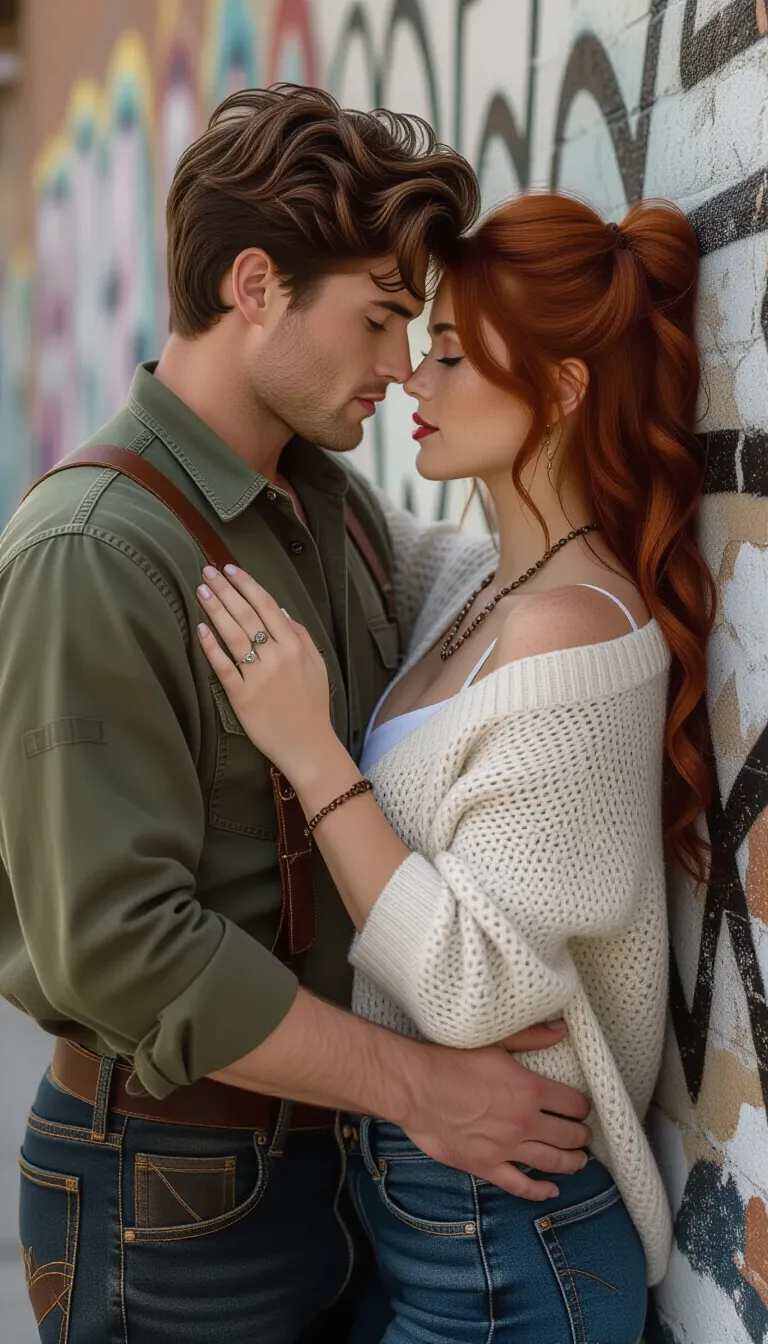
The wet lane smelled of damp wool and horse sweat, the cobblestones slick underfoot. A single lantern hung from a rusted bracket, its dim light pooling on the stones like spilled tea. Declan rounded the bend first, and there they were—three men, one with a shotgun resting on his shoulder like a farmer's tool, casual as if he'd come to mend a fence.
Declan stepped in front of Siobhan without thinking, his arm coming across her chest. "Get back."
She shoved past him. Her chin lifted, her voice cutting through the gray air. "You're looking for me, not him."
The man with the shotgun laughed—a dry rasp, like stones grinding together. He was older than Declan had expected, maybe fifty, with a face like cracked leather and eyes that had stopped caring a long time ago. "Is that what you think, girl?"
"I know who you work for." Siobhan's voice didn't waver. "Billy Patterson wants me. So take me and leave him."
"Billy Patterson." The man said the name like it tasted bad. He shifted the shotgun to his other shoulder, the motion unhurried. "I don't work for Billy Patterson."
Declan's blood went cold. He reached for Siobhan's wrist, tried to pull her back behind him, but she held her ground.
"Then who?" she said.
The man took a step closer. The lantern light caught the side of his face, and Declan saw the scar—a jagged line from temple to jaw, pale and puckered. Old. Professional.
"You're Declan Morrow." It wasn't a question. The man's eyes found him, measured him, dismissed him. "Your father was William Morrow. 1st Battalion, Parachute Regiment."
The words landed like a punch. Declan felt Siobhan's hand go limp in his grip.
"I don't—" Declan started.
"Bloody Sunday," the man said. "Your father was there. I know because I was there too. On the other side."
Siobhan's body went rigid beside him. Her hand slipped free of his.
"That's not—" Declan's throat closed. "My father never—"
"He fired into the crowd. I watched him. I watched him put a round into a boy who was running away." The man's voice was flat, reciting facts. "The boy was my cousin. Sixteen years old. Unarmed."
"That's not true." The words came out weak, and Declan hated how they sounded. "My father was a carpenter. He built furniture. He never—"
"He was a soldier first. The carpentry came after, when the blood was dry enough to scrub off his boots."
Declan's hands were shaking. He couldn't stop them. He looked at Siobhan, and her face was pale, her green eyes fixed on the scarred man like she was trying to find an exit in his face.
"I didn't know," he said to her. "I swear to God, I didn't know."
She didn't answer. Her hand was still loose at her side, not reaching for him.
The scarred man watched them both, patient as a cat. "You think I care what you knew? You think the boy's mother cared that the man who killed her son was just following orders?"
"What do you want?" Siobhan's voice was steady, but Declan heard the crack in it. "If you're not here for Billy, what do you want?"
"I want him to know." The scarred man nodded at Declan. "I want him to carry it. The way I've carried it. The way that boy's mother carried it until she died of a broken heart five years later."
Declan's throat burned. "You can't—"
"I can." The man stepped closer. Close enough that Declan could smell him—cigarettes and old sweat and something metallic. "Your father is dead. I checked. Died in his bed, didn't he? Peaceful. No one came for him."
"He died of a heart attack." Declan's voice was raw. "He was sixty-three."
"Sixty-three. That's twenty-three years more than my cousin got." The scarred man's eyes didn't blink. "But you're not your father, are you? You're just the son who has to live with it."
Siobhan moved. Not away from Declan—closer. She stepped between him and the scarred man, her shoulders squared, her red hair catching the lantern light like a flag.
"You've had your say," she said. "Now tell us what you want, or get out of our way."
The scarred man looked at her. Really looked at her, like he was seeing her for the first time. The corner of his mouth twitched. "You're the Catholic girl. The schoolteacher."
"I am."
"You know what his father did. You know what his people did to your people. And you're still standing next to him."
"I know exactly who he is." Her voice was stone. "And I know who you're not. You're not Billy Patterson's man. You're not the IRA. You're just a bitter old man with a shotgun and a grudge."
The two men behind the scarred man shifted, hands moving toward their belts. Declan stepped forward, ready—
The scarred man held up a hand. They stopped.
"You've got nerve," he said to Siobhan. "I'll give you that. But nerve won't save you from what's coming."
"And what's that?"
"Billy Patterson knows you crossed the border. He knows you're coming back. He's got your mother, boy." The scarred man's eyes slid to Declan. "And he's got twenty men waiting at that warehouse on Dover Street. Not twelve. Twenty. And they're not there to talk."
The weight of it pressed down on Declan's chest. Twenty men. His mother. A warehouse. A bullet waiting for him.
"Why are you telling us this?" Siobhan said.
"Because I want to see what happens." The scarred man smiled, and it was not a kind smile. "I want to see if the Protestant boy walks into that warehouse for his mother. I want to see if the Catholic girl follows him. And I want to see if either of you makes it out."
He turned and walked back toward the other two men. The one with the shotgun followed, the barrel glinting in the lantern light.
"Wait—" Declan started.
The scarred man stopped. Didn't turn around. "There's a farmhouse three miles east of the warehouse. Abandoned. There's a woman there who might help you, if you can convince her."
"Who is she?"
"Someone who owes me a debt." He started walking again. "Don't waste it."
The three men disappeared into the gray mist, their footsteps fading on the wet cobblestones. The lantern swung in the sudden silence, casting long shadows that stretched and shrank like breathing.
Declan stood frozen. His hands were still shaking. He looked at them—his hands, the same hands that had held her, touched her, promised her—and they looked like strangers' hands.
"Declan."
He didn't look up.
"Declan." Siobhan's hand found his. Warm. Steady. "Look at me."
He did. Her green eyes were wet, but she wasn't crying. She was looking at him the way she looked at everything—like she was memorizing it, cataloguing it, deciding what to do with it.
"I didn't know," he said again. "About my father. About Bloody Sunday. I swear to God, I didn't know."
"I know."
"He never talked about it. He never—he was just my da. He built things with his hands. He read the paper. He drank tea and watched the news and never said a word about—"
"Declan." She squeezed his hand. "I believe you."
"How can you?" His voice cracked. "How can you look at me and not see—"
"I see you." She stepped closer. Her free hand came up to his face, her palm pressing against his cheek. "I see the man who carved a bird for me. The man who held me when I cried. The man who promised to burn this city down before he let anyone hurt me."
"My father killed people."
"Your father was a soldier. He did what soldiers do. And I'm not saying I forgive it—I don't even know how to think about it yet—but I know you're not him."
"How?"
She held his gaze. "Because you're standing here, shaking, terrified that I'll see you differently. That's not the face of a man who inherited his father's sins. That's the face of a man who inherited his conscience."
Something broke open in his chest. He pulled her into his arms, buried his face in her hair, breathed in the smell of her—lavender and chalk dust and the faint salt of tears she hadn't shed yet.
"I love you," he said into her hair. "I love you so much it terrifies me."
Her arms tightened around him. "Then let's go get your mother back."
He pulled back. Looked at her face—the freckles across her nose, the green eyes that had seen him at his worst and hadn't flinched, the stubborn set of her jaw.
"You don't have to come," he said. "You could stay here. Wait at the cottage. Let me—"
"No."
"Siobhan—"
"I said no." Her voice was sharp. "We made a promise. Together or not at all. I meant it."
"Twenty men, Siobhan. With guns. Billy Patterson wants you there so he can watch me die."
"Then we find a way to make sure neither of us dies." She grabbed his hand, started walking back the way they'd come. "First, we find that farmhouse. Then we find this woman who owes the scarred man a debt. Then we figure out how to get your mother out without walking into a massacre."
He followed her because he didn't know what else to do. Because she was walking like she knew where she was going, and he had stopped knowing anything at all.
The lane curved, and the cottage came back into view. Maeve Connolly was standing on the doorstep, a shotgun of her own cradled in her arms. She looked at them—at Siobhan's grip on his hand, at the shock still written on his face—and nodded once.
"There's tea inside," she said. "And news. Sean called. Billy Patterson knows you're coming. He's moved the timetable."
Siobhan's hand tightened on his. "When?"
"He wants Declan's mother at the warehouse by midnight. If Declan isn't there by dawn, he'll send her back to Belfast in pieces."
The world narrowed. The gray sky pressed down. The wet cobblestones gleamed like a river of blood under the fading light.
Declan looked at Siobhan. She looked at him. And in her eyes, he saw not fear, not doubt—but the same fierce resolve that had pulled her through every locked door, every whispered threat, every moment when the world told her to let him go.
"We need to find a farmhouse," she said. "Three miles east of Dover Street. Do you know it?"
Maeve frowned. "The old Morrison place. Abandoned for years. Why?"
"Someone said there's a woman there who might help us."
"A woman?" Maeve's frown deepened. "The only woman who ever lived there was Eileen Morrison. She disappeared after her husband was killed in the Troubles. That was, what—fifteen years ago?"
"Then who's living there now?"
Maeve shook her head. "No one. The place is a ruin."
Declan looked at Siobhan. Her jaw was set, her eyes bright with the thing that had made him fall in love with her—the refusal to accept what the world told her was true.
"We'll find out," she said. "Let's go."
She pulled him forward, and he went. Because she was walking into the dark with him, and that was more than he had ever deserved.
Siobhan was already moving, her hand in his, pulling him toward the lane. Declan stopped. He planted his feet on the wet cobblestones and pulled her back.
She turned, a question in her eyes. "Declan—"
He didn't answer. He just opened his arms, and she walked into them like she'd been waiting for permission. Her body fit against his the way it always did—her forehead tucked under his chin, her hands finding the fabric of his coat at his ribs, her breath warm through his shirt. He wrapped his arms around her and held her, and the world stopped being a thing that was trying to kill them both.
For a moment, there was nothing else. Not Billy Patterson's twenty men. Not his mother in a warehouse somewhere, waiting to die. Not the scarred man's words still echoing in his skull, the confession that his father had been a killer, that his hands were built from the same blood and bone. Just Siobhan. Just her heartbeat against his chest. Just the smell of her hair, lavender and chalk dust and the morning rain.
He let himself feel it. Let himself feel her. The weight of her, the warmth of her, the impossible stubborn grace of a woman who had chosen him when every sensible voice in her head must have told her to run.
"I'm sorry," he said into her hair.
"For what?"
"For dragging you into this. For—" He stopped. Swallowed. "For not being the man you thought I was."
She pulled back just enough to look at him. Her green eyes were wet, but she wasn't crying. Not yet. "You're exactly the man I thought you were. You're just learning things about yourself that you didn't know before. That doesn't change who you are."
"How do you know?"
"Because I know you." She reached up, touched his face. Her palm was cool against his stubbled jaw. "I know the way you hold a piece of wood before you cut it, like you're asking permission. I know the way you say my name when you think I'm asleep. I know that you read Yeats alone at night and that you've never told anyone that before."
He closed his eyes. "Siobhan."
"I know that you promised to burn this city down before letting anyone hurt me. And I know that you meant it. That's not the promise of a man who inherited his father's sins. That's the promise of a man who chooses love over blood every single time."
He opened his eyes. She was still there. Still looking at him like he was worth something, like he was the man she'd fallen in love with, not the son of a soldier who had killed an unarmed boy.
"What did I do to deserve you?" he asked.
"You showed up at the butcher's back room." She almost smiled. "You kept showing up."
He kissed her. Not hard, not desperate—soft, slow, like they had all the time in the world, like the storm wasn't gathering at the edge of the lane. She kissed him back the same way, her fingers threading into his hair, her body pressing closer, and for a long, suspended moment, there was nothing but the taste of her and the feel of her and the impossible, fragile hope that they might survive this.
She broke the kiss first, but only by an inch. Her forehead rested against his. Her breath was warm on his lips. "When this is over," she said, "I want to take you somewhere there's no war. Somewhere the only thing we have to worry about is whether the rain will spoil the picnic."
"Where?"
"I don't know. The coast. Somewhere with cliffs and sea grass and a cottage with a blue door."
He laughed. It came out rough, broken, but real. "A blue door?"
"I've always wanted a blue door. Don't ask me why."
"I'll build you a house with a blue door," he said. "I'll carve the frame myself. I'll plant roses in the garden."
"Roses are Protestant."
"Then I'll plant whatever you want." He pressed his lips to her forehead. "I'll plant a garden full of things that don't give a damn about politics."
She laughed. It was a small sound, fragile, but it was real. "That sounds perfect."
From the cottage doorway, Maeve cleared her throat. "I hate to interrupt, but if you're going to find that farmhouse before sundown, you need to move."
Siobhan pulled back. Her hand found his. Her fingers interlaced with his, tight, like she was afraid he'd slip away.
"We're going," she said. "Thank you, Maeve. For everything."
Maeve nodded. "Bring him back, girl. Both of you."
"We will."
Declan looked at Siobhan. At the curve of her jaw, the set of her shoulders, the way she stood between him and the world like she'd decided long ago that nothing would touch him without going through her first.
"Let's go find a ghost," he said.
She squeezed his hand. "Let's go find a woman who owes a debt."
They walked down the lane together. The gray sky pressed down, heavy with rain that hadn't decided to fall yet. The cobblestones were slick under their boots. Somewhere in the distance, a dog barked once, then fell silent.
The silence that followed was worse than any noise. It was the silence of a city holding its breath, waiting to see which way the blood would spill.
Declan felt Siobhan's hand in his. Felt the warmth of her palm, the calluses on her fingers from grading papers, the small tremble she couldn't quite hide. She was afraid. He knew she was afraid. But she was walking into the dark with him, and that was everything.
"Declan?"
"Aye?"
"When we find this woman—what if she doesn't want to help?"
"Then we find another way."
"What if there isn't another way?"
He stopped. Turned to face her. The lane stretched behind them, empty and wet. The cottage had disappeared around a bend. They were alone in the gray light, two figures in a landscape that had forgotten them.
"Then I'll burn it all down," he said. "Every warehouse. Every pub. Every street Billy Patterson's men use to hide. I'll burn Belfast to the ground before I let him touch a hair on your head or my mother's."
She looked at him. Her green eyes searched his face, looking for the lie, looking for the doubt. She didn't find it.
"I believe you," she said. "That's what terrifies me."
"Why?"
"Because I'd help you light the match."
He kissed her again. Quick this time, hard, a promise sealed in the press of his lips against hers. Then he took her hand and pulled her forward, and they walked into the gray afternoon, toward a farmhouse that might be empty and a woman who might be dead and a storm that was coming for them both.
The sound came from the hedgerow to their left—a sharp rustle, like something heavy pushing through wet leaves. Not wind. Not a bird. Something deliberate.
Declan's hand shot out, catching Siobhan's arm. She stopped mid-stride, her breath catching, her fingers tightening around his. They stood frozen in the middle of the lane, two statues in the gray light, listening.
The rustle stopped.
The silence that followed was thick, alive, pressing against his eardrums. He could hear his own pulse, could feel Siobhan's arm trembling under his palm. The hedgerow was dense—blackthorn and hawthorn tangled together, their bare branches knitting into a wall of brown and gray. A man could hide in there. A man could watch and never be seen.
"Don't move," he whispered.
"I wasn't planning to." Her voice was steady, but he felt the tremor in it.
Seconds passed. Five. Ten. The only sound was the distant drip of water from a sagging branch, the low moan of wind through the empty fields beyond the hedge. Nothing moved. No one stepped out.
Declan's eyes traced the line of the hedgerow, looking for the shape of a shoulder, the glint of metal, the pale oval of a face. Nothing. Just thorns and shadow and the slow seep of evening into the afternoon.
"Could be a fox," Siobhan said, barely audible.
"Could be."
"Or a dog."
"Could be." He didn't believe it. Neither did she.
He let go of her arm. His hand found hers instead, and he pulled her forward, keeping himself between her and the hedgerow. They walked slowly at first, then faster, their boots splashing through puddles, the wet cobblestones sucking at their soles. The lane curved ahead, and the hedgerow thinned, opening onto a field of brown grass and gray stone walls.
Declan glanced back. Nothing followed. Nothing moved. But the weight of unseen eyes pressed against his spine like a hand.
"They're watching us," Siobhan said. Not a question.
"Aye."
"How far to the farmhouse?"
"Maeve said three miles east. Past the old mill, then left at the crossroads."
"That's an hour, maybe more on these roads."
"Then we'd better move."
They walked faster. The lane rose gently, climbing out of the valley where Maeve's cottage lay hidden, and the landscape opened around them—fields divided by drystone walls, a few scattered trees bent by decades of wind, the distant smear of the Mourne Mountains against the horizon. The sky was the color of old pewter, heavy with rain that hadn't decided to fall.
Declan kept his eyes moving. The hedgerow on the left. The wall on the right. The empty fields ahead. Every shadow was a man with a gun. Every bird that startled from a bush was a signal. His hand ached from gripping Siobhan's so tightly, but he couldn't make himself loosen it.
She didn't complain.
They reached the old mill twenty minutes later—a skeleton of red brick and rusted iron, its roof collapsed, its windows dark sockets staring at nothing. The wheel was still there, half-sunk into the mud of the stream that had once turned it, green with moss and slow decay.
Declan stopped at the crossroads. The lane split three ways: left, into deeper country; right, toward a cluster of farm buildings; straight, into a narrow track that disappeared into a stand of bare trees.
"Left," he said. "Maeve said left."
Siobhan was breathing hard, her cheeks flushed with the cold and the pace. She pushed a strand of red hair from her face, and he saw the small tremor in her fingers. Not fear, he realized. The same tension that was coiling in his own chest—the awareness that they were walking into something they couldn't see, couldn't measure, couldn't prepare for.
"What if the farmhouse is empty?" she asked.
"Then we keep walking."
"What if the woman isn't there?"
"Then we find another way."
"What if there isn't—"
"Siobhan." He stopped. Turned to face her. The lane was empty behind them, the mill silent, the fields still. "We're not stopping. We're not turning back. Whatever we find at that farmhouse—woman, ghost, or nothing—we keep moving. Billy has my mother. I'm not going to stop until I have her back."
She looked at him. Her green eyes held his, and he saw something shift in them—not doubt, but recognition. She was seeing the shape of the man he would become, the one who had promised to burn Belfast to the ground. She was deciding if she could follow him into that fire.
"I know," she said. "I'm not asking you to stop. I'm asking you to be ready for the possibility that this woman can't help us. That we get to that farmhouse and find nothing but rot and silence, and we have to come up with another plan with only hours left before midnight."
"Then we come up with another plan."
"What plan?"
He didn't have an answer. The truth sat in his chest like a stone—heavy, cold, immovable. He had no plan beyond this farmhouse, this woman, this thread of hope that Maeve had given them. If it snapped, he would be standing in the dark with nothing but his hands and his rage and the woman he loved, and Billy Patterson would have twenty men and a mother they could use as leverage.
"I don't know," he said. "But I'll find one. I always do."
She held his gaze for a long moment. Then she nodded, once, and squeezed his hand.
"Then let's go find this woman."
They took the left lane. It narrowed quickly, the hedgerows closing in on both sides, the branches overhead tangling into a canopy that blocked what little light remained. The cobblestones gave way to packed earth, wet and muddy, sucking at their boots with every step. The air smelled of damp earth and rotting leaves, the sweet decay of autumn giving way to winter's slow burial.
Declan's senses sharpened. Every sound was a warning—the creak of a branch, the rustle of leaves, the distant low of a cow in some unseen field. He counted his steps, measured his breathing, kept Siobhan's hand locked in his. She matched his pace, her stride sure, her eyes scanning the hedgerow with the same vigilance.
They had been walking for nearly an hour when the farmhouse appeared.
It sat at the end of the lane, a dark shape against the gray sky, its roof sagging, its windows boarded, its walls streaked with years of rain and neglect. A stone wall surrounded it, broken in places, the gate hanging from a single hinge. Beyond it, fields stretched to the horizon, empty and brown, waiting for a spring that was still months away.
Declan stopped at the gate. He looked at the house—at the collapsed porch, the missing slates, the way the front door hung slightly ajar, as if someone had left in a hurry and never come back.
"This doesn't look like a place where someone lives," Siobhan said.
"It's not supposed to look like it."
"You think she's here?"
"Only one way to find out."
He pushed the gate open. It groaned on its single hinge, the sound loud in the silence, and he winced. No way to approach quietly. No way to announce himself without announcing himself to anyone else who might be watching.
They crossed the yard. The ground was thick with weeds—nettles and brambles and dead grass that crunched under their boots. A rusted plow sat abandoned near the wall, half-swallowed by ivy. A child's shoe lay in the mud, sodden and rotten, the leather peeling away from the sole.
Declan stopped at the door. He pushed it open with his fingertips, and it swung inward with a long, low creak that seemed to go on forever.
Darkness. Dust. The smell of damp and decay and something else—something sharp, metallic, that made his stomach turn.
"Wait here," he said.
"Like hell I will."
He looked at her. She was already moving past him, her chin lifted, her eyes fixed on the dark interior. She stepped over the threshold without hesitation, and he followed, his heart hammering, his hands clenched into fists.
The farmhouse was a ruin. The roof had collapsed in places, letting in thin blades of gray light that revealed the wreckage below—broken furniture, shattered glass, the remains of a table that had been smashed to kindling. The walls were streaked with black mold, the floorboards warped and rotten. A staircase climbed into shadow, its banister missing, its steps sagging under their own weight.
"Someone's been here," Siobhan said quietly.
She was right. The dust on the floor was disturbed—footprints, recent, leading from the door to the staircase and back again. A single set, small, as if the person had been light on their feet. A woman's, maybe. Or a small man's.
Declan followed the footprints. They led to the staircase, then stopped. He looked up. The darkness above was absolute, a blackness so thick it seemed to press down on him.
The sound came from the hedgerow to their left—a sharp rustle, too heavy for a bird, too deliberate for the wind. Declan's hand shot out, catching Siobhan's arm, pulling her to a stop. The lane fell silent around them, the only sound the drip of water from the leaves overhead and the distant caw of a crow circling the field beyond.
He didn't breathe. He counted the seconds, his eyes fixed on the spot where the sound had come from, watching for movement. The hedgerow was thick there—hawthorn and blackthorn tangled together, their branches bare and skeletal, the undergrowth dense with dead ferns and brambles. A man could hide in there. A dozen men could hide in there, if they were patient enough.
Siobhan's fingers found his. She pressed close, her shoulder against his arm, and he felt her heartbeat through the layers of their clothes—fast, but steady. She wasn't trembling. He was trembling, a fine vibration running through his muscles, the adrenaline singing in his blood.
"Don't move," he breathed.
"I'm not moving."
The rustle came again. Closer this time. Something was pushing through the undergrowth, moving parallel to the lane, keeping pace with them. Declan's hand found the knife in his pocket—the one Siobhan had given him before they left the cottage, a blade she'd taken from her father's kitchen. It felt absurdly small in his grip, a butter knife against the guns and the rage of the men hunting them.
The movement stopped.
Silence. The crow cawed again, closer now, and Declan looked up to see it circling directly above them, its shadow passing over the lane like a dark blessing.
"Declan." Siobhan's voice was low, strained. "Look."
He followed her gaze. She was staring at the hedgerow, at the spot where the branches had been pushed aside. A face was looking out at them—pale, gaunt, the eyes wide and dark in the gray light. It was a girl, no older than sixteen, her hair a tangled mess of brown, her clothes stained with mud and damp. She was holding something in her hands. A bundle, wrapped in cloth, clutched to her chest like a child.
"Please," the girl said. Her voice was barely a whisper, cracked and hoarse. "Please don't hurt me."
Declan didn't move. He kept his hand on the knife, his body angled between Siobhan and the hedgerow. "Who are you?"
The girl's eyes darted between them. She was shaking, her whole body trembling, her breath coming in short, ragged gasps. "I—I saw you. From the lane. I was watching. I thought you were them." She swallowed hard, her throat bobbing. "You're not them, are you?"
"Who?"
"The men. The ones with the guns. They came through here last night, looking for a woman. They said she was hiding somewhere in the valley." The girl's voice broke. "They killed my father."
Siobhan's grip tightened on Declan's hand. He felt her go still beside him, the breath catching in her chest. "Killed him?" she said. "Why?"
"He wouldn't tell them where the woman was." The girl's eyes welled with tears, but she didn't let them fall. She blinked them back, her jaw setting, a flash of something hard and fierce crossing her face. "He didn't know. We don't know anything. We're just farmers. We keep to ourselves. But they didn't believe him."
Declan's chest tightened. The woman Maeve had sent them to find—the one who was supposed to help them, the one who lived in a farmhouse that looked abandoned. If Billy's men had found her first, if they'd already taken her—
"The woman," Declan said, his voice rougher than he'd intended. "The one they were looking for. Did they find her?"
The girl shook her head. "I don't know. We ran. My mother took my little brother to the church in Ballymore. I went back to see if the house was safe. That's when I saw you." She looked at them again, her gaze lingering on Declan's face, on the line of his jaw, the set of his shoulders. "You're him, aren't you? The one they're hunting."
Declan didn't answer. He didn't need to. The girl's eyes told him she already knew.
"They said you'd be coming. A Protestant boy and a Catholic girl, running south." Her voice dropped, barely audible now. "They said you were dangerous."
Siobhan stepped forward, her hand still in Declan's, her chin lifted. "We're not dangerous. We're not running. We're going to get his mother back."
The girl's eyes widened. "His mother?"
"They took her. Billy Patterson's men. They're holding her in a warehouse on Dover Street." Siobhan's voice was steady, but Declan could hear the strain underneath, the effort it took to keep it from breaking. "We came here looking for a woman who could help us get her out."
The girl was silent for a long moment. Then she looked down at the bundle in her arms, and when she spoke, her voice was different—older, harder, like she'd aged a decade in the space of a breath. "The woman you're looking for. She's gone."
"Gone?" Declan's stomach dropped.
"She left before dawn. I saw her go. She took the path through the woods, heading east. She said she was going to fetch someone—someone who could help." The girl looked up, and there was something in her eyes that made Declan's blood run cold. "She said to tell you, if you came looking for her, that the warehouse on Dover Street is a trap. It's not where they're holding your mother. It's where they're waiting for you."
Siobhan made a sound—a small, choked sound, half gasp, half sob. Declan felt her hand tighten in his, her nails digging into his palm. He didn't pull away. He held on, letting the pain ground him, keep him from falling into the black rage that was rising in his chest.
"Where is she, then?" he asked. "My mother. Where is she?"
The girl shook her head. "I don't know. The woman didn't tell me. She said it was safer that way." She hesitated, then added, "But she said your mother was alive. She saw her. Before they moved her."
Alive. The word hit Declan like a fist to the chest. His mother was alive. That was something. That was everything. He could still save her, still find her, still bring her home. But the clock was ticking. Midnight was coming, and every hour that passed brought them closer to the reckoning Billy Patterson had planned.
Siobhan was watching him, her eyes searching his face, reading the war raging inside him. "We'll find her," she said. "We'll find a way."
"How?" The word came out bitter, sharper than he'd intended. "We have no woman. No plan. No way into Belfast without walking into a trap. How are we supposed to find her?"
"I can help."
Both of them turned to look at the girl. She had stepped out of the hedgerow now, standing in the lane, the bundle still clutched to her chest. Her face was pale, streaked with mud and tears, but there was a steadiness in her eyes that hadn't been there before. A resolve.
"The woman who left," she said. "She told me to wait. She said someone would come, someone who needed help, and that I should give you this."
She held out the bundle.
Declan hesitated. Then he let go of Siobhan's hand and stepped forward, taking the bundle from the girl's outstretched arms. It was heavy, the cloth rough and damp, and when he unwrapped it, he found himself staring at a gun.
It was a revolver, old and worn, the metal pitted with rust, the grip wrapped in faded tape. A box of ammunition sat beside it, the cartridges gleaming in the gray light. He picked it up, feeling the weight of it in his hands—solid, real, a weapon that could kill.
"She said you might need it." The girl's voice was small again, fragile. "She said to tell you that the only way to save your mother is to stop running. Go west, to the Mourne Mountains. There's a man there, a smuggler, who owes her a debt. He'll get you into Belfast without anyone knowing."
Declan stared at the gun in his hands. Five bullets. A rusted barrel. A weapon that might misfire, might jam, might do more harm than good. But it was something. A thread of hope in the dark.
"Why?" Siobhan's voice cut through the silence. "Why would she help us?"
The girl looked at her, and for a moment, something flickered in her eyes—a sorrow so deep it seemed to swallow the light. "Because she knows what it's like to lose someone. Because she knows that love is worth fighting for, even when the whole world tells you it's wrong." She paused, then added, "Because she was young once, and she made the same choice."
The wind picked up, carrying the sound of distant thunder. The sky was growing darker, the clouds thickening, and Declan felt the weight of the hours pressing down on him. Midnight. He had until midnight to find his mother, to save her from whatever Billy Patterson had planned.
"Thank you," he said to the girl. It was all he could manage, but he meant it. He meant it more than he'd ever meant anything.
The girl nodded. She looked at them both, her gaze lingering on their clasped hands. "Be careful," she said. "The world doesn't forgive people like you. But that doesn't mean you're wrong to love each other."
She turned and disappeared back into the hedgerow, the branches closing behind her like a curtain. For a moment, there was nothing but the rustle of leaves and the distant roll of thunder. Then the silence settled again, heavy and watchful, as if the land itself was waiting for what came next.
Declan looked down at the gun in his hands. Then at Siobhan. She was watching him, her green eyes steady, her jaw set, her hand reaching out to take his.
"The Mournes," she said. "West."
"West," he repeated. He tucked the revolver into his waistband, the weight of it cold against his skin. "We need to find a way through the fields. Keep off the main roads."
"I know a path."
He looked at her. She was already turning, already scanning the landscape, her mind working through the problem like a soldier mapping a battlefield. She was fierce. She was brilliant. She was his.
"Lead the way," he said.
She did. She took his hand and led him off the lane, through a gap in the hedgerow, into the fields beyond. The grass was wet, soaking through their boots, the ground soft and yielding beneath their feet. The wind picked up, carrying the smell of rain, and the first drops began to fall, cold and sharp against their faces.
They walked in silence, their breath misting in the cold air, their hands locked together. Behind them, the farmhouse faded into the gray distance, and the lane disappeared into the mist, but Declan didn't look back. The only way forward was through. He had a gun, a direction, and the woman he loved.
It would have to be enough.