
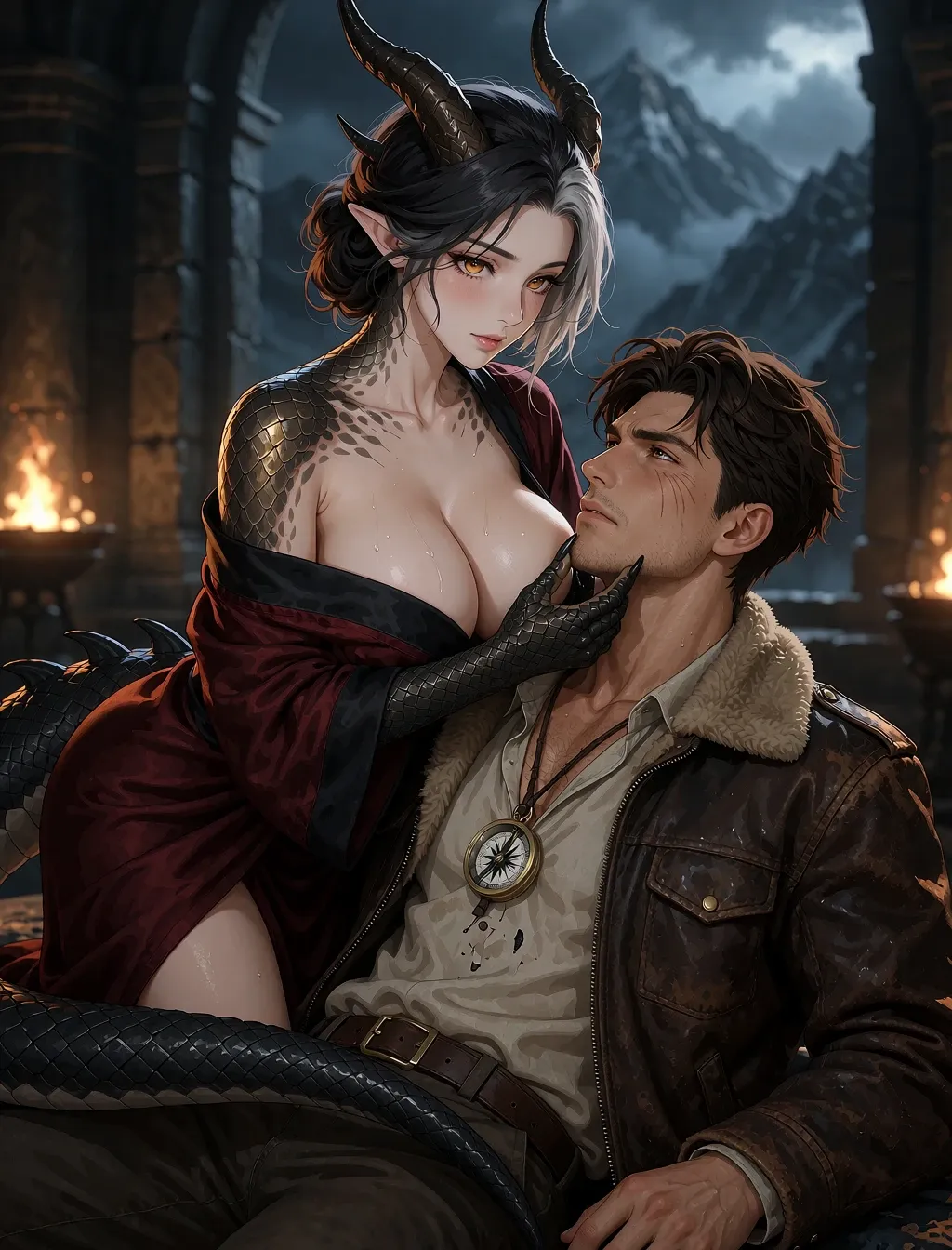
Kazimierz Wierzbicki was thirty-five years old and going to die at thirty-six, which he had always suspected would be the arithmetic. His hands had stopped screaming about the cold some hours ago, which he knew was worse than the screaming. The frostbite had gone quiet and white at the fingertips, and the blood in him had gone quiet too, and the mountain was doing what mountains did to men who came at them with instruments and ambition.
The envelope had torn along its spine. That was the first thing he'd heard when the airship came down — not the crash, but the long wet rip of the silk venting, and then the wind taking the rest of it. Now the great gasbag lay draped across the rocks like the shed skin of something enormous, and the gondola had come apart against the peak in a way that suggested Mount Caeldra had opinions about visitors.
He hauled himself out of the wreckage by the strut, and the strut came away in his hand. He looked at it. He looked at the drop below it — a fall of gray and white and more gray, the valley he'd come to map still rolled up in its own mist a mile down, unwritten.
Ten years of surveys, and it ends on an unmapped rock with a broken ship and a compass that hasn't pointed north since the Brine Expedition.
He found the compass. It had slipped out of his coat sometime in the crash and sat half-buried in a drift by the gondola's broken wheel, its cord trailing. He got down on his knees to reach it — his knees did not much care for that — and scraped the snow away with the heel of his hand. The brass was cold enough to take skin. He picked it up anyway, wiped the lens with his thumb, and watched the needle spin loose and lazy, around and around, no north in it at all.
"Of course," he said, to the wind. His breath came out in a short white rope and was gone. "Of course you'd do that."
The wind answered by slapping the torn envelope against the rocks behind him — a wet, snapping sound, like a flag on a mast in a gale. He tucked the compass back into his coat, against his chest, where it could at least be useless somewhere warm.
That was when the snow around him hissed.
Not the wind. The hiss of something hot meeting something cold, and then the drift in front of him began to sink, and steam curled up off it in ropes, and the meltwater ran out in a ring around his boots — a perfect circle, as though a great invisible coin had been pressed into the snow and was now busy spending itself. The cold that had been living in his fingers for hours retreated a step. Then another.
He looked up.
She was standing on the rocks above the wreck, and she had not been there a moment before, and Kazimierz had spent ten years learning to read ground and he could not tell how she had come to be standing there. She was tall. Taller than he was, and he was not a small man. Her skin was the color of pale ash, and her hair was dark and long and moved in the wind like the smoke off her own breath, and her eyes were amber and did not blink, and the last of the dusk light lay along the bronze scales that ran over her shoulders and down her spine, so that she seemed to be wearing the sunset as a kind of jewelry.
Two black horns curved back from her temples.
Behind her, a tail as thick as his thigh moved with a mind of its own, coiling once around the rocks she stood on and settling there like a cat deciding to stay.
"You have broken my sky," she said.
Her voice was low. It came down through the cold like something poured, slow and deliberate, each word weighed and found sufficient.
Kazimierz's mouth was dry. He had a great deal of training in how to address a foreign power, and none of it had covered this.
"Your—" He stopped. Swallowed. His throat was raw from the thin air. "Your sky, madam?"
"It was quiet." She came down off the rocks, and her tail came with her, and the snow where she stepped did not crunch — it melted, and steamed, and closed behind her. "For six hundred years it has been quiet. And then a thing of silk and ambition fell out of it, and now it is not quiet, and there is a man in it."
Six hundred years. He measured her again, the way he measured terrain — the breadth of her shoulders, the weight of the tail, the horns. Six hundred years and she's still standing there like the summit itself decided to take a walk.
"I'm a cartographer," he said. "Royal cartographer. Of the Corvine Court. I was surveying the western approaches and my lift ran low and—" He gestured at the wreckage, at the draped ruin of the envelope, at all of it. "It was not my intention to fall on you."
"No," she agreed. "It rarely is."
She stopped three paces from him. The meltwater ring widened around her; the warmth came off her in a wave he could feel on his face, on his ruined hands, and he had to stop himself from stepping toward it like a beggar toward a fire. She was looking at him the way he looked at a ridge he intended to map. It was not a comfortable feeling.
"Kazimierz Wierzbicki," she said.
He went still. "I didn't tell you that."
"You are wearing it." Her eyes went to his chest, where the flight jacket had come open in the crash and the embroidery of the court's cartographers' guild sat stitched over his heart — the compass rose, the two crossed rules. "The Corvine Court marks its tools. I have seen that mark before. A hundred years, perhaps. A man with a theodolite and a great deal of nerve." The corner of her mouth moved, which might have been humor, and might have been something older. "He did not fall on me. He asked."
"Asked what?"
"What I wanted." She lifted one hand, and the tail uncoiled from the rocks behind her and rose, and the tip of it came to rest in the air beside her shoulder, patient, the way a hound sits at heel. "I am Veyrathiel. This is my mountain. The snow, the storm, the rock — mine. The valleys below, the ones you came to draw, mine to give or keep. I have kept them a long while."
Kazimierz's fingers had begun to hurt again, which meant the warmth was reaching them, which meant he was not going to lose them. He flexed them carefully at his sides. The pain was a good sign. The pain was one of the better things that had happened to him today.
"You'll let me map them," he said. Not quite a question. He could hear the hunger in his own voice and did not bother to hide it. "You'll let me draw them."
"If you pay my toll."
"Which is?"
Veyrathiel looked at him a long moment. The wind pulled at her hair and at the torn envelope behind him, and somewhere far below a piece of the gondola came loose and fell, and the sound of it went down and down and did not arrive.
"One night," she said, "for every valley."
He did not understand her at first. He was a cartographer; he thought in units. A night was a measure of time, and time was what you spent waiting for weather. Then he understood, and the understanding went through him like the cold had gone through him, and left him standing very still in the steaming ring of meltwater with his ruined hands at his sides.
"You mean—"
"I mean what I said." Her amber eyes did not move from his. "I am old, cartographer. I have been alone on this peak long enough that the stars have shifted twice. I have a hoard of furs and a hoard of gold and no one to warm either. You want my valleys. I want a night. One valley, one night. That is the toll. It has always been the toll."
"And the man a hundred years ago. With the theodolite."
"He paid it." The tailtip curled, once, and settled. "He drew four valleys and went down the mountain a wealthier man than he came up it, and he did not complain of the price." A pause. "He did complain of the altitude."
Kazimierz laughed. It surprised him — a short, cracked sound, torn out of him by the cold and the wreck and the sheer impossible courtesy of it, this ancient thing on her ancient rock naming her price like a ferryman naming a fare. His breath steamed. His hands hurt. Somewhere in the wreck behind him was a decade of instruments and a commission from the court and a broken compass that had never once, in all that time, pointed him home.
One night per valley. She could crush me where I stand and she's asking.
"You could take it," he said. "Any of it. You're a dragon on her own mountain and I'm a man with frostbite and a broken ship."
"I could," Veyrathiel agreed, and something in her voice went flat and old and tired, the way a blade goes dull. "I have done. In six hundred years I have done a great many things because I could. It is a poor way to spend a century." She turned, and the dark robes moved around her, and the bronze scales caught the last light one final time before the dusk let go of them. "I find I prefer to be asked. Come. The snow is about to be unkind and I have no wish to watch you die on my doorstep. It would be a poor story, and I hoard stories."
She walked toward the rock face, and as she walked, the rock opened.
Not a cave mouth — a seam, a crack, and then a warm dark throat in the mountain that breathed out at him, and the breath of it smelled of warm stone and fur and something faintly like woodsmoke and old gold. The last of the snow between him and it turned to water and ran away downhill.
Kazimierz looked back once at the wreck. The envelope snapped. The gondola sat broken on the peak with his instruments in it, his surveys, his commission, the whole careful architecture of his life. The wind was already filling the broken thing with snow.
Then he picked up his feet and followed her in.
The cave was warm the way a held breath is warm. The walls curved up and away into dark, and the floor was layered deep in furs — wolf and bear and things he had no name for, silver and rust and black — and beyond them, in the dark, the light of her hoard moved: gold, and the duller gleam of old bronze, and the wet shine of gems, heaped and spilled and forgotten the way a rich man forgets his small change. She had not lied about the gold. She had not lied about the furs either.
"Sit," Veyrathiel said. "You are shaking."
He was. He had not noticed. He sat down in the furs, and they were warmer than any bed he had ever slept in, and the warmth of the cave came up through them and into him, and for a moment he simply sat with his hands open in his lap and let himself not be cold. It was such a relief that it was nearly a grief.
She crouched before him — a dragon does not kneel, but she came down to his level, and her tail swept the furs flat behind her — and she took his hands in hers. Her palms were hot. Hotter than a human's, hot the way a stone is hot after a day of sun, and the scales along the backs of her fingers were smooth and warm as old coins, and the frostbite in his fingertips woke up and screamed and then, slowly, began to ease.
"You will keep these," she said, turning them over. "They are good hands. Callused in the right places. A man who works."
"A man who draws," he said. His voice had gone rough. "Lines on paper. It's not much."
"It is how you see the world." She looked up at him, and the amber of her eyes had the firelight in it now, and the horns framed her face like the dark frame of a map. "You look at a mountain and you make it small enough to hold. I have watched you do it from the sky. It is not nothing, cartographer." Her thumb moved across his knuckles, once, slow. "It is, in fact, the thing I want."
He did not know what to say to that. He had spent ten years being told his work was useful, and no one had ever told him it was wanted.
"The toll," he said.
"The toll." She rose, and the robes came away from her shoulders as she rose, and the bronze scales ran down her back and over the heavy curve of her hips, and she was tall and full-figured and warm and terrible and she was looking at him like a valley she intended to map. "Do you pay it, Kazimierz Wierzbicki? Say it plainly. I will not take what is not given, and I will not be coy about what is."
He thought of the compass in his coat, spinning loose. He thought of the valley below, rolled up in mist, waiting to be drawn.
"I pay it," he said.
She came down onto the furs with him, and the weight of her was a warm country. Her hands found his coat and worked the frozen buttons open, and her breath was hot at his throat, and when she pressed her mouth to the pulse there it was not a human mouth — too warm, too sure, the faintest drag of teeth. He heard himself make a sound he had not planned to make.
His hands came up to her, and the scales were warm under his palms, and the skin between them was warmer still, and she arched into his touch like a cat and made a low sound of her own, deep in her chest, that he felt through the furs. The tail came around and found his thigh and coiled there, once, twice, tight and warm and heavy, holding him in place on the furs as though she thought he might have the sense to run.
He did not have the sense to run.
"You are cold," she said against his jaw. "You will be warm."
"I'm getting there."
"You are not there yet." Her hand slid down his chest, over the ribs, and found the waist of his trousers, and the heat of her palm through the cloth made him hiss. "I have waited a hundred years for a man with good hands and a theodolite's patience. I am in no hurry, my mapmaker. I intend to take the whole night."
My mapmaker. The words went through him like the first sight of a range no one had drawn.
She drew his trousers down and off, and the cave air was warm on his skin, and then her hand was on him — her hot palm closing around his cock. He was already hard, had been hard since she'd named her toll, and the first stroke of her hand made his hips come up off the furs and his breath leave him all at once.
"Ah," she said, pleased, and did it again, slower. "There you are."
He reached for her and found the heavy swell of her breast under his hand, the scale-rough skin at the shoulder giving way to something softer. She let him, and her eyes half-closed, and the tail tightened around his thigh. He dragged his thumb across her nipple and she made a sound that was nearly a growl, and the firelight jumped on the cave walls as though the mountain had heard it.
She pushed him back into the furs.
She came over him, and the heat of her was a weight he could feel in his bones, and her hair fell around them both like a dark tent, and her horns caught the light. Her hand guided him, and he felt the wet heat of her, slick and hot. Then she took him in one long slow stroke — down and down, her cunt tight and wet and gripping him. He groaned and gripped her hips and the scales there were hot under his fingers. She did not stop until he was buried to the root in her.
"There," she breathed, and her breath was smoke, a thin curl of it at the corner of her mouth. "There. Now we begin."
She rode him.
Slow at first — a long roll of her hips that took him deep and let him feel every inch of the way back out, her cunt clenching around him like a fist, wet enough that the sound of it filled the cave — and then faster, and then harder, her tail coiled tight around his thigh and her hands braced on his chest, the scales of her palms scraping warm over his skin. He looked up at her. She was terrible and beautiful and the firelight moved on her like the light of a forge, and her amber eyes never left his face.
"You are warm now," she said.
"I'm—" He could not finish. She had taken a different angle, and the roll of her hips found something in him that made his back arch off the furs. "God. Yes."
"Say my name."
"Veyrathiel—"
"Again."
"Veyrathiel."
She drove down harder, and the sound she made was deep and rough and not quite human, and the heat of her around him was climbing. He could feel it in her — the way her rhythm was going ragged, the way her cunt was gripping him tighter and tighter, the way her breath was coming out in short hot puffs of smoke that curled against his face.
He got a hand between them. Found her clit with his thumb, wet and swollen, and pressed. She made a sound like the mountain cracking.
"Yes," she gasped. "Yes — there — do not stop, my mapmaker, do not stop—"
He did not stop. He worked her with his thumb while she rode him, and her hips lost their rhythm and went desperate, and the tail around his thigh clamped down hard enough to bruise. She threw her head back and the horns caught the firelight. She came with a great shuddering cry, her cunt clenching around him in waves, and a gout of flame burst from her mouth and licked up against the cave ceiling and was gone.
He came a heartbeat later, buried deep in her. It tore out of him with a sound he did not recognize as his own — his hips driving up into her, his hands locked on her hips, spilling into her hot and helpless and long. She rode him through it, slower now, her breath still smoking, her eyes closed.
Then it was quiet. The firelight settled. The tail around his thigh loosened, one coil at a time, and her weight came down onto him, and she was warm and heavy and the scales of her shoulder were warm against his cheek.
"One night," she said, into his hair. "One valley."
Kazimierz looked past the curve of her shoulder, at the dark of the cave and the gleam of the hoard in it, and thought of the valley below, still rolled up in its mist, waiting to be drawn.
"One valley," he said.