
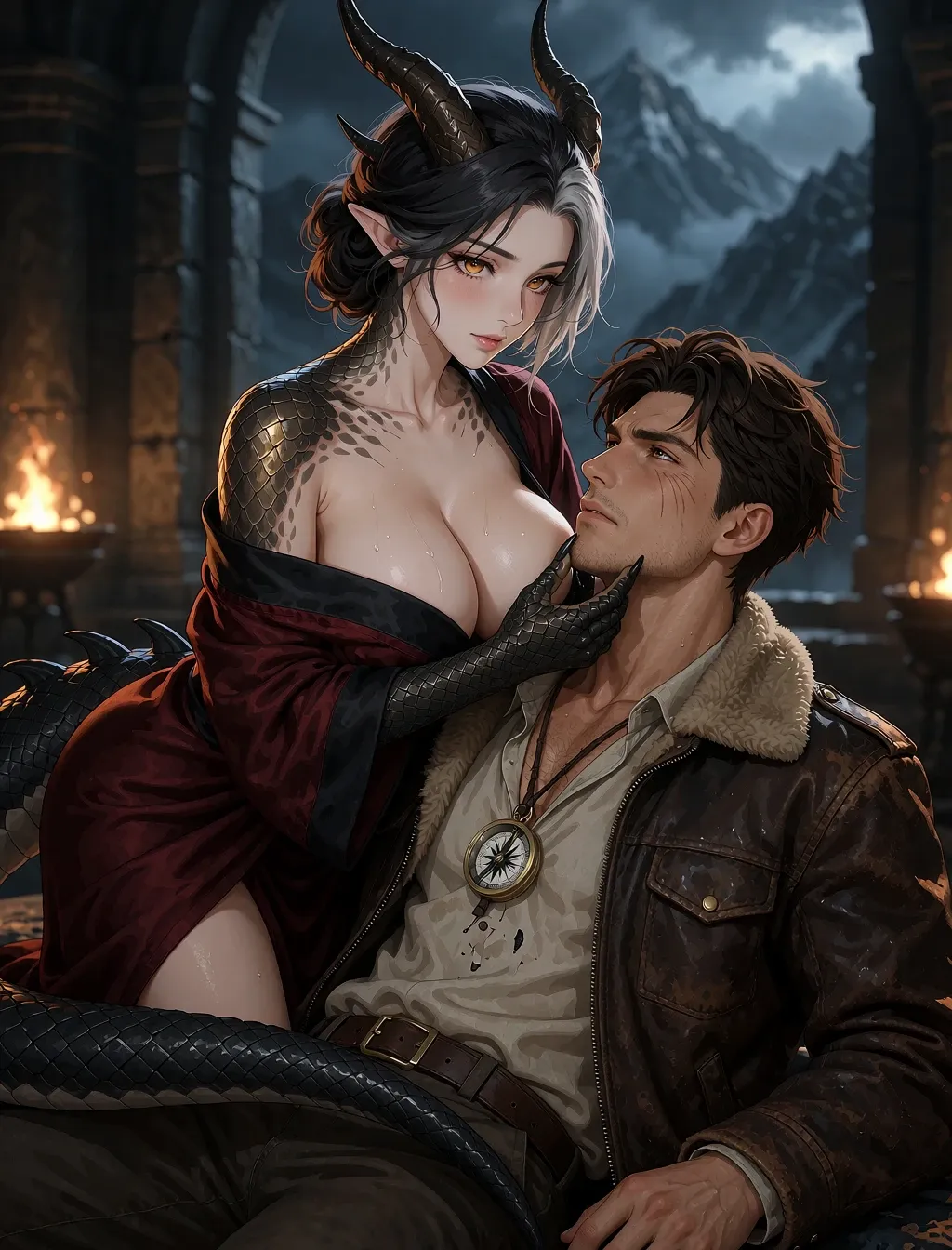
The wings came down once more and the world dropped away from beneath them—Kazimierz's stomach going light, the valley floor swinging up out of the mist like a held breath finally let go—and then the ledge met his boots with a jarring knock that went up through his knees and into his teeth.
She held him a moment longer than she needed to. One arm under his shoulders, the other under his knees, his weight nothing to her. Then she set him down.
The downdraft of her settling wings came over him in a warm gust off the stone—smelling of high air and something sulfurous underneath, the deep smell of her—and his ears popped, and he stood there swaying while the mountain stopped moving and the ledge stopped moving and the only thing still moving was his own heart, hammering away at the inside of his ribs.
"Breathe, cartographer," Veyrathiel said. "You have gone the color of chalk."
"I'm breathing." His voice came out thin. "I'm—yes. Breathing."
The ledge ran thirty paces along the cliff face, wide enough for a cart, its surface pale and gritty and warm where the afternoon sun had lain on it all day. He had crossed it a hundred times in the past days without thinking about it, a threshold to be passed between the cave and the open air. Now he crouched and put his palm flat to it and felt the heat come up through his hand, old and patient as a hearthstone, and for some reason that steadied him more than any of his own breathing.
She was watching him. He could feel it—the amber of her eyes on the back of his neck, the way she had not yet gone in, the way her tail had come to rest along the stone and lay there against the ledge like a thing asleep.
"Two valleys," she said. "Below the ridge. The one with the river fork and the one east of it, where the pines run down into the scree."
He looked up. "You counted."
"I count everything, cartographer. I have had six hundred years to learn the habit, and the habit has served me." She folded her wings against her back, one after the other, a slow deliberate closing, and the light went out of them. "You will draw them tonight. I will look at what you have drawn. And then we will discuss what you owe."
"I know what I owe."
"You know what I named." Her head tilted, the black horns catching the sun. "Those are not always the same thing."
She's testing me, he thought. Or she's bored. With a dragon, those look a great deal alike.
He got out his notebook and his charcoal and set them on the stone, and then—because his hands were still not entirely steady, because the flight had left a strange bright humming in his blood and he did not want to sit down yet and be a man drawing lines—he did not sit. He walked the ledge instead, to the far end where the stone broke away into a lip of raw rock, and stood at the edge with the wind at his face and looked down.
The valley. The one with the river fork. It had opened beneath him on the flight the way a book opens, and he had seen the shape of it whole for one moment—the fork like a wishbone, the terraces of old field lines gone to grass, the little huddle of roofs at the confluence that had no road out of it and never had—and now it lay below him in the late gold light, and he could not have said whether his chest hurt from the beauty of it or from the height.
Behind him, the stone shifted under her weight.
"You look at it the way I look at gold," she said. She had come to stand near him—not close, but near, the way a cat will sit in a room without committing to it. Her shadow fell across the ledge and did not reach him. "It is the only thing I have ever seen you look at that way."
"It's the only thing worth looking at that way."
"Mm." A sound from deep in her chest. "And me? I am merely the toll-keeper. The inconvenience between you and your lines."
He turned.
The sun was behind her and it made her a shape rather than a woman—pale ash gone gold at the edges, the bronze scales along her shoulders burning where the light caught them, her hair lifting in the wind, her eyes two coals that had decided to be amber. She was tall, and she was broad, and she filled the end of the ledge entirely, and he was aware, suddenly and with a cartographer's precision, of exactly how much of the world she occupied.
"You're not an inconvenience," he said.
"No?"
"You're the mountain." He said it simply, because it was simply true, and because he had spent ten years learning that the truest thing to say about a place was usually the plainest. "Everything else is what's on the mountain. You're the thing the mountain is."
The wind pulled at the hem of her robes. Something moved behind her eyes that he could not read, and he had spent his life reading land.
"A pretty answer," she said at last. "I will decide later whether I believe it."
She turned away and went to the mouth of the cave, and he thought that was the end of it, and bent to his notebook. But she did not go in. She lowered herself down onto the warm stone at the cave's edge instead, in a slow gathering of robes and tail and folded wing, and sat with her back against the rock and her eyes half-closed against the sun, and let out a breath that smoked faintly in the cooling air.
"The light will be gone in an hour," she said. "Draw."
So he drew.
He sat cross-legged on the stone with the notebook braced on his knee and the charcoal moving, and the valley came up under his hand line by line—the fork, the terraces, the roofs—and the sun went from gold to copper to a red that lay along the ridge like a wound. The stone cooled under him by degrees. He worked until his fingers ached and the light failed, and then he set the charcoal down and flexed his hand and found that she had not moved, and that her eyes were open now and on him, and had perhaps been on him for some while.
"Show me," she said.
He brought the notebook to her. She took it in both hands—carefully, the way she did everything, as though the world were made of things that could be broken by strength—and turned it toward the last light and studied the page.
"This is the fork," she said, and her claw touched the paper, very lightly, at the wishbone's join. "And this—this is the old field boundary. The one that runs to the standing stone."
"You know it."
"I have flown over it for six hundred years, cartographer. I know every stone on this mountain and every stone in the valleys under it." She turned the page. "But I have never seen it held still before. You have made it small enough to keep."
Something in her voice had gone quiet and strange.
"That's what a map is," he said. "A place you can keep."
"Yes," she said. "I had not thought of it that way." She closed the notebook and held it a moment, and then gave it back. "It is good. It is very good. I have seen the work of royal cartographers before and most of them drew what they were told to see. You draw what is there."
He tucked the notebook away. The praise sat oddly in his chest, warm and uncomfortable, like a coal he had not asked for.
"You're cold," she said.
"I'm—" He stopped, because he was, now that the sun was gone the wind had teeth in it, and his jacket was worn thin at the elbows. "I'll manage."
"Come here."
He looked at her. She had not moved; she sat against the rock with her tail curled along the stone beside her, and she was looking at him with the flat patience of something that did not expect to be argued with. And he thought, she is six hundred years old and she has just told me my work is good and now she is offering me her warmth like a hearth, and I do not know what any of it means.
He went.
He sat down beside her, close enough that the heat of her came off her in a slow wave, and she lifted one arm and drew him in against her side, and the bronze scales of her shoulder were warm against his cheek, and her wing came half-open and settled over him like a roof. The smell of her was all around him—high air and sulfur and something like resin, something like the inside of a temple.
"There," she said. "You are a small warm thing, and I am a very large warm thing, and between us we will contrive."
He laughed, before he could stop himself. It came out cracked and surprised.
"You find me funny."
"I find you—" He turned his head against her shoulder, and his mouth was suddenly very close to the curve of her neck, to the place where the scales thinned to almost nothing and the skin beneath was pale and soft as the inside of a wrist. "I find you unexpected. I've surveyed a great many places and none of them were like you."
"Flattery."
"Observation."
Her breath came out of her slow and warm, and there was a thread of smoke in it, and he felt it move across his hair. "There is a place," she said, "under my jaw. Where the scales turn soft. I have not—" She stopped. Six hundred years, and she stopped. "No one has found it in a very long time."
He did not ask permission, because she had already given it, because she had said it the way a person says the thing they want and cannot ask for.
He turned his face up into the curve of her throat and found it—the soft place, the one place on all that armored length where the scales gave way—and put his mouth there.
Her whole body went still. Not the still of stone, but the still of a thing that had been struck and had not yet decided how to fall. Then her breath came out of her in a rush, hot and smoking, and her claw came up and closed in the back of his jacket, and she made a sound low in her chest that he felt through his whole side where they touched.
"Cartographer," she said. It came out wrong—roughened, unmade, all her ancient formality gone to gravel.
He pressed his mouth there again, and again, and found with his lips that the soft place ran down under her jaw and into the hollow of her throat. He followed it. She tilted her head back against the rock and let him, and her tail came up off the stone and coiled once, hard, around his thigh.
"Tell me to stop," he said against her skin, "and I'll stop."
"If you stop," she said, "I will throw you off this mountain." Her claw tightened in his jacket. "Do not stop."
The wing over him folded down and shut out the last of the sky. In the dark beneath it there was only her heat and her breath and the slow thunder of her heart, and he found the ties of her robes with fingers that were not steady and pulled them loose, and the pale ash of her came open under his hands, and she was warm, so warm, the heat of her rising off her like the heat off sun-struck stone.
He moved down her. She let him—more than let him, she gathered herself and shifted and made room, one leg drawn up, her tail sliding free of his thigh to lie along the ledge, and he knelt between her knees on the warm gritty stone and looked up the long pale length of her to where her eyes burned down at him in the dark.
"You are certain," she said. It was not quite a question.
"I'm certain."
He put his mouth on her.
She was wet already, slick and hot and salt-sweet, and the sound she made when his tongue found her clit was not a sound he had any word for—it started low and came up through her whole body and broke against the roof of her wing. Her claws scraped the stone on either side of him, gouging it, and the smell of scorched rock rose up around them.
He worked her slowly. He had all night, and he had a cartographer's patience, and he had never in his life wanted to do a thing well the way he wanted to do this well. He licked up the whole length of her, root to clit, and felt her thighs shake on either side of his head. He circled her clit with the flat of his tongue, then the tip, then his lips, and each time she made that broken sound and her hips came up off the stone and her tail lashed along the ledge.
"More," she said. "Cartographer—more—"
He gave her more. He pushed two fingers into her—she took them easily, she was so wet, so open—and curled them up and found the place that made her whole body bow, and put his mouth back on her clit and did not stop.
Her breath came faster and hotter. Smoke was curling from her lips now, thin grey threads of it, and her claws had gouged deep channels in the stone and her tail had wrapped around his back and was pulling him in, and she was saying something in a language he did not know, old and harsh and beautiful, over and over.
"Look at me," he said against her, and she did, her amber eyes gone wide and molten in the dark under her wing, and he held them and did not look away and did not stop, and he felt her come apart.
Her cunt clenched hard around his fingers—once, twice, a third time—and her whole body went rigid and then broke, and the smoke poured from her lips in a hot grey rush and her claws raked the stone. She cried out, a raw cracked sound with no formality left in it at all. Her hips ground against his mouth through it, and he stayed with her, licking her through it, until she went slack.
The wing above him lifted. The last of the light came in, red and dying, and the smoke from her lips drifted up into it and turned to gold.
She lay back against the stone, her chest heaving, her eyes closed, one hand still gripping the rock as though it were the only thing holding her to the mountain.
Then she turned her head and looked back at him, and the look in her amber eyes was no longer amused at all.
"Cartographer," she said, and her voice was low and certain and terrible, and her tail tightened around him, and she did not say the rest.