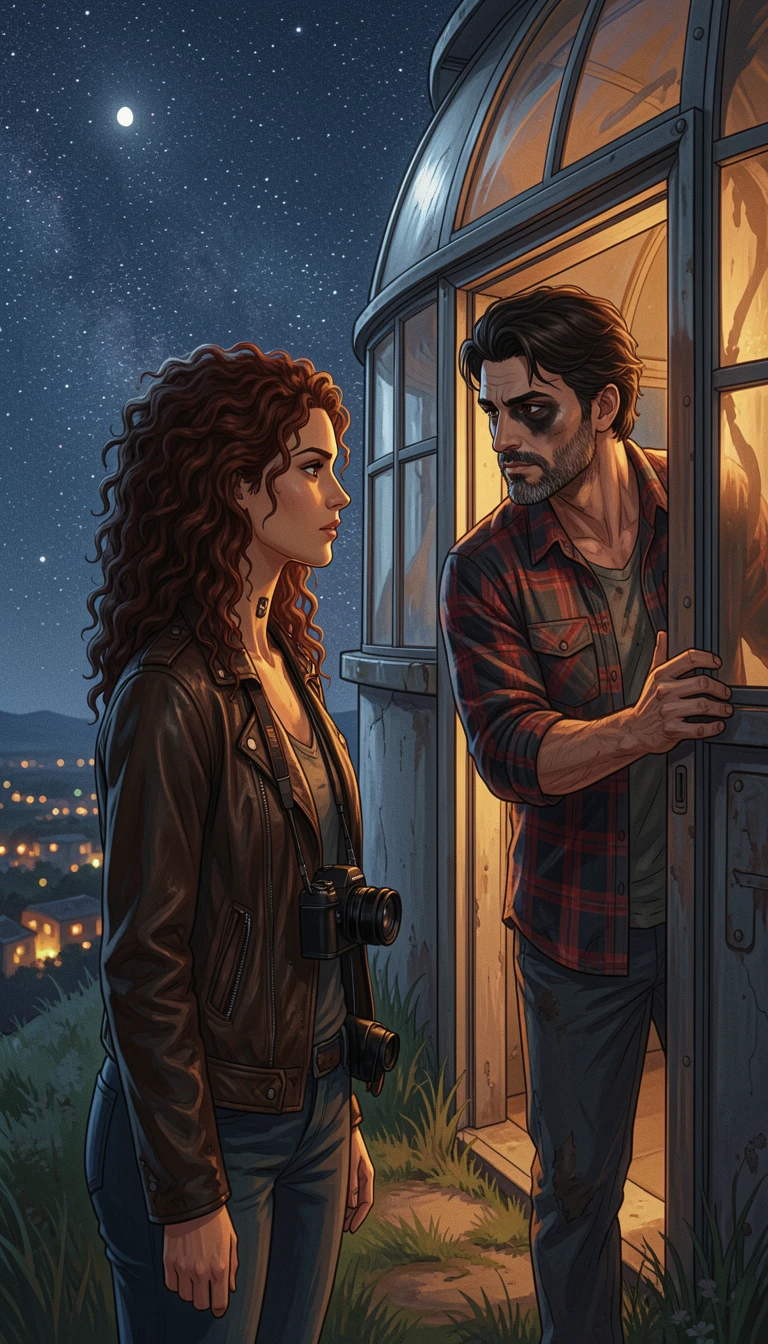
The console hummed beneath his fingertips, a familiar vibration he’d felt through a decade of nights, but tonight the sound was wrong—too loud, too fast, like the equipment was impatient with him. He pulled his hand back and watched it hover over the azimuth controls, the calibration reading wavering on the monitor because he hadn't touched a single dial in three minutes. The pendant in his shirt pocket pressed against his ribs with every breath, the star's edges catching on the fabric each time he shifted. He nudged it with his thumb through the flannel, feeling the weight of it, the cold metal that shouldn't still be warm but somehow was.
The red interval light on the hill blinked once. Twice. A steady rhythm he’d seen a hundred times while watching her pack up her gear, but now it felt like a message he couldn't decode. He turned back to the console and tried to remember what he’d been doing. Calibration. Right. He reached for the knob, hesitated, and let his hand fall to his lap instead.
"Focus," he muttered, the word thin in the dark dome. The moths were quiet tonight—no wings brushing the glass, no shadows circling the lamps. Even the insects had abandoned him. He looked at the clock. 3:49. Two minutes since he'd last checked. The time was moving slower than the azimuth had ever drifted, a viscous crawl toward a horizon he didn't know how to meet.
He pulled the pendant out from beneath his shirt, the silver star catching the faint glow of the console lights. The initials were worn, softened by years of thumbprints, but they were still sharp enough to catch on his calluses. E.M. He traced them once, twice, then tucked the pendant back against his chest, the metal settling into the hollow of his collarbone like it belonged there.
"Tomorrow," he said, the word a question this time. He'd spoken it into the dark last night, a promise he'd made to a woman he'd never met. Now it sat between his ribs, heavy and sharp, and he didn't know if he was ready to mean it.
He stood, the chair scraping against the worn floorboards. The console screen flickered, the calibration error still blinking, but he didn't look back. He walked to the window that faced the hill, the glass cold against his palm, and stared at the red light. It was still there. Still blinking. Still waiting.
She had to be out there. Somewhere behind that lens, watching him through her viewfinder, cataloging his stillness the way he'd cataloged hers. The thought should have made him uneasy—a stranger with his measures, his habits, his small failures. Instead, it made him press his hand flatter against the glass, as if the gesture might reach her across the valley, across the dark, across the hours before dawn.
He thought of her wave, that first night, the way her arm had sliced through the moonlight like she'd known he'd be watching. She had known. She'd seen him in the shape of the dome, in the faint glow of the observatory lights, and she'd waved anyway. Not a warning. An invitation.
The red light blinked a third time, and he felt something shift in his chest—not the pendant, but the space around it. The word Tomorrow had been a door he was walking through. Now it was a threshold he was standing on, one foot suspended over air, waiting for a sign that the ground would hold.
He let his hand fall from the glass. The clock read 3:55. Seventeen hours until tomorrow became now. He didn't know where to go or what to do with that time, but he knew where he wouldn't be: staring through a telescope at a woman who was no longer a stranger, pretending the stars mattered more than the weight of silver against his skin.
He turned from the window and the motion caught the pendant—swung it out from beneath his collar, a silver flash in the dim light. He caught it before it settled, the star resting in his palm, the initials familiar now in a way that felt dangerous. E.M. He curled his fingers around it, metal pressing into his flesh, and felt the warmth of his own skin against something that had lived against hers.
The console hummed at his back, a forgotten obligation. The calibration error still blinked. The telescope still pointed at nothing. He was supposed to want to fix it—that was who he was, the meticulous astronomer, the one who caught the drift before it cost the data. But the truth was he didn't care about the data. He cared about the red light on the hill and whether it would still be there when he looked again.
He crossed to the west window, the one that faced the tree line where he'd found her note, and pressed the pendant flat against the glass. The cold hit first, a shock through the silver, then a slow burn that spread across his palm as the glass drained the warmth from his skin. He held it there, the star between him and the dark, and watched the metal fog, then clear, fog again with the rhythm of his breath.
The clock ticked. 3:56. Fifty-nine seconds had passed since he'd last checked. He pressed harder, the cold deepening into something that ached along his knuckles, and thought about her hands—the ones that had folded that note, the ones that had wedged it into the tree. They'd been steady. Certain. She'd known what she was doing when she left it. He still didn't know what he was doing standing here, burning his palm against a window, waiting for a woman whose full name he didn't even know.
The pendant grew colder, then colder still, until the cold was just a numbness that spread from his palm up his wrist, and still he held it there. The gesture felt like an offering, though he couldn't name what he was offering or to whom. Maybe to her. Maybe to the version of himself that had existed before he'd seen her wave—the one who thought the stars were enough.
He let his forehead fall against the glass, the cold shocking against his skin, and closed his eyes. The pendant pressed between his palm and the window, a third heartbeat in the space between them, and he let himself imagine her standing at her own window across the valley, doing the same thing. It was a stupid thought. Sentimental. He didn't know where she lived or what her windows faced. But the image stayed, and he didn't push it away.
When he opened his eyes, the glass had fogged around his forehead, a small circle of obscurity in the clear pane. He pulled back, the pendant dragging against the window with a soft scrape, and looked at his palm. The imprint of the star was pressed into his skin, red and angry, a pattern that would fade in minutes but felt, in this moment, like a bruise he wanted to keep.
He looked at the console. The calibration error still blinked. The telescope still pointed at nothing. He could fix it in his sleep—a twist of the azimuth knob, a glance at the monitor, a night saved. But the words Tomorrow sat in his pocket with the folded note, and the pendant hung warm against his chest where he'd tucked it back beneath his shirt, and he knew, with a certainty that felt like surrender, that he wasn't going to fix anything tonight.
He killed the console instead. One button, then another, the hum dying in stages until the dome fell silent. The red light on the hill blinked once in the quiet, then held steady—no longer a rhythm, just a single point of light in the dark, a question that wouldn't stop asking.
He picked up his jacket from the back of the chair, the leather cold from hours of disuse, and walked to the door that led to the spiral staircase. The glass was still warm from his palm, the ghost of the star still pressed into it, and he didn't look back. The pendant swung against his chest with each step, a steady pulse that counted down the hours until tomorrow became now.
His foot found the top of the staircase, the iron grating cold through his boot, and he stopped. Not because the path ended—it opened onto the narrow landing that led to the exit door and the night beyond—but because the pendant swung forward against his chest, catching on the fabric of his shirt, pulling his attention down to the silver star now visible in the gap of his collar. He pressed his palm flat against it, the metal warm from his skin, and felt the initials dig into his fingertips. The red light on the hill was still there, a pinprick of insistence in the dark, and he turned to face it.
The dome's glass was dark now, the console dead, the telescope a sleeping metal beast pointing at nothing. But the window he'd pressed his palm against still held the ghost of his handprint, a faint smear on the cold pane that caught the distant red glow. He stood at the top of the stairs with his hand over his heart and the pendant sharp beneath his palm, and he let himself feel the weight of what he was leaving behind: the calibration error, the years of meticulous data, the version of himself that believed the stars were enough. The red light blinked once, steady, and he held his breath.
The silence in the dome was absolute—no hum of the console, no tick of the clock, no wings brushing the glass. Just the sound of his own blood moving through him, a low thrum that matched the rhythm of the pendant against his chest. He counted the seconds between blinks. One, two, three, four. Then another blink, patient and unhurried, like a heartbeat that had been waiting for him all along. He let his hand fall from the pendant, the metal settling back against his collarbone, and wrapped his fingers around the cold iron railing of the staircase.
The exit door was two steps away. The night was waiting, the hill was waiting, and somewhere out there in the dark, the woman with the note and the camera was probably already gone, her red light a final message left behind like the pendant she'd tucked into the tree. But the light was still blinking. Still there. He could walk through the door and cross the field and stand exactly where she had stood, and the grass would still be bent from her footsteps, the air would still carry the faint trace of her scent if he breathed deep enough. He could follow the trail of her presence into the dark and find nothing but the memory of her, and that would be enough. He held the thought like a promise he wasn't ready to break.
His breath came out in a slow release, the fog of it dissolving into the cold air of the stairwell. The pendant pressed against his ribs with each exhale, a steady reminder that he was carrying something that had lived against her skin. He wondered if she could feel it too—not the pendant itself, but the absence of it, the space where it had been. He wondered if she had expected him to find it, or if she had left it as a test he was still passing by standing here, not running, not hiding, not pretending the calibration error was more important than the red light on the hill.
He looked down at his palm, the one that had pressed the pendant against the glass, and saw the faint red imprint of the star still etched into his skin. The lines were softening, fading into the warmth of his hand, but the shape was still there—a ghost of a ghost, a trace of a trace. He curled his fingers around the memory of it and thought about her hands again, the ones that had folded the note, the ones that had adjusted the tripod, the ones that had waved at him through the moonlight. He thought about the way she must have looked through her viewfinder, seeing him standing in the observatory window, a silhouette against the glow of the console, a man who spent his nights charting galaxies and had somehow become a fixed point in her frame.
The red light blinked again, and he felt something crack open in his chest—not the pendant, not the space around it, but something deeper, something that had been sealed shut for years of solitary nights and forgotten meals and conversations with moths. He leaned into it, let himself feel the ache of wanting something he couldn't name, and held his breath again, counting the seconds until the next blink. One, two, three. The light stayed dark. Four, five. Still dark. His heart hammered against the pendant, a frantic counterpoint to the stillness, and he felt the cold of the iron railing bite into his fingers as he gripped harder. Six, seven. The light blinked.
The relief that washed through him was sharp and unexpected, a heat that spread from his chest to his throat, and he let out a breath he hadn't realized he was holding. The light was still there. She was still there, somewhere, or at least her message was, and the word Tomorrow in his pocket felt less like a door and more like a hand reaching through the dark to find his. He turned back to the exit door, its metal handle glinting in the faint glow of the distant red light, and his hand found the latch without hesitation. The cold metal of the handle bit into his palm, the same hand that had pressed the pendant against the glass, and he felt the connection between the two moments—the offering and the taking, the waiting and the going.
He pulled the door open, and the night air rushed in, cold and sharp and smelling of pine and earth and the faint metallic scent of the observatory that clung to his clothes. He stepped through the threshold and onto the small landing at the top of the spiral staircase, the door closing behind him with a soft click that sealed the dome away. The red light on the hill was clearer now, unobstructed by glass, a single steady point of warmth in the vast dark. The pendant against his chest felt heavier, as if the night air had weight, and he pressed his hand over it again, feeling the star through his shirt, the initials a secret he was still learning to keep.
He stood there, one hand on the iron railing of the staircase that spiraled down toward the observatory grounds, one hand over the pendant, and let himself imagine what it would feel like to walk across the field and stand where she had stood, to touch the tree where she had wedged the note, to breathe the air she had breathed. The red light blinked once more, and he felt the word Tomorrow rise in his throat, a question and a promise and a prayer all at once. He didn't say it aloud. He just held it, the way he held the pendant, the way he held the ache in his chest, and waited for the night to tell him what to do next.
He drew a breath, the cold air sharp and clean in his lungs, and let his hand find the railing again—not as a support, but as a guide. The iron was rough beneath his palm, pitted with rust and the memory of a hundred other nights he'd climbed these stairs in the dark. He'd never descended them like this, one slow step at a time, the red light on the hill pulling him down like gravity had found a new center. The pendant swung against his chest, a silver heartbeat that matched the rhythm of his boots on the grating.
At the first landing, he stopped. Not to turn back—the door above was already closed, the dome dark—but because the window here faced the hill at a different angle, sharper, and the red light was no longer a distant star but a lantern at the edge of the woods. He could see the shape of the tree line now, the faint glow of the town beyond, the way the hill rose against the sky like a shoulder shrugging off the dark. He pressed his palm against the glass, the cold familiar, and felt the phantom imprint of the star tingle against his skin.
He had watched her for weeks from above, a god in his glass temple, charting her movements like constellations. But gods didn't descend. They observed. They remained untouched. His fingers curled against the glass, and he realized he was no longer a god—he was a man walking down a staircase toward a woman whose name he didn't know, whose voice he had only heard in his imagination, whose hands had touched the same silver that now rested against his heart.
He touched it again without thinking, his thumb finding the worn edges of the initials. E.M. He said them under his breath, the syllables foreign in his mouth, and the sound of them made the pendant feel heavier. Not a weight of obligation, but of possibility. The way a star felt heavy when you knew it was already dead, its light a message traveling across an impossible distance. He was traveling now. Crossing the distance. And the light was still blinking.
The stairs creaked beneath him as he continued. The spiral tightened, the walls closing in, the smell of cold metal and dust replaced by the scent of damp earth and pine seeping through the cracks in the door below. Each step was a countdown. He reached the second landing, the one with the worn leather shoe on the bench and the faded coat rack, and he didn't stop. His hand brushed the wall, trailing a path through the condensation, a streak of clarity in the obscurity.
The bottom of the stairs opened onto a narrow vestibule. A single lightbulb hummed overhead, casting a jaundice glow over the concrete floor. The exit door was right there—metal, gray, a push bar across its middle. He stood in front of it, his breath fogging in the cold, and let his hand rest on the bar. The metal was shockingly cold, a bite that traveled up his arm and settled in his shoulder.
This was the last threshold. The dome was dead behind him. The console was dark. The telescope was a sleeping beast. On the other side of this door was the field, the tree line, the hill. On the other side was the red light, and the camera, and the memory of her wave. He pressed the bar, felt the mechanism give, and the door swung open.
The air hit him like a living thing—wet, cold, full of the smell of wet grass and pine needles and the distant, metallic tang of frost. He stepped through, and the door closed behind him with a soft click that sealed the dome away. He was outside. He was on the grounds. The hill rose before him, black against a sky full of stars he was supposed to be calibrating for.
He started walking. The grass was wet, soaking through the hem of his jeans, numbing his ankles with cold. He didn't care. The red light was brighter now, visible between the trunks of the pines that marked the edge of the property. He could hear the wind moving through the needles, a sound he had heard a thousand times through the glass but had never walked into. The pendant swung with each stride, a steady pulse against his sternum.
He reached the tree line and didn't stop. The branches closed over him, blocking the sky, the darkness thickening until he was walking blind, following the red glow like a compass. The ground became uneven, roots and stones catching at his boots, and he stumbled once, catching himself on a trunk, the bark rough against his palm. He pushed off and kept going.
The trees thinned, and he stepped into the clearing. The red light was fifty yards ahead, mounted on the tripod, the camera a dark shape beneath it. The hill was empty. The woman was gone. But the light was still blinking, a message without a sender, an invitation without a host. He walked toward it, his breath coming harder than the walk warranted, and stopped when he was close enough to see the scratch on the aluminum leg of the tripod, the fingerprint smudge on the lens cap resting beside it.