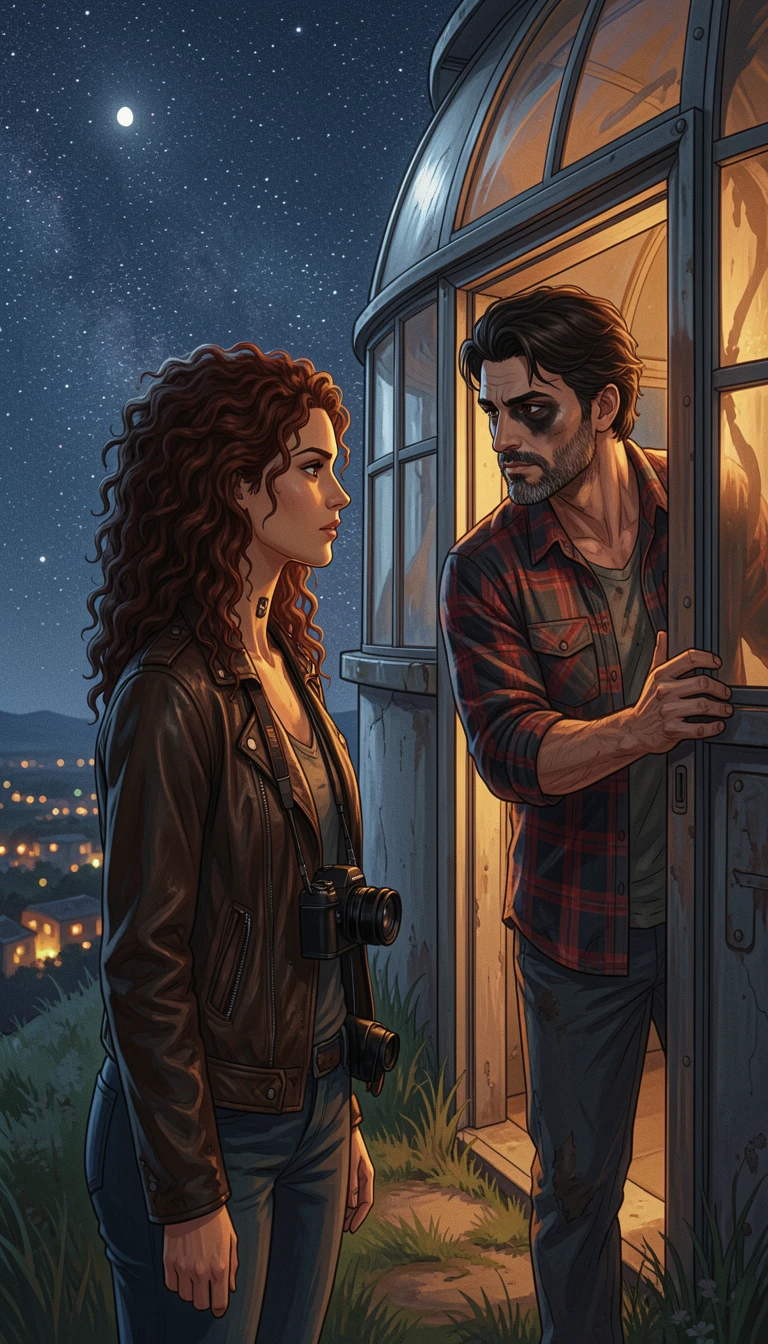
He counted again. One-three. One-three. The red light held its rhythm like a pulse, like she'd left something alive here, breathing in the dark. His thumb traced the lens cap's edge—the smudge sat exactly where a thumb would rest when unscrewing it, a ghost of her fingerprint he couldn't stop touching. He brought the cap closer, tilting it into the moonlight, and found the whorl of her print pressed into the brass like a signature he was only now learning to read.
The pendant lay against his thigh, silver warmed by his body heat. He'd taken it off once, examined it under the dome's harsh light, and found nothing but the etched E.M. and a tiny star at the curve of the M's final stroke. Now he wore it beneath his shirt, the chain a constant reminder of the weight she'd chosen to leave him. Not a note. Not a photograph. Something she'd worn against her skin.
He looked up at the camera. The lens stared back at him, dark and blind—interval timer off, shutter silent, waiting for a command only she could give. He knew this model: a medium-format digital, weather-sealed, the kind of body that cost three months of an observatory stipend. The tripod legs were scratched, duct-taped near one joint, a tool used hard and trusted completely. She'd left it here. In the wet grass. In the dark. For him to find.
The wind bent the grass flat, carrying the metallic tang of the dome's copper roof and something else—lavender, maybe, faint and sweet, tangled in her hair when she'd stood here. He inhaled without meaning to, holding the air until his lungs ached, and when he let it go, the word came with it. "Tomorrow." He spoke it aloud, a low rasp against the hill's silence, and the camera's red light blinked as if answering.
He didn't know what he expected. A voice from the trees. A shutter click. The impossible—her stepping out of shadow, hair wet with dew, asking if he'd found what he was looking for. Nothing came. Just the grass shifting, the pendant cool against his chest again, the red light counting seconds that felt like years.
His hand moved toward the camera body without thinking. The grip was warm, salted from his own palm now, and he traced the seam where the memory card slot sat sealed. She'd left the shot. He could look. Could pull the card, slip it into his pocket, see exactly what she'd captured of him through the trees on the nights he'd thought himself invisible. His thumb pressed against the latch. It clicked, half-open.
He stopped. Held his breath. The red light blinked. One-three. One-three.
He pressed the latch closed again and pulled his hand back like he'd touched something hot. Looking at her photographs before she gave them—that wasn't the game. That wasn't even the rules. The rules were: she left things, he found them, and tomorrow she would be here to show him what they meant. He'd already broken enough tonight, walking through her setup, touching her equipment, wearing her pendant against his chest like a claim he hadn't earned.
The word Tomorrow was still in his throat, lodged there, pressing against the breath he couldn't quite release. He closed his eyes and let the hill's darkness fill him—the cool seeping through his jeans, the wind pulling at his collar, the pendant's chain a thin line of heat against his collarbone. He could stay here all night. He could wait for dawn. He could sit cross-legged in the wet grass until she found him, and when she did, he would have nothing to say except: I came.
He opened his eyes. The red light blinked. One-three. One-three. And from somewhere below, down the slope where the pines thickened and the path to town began, a single coyote called—three sharp yips and a long, falling note that sounded almost like a question. Marcus smiled in the dark, his teeth catching moonlight, and felt the word finally release, dissolving into the air around him like fog burning off at sunrise.
He lowered himself to the grass, the damp seeping through the back of his flannel before he'd fully settled, and let his spine find the tripod's center column. The metal was cold through his shirt, a shock against the heat his body had carried up the hill, and he tilted his head back until the pendant's chain slipped free of his collar and lay against his throat like a line of cooling water. The silver had been warm against his chest—her warmth, or his own, he couldn't tell anymore—but now it settled into the night's temperature, becoming just another thing that belonged to this hill and this hour and this red light that would not stop blinking.
He stretched his legs out in front of him, crossing his ankles, and let his hands rest palms-up on his thighs. The posture was deliberate—open, unguarded, the opposite of how he stood in the dome with his arms crossed and his shoulders hunched against the console's glow. If she was watching from somewhere in the dark, he wanted her to see him like this: still, waiting, unarmored. The grass pricked through his jeans at the knee where the fabric had worn thin, and he wondered if she'd noticed that too, if her lens had caught the patch of denim gone soft from years of kneeling at eyepieces and crawling under dome shutters.
The coyote didn't call again. The silence it left was different from the hill's usual quiet—sharper, more expectant, like a held breath that hadn't decided whether to release. Marcus turned his face toward the sound's origin and watched the pines resolve out of the darkness, their tops silver-tipped where the moon found them, their trunks solid and black as the space between stars. Somewhere in there, she'd stood. She'd leaned her camera into the same wind that was pulling at his collar now, and she'd known, somehow, that he would follow.
He lifted the pendant between thumb and forefinger, letting the chain slide through his other hand until the star hung at eye level, catching the glow from the camera's red light in its etched surface. The tiny star at the curve of the M caught the light differently—a flare, brief and accidental, like a signal he hadn't known he was sending. He turned it, watching the metal catch and release, and thought about the years she'd worn this against her collarbone, the nights she'd stood on hills just like this one, the unknown hours she'd been out here before he ever thought to look. The pendant had been hers. Now it was his to hold, to wear, to return—if that was what Tomorrow meant.
He let the chain settle back against his chest and looked up at the camera. The red light blinked. One-three. One-three. The rhythm had become a second heartbeat, a metronome counting toward something he couldn't name. He reached out and pressed his palm flat against the grass beside him, feeling the cool soil and the broken blades, and imagined her doing the same—sitting cross-legged in the same spot, watching the same horizon, waiting for a shutter that would open and close without her hand on it. She'd left the camera running. She'd pointed it at where she knew he would stand. She'd programmed an interval that would capture him crossing the clearing, and she'd done it without asking, without warning, without giving him a chance to decide whether he wanted to be seen.
He wanted her to have seen it. Every step. Every hesitation. The moment he'd reached for the memory card and pulled back. The word Tomorrow falling from his lips like a prayer he hadn't meant to speak. He wanted her to have watched him become the man who followed a red light into the dark, and he wanted her to have found him worthy of whatever came next.
The wind shifted, bringing the lavender scent again—stronger now, closer, like she'd passed through this exact spot not long before he arrived. He inhaled and held it, letting the sweetness settle in his lungs, and when he exhaled, his shoulders dropped an inch he hadn't known they were carrying. He looked down at his hands, at the calluses and the faint grime under his nails from the dome's machinery, and he thought about how different they looked in this light—foreign, almost, belonging to someone who did things he hadn't done before.
He was still wearing the same jeans he'd put on that morning, still hadn't shaved the stubble that had darkened into something close to a beard, still smelled faintly of coffee and telescope grease and the copper tang of the dome's roof. He'd walked out of the observatory without a jacket, without a plan, without anything but the pendant and the note and the certainty that the red light would still be blinking when he got here. And it was. It had been. It would keep blinking until dawn, if she'd programmed it that way, or until the battery died, or until he finally stood up and walked back to the dome and tried to remember why the stars had ever seemed like the only thing worth looking at.
He didn't stand. He leaned his head back against the tripod's center column, felt the vibration of the wind traveling up the metal into his skull, and closed his eyes. The red light's pulse came through his eyelids as a faint warmth, a shift in the dark, a rhythm he was beginning to trust. He let his breathing slow to match it—one beat in, three beats out, one-three, one-three—and for a long moment, he was nowhere else. Not in the dome calibrating a telescope he'd already ignored. Not in his apartment wondering what morning would bring. Not in the past or the future or anywhere but here, on this hill, in this grass, with her camera counting toward the moment she would step out of the trees and ask if he'd found what he was looking for.
He opened his eyes. The red light blinked. And above the pines, the first seam of gray was breaking the horizon—pale and tentative, like a question asked in the quietest voice. Dawn was coming. Tomorrow was coming. And he was still sitting in the grass, wearing her pendant against his chest, waiting for the red light to stop so the real waiting could begin.