
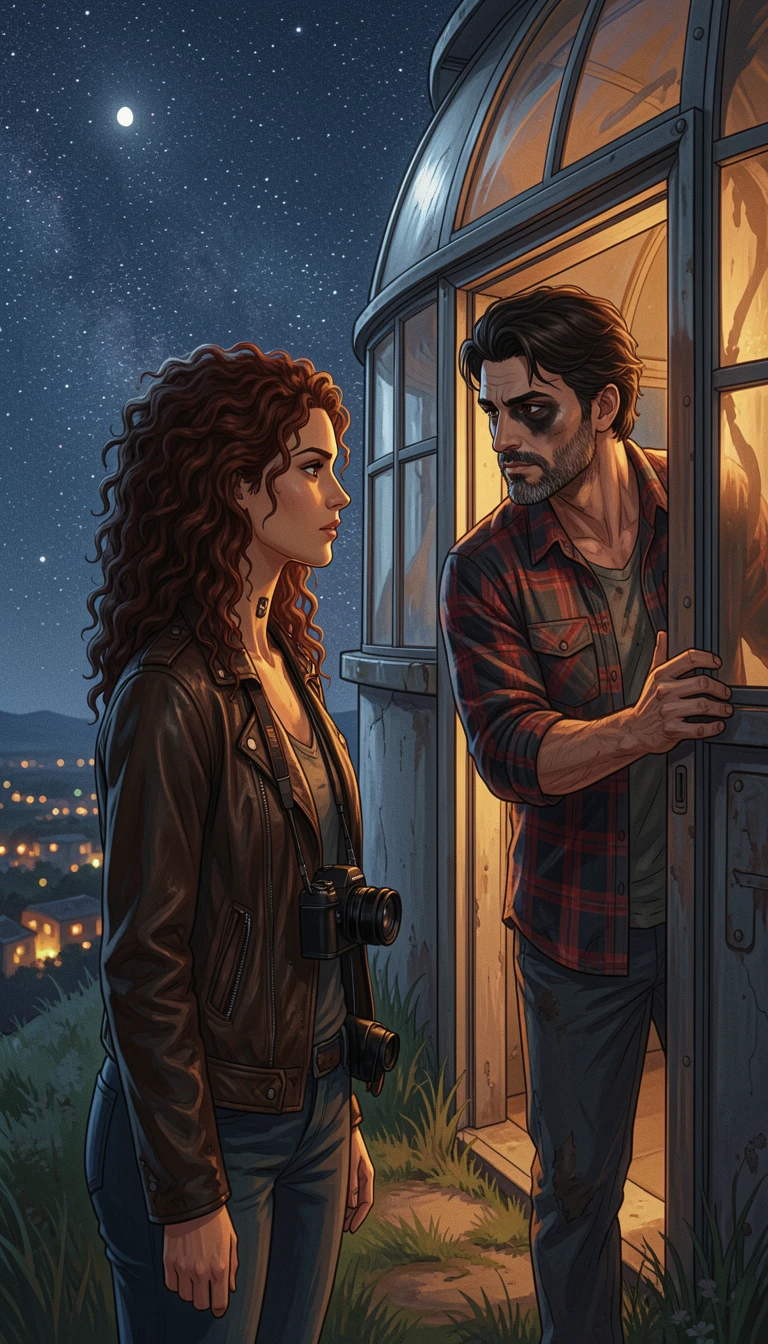
His fingers found the creases blind, pressing them back into alignment with the same muscle memory he used to collimate a mirror—precise, unhurried, a ritual that gave the hands something to do while the mind caught up. The paper had grown warm against his palm. He tucked it into his shirt pocket, over his heart, and felt the faint pressure of it with each breath—a second pulse, softer than his own.
The dew had soaked through the leather of his boots, cold and patient, working its way to his socks in the slow way of things that had all night. He didn't move. The oak's bark pressed against his shoulder blades through the flannel, and he let it hold him there, let the roughness remind him he was still in his body and not floating somewhere above the tree line, watching himself stand in the dark like he was the one being observed.
The hill where she'd stood was empty. Silver-edged against the deeper black of the treeline, the grass still bent in the shape of her passage—a darker wedge of shadow where her tripod had been, a faint trail where she'd walked back toward the pines. Her absence was carved into the skyline like a missing star in a constellation he'd memorized. He knew exactly where she should have been standing. The space she left behind was louder than any presence.
A gust of wind lifted his collar, cold against the back of his neck. He didn't shiver. His body had stopped bothering with small reactions somewhere around the third hour of watching her through the eyepiece, when his hand had gone numb from gripping the focus knob and he hadn't noticed. When he'd forgotten to breathe until she looked up, straight into the lens, and waved.
The note pressed against his chest with every heartbeat. Tomorrow. Not a question. A promise, or a challenge, or both. He couldn't tell which, and that was the part that kept him standing at the tree instead of walking back to the warm hum of the observatory, back to the familiar shape of his chair and the telescope's patient eye.
He'd watched her for weeks. Learned the rhythm of her movements—the way she tilted her head to check the histogram, the way she bit her lip when she was waiting for a long exposure, the way she talked to her camera in a low murmur he could never quite hear but could see in the shape of her mouth. He'd told himself it was professional curiosity. A photographer working the same patch of dark sky, shooting the same stars. A fellow traveler in the night.
That lie had crumbled the moment she'd waved. She'd known. She'd always known, maybe, and she'd chosen to let him watch, chosen to give him something to look at besides the cold geometry of galaxies. And then she'd walked down to his tree and left him a word that meant nothing and everything.
He pulled the note out again, unfolded it, read the single word in the faint glow of the half-moon. The handwriting was unhurried, the letters leaning slightly forward like they were already moving toward something. Not cursive, not printed. Just her hand, pressing ink into paper, knowing he'd find it.
A shutter clicked somewhere above him—sharp, deliberate, unmistakable. His head snapped up. The hill was still empty. But the sound had come from the treeline at its crest, from the deeper dark where the pines swallowed the moonlight. From where she'd disappeared.
He stood frozen, the paper trembling in his fingers, the echo of the shutter fading into the rustle of wind through leaves. She was still here. Or she'd left a camera behind, running on interval timer, waiting to catch him standing exactly where he was. Either way, she'd seen him. Either way, the game was still being played.
A laugh caught in his throat—low, startled, a sound he barely recognized. He folded the note again, slower this time, pressing each crease with the pad of his thumb, and slipped it back into his pocket. Then he looked up at the dark tree line and raised his hand. A wave. Deliberate. Measured. A question, returned.
No wave came back. But the shutter clicked again—closer, this time. And somewhere in the dark, he heard her laugh. Faint. Warm. A sound he'd never caught through the telescope but would know anywhere now that it existed in the world instead of his imagination. He lowered his hand and let the silence settle around him, full of everything she hadn't said yet.
That laugh. He'd heard it a hundred times through the telescope lens, watching her settle her camera or pack her bag or knock a loose strand of hair from her face. But it had been a ghost of a thing then, a shape his mind projected onto a silent figure—the way he imagined she might sound if he could hear through glass and distance. This was different. This was real, pitched exactly where his ribs remembered a tightness he hadn't noticed until it loosened. He touched his shirt pocket. The paper was still there.
His boots found the edge of the grass where it gave way to pine needles, the transition from soft to yielding, and he felt each step press into the earth as if the ground itself was keeping time. The moon had slipped behind a thin band of cloud, dimming the clearing to charcoal and deeper charcoal, and the treeline swallowed the last of the silver light. He walked into that darkness like stepping into the dome after hours—familiar, watchful, alive with the sense of being surrounded by something he couldn't quite see.
A branch snapped under his foot, sharp and sudden in the quiet. He stopped, let the sound settle, let the forest adjust to his presence. Somewhere to his left, an owl called once, then fell silent. The air changed as he moved deeper: cooler, damper, thick with the smell of wet bark and the sweet rot of fallen leaves. He counted his breaths. Three. Four. Five. Each one slower than the last, settling his pulse into something that wouldn't betray him when he found her.
He didn't know if she was still here. The click of the shutter and the laugh could have been a gift—a final tease before she vanished into the night. Or she could be standing thirty feet ahead, watching him walk straight into her frame. The thought sent a strange current through his chest, half unease, half something he refused to name. He kept walking.
The pines thickened, their lower branches brushing his shoulders, and he ducked under a low bough that scraped the back of his neck with hard-won needles. The trail he was following wasn't a trail at all—just the faintest disturbance in the undergrowth, a darker seam through the dark, the ghost of her passage. He stayed with it, trusting the hours he'd spent learning her rhythms. She moved through these trees the same way she moved around her tripod: purposeful, unhurried, leaving almost no trace. Almost.
Ahead, the trees opened into a small pocket of moonlight—a clearing no bigger than the dome's floor, ringed by ferns and the pale trunks of birches. And there, at its center, a tripod. Her tripod, legs sunk into the soft earth, the camera mounted and facing not the sky but the path he'd just come down. Pointed exactly where he'd been standing. He stopped at the edge of the clearing, his hand going to the note in his pocket again, his thumb tracing the edge of the folded paper.
The camera's red indicator light blinked once, slow and patient. Interval timer. She'd set it before she left, programmed it to keep shooting long after she was gone. He didn't know whether to feel caught or spoken to. Probably both. That was her game—leaving him evidence of himself, showing him what he looked like from the outside, through her lens. He let out a breath he hadn't realized he was holding, and it misted in the cold air, dissolving into the space between him and the tripod.
He walked around the camera slowly, giving it his profile, his back, the side of his face lit by the moon. If she was going to have a photograph of him, he wanted to choose which one. When he reached the far side of the clearing, he stopped and looked back the way he'd come—toward the observatory dome, a pale ghost on the hillside, toward the tree where she'd left the note, toward the hill where she'd stood for weeks, the grass still bent in her shape. All of it visible from here. All of it arranged for him to see.
A glint of something caught his eye—metal, low in the grass near the base of a birch. He crouched, and his fingers found a small silver pendant, a single star etched into its face, still warm from the skin that had worn it. He picked it up, the chain pooling in his palm, and felt the weight of it the same way he'd felt the weight of the note: like a message he hadn't finished reading. He closed his fingers around it and stood, scanning the treeline one last time. No shutter click. No laugh. Just the pendant in his hand, warm and waiting, speaking for her now that she was gone.
His thumb found the edge of the etching before his eyes did—a faint scratch of metal against calloused skin, the kind of detail you feel before you see. He turned the pendant over in his palm, angling it toward the moon, and the light caught the letters like they'd been waiting for him to look. E.M. Two letters, pressed deep into the silver, the edges worn smooth from years of contact with skin and sweat and the salt of a body that wore it close. He traced the E with the pad of his index finger, once, then the M, and felt the shape of them settle into his chest like a second word he hadn't known he was waiting for.
E.M. He didn't know what the E stood for. He didn't know if the M was her last name or someone else's, a mother or a lover or a name she'd chosen for herself. But he knew, with the same quiet certainty that had kept him at the telescope night after night, that she had left this here for him to find. Not dropped. Not lost. Left. The warmth of it was still dissolving into his palm, the ghost of her skin fading with every second he held it, and he closed his fingers around it again, trapping the last of the heat against his own body.
A breeze moved through the clearing, lifting the chain where it hung from his grip, and the silver caught the moonlight in a thin, cold arc. He watched it sway, watched the star on the pendant's face catch and release the light as it turned, and he thought about the hours she must have spent wearing this against her throat, under her shirt, close to the pulse he'd never seen but had imagined a hundred times. The same pulse he'd watched flutter at her jaw through the telescope on nights when the air was still and the seeing was good enough to catch the smallest movements.
He slid the pendant into his shirt pocket, next to the note. The two objects settled against each other, paper and metal, the word and the initial, and he pressed his hand flat against the pocket, feeling the shapes of them through the flannel. They were heavier together than either had been alone, and the weight of them pulled the fabric taut over his chest like a second skin he hadn't asked for but couldn't take off.
The red light on the camera blinked again—patient, steady, still running its interval timer, still waiting for the next frame. He looked at the lens, at the dark pupil of glass pointed exactly where he'd been standing, and he wondered how many shots she'd programmed. Fifty? A hundred? Enough to fill a roll, enough to catch him in every moment of confusion, surprise, and quiet wonder she'd orchestrated. She had seen him through her camera's eye more times tonight than he'd seen her through his telescope in weeks.
He took a step toward the tripod, then stopped. The urge to touch it, to adjust the angle or look through the viewfinder or press the button that would stop the timer, was almost physical—a pull in his hands that matched the pull in his chest. But he held still. It wasn't his camera. It wasn't his game. The pendant was in his pocket, warm against the note, and she had given him both freely. He didn't need to take anything else.
He turned his back on the camera, deliberately, and faced the way he'd come. The path through the pines stretched dark and uneven, the moonlight catching only the highest branches, and the observatory dome rose beyond them, pale and familiar, waiting for him to return to the only language he'd ever been fluent in. But the pocket over his heart spoke a different language now, and he didn't know how to translate it back into stars and azimuths and the cold comfort of numbers.
The silence around him was different than it had been before. Fuller. Loaded with the weight of a name he only had initials for, a face he'd seen through glass but never in the same air he was breathing. He lifted his head, scanned the treeline one last time, and saw nothing but the slow sway of branches and the deep blue-black of the sky between them. No shutter click. No laugh. Just the pendant and the note, and the promise of a word he was still trying to understand.
"Tomorrow," he said, aloud, testing the shape of it in his own voice. The word hung in the cold air, misted in front of his mouth, and dissolved into the dark. He didn't know if she had heard him. He didn't know if she was still close enough to hear. But the word was out now, spoken into the space between them, and it felt realer than it had when it was just ink on paper.
His boots found the path back through the pines, the same trail he'd followed in, and the branches brushed his shoulders the same way, and the owl called once from the same direction. Everything was the same. But his pocket was heavier, and his chest was fuller, and the word Tomorrow had begun to feel less like a promise and more like a door he was already walking through.