
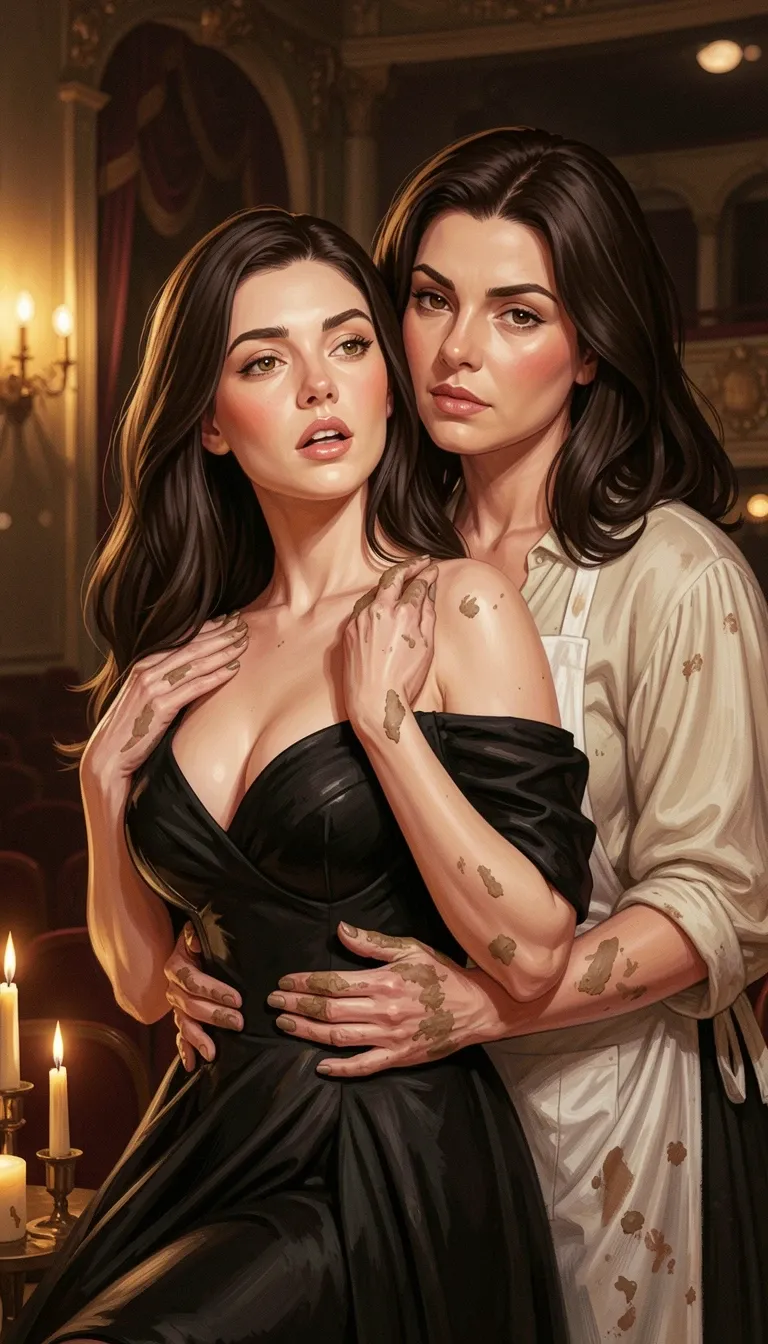
The queue for the club ran down the pavement past a shuttered pastelaria, and Inês counted the women ahead of her twice before she let herself believe it. Thirty-one years old and she had never stood in a line like this one, women in leather and women in slip dresses and one woman with a shaved head and a silver hoop through her septum who looked at Inês's cello case and said, "You playing tonight?"
"No," Inês said. "I brought it to—" She had no ending for the sentence. Marta's hand closed around her elbow.
"She plays," Marta said, easy as weather. "Not tonight."
The woman laughed and turned away, and Inês breathed out through her nose, long and slow, the way she did before a solo. The case handle was slick under her palm. She had not been able to leave it at home — it was the only thing in the flat that felt like a part of her body, and she had carried it here like a child carries a blanket, and now she was going to have to hand it to someone at a door.
Marta leaned close. Her hair smelled of the clay dust she never quite washed out, and under it the clean sharpness of the soap she used at the studio sink. "Second thoughts?"
"No." Inês said it too fast. Then, quieter, "Ask me again inside."
The door was steel painted black, no sign, just a woman on a stool with a tablet and a face that had seen everything twice. She looked at the cello case and raised one eyebrow.
"It's not a weapon," Inês said.
"Shame." The woman jerked her chin at a rack of numbered hooks behind her. "Case goes there. You get a tag. You lose the tag, you don't get the case."
Inês slid the strap off her shoulder. The case was heavier than it looked and she had carried it across half of Lisbon tonight, and handing it over felt like handing over a lung. She watched the woman lean it against the wall with the others — a saxophone, two guitar cases, someone's violin — and she took the plastic tag and put it in her bra strap because her dress had no pockets.
Inside, the ceiling pressed down. That was the first thing: how low it was, a cellar or a converted garage, beams black with old paint, and the crowd of women packed so close that the heat came at you in a wall before you'd taken three steps. The second thing was the noise. Not music yet — talking, laughing, a glass breaking somewhere and a cheer going up for it.
"Breathe," Marta said at her shoulder.
"I am breathing."
"You're doing the thing."
"What thing."
"The thing where you hold your breath and call it breathing." Marta steered her by the small of her back, past a bar made of scaffold planks, past a woman in a waistcoat pouring something the colour of brake fluid into tiny glasses. "We can leave at any point. You know that. You say the word and we're out on the pavement and I buy you a terrible coffee and we never speak of it again."
"I know."
"Say it back to me."
Inês stopped walking. A woman behind her swerved and swore good-naturedly and Inês said, "We can leave at any point. I say the word. Terrible coffee. Never speak of it." Her hands were trembling, she noticed, the way they did in the wings before a concert, and there was nothing in them to hold. "Marta. My hands."
Marta took one and turned it over and pressed her thumb hard into the centre of the palm, a steady pressure, and held it there. "There. Feel that instead."
The stage was at the far end, barely raised, a platform of black-painted boards about the length of a bed, with a pole at its centre running from the boards up into the dark of the ceiling. Women stood along its edge with their drinks. A woman in a red slip was up there now, not dancing exactly — swaying, talking to the front row, one hand on the pole and the other around her glass, and the front row was laughing at something she'd said.
"That's it?" Inês said.
"What did you expect?"
"I don't know. Velvet. A curtain."
Marta laughed, low, into her ear. "You've been to the opera too much."
They found a stretch of wall near the back where a shelf of exposed brick gave them a ledge to put their glasses on. Marta shrugged off her jacket and folded it and put it on the shelf, and under it she was wearing a black shirt with the sleeves rolled, and there was a smear of red clay on her forearm in the shape of her own thumb. Inês looked at that thumbprint for longer than it deserved.
"Tell me the list," Marta said.
"Here?"
"Here. Quietly. Into my ear." Marta turned so her shoulder made a kind of screen between Inês and the room, and Inês leaned in and said it, her mouth almost touching the shell of Marta's ear, the words going out of her in a rush because that was the only way she could get them out at all.
"Nothing that leaves a mark anyone can see in the morning. Nothing that goes near my throat. If I say intermission, it stops, everything stops, no arguing, no finishing." She paused. "And I don't go under unless you've asked me first, out loud, and I've said yes."
"Good." Marta's hand found her hip and stayed. "And what's the yes for tonight?"
Inês had thought about this on the bus. She had thought about it so hard she'd missed her stop and had to walk back four blocks in the drizzle. "The stage," she said. "I want to be on the stage. With them watching."
"All of them?"
"All of them."
Marta was quiet a moment. Then: "That's more than the window."
"I know."
"Inês." Marta turned her, both hands on her shoulders now, and her face in the low light was doing the thing it did when she was deciding how honest to be. "Once you're up there, I can't put the room back. You understand? The window was one stranger and a dark pane of glass. This is a hundred women and a stage and a pole, and if you go under and you don't like it, I'll bring you back, but you'll have been up there in front of them for however long it takes."
"I know what it is."
"Do you?"
Inês looked past her, at the stage, at the woman in the red slip stepping down into a crowd of hands, at the pole standing there in the light. Her stomach had gone cold and loose and there was a ringing in her ears that was not the music. "I've played the Coliseu," she said. "Two thousand seats. I walked out and my hands were shaking so badly I nearly dropped the bow and then I sat down and I played and it was—" She stopped. "It was the only time I've ever felt like myself. And then I came off and it was gone." She met Marta's eyes. "I want it back. I want it back with you watching."
Marta's thumbs moved on her shoulders, once, a small circling. "Then we do it properly. Not here against a wall with a glass in your hand. Come."
She led her to the back, past the bar, to a corridor that smelled of bleach and cigarettes, where a door marked with a hand-drawn star led into a small room with a cracked mirror and a rail of costumes and a stack of folding chairs. It was empty. Marta closed the door and the noise of the club went muffled and distant, and Inês stood in the middle of the room with her arms at her sides and felt the sudden enormous quiet of it.
"Sit," Marta said, and pointed at a chair.
Inês sat. The chair was cold through her dress. Marta dragged another one around and sat facing her, close, their knees almost touching, and took Inês's hands in both of hers and set them palm-up on her own thighs.
"Look at me." Marta's voice had dropped into the register Inês knew, the low steady one, the one that came out of her when she was at the wheel with wet clay and the room went quiet around her. "You're going to listen to me and nothing else. The music's going to be there and the noise is going to be there and it doesn't matter. You can hear it and let it go past you. Can you do that?"
"Yes."
"Your hands are shaking."
"Yes."
"Good. Let them. They'll stop when they're ready." Marta's thumbs pressed into her palms again, that same hard steady pressure, and Inês felt her shoulders come down an inch. "Now. Tell me what you want. Not the list. The wanting."
Inês closed her eyes. The muffled bass came through the wall like a heartbeat in another room. "I want to be looked at," she said. "I want all of them looking at me and I want to not be able to hide, and I want—" Her voice cracked and she pushed through it. "I want to be good at it. I want to be good at being looked at. The way I'm good at the cello."
"And when they look at you," Marta said, "what are you?"
"Wanted." The word came out before she'd decided to say it. "I'm wanted."
Marta's hands tightened, just slightly, and Inês opened her eyes and saw something cross Marta's face that she couldn't read — not quite a smile, something more careful than a smile. "All right," Marta said. "Then let's give you to them."
She reached into the canvas bag at her feet — the one she carried everywhere, the one with the clay dust in the seams — and brought out a folded scarf, dark green, heavy silk. "This was going to be for later," she said. "But you'll want something over your eyes at the start. It's easier to go under when you can't see the room looking back."
"And when you take it off?"
"Then you'll have already gone, and the room won't matter. Only the being seen." She held the scarf up. "Yes or no."
"Yes."
The silk came down over her eyes and the world went green-dark and Marta's hands were at the back of her head, tying it, and the knot settled firm against her skull and everything got louder and closer and more hers. She could hear her own breath. She could hear a woman laughing somewhere out in the club, a bright ringing laugh, and she could hear Marta's chair creak as she shifted.
"Now," Marta said, close to her ear, and her voice was the whole world now, "you're going to go down deeper than the balcony. Deeper than the studio. Down past all of it. And when you come up, you'll be on the stage, and you won't be afraid, because there's nothing on that stage to be afraid of. There's only you, and the light, and the women who came to watch. And you'll want them to watch. You'll want it more than you've ever wanted anything." Her hand came to rest flat on Inês's sternum, over the heart. "Do you trust me?"
"Yes."
"Then go down."
And Inês went. It was not like the balcony, where she had gone under slow and easy with the dusk coming on and Marta's voice a thread through the quiet. This was the club, the bass through the wall, the smell of bleach and cigarettes and spilled beer, and Marta's hand on her chest. She went down through all of it like a diver going through the surface chop and into the still cold underneath. The chair held her up. Her hands lay open on her thighs. Somewhere far above her own head she could hear the muffled thump of the music and it was the most beautiful thing she had ever heard, and she was not afraid.
"Encore," Marta said.
The word went through her like a struck string. Inês's back arched against the chair and her mouth opened and she made a sound she had never made in her life, and behind the blindfold the green dark went warm and bright, and she wanted — she wanted — the wanting was enormous and clean and it had no bottom to it.
"Stand up," Marta said. "And walk out there."
Inês stood. The chair scraped. Marta's hand found her elbow and guided her out of the little room and down the corridor and the noise came up around her like water rising, and she walked into it with her head up and her hands steady and the blindfold still on, and she could feel the whole room turn.
"Up you go," Marta said at the stage edge, and Inês stepped up onto the boards.
The stage light came through the silk, a warm red glow, and she stood in the middle of it and heard the crowd go quiet and then not quiet — a ripple, a murmur, someone saying oh, someone else saying who is that. Marta's hands were at the back of her head again, unknotting the scarf, and the silk slid away and the room hit her all at once: a hundred faces turned up at her, the low ceiling packed with women, the bar, the pole at her shoulder, the light hot on her skin.
She did not flinch. That was the thing that stayed with her afterward — that she did not flinch. She looked out at all of them and her hands came up and found the hem of her dress and she pulled it over her head and let it drop.
The cheer went up like a wave breaking. Inês stood in her bra and pants in the hot light and the sound rolled over her and she laughed — she actually laughed, delighted, her head going back — and then she reached behind her and unhooked the bra and let it fall too, and the cheer got louder, and she felt her nipples tighten in the warm air and the hair on her arms stand up and she had never, in her whole careful life, felt anything like this.
"The pole," Marta said at her shoulder, and Inês turned and put both hands on it, and it was cold and real and hers. She walked around it once, slow, letting them look, and the women at the stage edge reached up and she let them, and one of them — a woman with grey in her hair and a ring on every finger — put a hand on Inês's ankle and Inês stood still and let her.
"Pants off," someone shouted from the dark, and Inês looked at Marta, and Marta raised one eyebrow and said, "Your call."
Inês pushed her pants down her hips and stepped out of them and stood naked on the stage, and the sound the room made was not a cheer this time, it was lower and hungrier. It went right down through her. She was wet. She could feel it on her thighs, the slick of it, and she turned so they could all see. She put her back against the pole and her hands above her head and she arched.
Marta came up the steps with the canvas bag. She set it down on the boards and knelt and opened it, and Inês, from the pole, watched her draw out a coil of black rope and then something else — a harness, black leather, and a strap of deep purple silicone that caught the stage light. Inês's breath went out of her. She had seen it once, in the bag, and Marta had said nothing, and now Marta was stepping into the harness and pulling the straps up over her hips and tightening them with two sharp tugs, and the silicone stood out from her body, and the room saw it and the room roared.
"Hands," Marta said, and Inês put her hands up, and Marta looped the rope around her wrists and around the pole and tied it with quick sure knots, the same knots she used on the kiln, and Inês pulled against it and it held. The rope was rough and real and she was tied to a pole on a stage in front of a hundred women and she had never been so wet in her life.
Marta stepped in close and put her mouth to Inês's ear. "You still with me?"
"Yes."
"Say the word if you need it."
"I won't need it."
Marta's hand came down between her legs, two fingers sliding through her, and Inês's hips jerked against the rope. She heard herself moan into the microphone-less dark and the women at the front went quiet to hear it. "You're soaked," Marta said, loud enough for the front row. "You like being tied up in front of them?"
"Yes—"
"Say it to them."
Inês turned her head and looked out at the upturned faces in the dark beyond the light, and she said, her voice cracking and then steadying, "I like being tied up in front of you."
The cheer was enormous. Marta's fingers pushed into her and Inês's knees went weak and the rope took her weight, and Marta fucked her with her hand, slow and deep, her thumb finding her clit and circling, and the stage light was hot on Inês's closed eyelids and the noise of the room was a wall. She was climbing already, climbing fast, and then Marta pulled her hand away.
"Not yet," Marta said. "Not until they've watched you properly."
Inês made a sound of protest and pulled against the rope and Marta laughed, low, and stepped back and let them look at her — spread against the pole, wet and open and shaking — and the women looked, and Inês felt every single pair of eyes on her. It was not exposure, it was permission. She arched her back and let them see her cunt and the wet shining on her thighs. She heard someone in the front row say Jesus, and she smiled at the ceiling.
Then Marta was behind her, and the silicone pressed against her, and Marta's hand came around her hip to hold her steady. "Breathe," Marta said. "And take it."
She pushed in. Inês felt the stretch of it, the slow thick slide, and her mouth opened and nothing came out, and the rope creaked as her hands clenched above her head. Marta went in to the hilt and stopped and Inês felt every inch of it filling her, the silicone hot from the stage light, and Marta's hips pressed against her ass and Marta's breath was at her ear.
"All right?"
"More."
Marta pulled back and thrust and Inês cried out, and the crowd cheered, and Marta thrust again, and again, and the pole took her weight and the rope held her hands and Marta fucked her in front of all of them, slow and then faster, her hips slapping against Inês's ass, the wet sound of it carrying out into the dark. Inês's head dropped back against Marta's shoulder and she watched the ceiling beams jump with each thrust. She heard her own voice coming out of her without any control at all, a long broken moan, and the women were cheering her on, shouting, one voice rising above the rest — "Go on, love, go on—"
"Tell them," Marta said into her ear, thrusting. "Tell them what you want."
"I want—" Inês's voice broke and she pushed back against Marta's hips. "I want all of you to watch me come."
The room roared. Marta's hand came around and her fingers found Inês's clit and rubbed hard and fast and Inês's whole body pulled tight against the rope. She came, screaming, her cunt clenching around the silicone, her thighs shaking, and Marta held her up against the pole and kept thrusting through it, slow now, deep, while Inês shook and sobbed and the cheer went on and on around her.
When it let her go she hung in the rope with her forehead against the cold pole and her breath coming in ragged gulps, and Marta's hand was flat on her back, warm and steady, and the room was still cheering, and Inês lifted her head and looked out at all of them and laughed, wet-eyed, wrecked, and said, "Encore."