
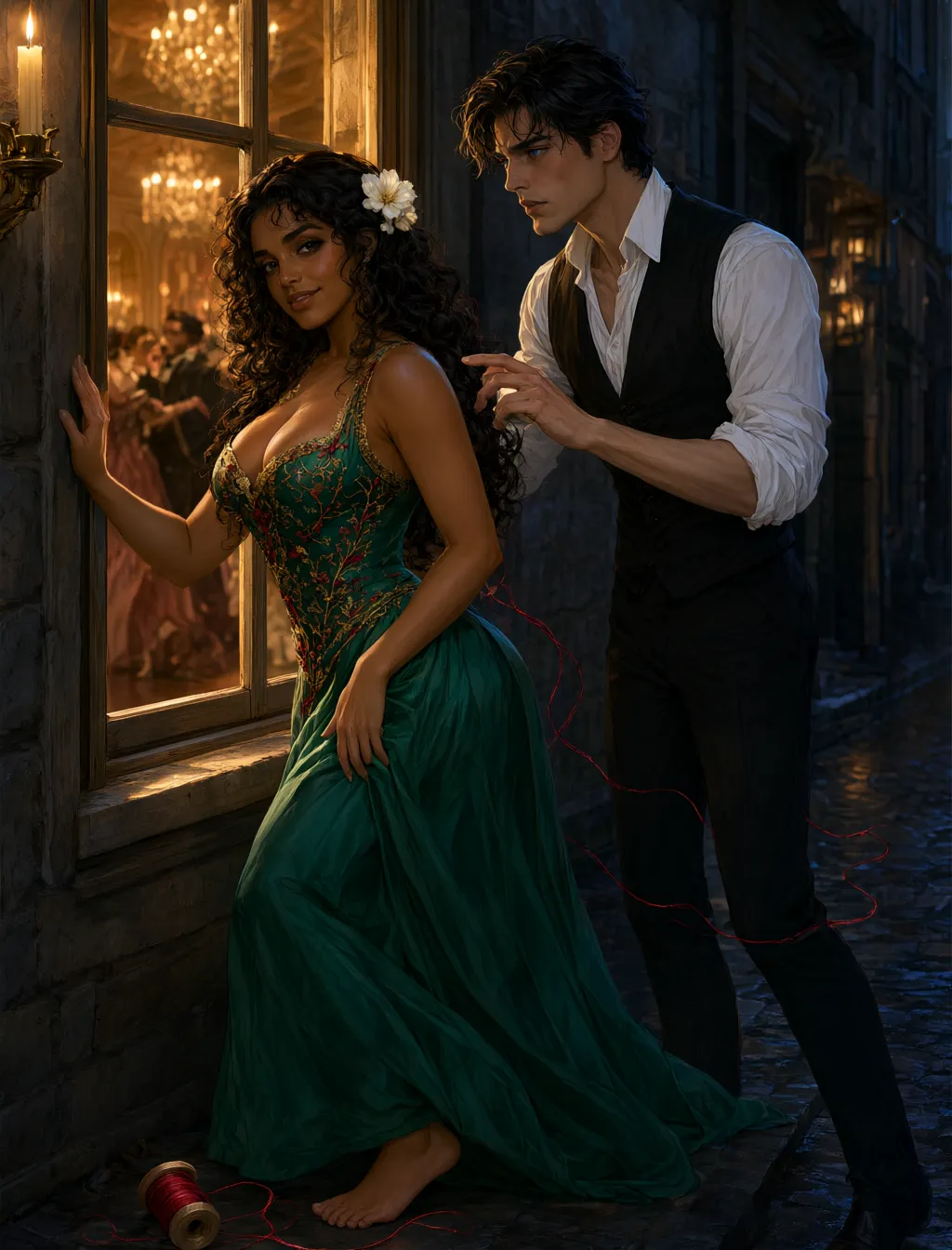
The silk was cool against her fingertips, a ribbon of crimson that caught the morning light and turned it liquid. Leia drew it through her thumb and forefinger, feeling the threads slide against the calluses she'd grown there—years of needlework, years of making small, beautiful things that no one ever saw. The library was quiet around her, the way it always was at mid-morning, when the court was still waking and the tall windows let in long columns of sun that fell across the polished oak like spilled honey.
She breathed in. Old paper. Beeswax from the floor polish. The faint dust of something ancient and patient. She liked this room for its silences—there were so many kinds, and she knew them all. The hush of a held page. The quiet of a turned corner. The particular stillness of being alone in a place that expected company.
Her needle pierced the linen again. A single stitch, pulled tight, and the blue eye on the cloth gained another thread of its iris. She worked slowly, the way her grandmother had taught her—small movements, patient ones, letting the thread find its own path instead of forcing it. The embroidery hoop rested in her lap, cradled against the soft weight of her chest, and the colors around her on the table were a small riot: gold and indigo and a green so deep it was almost black.
She was stitching an eye.
She had been stitching it for six days now, hiding it in the bottom of her sewing basket whenever anyone came near, tucking it between the pages of a folio when she heard footsteps in the corridor. She didn't know why she'd started it. That was a lie. She knew exactly why she'd started it—she just couldn't say it out loud, couldn't even think it in words that would hold still long enough to examine.
His eyes were blue. Not the pale blue of the winter sky, or the watery blue of the harbor on a gray day. They were the blue of something deeper—a gemstone, maybe, or the shadow under the ice when the river froze. She had spent so long trying not to look at them that she'd memorized them instead. The way they caught the light. The way they narrowed when he was thinking. The way they softened, just slightly, when he looked at her—though she was probably imagining that part.
She was probably imagining all of it.
The needle slipped, pricking her thumb. She hissed softly, brought the finger to her mouth, tasted the salt and iron. A single bead of blood welled up, bright against her brown skin. She wiped it on her apron, leaving a small dark bloom on the embroidered flowers there, and returned to her work.
The stitch she'd been making was ruined. She pulled it out, rethreaded the needle with a fresh length of indigo, and started again.
Her hands trembled. They did that sometimes, especially when she was working on this—this particular piece, this secret thing she couldn't name. The tremor was small, almost invisible, but she could feel it in her fingertips, a hum just under the skin. Her mother would have said it was nerves. Her sisters would have said she was being dramatic. Leia knew it was something else entirely—a current running through her that had nowhere to go, a feeling too big for her body, too loud for her voice.
She had never been good at saying things. The words always came out wrong—too flat, or too late, or not at all. People thought she was cold because she didn't smile when they expected her to. They thought she was rude because she didn't answer when they spoke. They thought she didn't care because her face didn't change, because her eyes stayed steady and her mouth stayed still, because the feelings inside her were a river and her face was a stone.
But her hands. Her hands could say everything.
The needle moved again. Another stitch. Another thread of blue. The eye on the linen was taking shape now—the curve of the lid, the dark pupil at the center, the tiny spokes of the iris that she'd worked in three different shades of blue to get the light right. She'd been careful with it. More careful than she'd ever been with anything.
Because it was his eye. Because she was stitching Tarrant Hightopp's eye into a piece of linen in the palace library, and if anyone found it, she would have to explain why, and she didn't have words for that.
She didn't have words for a lot of things.
The gold thread caught the light, glowing like a filament of fire. She'd added that last—a single thread of gold in the pupil, a tiny fleck she'd noticed once when he'd turned his head at a certain angle. It was the kind of detail no one else would see, the kind of thing she noticed because she noticed everything, because her eyes were always moving, always cataloging, always building a world of small truths that she could retreat into when the big ones got too loud.
She heard the footsteps a moment before she understood what they meant.
Leather on stone. A measured pace. Not the quick, light step of a servant, or the heavy tread of a guard. This was someone who walked like they had time, like they owned the ground they crossed. She knew that walk. She'd been listening for it for months, half without meaning to, the way you learn the sound of a particular bird in a forest full of birds.
Her hands stilled. The needle hung mid-stitch, the blue thread catching the light.
She should hide it. She should tuck the hoop back into the folio, slide it under the botanical illustrations, pretend she'd been reading, not stitching. That was what she always did—a quick, practiced motion, the fabric disappearing before anyone could see. She'd done it a hundred times. A thousand. She knew exactly how long it took, exactly how to move so that no one noticed.
But her hands wouldn't move.
She was frozen. The needle in her fingers, the linen in her lap, the blue eye half-formed and staring up at her. And the footsteps getting closer, and closer, and then stopping—right at the edge of the table.
She looked up.
Tarrant Hightopp stood there, tall and lean, the morning light catching the sharp angles of his face. His black hair was combed back, the way it always was, and his waistcoat was dark—charcoal, maybe, or a blue so deep it read as black. His hands were at his sides. His eyes were on her.
No. Not on her. On the fabric in her hands.
On the eye she'd been stitching.
On his own eye, rendered in silk and thread, staring back at him from her lap.
Her breath caught. The needle slipped from her fingers, landed on the table with a soft click, and rolled to a stop beside a coil of indigo thread. She didn't reach for it. She couldn't. Her hands were frozen around the hoop, holding it up like an offering, like a confession, like a thing she'd been caught with and couldn't put down.
The silence stretched.
She could feel it—the weight of it, the heat of it. The library was so quiet that she could hear her own heartbeat, a dull thud in her ears, and the distant sound of a bird somewhere outside the window. The sun moved a fraction across the table. The gold thread glinted. She didn't breathe.
And then Tarrant's eyes moved from the fabric to her face, and she saw it—the thing she'd been imagining for months, the thing she'd told herself she was inventing, the thing she'd stitched into a piece of linen because she couldn't say it in words.
His eyes softened.
Just slightly. Just a fraction—the lines around them easing, the focus changing. He looked at her the way she'd always wanted him to look at her, the way she'd never let herself believe he did, and she felt something crack open in her chest, a fissure of heat running through the stone she'd built around herself.
She pulled the fabric closer to her chest.
It was instinct. A reflex. The same motion she'd made a thousand times, hiding her work, hiding herself, making herself small and quiet and invisible. The hoop pressed against her ribs, the linen crumpling in her grip, and she could feel the blue eye staring up at her, accusing her, asking her why she always ran.
Tarrant didn't move. He didn't reach for the fabric. He didn't say anything.
He just stood there, at the edge of the table, looking at her. And then, very slowly, he raised his hand—not toward the cloth, not toward the embroidery, but toward her. Toward her hands, frozen around the hoop. Toward the space between them that had been shrinking for months without either of them acknowledging it.
His fingers brushed hers.
The touch was light—barely there, a whisper of contact. But she felt it like a brand, like a spark leaping across a gap. Her hands trembled. The hoop shifted in her grip. The blue eye stared up at the ceiling, forgotten.
She didn't pull away.
Tarrant's fingers settled over hers, warm and careful, and she felt the calluses on his palm against her knuckles. He didn't squeeze. He didn't grip. He just held her, the way you'd hold something fragile, something precious, something you were afraid to break.
The silence between them was heavy with everything she couldn't say. The words piled up in her throat—I didn't mean for you to see. I didn't mean for you to know. I've been stitching your eyes for six days because I can't stop looking at them, because I can't say what they do to me, because I don't have words for the way you make me feel—and they stayed there, locked behind her teeth, because she'd never learned how to let them out.
His thumb moved across her knuckles. A small, slow stroke. Almost unconscious.
She felt it in her chest, in her stomach, in the place between her ribs where the fear lived. Her whole body was trembling now, a fine vibration she couldn't control, and she hated it—hated that he could see it, hated that he could feel it, hated that her hands were betraying her the way they always did, showing everyone the things she couldn't say.
But she didn't pull away.
She looked at him. At his face, his eyes, his mouth—the mouth that had said her name once, in the garden, and she'd replayed it in her head for a week. His gaze was steady, patient, waiting. He wasn't going to speak first. He was going to let her decide.
And she didn't know how to decide. She didn't know how to move, how to speak, how to be the person he seemed to want her to be. She was just Leia—the quiet sister, the round sister, the one who hid in libraries and stitched eyes into linen because she couldn't say the words out loud.
The gold thread caught the light. The blue eye stared at the ceiling. His hand was warm over hers.
And the silence held them both, suspended, waiting for one of them to break it.
Tarrant's thumb moved again across her knuckles—slower this time, deliberate, as if he were memorizing the shape of her hand. She watched his face, searching for the thing people usually did when they looked at her: the flicker of impatience, the polite blankness that meant they'd already stopped listening. But there was none of that in his eyes. Just that softness, that patience, as if he had all the time in the world and wanted to spend it right here.
"You've been stitching for a while," he said. His voice was low, careful—the same voice he used in council meetings, she'd noticed, when he wanted people to lean in. "Your hands are steady now. They weren't, before."
She blinked. He'd noticed the trembling. Of course he'd noticed. He noticed everything—that was the thing about Tarrant Hightopp that unsettled her most. He saw the small things, the details other people walked past, and he kept them in that quiet ledger of his without ever saying what he was counting.
"I—" Her voice came out scratchy, unused. She cleared her throat. "It's easier now. The stitch. I know the pattern."
"You know it by heart."
It wasn't a question. She nodded anyway, because she didn't know what else to do with her mouth, and his thumb was still moving across her knuckles, and the heat of his hand was traveling up her arm in slow, patient waves.
He looked down at the embroidery hoop in her lap—at his own eye rendered in silk, the iris catching the sun. She braced herself for him to ask why. For the question she couldn't answer, the one that would crack her open and spill everything she'd been holding in for months.
But he didn't ask.
"You used three blues," he said instead. "For the iris."
Her breath caught. "You can tell?"
"The shadows." He touched the edge of the hoop, not quite taking it from her. "There's a darker line along the bottom curve. And a lighter one at the top, where the light hits." His finger traced the air above the fabric, not the silk itself. "You paid attention."
She felt her face warm. The heat crept up her neck, settled in her cheeks, and she hoped—stupidly, desperately—that her skin didn't show it the way her sisters' did. But she could feel it, the flush spreading like spilled ink, and she knew he could see it too. He saw everything.
"I notice things," she said. It came out smaller than she meant it to.
"So do I."
His hand was still on hers. She should pull away. That was what she always did—retreated, made herself small, disappeared into the stacks before anyone could expect anything from her. But her hand stayed where it was, warm under his, and the trembling had stopped. That was the strangest part. The tremor that lived in her fingers like a second heartbeat had gone quiet, as if his touch had stilled it.
"I've been bringing you things," he said. "For months. Books, threads, that set of steel needles from the market at Hatter's Row."
She nodded. She remembered all of it—the way he'd set each gift down without ceremony, as if it were nothing, as if he hadn't spent hours choosing it. The books were always ones she hadn't read, histories and folktales from kingdoms she'd never visited. The threads were always colors she used, shades she'd mentioned once in passing, in a conversation she'd assumed he wasn't really listening to.
"I thought you didn't want them," he said. "You never said anything. You'd look at me with that face—" He stopped, and something flickered across his own. "I thought you were tolerating me. That you were too polite to tell me to stop."
"No." The word came out sharper than she meant it to. "No, I—" She swallowed. The words were there, piled up behind her teeth, but they never came out in the right order. She tried anyway, because he was looking at her with that patient expectation, and she couldn't bear to disappoint him. "I don't know how to say thank you. I mean—I know the words. But they don't come out right. They sound small. Like they're not enough."
His hand tightened on hers. Just slightly. A reflex.
"I don't need you to say it," he said. "I just needed to know you understood. That you knew I wasn't—" He paused, and she watched him choose his words with the same care she gave her stitches. "That I wasn't just being polite."
She looked down at the embroidery hoop. At his eye, rendered in silk, staring up at her. She'd spent six days on it, hiding it from everyone, terrified of what it meant. And now he was here, his hand over hers, telling her he'd been terrified too.
"I don't smile," she said. "Not the way people expect. My face—it doesn't always show what I'm feeling. I try, but—" She stopped. The confession felt like pulling thread through a too-small eye, awkward and clumsy. "People think I'm cold. Or rude. Or that I don't care."
"I know."
She looked up, startled.
"I watched you," he said. "I paid attention. The way you hum when you're working on something you love. The way you tuck your hair behind your ear when you're nervous. The way your hands move when you're thinking—you don't even look at the needle, you just know where it goes."
Her throat tightened. No one had ever said that to her. No one had ever noticed the humming, or the hair, or the way her hands knew things her mouth couldn't say.
"I thought you hated me," she whispered.
His brow furrowed. "What?"
"The first time you brought me something. The book about the silk road. I thought—" She looked down at their hands. "I thought you were mocking me. That someone had put you up to it. That it was a joke."
"A joke." His voice was flat. "You thought I was—" He stopped, and something in his jaw tightened. "Leia. I spent three weeks finding that book. It's out of print. I had to write to a dealer in the eastern provinces."
She blinked. "You wrote—"
"To a dealer. In the eastern provinces." He said it slowly, as if making sure she heard every word. "Because you mentioned once, in passing, that you'd read an excerpt in a folio and wanted to know the rest of the story. You said it to Mira, not to me. I was standing three feet away."
The heat in her face was unbearable now. She could feel it in her ears, in her scalp, everywhere. "I didn't—I didn't think anyone heard that."
"I did." His thumb traced the edge of her knuckle again. "I hear everything you say, Leia. Even the things you think are too quiet for anyone to notice."
There was a beat of silence. The library was still around them, the sun moving in its slow arc across the table, and she could hear her own heartbeat in her ears, loud and unsteady.
"I don't know how to be wanted," she said. The words came out before she could stop them, raw and honest and terrifying. "I've never—people don't look at me the way you're looking at me. They look at my sisters. Mirana, with her crown. Iracebeth, with her fire. I'm just—" She gestured vaguely at herself, at her round body, her brown skin, the embroidery hoop in her lap. "I'm the one in the library."
Tarrant was quiet for a long moment. Then he moved.
He didn't let go of her hand. He shifted instead, closing the distance between them, and she felt the warmth of him settle beside her—not crowding, not looming, just present. His shoulder brushed hers. His face was close enough that she could see the faint lines at the corners of his eyes, the ones that appeared when he was thinking hard.
"I don't want your sisters," he said. "I never have. I want the person who stitches eyes into linen because she can't say what she's feeling. I want the person who hums when she works and tucks her hair behind her ear when she's nervous and knows the exact shade of blue that matches the shadow under ice."
Her breath caught. The tears came without warning—not a flood, just a prickling at the corners of her eyes, a warmth that blurred his face. She tried to blink them away, but one escaped, sliding down her cheek, and she felt it hot against her skin.
His hand moved. Not to her face—he was careful, always careful—but to the edge of her sleeve, where the embroidery flowers were. He touched one of the petals, a small crimson bloom, and she felt the pressure of his finger through the fabric.
"You don't have to say anything," he said. "I'm not asking you to. I just—" He paused, and for the first time since she'd known him, he looked uncertain. "I needed you to know. That I see you. All of you. Not the version you hide in libraries."
She looked down at their hands—his pale against her brown, his fingers wrapped around hers like he was afraid she'd slip away. The embroidery hoop was still in her lap, his eye staring up at the ceiling, forgotten.
"I was going to give it to you," she said. Her voice was barely a whisper. "The embroidery. I was going to finish it and leave it in your study, with a note." She swallowed. "I didn't know what the note would say. I still don't."
"Then don't write one." His voice was low, rough. "Just give it to me. When it's done."
She nodded. The motion was small, almost imperceptible, but she felt it change something between them—a door opening, a thread pulling tight.
His thumb traced the back of her hand one more time, and then he let go. The absence of his warmth was sudden, almost cold, and she felt the trembling start up again in her fingers.
But he didn't leave. He reached past her, carefully, and picked up the coil of indigo thread from the table. He held it out to her, the silk catching the light.
"You'll need more," he said. "For the shadows."
She took it. Her fingers brushed his, and the trembling stopped again, just for a moment.
The library settled around them. The sun moved. The gold thread glinted on the table. And Leia, for the first time in months, let herself believe that maybe—just maybe—she didn't have to hide.
She threaded the needle, and began to stitch.
The needle slid through the linen with a soft pull, and the rhythm of it steadied her—one stitch, two, the indigo thread he'd given her catching the light as she worked the shadow beneath the eye's lower lid. She could feel him watching, not with the impatient weight she was used to, but with something quieter, a patience that seemed to wrap around her like the warmth of the sun through the window.
She didn't look up. She couldn't. If she looked up, she would have to say something, and she still didn't have the words for what was happening between them. So she stitched instead, letting her hands speak the way they always had, the way they knew better than her mouth ever did.
He reached out—slow, giving her time to pull away—and touched the edge of the hoop. Not to take it. Just to hold it steady while she worked. His finger rested on the wooden rim, close enough that she could feel the warmth of him through the grain.
"What do you do," he asked, "when you're not in the library?"
The question surprised her. No one ever asked her that. They asked about her sisters, about the court, about the weather. They asked about her embroidery only when they wanted to compliment it, and then they moved on, as if the answer didn't matter.
She thought about it. The question deserved a real answer, not the one she usually gave—the one that made her sound small and forgettable. She pulled the needle through the linen and let the thread go slack.
"I walk," she said. "In the gardens, mostly. There's a corner near the south wall where the roses grow wild, where no one prunes them. I like it there." She paused, and the next words came out softer than she meant them to. "I talk to the plants. Not—not out loud. In my head. I tell them about the books I'm reading."
He didn't laugh. He didn't even smile. He just nodded, as if she'd said something perfectly ordinary, as if talking to roses in your head was the most reasonable thing in the world.
"I know the corner," he said. "The one with the climbing rose, the pale pink one. It's been left to grow over the wall."
She looked up then, startled. "You've seen it?"
"I've walked past it." His voice was careful, measured. "I've seen you there, sometimes. Sitting on the low stone wall, reading. You don't hear me when I pass."
Her face warmed again. The flush crept up her neck, and she bent her head to the hoop, hiding in the work. "I'm usually—when I read, I'm somewhere else. In the story. I don't notice—"
"I know." He said it gently, like he was telling her something she already knew but needed to hear anyway. "I never minded. I liked watching you read. The way your lips move when you get to a good part. The way you hold the book with both hands, like it might get away from you."
The needle slipped. She caught it before it pricked her, but the thread pulled tight, and she had to stop and work the knot free with her fingers. Her hands were trembling again, the tremor back in full force, and she couldn't seem to make it stop.
"I'm sorry," she said, to the knot, to the thread, to the space between them. "I'm not—I don't—"
"Leia." His voice was low, and it cut through the tangle of half-formed words. "You don't have to apologize. Not to me. Not for this."
She looked up. His face was close, closer than she'd realized, and his blue eyes were soft in a way she'd never seen them—soft in a way she didn't think he let anyone see. He reached out, and this time he didn't touch the hoop. He touched her hand, the one that was still trembling, and he held it gently, his thumb tracing the callus on her index finger, the one she'd earned from years of needlework.
"I've been watching you for months," he said. "I've seen you smile. Not often. But when you do—when you're reading something you love, or when you're working on a piece that's going well, or when you're in the garden and the light hits your hair just right—you smile, and it's like the whole room changes."
She couldn't breathe. The words were too much, too big, too bright, and she didn't know where to put them. She'd spent so long being invisible, being the sister no one noticed, the one who lived in libraries and talked to roses in her head. And here he was, telling her he'd seen her all along.
"I don't know what to do with that," she whispered. "What you're saying. I don't know how to—"
"You don't have to do anything." His thumb moved across her knuckles, slow and patient. "I'm not asking you to be different. I'm not asking you to smile more, or talk more, or be anything other than what you are. I just—" He paused, and when he spoke again, his voice was rough, almost raw. "I needed you to know that I see you. And that I'm not going anywhere."
The tears came again, and this time she let them fall. She didn't try to blink them away. She just sat there, his hand around hers, the embroidery hoop in her lap, and let herself cry without making a sound.
He didn't move to hold her. He didn't try to fix it. He just stayed, his hand steady around hers, his thumb moving in that slow, patient rhythm, and she felt something in her chest unclench—something she hadn't even known was tight.
The sun moved across the table. The gold thread glinted. And Leia, for the first time in her life, let someone see her cry without trying to hide it.
The tears ran until they ran out, which took a while, and Tarrant held her hand through all of it. He didn't rush her. He didn't pat her shoulder the way people did when they wanted you to stop. He just sat beside her in the warm library light, his thumb tracing slow circles on her knuckles, and let her cry herself empty.
When she finally sniffed and wiped her face with the back of her free hand, he reached into his waistcoat and produced a handkerchief—crisp, white, monogrammed with a small H in the corner. She stared at it.
"You carry a handkerchief?" Her voice came out thick and nasal.
"I carry a lot of things." He didn't smile, but something moved in his eyes. "I've been hoping you'd need one."
She took it. The fabric was soft, worn soft from washing, and it smelled faintly of cedar and something green. She pressed it to her face, breathing him in through the cotton, and the trembling in her hands finally settled.
"This is yours," she said, folding it carefully, meaning to give it back.
"Keep it." He said it like it was nothing. "You can give it back when you give me the embroidery."
She looked down at the hoop in her lap. His eye stared up at her, half-finished, patient. The shadow beneath the lower lid was nearly done now, the indigo thread he'd given her lying in neat rows of tiny stitches. It was good work. She knew it was good work. But it wasn't finished, and she couldn't seem to find the last thread of it, the final line that would close the lid and make it whole.
"It needs one more thing," she said. "The eye—it needs the light. The fleck I saw once, at the market. When you turned your head and the sun caught it."
"The gold." He said it softly, like he already knew.
She nodded. "I have the thread. I just—" She stopped, aware of how it sounded. Aware that she was telling him she'd seen something in his eye at the market, that she'd been watching him closely enough to catch a fleck of gold in his iris, that she'd carried that detail around for months like a stone in her pocket. "I haven't found the right gold yet."
He was quiet for a moment. Then he stood, and she felt the absence of him like a cold patch on her skin. He crossed to the shelves along the south wall, ran his fingers along the spines, and pulled down a thin volume bound in faded green leather. He brought it back and set it on the table between them.
"What's this?" she asked.
"Open it."
She did. The pages were old, the paper thick and deckle-edged, and the illustrations were hand-painted—dozens of them, tiny and precise, each one a different shade of gold. Gold leaf. Gold thread. Gold pigment. Gold dust. The colors spilled across the pages like a hoard, each one labeled in a cramped, elegant hand she didn't recognize.
"It's a sample book," she breathed. "From a dyer's workshop."
"From a monastery in the eastern provinces. The monks there make pigments from crushed minerals and plant resins. They sent it to my father's family as a gift, years ago, when the mines first opened." He touched the spine, gentle. "There's a gold in there. The one they make from weld flowers and iron. It's the color of sunlight on a river."
She turned the pages slowly, her fingers brushing the painted swatches. Each one was a tiny rectangle of color, some smooth and matte, some glittering with ground mica. She found the weld gold near the back, a warm, honeyed shade that caught the light and held it.
"This is it," she said. "This is the color."
He didn't say anything. He just watched her, his blue eyes steady, and she realized he'd known. He'd known which gold she needed, had brought the book for that exact purpose, had probably been carrying it around for days waiting for the moment to give it to her.
"You could have just told me where to find it," she said. "You didn't have to bring the whole book."
"I wanted you to see them all." He sat back down, close enough that his shoulder brushed hers. "I thought you might like to look. The colors, I mean. The way they're made. I thought—" He paused, choosing his words with the same care she gave her stitches. "I thought you might want to know where the colors come from."
Her chest ached. Not the sharp ache of fear or the dull ache of loneliness, but something else—a fullness, a pressure behind her ribs that felt like it might crack her open if she let it. No one had ever given her a book of colors. No one had ever thought she might want to know where they came from.
"Thank you," she said. The words felt small, but she said them anyway, looking at him. "For this. For all of it."
He nodded. "You said the words come out small."
"They do."
"They don't sound small to me." His hand found hers again, warm and sure. "They sound like you."
She turned back to the gold swatches, but she didn't really see them. She was thinking about the way he'd said her name in the garden, the way he'd walked past her on the low stone wall without stopping, the way he'd been watching her all this time without ever once making her feel like a spectacle. She was thinking about the three months of gifts, each one chosen with such care, and how she'd never once said thank you properly—how she'd let them pile up in her rooms like evidence of a kindness she couldn't return.
"I want to give you something," she said. "Not the embroidery. Something else. Something you'd actually—" She stopped, the words tangling. "Something that would fit."
He tilted his head. "Fit?"
"I make things," she said. "Clothes. Swimwear, sometimes. I made a set for myself last spring, out of bamboo and nettle fibre. It fit well. I was proud of it." She looked down at her hands, at the calluses on her fingers. "I could make something for you. If you wanted. A waistcoat, or—or something. Something that would fit you properly."
He was quiet for so long that she looked up, afraid she'd said something wrong. But his face wasn't closed. It was open, softer than she'd ever seen it, and there was something in his eyes she couldn't name.
"You'd make me something?" he asked.
"If you wanted."
"I want." He said it quickly, almost too quickly, and then he seemed to catch himself. "I mean—yes. I'd like that. I'd like anything you made."
She felt the heat creep up her neck again. "I'd have to measure you. For the fit. It's—it's not hard, but I'd need to—" She gestured vaguely at his shoulders, his chest, the long lines of him. "I'd need to see the measurements."
He stood up. Just like that, without hesitation, and held his arms out at his sides.
"Measure me," he said.
She stared at him. "Now?"
"Why not now?"
Her heart was pounding. She could feel it in her throat, in her ears, in the tips of her fingers. She'd measured people before—her sisters, the seamstresses she sometimes worked with, the mannequins in the palace workroom. It was a practical thing, a mechanical thing, a task she could do with her eyes closed.
But this was Tarrant. Tarrant Hightopp, standing in the library in his charcoal waistcoat, his arms at his sides, waiting for her to touch him.
She stood. Her legs felt unsteady, but she made them work. She crossed to the table where her sewing basket sat, the one she'd carried from her rooms, and pulled out the measuring tape—a strip of soft yellow cloth, marked with tiny black stitches where the numbers should be.
He watched her the whole time. His eyes followed her hands, her face, the way she moved. He didn't say anything. He just stood there, patient, waiting.
"I'll need to start at the shoulders," she said. Her voice came out steadier than she felt. "If you could—"
He turned his back to her, and she realized he knew the protocol. He'd been measured before, by tailors in the city, by the palace seamstresses who made his court clothes. He knew where to stand, how to hold his arms, how to be still.
She pressed the end of the tape to the seam of his left shoulder and drew it across to the right. Her fingers brushed the wool of his coat, and she felt the warmth of him through the fabric. She measured the width of his shoulders, the length of his arms, the circumference of his chest. She tried to be quick, tried to be professional, tried not to think about the fact that she was touching him, that he was letting her touch him, that he'd asked her to.
But her hands were trembling again. The tremor was back, humming under her skin, and she couldn't hide it. She pressed the tape to his waist, drew it around, and her knuckles brushed the small of his back.
He went very still.
"Sorry," she said. "I didn't mean—"
"You're fine." His voice was rough, lower than before. "Keep going."
She measured his waist, his hips, the length of his torso from shoulder to hem. She tried not to think about the shape of him, the lean muscle under the wool, the way he stood so still for her, like he trusted her hands completely.
"I think that's—" She stepped back. "That's everything I need."
He turned to face her. The tape was still in her hands, coiled loosely, and she realized she was gripping it like a lifeline. His eyes moved over her face, her shoulders, her hands, and something in his expression shifted—a flicker, quick as a fish under water.
"You're good at that," he said. "The measuring. You're careful."
"I like making things fit," she said. "I like the precision of it. The way a thing can be made to fit exactly, if you take the time."
"I know what you mean." He reached out and touched the edge of the tape where it hung from her fingers. "I've been trying to make something fit for months now."
She looked up at him. His face was close, closer than it had been before, and she could see the gold fleck in his eye—the one she'd been looking for, the one she'd known she'd find. It was there, right there, a tiny point of light in the blue, and she'd been right about it all along.
"I found it," she said. Her voice was barely a whisper. "The gold. In your eye."
He didn't move. "Did you?"
"It's there. Right at the edge of the iris. It catches the light when you turn your head." She lifted her hand, not quite touching his face, hovering at the line of his jaw. "I saw it at the market. I thought I imagined it."
"You didn't."
Her fingers touched his cheek. Just barely. Just the tips, resting against the warmth of his skin. He went still again, the same stillness he'd had when she measured his waist, and she felt the breath leave her in a long, slow sigh.
"I'm going to finish it," she said. "The embroidery. I'm going to finish it and give it to you."
"I know."
"And I'm going to make you a waistcoat," she said. "Out of the good wool, the blue one I saw in the market. The one that matches your eyes."
His jaw tightened under her fingers. "You saw that?"
"I notice things," she said, echoing her own words back at him. "Even the things you think are too quiet for anyone to notice."
He laughed. It was a small sound, almost surprised, and it cracked something open in her chest. She'd never heard him laugh before. She'd seen him smile, sometimes, a careful polite curve of his mouth. But this was different. This was real, and it was for her.
"You're going to be the death of me," he said. "You know that, right?"
She didn't know what to say to that. She didn't know how to tell him that he was already the death of her, that she'd been dying slowly for months, that every time he brought her a gift or looked at her with those patient blue eyes, she felt something in her chest crack a little wider.
So she stepped back instead, and let her hand fall, and picked up the measuring tape from where she'd dropped it.
"I should go," she said. "I need to find the wool. The blue one. Before someone else buys it."
He nodded. "I'll walk with you."
"You don't have to—"
"I want to."
She looked at him. At his sharp face, his careful eyes, the way he stood so still and patient, waiting for her to decide. And she realized, with a sudden clarity that made her breath catch, that she didn't want to go alone.
"Okay," she said. "Okay."
She packed her basket slowly, folding the embroidery hoop into the linen, tucking the sample book of golds beside it. He watched her the whole time, not moving, not rushing, just there. When she was done, she stood and slung the basket over her shoulder.
He held out his hand.
She took it.
His fingers closed around hers, warm and sure, and they walked out of the library together, into the long golden light of the corridor. The palace was waking around them—servants moving, doors opening, the distant sound of voices. She could feel the weight of their joined hands, the way his thumb rested against her palm, and she didn't pull away.
The market was in the lower courtyard, a sprawl of stalls and carts that appeared every third day. She knew the wool seller by name—old Marta, who dyed her own yarns and kept the good skeins hidden under the counter. Leia led Tarrant through the crowd, her hand still in his, and she felt the stares as they passed. The quiet sister, walking hand in hand with the heir to the Hightopp mines. She heard the whispers, the sharp intakes of breath, the way the crowd parted around them like water around a stone.
She didn't let go.
Marta's stall was at the far end, under a striped awning that had faded to a soft rose. The old woman looked up as they approached, her eyes moving from Leia's face to their joined hands and back again. A slow smile spread across her lined face.
"Miss Taozi," she said. "You've brought company."
"I need the blue wool," Leia said. "The one you showed me last month. The deep one, with the shine."
Marta ducked under the counter and came up with a bolt of cloth wrapped in brown paper. She unwrapped it carefully, and the wool spilled out—a deep, rich blue, the color of the shadow under ice, the color of Tarrant's eyes in the morning light.
Leia touched it. The fibers were soft, dense, woven tight. She could feel the quality of it, the way it would drape, the way it would hold a stitch.
"It's perfect," she said.
"It's yours," Tarrant said.
She looked up, startled. "You don't have to—"
"I want to." He reached into his waistcoat and produced a small leather purse, weighed it in his palm. "It's for me, isn't it? The waistcoat?"
She felt the heat creep up her neck again. "Yes, but—"
"Then I'm paying for it." He set the purse on the counter. "Marta, we'll take the whole bolt."
Marta's eyes went wide. "The whole bolt, sir?"
"The whole bolt." He didn't look away from Leia. "She might need to make mistakes."
Leia's throat tightened. She wanted to say something—thank you, or you don't have to, or I don't deserve this—but the words wouldn't come. They never came. She just stood there, holding the blue wool in her hands, and let him pay for it, and tried not to cry again.
Marta wrapped the bolt in fresh paper, tied it with twine, and handed it to Leia. The package was heavy, solid, real. She held it against her chest like something precious.
"Thank you," she managed.
Marta smiled. "You bring him back, child. I want to see the waistcoat when it's done."
Leia nodded. She couldn't speak. She turned and walked out of the stall, Tarrant's hand finding hers again, and they made their way back through the crowd. The whispers followed them, but she didn't hear them anymore. She could only feel the warmth of his hand, the weight of the wool against her chest, the way the sun caught the gold in his eye when he turned to look at her.
"I'm going to make it fit," she said. "I'm going to make it perfect."
"I know you will."
They walked in silence for a while, through the courtyard, past the fountain with its chipped stone angels, up the steps to the palace. At the door to her rooms, she stopped. She didn't want to let go of his hand.
"I'll start tonight," she said. "The waistcoat. I'll cut the pattern and start stitching."
"Take your time." He squeezed her hand, then released it. "I've been waiting for you for months. I can wait a little longer."
She looked at him. At his sharp face, his patient eyes, the way he stood so still and sure. And she realized, with a clarity that made her chest ache, that she didn't want to make him wait anymore.
"Come inside," she said.
He blinked. "What?"
"Come inside." She opened the door to her rooms. "I have tea. And I have the sample book. I want to show you the gold I'm going to use in the embroidery."
He followed her in. The door closed behind them, soft and final, and the world outside went quiet.
Her rooms were smaller than his, but they held more of her—the walls lined with shelves of thread in every color she'd ever seen, bolts of fabric leaning against the furniture, a loom in the corner with a half-finished piece stretched across it in shades of sunset. She watched him take it in, his eyes moving slowly, cataloging the way he always did, and she felt the familiar flutter of exposure, the urge to hide the messier parts of herself.
But he didn't look at her like she was a mess. He looked at her like she was a book he wanted to read slowly, page by page.
"Tea," she said, remembering. "I said I had tea."
He smiled—a small, real smile, the kind that creased the corners of his eyes. "You did."
She crossed to the small table by the window, where a kettle sat on a trivet and a tin of dried leaves waited beside a pair of mismatched cups. Her hands moved through the familiar motions—water from the pitcher, leaves measured and dropped, the little flame coaxed to life under the kettle. It was easier than talking. Easier than standing still under his gaze while he took her apart with those patient blue eyes.
He didn't sit. He wandered instead, his fingers trailing over the shelves, stopping at a small wooden box she'd painted with birds. He didn't open it. He just touched the lid, gentle, the way he touched everything.
"What's in here?" he asked.
"Threads." She measured the leaves into the pot, not looking at him. "The ones I don't use often. The special ones."
"Special how?"
She hesitated. The kettle began to whisper, a soft hiss of steam. "Some of them are from places I've never been. The dyer in the eastern provinces sent me a sample once, through a trader who owed my sister a favor. It's a red they make from crushed beetles, the color of old blood. I've never found a use for it. It's too—" She searched for the word. "Too loud. But I keep it anyway. I like knowing it exists."
He turned from the box, watching her with an expression she couldn't read. "You keep things that are too loud."
She felt the heat creep up her neck. "It's different. The thread doesn't have to speak. It just has to wait."
"And you?"
The question hung between them. She poured the water into the teapot, the stream steady, and tried to think of an answer that wasn't a lie.
"I'm learning," she said finally. "To not wait so long."
The kettle settled. The tea steeped. She carried the pot to the table, set out the cups, and gestured for him to sit. He did, folding his long frame into the chair across from her, and she watched his hands wrap around the cup—pale against the ceramic, careful, like he was holding something fragile.
"This is good," he said after the first sip. "What is it?"
"Jasmine and something my grandmother used to grow. I don't know the name of it. She called it quiet leaf." She paused. "It's for days when your thoughts are too loud."
He looked at her over the rim of the cup. "You drink it often?"
"Every day."
Something passed between them—a flicker of understanding, a thread pulled taut. She looked away first, because she always looked away first, and reached for the sample book he'd given her, the one with the golds.
"I want to show you," she said, "the one I'll use."
She found the page, the weld gold, the color of sunlight on a river. She turned the book toward him, and he leaned in, close enough that she could smell the cedar and green of his coat, the soap on his skin.
"This is it," she said. "This is the color in your eye."
He studied the swatch, then lifted his gaze to hers. "You're sure?"
"I've been looking at it for six days." The words came out before she could stop them, and she felt her face warm. "I mean—the embroidery. I've been working on it for six days. I know the color."
He didn't smile, but something moved in his eyes, a warmth that made her chest tighten. "You've been looking at my eye for six days."
"That's not—" She stopped. The truth sat between them, heavy and bright, and she couldn't seem to pick it up or put it down. "Yes," she said finally, quietly. "I have."
He set down his cup. His hands were still, resting on the table, and she watched them—the long fingers, the calluses on his palms, the way they curled slightly, like they were waiting for something to hold.
"Leia." His voice was low, careful. "I've been bringing you things for months. Books. Threads. A set of steel needles. I thought—" He stopped, and she watched him choose his words with the same care she gave her stitches. "I thought you were tolerating me. That you were too polite to tell me to stop. And today, in the library, I thought—" He shook his head. "I thought I'd finally pushed too far."
"You didn't push." She said it quickly, the words tumbling out before she could catch them. "You never pushed. I just—" She swallowed. "I don't know how to say things. The words come out wrong, or too late, or not at all. But I never wanted you to stop. I was just—" She looked down at her hands, at the calluses on her fingers. "I was afraid you'd stop if I said something. Afraid I'd say it wrong, and you'd realize I wasn't worth the trouble."
The silence stretched. She could hear her own heartbeat, a dull thud in her ears, and the distant sound of the palace waking around them. She didn't look up. She couldn't. She'd said too much, she knew it, the words lying between them like spilled thread, and she couldn't take them back.
"Leia." His voice was rough. "Look at me."
She did. His eyes were bright, brighter than she'd ever seen them, and there was something in his face she couldn't name—something raw, almost fierce.
"You're not the trouble," he said. "You're the first thing that's made sense to me in years."
Her breath caught. The words were too big, too bright, too much. She felt the tears prick at her eyes again, and she blinked them back, hard, because she'd already cried once today and she didn't want him to think she was always like this, always falling apart at the slightest kindness.
But he didn't seem to mind. He reached across the table and took her hand, his fingers warm around hers, and she felt the trembling in her fingers quiet at his touch.
"I want to understand you," he said. "I want to learn the way you speak. The humming, the way you tuck your hair behind your ear, the way your hands say what your mouth can't. I want to know all of it." He paused. "If you'll let me."
She looked at him. At his sharp face, his patient eyes, the way he held her hand like it was something precious. And she realized, with a clarity that made her chest ache, that she wanted to let him. She wanted to show him the quiet places, the ones she'd never shown anyone.
"I have a mine," she said.
He blinked. "What?"
"My sisters—they have their mines. Iracebeth has the rubies, Mirana the diamonds. Everyone knows that. But I have one too." She pulled her hand free, reached into the pocket of her skirt, and drew out a small stone—rough, unpolished, the color of a deep blue sky at dusk. "Azure. And cinnabar, from the flower beds that grow along the southern ridge. They're not as grand as rubies or diamonds. But they're mine."
He took the stone from her palm, turned it over in his fingers. The light caught it, and it glowed, a deep, rich blue that seemed to hold the dusk inside it.
"It's beautiful," he said.
"It's the color of your eyes," she said. "When you're thinking. When you go quiet and I can't tell what you're thinking, but I know it's something deep." She paused. "I've been carrying it for a week. I wanted to give it to you, but I didn't know how."
He looked up at her. His eyes were soft, softer than she'd ever seen them, and she watched him close his fingers around the stone, holding it like it was the most precious thing he'd ever held.
"You give me a stone the color of my eyes," he said slowly, "and you say you don't know how to say things."
She felt the heat creep up her neck again. "It's different. The stone doesn't need words. It just—" She gestured vaguely. "It is what it is."
"Like you."
The words landed soft, but they hit her like a blow. She looked at him, at the stone in his hand, at the way he held it so carefully, and she felt something crack open in her chest—another fissure, another thread pulled tight.
"I want to make you something," she said. "Not just the waistcoat. Something else. Something from the mine." She reached for the sample book, turned to a page near the back. "There's a way to set azure in silver. My grandmother taught me. She used to make jewelry for the court, before—" She stopped. "Before she died. I have her tools. I could—"
"Leia." He reached across the table and took her hand again, stilling the words. "You don't have to give me anything."
"I want to." The words came out fierce, surprising her. "I want to make you something that fits. Something that's exactly right. I've been making things for other people my whole life—things they didn't see, things they didn't want. But you—" She stopped. The words were too big again, too bright. "You see them."
He was quiet for a long moment. Then he lifted her hand to his lips and pressed a kiss to her knuckles—soft, barely there, but she felt it like a brand, a spark leaping across a gap.
"Then I'll wear it," he said. "Whatever you make. I'll wear it every day."
The tears came again, and this time she didn't blink them back. She let them fall, hot and silent, and he didn't move to wipe them away. He just held her hand, his lips still warm against her skin, and let her cry.
When she finally pulled her hand free, she wiped her face with the back of her sleeve and laughed—a small, watery sound. "I'm sorry. I don't usually—"
"Don't apologize." His voice was gentle. "I told you. Not for this."
She nodded, sniffed, and reached for the sample book again. "I'll show you the setting," she said. "The way my grandmother taught me. It's not hard, but it takes patience. The silver has to be worked slowly, or it cracks."
"Like people," he said.
She looked at him, startled. "Yes. Like people."
He smiled—that small, real smile that creased the corners of his eyes. "I'm patient," he said. "I've been waiting for you for months. I can wait a little longer."
She looked at him, at the stone in his hand, at the way he sat so still and sure in her cluttered room, and she realized, with a clarity that made her chest ache, that she didn't want to make him wait anymore.
"Come with me," she said. "I'll show you the mine."
He raised an eyebrow. "Now?"
"Now." She stood, already moving toward the door. "It's not far. Just past the southern ridge, where the flowers grow. I want to show you where the azure comes from."
He followed her. Of course he followed her. He'd been following her for months, in his way, patient and steady, waiting for her to lead him somewhere real.
The corridor was quiet as they walked, the palace still waking around them. She led him through the servants' passages, the ones she knew by heart, past the kitchens and the storerooms, out through a door she'd oiled herself so it wouldn't squeak. The morning air hit her face, cool and clean, and she breathed it in, feeling the tension in her shoulders ease.
The path to the mine wound through the gardens, past the wild roses she'd told him about, up the southern ridge where the cinnabar flowers grew—bright red blooms that stained your fingers if you touched them, that she'd learned to harvest with gloves and a careful hand. She led him past them, up the slope, to the place where the earth opened into a shallow cave, its mouth draped with moss and wild vines.
"Here," she said. "It's not much. But it's mine."
He stepped past her, into the cave mouth, and she watched him take it in—the veins of azure running through the stone, glowing faintly in the dim light, the cinnabar crystals clustered along the walls like tiny red lanterns. He reached out and touched the stone, his fingers tracing the blue veins, and she saw his face change—not surprise, exactly, but wonder, a quiet awe that made her chest ache.
"It's beautiful," he said. "You've been keeping this secret?"
"Not a secret," she said. "Just—mine. No one ever asked."
He turned to look at her, and the light from the azure caught his face, painting him in shades of blue. "I'm asking now."
She stepped closer. The cave was small, intimate, the air cool and still. She could hear his breathing, steady and calm, and her own, faster, unsteady.
"I want to show you," she said. "All of it. The mine, the embroidery, the waistcoat, the—" She gestured, helpless, at everything. "The quiet places. I want to show you where I live."
He reached out and took her hand. His fingers were warm, sure, and she felt the trembling in her hands quiet at his touch.
"Then show me," he said. "I'm not going anywhere."
She looked at him, at the azure glow on his face, at the way he held her hand like it was something precious. And she realized, with a clarity that made her chest ache, that she believed him.
"There's a vein," she said, "further back. The deepest one. It's the color of your eyes in the morning, when the light first hits them." She paused. "I want to show you."
He followed her into the dark, his hand warm in hers, and the world outside went quiet.
The cave opened around them like a held breath. The azure veins caught the dim light and threw it back in shades she knew by heart—seven of them, from the pale blue of a robin's egg to the deep indigo of a storm sky at dusk. She watched Tarrant's face as he took it in, the way his eyes moved along the walls, cataloging, memorizing, the way he did everything.
"It's bigger than I thought," he said. His voice echoed softly against the stone.
"A hundred feet tall," she said. "A hundred back. A thousand side to side. It runs under the ridge, past where the cinnabar flowers grow." She gestured to the walls. "The azure is in seven shades. The cinnabar in five. My grandmother mapped them all before she died. I have her charts in my rooms."
He turned in a slow circle, taking in the full span of it. The cave was cathedral-huge, its ceiling lost in shadow above them, its walls streaked with veins of blue that pulsed faintly in the half-dark. The air was cool and mineral, smelling of stone and something green, and the silence here was different from the library—deeper, older, a silence that had been holding its breath for centuries.
"You said the cinnabar is a version of ruby," he said. "Mixed with lily."
She nodded, stepping past him to where the red crystals clustered along the far wall. They caught the light as she approached, five distinct shades—from a pale rose to a deep, almost black crimson. She touched one, careful, her fingers tracing the facets.
"It's not toxic," she said. "That's what makes it strange. Most cinnabar is—you have to be careful with it, the mercury content. But this—" She turned to look at him. "This is different. It's ruby, but it grew with the lilies that bloom along the ridge. The two minerals fused somehow. The crystals carry the flower's color in them."
He crossed to stand beside her, his shoulder brushing hers. He reached out and touched the same crystal she'd touched, his fingers resting where hers had been.
"Five shades of red," he said.
"And seven of blue." She gestured to the walls. "The azure is harder than it looks. Left alone, it's as hard as diamond. But ground into pigment, it becomes paint. Dye. Ink." She paused. "I've been grinding it for years. The colors you see in my embroidery—the deep blues, the ones that look almost black—those come from here."
He was quiet for a long moment, his hand still resting on the crystal. When he spoke, his voice was low, careful.
"You've been keeping this place to yourself."
"No one ever asked." She said it simply, without bitterness. "My sisters have their mines. Everyone knows about those. The red queen's rubies, the white queen's diamonds. But this—" She gestured at the cave around them. "This was always just mine. The quiet one's quiet place."
He turned to look at her. The azure light caught his face, painting him in shades of blue, and she saw the gold fleck in his eye catch the glow—a tiny point of warmth in all that coolness.
"It's not quiet," he said. "It's full. Full of color, full of—" He gestured, searching for the word. "Full of you."
The heat crept up her neck. She looked away, down at her hands, at the calluses on her fingers from years of grinding pigment and pulling thread.
"I want to show you the deepest vein," she said. "The one I told you about. The one the color of your eyes in the morning."
He nodded, and she led him deeper into the cave, past the cinnabar clusters, past the veins of pale blue and indigo, to the place where the walls opened into a smaller chamber. The light here was different—softer, warmer, a blue that seemed to glow from within. She watched his face as he saw it, the way his breath caught, the way his hand reached out without thinking.
"This is it," she said. "This is the color."
The vein ran through the stone like a river, a deep, luminous blue that seemed to hold the morning light inside it. She'd spent hours here, just looking at it, trying to match it in thread and pigment, never quite succeeding. It was the color of his eyes when the sun first hit them, when he was thinking, when he looked at her with that patient, waiting gaze.
He touched the vein, his fingers tracing its length. "It's exact," he said. "You said it was the color of my eyes. It's exact."
She stepped closer, close enough that she could feel the warmth of him through the cool air of the cave. "I've been trying to match it for weeks. In the embroidery, in the dye. I can't get it right. It's always a little too dark, or a little too pale, or—" She gestured, helpless. "Not quite."
He turned to face her. The blue light was on his face, in his eyes, and she saw the gold fleck again, bright and warm.
"Maybe you're not supposed to match it," he said. "Maybe you're supposed to let it be its own color."
She looked at him. At his sharp face, his patient eyes, the way he stood so still and sure in her secret place. And she realized, with a clarity that made her chest ache, that she wanted to kiss him.
The wanting was sudden and fierce, a current running through her that she couldn't name. She'd never kissed anyone before. She'd never wanted to. But here, in the blue light of her mine, with his hand on the stone that matched his eyes, she wanted to.
She stepped closer. He didn't move. She watched his eyes, watching for the flicker of impatience, the polite blankness that meant she'd misread everything. But there was none of that. Just that softness, that patience, that waiting.
She reached up and touched his face. Her fingers were trembling, but she didn't pull away. She traced the line of his jaw, the sharp angle of his cheekbone, the corner of his mouth. He went very still, the way he had when she'd measured his waist, and she felt the breath leave her in a long, slow sigh.
"I don't know how to do this," she whispered. "I've never—"
"I know." His voice was rough, low. "Neither have I."
She blinked. "You haven't—"
"I've never wanted to." He lifted his hand, slow, giving her time to pull away, and touched her cheek. His palm was warm against her skin, rough with calluses, and she felt the trembling in her hands quiet at his touch. "I've been waiting for you. For this. For months."
The words cracked something open in her chest. She leaned in, and he met her halfway, and their lips touched.
The kiss was soft, tentative, a question more than an answer. She felt the warmth of his mouth against hers, the faint roughness of his jaw, the way his hand tightened on her cheek. She didn't know what she was doing, but her body seemed to, her lips moving against his in a rhythm she'd never learned but somehow knew.
He pulled back first, just a fraction, his forehead resting against hers. His breath was warm on her face, and she could feel his heartbeat through the wool of his coat, fast and unsteady.
"That was—" He stopped, and she watched him search for the word. "That was worth waiting for."
She laughed—a small, surprised sound that echoed against the stone. "I don't know if I did it right."
"You did it perfect." He kissed her again, quicker this time, a brush of lips that made her chest tight. "You're perfect."
The words were too big, too bright. She felt the tears prick at her eyes, and she blinked them back, hard, because she'd already cried twice today and she didn't want him to think she was always like this.
But he didn't seem to mind. He pulled back, his hands finding hers, and she felt the rough azure stone she'd given him press between their palms.
"I'm going to set this," she said. "The stone. In silver, the way my grandmother taught me. I'm going to make it into something you can wear."
He looked down at their hands, at the stone caught between them. "I'll wear it every day."
"And I'm going to finish the embroidery," she said. "The eye. With the gold fleck. I'm going to get it right."
"I know you will."
She looked at him, at the blue light on his face, at the way he held her hands like they were something precious. And she realized, with a clarity that made her chest ache, that she didn't want to leave this place. She wanted to stay here, in the blue glow, with his hands in hers, forever.
But the world was waiting outside. The palace, the court, the whispers. Her sisters, with their crowns and their mines and their expectations.
"I should get back," she said. "Before anyone notices I'm gone."
He nodded, but he didn't let go of her hands. "I'll walk you to the door."
They made their way back through the cave, past the cinnabar and the azure, out into the bright morning light. The flowers along the ridge were blooming, their red petals catching the sun, and she breathed in the warm air, feeling the tension in her shoulders ease.
At the door to her rooms, she stopped. She didn't want to let go of his hand.
"I'll start tonight," she said. "The waistcoat. And the setting for the stone."
The deepest vein was a cathedral of blue—a wall of azure that caught the faint light and held it, glowing from within like a frozen sunrise. She watched him take it in, the way his breath caught, the way his hand reached out without thinking. The blue washed over his face, softening the sharp angles, and she saw the gold fleck in his eye catch the glow.
"It's exact," he said. "The color. It's exact."
She stepped closer, close enough that she could feel the warmth of him through the cool air of the cave. "I've been trying to match it for weeks. In the embroidery, in the dye. I can't get it right."
He turned to face her. The blue light was on his face, in his eyes, and she saw the gold fleck again, bright and warm. "Maybe you're not supposed to match it," he said. "Maybe you're supposed to let it be its own color."
She looked at him, at the blue light on his face, at the way he stood so still and sure in her secret place. And she realized, with a clarity that made her chest ache, that she wanted to kiss him.
"Come inside." She opened the door to her rooms. "The tea is still warm. And I have the sample book. I want to show you the gold."
He followed her in. The door closed behind them, soft and final, and the world outside went quiet.
The morning light slanted through her windows, falling across the shelves of thread and the bolts of fabric. She poured the tea, her hands steadier now, and set the cup in front of him. He wrapped his fingers around it, and she watched the steam rise between them.
"You keep the sample book here?" he asked.
"I keep everything here." She sat across from him, tucking her feet under her. "The book, the threads, the stone. The things that matter."
He looked at her over the rim of the cup. "Do I matter?"
The question was quiet, careful, and it hit her like a blow. She set down her own cup, her hands trembling again, and reached across the table to take his hand.
"You're the first thing that's made sense to me in years," she said, echoing his words back at him. "You matter more than anything."
His hand tightened around hers. The blue stone was still in his palm, pressing between their fingers, and she felt its warmth against her skin.
"Then I'll stay," he said. "As long as you'll have me."
She looked at him, at his sharp face, his patient eyes, the way he held her hand like it was something precious. And she realized, with a clarity that made her chest ache, that she wanted him to stay forever.
"Then stay," she said.
He did.
He stayed.
They sat in her rooms while the morning climbed higher, the tea cooling between them, and she talked—really talked, the words coming easier than they ever had, because he listened with his whole face. He asked about the mine, about her grandmother's charts, about the difference between grinding azure for pigment and cutting it for stone. She showed him the box of special threads, let him hold the red made from crushed beetles, watched his fingers turn it in the light.
And then she said, "There's somewhere else I want to show you."
He set down the thread. "The mine again?"
"No." She stood, smoothing her skirt. "Something else. Something I've never shown anyone."
The walk took them through the tailors' market, past stalls of wool and linen and silk, past the dyers with their vats of indigo and madder, past the button sellers with their trays of carved bone and horn. Tarrant kept pace beside her, not asking where they were going, trusting her to lead. She felt the stares again—the quiet sister, walking with the heir—but they mattered less now. His hand was warm at her back, a constant pressure, and she leaned into it.
At the end of the market, where the stalls thinned and the street curved toward the old warehouses, she stopped in front of a building that looked like all the others—weathered brick, a heavy wooden door, windows that had been boarded over. But the boards were painted, she realized, painted in colors that shifted as the light moved across them. Wonderland sands, blown into the glass itself, so that the windows shimmered with every shade of dawn and dusk.
Tarrant stopped beside her, taking it in. "These windows—"
"Wonderland glass," she said. "My sister had it brought in. Mirana. She built this place for me, three years ago." She pulled a key from her pocket, worn and warm from years of carrying. "She said I needed somewhere big enough to hold all the things I make."
The lock turned with a soft click. The door swung inward, and she stepped through, hearing his breath catch behind her.
The warehouse was a cathedral of light and color. Fifteen thousand square feet of open space, the ceiling lost in shadow above them, the walls lined with shelves that climbed to the rafters. Bolts of fabric in every color she'd ever dreamed of stood like sentinels—silks and wools and linens, cottons and velvets, a rainbow made solid. Looms stood in a row along one wall, their warps strung with threads that caught the light from the wonderland windows and threw it back in fragments of color. Mannequins wore half-finished garments, draped and pinned, waiting for her hands.
In the center of the floor, on a table as long as a boat, lay her current work—a gown of deep midnight blue, the bodice covered in embroidery that spilled down the skirt like a waterfall of stars. She'd been working on it for months, in secret, for no one but herself.
Tarrant walked slowly through the space, his head tilted back, taking it in. The wonderland windows threw pools of colored light across the floor—amber and rose and violet, shifting as the clouds moved outside. He stopped beside a shelf of finished pieces: shawls and jackets and a row of swimsuits, each one made with the same care, the same precision.
"You made all of this," he said. It wasn't a question.
"Yes." She stood in the middle of the floor, watching him. "Mirana paid for the building. But everything in it—" She gestured at the shelves, the looms, the bolts of fabric. "I made that. I bought that. I dyed that. I wove that."
He turned to face her. The colored light moved across his face, painting him in amber and rose, and his eyes were bright.
"Why haven't you shown anyone?"
She looked down at her hands. "No one asked. No one came to see. Mirana built it for me, but she's busy being queen. Iracebeth has her own court, her own wars. They don't have time to walk through my fabrics." She paused. "And everyone else—they see the sister who hides in libraries. They don't think I could make something like this."
"I believe you could make anything."
The words landed soft, but they hit her like a blow. She looked up at him, standing in the colored light, his hands at his sides, his eyes on her. And she realized, with a clarity that made her chest ache, that she wanted him to see all of it. Every piece. Every color. Every stitch.
"There's one more thing," she said. "The diamonds."
She crossed to the far wall, where a door stood closed—a plain wooden door, unremarkable except for the stones set into its frame. Diamonds, each one the size of her thumbnail, catching the light and throwing it back in sharp white sparks. She touched one, feeling its coolness against her fingertip.
"Mirana had them set in," she said. "Every door in this building. Every window frame. She said—" She paused, remembering her sister's voice, brisk and matter-of-fact. "She said the Taozi sisters don't hide their treasures in plain sight. She said if I was going to have a warehouse, it should look like it was worth something."
Tarrant crossed to stand beside her, his shoulder brushing hers. He touched the diamond, a single finger tracing its edge.
"She loves you," he said.
"She does." Leia's voice was quiet. "She just doesn't know how to say it. Neither of them do. We're not—" She gestured, helpless. "We're not a family that says things out loud."
He turned to look at her. The colored light from the windows moved across his face, and she saw the gold fleck in his eye catch the glow.
"You're learning to," he said.
She looked at him, at the diamond beneath his fingers, at the way he stood so still and sure in her secret place. And she felt something shift inside her—a door opening, a thread pulling tight.
"I want to show you something else," she said. "But I need you to promise me something first."
"Anything."
"Don't turn away."
He blinked. "What?"
"Don't turn away," she repeated. "Whatever I do, whatever you see—don't look away. I need to know you can see all of me. Not just the parts that are easy."
He was quiet for a long moment. Then he nodded, slow and deliberate. "I promise."
She took a breath. The air in the warehouse was warm, still, scented with wool and dye and the faint mineral smell of the wonderland glass. She reached for the hem of her dress—the colorful embroidered thing she'd worn to the library that morning, the one that hid her body in layers of fabric and pattern.
She pulled it over her head.
The dress pooled at her feet. She stood in her shift, thin linen that clung to the curves of her body, and she watched his face. His eyes moved over her—her shoulders, her chest, the full weight of her breasts under the linen, the soft swell of her belly, the width of her hips. She waited for the flicker of disappointment, the polite blankness that meant he was looking for a way out.
It didn't come.
His eyes were steady, warm, and there was something in them she couldn't name—something that made her breath catch.
She reached for the ties of her shift.
"You said you wouldn't turn away," she said, her voice barely a whisper.
"I'm not turning away."
She untied the shift and let it fall.
The air was cool on her skin, raising goosebumps along her arms. She stood before him in nothing but her skin—her round body, her brown skin, the double-G weight of her breasts, the soft rolls at her waist, the full curve of her hips and thighs. Years of being taught to apologize for this body, to hide it, to make it small. And here she was, standing in the colored light of her warehouse, letting him see all of it.
His breath left him in a long, slow exhale. She watched his face, searching for the thing she feared—the flicker, the flinch, the careful politeness that meant he was already planning his exit.
There was none of that.
"Leia." His voice was rough, low, and she heard something in it she'd never heard before. "You're—" He stopped, and she watched him search for the word. "You're the most beautiful thing I've ever seen."
The tears came without warning. She felt them hot on her cheeks, and she didn't try to wipe them away. She stood there, naked and crying, in the colored light of her warehouse, and let him look at her.
He crossed the space between them in three steps. His hands came up to her face, cupping her cheeks, his thumbs tracing the tears. His eyes were bright, brighter than she'd ever seen them, and his voice was rough when he spoke.
"Don't hide from me," he said. "Not ever. Not from me."
She nodded, the motion small and broken. His hands moved from her face to her shoulders, warm and sure, and then down her arms, leaving trails of heat on her skin. He stopped at her wrists, lifted her hands, and pressed a kiss to each palm.
"I want to see all of you," he said. "Every inch. Every color. I want to learn you the way you learned me."
She looked at him—at his sharp face, his patient eyes, the way he held her hands like they were something precious. And she realized, with a clarity that made her chest ache, that she believed him.
She lifted her hands and unbuttoned his waistcoat.
The fabric fell open, and she pushed it from his shoulders, letting it drop to the floor. She worked the buttons of his shirt next, her fingers trembling but sure, and pushed that off too. His chest was lean and warm, dusted with dark hair, and she pressed her palms flat against it, feeling his heartbeat under her hands.
He stood still for her, the way he had when she'd measured him, and she took her time. She traced the lines of his collarbones, the hollow of his throat, the ridges of his ribs. She learned the shape of him the way she learned a pattern—stitch by stitch, detail by detail, committing it to memory.
His hands came to her waist, hesitant, asking. She nodded, and he pulled her closer, his palms warm on her skin. She felt the heat of him through her chest, her belly, the soft press of her body against his. She was so much rounder than him, so much softer, and she waited for that to matter.
It didn't.
He looked down at her, at the top of her head, and she felt his breath stir her hair. "You feel—" He stopped, and she heard him swallow. "You feel like home."
She pressed her face into his chest, breathing him in—cedar and green and the faint mineral smell of the mine. His arms came around her, holding her close, and she felt the trembling in her hands quiet at his touch.
"I want to make you something," she said against his skin. "Something from the mine. The azure, set in silver. I want to make you something that fits."
His arms tightened around her. "I'll wear it every day."
"And I want to finish the embroidery," she said. "The eye. With the gold fleck. I want to get it right."
"You will."
She pulled back, just enough to look at him. The colored light from the wonderland windows moved across his face, painting him in amber and rose, and she saw the gold fleck in his eye catch the glow.
"I want to show you the rest of the warehouse," she said. "The looms. The dye vats. The room where I keep the finished pieces." She paused. "But I don't want to put my dress back on."
His eyes went dark, warm. "Then don't."
She took his hand and led him through the warehouse, naked in the colored light, and he followed without hesitation. She showed him the looms, the warp threads strung in rainbows, and he touched them with careful fingers. She showed him the dye vats, the deep wells of indigo and madder and weld gold, and he breathed in the sharp, earthy scent. She showed him the room where she kept the finished pieces—gowns and jackets and shawls, each one perfect, each one made with her own hands.
And when she stopped in front of the last door, the one with the diamonds set into its frame, she turned to face him.
"This is the last one," she said. "The room I've never shown anyone."
He reached past her and pushed the door open.
The room beyond was small, intimate, lit by a single window of wonderland glass that threw a pool of colored light onto the floor. The walls were lined with shelves, and on the shelves sat her grandmother's tools—the silver-working hammers and files, the tiny anvil, the crucible for melting metal. In the center of the room stood a workbench, worn smooth by years of use, and on it lay a piece of unfinished silver, curved and waiting.
"This is where I'll make it," she said. "The setting for the stone."
He stepped into the room, his fingers trailing over the tools. He picked up a small hammer, weighed it in his palm, set it down.
"Your grandmother taught you," he said.
"Yes." She crossed to the workbench, touched the unfinished silver. "She taught me everything. The embroidery, the dyeing, the silver work. She said—" She paused, remembering. "She said a woman who can make things can always make a way."
He came to stand behind her, his hands settling on her waist. She felt the warmth of him against her back, the press of his chest against her shoulders.
"Then make a way," he said. "I'll follow."
She turned in his arms, looking up at him. The colored light moved across his face, and she saw the gold fleck in his eye, bright and warm.
"I want to kiss you again," she said.
"Then kiss me."
She did. She rose on her toes and pressed her mouth to his, and this time the kiss was not soft or tentative. It was deep and hungry, a thing that had been waiting for months, years, a lifetime. His hands tightened on her waist, pulling her closer, and she felt the heat of him through her skin, the press of his body against hers.
They broke apart, breathing hard. His forehead rested against hers, and she could feel his heartbeat through his chest, fast and unsteady.
"I want to stay," he said. "Here, with you. I want to learn every corner of this place, every tool, every color." He paused. "I want to learn you."
She looked at him, at the colored light on his face, at the way he held her like she was something precious. And she realized, with a clarity that made her chest ache, that she wanted him to.
"Then stay," she said. "I'll show you everything."
He kissed her again, and she let herself be kissed. She let herself be held, be seen, be known. And in the colored light of her warehouse, surrounded by the things she'd made, she let herself believe that this—this was the thing she'd been making for all along.
She pulled back first, her palms flat against his chest, and he let her go—reluctantly, she could feel it in the way his fingers lingered at her waist. The colored light from the wonderland windows moved across his face, and she watched him take a breath, steadying himself.
"There's one more door," she said. Her voice came out softer than she meant it to, almost shy. "I told you I'd show you everything."
He tilted his head. "The one with the diamonds?"
"No." She shook her head. "That was the last one, I said. But I lied." She felt her face warm. "There's one more. Behind the looms. I built it myself, two years ago. No one knows it's there."
He followed her without hesitation, barefoot across the worn floorboards, his shirt still open and hanging from his shoulders. She led him past the row of looms, past the dye vats with their sharp earthy scent, to a section of wall that looked like all the others—plain wood, a few nails, a shelf of spare spindles.
She pressed the corner of a particular plank. It swung inward on hidden hinges, revealing a narrow stairwell that descended into warm, golden light.
"You built a secret room," he said. There was wonder in his voice, not surprise. As if he'd come to expect nothing less from her.
"I build a lot of things." She started down the stairs, and he followed.
The room at the bottom was small—maybe twelve feet square—and it smelled of cedar and beeswax and something floral she couldn't name. The walls were lined with shelves, but not like the ones above. These held folded garments in neat stacks, each one wrapped in tissue paper. There were dozens of them. More than dozens.
She watched him take it in, the way his eyes moved along the shelves, cataloging, counting. His hand reached out and touched the edge of a stack wrapped in pale blue tissue.
"What is this place?"
"My lingerie room." She said it plainly, the way she'd learned to say things to him. "I told you I make things. Clothes, swimwear. But this—" She gestured at the shelves. "This is where I make the pieces I never show anyone."
He turned to look at her, and she saw the gold fleck in his eye catch the warm light. "You never show anyone?"
"I never had anyone to show." She crossed to the nearest shelf and pulled down a folded piece wrapped in deep crimson tissue. She unwrapped it carefully, the way she'd been taught to handle fine things, and held it up.
It was a set—a bralette and matching briefs, made of deep blue silk that shifted color as it caught the light. The stitching was tiny, precise, each seam finished with a delicate embroidery of vines and small flowers in gold thread. She'd spent weeks on it, months, working on it in secret while her sisters slept and the palace went quiet.
"This one took me four months," she said. "The silk is from the eastern provinces. It's woven so fine it feels like water." She touched the embroidery. "The thread is real gold. I spun it myself, from the weld flowers in the garden."
He stepped closer, his fingers hovering over the fabric without quite touching it. "Leia. This is—" He stopped, and she watched him search for the word. "This is art."
"They're just pieces," she said, but the warmth in her chest said otherwise. "I make them for the shape of the thing. The way a garment can fit so perfectly it becomes part of you." She paused. "I have fifty sets in here. Each one different. Each one made to fit a body I was taught to hide."
He looked at the shelves again, at the stacks of tissue-wrapped colors, and she saw him understand. This was where she'd been making herself whole, one stitch at a time, in secret, in the dark.
"Show me," he said. "Show me your favorite."
She hesitated. The question felt like a door opening—not the one she'd built into the wall, but the one she'd kept locked inside herself. She crossed to the far shelf, where a single piece lay wrapped in black tissue, set apart from the others. She'd never shown it to anyone. She'd barely let herself look at it.
She unwrapped it slowly, and the fabric spilled out—a deep emerald green, the color of the forest at dusk, made of a silk so fine it seemed to glow. The cut was simple: a slip dress, cut on the bias, with a neckline that dipped low and straps so thin they were barely there. The embroidery along the hem was her best work—tiny stars and crescent moons in silver thread, catching the light like the night sky.
"This is it," she said. "This is the one I made for—" She stopped. "I made it for the person I wanted to be. The one who didn't hide."
He was quiet for a long moment. Then he reached out and took the dress from her hands, holding it like it was something sacred.
"Put it on," he said.
Her breath caught. "Now?"
"Now." His voice was low, sure. "I want to see you in it. I want to see the person you made it for."
She looked at him—at his sharp face, his patient eyes, the way he held the dress like it was precious. And she realized, with a clarity that made her chest ache, that she wanted to.
She took the dress from him and turned away, her hands finding the ties of her shift. She'd never undressed in front of anyone before. She'd never let anyone watch her become something else. But she could feel his eyes on her back, warm and steady, and the trembling in her hands was not fear.
The shift fell to the floor. She stepped into the dress and pulled it up over her hips, her breasts, her shoulders. The silk settled against her skin like water, cool and smooth, and she felt it—the way the cut of the dress changed her. The way it held her, shaped her, made her feel like the person she'd been trying to become.
She turned to face him.
The emerald silk caught the warm light, flowing over her curves, the low neckline framing the full weight of her breasts, the hem brushing her thighs. She stood before him in the dress she'd made for the woman she wanted to be, and she watched his face.
His eyes went dark. Not with disappointment—with something else, something that made her breath catch. He crossed the space between them in two steps and took her face in his hands.
"You made this," he said. His voice was rough, barely a whisper. "You made this with your own hands."
She nodded, not trusting her voice.
"You're the most beautiful thing I've ever seen," he said. "In it. Out of it. Every version of you." He pressed his forehead to hers. "I want to see every piece you've made. Every color. Every stitch. I want to know the woman who made all of this."
The tears came again, hot and silent, and she didn't try to stop them. She stood in the warm light of her secret room, wearing the dress she'd made for herself, and let him hold her face and promise her things she'd never let herself believe.
"There's something else," she said. Her voice was thick. "Something I made for you."
He pulled back, his thumbs tracing the tears on her cheeks. "For me?"
She crossed to a small chest in the corner of the room, the one she'd kept locked until tonight. She knelt and opened it, and the smell of lotus flowers rose up to meet her—sweet and clean, the scent of the thing she'd spent three weeks making.
The scarf was folded at the bottom of the chest, wrapped in white silk. She lifted it out carefully, the way you'd lift something fragile, and unfolded it.
It was four feet square, a soft, shimmering fabric the color of his eyes—the deep blue of the shadow under ice, threaded with the gold fleck she'd seen in his iris at the market. She'd spun it herself, from lotus silk, the way her grandmother had taught her. The process was brutal—the stems had to be cut at exactly the right time, the fibers extracted by hand, the thread spun while the silk was still wet. She'd bruised her hands. She'd cut them, over and over, the fine fibers slicing through her skin like paper. She'd kept working.
Three weeks. Every night, after the palace went quiet, she'd sat in this room and spun the silk, letting the fibers slide through her bleeding fingers, making something beautiful out of the pain.
She'd slept with it. Every night, she'd wrapped it around her shoulders and held it close, breathing in the scent of lotus, pretending it was him.
"I made this for you," she said. Her voice was barely a whisper. "I spun the silk myself. It took three weeks. I—" She stopped, and the words came out raw. "I cut my hands. I bruised them. But I kept going, because I couldn't stop thinking about your eyes, and I wanted to make something that matched them."
She held it out to him, the scarf catching the light, shimmering with the blue of his gaze and the gold of his fleck.
He didn't take it. He stared at it, his face unreadable, and she felt the fear rise in her chest—the old familiar fear, the one that said she'd done too much, said too much, been too much.
Then he moved.
He took the scarf from her hands with a tenderness that made her throat tight, and he pressed it to his face. He breathed in, and she watched his eyes close, and she saw the way his hands trembled around the fabric.
"You made this," he said. His voice was cracked, rough. "You made this for me."
She nodded, the tears falling freely now.
He opened his eyes and looked at her, and she saw something in them she'd never seen before—something raw and fierce and unguarded. He crossed to her and wrapped the scarf around his neck, the blue silk settling against his collar, and then he took her face in his hands again.
"I'm going to wear this every day," he said. "Every single day. And when people ask me where I got it, I'm going to tell them that the woman I love made it for me. With her own hands. Out of lotus silk and three weeks of bleeding."
The word hung between them—love. He'd said it. He'd said it like it was the simplest thing in the world, like it was a fact as undeniable as the color of his eyes.
"I love you," she said. The words came out before she could stop them, raw and honest, and she felt the weight of them settle in the room. "I've loved you for months. I didn't know how to say it. I didn't know if you'd want to hear it. But I love you."
He kissed her. It was not soft or tentative—it was deep and hungry, a thing that had been waiting for months, years, a lifetime. His hands moved from her face to her waist, pulling her close, and she felt the heat of him through the thin silk of the dress she'd made.
They broke apart, breathing hard. His forehead rested against hers, and she could feel his heartbeat through his chest, fast and unsteady.
"I love you," he said. "I've loved you since the first time I saw you in the library, stitching something I couldn't see. I've loved you through every gift I brought, every book I found, every thread I chose. I've loved you in silence, because I didn't think you could ever want me back."
She laughed—a small, wet sound. "I've been stitching your eyes for six days because I couldn't stop looking at them."
"I know." He kissed her forehead. "I saw. I saw the moment I walked in, and I couldn't breathe."
She pressed her face into his chest, breathing him in—cedar and green and the lotus scent of the scarf now wrapped around his neck. His arms came around her, holding her close, and she felt the trembling in her hands quiet at his touch.
"I want to show you the rest," she said against his skin. "The other pieces. All fifty of them. I want you to see every version of me I've ever made."
His arms tightened around her. "I want to see all of them."
She pulled back, just enough to look at him. The warm light of the room caught the scarf at his throat, the blue silk shimmering with every shade of his eyes, and she saw the gold fleck in his iris catch the glow.
She took his hand and led him to the shelves, and one by one, she unwrapped the pieces she'd made. The crimson set with the gold vines. The indigo one with the silver stars. The pale pink one with the tiny embroidered roses, each petal a separate stitch. She showed him the ones she'd made for the body she'd been taught to hate—the high-waisted briefs, the long-line bras, the slips that covered without hiding. She showed him the ones she'd made for the body she was learning to love.
He touched each one with careful fingers, asking questions, learning the stories. He asked about the silk, the thread, the hours. He asked about the stitches and the patterns and the colors. And she told him, the words coming easier than they ever had, because he listened with his whole face.
When she'd shown him the last piece—a simple white set with delicate lace at the edges, the one she'd made for the wedding she'd never let herself imagine—he was quiet for a long moment.
"You made all of this," he said finally. "In secret. For yourself."
"For the person I wanted to be," she said. "The one who didn't hide."
He looked at her, standing in the emerald dress, the colored light from the wonderland windows above spilling down the stairs in soft pools. The scarf was still around his neck, the blue silk catching the light.
"You're not hiding anymore," he said. "You're standing in front of me, in a dress you made with your own hands, in a room you built yourself, surrounded by everything you've ever created. You're not hiding, Leia. You're showing me everything."
She felt the tears prick at her eyes again, but this time they weren't sad. They were something else—something bright and full and terrifying.
"I want to show you one more thing," she said. "But I need you to promise me something first."
"Anything."
"Don't let go of my hand."
He took her hand, his fingers warm and sure around hers. "I won't."
She led him back up the stairs, through the warehouse, past the looms and the dye vats and the wonderland windows throwing their colored light across the floor. She led him to the door at the far end, the one with the diamonds set into its frame, and she pushed it open.
The room beyond was the one she'd shown him before—her grandmother's tools, the workbench, the unfinished silver. But she didn't stop there. She crossed to the far wall, where a small cabinet stood, and she opened it.
Inside, on a velvet cushion, lay a piece of finished silver—a pendant, shaped like a teardrop, with the rough azure stone she'd given him set into its center. The stone caught the light and glowed, a deep, luminous blue that seemed to hold the dusk inside it.
She'd made it. She'd spent weeks working the silver, shaping it, polishing it, setting the stone with her grandmother's tools. She'd made it in secret, in the dark, while the palace slept.
"I made this for you," she said. "I started it the night you gave me the book of golds. I wanted to give you something that would fit. Something that would be exactly right."
He reached out and touched the pendant, his fingers tracing the silver, the stone. "You made this."
"With my grandmother's tools," she said. "The way she taught me."
He lifted it from the cushion, and she watched him turn it over in his hands. The silver was warm now, warmed by his touch, and the azure stone caught the light and threw it back in shades of blue.
"I'll wear it," he said. "Every day. I'll wear it next to my heart."
She helped him fasten it around his neck, the silver chain settling against his collar, the azure stone resting over his heart. The scarf was still at his throat, the blue silk brushing the silver, and she saw the two things she'd made for him, together, finally fitting.
"I love you," she said again, because the words were easier now, because she'd said them once and they hadn't broken anything. "I love you, and I'm going to make you a waistcoat, and I'm going to finish the embroidery, and I'm going to spend the rest of my life making things that fit you perfectly."
He kissed her, and she felt the azure stone press between them, warm and solid, a thing she'd made with her own hands, a thing that was finally, exactly right.
She woke before dawn, the way she always did when she had work to do. Tarrant was still asleep beside her, one arm thrown across her waist, his breath warm against her shoulder. The azure pendant lay against his chest, catching the first gray light, and the lotus-silk scarf was tangled at his throat. She watched him for a long moment—the sharp lines of his face softened in sleep, the way his lips parted slightly, the gold fleck hidden behind his closed lid.
She slipped out from under his arm carefully, the way you'd slide a thread from a too-tight weave, and padded barefoot across the cool floor. Her bedroom was three thousand square feet of it—upstairs and down—and she'd never felt the size of it until now, until she was crossing it alone while he slept in her bed.
The kitchen was a thousand square feet of stone and copper, built for a cook who never came and a family that never visited. She'd filled it anyway, with copper pots and clay jars and a hearth wide enough to roast a whole boar. She lit the fire with practiced hands, fed it until it caught, and set a pot of water to boil.
She was going to make him candy.
The sugarcane was in the pantry, a bundle of stalks wrapped in burlap, and the edible lilies were in the cold room, their petals still dew-fresh. She remembered the night he'd told her about them—drunk, loose-tongued, his hand on her knee at a court dinner, his voice low and rough in her ear.
"I'd eat them off you," he'd said. "Or out of you. The lilies. If you'd let me."
She'd gone home that night and pressed her face into her pillow and thought about it until she couldn't breathe. The words had stayed with her, a secret heat she carried like a stone in her pocket.
Now she crushed the sugarcane with a mallet, the way her grandmother had taught her, extracting the juice into a copper pot. She added the lily petals—pale pink, nearly white, the ones that tasted like honey and something green—and set the pot over the fire. The sugar began to bubble, sweet and thick, and she stirred it with a wooden spoon, watching it turn from pale to amber.
The candies were a thing she'd made for herself, once, a secret recipe she'd perfected in the dark of this kitchen. She'd never told anyone about them. But he'd mentioned them once, in passing, at the market—"those little amber things you were eating, the ones that smelled like flowers"—and she'd seen the way his eyes had lingered on her mouth.
She poured the hot sugar into molds, tiny flower shapes she'd carved herself from soapstone, and set them by the window to cool. The smell filled the kitchen—sweet and floral and warm—and she breathed it in, feeling the familiar hum of making settle in her chest.
The maid came at first light, as she always did, and found Leia already at work.
"Miss Taozi." The maid's eyes went wide at the spread on the counter—the cooling candies, the bowls of sugar, the lily petals she'd set aside for the second batch. "What are you—"
"I need soft cakes," Leia said. "The kind with the honey glaze. The ones you made for the winter festival." She paused. "And I need a ham. The turkey one. The big one."
The maid blinked. "The full turkey, miss?"
"All of it," Leia said. "Every usable piece. In a box." She measured the dimensions with her hands. "Thirty inches round. Four feet tall. Can you do that?"
The maid was already nodding, because she'd learned years ago that Miss Taozi gave instructions like a queen even when she didn't sound like one. "Yes, miss. I'll start on the cakes now. The ham—I'll need the day. It's a full turkey, all the pieces, that's—"
"I know how long it takes," Leia said. "I'll be here. I have bread to make."
The maid's eyes went wider. "Bread, miss?"
"Challah," Leia said. "Fifty loaves. Five flavors, ten each."
The maid stared at her for a long moment. Then she rolled up her sleeves and reached for the flour.
They worked through the morning, side by side, the kitchen filling with heat and the smell of rising dough. Leia measured and kneaded, her hands moving in the rhythms her grandmother had taught her—the same rhythms she used for embroidery, for silver work, for everything she made. The challah dough was soft under her palms, warm and alive, and she shaped each loaf with care, braiding the strands into thick, golden ropes.
Five flavors. Ten each. The plain one, brushed with egg and sprinkled with poppy seeds. The honey one, sticky and sweet, the dough worked with amber from the palace hives. The saffron one, pale yellow, fragrant with the threads she'd bought from a trader who owed her sister a favor. The rose one, pink-tinged, made with petals from the wild roses she'd told him about. And the chocolate one, dark and rich, studded with shards from the bar she'd been saving for a special occasion.
This was a special occasion.
The loaves rose on the counter, covered with clean cloths, and she moved to the next task. The soft cakes were cooling on racks, their honey glaze catching the light, and the maid was in the cold room, wrestling with the turkey. Leia could hear her muttering, the sounds of a woman who'd been asked to do something impossible and was determined to do it anyway.
She checked the candies. The amber flowers were set, firm and glossy, and she lifted one from the mold, holding it up to the light. It glowed like a small sun, the lily petals suspended in the sugar, and she could smell the honey and green of it, the exact scent of the night he'd whispered those words in her ear.
She ate one. It dissolved on her tongue, sweet and floral, and she closed her eyes, remembering the way his hand had felt on her knee, the way his breath had been warm against her ear.
She made a second batch. And a third.
By midday, the kitchen was a battlefield of sweetness. Fifty loaves of challah stood in golden rows on every surface. The soft cakes were stacked on a serving board, their honey glaze gleaming. The candies filled two ceramic jars, the amber flowers packed tight. And the maid was emerging from the cold room, sweating and triumphant, carrying a box that was thirty inches round and four feet tall.
"The turkey," the maid said, setting it down with a thud. "Every usable piece. Ham, breast, thigh, leg, wing. The skin, crisped. The bones, for stock. The liver, pâté. The heart, the gizzard, the neck—"
"You used everything?" Leia asked.
"Everything, miss. Even the fat, rendered down for the crust." The maid lifted the lid. "The box is lined with pastry. It's a pie, really. A turkey pie, in the shape of a ham."
Leia looked at it. It was beautiful—a golden crust, glazed and scored, shaped like a ham hock. She could smell the turkey through the pastry, rich and savory, and her stomach turned over.
"It's perfect," she said. "Thank you."
The maid nodded, wiping her hands on her apron. "Miss Taozi, if you don't mind my asking—who's this all for?"
Leia looked at the rows of bread, the stacks of cakes, the jars of candy. She thought about Tarrant, asleep in her bed, the azure pendant against his chest. She thought about the way he'd said her name in the mine, the way he'd kissed her in the colored light of the warehouse.
"A friend," she said. "Someone who's been very patient."
The maid smiled—a knowing smile, the kind that said she'd seen the scarf around his neck, the pendant at his throat. "He's a lucky man, miss."
Leia felt the heat creep up her neck. "I don't know about lucky. I just—" She gestured at the kitchen, at the bread and the cakes and the candy. "I wanted to give him something. Something that would fit."
The maid's smile widened. "I think it will, miss. I think it will fit very well."
Leia looked at the box, at the loaves, at the jars. It was too much. It was absurd, a mountain of food for one person. But she couldn't stop herself—the making was a language she knew, a way of saying the words she couldn't speak out loud.
She heard footsteps on the stairs.
She turned, her heart suddenly loud in her chest, and there he was—Tarrant, rumpled and warm, his shirt hanging open, the scarf still at his throat. He stopped at the bottom of the stairs, his eyes going wide at the sight of the kitchen.
"Leia." His voice was rough with sleep. "What is all this?"
She crossed to him, her hands still dusted with flour, and touched the edge of the scarf at his neck. "I made you things," she said. "The candies. The ones you mentioned. The lilies—you said—" She stopped, the words sticking in her throat.
He looked at the jars of amber flowers, and something moved in his eyes—a heat she recognized, a memory of the night he'd whispered those words in her ear.
"You made me the lilies," he said. His voice was low.
"And the cakes," she said. "My maid made them. The soft ones, the ones you like." She gestured at the bread. "And challah. Fifty loaves. Five flavors, ten each. I made them myself."
He walked past her, into the kitchen, his bare feet silent on the stone. He touched the loaves, one by one, his fingers tracing the braids. He lifted the lid of the box and looked at the turkey pie, his face unreadable.
"You made me a whole turkey," he said.
"Every usable piece," she said. "In a box. Thirty inches round, four feet tall."
He turned to look at her. The morning light caught the gold fleck in his eye, and she saw something in his face she couldn't name—something raw and fierce and unguarded.
"Leia." His voice cracked. "No one has ever—" He stopped, and she watched him swallow. "No one has ever made me anything. Not like this. Not—" He gestured at the kitchen, at the bread and the cakes and the candy. "Not everything."
She crossed to him, her hands finding his. The flour dusted his skin, and she laughed—a small, surprised sound. "I don't know how to say things," she said. "The words come out wrong, or too late, or not at all. So I make things instead. I make them fit."
He looked down at their hands, at the flour between their fingers. "You made me fifty loaves of bread."
"Five flavors," she said. "Ten each. The rose one is from the garden, the one I told you about. The one where I talk to the plants."
His hands tightened around hers. "You talked to the roses and then you made them into bread."
"They wanted to be useful," she said. "I think. The roses, I mean. They'd been growing wild for so long. I thought they might like to be part of something."
He kissed her. It was not soft or tentative—it was deep and hungry, a thing that had been building all morning, all night, all the months of watching her from across the library. His hands came up to her face, cupping her cheeks, and she felt the flour transfer to his skin, marking him.
They broke apart, breathing hard. His forehead rested against hers, and she could feel his heartbeat through his chest, fast and unsteady.
"I'm going to eat every single thing you made," he said. "Every loaf. Every cake. Every candy. It's going to take me weeks. I don't care. I'm going to eat it all."
She laughed, the sound bright and surprised. "There's a lot of it."
"I'm going to need help." He pulled back, looking at the kitchen, at the rows of bread and the stacks of cakes and the jars of candy. "I'm going to need to share it with the whole court."
She felt a flicker of something—fear, maybe, or hope. "The whole court?"
"The whole court." He looked at her, his eyes steady. "I want them to know. I want them to see what you made for me. I want them to know that the woman who hides in libraries and stitches eyes into linen and makes fifty loaves of bread for a man she loves—I want them to know she's mine."
The words landed like a blow, bright and terrible and wonderful. She felt the tears prick at her eyes, and she blinked them back, hard, because she'd already cried so much and she didn't want him to think she was always like this.
"I love you," she said. "I love you, and I made you candy from the lilies you said you'd eat off me, and I don't know how to say what that means, but I made it anyway."
He kissed her again, slower this time, and she felt the words settle between them like a promise. The kitchen smelled of sugar and bread and the faint mineral scent of the mine, and the morning light poured through the windows, turning the flour-dusted air to gold.
The maid cleared her throat from the doorway.
"Miss Taozi," she said. "The cakes are done. And I've wrapped the turkey in cloth to keep it warm." She paused. "Should I start on the second batch of candies?"
Leia pulled back from Tarrant, her face warm. "No," she said. "The candies are done. But—" She looked at Tarrant, at the flour on his face, at the way he was looking at her like she was the only thing in the room. "There's one more thing I want to make."
"What is it?" he asked.
She reached up and wiped a smear of flour from his cheek. "The waistcoat," she said. "I have the blue wool. I have the measurements. I'm going to cut the pattern today."
He looked at her, at the flour on her hands, at the kitchen full of things she'd made for him. "I'll wear it every day," he said. "I'll wear it until it falls apart, and then I'll ask you to make me another one."
She felt the smile spread across her face, slow and real. "I'll make you a hundred," she said. "I'll make you one for every day of the year. I'll make you so many waistcoats you'll never have to wear anything else."
He laughed—that small, surprised sound she'd heard in the library, the one that cracked something open in her chest. "I'll hold you to that."
The maid slipped out of the kitchen, closing the door softly behind her, and Leia found herself alone with him again, surrounded by the things she'd made.
The candies glowed in their jars. The bread stood in golden rows. The turkey pie waited in its box, thirty inches round and four feet tall.
The azure pendant caught the light at his throat, and the lotus-silk scarf brushed his collar, and she saw the gold fleck in his eye, bright and warm.
"I love you," she said again, because the words were easier now, because she'd said them enough times that they no longer felt like they might break her. "I love you, and I'm going to make you a waistcoat, and I'm going to finish the embroidery, and I'm going to spend the rest of my life making things that fit you perfectly."
He kissed her, and she felt the azure stone press between them, warm and solid, a thing she'd made with her own hands, a thing that was finally, exactly right.
And then he reached past her and picked up a candy from the jar—an amber lily flower, glowing in the morning light—and held it to her lips.
"Open," he said.
She did, and he placed the candy on her tongue. It dissolved, sweet and floral, the taste of honey and lilies and the night he'd whispered those words in her ear.
"Now I know what they taste like," he said. "The lilies. On you."
She felt the heat creep up her neck, her chest, her cheeks. "They're better fresh," she managed. "From the garden."
He smiled—a slow, dark smile that made her breath catch. "Then I'll have to come to your garden."
The kitchen was warm around them, full of the things she'd made with her own hands, and the morning light poured through the windows, turning everything to gold.
The letters had started five months ago, though she'd never told him she'd kept them. All of them. Every single one, tied with a length of indigo thread in the bottom of her sewing basket, pressed flat and smooth from being read so many times. She'd read them in the dark of her rooms, by candlelight, by the gray light of dawn. She'd read them until she knew them by heart, until the words were so worn in her mind they felt like her own memories instead of his sentences.
The first one had arrived wrapped around a spool of crimson thread, delivered by a page who didn't know what he was carrying. It had said, in his careful, measured hand: I noticed you at the market today. You were wearing a dress the color of the sky at dusk, and you were buying thread you didn't need. I bought the same spool so I'd have an excuse to speak to you. I didn't. I'm writing this instead.
She'd read it seventeen times that night. She'd counted.
The second had come with a book about the silk road, tucked between the pages like a pressed flower. I keep thinking about your hands. The way they move when you're stitching. I want to watch them for the rest of my life.
The third had made her press her face into her pillow and scream, very quietly, into the feathers.
By the tenth letter, he'd stopped pretending they were about gifts. I dream about you. I dream about the curve of your throat and the sound of your voice and the way you smell when you've been working with dye. I dream about your hands on my skin. I dream about your mouth. I dream about the sounds you'd make if I touched you the way I want to.
She'd written back. That was the part she'd never told anyone—not her sisters, not the maid who'd seen the flour on his face, not even him, not directly. She'd written back in her careful, precise hand, the words coming out the way they never did when she spoke. She'd told him things she'd never said out loud. She'd told him about the way her body felt when she read his words. She'd told him about the dreams she had, the ones she woke from with her heart pounding and her thighs pressed together. She'd told him about the things she wanted him to do to her, in language that made her face burn even as she wrote it.
The letters had gotten filthier after that. He'd gotten bolder. She'd gotten bolder back.
I want to taste you, he'd written. I want to put my mouth on you until you forget your own name. I want to learn every sound you make. I want to memorize the way you say my name when you're close.
She'd written back: I think about your mouth all the time. I think about it when I'm stitching. I think about it when I'm in the garden. I think about it when I'm alone in my rooms at night, and I touch myself, and I pretend it's you.
He'd arrived at her door the next morning with a bouquet of lilies and a look on his face that had made her knees go weak.
"I want to see it," he'd said, his voice low and rough. "The place where you touch yourself. I want to see it when I go down on you."
She'd pulled him inside and locked the door.
Now, five months later, she was in bed with him, the morning light slanting through the windows of her bedroom, and he was eating a soft cake he'd dipped in the sweat at the hollow of her throat.
The cakes were from the batch she'd made that first morning—the honey-glazed ones the maid had baked while Leia worked the bread. They'd lasted longer than she'd expected, stored in a tin lined with waxed paper, and Tarrant had developed a habit of taking one with his morning tea. But this morning, he'd done something else with it.
He'd been kissing her for a long time. Not the hungry, desperate kisses of the night before, but slow ones, lazy ones, the kind that said he had nowhere to be and no intention of leaving. His hand had been on her waist, his thumb tracing the soft curve of her hip, and she'd been half-asleep, drifting in the warm haze of his touch.
Then he'd reached for the tin on the nightstand.
"What are you—" she'd started, but he'd already lifted a cake to his lips, taken a bite, and leaned over her.
The sweat had gathered at her throat, in the hollow where her pulse beat, from the warmth of the bed and the warmth of him and the warmth of the morning sun through the windows. He'd dipped the cake in it, the honey glaze catching the light, and then he'd brought it to her lips.
"Taste," he'd said.
She'd opened her mouth, and he'd placed the cake on her tongue. The honey was sweet, the cake soft, and underneath it—salt. Her own salt, the taste of her skin, the taste of the night they'd spent together.
"You taste like morning," he'd said, and he'd kissed her, and she'd tasted herself on his lips.
Now he was doing it again. Dipping the cake in the sweat at her throat, at the hollow between her collarbones, at the soft swell of her breasts where the heat had gathered. He was eating her, in a way, tasting her skin through the sweetness of the cake, and she was lying beneath him, her hands in his hair, her breath coming faster than it should.
"You're going to make me want you again," she said. Her voice came out rough, unused.
"Good." He dipped the cake lower, into the sweat between her breasts, and brought it to her lips again. "I want you again. I want you always."
She took the bite, tasting herself on the honey, and she felt the heat coil low in her belly. Five months of letters, five months of learning each other's bodies, five months of this—and it still hadn't stopped. The wanting. The hunger. The way he looked at her like she was the only thing in the room.
He set the cake aside and lowered his mouth to her throat. Not to kiss—to taste. His tongue traced the path the cake had taken, lapping the salt from her skin, and she felt the shiver run through her like a current.
"I dreamed about this," he said against her skin. "In the months before you showed me the warehouse. I dreamed about your skin. The taste of it. The way you'd feel under my mouth."
She arched into him, her hands tightening in his hair. "Did you dream about the rest of it?"
"Every night." His mouth moved lower, tracing the line of her collarbone, the swell of her breast. "I dreamed about your cunt. The way it would feel around my fingers. The way you'd taste on my tongue. I dreamed about the sounds you'd make."
She made a sound then, a small, helpless thing, and he smiled against her skin.
"Like that," he said. "I dreamed about that sound."
His hand slid down her body, over the soft curve of her belly, into the heat between her thighs. She was already wet—she'd been wet since he'd dipped that first cake in her sweat, since she'd tasted herself on his lips. His fingers found her slick and swollen, and he made a low sound of approval.
"You're ready for me," he said. "You're always ready for me."
"I want you," she said. "I always want you."
He pushed a finger inside her, slow, and she gasped. The stretch was familiar now, the fullness of it, but it still surprised her every time—the way he could make her body sing with just a touch. He moved his finger in a slow circle, finding the spot he knew so well, and she felt her hips roll against his hand.
"Tell me what you want," he said. "Say it."
She looked at him. His face was close, his eyes dark, the gold fleck catching the morning light. Five months ago, she couldn't have said the words. Five months ago, she'd have hidden her face and let him guess. But he'd taught her—patiently, carefully, with letters and kisses and the slow work of learning each other—that she could say the things she wanted. That he wanted to hear them.
"I want your mouth," she said. "I want you to eat me the way you ate that cake. I want to taste myself on your tongue."
His eyes went dark. "Get on your back."
She moved, shifting to lie flat on the bed, her thighs falling open. He settled between them, his hands on her hips, and he looked at her—at the soft roundness of her body, the dark curls between her thighs, the way she was already glistening for him.
"You're beautiful," he said. "Every time I see you like this, I think I couldn't possibly want you more. And then you open your legs and I'm wrong."
He lowered his mouth to her.
The first touch of his tongue was always a shock—the heat of it, the wetness, the way he seemed to know exactly where to press. He licked her slowly, from the bottom to the top, and she felt the pleasure arc through her like lightning. Her hands found his hair, gripping, and she heard herself make a sound she didn't recognize.
He ate her the way he ate the cake—slowly, deliberately, savoring. He licked her until she was trembling, until the pleasure was a building wave she couldn't control. He pushed two fingers inside her, curling them, and she cried out.
"That's it," he said against her. "Let me hear you."
She couldn't stop the sounds. They came out of her like they'd been trapped for years, like he'd unlocked something in her that had been waiting to be set free. She said his name. She said words she'd never said out loud, words she'd only written in the letters. She told him how good it felt, how close she was, how she didn't want him to stop.
He didn't stop. He kept licking, kept sucking, kept pushing his fingers into her until she was right at the edge, trembling, desperate.
"Please," she gasped. "Please, I'm—"
He looked up at her, his mouth slick with her, his eyes dark. "Come for me," he said. "I want to taste it."
She came. It crashed over her like a wave, pulling her under, and she heard herself cry out his name as her body clenched around his fingers. He kept his mouth on her through it, lapping at her, drawing it out until she was shaking, oversensitive, gasping.
When she finally stilled, he crawled up her body, his mouth finding hers. She tasted herself on his lips, salty and sweet, and she kissed him deep, pulling him into her.
"I love you," she said against his mouth. "I love you, and I want you inside me."
He positioned himself at her entrance, the head of his cock pressing against her slick heat. "Say it again."
"I love you."
He pushed inside her, slow, and she felt herself stretch around him, the familiar fullness, the way he filled her so completely. He stayed there for a moment, buried deep, his forehead against hers.
"I love you," he said. "I love you, and I'm going to spend the rest of my life making you feel like this."
He began to move. Slow at first, a gentle rocking that built the heat again, then faster, harder, until the bed was creaking and she was crying out with every thrust. She wrapped her legs around him, pulling him deeper, and she felt the pleasure build again, coiling low in her belly.
"I'm close," she gasped. "I'm—"
"Me too." His voice was rough, strained. "Come with me. Let me feel it."
She came first, her body clenching around him, and he followed, his hips stuttering as he poured into her. She felt it, hot and deep, and she held him through it, her arms wrapped around him, her face pressed into his neck.
They lay there for a long moment, tangled together, breathing hard. The morning light had shifted, moving across the bed, and the room was warm and still.
He lifted his head, his eyes soft. "I need to tell you something."
She felt a flicker of fear. "What?"
"I told my father about the feast," he said. "All of it. The bread, the cakes, the candy. The turkey pie. He wants to see it. He wants to see what you made."
She blinked. "Your father?"
"He's been asking about you," Tarrant said. "He's noticed I've been—" He gestured vaguely. "Different. Happier. He asked me what changed."
She felt the heat creep up her neck. "What did you tell him?"
"I told him the truth." He kissed her forehead. "I told him I met a woman who makes me feel like I've been sleepwalking my whole life. I told him she stitches my eyes into linen and makes me fifty loaves of bread and talks to roses. I told him I'm going to marry her."
The words hung between them, bright and terrible and wonderful. She stared at him, her heart pounding.
"You—" She stopped. "You told him you're going to marry me?"
"Yes." He said it simply, like it was the most obvious thing in the world. "I'm going to marry you, Leia. I've known it since the first letter. I've known it since I watched you stitch my eye into linen. I've known it since you showed me the mine and the warehouse and the room where you keep your grandmother's tools." He paused. "I'm going to marry you, and I'm going to wear your waistcoat and your pendant and your scarf every day, and I'm going to eat your cakes and your candies and your bread, and I'm going to spend the rest of my life making you feel like the most beautiful woman in the world, because you are."
The tears came. She couldn't stop them. She pressed her face into his chest and cried, and he held her, his hand stroking her hair, his voice low and steady in her ear.
"I love you," he said. "I love you, and I'm going to marry you, and we're going to have a hundred waistcoats and a thousand loaves of bread and a whole garden full of roses."
She laughed, wet and broken. "A whole garden?"
"A whole garden," he said. "You can talk to them all."
The morning light poured through the windows, turning everything to gold. The tin of cakes sat on the nightstand, half-empty. The azure pendant lay against his chest, warm from his skin. And Leia, for the first time in her life, let herself believe in the future he was promising her.