
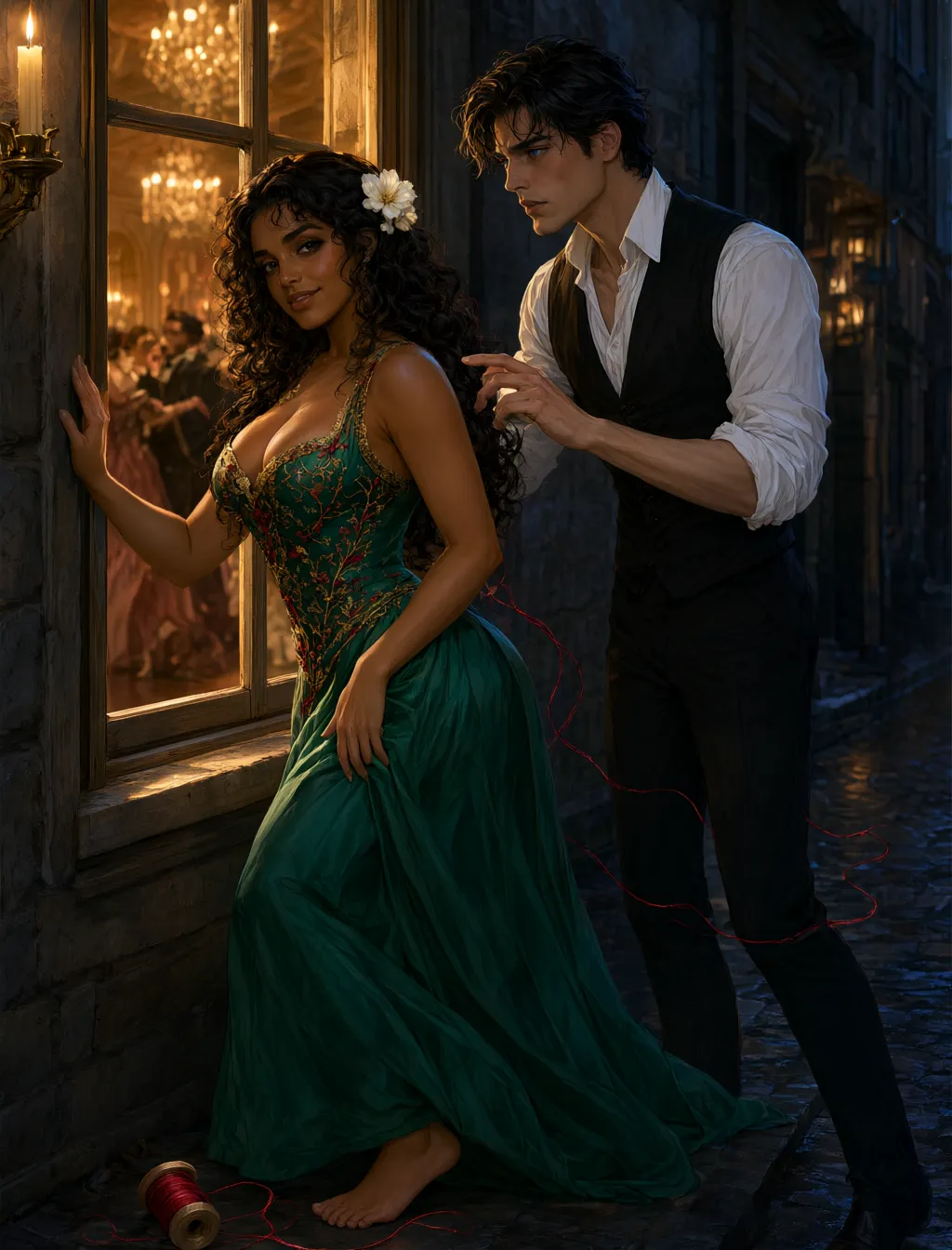
Leia woke to the light before she woke to anything else—pale gold spilling across the blue walls, catching the dust motes that drifted in the still air like tiny suspended worlds. The sheets were tangled around her legs, damp in places, clinging to the curve of her hip. She lay very still, cataloging the sensations the way she cataloged thread colors: the ache between her thighs, the tenderness of her lips, the particular hollow feeling in her chest where Tarrant had been.
He was gone.
She knew it before she opened her eyes, the way she knew when a color was slightly off in a pattern. The bed was too empty. The warmth of him had faded from the sheets, leaving only the faint ghost of his scent—something clean and sharp, like cedar and rain. She pressed her face into the pillow where his head had been and breathed in what remained.
The night came back in fragments. His hands on her body, reverent and hungry. His voice against her throat, saying her name like it was a prayer. The way he had looked at her in the golden morning light, his blue eyes soft and certain, promising her a garden full of roses.
She had believed him.
That was the strange part. Leia Taozi, who had spent twenty-two years learning not to believe in promises, had let herself fall into his arms and trust the future he was building for them. She had laughed and cried and told him she loved him, and the words had come out of her mouth like they had always been there, waiting for him to unlock them.
She sat up slowly, wincing at the protest in her muscles. The sheet fell away from her chest, and she looked down at herself—the full weight of her body, the double-G breasts that she usually hid under layers of colorful fabric, the softness of her stomach and hips. Tarrant had touched all of it. He had kissed the curve of her waist, the inside of her thigh, the place where her pulse beat beneath her skin. He had looked at her like she was the most beautiful thing he had ever seen, and for once, she had not felt the need to apologize.
The nightstand held the tin of cakes, half-empty, and a small velvet box she had not opened yet. The ruby pendant. She reached for it, tracing the velvet with her fingertips. He had given it to her last night, before everything else, pressing it into her palm with that careful, deliberate way he had about him. She had not been able to speak then. She had only stared at the deep red stone, feeling the weight of his attention like a physical thing.
She opened the box now. The ruby caught the morning light, throwing a small red star onto the wall. It was beautiful. It was too much. Everything he gave her was too much, and she never knew how to tell him that she would rather have him than any of it.
Her hands found the book on the bedside table—the one with the embroidered cover she had stitched herself, slightly crooked where she had misjudged the tension on the hoop. She ran her thumb over the uneven stitches, a familiar comfort. The book was a collection of folk tales from the islands, stories her grandmother had told her when she was small. She opened it to a random page, not really reading, just letting the weight of it settle in her hands.
The room was so quiet. The palace was always quiet in the mornings, the servants moving soft-footed through the halls, the sound of birds filtering through the open window. She could hear them now—a thrush, she thought, or maybe a wren. She was not good at birds. She was good at thread and cloth and the way colors fit together, not the way feathers moved.
She should get up. She should wash and dress and face the day. But her body felt heavy, weighted down by the memory of his hands, and she could not make herself move.
Instead, she lay back against the pillows, the book open on her chest, and let her mind drift to the letters. Five months of letters, tied with indigo thread, hidden in a drawer. She had written things to him in those letters that she had never said aloud to anyone—her fears, her hopes, the shape of her loneliness. He had written back in his measured, careful hand, answering every question she had not known how to ask.
She had told him about her autism in one of those letters. Not in those words, exactly. She had tried to explain the way her mind worked, the way she sometimes could not find the right words, the way she felt everything so deeply that it threatened to drown her. She had written: I do not always show what I feel. I think sometimes people believe I do not feel at all. But I do. I feel everything. It is just that my face does not know how to say it.
He had understood. He had written back: I will learn to read you. I will learn every silence.
And he had. He had learned to see the way her hands moved when she was happy, the way she hummed when she was comfortable, the way she tucked her hair behind her ear when she was nervous. He had learned her the way she learned embroidery patterns—stitch by stitch, patient and deliberate.
The pendant was cool against her palm. She closed her eyes and let herself remember the weight of his body against hers, the way he had whispered her name in the dark, the way he had held her afterward like she was something precious.
She had never felt precious before.
The sheets were still tangled around her legs. She kicked them free, letting the morning air cool her skin. Somewhere in the palace, a door opened and closed. The sound was distant, muffled by stone and distance.
She should get up. She should find her robe and go to the kitchens and drink tea and pretend that the world had not changed. But the world had changed. The world had shifted on its axis last night, and she was still trying to find her footing.
Her eyes fell on the embroidery frame by the window. His eye, half-finished, captured in thread. She had been working on it for weeks, trying to get the exact shade of blue, the particular sharpness of his gaze. She had thought she knew his eyes before. She had been wrong. She knew them now—knew the way they softened when they looked at her, the way they darkened when he wanted her, the way they held hers like she was the only thing in the world worth seeing.
She would finish it today. She would finish his eye and start on the waistcoat, the blue wool they had bought together folded carefully in her wardrobe. She would make him something worthy of him, something that would show him what she could not say.
Her hands were already reaching for her robe when she heard it.
Footsteps.
Not the soft, measured steps of a servant. Not the quick, purposeful stride of a messenger. These were slow, unhurried, confident—the footsteps of someone who belonged here, who had no reason to rush.
They came closer. Closer. And then they stopped, just outside her door.
Leia's breath caught in her throat. Her hand froze on the robe, halfway to her shoulder. The book slid from her chest onto the bed, pages fluttering.
Three soft taps landed on the wood.
She did not answer. She could not. Her voice had gone somewhere else, a place she could not reach, and all she could do was sit there, frozen, her heart hammering against her ribs as the silence stretched between the door and her body.
The footsteps had paused. The door had not opened. But she knew—she knew with the same certainty she knew the shade of his eyes—who was standing on the other side.
Mirana.
Her sister. Her first lover. The one who had taught her body what pleasure was, before she had known what to do with it. The one who had funded her warehouse, who had given her the freedom to create, who had never asked for anything in return except the comfort of her presence.
The one she had not told about Tarrant.
The one who did not know she was no longer his alone.
The silence stretched. The door handle did not move. But she could feel him there, waiting, patient, the way he had always been patient with her. And she knew that when he finally opened that door, everything would change.
Her hand trembled on the robe. The ruby pendant was still in her other hand, warm from her skin.
She did not move. She could not move. She could only sit in the tangled sheets, her body still marked by another man's hands, and wait for the door to open.
The knock came again—softer this time, almost gentle, as if the person on the other side knew she was there and wanted to give her time. That was Mirana all over. He had always been patient with her, even when she had not deserved it, even when she had been too lost in her own head to explain why she needed the silence.
Her fingers found the loose thread on the pillowcase—a single strand of indigo, pulled free from some garment she had been mending. She wound it around her index finger, once, twice, the pressure grounding her the way her embroidery hoop did. The thread was the same color as the one that tied her letters to Tarrant. She had not thought about that until now.
The room was too quiet. The birds had stopped singing—or maybe she had stopped hearing them. All she could hear was her own breath, too fast, and the small sound of the thread creaking against her skin as she pulled it taut.
She looked down at herself. The sheet had slipped to her waist, and the morning light fell across her chest, across the soft expanse of her stomach. There was a bruise on her hip—small, the shape of a thumbprint, already fading to green at the edges. Tarrant had held her there. She remembered the pressure of his hand guiding her, steadying her, and the way she had arched into him without shame.
The bruise was proof. Proof that last night had happened, that he had been real, that she had not dreamed the whole thing in the lonely hours before dawn. She touched it with her free hand, the pad of her finger pressing gently against the discolored skin. It ached, but it was a good ache. An ache that meant she had been wanted.
Mirana had never left marks like that.
The thought came unbidden, and she flinched from it. That was not fair. Mirana had been careful with her, so careful, always asking before he touched, always watching her face for signs of discomfort. He had been her first, and he had treated her like something fragile, something to be handled with reverence. She had loved him for that. She still loved him, in the way one loves a person who has been kind to them at the exact moment they needed it most.
But Tarrant had not been careful. Tarrant had been hungry, and desperate, and he had touched her like she was the answer to every question he had ever asked. He had gripped her hip hard enough to bruise, and she had gasped, and he had asked if it was too much, and she had said no. She had said no because it was not too much. It was exactly enough. It was the first time someone had wanted her without apology, without the careful distance everyone else kept from her body.
The thread snapped. She had wound it too tight, pulled it too far, and it broke against her finger with a small, sharp sound. She stared at the two ends, one still wrapped around her knuckle, the other dangling loose against the pillowcase.
She should answer the door.
She knew she should. Mirana was standing out there, waiting, patient, and if she stayed silent much longer he would start to worry. He would knock again, harder this time, or he would call her name through the wood, and she would have to answer with her voice, and her voice would betray everything.
Her voice always betrayed her. It was too flat, too quiet, too slow. People heard her silence and thought she did not care. They heard her careful, literal speech and thought she was cold. Only Tarrant had ever heard the warmth underneath, and that was because he had taken the time to listen.
She pressed the pendant into her palm, the ruby warm and solid against her skin. It was a promise. He had given it to her as a promise, and she had accepted it, and now she was wearing the weight of that promise like a second skin.
The door handle turned.
The sound was small—a click, a shift of metal—but it filled the room like a bell. Leia's breath stopped. Her hand closed around the pendant, hiding it from sight as if she could hide the truth of it from the person who was about to walk through the door.
The door swung open, and Mirana stood in the threshold, naked as the day he was born, his dark hair loose around his shoulders and his smile soft and familiar.
"Leia," he said, and his voice was exactly as she remembered it—warm, unhurried, full of a tenderness that made her chest ache. "I hope I did not wake you."
Leia's throat closed. The words she had practiced—hadn't practiced, couldn't have practiced—died somewhere behind her teeth. Mirana stood in the doorway, naked and unbothered, his dark hair loose around his shoulders, his smile soft with the particular tenderness he had always worn like a second skin. He stepped inside without waiting for an invitation, because he had never needed one. He had walked into her room a thousand times like this, casual and warm, expecting nothing but her presence.
"You're up early," he said, crossing to the window seat. He sat down, tucking one leg under himself, the morning light falling across the lean lines of his body. "I thought you would sleep until noon after the feast. You ate enough for three people."
She could not speak. Her hand was still closed around the pendant, the ruby hidden in her fist, the metal warm and insistent against her palm. The sheet had slipped to her waist, and she was aware, suddenly and acutely, of her own bare skin—the bruise on her hip, the tenderness between her thighs, the evidence of another body pressed against hers.
Mirana's gaze drifted over her, unhurried, the way he looked at everything. His eyes caught on the bruise.
The smile did not leave his face. But something behind it shifted, like a shadow moving under still water.
"That's new," he said, his voice still warm, still unhurried. "Did you fall?"
Leia's breath came out too fast, too audible. She pulled the sheet up to her chest, covering herself, and the motion felt like a confession. Mirana's eyes tracked the movement, and she watched his face change—not the careful, patient Mirana she knew, but something sharper underneath, something she had only glimpsed once or twice in all the years she had known him.
"I didn't fall," she said. Her voice came out flat, the way it always did when her mind was racing too fast for her mouth to catch up.
"No." He said it like he was agreeing with her, but his eyes had gone dark. "No, I don't think you did."
He stood up. The movement was slow, deliberate, the way he did everything. He crossed the room, his bare feet silent on the floor, and stopped at the foot of her bed. He was close enough that she could smell him—the same soap he had always used, the faint sweetness of his skin. He had smelled like this when he had held her, when he had been her first, when he had taught her body what pleasure meant.
"Who?" he asked.
The word was soft. Gentle. But there was something underneath it that made her skin prickle.
"Mirana—"
"Who, Leia?"
She could not lie to him. She had never been able to lie to him. He had known her before she had learned to hide her face, before she had perfected the stillness that made people think she felt nothing. He had read her like a book, back when she had been an open page.
"Tarrant Hightopp," she said.
The silence that followed was not empty. It was dense, heavy, like the air before a storm. Mirana's face did not change. His smile did not falter. But his hands, hanging at his sides, curled into loose fists.
"Tarrant Hightopp," he repeated. "The mine owner's son."
"Yes."
"The one who has been sending you gifts for months."
"Yes."
Mirana nodded slowly, like he was turning something over in his mind, examining it from every angle. "I saw the scarf," he said. "The lotus silk. That cost more than most people make in a year."
"I know."
"And the pendant." His eyes dropped to her closed fist, the one still hiding the ruby. "Is that what you're holding?"
She opened her hand. The ruby caught the light, throwing a small red star onto the wall. Mirana looked at it, and something in his face closed, like a door shutting softly in a quiet house.
"He gave you that last night?"
"Yes."
"And the bruise on your hip?"
Leia's face heated. She could not answer. She did not need to.
Mirana sat down on the edge of the bed. The mattress dipped under his weight, pulling her toward him, and she had to brace herself to keep from sliding into his side. He did not touch her. He just sat there, close enough that she could feel the warmth of his body, and looked at the bruise with an expression she could not read.
"I have known you since you were sixteen years old," he said. His voice was quiet, measured, the same patient voice he had always used with her. "I have watched you hide from the world, fold yourself into corners, apologize for taking up space. I have watched you learn to smile when you do not feel it, to speak when you do not have the words. I have loved you through all of it."
"Mirana—"
"Let me finish." He held up a hand, and she fell silent. "I have never asked you for anything. I have never demanded anything from you. I have been patient, Leia. I have waited. I have told myself that when you were ready, you would come to me."
His eyes met hers, and she saw something in them she had never seen before. It was not anger. It was not hurt. It was something older, colder, more patient than either of those things.
"But I did not expect this," he said. "I did not expect you to give yourself to someone else."
"I did not give myself," she said, and her voice was steadier than she felt. "I chose him."
Mirana's smile flickered. "Chose," he repeated, tasting the word. "That is an interesting way to put it."
"It is the truth."
"Is it?" He leaned forward, and she could smell him again, that familiar scent that had once meant safety. "Or did he simply want you more loudly than I did? Did he push where I waited?"
Leia's hands tightened on the sheet. "He listened. He learned to read me. He did not treat me like something fragile."
"I treated you like something precious."
"I know." Her voice cracked, just slightly, on the words. "I know you did. And I loved you for it. I still love you. But it was not—" She stopped, searching for the words, the way she always had to search. "It was not the same."
Mirana was quiet for a long moment. Then he stood, his movements unhurried, and walked to the window. He looked out at the gardens, the morning light catching the edges of his profile, and she watched his shoulders rise and fall with a breath he did not let her hear.
"Do you remember the warehouse?" he asked.
Leia's heart stuttered. "The warehouse."
"The one I funded for you. The one where you keep all your creations." He turned to face her, and his smile was back, but it was different now—thinner, sharper, with an edge she had never seen before. "I bought that building, you know. I did not rent it."
She stared at him. "You said you rented it."
"I lied."
The word landed like a stone in still water. Leia felt the ripple of it move through her, cold and slow.
"I bought it five years ago," Mirana continued, his voice conversational, almost light. "Before I even told you about it. I wanted you to have a place that was truly yours, a place no one could take from you. I paid for it outright, in full, with money I had set aside for—" He paused, a small smile curving his lips. "Well. It does not matter what I set it aside for."
"You bought it," she repeated, her voice flat.
"I bought it." He crossed the room again, stopping in front of her. "And I have visited it, from time to time. Just to make sure it was being kept well. Just to make sure you were safe."
Leia's blood went cold. "You went inside?"
"I have a key." He said it simply, like it was nothing. "I have always had a key. I had one made the day I signed the deed."
The room seemed to tilt. Leia gripped the sheet, her knuckles white, her mind racing through the rooms of the warehouse—the embroidery frames, the bolts of silk, the lingerie she had sewn in secret, the silver-working tools that had belonged to her grandmother. All of it, spread out for him to see, whenever he had wanted.
"You never told me," she said, and her voice was barely a whisper.
"You never asked."
"You let me believe it was mine."
"It is yours." His voice was gentle, so gentle. "It has always been yours. I gave it to you because I wanted you to have something that belonged only to you. I did not ask for anything in return."
"But you watched."
"I watched over." He corrected her softly. "There is a difference."
Leia's hand found the loose thread on the pillowcase again—another strand of indigo, pulled free from some forgotten mending. She wound it around her finger, once, twice, the pressure grounding her. "What else have you watched?"
Mirana's smile did not waver. "What do you mean?"
"You said you have a key. You said you visit. What else have you seen?"
He was quiet for a moment. Then he sat down on the bed again, closer this time, close enough that his knee brushed her thigh through the sheet. She felt the warmth of him, the familiar weight of his presence, and she did not know whether to lean into it or pull away.
"I have seen your work," he said. "All of it. The embroidery, the waistcoats, the dresses. The lingerie you sew in the back room, the pieces you never show anyone." His voice dropped, softer now. "I have seen the way you fold your hands when you are thinking. The way you hum when you are happy. The way you talk to yourself when you think no one is listening."
Leia's breath came short. "That is—that is not—"
"It is not what?" He tilted his head, waiting.
"That is not watching over. That is watching."
Mirana's smile widened, just slightly. "Perhaps." He reached out, and before she could move, his fingers brushed the bruise on her hip—featherlight, almost reverent. "I have watched you give yourself to him. I have watched you let him touch you, let him mark you, let him claim you." His voice was soft, almost wondering. "I have watched you become his."
Leia's hand shot out and caught his wrist. "Stop."
He did not pull away. He just looked at her, his dark eyes patient and warm and utterly unreadable. "Why?"
"Because you are not allowed to touch me like that anymore."
The words hung between them, heavy and final. Mirana's smile did not falter, but something in his eyes dimmed, like a candle guttering in a draft.
"No," he said slowly. "I suppose I am not." He withdrew his hand, letting it fall to his lap. "But I will tell you something, Leia. And I want you to hear it."
She waited.
"I have watched five men," he said, his voice quiet, conversational, "who I thought might take you from me. Five men who showed interest, who sent gifts, who looked at you the way he looks at you." He paused. "They are all dead."
The words settled into the quiet of the room like dust finding the floor. Leia's fingers went still on the thread she had been winding, the indigo strand frozen mid-loop around her knuckle. She blinked once, twice, the way she did when her mind was trying to catch up to a sentence that had already landed.
"Dead," she repeated. Not a question. A word she was testing for weight.
"Dead." Mirana said it the way he said everything—softly, reasonably, as if he were explaining the weather. "The first one was a merchant's son from the eastern quarter. He sent you flowers for three months. You never even noticed them. I thought that was the end of it." He tilted his head, considering. "Then he started waiting outside the library. Watching you walk home. I asked him to stop. He did not stop."
Leia's hands had gone cold. She could feel the pendant in her fist, the ruby pressing against her palm, and she tightened her grip on it like it was the only warm thing left in the room.
"How?" she asked. The word came out smaller than she meant it to.
Mirana's smile did not change. "He was found in the river three weeks later. The guards said he fell. He was a clumsy man."
She stared at him. The morning light was moving across the floor now, creeping toward the bed, and she watched it catch the edge of his bare foot. He had always been beautiful in the morning. She had always thought so.
"The second," he continued, "was a painter. He asked to sketch you at a garden party. You said no, but he kept asking. He was found in his studio, his hands—" Mirana paused, and his eyes went distant, like he was remembering something fond. "Well. He never painted again."
"Mirana."
"The third was a lord from the northern provinces. He sent you a letter proposing marriage. You never read it—I made sure of that—but he was persistent. He came to the palace three times to ask for an audience with you." Mirana's voice dropped, almost gentle. "He was thrown from his horse on the road home. A broken neck. Very sad."
Leia's breath was coming short now, her chest rising and falling under the sheet. She could feel the bruise on her hip throbbing, the mark Tarrant had left on her, and she pressed her hand against it without thinking, as if she could hide it from Mirana's patient gaze.
"The fourth was a scholar. He left books for you at the palace gate. I thought he might be harmless—he was old, and shy, and he never tried to speak to you." Mirana shrugged, a small, elegant motion. "But he wrote your name in his journal. Every day. I found it by accident, and I could not stop thinking about it. Your name, in his handwriting, over and over."
"What happened to him?" Leia's voice was barely a rasp.
"He moved away. To the coast, I believe. He sends his mother letters twice a year." Mirana smiled. "I let him live. He was not a threat. Just a lonely man with a habit he could not help."
Leia's stomach turned. She thought of the warehouse, of her grandmother's silver-working tools, of the lingerie she had sewn in the back room, and she felt the walls of the room closing in around her. "And the fifth?"
Mirana was quiet for a moment. He looked at her, and something in his face softened, the way it always did when he looked at her. "The fifth was a guardsman. Young, handsome, kind. He smiled at you in the corridor one day, and you smiled back." His voice went quiet. "You never smile at anyone, Leia. You never smile at me."
The room was very still. Leia could hear her own heartbeat, slow and heavy, like a drum under the floorboards.
"He was found in the warehouse," Mirana said. "On the roof. In five pieces."
Leia's hand flew to her mouth. The sheet slipped, and she did not notice. She was staring at him, at the patient, gentle face of the man who had taught her to read, who had held her when she cried, who had funded her dreams and never asked for anything in return.
"You said the warehouse was being kept well," she whispered. "You said you visited to make sure I was safe."
"I did." Mirana's voice was still soft. "I visited to make sure you were safe. And I visited to make sure the roof was clean."
The words did not make sense at first. They slid past her, smooth and incomprehensible, and then they caught, and she felt them pull her under.
"The roof," she repeated.
"The roof." He nodded. "I rented the building for five years before I bought it. The guardsman was found there before the deed was signed. The landlord wanted to sell, but he could not find a buyer—the property had a reputation by then." He smiled, a small, almost apologetic thing. "So I bought it. For you. It was the only way to keep it."
Leia's mind was racing, her fingers finding the loose thread again, winding it around her knuckle until it cut off the blood. "You killed him. You killed five men."
"I removed threats." Mirana's voice was gentle, so gentle. "I did what I had to do to keep you safe. To keep you mine."
"I am not yours." The words came out sharp, harder than she meant them to, and she saw something flicker in his eyes—not anger, not hurt, but something older, colder, more patient than either of those things.
"No," he said slowly. "I suppose you are not. Not anymore." He stood, and the movement was unhurried, the way he did everything. He walked to the window and looked out at the gardens, the morning light catching the edges of his profile. "But I will tell you something, Leia. And I want you to hear it."
She waited, her hand still pressed to the bruise on her hip, the ruby pendant warm against her palm.
"Tarrant Hightopp is the sixth man." Mirana turned to face her, and his smile was back, thin and sharp and utterly calm. "And I have already sent word to my contacts in the city. If he comes near you again, if he touches you again, if he so much as looks at you the way he looked at you last night—" He paused. "He will not be found in one piece."
Leia's fingers went numb around the ruby. The stone was warm, still warm from her palm, and she thought of Tarrant's hands pressing it into hers, his voice low and certain in the dark. She thought of his laugh, the way it cracked when he was nervous, the way he looked at her like she was the only person in the room.
"You cannot," she said. The words came out flat, the way they always did when her mind was moving too fast. "He is not like the others."
"They were all not like the others." Mirana's voice was patient, almost kind. "The merchant's son wrote poetry. The painter saw beauty in everything. The lord was going to give you a house in the north, away from the palace, away from me. And the guardsman—" He paused, his eyes going distant. "The guardsman was the only one who ever made you smile."
"He did not make me smile. I smiled at him because he tripped over his own feet and I did not know what else to do."
Mirana's smile widened, just slightly. "You smiled. That was enough."
Leia's throat worked. She could feel the shape of the words she wanted to say, the ones that would explain everything—that Tarrant had read her letters, that he had learned her silences, that he had seen her, truly seen her, in a way no one else ever had. But the words would not come. They never came when she needed them most.
"You do not understand," she said finally. "He is different."
"You said that about the painter."
"I never said that about the painter. I never even spoke to him."
"You did not have to." Mirana's voice was soft, almost gentle. "I could see it in the way you looked at him. The way you looked at all of them. The way you are looking at me now."
Leia's hands tightened on the sheet. "I am not looking at you any way."
"You are." He took a step closer, and she felt the warmth of him, the familiar weight of his presence. "You are looking at me like I am a stranger. Like you do not know me. Like I am someone you have to protect yourself from."
"You killed five men."
"I removed threats."
"You killed them, Mirana." Her voice cracked on his name, and she hated the sound of it, the way it betrayed her. "You killed them and you left them on my roof. My roof. The one I stand under when I need to think."
Mirana's expression did not change. "You never go to the roof."
"That is not the point."
"It is exactly the point." He crossed the room, his bare feet silent on the floor, and stopped at the foot of the bed. "You never go to the roof. You never go to the warehouse at night. You never walk through the eastern quarter alone. You never do any of the things that would put you in danger. Because I made sure of it."
"You made sure of it by killing people?"
"I made sure of it by removing the people who would have hurt you." His voice was still soft, still patient. "The merchant's son was not just sending flowers. He was following you. The painter was not just asking to sketch you. He was watching you through your window. The lord was not just proposing marriage. He was planning to take you from the palace, from your sisters, from everything you know."
Leia stared at him. "How do you know that?"
"Because I watched them." He said it simply, like it was nothing. "I watched them the way I watch you. I learned their habits, their routines, their secrets. I knew what they were going to do before they did it."
"You are not a guard." Her voice was rising now, the flatness cracking. "You are not my keeper. You are not—"
"I am the one who loves you."
The words landed like a blow. Leia's breath caught, and she felt the heat of tears behind her eyes, the familiar burn she always tried to swallow down.
"You do not love me," she said. "You love the idea of me. The version of me you made up in your head. The one who needs you."
"I love the version of you that exists." Mirana's voice was quiet, almost wounded. "The one who hides in libraries. The one who hums when she is happy. The one who sews her feelings into cloth because she cannot say them out loud." He paused. "The one who gave herself to a man who does not know her at all."
"He knows me."
"He knows the version of you that you showed him. The one who embroiders his eye. The one who makes him gifts. The one who lets him touch her." Mirana's voice dropped. "He does not know the you that cries in the dark. The you that cannot sleep without a lamp on. The you that flinches when someone raises their voice."
Leia's hands were shaking now. She could feel the thread around her knuckle, the indigo strand cutting into her skin, and she wound it tighter, tighter, until the blood stopped flowing.
"You do not get to use that against me," she said. "You do not get to use the things I told you in confidence."
"I am not using them against you. I am using them to show you that I know you. That I have always known you. That no one else will ever know you the way I do."
"That is not love. That is possession."
"They are the same thing."
The words hung in the air, heavy and final. Leia stared at him, at the patient, gentle face of the man who had taught her to read, who had held her when she cried, who had funded her dreams and never asked for anything in return—except for everything.
"No," she said. "They are not."
Mirana's smile did not waver. "Then tell me," he said. "Tell me what he knows about you that I do not."
Leia opened her mouth. Closed it. The words were there, pressing against her teeth, but they would not come. They never came.
"You cannot," Mirana said softly. "Because there is nothing. There is nothing he knows that I do not. There is nothing he has given you that I have not already given you, and more."
"He gave me his heart."
"I gave you mine years ago. You just never noticed."
Leia's eyes burned. She blinked, and a tear slipped down her cheek, hot and unwelcome. She wiped it away with the back of her hand, but it was too late. He had seen it.
"I am going to marry him," she said. Her voice was barely a whisper, but it was steady. "I am going to marry him, and I am going to tell my sisters, and I am going to live a life that has nothing to do with you."
Mirana was quiet for a long moment. The morning light moved across the floor, creeping toward the bed, and she watched it catch the edge of his bare foot. He had always been beautiful in the morning. She had always thought so.
"You are not going to marry him," he said finally. His voice was soft, almost kind. "Because he is not going to survive the week."
Leia's blood went cold. "You cannot—"
"I can. I have. I have already sent word to my contacts in the city. They are waiting for my signal." He smiled, a small, almost apologetic thing. "If you tell your sisters, if you try to warn him, if you do anything to interfere, I will give the signal. And Tarrant Hightopp will be found in the river, or in his bed, or in pieces on a roof."
"You are a monster."
"I am a man who loves you." He took a step closer, and she felt the warmth of him, the familiar weight of his presence. "And I will do whatever it takes to keep you safe. Even from yourself."
Leia's hand found the loose thread again, winding it around her knuckle until it cut off the blood. She could feel the ruby in her other hand, warm and heavy, and she thought of Tarrant's face, the way he had looked at her last night, the way he had said her name like it was a prayer.
"You will not touch him," she said. Her voice was flat, cold, the way it always got when she was afraid. "You will not touch him, or I will—"
"You will what?" Mirana's voice was gentle, curious. "You will tell your sisters? You will tell the guards? You will tell anyone who might believe you?" He tilted his head. "You know what they will say. You know what they have always said. That you are the quiet one. The strange one. The one who does not understand how the world works."
Leia's throat closed. He was right. She knew he was right. She had spent her whole life being invisible, being overlooked, being the sister no one noticed. And now, when she finally had something worth fighting for, she had no voice to fight with.
"I will tell Tarrant," she said. "I will tell him everything."
"And what will he do?" Mirana's smile widened, just slightly. "He will be angry. He will be frightened. He will try to protect you, and he will fail. And then he will be dead."
Leia's hands were shaking. She could feel the tears on her cheeks, hot and silent, and she hated herself for crying, hated the way her body betrayed her when she needed it most.
"Please," she whispered. The word came out broken, small, the way it always did when she was desperate. "Please do not do this."
Mirana's face softened. He crossed the room, his bare feet silent on the floor, and sat down on the edge of the bed. The mattress dipped under his weight, pulling her toward him, and she had to brace herself to keep from sliding into his side.
"I am not going to hurt him," he said. His voice was gentle, so gentle. "I am not going to hurt him as long as you do what I ask."
Leia stared at him. "What do you want?"
Mirana was quiet for a moment. Then he reached out, and before she could move, his fingers brushed the bruise on her hip—featherlight, almost reverent.
"I want you to stay away from him," he said. "I want you to end it. I want you to tell him that you made a mistake, that you do not want to see him again, that you are sorry for leading him on." He paused. "And I want you to mean it."
Leia's breath came short. "I cannot."
"You can." His voice was soft, patient. "You can, and you will. Because if you do not, he will die. And it will be your fault."
The words landed like a stone in still water. Leia felt the ripple of them move through her, cold and slow, and she knew, with a certainty that made her stomach turn, that he meant every word.
"You are not going to let me go," she said. It was not a question.
Mirana's smile did not waver. "No," he said. "I am not."
Leia looked at him, at the patient, gentle face of the man who had taught her to read, who had held her when she cried, who had funded her dreams and never asked for anything in return. And she felt something inside her break, clean and quiet, like a thread snapping under too much tension.
"I hate you," she said.
Mirana's smile softened, and for a moment, he looked almost sad. "I know," he said. "But you will not hate me forever. You will learn to understand. You will learn to see that I did this for you, because I love you, because I have always loved you."
He stood, his movements unhurried, and walked to the door. He paused with his hand on the frame, looking back at her, the morning light catching the edges of his profile.
"You have until sunset," he said. "Tell him it is over. Or I will make sure he never sees another sunrise."
The door closed behind him with a soft click. Leia sat in the silence, the ruby warm in her palm, the indigo thread cutting into her knuckle, and she felt the walls of the room closing in around her.
She looked at the pendant. Tarrant's pendant. The one he had pressed into her hand last night, his voice low and certain in the dark. She thought of his laugh, the way it cracked when he was nervous. She thought of his hands, the way they had held her face, the way he had said her name like it was a prayer.
And she thought of Mirana's smile, thin and sharp and utterly calm.
The thread on her knuckle snapped. She watched the indigo strand fall to the sheet, and she did not move to pick it up.
She had until sunset.
She had until sunset.
The words sat in the air like a physical weight, pressing down on her chest until she could barely breathe. The ruby pendant was still in her hand, warm from her palm, and she stared at it without seeing it. Her mind was a tangle of thread, all the colors running together, and she could not find the end of any of them.
She heard the door open again.
Her head snapped up, her heart slamming against her ribs. But it was not Mirana. It was a servant girl, small and quick, her head bowed low. She carried a tray with tea and bread, and she set it on the table by the window without looking at Leia, her movements practiced and silent.
"The White Queen asked me to bring you breakfast," the girl said, her voice barely above a whisper. "He said you did not eat enough at the feast."
Leia's throat tightened. Of course he had noticed. He always noticed. He had probably counted every bite she had taken, every glass of wine she had touched, every moment her attention had drifted toward the tall man with the blue eyes and the careful hands.
"Thank you," she managed. Her voice came out flat, the way it always did when her mind was moving too fast for her mouth to catch up.
The servant girl hesitated at the door. "He also said to tell you that he has gone to the gardens. He said you would know where to find him, if you wanted to."
Leia's fingers tightened around the pendant. The gardens. Their old place, the one with the rose arbor and the stone bench where she had spent so many afternoons with her embroidery hoop, where Mirana had first kissed her, soft and questioning, when she was sixteen and did not know what to do with the warmth spreading through her chest.
"I do not want to," she said.
The servant girl's eyes flickered up, just for a moment, before dropping back to the floor. "He said you would say that. He said to tell you that the offer stands until sunset."
The door closed. Leia was alone again.
She looked at the tray. The bread was still warm, steam rising from the surface, and the tea was the pale green she favored, the one with the jasmine notes that reminded her of her grandmother's garden. Mirana had remembered. Of course he had remembered. He remembered everything.
She pushed the tray away. The bread sat untouched, the tea cooling, and she watched the steam curl and vanish into the morning air.
The pendant was heavy in her hand. She opened her palm and looked at it—the deep red stone, the gold setting, the careful craftsmanship that spoke of hours of work. Tarrant had given it to her last night, pressing it into her hand with that particular look on his face, the one that made her chest ache. He had told her it was a promise. He had told her he was going to marry her.
And now Mirana had given her until sunset to break that promise.
She thought of Tarrant's face. The way his eyes softened when they landed on her. The way his voice dropped when he said her name, like it was something precious. The way his hands had moved over her body last night, reverent and hungry, learning every curve and hollow like he was memorizing a map.
She thought of the letters. Five months of letters, tied with indigo thread, hidden in a drawer. She had written things to him in those letters that she had never said aloud to anyone—her fears, her hopes, the shape of her loneliness. He had written back in his measured, careful hand, answering every question she had not known how to ask.
Mirana had never learned to read her like that. He had loved her, she knew that. He had loved her in his own way, the way he loved all his pretty things—with care and attention and a possessive tenderness that she had mistaken for devotion. But he had never learned her silences. He had never needed to. He had always assumed he already knew her, and she had let him believe it because she had not known how to correct him.
She stood up. The sheet fell away from her body, and she did not bother to catch it. The morning air was cool on her skin, raising goosebumps along her arms, and she crossed the room to the embroidery frame by the window.
His eye. Half-finished, captured in thread. The blue was not quite right—she had been mixing shades for weeks, trying to find the exact color of his gaze, the particular sharpness that softened only when he looked at her. She touched the thread with her fingertip, feeling the tension of the stitches, the hours of work she had poured into this small square of cloth.
She would finish it. She had promised him she would finish it. She had promised him a waistcoat, too, from the blue wool they had bought together, folded carefully in her wardrobe. She had promised him so many things last night, in the dark, with his body warm against hers and his voice low and certain in her ear.
She had promised him forever.
And now Mirana had given her until sunset to take it all back.
Her hand found the loose thread on the windowsill—another strand of indigo, pulled free from some forgotten mending. She wound it around her finger, once, twice, the pressure grounding her. The thread cut into her skin, and she welcomed the pain. It was something to hold onto when everything else was slipping away.
She looked out the window. The gardens stretched below, green and gold in the morning light, and she could see the rose arbor in the distance, the stone bench where she had spent so many afternoons. Mirana would be there now, waiting, patient, certain that she would come.
He was always so certain.
She turned away from the window. The robe was still on the floor where she had dropped it, a pool of colorful silk against the pale wood. She picked it up and shrugged it on, the familiar weight of it settling over her shoulders. The embroidery on the sleeves caught the light—tiny flowers, stitched in thread she had dyed herself, in colors that reminded her of the islands where her grandmother had been born.
She would not go to the gardens. She would not give him the satisfaction of watching her come to him, broken and obedient, ready to do his bidding.
But she could not stay here either. The room was too quiet, too full of the memory of Tarrant's hands on her body, his voice against her throat, his breath warm on her skin. She could still smell him on the sheets, that clean, sharp scent of cedar and rain, and it made her chest ache with a pain she could not name.
She needed to move. She needed to do something, anything, to keep her hands busy and her mind from spiraling.
Her eyes fell on the embroidery frame again. His eye, half-finished, waiting for her. She crossed the room and sat down in the chair by the window, pulling the frame into her lap. The needle was still threaded with the blue she had been using, and she picked it up, her fingers finding the rhythm automatically.
Stitch. Pull. Stitch. Pull.
The motion was familiar, grounding, the way it always was. She had learned to embroider when she was seven, sitting at her grandmother's knee, watching the old woman's hands move with a grace that seemed impossible for fingers so worn. Her grandmother had taught her to feel the tension of the thread, to let the needle find its own path through the cloth, to trust her hands even when her mind was a tangle of noise.
She had never been good at drawing. She had known that for years, even when she had pretended otherwise, even when she had shown her sisters her clumsy sketches and watched them smile and say they were lovely. But embroidery was different. Embroidery was patient. Embroidery did not require her to see the whole picture at once; it only required her to make one stitch at a time, and trust that the pattern would emerge.
She was good at embroidery. She was good at the slow, careful work of building something beautiful from nothing, one thread at a time.
She was not good at this. She was not good at choosing between the man who had loved her first and the man who had learned to read her silences. She was not good at knowing what to do when the world demanded she pick a side and she could not find the words to explain why both choices felt like losing.
The needle slipped. She pricked her finger, a small bead of blood welling up on the pad, and she watched it for a moment before wiping it on her robe. The stain spread, a tiny red flower blooming on the silk, and she stared at it without seeing it.
She should tell Tarrant. She should go to him, now, before Mirana could do anything, and tell him everything. She should warn him about the danger, about the men who were waiting for a signal, about the price of loving her.
But if she told him, he would try to protect her. He would be angry, and frightened, and he would try to fight back, and he would fail. Mirana had been playing this game for years. He knew every move. He had killed five men already, and he would not hesitate to make Tarrant the sixth.
And if she did not tell him—if she did what Mirana asked, if she told Tarrant it was over and watched the light die in his eyes—she would lose him anyway. She would lose the only person who had ever seen her, truly seen her, and she would be left with nothing but the memory of his hands on her skin and the knowledge that she had let him go to save his life.
The needle moved again. Stitch. Pull. Stitch. Pull.
She was almost done with the eye. A few more rows of thread, a few more careful strokes, and it would be complete. She could see it taking shape beneath her fingers—the sharp line of his brow, the depth of his gaze, the particular way the light caught his iris when he looked at her.
She had never been able to capture him in drawings. Her sketches were always slightly off, the proportions wrong, the expression flat. But in thread, she could show him the way she saw him. She could show him the tenderness she could not say aloud, the love that had nowhere else to go.
The knock came again.
She froze, the needle hovering over the cloth. Three soft taps, the same rhythm as before, but different somehow—lighter, quicker, less patient.
Not Mirana.
Her heart lurched. She set down the frame and crossed the room, her bare feet silent on the floor, and pressed her hand against the wood of the door. She could feel the warmth of someone on the other side, the faint shift of weight, the sound of breathing.
"Leia?"
The voice was low, careful, measured. She knew it the way she knew the shade of his eyes, the way she knew the particular weight of his hand on her waist.
Tarrant.
Her throat closed. She leaned her forehead against the door, her eyes burning, and she could not find the words. They were there, pressing against her teeth, but they would not come. They never came when she needed them most.
"Leia, are you all right?" His voice was soft, worried. "You did not come to breakfast. I was—I wanted to make sure you were—"
He stopped. The silence stretched between them, the wood the only thing separating her from the man she loved, the man she was supposed to push away by sunset.
"I am fine," she said. The words came out flat, the way they always did, and she hated them. She hated the way her voice betrayed her, the way it made her sound cold and distant when she was falling apart inside.
"You do not sound fine."
"I am fine." She said it again, louder, as if repetition would make it true.
There was a pause. She heard him shift his weight, heard the soft sound of his hand pressing against the wood on his side. "Leia, please. Open the door. I just want to see you."
She closed her eyes. The tears were burning now, and she pressed her hand against her mouth to hold back the sound that wanted to escape.
She could open the door. She could let him in, let him see her, let him wrap his arms around her and tell her everything would be all right. She could fall into him the way she had last night, and for a few stolen hours, she could pretend that Mirana did not exist, that the deadline was not looming, that the world was not about to end.
But it would not be fair. It would not be fair to let him love her, to let him hope, when she knew what was waiting for him at sunset.
"I cannot," she said. Her voice cracked on the words, and she felt the tears spill over, hot and silent on her cheeks. "I cannot open the door."
"Why not?"
"Because if I open the door, I will not be able to let you go."
The words hung in the air, heavy and final. She heard him draw in a sharp breath, heard the wood creak as he leaned against it, and she felt the warmth of him through the barrier between them.
"Leia." His voice was rough, desperate. "What are you talking about? What happened?"
"I cannot tell you."
"You can tell me anything. You know that."
"I know." She pressed her hand flat against the wood, wishing she could reach through it, wishing she could touch his face, his hands, the warmth of his skin. "But this is not something I can fix. This is not something we can fix."
"Then let me try." His voice was fierce now, the quiet intensity she had fallen in love with. "Whatever it is, let me try. I promised you I would learn to read you. I promised you I would learn every silence. Let me do that now."
She shook her head, even though he could not see her. "You cannot read this one. This one is not written in my silences. It is written in someone else's."
The silence stretched. She could hear him breathing, slow and steady, the way he did when he was trying to calm himself. She knew him so well. She knew the way his jaw tightened when he was angry, the way his hands moved when he was nervous, the way his voice dropped when he was afraid.
"Is it Mirana?" he asked.
Her breath caught. "What?"
"The White Queen. Your sister. Is it him?"
She could not answer. The words were stuck in her throat, caught on the truth she could not say.
"I saw him leave your room this morning," Tarrant said, his voice careful, measured. "He was not wearing much. I assumed—" He stopped. "I assumed it was nothing. But the way you are speaking now—"
"It is not what you think," she said quickly. "It is not—he was not—"
"Then what was he doing in your room?"
She could not answer. The tears were falling faster now, and she pressed her hand against her mouth to hold back the sob that wanted to escape.
"Leia." His voice was soft, unbearably soft. "Please. Open the door. Let me help you."
"You cannot help me." The words came out broken, raw. "No one can help me. This is not something that can be fixed."
"Then let me be with you while it breaks."
The words landed like a blow. She felt them move through her, warm and painful, and she wanted nothing more than to open the door and fall into his arms. But she could not. She could not let him see her like this, broken and afraid, with the weight of Mirana's threat pressing down on her chest.
"I love you," she said. The words came out before she could stop them, raw and desperate. "I love you, Tarrant. I love you so much that I do not know what to do with it."
The silence on the other side of the door was deafening. She heard him draw in a breath, heard the small sound of his hand sliding against the wood.
"Then let me in," he said. "Let me love you back."
She closed her eyes. The tears were still falling, but she felt something shift inside her, a small crack in the armor she had built around herself.
She reached for the handle.
And stopped.
Mirana's voice echoed in her head, soft and patient and utterly calm. You have until sunset. Tell him it is over. Or I will make sure he never sees another sunrise.
Her hand trembled on the handle. She could feel Tarrant on the other side, warm and solid and alive, and she knew that if she opened this door, she would be signing his death warrant.
"I cannot," she whispered. "I am sorry. I cannot."
She pulled her hand away. The tears were falling faster now, and she pressed her back against the door, sliding down until she was sitting on the floor, her knees drawn up to her chest, the ruby pendant cold against her palm.
"Leia." His voice was rough, desperate. "Please."
"Go," she said. The word came out broken, barely a whisper. "Please, Tarrant. Go. Do not come back. Do not—" She stopped, her voice catching. "Do not come back."
The silence stretched. She heard him breathing, heard the small sound of his hand pressing against the wood, and she felt the warmth of him through the barrier between them.
"I will not go," he said finally. His voice was quiet, but there was steel underneath it. "I do not know what has happened, and I do not know why you are pushing me away. But I will not go. I will wait here until you open this door, and if you never open it, I will wait until I die."
"Tarrant—"
"I love you, Leia Taozi. I love you, and I am going to marry you, and no amount of silence is going to change that."
She sat on the cold floor with her back against the door, and the words he had spoken settled into her like stones dropped into still water. He would wait. He would wait until he died. She knew him well enough to know he meant it, every syllable of it, and the knowledge broke something open inside her chest that she had been trying to keep sealed.
"You cannot wait here," she said, and her voice came out thin, the words scraping past the knot in her throat. "People will see you. People will talk."
"Let them talk." His voice was calm now, the steel underneath it polished smooth. "I have told my father I am going to marry you. I have told him about the feast you made, about the warehouse, about the mine. I have told him you are the most remarkable woman I have ever met, and he believes me. He has already sent word to the kitchens to prepare for your visit."
She pressed her forehead against the wood. The grain was rough against her skin, and she focused on that small discomfort because it was easier than focusing on the words he was saying. He had told his father. He had told his father about the mine, about the warehouse, about her. The secret she had kept for years, the one that had been hers alone, was no longer hers alone.
"You should not have told him about the mine," she said. "It is not mine. It was never mine."
"What do you mean?"
The question hung between them, and she could hear the shift in his voice, the careful attention he gave to every word she spoke. He was trying to read her. He was trying to find the shape of her silence, the way he always did, and she did not know how to tell him that this particular silence was not hers to give away.
"The warehouse," she said slowly, the words tasting like ash in her mouth. "The mine. The money. All of it. It was Mirana's. It has always been Mirana's."
There was a long pause. She heard him draw in a breath, hold it, release it slowly. "Leia, you showed me the warehouse. You showed me your creations. You told me you built it yourself."
"I did build it. I built every piece of it. But he paid for it. He funded it, quietly, through channels I did not understand at the time. He said it was a gift, a way to support my art, and I believed him. I was sixteen, and I believed him."
The silence on the other side of the door was heavy, and she could feel him processing the information, turning it over in his mind the way he turned over every piece of information he received. She knew the habit well. She had watched him do it a hundred times, in a hundred different conversations, his eyes going distant and focused at the same time.
"And now he is using it against you," Tarrant said. It was not a question.
"Yes."
"What does he want?"
She closed her eyes. The tears were still falling, silent and hot, and she pressed her hand against her mouth to hold back the sound that wanted to escape. She could not tell him. She could not tell him that Mirana wanted her to break his heart, that the price of his life was the death of everything they had built together.
"Leia." His voice was soft, unbearably soft. "Whatever it is, I can face it. I can face anything, as long as I know what I am facing."
"He will kill you," she said. The words came out flat, matter-of-fact, the way her voice always went when her mind was moving too fast for her mouth to catch up. "He has killed before. Five men. Five suitors who came too close. He killed them, and no one ever knew, because he is the White Queen and he is beautiful and everyone believes what he tells them."
The silence stretched. She heard him breathing, slow and steady, and she knew he was trying to calm himself, trying to find the right words to say. She knew him so well. She knew the way his jaw tightened when he was angry, the way his hands moved when he was nervous, the way his voice dropped when he was afraid.
"Leia," he said finally. "Open the door."
"I cannot."
"You can. You can open the door, and I will come in, and we will figure this out together."
"You do not understand. He has given me until sunset. If I do not tell you it is over by sunset, he will have you killed. He has men waiting. He has a plan. He has always had a plan."
"Then we will leave." His voice was fierce now, the quiet intensity that had drawn her to him in the first place. "We will leave tonight. We will go to my father's estate, and I will have guards posted, and we will be safe."
"You cannot guard against him. He is patient. He is clever. He has been playing this game for years, and he has never lost."
"There is a first time for everything."
She pressed her hand flat against the wood, wishing she could reach through it, wishing she could touch his face, his hands, the warmth of his skin. "Tarrant, please. Please just go. Please just leave me here and forget about me. It is the only way."
"No."
"Please."
"No." His voice was quiet, but there was steel underneath it. "I told you I would wait until you opened this door, and I meant it. I will wait until sunset. I will wait until the stars come out. I will wait until I die, if that is what it takes. Because I love you, Leia Taozi, and I am not going to let your sister take you away from me."
She closed her eyes. The tears were still falling, and she felt the crack in her armor widening, the warmth of his words seeping through the break. She wanted to open the door. She wanted to fall into his arms and let him hold her until the world stopped spinning. But she could not. She could not sign his death warrant.
"I love you," she said. The words came out raw, desperate. "I love you so much that I cannot let him hurt you. Do you understand? I cannot."
"I understand." His voice was soft now, gentle. "I understand that you are trying to protect me. But I need you to understand something too. I would rather die than live in a world where you are not mine."
The words landed like a blow. She felt them move through her, warm and painful, and she pressed her hand against her mouth to hold back the sob that wanted to escape. He meant it. She knew he meant it, the same way she knew the shade of his eyes, the same way she knew the particular weight of his hand on her waist.
"I cannot," she whispered. "I cannot let you die."
"Then do not let me die. Open the door, and let me fight for you. Let me fight for us."
She sat there for a long moment, her back against the wood, her knees drawn up to her chest. The ruby pendant was still in her hand, warm from her palm, and she looked at it without seeing it. She thought of the letters, tied with indigo thread, hidden in a drawer. She thought of the waistcoat, folded carefully in her wardrobe, waiting for him to wear it. She thought of the embroidery frame by the window, his eye half-finished, waiting for her to complete it.
She had promised him so many things. She had promised him forever.
And now she had to choose between keeping that promise and keeping him alive.
Her hand moved to the handle. She felt the cold metal under her fingers, felt the weight of the decision pressing down on her chest, and she closed her eyes.
She turned the handle.
The door swung open, and he was there, tall and solid and alive, his blue eyes soft with worry and love and something else, something fierce and determined. He was wearing the lotus-silk scarf she had given him, the azure pendant at his throat, and he looked at her like she was the only thing in the world that mattered.
"Leia," he said, and her name in his mouth was a prayer and a promise and a plea.
She fell into him.
His arms came around her, strong and steady, and he held her against his chest while she sobbed, her face pressed into the wool of his coat, her hands gripping the fabric of his shirt. He did not speak. He just held her, his hand stroking her hair, his breath warm against her temple, and she felt the tension in her body begin to ease, the weight of her fear settling into something she could carry.
"I am here," he said softly. "I am here, and I am not going anywhere."
"He will kill you," she said, her voice muffled against his chest. "He has killed before. He will kill you."
"He can try."
She pulled back, looking up at him, her eyes red and swollen, her cheeks wet with tears. "You do not understand. He is not like other people. He is patient. He is clever. He has been planning this for years."
"I understand that you are afraid," he said, his hand cupping her cheek, his thumb brushing away a tear. "And I understand that you love me. That is enough. That is all I need."
She shook her head, the tears falling faster now. "You are going to die."
"Then I will die loving you." He said it simply, without drama, the way he said everything. "There is no better way to go."
She stared at him, and she felt the crack in her armor widen, the warmth of his words flooding through the break. She had spent so long alone, so long hiding her heart behind her silence, and here he was, offering her everything, asking for nothing in return.
"I do not deserve you," she whispered.
"You deserve everything," he said. "You deserve the sun and the moon and every star in the sky. And I am going to spend the rest of my life trying to give them to you."
She kissed him.
It was not a gentle kiss. It was desperate and hungry, her hands fisting in his shirt, pulling him closer, her mouth opening under his like she was drowning and he was air. He responded in kind, his hands sliding into her hair, tilting her head back, kissing her like he had been waiting his whole life for this moment.
They stumbled back into the room, the door swinging shut behind them, and she pushed him toward the bed, her hands already working at the buttons of his waistcoat. He helped her, his fingers clumsy with haste, and soon the waistcoat was on the floor, the shirt following it, and she was pressing her palms against the warm skin of his chest, feeling his heart beat under her hands.
"I love you," she said, the words coming out broken and raw. "I love you, Tarrant. I love you so much."
"I know," he said, his hands on her hips, pulling her closer. "I know, Leia. I have always known."
She kissed him again, and the world fell away. There was no Mirana, no deadline, no threat of death. There was only him, his hands on her body, his mouth on her skin, his voice in her ear telling her he loved her, over and over, until the words lost their shape and became something else entirely.
The robe fell from her shoulders, pooling on the floor, and she was naked under his gaze, her full body on display, the curves she had spent years apologizing for. He looked at her like she was a masterpiece, his eyes tracing every line, every hollow, every place where her skin met his.
"You are beautiful," he said, and she believed him.
He lowered her onto the bed, his body covering hers, and she felt the familiar weight of him, the warmth of his skin against hers, the particular way his hand found her waist. She arched into him, her hands sliding into his hair, pulling him down for another kiss, and she felt his cock against her thigh, hard and ready, and she wanted him inside her, wanted to feel him moving against her, wanted to lose herself in the only thing that made sense anymore.
"Please," she whispered against his mouth. "Please, Tarrant. I need you."
He reached between them, his hand finding her cunt, and she gasped as his fingers slid through her wetness, slick and hot. He stroked her slowly, deliberately, watching her face as he worked, and she felt her hips buck against his hand, desperate for more.
"Tell me what you need," he said, his voice low and rough. "Tell me, and I will give it to you."
"I need you inside me." The words came out breathless, desperate. "Please. I need to feel you."
He positioned himself at her entrance, the head of his cock pressing against her, and she felt the familiar stretch, the fullness, the moment when he pushed inside her and she was complete. He groaned, his forehead dropping to hers, and she wrapped her legs around his waist, pulling him deeper.
"Yes," she breathed. "Yes, yes, yes."
He began to move, slow and deep, his hips rocking against hers, and she felt the world narrow to this: his body on hers, his breath in her ear, his cock moving inside her, filling her, completing her. She clung to him, her nails raking down his back, her mouth open against his throat, and she felt the tears prick her eyes again, but this time they were not tears of fear.
She was not going to lose him. She was not going to let Mirana take him away.
She was going to fight for him, the only way she knew how.
She pushed him onto his back, straddling him, and she rode him with a fierceness that surprised them both. Her hands pressed flat against his chest, her hips moving in a rhythm that was all instinct, and she watched his face as he watched her, his eyes dark with desire, his hands gripping her hips, guiding her, urging her on.
"You are going to marry me," she said, the words coming out between breaths. "You are going to marry me, and I am going to make you the happiest man in the world."
"I already am," he said, his voice strained. "I already am, Leia."
She leaned down and kissed him, her hair falling around them like a curtain, and she felt the tension building in her core, the familiar heat coiling low in her belly. She wanted to hold on, wanted to make this last, but she was too far gone, too desperate, too full of love and fear and need.
She came with a cry, her cunt clenching around him, and she felt him follow, his hips bucking up into her as he spilled inside her, his groan swallowed by her mouth. She collapsed against his chest, her body trembling, her breath coming in ragged gasps, and she felt his arms come around her, holding her close.
"I love you," she said, her voice muffled against his skin. "I love you, Tarrant. I am so sorry."
"Do not be sorry," he said, his hand stroking her hair. "Do not ever be sorry for loving me."
She closed her eyes, and for a moment, she let herself believe that everything would be all right. She let herself believe that love was enough, that they could outrun the shadow of her sister, that the future she had dreamed of was still possible.
But the sun was already moving toward the horizon, and she could feel the weight of the deadline pressing down on her, even here, even now, in the warmth of his arms.
She had until sunset.
And she had no idea what she was going to do.
She lay in the warmth of his arms, her cheek pressed to the steady rise and fall of his chest, and tried to anchor herself to the present moment. His hand moved in slow circles on her back, soothing and patient, and she could feel his heartbeat under her ear, slowing now, matching the rhythm of her own. The room was quiet except for their breathing, and the morning light had shifted, growing brighter, more insistent, as if the sun itself was urging her to face what she had been avoiding.
But her mind would not stay still. It kept sliding backward, the way it always did when she was overwhelmed, reaching for the memories that had shaped her, the ones she had never known how to speak aloud. She had told Tarrant so much last night, in the dark, with his body warm against hers. But there were silences she had not known how to fill, places in herself she had never shown anyone.
She had been sixteen when Mirana first touched her.
The memory came unbidden, rising up from the place where she kept it buried. She had been sitting in the library, her embroidery hoop in her lap, working on a pattern her grandmother had taught her. The door had opened, and Mirana had come in, his movements unhurried, his smile soft and familiar. He had sat down beside her, close enough that she could feel the warmth of him, and he had watched her hands move for a long moment before he spoke.
"You are so beautiful when you concentrate," he had said, and she had looked up, startled, because no one had ever called her beautiful before. Her sisters were the beautiful ones, the queens, the ones everyone noticed. She was the quiet one, the strange one, the one who hid in corners and stitched her feelings into cloth.
"I am just embroidering," she had said, her voice flat, the way it always was when she did not know how to respond.
He had reached out and touched her hand, his fingers brushing over her knuckles, and she had felt something shift inside her, something she had not known was there. "You are doing more than that," he had said. "You are creating something beautiful. That is who you are, Leia. That is what you do."
She had not known what to say. She had only stared at him, at the patient, gentle face of the man who had been her sister's husband since before she was born, and she had felt the warmth of his hand on hers like a promise she did not understand.
He had kissed her that day. Soft and questioning, his lips brushing against hers like he was asking permission. She had not known how to say no. She had not known she was allowed to say no. He had been so gentle, so careful, and he had told her she was precious, that he would never hurt her, that he only wanted to show her what love meant.
She had believed him.
Tarrant shifted beneath her, his hand moving to her hair, and she felt herself pulled back to the present. She pressed her face into his chest, breathing him in, and she tried to hold onto the warmth of him, the solid reality of his body against hers.
But the memories would not stop coming.
She remembered the first time he had touched her, really touched her, in the way that had changed everything. She had been seventeen, and she had been sitting in his study, watching him work, when he had called her over to his chair. She had gone to him, the way she always did, and he had pulled her onto his lap, his hands settling on her hips.
"You are tense," he had said, his voice low and warm. "Let me help you relax."
She had not known what he meant. She had only felt his hands moving on her body, his fingers finding the places that made her gasp, and she had let him, because she had not known how to stop him, because she had trusted him, because he had told her this was what love was.
He had pushed her skirt up, his fingers sliding under the fabric, and she had felt his hand between her thighs, warm and insistent. She had stiffened, her breath catching, and he had paused, looking at her with that patient, gentle expression.
"Do you want me to stop?" he had asked.
She had not known how to answer. She had not known what she wanted. She had only known that his hand felt good, that the warmth spreading through her body was something she had never felt before, and that she did not want him to stop.
"No," she had whispered. "Do not stop."
He had not stopped. He had kept going, his fingers moving inside her, finding the places that made her cry out, and she had clung to him, her face pressed into his neck, her body trembling with a pleasure she had not known she was capable of. He had taught her body what pleasure meant, had shown her the secret places where sensation pooled and bloomed, and she had let him, because he had made her feel alive in a way nothing else ever had.
She remembered the way his fingers had curled inside her, pressing against a spot that made her see stars, and the way he had whispered in her ear, his voice low and patient, telling her she was doing so well, that she was so beautiful, that he loved the sounds she made. She remembered the way he had pulled her closer, his thumb rubbing against her clit in a rhythm she had learned to crave, and the way she had come apart in his arms, shuddering and gasping, her body no longer her own.
She had been his stress toy, his release, the thing he used when the weight of the crown pressed too heavy on his brow. He had fingered her in his study while he read reports, his fingers moving inside her absently, like she was a habit he could not break. He had rubbed her clit while he dictated letters, watching her face as she tried to stay quiet, as she failed, as she came undone under his hands. He had used her holes like they were his, like her body was a thing he owned, and she had let him, because she had not known how to say no.
She had not known she had a choice.
Tarrant's hand stilled on her hair. "Leia?" His voice was soft, questioning. "Where did you go?"
She blinked, the present rushing back in a flood of light and warmth. She was in her bedroom, in the arms of the man she loved, the man who had promised to marry her. The morning sun was streaming through the window, catching the dust motes in the air, and she could hear the birds outside, singing their small, insistent songs.
"I am here," she said, but her voice came out flat, the way it always did when her mind was elsewhere.
"You were not." He shifted, turning her face toward him with a gentle hand under her chin. "You were somewhere else. I could see it in your eyes."
She looked at him, at the sharp lines of his face, the blue eyes that softened only when they landed on her. She wanted to tell him everything. She wanted to explain the years of silence, the way Mirana had shaped her body and her mind, the things she had let him do because she had not known how to refuse.
But the words would not come. They never came when she needed them most.
"I have a condition," she said instead, her voice quiet. "Something I have never told anyone. Not even my sisters."
Tarrant's hand stilled on her chin. "What kind of condition?"
She took a breath. The words were hard to find, hard to shape, but she forced them out, one at a time, like stitches in a pattern she had been working on for years. "I was born with three wombs. The healers said it was rare, almost unheard of. Two of them are healthy. The third is barren—it never developed fully. It is just there, a part of me that does not work."
He was quiet for a long moment, his eyes searching her face. "Does it cause you pain?"
"Sometimes. Not often. It is just… a thing I carry. A thing that makes me different." She paused, her fingers finding the loose thread on the sheet, winding it around her knuckle. "Mirana knew. He was the only one who knew. He said it made me special, that it was a secret we would keep together."
"And my inner circle," she added, her voice barely a whisper. "They knew too. The ones who helped him. The ones who watched."
Tarrant's jaw tightened. "Watched what?"
She could not answer. The words were stuck in her throat, caught on the shame she had carried for so long. She thought of the way Mirana had touched her, the way he had used her, the way he had taught her body to respond to him before she had known what she was giving away. She thought of the second entrance, the one hidden beneath her clit, the one he had discovered when she was seventeen and he had been exploring her body like it was a map he was learning to read.
She had not known she had it. She had not known her body could feel pleasure in that place, the deep, aching fullness that had made her cry out his name. He had found it by accident, his fingers sliding lower, pressing against a spot that had made her arch off the bed, and he had looked at her with wonder in his eyes.
"You are full of surprises," he had said, and he had pushed his fingers inside her, deeper than she had thought possible, and she had felt herself stretch around him, her body opening for him in a way she had not known it could.
He had called it her hidden treasure. He had used it when he was bored, when he wanted to feel her clench around him, when he wanted to watch her come undone. He had fingered her cervix, pressing against the sensitive spot at the deepest part of her, until she had begged him to stop, and then he had kept going, because he had known she did not really want him to stop.
"Leia." Tarrant's voice was insistent now, his hand on her face, turning her to look at him. "Whatever it is, you can tell me."
She looked at him, at the man who had learned to read her silences, and she felt the crack in her armor widen. She wanted to tell him. She wanted to pour out the whole ugly truth, the years of being used, the way her body had been shaped by someone else's hands, the secrets she had kept locked inside her for so long.
But she could not. She could not give him the weight of it, the shame of it, the knowledge of what she had let Mirana do. She could not let him see her the way Mirana had seen her—as a thing to be used, a body to be filled, a toy to be played with when he was bored.
"It is nothing," she said, and the lie tasted like ash in her mouth. "Just something I was born with. It does not matter."
"It matters if it matters to you." He said it simply, without judgment, and she felt the tears prick her eyes again.
She wanted to tell him about the second entrance. She wanted to tell him about the way Mirana had used her, the way he had filled her until she could not breathe, the way he had made her feel things she had not known she was capable of feeling. She wanted to tell him about the barren womb, the one that would never hold a child, the one that made her feel like she was broken in a way she could not fix.
But she could not. The words were there, pressing against her teeth, but they would not come. They never came when she needed them most.
"I love you," she said instead, the words coming out raw and desperate. "I love you, Tarrant. I love you so much that I do not know what to do with it."
He kissed her forehead, soft and tender. "I love you too, Leia. I love you, and I am going to marry you, and we are going to figure this out together."
She closed her eyes, and she let herself believe him. She let herself believe that love was enough, that they could outrun the shadow of her sister, that the future she had dreamed of was still possible.
But the memories were still there, pressing against the edges of her mind, and she knew, with a certainty that made her stomach turn, that she had not told him everything. She had not told him about the second entrance, the hidden place that Mirana had discovered and claimed and used. She had not told him about the way her body had learned to respond to that kind of fullness, the way she had craved it even as she had hated herself for wanting it.
She had not told him that she was not whole, that she had been shaped by another man's hands, that the body he loved had been used in ways he could not imagine.
She had not told him the truth.
And she did not know if she ever could.
His thumb traced the curve of her cheek, catching the tear that had escaped without her permission. "You are crying," he said, not as an accusation, but as an observation, the way he might note the weather or the angle of the light.
She touched her face, surprised to find it wet. She had not felt the tears come. They had simply arrived, the way they always did when her body betrayed what her voice could not. "I did not notice," she said, and the flatness of her own voice startled her, the way it always did when she was drowning in feeling and could only surface long enough to breathe.
"Then let me notice for you." He said it without weight, the way he might promise to carry a parcel or hold a door, and yet it landed somewhere in her chest, a hook she could not shake loose. He shifted, drawing her closer, and she let herself be drawn, her body molding to the shape of him like it had been waiting for the mold to arrive.
She thought about the second entrance then, the one Mirana had named her hidden treasure. She thought about the way his fingers had found it, the way her body had opened for him like a lock recognizing its key. She thought about the shame of it, the way she had learned to crave that fullness, the way she had hated herself for wanting it, the way she had never once told anyone that her body held a door she had not known was there until he had turned the handle.
"Tarrant," she said, and her voice cracked on his name, the way it always did when she was about to say something she could not take back. He looked at her, and she saw the patience in his eyes, the way he waited for her words like a man waiting for a letter he had been promised. She opened her mouth, and the truth pressed against her teeth, and she almost let it out, almost told him about the place Mirana had claimed, the place that made her feel like she was two women sharing one skin.
But the words would not come.
They never came when she needed them most.
She closed her mouth and looked away, and she felt the shame settle in her stomach like a stone she had swallowed whole. She thought about the way Mirana had used her, the way he had fingered her cervix until she had begged him to stop, the way he had kept going because he had known she did not really want him to stop. She thought about the way her body had betrayed her, the way it had learned to respond to his touch, the way it had craved the fullness he gave her even as her mind had screamed at her to run.
She thought about the barren womb, the third one, the one that would never hold a child. She thought about the way Mirana had called it special, the way he had said it made her unique, the way he had used it as a reason to keep her close, to keep her secret, to keep her his.
"I am not whole," she said, and the words came out before she could stop them. "I have never been whole. There is a part of me that is broken, and I do not know if I can ever fix it."
Tarrant's hand stilled on her cheek. "What do you mean?"
She could not look at him. She stared at the sheets instead, at the tangled white fabric, at the place where their bodies had been joined only hours ago. "I was born with three wombs," she said, and the words were flat, the way they always were when she was drowning in feeling. "Two of them are healthy. The third is barren. It never developed fully. It is just there, a part of me that does not work."
He was quiet for a long moment, and she felt the silence stretch between them like a thread she had pulled too tight. She waited for him to speak, to say something, to tell her that it did not matter, that he loved her anyway, that she was not broken, that she was beautiful, that she was whole enough for him.
But he did not say any of that.
He said, "Who else knows?"
The question caught her off guard, and she looked up at him, startled. His eyes were steady, his jaw set, and she saw something in his face that she had not seen before. It was not pity. It was not disgust. It was something harder, something sharper, something that made her stomach clench with a fear she could not name.
"I told you," she said, her voice small. "Mirana knew. And his inner circle."
"His inner circle." Tarrant repeated the words like he was tasting them, like they left a bitter residue on his tongue. "The ones who helped him. The ones who watched."
She nodded, and she felt the tears prick her eyes again, and she did not know why she was crying, only that the tears were there, pressing against the backs of her eyes like they had been waiting for permission to fall.
"What did they watch, Leia?" His voice was gentle, but there was an edge to it now, a sharpness that made her want to look away. "What did they see?"
She could not answer. The words were stuck in her throat, caught on the shame she had carried for so long. She thought about the second entrance, the hidden place that Mirana had discovered and claimed and used. She thought about the way he had fingered her cervix, pressing against the sensitive spot at the deepest part of her, until she had begged him to stop, and then he had kept going, because he had known she did not really want him to stop.
She thought about the way he had used her holes like they were his, like her body was a thing he owned, like she was a toy he could play with when he was bored. She thought about the way he had rubbed her clit while he dictated letters, watching her face as she tried to stay quiet, as she failed, as she came undone under his hands.
She thought about the way he had taught her body to respond to him, the way he had shaped her pleasure like a potter shaping clay, the way he had made her crave the things he gave her even as she had hated herself for wanting them.
"Leia." His voice was insistent now, and she felt his hand on her face, turning her to look at him. "Tell me what they saw."
"You never do," he said, and there was no judgment in it, only a kind of sad understanding. He pulled her closer, his arms wrapping around her, and she pressed her face into his chest, breathing him in. He smelled like sleep and soap and something warm, something that was only his, and she let herself sink into the feeling of being held, of being wanted, of being loved in a way she had never thought she deserved.
But even in his arms, the memories would not leave her alone. They pressed against the edges of her mind like a tide she could not hold back, and she felt herself slipping under, drowning in the past.
She remembered the way Mirana had looked at her the first time he had touched her, the way his eyes had darkened with something she had not understood. She remembered the way his hands had moved on her body, the way he had taught her to want him, the way he had made her feel like she was the only thing in the world that mattered. She remembered the way he had whispered her name in the dark, the way he had told her she was precious, that she was special, that she was his.
She remembered the way he had used her.
The way he had fingered her while he read reports, his fingers moving inside her absently, like she was a habit he could not break. The way he had rubbed her clit while he dictated letters, watching her face as she tried to stay quiet, as she failed, as she came undone under his hands. The way he had pushed into her second entrance, the hidden one, the one he had discovered and claimed and used, until she had felt so full she could not breathe.
She remembered the way he had called it her hidden treasure.
She remembered the way he had made her feel like it was a gift, like it was something only he could give her, like it was a secret they would keep together.
She remembered the way she had believed him.
Tarrant's hand moved on her back, slow and soothing, and she felt herself pulled back to the present. She pressed her face into his chest, breathing him in, and she tried to hold onto the warmth of him, the solid reality of his body against hers.
But the memories were still there, pressing against the edges of her mind, and she knew, with a certainty that made her stomach turn, that she had not told him everything.
She had not told him about the second entrance.
She had not told him about the way Mirana had used her, the way he had filled her until she could not breathe, the way he had made her feel things she had not known she was capable of feeling.
She had not told him about the barren womb, the one that would never hold a child, the one that made her feel like she was broken in a way she could not fix.
She had not told him that she was not whole, that she had been shaped by another man's hands, that the body he loved had been used in ways he could not imagine.
She had not told him the truth.
And she did not know if she ever could.
She felt his lips press against her forehead, soft and warm, and she felt the tears spill over her cheeks, hot and silent. She did not know why she was crying. She only knew that the tears were there, that they would not stop, that they had been waiting for this moment for years, waiting for someone to hold her and tell her she was not broken, waiting for someone to love her anyway.
"I love you," she whispered, and the words were raw, scraped out of her like they were the last thing she had to give. "I love you, Tarrant. I love you so much that I do not know what to do with it."
He held her tighter, his arms a cage of warmth around her. "I love you too, Leia. I love you, and I am going to marry you, and we are going to figure this out together."
She had not told him that she was not whole, that she had been shaped by another man's hands, that the body he loved had been used in ways he could not imagine.
She had not told him the truth.
And she did not know if she ever could.
She had not told him that she was not whole, that she had been shaped by another man's hands, that the body he loved had been used in ways he could not imagine.
She had not told him the truth.
And she did not know if she ever could.
She had not told him that she was not whole, that she had been shaped by another man's hands, that the body he loved had been used in ways he could not imagine.
She had not told him the truth.
And she did not know if she ever could.
She had not told him that she was not whole, that she had been shaped by another man's hands, that the body he loved had been used in ways he could not imagine.
She had not told him the truth.