
“Arms up,” said Colette.
“I can dress myself.”
“Not in eleven minutes, you can’t.” The silk came down over Juno’s head, sea-glass green and cool as river water, and settled against her skin with a hush. Colette tugged the high neck straight and stepped back. “Where did you meet?”
“Marché aux fleurs in Nice. He bought every peony on my stall.”
“Why?”
“Because he couldn’t decide which one I’d touched first.”
“Good. Don’t smile when you say it. Smile after.” Colette pinned a curl, unpinned it, pinned it again. “His favourite food?”
“He doesn’t have one. He has a preferred one.”
Colette’s mouth twitched. “You’re quick.”
“I sell flowers to brides’ mothers. You learn.”
The door opened. Rafe stood there in a dinner jacket the colour of midnight, holding a small velvet box he looked prepared to throw into the sea. Colette took one glance at him and remembered urgent business in the corridor.
He crossed the room. Juno held out her left hand.
He didn’t take it. The box was open, and the ring sat inside: an old emerald, square cut, borrowed from a vault somewhere. His hand stopped a few inches from hers.
“May I,” he said. It wasn’t quite a question. It came out through his teeth.
“Better,” said Juno. “Again, with a question mark.”
His eyes came up to hers. “May I?”
“Yes.”
The metal was cold and his fingers were warm, and he slid the ring over her knuckle with the exact attention of a man defusing something. It caught at the joint. He went slower. When it was seated, he didn’t let go straight away, and she didn’t pull back.
“It’s too big,” he said.
“I’ll curl my finger.”
“For six weeks?”
“For one dinner,” she said. “Let’s see if you survive it.”
. . .
The terrace was strung with paper lanterns that swayed in the warm wind off the water, and the jasmine was so thick on the balustrade that Juno could taste it. Candles guttered in hurricane glasses. Below, the sea breathed in and out against the rocks.
Ottilie Varga-Moreau was eighty-one, silver-haired, sharp as secateurs, and she had arranged Juno’s roses herself, badly, in a crystal jug at the centre of the table. Juno loved her on sight and had to stop herself from fixing them.
“Nice,” Ottilie said. “The peonies. Charming. Rafe, I didn’t know you could be charming.”
“Neither did I,” he said.
“Neither did anyone,” said a new voice, and the table changed.
He was slim and elegant in cream linen, with tortoiseshell sunglasses folded into his breast pocket though the sun had been down an hour. He had chestnut hair that had cost money to look careless, and pale amber eyes that seemed amused by some private joke. He kissed Ottilie on both cheeks, nodded at Rafe as one might at a parking fine, and took Juno’s hand before she could decide whether to offer it.
“Lucien Saffray,” he said. “And you’re the miracle.”
“I’m Juno.”
“Of course you are.” He pulled out the empty chair beside her. Nobody had set a place there. “Rafe and I used to share everything. Offices. Ideas. He never mentioned you.”
“Rule three,” Juno said sweetly. “He doesn’t like personal questions.”
Lucien’s eyes lit with delight. “Doesn’t he.”
He asked about the peonies. He asked which stall, which Saturday, what colour. He asked whether Rafe snored, whether he took sugar, whether he’d proposed on his knees or by memo. Juno answered every question with Colette’s script and a little of her own, and felt the ground narrow under each one.
“How long did he wait,” Lucien murmured, “before he held your hand?”
Rafe’s hand was on the tablecloth, an inch from hers. It didn’t close the distance.
He leaned in instead, near enough that she felt his voice more than heard it.
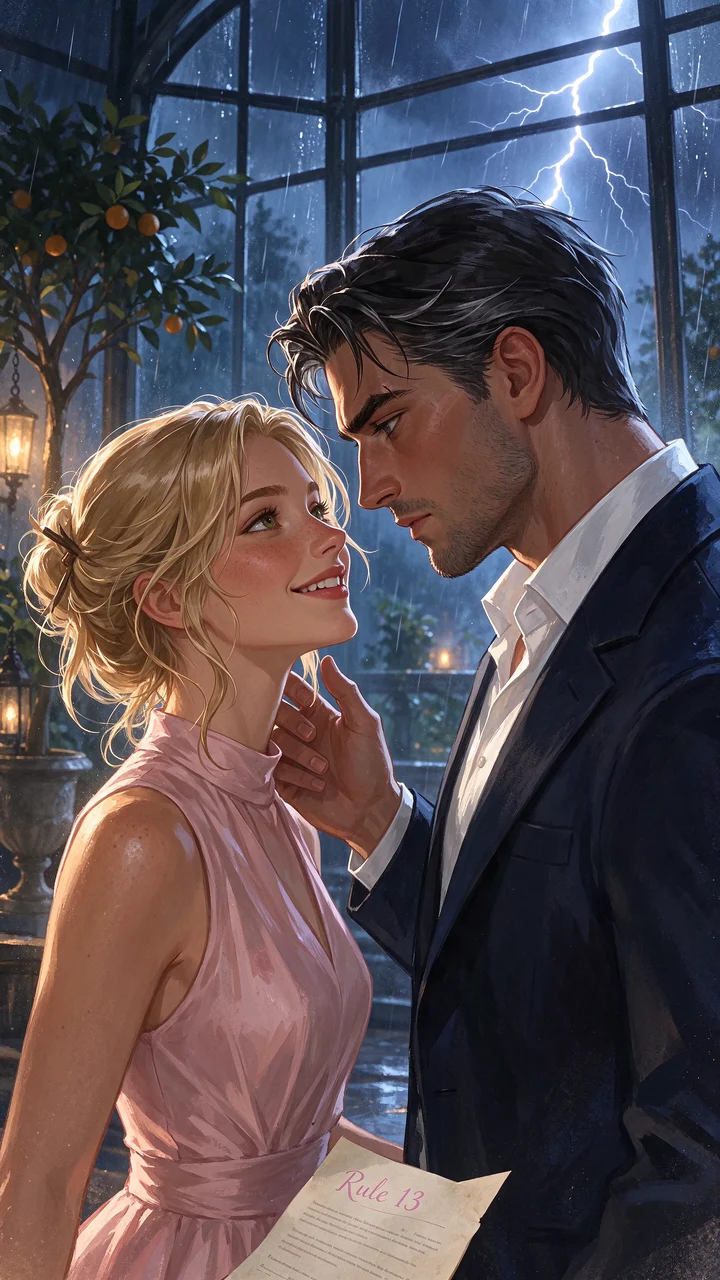
“May I?”
It was the smallest question she had ever been asked. Her pulse stuttered all the same.
She turned her palm up. He laid his hand over it, warm and dry and steady, and his thumb settled over the inside of her wrist, where he could certainly feel what he was doing to her.
“Not long,” Juno told Lucien. “He’s very decisive.”
Lucien looked at their joined hands, then at Rafe’s face. He smiled, slow and pleased, and said nothing at all.
When the quartet started, Ottilie clapped. “Dance. Both of you. I want to see it.”
Rafe stood and held out his hand. This time Juno took it without being asked. He led her to the cleared stone under the lanterns and then stopped, close but not touching, his right hand raised behind her.
It hovered. She felt the heat of his palm through the silk, a quarter-inch from the small of her back, not landing.
“May I?”
She nodded. His hand settled. They moved.
“Closer?” he said, under the violins.
“Ask.”
“May I come closer?”
“Yes.”
One step. His jacket brushed the front of her dress. The jasmine and the salt and something under them, cedar and clean skin, made her a little stupid. Every inch was a negotiation, and he conducted each one as though it were a merger he could not afford to lose.
“You’re good at this,” she said.
“I’ve never done it.”
“Danced?”
“Asked.”
. . .
“There’s one suite,” Colette said in the corridor, without apology. “Ottilie booked it as a gift. The bridal suite. If either of you sleeps on a sofa and housekeeping notices, it’s over.”
The suite was white linen and moonlight, and one enormous bed.
They didn’t turn on the lamps. Juno sat cross-legged at the foot of it, still in green silk, and Rafe sat at the head with his jacket off and his collar finally undone, two buttons, which she found more distracting than she’d have liked to admit. The windows were open. The sea filled the silence for them.
“Rule five’s dead,” she said.
“So are four of the others.”
“Then let’s write new ones.” She held up a finger. “You ask. I answer. That’s the whole engine.”
“Agreed.”
“Either of us can say stop. Any time. For any reason. No sulking about it.”
“I don’t sulk.”
“You’re sulking now.”
He was quiet a moment. “Agreed.”
“And my pitch.” Her voice came out steadier than she felt. “Tomorrow, to your board. It gets judged on the flowers. Not on this. If they hate my work, they say so. I don’t want a single stem bought because I’m wearing your ring.”
“It isn’t my ring.”
“Rafe.”
He looked at her across the length of the bed, a dark shape against the window. “On merit,” he said. “You have my word.”
“Then we’re done.”
“Are we?” Something rough had come into his voice. “You realise you’ve just told me exactly what to do, four times, and I’ve said yes four times.”
“Do you mind?”
He didn’t answer. That was an answer.
She lay down on her side of the bed, on top of the covers, in the borrowed silk. She meant to stay awake and think. She didn’t.
. . .
He watched her breathing slow. One hand was tucked under her cheek, the emerald was loose on her curled finger, and the pencil was still somehow in her hair.
The room had cooled. Her bare arms prickled.
Rafe Dunmore had bought three hotels that year without asking anyone’s permission, including the bank’s. He reached for the folded blanket at the end of the bed and stopped with it in his hands.
“Juno,” he said quietly. “May I put this over you?”
“Mm. Yes,” she said, without opening her eyes.
He laid it over her as though it weighed something. Then he sat in the dark with his heart doing something unauthorised, until his phone lit on the nightstand.
Lovely girl, Lucien had written. Shame she waits for permission every time you touch her. I wonder why.