
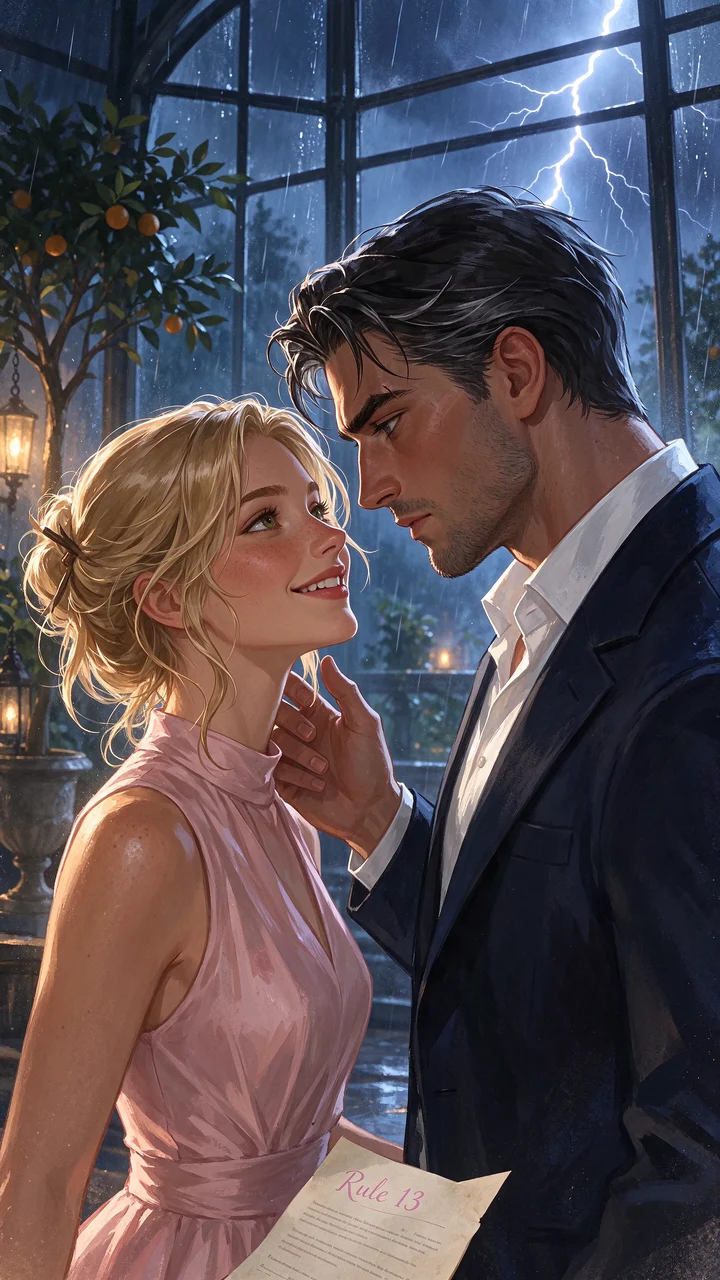
“The fiancée, finally,” said the woman at the front desk, and lifted the bucket of garden roses out of Juno’s arms before she could explain they were samples.
“Sorry, I’m actually here to...”
“He’s been waiting forty minutes.” A lacquered nail pressed the lift button. “Top floor. Don’t knock. He hates knocking.”
Juno had climbed two hundred stone steps from the bus stop because the taxi had wanted thirty euros. Her portfolio was slick under one arm, and a thorn from a Gertrude Jekyll was still lodged in the pad of her thumb. The lift doors closed on her reflection: blush sundress creased from the bus, honey hair half up with a pencil, pink pen behind her ear. Nobody’s fiancée. Certainly not his.
She had come to be seen. That part, at least, was true.
The doors opened onto cold. The air-conditioning was fierce enough to lift the fine hairs on her arms, and beyond it was glass, nothing but glass. The whole office was cantilevered off the cliff, with the sea a hundred metres down throwing scraps of light onto the ceiling. It smelled of salt, espresso and good leather. The desk held a steel watch, face down, and a single sheet of paper.
It also held the attention of a man who did not look up.
“You’re late,” he said.
“The bus...”
“I don’t need the reason.” He turned the page with two fingers and slid it across the desk. “Read it. Sign it. Colette will deal with your wardrobe.”
Rafe Dunmore. She knew the face from the brochure she’d studied until the gloss wore off the corners, but the brochure hadn’t shown the scar. It cut through his left eyebrow and gave him a look of permanent, expensive disbelief. His eyes were storm grey. He wore a navy suit and a white shirt buttoned to the throat with no tie, as though a tie would have been a concession.
She should have said florist. Two syllables. Instead she set her portfolio on the leather chair, perched on its arm, and picked up the contract.
“Out loud?” she asked.
“If it helps you.”
“Oh, it does.” She cleared her throat. “‘Terms of Engagement. Rule one. Instructions from the Party of the First Part are not to be questioned.’” She looked up. “Is that you? The First Part?”
“Obviously.”
“‘Rule two. No public displays of affection without cause.’ What counts as cause?”
“An audience.”
“Romantic.” She ran her finger down the page. “‘Rule three. No personal questions.’ Is asking about rule three a personal question?”
“Yes.”
“‘Rule four. The Party of the Second Part will not post, photograph, or discuss the arrangement.’ ‘Rule five. Separate rooms at all times.’ ‘Rule six. The Party of the Second Part will not touch the First Party’s phone, watch, or hair.’” She paused. “Your hair?”
His jaw moved. “There was an incident.”
“I’d love to hear about it.”
“Rule three.”
She bit down on a laugh and kept going in her best courtroom voice. No lateness. No alcohol beyond two glasses. No contact with the press. No contact with a Monsieur L. Saffray under any circumstances. “Ominous,” she murmured. No discussion of fees in public. Then she reached the last line and read it twice in her head before she said it aloud.
“‘Rule twelve. Neither party will fall in love.’” She lowered the page. “People need that one written down?”
“You’d be surprised.”
“I would. I really would.” She studied him over the top of the contract. “Have you?”
“Rule three,” he said, more quietly.
The fee was printed at the bottom in a font so small it felt embarrassed. It was more than her boathouse earned in two years. Juno felt the number in her teeth.
She uncapped her pen.
The ink came out bright, unapologetic pink. She signed her name with the loop on the J she’d practised at fourteen, and felt him watch it with the expression of a man who has found a flamingo in his boardroom. Then, before she could think better of it, she drew a neat line under rule twelve and wrote:
13. He asks nicely. For everything.
She turned the page around and slid it back with two fingers, exactly the way he had.
Rafe Dunmore read it. Then he read it again. The sea glittered. Somewhere far below, a gull complained. Juno counted her own heartbeats and reached nine before he spoke.
“That isn’t how contracts work.”
“It’s how this one works now. It’s in ink.”
“It’s in pink.”
“Ink is ink.”
He set one finger on the thirteenth line and left it there. His hands were large and very still, and the knuckle of his forefinger was scarred white. He was not looking at her. He was looking at the word nicely, the way she looked at a bloom that had opened wrong.
“Define everything,” he said.
“Everything.”
“That’s circular.”
“So is your rule one.”
The door opened without a knock.
The woman who came through it was tall and wore emerald, with gold-rimmed glasses and a tablet held flat against her chest like a shield she’d stopped needing years ago. She didn’t look at Juno at all.
“Sienna’s gone,” she said. “She took a three-month shoot in Vancouver. She’s already through security. Her agent says she’s so sorry and her phone is off.”
Rafe didn’t move. “Gone.”
“Left the country. I’ve called everyone on the backup list. Two are married, one’s in rehab, and one laughed at me.” Colette Imbert took a breath, turned, and finally saw her. “Who is this?”
They both turned to stare at Juno.
She felt the stare land on her freckles, on the chip in her front tooth, on the pencil in her hair. It was a long way from overlooked.
“Hi,” she said. “I’m the florist.”
Silence.
“I have a half-two with your events manager. Had. I brought roses. Somebody downstairs took them.” She lifted the pink pen as if it might help. “I did try to say.”
“You read,” Rafe said, very evenly, “twelve rules. Aloud.”
“You told me to.”
“You signed it.”
“I’m told I have good handwriting.”
The temperature in the room dropped a degree beyond what the air-conditioning could manage. He stood, and he was taller standing than she had braced for, broad through the shoulders, built for long lengths of cold water. “Colette. Get her out. Get the board on the phone. Tell Ottilie there’s been a family emergency and...”
Colette’s tablet chimed. She glanced down, and her face did something careful.
“Ottilie Varga-Moreau is in the lobby,” she said. “She came early. She’s holding a bucket of garden roses and asking where the bride-to-be is, because apparently, and I’m quoting, ‘only a woman in love brings her own flowers.’”
Nobody breathed.
Juno thought of her roses, the Gertrude Jekylls and the one Constance Spry she’d cut at dawn because it was the best thing in her garden. She thought of the boathouse, the rent, and the forty pitches she’d posted to forty hotels who had never written back.
Rafe looked down at the desk. At her signature. At the pink line beneath his twelve rules, still a little wet where her hand had pressed too hard.
He looked at it for a long time. Then he looked at her, and the grey of his eyes wasn’t stormy any more. It was something worse. It was careful.
“Stay,” he said.
Juno didn’t move. She didn’t even blink. She just tipped her head toward the contract, toward the thirteenth line, and waited.
His throat worked. Colette, behind him, had gone utterly still.
“Stay,” Rafe Dunmore said again, low and reluctant, as though the word had to be pried loose from somewhere it had been rusted shut. “Please.”
Juno capped her pen.