
“Your little cellist,” Severin Kade said, “plays beautifully. Or so I’m told.”
The private room at Corvi’s had one table, one window, and one waiter who never looked at either man. Kade cut his veal into small exact squares. His heavy gold signet ring caught the candlelight each time the knife moved.
Lucan did not touch his wine. “I didn’t know you followed music.”
“I follow you.” Kade smiled beneath the white moustache, a warm, grandfatherly smile, and dabbed his mouth with his napkin. “You emptied a room for her. Forty paying guests. In eleven years you’ve never emptied a room for anyone, Lucan.”
“It was a good sonata.”
“It was a weakness.” Kade set down his knife. His small blue eyes were bright and pleasant. Lucan had seen them look exactly that pleasant the night before a printer on Harbor Street lost his shop, and then his hands. “Weaknesses are expensive for men in your position. For men holding what you hold for me.” He leaned in, kindly. “Would you like me to take care of it? I’d be gentle. As a favor.”
Under the table, Lucan’s hand closed until the knuckles went white.
“No,” he said. “Thank you.”
“Think on it,” said Kade, and went back to his veal.
. . .
It was past one when the elevator opened.
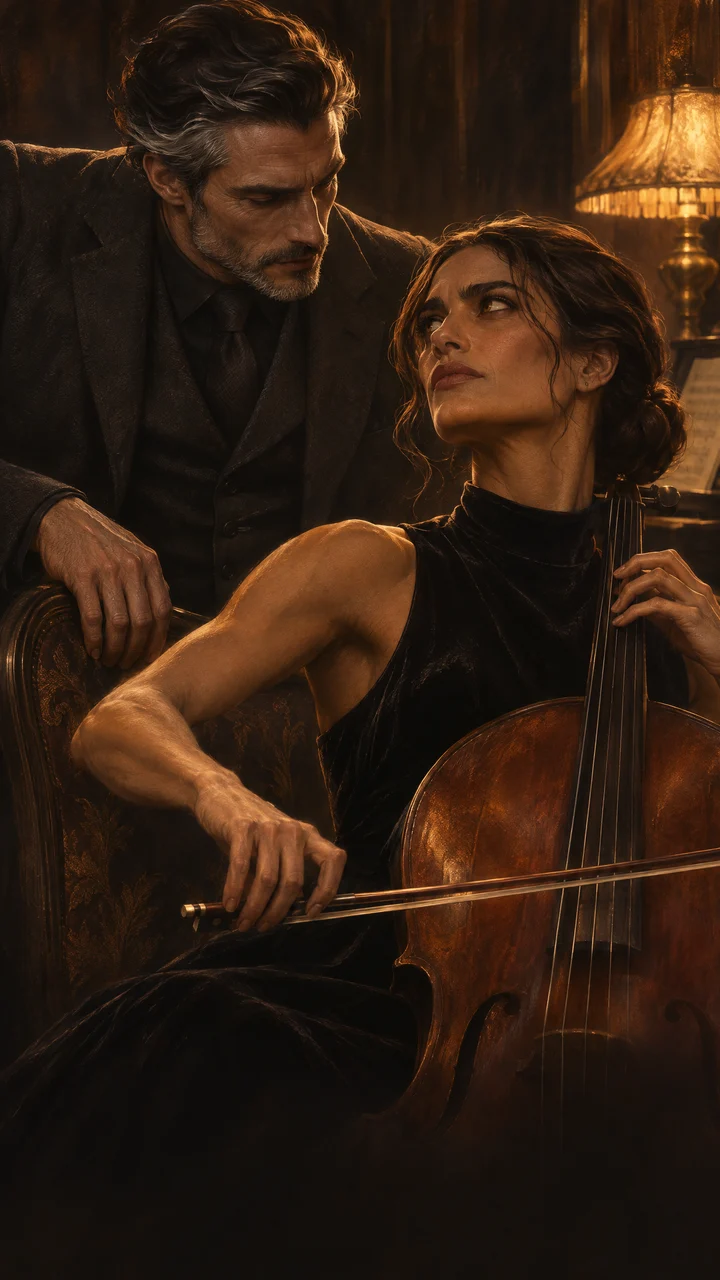
Inès heard it from the music room, where she had been sitting in the dark for two hours with the signed sheet on her knee and the city’s glow on the rain. She did not get up. She had decided that around eleven: whatever came through that door would come to her.
Dace had been quiet most of the night, which meant he was angry. Near midnight he had said, “If he walks in with Kade’s people, you say the word and you run. I don’t care if it burns the cover.” She hadn’t answered. She had been thinking about the word, and about the fact that Lucan had agreed it was hers to say. And his.
He came in without his jacket. For the first time since she’d met him his collar was open, one button, and dried blood crossed the knuckles of his right hand, split in two places.
She looked at it. He watched her look.
“Not mine,” he said. Then, “Mostly.”
“Kade?”
“Kade’s driver. He put his hand on my car door after I asked him not to.” Lucan stood just inside the room and came no closer. Waiting for her. “It was stupid. I don’t do stupid things.”
“You emptied a room for me.”
“Yes,” he said. “That’s what Kade said.”
Something cold went through her. She set it aside to look at later and held up the sheet of manuscript paper.
“The terms still stand,” she said. “But you’ve had a night. So I’m asking. Do you still consent to this? Tonight, here.”
He didn’t answer quickly, and she liked that. He looked at the paper, at the lamp, at her bare shoulders above the black velvet, and something in him settled.
“Yes.”
“Then kneel.”
He went down slowly onto the bare floor in front of her chair, one knee and then the other, and laid his hands open on his thighs with the split knuckles turned up to the light. Tall as he was, kneeling put his eyes level with the scroll of her cello. He did not look away from her.
She tuned in silence. Then she played.
Not Bach tonight. She played Fauré’s Élégie, something written to ache, and she played it rubato, stealing time from one phrase and paying it back late in the next. She drew notes out longer than he expected and arrived early where he had braced for her to linger. She held one rest until the rain on the glass was the only music in the room. She made him wait for the resolution, and then she made him wait again.
She watched it work on him. His breath went first. Then his hands, which curled and opened. Then his face, the long composed lines of it giving way by degrees, until near the end, when she held the penultimate note and would not let it fall, his lips moved.
“Please.”
It was hardly a sound. She heard it anyway.
She finished the phrase and let the last note die completely. Then she laid the bow across the music stand, leaned the cello aside, and slid forward to the edge of the chair.
She took his face in both hands.
His skin was hot. His eyes were wide and pale, nearly black at the center. She bent toward him slowly, the loose strands at her temple falling forward, until she could feel his breath on her mouth and he could feel hers. The smallest distance. The width of a sheet of paper.
He tipped up toward her on instinct, then checked it.
“Not yet,” she said.
His eyes closed. He breathed through it, hard, and stayed exactly where he was, his mouth a quarter inch from hers, trembling with the effort of not closing the distance.
She held him there. Suddenly and completely, she wanted to be the one who broke. She didn’t.
“Stay,” she said against his cheek, and stood. “I’ll be back.”
. . .
The study door at the end of the hall was unlocked.
She stood looking at the brass plate longer than she should have. The door had not been unlocked yesterday.
“Go,” Dace said in her ear, low and urgent. “Go. You’ve got two minutes, maybe.”
Inside, the room smelled of leather and old paper. A green-shaded lamp was already on. On the desk lay a black clothbound ledger, open, as though someone had been reading it and stepped out. The handwriting was one she now knew: narrow, upright.
The first page held columns of dates, amounts in seven figures, and account numbers she knew by heart from the task force wall. One name headed every column: KADE.
Her phone was out before she had decided anything. One shot, two, steady.
“That’s it,” Dace breathed. “That’s the whole case. Get out of there. Now, Inès.”
She closed the ledger exactly as she had found it, turned the lamp back to its old angle, and walked back down the oak hall with her heart pounding against the high velvet neckline.
Lucan was still kneeling.
He was exactly where she had left him, with the same set of the shoulders and his hands open on his thighs. Except that now, in the bloodied palm of his right hand, lay a small brass key.
He raised his eyes to hers.
“You were going to look anyway, Ms. Varenne,” he said. “I’ve known since the first night.” He held the key out a little farther, and his voice did not shake at all. “Ask me what’s in the second ledger.”