
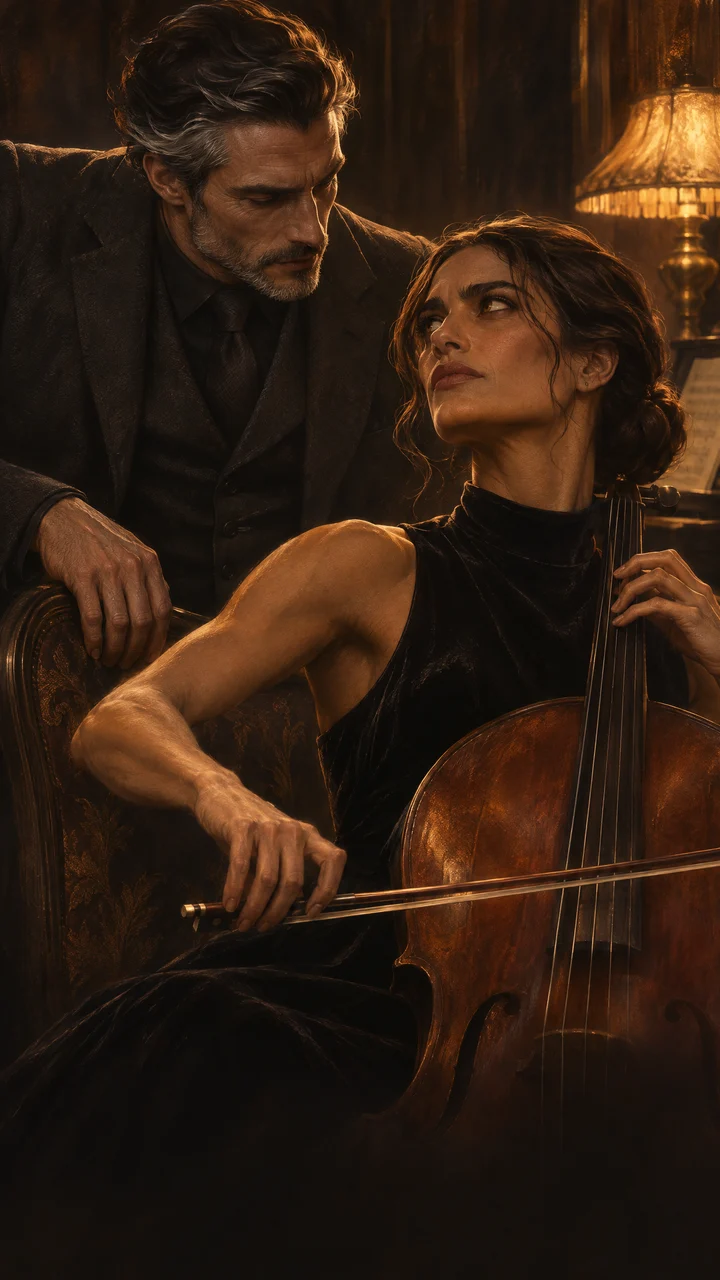
“Seat belt’s on the cello,” the driver said, as if this were ordinary. “Mr. Draye was specific.”
He had been. The case rode up front with the belt strapped across its middle, while Inès sat in the back of the Maybach and watched the city slide past in long smears of red and gold. Rain had started an hour ago. It ticked on the roof the whole way up Meridian Avenue, and it was still ticking when the private elevator opened onto the sixty-first floor.
“Count doors,” Dace said in her ear. The earpiece was smaller tonight, molded and flesh-toned, sunk deep. “Every one.”
A long hall of pale oak. Four doors on the left stood open onto rooms full of glass and nothing personal. Two on the right. At the far end was a single door of darker wood with a brass keyplate and no handle on the outside, only a lock.
“End of the hall,” she murmured, bending to fix the strap of her shoe. “Locked. No handle.”
“That’s it. That’s the study.”
“Ms. Varenne.”
Lucan stood in a doorway to her right, in the same charcoal suit or its twin, without the mask. He looked at the cello case on the driver’s shoulder, then at her. She had the uncomfortable sense that he had watched her look down the hall and decided not to mention it.
“This way,” he said.
The music room had three walls of glass and one of cedar paneling. Beyond the glass the whole city lay wet and burning under low cloud. There was one amber lamp, and a black Steinway with its lid down and not a fingerprint on it.
“Do you play?” she asked.
“No. It came with the room.” He drew out a chair for her at a small writing table. “So did the view. I don’t use that much either.”
On the table lay a single sheet of manuscript paper, its staves ruled in faint grey, and a fountain pen.
“I thought,” Lucan said, sitting across from her, “you’d want it in writing. You strike me as someone who reads contracts.”
She kept her face still. “You’ve been reading about me.”
“I read about everyone who plays in my club.” He uncapped the pen and set it in front of her. “You weren’t very interesting on paper. That’s what made me curious.”
Dace said nothing. She could hear him breathing.
Inès picked up the pen. It was heavier than it looked. Across the top stave, in her small square accountant’s hand, she wrote a heading the way she’d head a schedule of assets: Terms.
“One,” she said, writing. “Scope. Whatever this is, it happens in this room. Not the club. Not the hall. Not your bank, not your car, not the rest of your life.”
“Agreed.”
“Two. I command. You may refuse anything I ask, at any time, and I won’t punish the refusal.”
He was quiet. “You’d let me refuse you.”
“I’d require it. A man who can’t say no isn’t saying yes.” She didn’t look up. “Three. A word. If either of us says it, everything stops. No questions, no sulking.”
“Pick one.”
She considered the staves and the little curved symbols she had stopped drawing nine years ago. “Fermata.”
“Hold,” Lucan said softly. “Hold as long as the player likes.”
“Stop,” she corrected. “Here it means stop.”
“Fermata.” He said it as though testing the edge of it. “Either of us.”
“Either of us.”
She wrote it. Lucan watched the nib move. Rain slid down the glass in long uneven threads, and the lamp threw his shadow across the cedar, larger than he was and very still.
“Condition one,” she said, and set down the pen. “Your phone. Your watch.”
He did not ask why. He took the phone from his inside pocket, undid the steel clasp of the watch with one practiced flick, and laid both in her open palm. The watch was warm from his skin. The phone lay face-down and buzzed once, then twice. He didn’t glance at it.
“Who’s that?” she asked.
“Someone who will wait,” he said.
She set both on the Steinway’s closed lid, where he could see them but could not reach them without standing. Then she unpacked the cello.
“Sit there.” She pointed with her bow to a leather chair six feet away, facing her. “Feet flat. Hands on your knees. You don’t move and you don’t speak until I’ve finished the first movement. If you can’t do that, say so now.”
“I can.”
“Most men think they can.”
He sat. Feet flat. Long hands on his knees, palms down. He looked at her and waited. With a small cold drop in her stomach, she realized he was good at this, and that he had been waiting his whole life for someone to make it a rule.
She played the Prelude from the first Bach suite.
She played it slower than Bach wrote it, slower than any recording he could own. Most cellists ran the rolling sixteenths like water down a gutter. She laid them out one at a time, every bow change audible, every open G given its full ring before she let it go. A movement of under three minutes stretched to five, then to six.
She watched him the entire time.
He did not move, and that was the astonishing thing. A muscle in his jaw tightened around the fourth minute. His breathing, which she could hear in the pauses, grew deliberate. Somewhere in the long climbing passage near the end his fingers pressed a quarter inch into the wool of his trousers, then went flat again, as though he had caught himself and put himself back.
The last chord. She let it sound until the room had taken all of it.
Then she leaned the cello against the chair and crossed to him. Her heels were loud on the floor. As she’d told him, he kept his eyes forward, on the place where she had been.
She put two fingers under his chin and tilted his face up to her.
He let her. The beard was softer than she’d expected. His skin was warm, and under her fingertips, at the hinge of his jaw, his pulse leapt once, hard, and kept running.
So he wasn’t still. Not inside.
Neither was she. That was the problem.
She stayed there long enough to be certain of it, long enough for his lips to part. Then she took her hand away and stepped back.
“Good,” she said. Her voice came out lower than she meant it to.
He closed his eyes for a second. When he opened them, something in the grey had loosened, the way a fist loosens.
“May I speak?”
“You may.”
“Give me the pen.”
She brought him the sheet. He read the whole page once, the way she would have, then signed beneath her terms in a narrow upright hand: Lucan Draye. He dated it and blotted the ink on his own cuff.
“Tomorrow night,” he said, handing it back, “Severin Kade has asked me to dinner. He doesn’t ask.”
The name went through the earpiece like a dropped tray. She heard Dace swear under his breath.
“I’ll come here afterward,” Lucan said. “Whatever state I’m in. If you’ll be here.”
“And if I’m not?”
He looked at the watch and the phone on the piano, then at the signed page in her hand, then at her.
“Then I’ll wait,” he said. “You told me to learn.”