
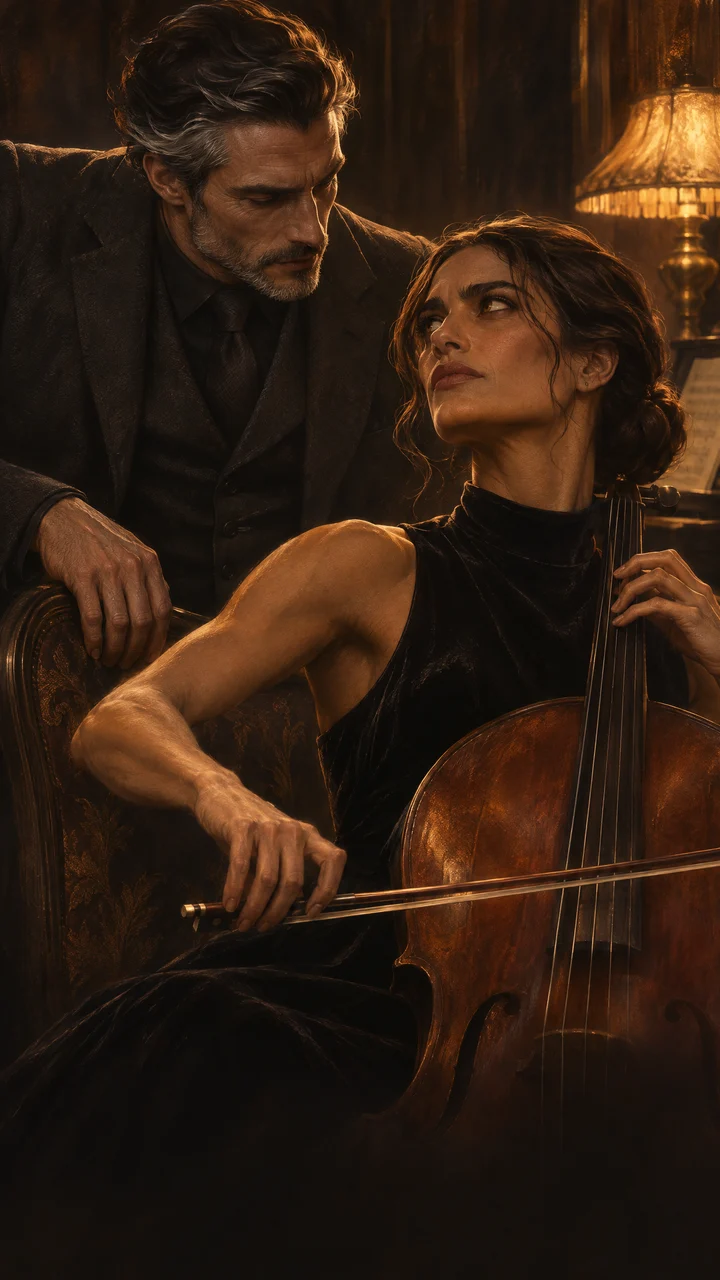
“Don’t look at the booths,” Dace said in her ear. “He owns the floor you’re sitting on. He owns the chair.”
Inès looked at the booths.
Green velvet, black lacquer, forty-odd faces lit from below by candles in brass cups. Bourbon on every table. Beeswax dripping onto the lacquer, where some busboy would scrape it off at four in the morning with a butter knife. She knew the price of every bottle on the back bar to within six dollars. She had read the liquor license, the lease, and the three shell companies stacked under the lease like nesting dolls. She had not read the room yet, and the room was reading her.
She set the endpin into the small worn pit some player before her had left in the stage, tightened the bow two turns, and drew the first chord of the Kodály.
It came out of her rough and enormous. The solo sonata did that. Its low strings were tuned down a half step, so the whole instrument growled against its own grain, and the sound climbed past the chandeliers to the gilded ceiling and came back down on the drinkers like weather. Conversations stopped. A woman in pearls set her glass down without drinking from it.
Nine years. Nine years since a stage, since the particular weight of a room leaning toward her, and her left hand still knew every shift.
“Easy,” Dace murmured. “You’re a musician, not a hostage.”
She played through him.
Halfway into the first movement, the room began to empty.
She didn’t notice at first. A man in a dinner jacket rose with a murmured apology. Two women left with their coats already over their arms. Then the waiters moved booth to booth, bending low, and every guest they bent to stood and went. No complaints. No raised voices. Bills settled with a nod. In four minutes the salon held only candles, abandoned glasses sweating rings onto the lacquer, and Inès, playing to green velvet.
Then the doors at the back opened, and one man came in.
Charcoal suit. Tall. A black half-mask over the upper face, the kind sold to tourists in Venice and worn in rooms like this by people who were not tourists. He walked the length of the salon without hurry, sat in the center booth directly in her line, and crossed one long leg over the other.
“That’s him,” Dace said, very quietly. “Inès. That’s Draye.”
She knew. She had known from the way the staff stopped breathing when the doors opened.
He had paid for the room. Every glass left unfinished, every table that wouldn’t be turned. Somewhere a ledger she would very much like to read held a line for tonight: one cellist, one salon, exclusive.
Her bow was on the D string, mid-phrase, the line reaching toward a resolution it needed the way a lung needs air.
She lifted it off.
The note died against the ceiling. The silence after it was the loudest thing she had heard in years. A candle guttered. Ice shifted in someone’s forgotten glass.
“What are you doing,” Dace said. It was not a question.
Inès rested the bow across her knee and looked at the man in the booth.
He looked back. The mask hid his eyes but not his stillness. Most people, faced with a silence they had not ordered, fidgeted. They reached for a glass or cleared a throat. He did nothing at all. He let it go on.
So did she.
One minute. Two. Her shoulders began to ache from holding the instrument upright without playing it. She let them ache. She had sat through federal depositions that lasted nine hours, and she could outlast a rich man in a mask.
“Varenne,” Dace hissed. “Play the damn cello.”
The man in the booth reached up and untied the mask.
He set it on the table beside his untouched drink. The face underneath was angular, older than the photographs in the file by a year or two of silver in the beard, and the eyes were a pale, unhurried grey. He rose, crossed the empty floor, and stopped at the lip of the stage, close enough that she could see the dark steel watch at his wrist and the black shirt buttoned to the throat.
“You stopped,” Lucan Draye said.
“You noticed.”
“I paid for the rest of it.”
“You paid for the room.” She turned the bow over in her fingers. “The room’s very quiet. You should enjoy it.”
Something moved at the corner of his mouth. It was the beginning of a smile, restrained before it got anywhere.
“What would it cost,” he said, “to keep you playing? Only for me.”
Every instinct from nine years of following money told her what to say. A number. A soft one, a greedy one, the kind that gets a woman invited back. Dace was saying it in her ear: give him a price, give him anything—
“You’d have to learn to wait,” Inès said. “For every note.”
He went very still. This was not the stillness of before. Something underneath it had caught.
“That’s all?”
“That’s everything.” She stood, laid the cello on its side, and opened the case. “Most men can’t.”
She packed with care. Endpin in. Bow loosened and clipped into the lid. Rosin back in its velvet nest. She did not hurry. She could feel him watching every motion, the way she watched a column of figures for the one that didn’t belong. When the latches snapped shut she shouldered the case, stepped down off the stage, and walked past him.
She passed close enough to brush his sleeve. She didn’t.
He did not reach for her. He did not say her name, which he must have known. He stood at the edge of the empty stage with his hands at his sides, and the last thing she saw before the doors swung shut was that he had not turned around.
. . .
The parking garage on Faber Street smelled of wet concrete and brake dust. Level three, the corner where the light was out. Dace leaned against the driver’s door of a grey sedan nobody would look at twice. His navy overcoat hung open, and his face was doing what it did when he was trying not to shout.
“You walked out.”
“I did.”
“On the target. On night one. Mid-song.”
“Sonata.”
“I don’t care if it was the national anthem.” He pushed off the car. “Six months to build that cover, Inès. Six months. You were supposed to be pleasant. Grateful. Available. Instead you made the man who washes money for Severin Kade stand there like a—”
“Like someone who’d been told no.” She set the cello case down between them. “When was the last time that happened to him?”
“That’s not the point.”
“It’s the only point.” Her hands were steady. Her pulse was not, and she disliked that, and filed it. “He emptied a room of forty people to sit alone with me. He didn’t need to. He could have bought me after the set for the price of a drink. He wanted to watch what I’d do.”
“And what you did was leave.”
“And he let me.”
Dace looked at her for a long moment, the crooked nose, the tired eyes. “You overplayed it,” he said, and he said it gently, which was worse. “Men like that don’t chase. They replace.”
Her phone buzzed in her coat pocket.
She took it out. Unknown number. No name, no photograph. A single message.
Teach me.
Dace read it over her shoulder and said nothing for a while. Somewhere below them a car alarm started and stopped.
The phone buzzed again. An address in Meridian Tower, top floor. Tomorrow, nine o’clock. Underneath, three more words.
To discuss terms.
“Well,” Dace said at last, and his voice had changed. “That penthouse has a private study. Nobody we’ve gotten inside has ever seen it.” He looked at her. “Find it.”
Inès closed her thumb over the screen. The light went out, and the two words stayed behind her eyes.