
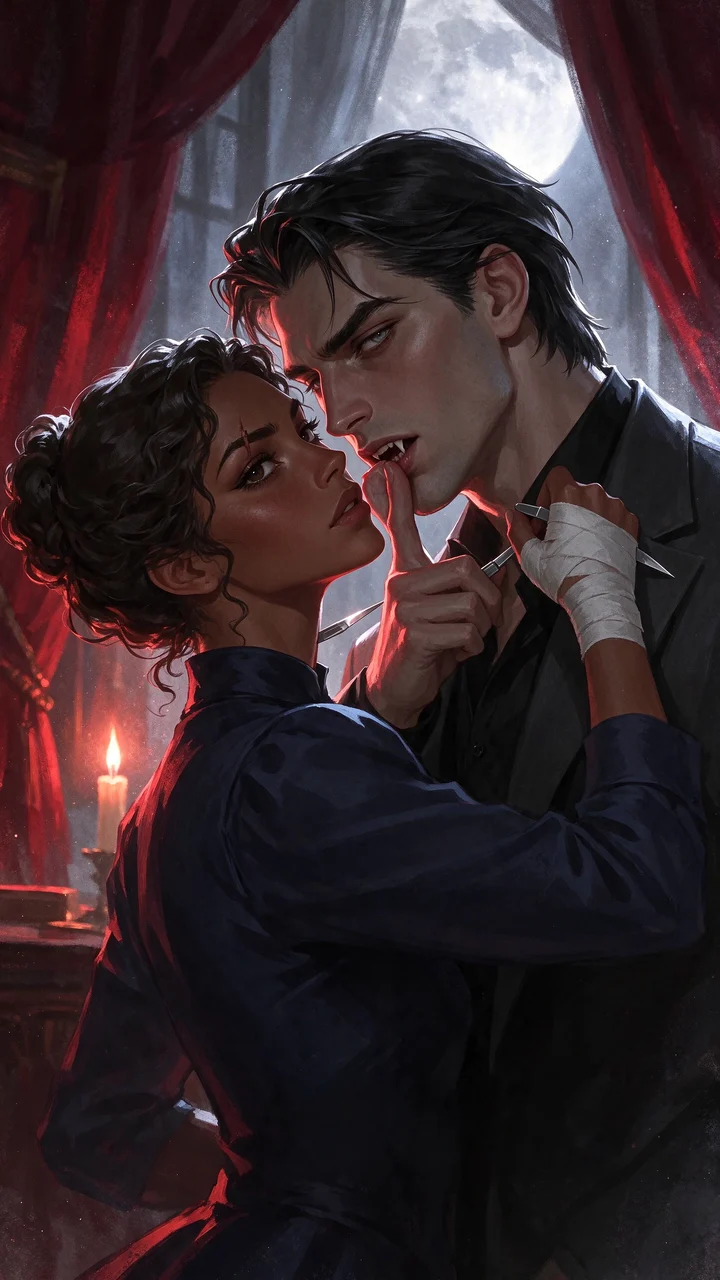
“Nobody sent me,” Josette said. “I was locking up.”
He sat with his back against the steel leg of the exam table where she’d propped him at four, his ruined waistcoat open over the gauze. Weak as he was, he took up the room. Odile had come off the desk and stood with the crowbar on her shoulder, hoping.
“Locking up,” he repeated.
“Pawnshop deadbolt. Sticks in the rain. You can test it on your way out.”
“Three of my people lie dead on your steps, mademoiselle.”
“Your people cut my hand open and licked it.” She held his gaze. “Where I trained, we’d call that self-inflicted.”
Odile made a sound that wasn’t quite a laugh.
He didn’t smile. He tilted his head, the slow tilt of something that had watched a great many people lie to it. “And you simply happen to carry the one thing in this city that kills us.”
“I had a fever when I was eight. Nine days. My mother said I came back different.” She shrugged. “I thought she meant the scar.”
“Prove it.”
“How do you prove you didn’t do something?”
He looked at the bandage.
She understood. She sat on the rolling stool, wheeled it until her knees nearly touched his, and began to unwind the gauze.
“Jo,” Odile said.
“He wants to see if I’ll put it in his mouth.” She peeled the last layer away. The cut ran clean across her palm, puckered and angry. “An assassin would.”
. . .
The smell reached Corvin before the gauze was off.
It was not like other blood. He had lived a hundred and seventy years on the coppered sweetness of human veins, and this was that and something under it, river iron and burnt sugar and a cold green note he had no name for. Every starved cell in his body turned toward it.
She swabbed the wound with iodine. She did not hurry. Her hands were the steadiest thing he had seen in a century, long fingers and short nails, and she worked eight inches from his face and never once looked at his mouth.
He could have taken her wrist. He was weak, but not that weak. One pull, and either he would die or he would know.
He did not move. He kept his palms flat on the cold linoleum and let his fangs ache in his gums, and watched her lay a fresh square of gauze over the cut, and found that not moving was the most interesting thing he had done in decades.
“Satisfied?” she asked, taping it down.
“No,” said Corvin. “But I believe you.”
. . .
The cars came at sunrise.
Three of them, long and black, idling at the curb with their engines purring low and patient. The rain had thinned to drizzle and the light came up grey and cloud-thick behind it, and men in dark coats moved under black umbrellas from car doors to the clinic steps, collars up, faces in shadow. They lifted the dead with gloved hands, quick and careful, the way you’d move furniture belonging to someone important.
The man who came in last closed his umbrella in her doorway and shook it once.
Tall, slender, silver hair cut close, a silver beard trimmed to a ruler’s edge. Dove-grey suit, waistcoat buttoned high, black silk cravat with a pearl pin. He took in the floor, the empty blood bags, Odile’s crowbar, and finally Josette, with pale blue eyes that seemed to add her up.
“Gaspard,” Corvin said.
“You look dreadful.” The man crouched, tilted Corvin’s jaw with two fingers, checked his pupils. Then he rose. “Mademoiselle Marchand. Thank you for your care of him.”
She hadn’t told anyone her name.
“It’s on the sign,” Gaspard said kindly, reading her face. Then, to Corvin, in the same mild voice: “Laurent, Benoît and the younger Achard. Black at the lips. I’ve seen nothing like it since the cholera houses.” He folded his hands on the umbrella’s handle. “You know what I’ll advise.”
“Say it anyway.”
“A woman whose blood does that to our kind cannot live past this morning. Not because she means harm. I’m sure she doesn’t.” His smile at Josette was genuinely sorrowful, which was worse. “But what she is will be known by nightfall, and someone will use it. Better we grieve one stranger than bury a Family.”
Odile’s crowbar came off her shoulder.
Corvin stood up.
It cost him. Josette saw it in the grey of his lips and the way his hand found the table’s edge. But he stood, tall and torn in his ruined charcoal suit, and the enforcers in the doorway went still the way dogs go still.
“Mademoiselle Marchand is under my protection,” he said softly, every word set down with care. “Mine. Personally. Anyone in this city who lays a finger on her, or lets one be laid, answers to me. And I will not be quick.”
Nobody spoke. Outside, an engine idled. Gaspard inclined his head a fraction. “As you say.”
Josette’s heart was going harder now than it had on the steps.
“No,” she said.
Every head turned.
“I’m not your property. I’m not a dog you collar in front of the neighbours.” She stood so she wasn’t looking up at him. It didn’t help much. “You want me protected, fine. Here are my terms.”
His eyebrows rose. “Terms.”
“My clinic stays open. I have a diabetic on Thursday who’ll lose a foot if I’m not here. Odile stays out of this, all the way out. Nobody so much as learns her address. And you don’t feed from me.” She lifted the bandaged hand. “You don’t touch me at all unless I say yes.”
“And if you never say it?”
“Then you’ll have very clean hands.”
Something moved at the corner of his mouth. His gaze dropped, unhurried, to her lips and stayed there long enough that she felt it like heat off a stove.
“Agreed,” Corvin said. “All of it.”
. . .
Odile hugged her at the door, hard, while one of the coats waited with an umbrella to walk her to her truck.
“This is the dumbest thing you’ve ever done,” she said into Josette’s hair, “and I watched you date a drummer.” Something slid into Josette’s sleeve, cool and thin: a scalpel in its paper sheath, and wrapped around it, a gauze wrapper with a number written in eyeliner. “My cousin Thierry. He’s got a boat. Don’t call me. Call him.”
She pulled back and looked at Corvin over Josette’s shoulder. “If she dies, I will find out where you sleep.”
“I don’t doubt it,” he said.
She left swearing.
. . .
The back of his car smelled of leather and cold rain, the windows black glass. Corvin sat facing her on the rear-facing seat, so close their knees nearly touched every time the car hit a pothole on Tchoupitoulas, and he didn’t pretend not to notice, and neither did she.
“You could have let him kill me,” she said. “Easier.”
“Much.”
“So why didn’t you?”
He watched the grey blur of warehouses. “Because Gaspard is right about one thing. By nightfall, someone will try to use you.”
“Comforting.”
“It isn’t meant to be.” He turned back. In the dimness his eyes were the colour of the river before a storm. “My people had no reason to be on your street. They were sent there. And they cut your hand instead of simply killing you, which is not how I trained them.”
“Somebody told them to.”
“Somebody knew exactly what your blood would do.” His voice stayed soft. “And I was in that alley, bleeding, starving. If they had left you over me. If I had woken with your blood in reach.”
The scalpel in her sleeve was suddenly very cold.
“It was meant to end up in me,” Corvin said. “You were never the target, Josette. You were the knife.”
She thought of her steps, of strangers in good coats hosing them clean at dawn.
“Then they picked the wrong clinic,” she said.