
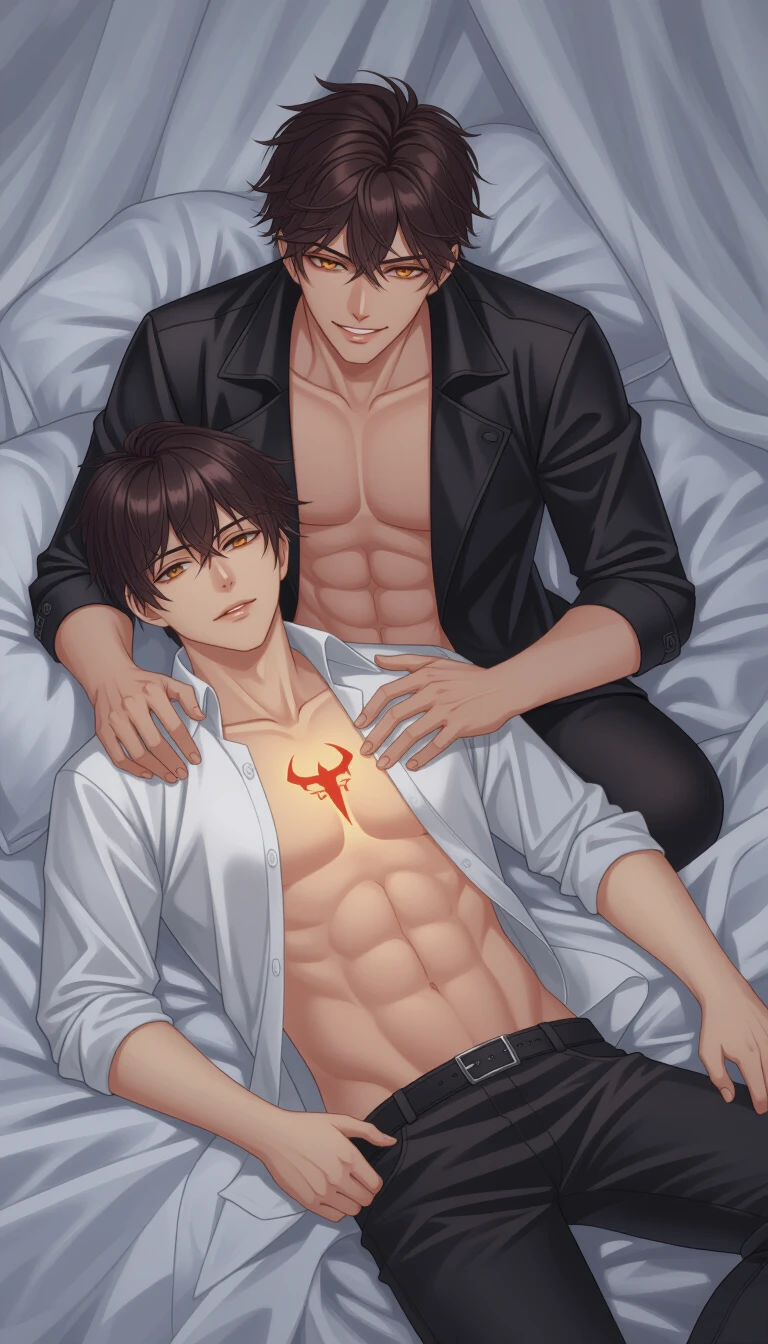
I watched Kanato's smile die on his face before he even said a word. There was a heaviness to the way he sat, shoulders curved forward, hands clasped loose between his knees. The lamplight caught the gold in his hair but missed his eyes entirely.
"I'm sorry," he said, and the words came out rough, scraped raw. "I know tonight was supposed to be—we were supposed to be celebrating. The tournament, the win, all of it. And then I…" He trailed off, jaw working. "I made it heavy. I brought out that file and made everyone read it like it was required homework."
Rou set down the last page of the SPIA file with a care that bordered on reverence. The paper had gone soft at the edges from how many times we'd turned it over, how many times we'd stopped to breathe around the words. He reached for the pitcher on the coffee table, and I watched his hand shake—just slightly, just once—before he steadied it against the glass.
"You didn't ruin anything," Rou said. He poured water into each glass with a steady hand, but I saw his fingers tremble again as he passed one to me. I took it, and the condensation was cold against my palm. "We needed to know."
"Did you, though?" Kanato's laugh was hollow. "I could have waited. I should have waited. Akira's upstairs asleep, Seraph's with him, Hibari's making tea, and I just—" He pressed the heels of his hands against his eyes. "I wanted someone to know. I wanted it to be real. But I didn't think about what it would cost all of you to carry it too."
Sho hadn't touched his water. He was staring at the unopened medical folder on the table, its corner catching the lamplight, a thin rectangle of sealed white against the dark wood. His voice, when it came, was soft—the kind of soft that meant he was holding something careful.
"Is that the check-up results?"
Kanato's hands dropped from his face. He looked at the folder like he'd forgotten it was there. "Arata sent it over this morning. I haven't—" He swallowed. "I haven't opened it yet."
"Are you ready to?" Sho asked. "Because we don't have to. We can put it away, order food, pretend tonight ended differently. You don't have to do this to yourself twice in one night."
I watched Kanato's throat move. He was a man who always had a joke ready, a deflection loaded, a smile that could charm a room into forgetting the tension in his shoulders. But tonight, all of that was gone. What was left was a boy who'd read a file about the man he loved and was still trying to find the floor.
"We should read it," Kanato said finally. "Akira would want us to know. He's never once hidden anything from us—not the hard stuff, not the ugly stuff. It's the least I can do to look."
Kuzuha had been quiet through the whole exchange, sitting at the edge of the couch with his elbows on his knees. He was the kind of still that meant he was listening to something beneath the words—the pulse of the room, the weight of the silence, the way Kanato's breath came a little too fast. He reached for the folder before anyone else could, and his voice was gentle when he spoke.
"Let's see what we're really dealing with, then."
The seal gave way with a soft, dry sound. Kuzuha opened the folder flat against his knee, and I leaned in without meaning to, drawn by the pull of paper and the promise of answers. The first page was a bloodwork summary, dense with columns and abbreviations I couldn't fully parse, but the highlighted rows told their own story.
Elevated stress markers. Lingering traces of the drug from the abduction. Organ stress values that made my stomach turn.
"He's been hiding this from us too," I breathed. The words came out before I could stop them.
Kanato's head snapped up. "What?"
"The bloodwork. It's not—" I pointed at the rows, my finger hovering over the numbers I didn't want to touch. "It's not good. The stress markers are through the roof, and there's still traces of whatever they gave him during the abduction. His body hasn't fully cleared it."
The room went quiet. The kind of quiet that has texture, that you can feel pressing against your skin.
Sho picked up his water glass, took a sip, set it down. The movements were deliberate, almost mechanical. "He didn't tell you."
"He didn't tell me." Kanato's voice was flat. "He said he felt fine. He said the fever was gone and he was eating again and I—" He stopped, and I watched him close his eyes. "I believed him. I wanted to believe him."
Rou reached over and put a hand on Kanato's shoulder. It was a small gesture, barely a touch, but I saw Kanato's jaw unclench by a fraction. "You're not a mind reader, Kanato-san. None of us are. He's spent his whole life learning how to hide pain. That's not something you can undo with love alone."
"I know." Kanato's laugh was broken. "I know that. But I keep thinking—if I'd just looked closer. If I'd paid more attention to what his body was telling me instead of what his mouth was saying." He shook his head. "I'm supposed to be the one who sees him. That's what I told myself. That's what I told you all. And I missed this."
"You didn't miss it," Kuzuha said quietly. He was still holding the folder, but his eyes were on Kanato. "You're reading it now. That's not nothing."
Kanato opened his mouth to argue, then closed it. He looked down at his hands, at the empty space where the file had been, at the water glass that was still full.
"There's more," Kuzuha said. He turned to the next page, and I heard his breath catch. "Kanato, there's more."
"What is it?" Sho leaned forward, and I did too, the four of us bending toward the folder like it was a fire we were trying to warm our hands on.
Kuzuha read slowly, his voice careful, as if the words might break if he said them too fast. "It's your file, Kanato. Arata's notes on your physical."
Kanato blinked. "My—why would he send you my file?"
"Because it's the full Voltaction medical folder," Kuzuha said. "He sent all four of you. Akira's was just the first."
I watched Kanato's face shift through surprise, then embarrassment, then a reluctant curiosity. He reached for the folder, and Kuzuha handed it over without a word.
Kanato read his own file in silence. I watched his eyes move across the page, saw the furrow between his brows deepen, then smooth, then deepen again. Finally, he let out a breath that was almost a laugh.
"Well," he said. "That's embarrassing."
"What does it say?" Rou asked.
"Apparently I'm very fit, except for my stomach." Kanato tapped the page. "Arata says I need to reduce fast food. Says I eat takeout almost every day and it's starting to catch up with me."
Sho snorted. "That's because you can't cook."
"I can cook!"
"You burned water," Rou said mildly. "I was there. I saw it."
"It was a one-time thing."
"You set off the fire alarm," Kuzuha added. "In a building with a sprinkler system. The entire floor got wet."
Kanato's ears went red. "That was a miscalculation, not a lack of skill."
"Kanato-san," I said, unable to keep the grin off my face, "you're the only person I know who could burn a pot of rice."
"It was a new pot! It had different thermal properties!"
The tension in the room cracked, just a little. It wasn't gone—it was still there, a weight we were all carrying—but the laughter helped. It made the air breathable again.
"So you're healthy," Sho said, "except for your terrible eating habits."
"Essentially." Kanato set his file aside. "Which means the next one is—"
"Seraph," Rou finished. He reached for the folder, but Kuzuha was already turning the page.
The silence that followed was different. It was the kind that comes when you're reading something that doesn't make sense, and your brain is still trying to catch up with what your eyes are telling it.
"He's fine," Kanato said slowly. "He's more than fine. Arata says his physical condition is comparable to an Olympic athlete."
"That's—" I started.
"Wait." Kuzuha's voice cut through. "There's a note here. About his throat."
We all leaned in.
"He doesn't have a certain bone in his throat," Kuzuha read. "The hyoid bone. It's normally there in adult men—it anchors the tongue and supports the voice box. Seraph doesn't have one. Arata says that's why his voice is higher than expected for someone his size."
"Huh," Sho said. "I always thought his voice was just—his voice."
"It is his voice," Kanato said. "It's just that his voice is the way it is because of a missing bone." He paused, and I saw something shift in his eyes. "That's why he sounds like that. That's why he always sounded like that, even when we first met. I thought it was just—" He shook his head. "I don't know. I never thought about it."
"None of us did," Rou said gently. "It's not the kind of thing you think about."
But there was something else in the room now, something heavier than curiosity. I could see it in the way Kanato's hands tightened on the folder, in the way his breath came a little slower, a little more deliberate.
"Most SPIA agents die in their thirties," he said quietly. "That's what the file said. The performance enhancer drugs they're given—they destroy the body slowly. The heart, the liver, the kidneys. By thirty, most of them are already failing. By thirty-five, most of them are dead."
I knew where this was going. We all did.
"But Seraph is healthy," Kanato said. "He's not just healthy. He's Olympic-level healthy. He has the body of a man who grew up safe, who was fed properly, who never had his organs slowly poisoned by the drugs they gave him." His voice cracked. "Because Akira took his doses. Because Akira drank double the amount, every time, to keep Seraph's body clean. And it worked. It actually worked."
The words sat in the room like stones dropped into still water. The ripples spread outward, touching all of us.
"He gave himself organ damage," I said slowly, "so Seraph could have a healthy body. He traded his own life span for Seraph's."
"And Seraph doesn't know," Sho said. It wasn't a question.
"He knows Akira did something," Kanato said. "He knows about the rations. He knows about the drug—he found out when Akira collapsed from withdrawal. But he doesn't know the full extent. He doesn't know Akira was taking his doses for years, every single time, without ever telling him."
"God," Rou breathed. "And Akira's own file says—"
Kuzuha was already turning to the next page. "Akira's file," he said. "It's bad."
The room went still again, but this time it was the stillness of dread. The kind that comes before bad news, when you know it's coming and you still can't prepare for it.
"Bloodwork is what we already saw," Kuzuha read. "Elevated stress markers, lingering drug traces. But there's more. Arata notes that Akira has permanent damage from the performance enhancers and other drugs they forced on him during his honey trap missions. His immune system is weak. He gets tired faster because of organ damage."
Kanato made a sound—small, wounded, barely audible. I watched him press his fist against his mouth, his eyes fixed on the page like he could undo the words by staring at them hard enough.
"His muscles and skin show high sensitivity to touch, temperature, and pain," Kuzuha continued. "Arata says it's because they were torn up and damaged repeatedly before they could fully heal. The scar tissue makes him more sensitive, and it's also why he gets cold easily."
"That's why he always wears layers," I said, the realization hitting me like cold water. "Even in summer. Even when everyone else is sweating. I thought it was just—I thought he liked the aesthetic."
"He's cold," Kanato said. His voice was hollow. "He's always cold. And I never—I never asked. I just assumed."
"The organ failure also causes nausea sometimes," Kuzuha read on, his voice getting quieter. "Which explains why he loses his appetite even when he likes the food. Arata says Akira refuses even his favorite dishes sometimes because his body can't handle it."
"He loves food," Rou said, and there was something fragile in his voice. "He always gets so happy when we eat together. I thought—I thought that meant he was okay."
"He was happy," Sho said softly. "He is happy. It's just that his body doesn't cooperate with his heart."
Kuzuha turned the page, and I saw his eyes widen. "There's more. There's a list of medicines he can't take—because they'll damage his internal organs further. And another list of medicines that don't work on him at all, because he's built up resistance from being drugged repeatedly during SPIA."
"So he's in pain," Kanato said, "and most of the things that could help him are either off-limits or useless."
"He's been managing," Rou said. "He has to have been. He's survived this long."
"Surviving isn't the same as living," Kanato said. "He's been surviving his whole life. I just—" He stopped, and I saw his jaw tighten. "I wanted him to live. I wanted to give him that. And I don't know if I can."
The silence that followed was the heaviest yet. It pressed down on all of us, and I felt it in my chest, a weight that made it hard to breathe.
Then Kuzuha cleared his throat. "There's something else. Something—unexpected."
"What is it?" Sho asked.
"Arata notes that the incubus energy—the spiritual energy from the contract—has actually healed some of the old damage." He looked up, and there was wonder in his eyes. "The muscle tissue that was torn and re-torn has been reinforced. Some of the organ stress has been reduced. Akira's body is stronger now than it was before the contract was sealed."
"That's why he doesn't get internal bleeding," Kanato said slowly. "Even after—even when we're intimate, he doesn't get hurt the way he used to. I thought it was because I was being careful. I thought it was because we were learning his limits. But it's—"
"It's the contract," Kuzuha finished. "The energy is healing him. It's making him stronger."
"That's good," Rou said. "That's—that's really good, right?"
"It's the best news we've gotten all night," Sho said. "He's healing. He's actually healing."
Kanato let out a breath I didn't realize he'd been holding. "Okay. Okay, that's—that's something. That's a real something."
But Kuzuha was still reading, and his face had gone pale. "There's a special note," he said. "From Arata. About Akira's hormone levels."
The room shifted. I felt it in my own body—the sudden tightening of my shoulders, the quickening of my pulse. Hormones. That word never meant anything good when it came to Akira.
"He has higher female hormones than a normal man," Kuzuha read. "Arata says it affects many aspects of his body and behavior. The long lashes. The lean figure. The small waist—the file says he can fit in women's gowns."
"That's why he's so pretty," I said, without thinking. Then I flushed. "I mean—he is. Everyone can see that. I just didn't know there was a reason."
"There's always a reason," Kanato said quietly. "There's always a reason with him."
"The hormone levels also affect his attractions," Kuzuha continued. "He's attracted to both men and women. And his interests—" He paused. "Arata says this is why Akira likes things that are generally targeted at women. Shojo manga. Sweets. Girls' fashion. Makeup and skincare. Romantic games. Shiny and cute things."
"He always gets so excited about skincare," Rou said, a smile tugging at his lips despite everything. "I remember he spent an entire stream talking about the difference between hydrating and moisturizing serums."
"And he has a low sex drive," Kuzuha added. "Arata notes that the hormone balance affects that too."
Kanato made a sound that might have been a laugh. "That explains a lot. I always wondered why he never seemed interested in—" He stopped, and his ears went red. "Never mind."
"It also explains why he can scream like a girl," Sho said. "He has the deepest voice in Voltaction, but during horror game streams—"
"We've heard," I said, and I couldn't help the grin. "The clips went viral. 'The moment Voltaction's deepest voice discovered fear.'"
"He was so embarrassed," Rou said, laughing softly. "He apologized for an entire hour afterward. Kept saying he didn't know why his voice did that."
"And now we know," Kuzuha said. "The hormones affect his voice range too. And his talkativeness—Arata says he talks a lot more than average. And his moodiness, his anxiety. The high pain tolerance. The flexibility."
"He's always been like that," Kanato said. "I just thought it was—him. I never thought there was a reason."
"There's always a reason," I echoed, and the words felt heavier than I meant them to.
"He barely needs to shave," Kanato said, almost to himself. "I've been with him for months now, and he's only shaved a handful of times. And he doesn't have much body hair in general. I thought it was just—genetics."
"It is genetics," Lauren said, speaking up for the first time. He'd been quiet, watching, taking it all in. "But the hormones are part of it too."
"His voice is deep though," I said. "Really deep. Wouldn't higher female hormones make his voice higher?"
Kuzuha scanned the page. "The file says his voice and strength—he used to do heavy lifting during SPIA—come from his parents' DNA. His father most likely also had a deep voice."
"So he got the best of both," Sho said. "The deep voice and the pretty face."
"He really did," Rou said, and there was something wistful in his voice. "He's—Akira-san is genuinely beautiful. Not in a feminine way, not in a masculine way. Just—in his own way."
Kanato's expression softened. "Yeah," he said. "He is."
The warmth of the moment was brief. Kuzuha was still reading, and his face had gone pale again.
"There's more," he said. "About Hibari."
"Hibari?" Kanato blinked. "What about him?"
"His file says he's the opposite of Akira. He has male hormones a bit higher than average." Kuzuha read on. "That's why he looks so physically manly. Sharp jaw, very pronounced Adam's apple, raspy voice even though he's never smoked. Veiny hands. Wide shoulders. Huge strength even without training."
"Hibari's always been athletic," Kanato said. "Even in high school, he had the best grades in sports. He never joined any clubs—he was always focused on music—but he could run faster, jump higher, lift more than anyone else. I always thought it was just—him."
"It is him," Kuzuha said. "The hormones are part of him."
"There's more," he added, and his ears went red. "The file says the high hormone levels also cause a higher sex drive."
The room went very quiet.
Kanato's face went through a complicated series of expressions—surprise, embarrassment, then a slow dawning amusement. "Oh," he said. "Oh, that explains—" He stopped, and his ears went red. "That explains a lot."
"We don't need details," I said quickly.
"I wasn't going to give details—"
"Kanato-san, your face is the color of Akira-san's blush when he's embarrassed," Sho said, and there was a wicked edge to his soft voice. "You were absolutely going to give details."
"I was not—" Kanato sputtered. "I was just going to say that it explains his stamina. That's all. Nothing else."
"His stamina," Rou repeated, deadpan.
"His general stamina! He can sing for hours, dance for hours, stream for hours—"
"Sure," I said. "His general stamina."
Kanato buried his face in his hands. "You're all terrible."
"We learned from the best," Sho said sweetly.
The laughter that followed was different from before. It was lighter, easier, a release of pressure we didn't know we'd been holding. But it faded quickly, because there was still one page left in the folder, and Kuzuha was holding it like it might bite him.
"There's one more note," he said. "From Arata. About Akira's condition."
"What does it say?" Kanato asked, and his voice was steady. Steady in the way that meant he was bracing himself.
Kuzuha read, and his voice was quiet. "Past data has shown that men with high female hormones are almost always good-looking, because they have the attractive traits of both male and female. And since high female hormone levels can be detected from a young age, SPIA most likely was aware of Akira's condition."
He paused. I saw his throat move.
"Which is why they chose him as a honey trap agent," Kuzuha finished. "They knew he would have the looks they needed for that kind of mission. They trained him from a young age to be good at it. Because they knew what he would become."
The room didn't go quiet. It went empty. The kind of empty where sound stops existing, where the air itself seems to hold its breath.
"He was chosen," Kanato said, and his voice was barely a whisper. "He wasn't just—he wasn't just used because he was there. He was selected. Because of his hormones. Because of how he would look. They saw a child with high female hormones and decided he would be their honey trap."
The words hung in the air like smoke from a candle that had just been snuffed out—still visible, still curling, still refusing to dissipate. I watched Kanato's hands, the way they had gone still on his knees, the knuckles white where he was gripping his own thighs. He wasn't looking at any of us. He was looking at the space on the coffee table where the folder had been, as if the answer to every question he'd ever asked about Akira was still sitting there in the lamplight.
Rou was the first to move. He reached across the table, slow and deliberate, and closed the folder. The sound of it was soft, almost gentle, like a hand settling over a wound. He didn't push it away. He just rested his palm on the cover, the paper cool beneath his fingers, and let the weight of the gesture speak for him.
"He doesn't know," Rou said, and it wasn't a question. "Akira doesn't know that they chose him. He thinks he was just—a body that was there. A tool that was convenient."
"He knows," Kanato said, and his voice was raw. "He knows he was a tool. He's never once pretended otherwise. But he doesn't know this. He doesn't know that they looked at a child and saw the potential for a weapon before he could even speak in full sentences. He doesn't know that his body was the reason he was never allowed to be anything else."
Sho's voice was quiet when he spoke, the softness of it cutting through the heaviness like a blade through silk. "Do we tell him?"
The question landed in the center of the room, and I felt it hit me in the chest. Do we tell him. As if it were that simple. As if the telling wouldn't be another kind of wound, another scar laid over a body already covered in them.
"I don't know," Kanato said, and the honesty of it was more painful than any deflection. "I don't know if it would help him. I don't know if it would hurt him. I don't know if he'd see it as validation—that he was always meant to be this, that he was never going to escape it—or if he'd see it as proof that he was never in control of anything, not even his own body."
"He'd see it as both," Kuzuha said quietly. "That's the thing about Akira. He holds two truths in his hands at once and refuses to drop either of them. He was a victim. He was also a survivor. He was used. He also chose to escape. He was selected for his body. He also made that body his own, in every way that mattered."
I watched Kanato's shoulders drop by a fraction, the tension in them easing just enough to let him breathe. He looked at Kuzuha, and there was something unreadable in his eyes. "How do you do that?"
"Do what?"
"See him like that. See the whole of him, without flinching. I've known him for months now, and I still—" Kanato stopped, his jaw working. "I still see the parts that scare me. The parts that could break. I see all the ways I could lose him, all the ways I already have, in small increments, without noticing until the space where he used to be feels empty."
Kuzuha leaned forward, his elbows on his knees, and for a moment he looked less like a vampire and more like a man carrying the weight of his own long years. "Because I've been where you are," he said. "Not with Akira. But with someone who carries their past in their body, the way he does. Someone who flinches at the wrong touch and smiles through it anyway. You learn to see the whole of them because the alternative is seeing only the wounds—and that's not love. That's just looking at a person and calling it love."
The room was quiet again, but it was a different kind of quiet. The kind that comes after something true has been said, when the air itself feels like it's settling into a new shape.
Rou's hand was still on the folder. He turned it over, not opening it, just tracing the edge of the cover with his thumb. "He's upstairs," he said. "He's asleep. He's in a bed in this house, and he's safe, and he's healing. That's what matters tonight. The rest of it—the telling, the knowing, the carrying—that can wait until he's ready. Until all of you are ready."
Kanato looked at him, and something in his face shifted. It was small, almost imperceptible—the loosening of a muscle, the softening of a line—but I saw it. "You're right," he said. "You're right. I keep forgetting that he's here. That he's not—" He stopped, and his voice caught. "That he's not somewhere I can't reach him."
"He's here," I said, and I heard my own voice come out steadier than I felt. "He's upstairs, in your bed, and he's going to wake up tomorrow and eat whatever Hibari makes for breakfast and complain about the tea being too hot and then he's going to sit in the studio and laugh at something stupid on his phone. He's going to be fine, Kanato. Not because his body is fine—it's not, and it might never be—but because he's still here. And he's still choosing to be."
Kanato's eyes were wet when he looked up. He didn't try to hide it. He just let the tears sit there, unshed, catching the lamplight like small, fragile things. "I don't deserve you all," he said. "Any of you. I know I joke around and I act like I'm the one holding everything together, but I'm not. I'm the one who's barely holding on, and you're all just—here. You're all just here, and I don't know how to thank you for that."
"You don't have to thank us," Sho said, and his soft voice was gentle. "You just have to keep being here. For him. For all of them. That's enough."
Kanato nodded, slow and deliberate, like he was testing the weight of the words. He reached for the folder, and Rou let him take it. He held it for a moment, his thumb tracing the corner, before he set it down on the table again—not closed, not open, just resting there between them like a thing that had been carried long enough.
"I'm going to go check on him," Kanato said, and there was a quiet resolve in his voice now, a steadiness that hadn't been there before. "I'm going to go upstairs and I'm going to make sure he's warm and he's breathing and he's not alone. And then I'm going to come back down and we're going to finish this—all of it, together. But not tonight. Tonight I just need to be there for him."
Kuzuha's hand found my shoulder before I could move. His grip was light, almost absent, but it stopped me at the threshold of the bedroom doorway. I looked back at him, and he tilted his chin toward the scene in front of us—a silent instruction to wait, to watch, to not break whatever spell was holding this room together.
The dim light from the hallway spilled across the floor in a long, pale rectangle. Inside, Akira's bedroom was swallowed in shadow, the curtains drawn tight against the evening, the only illumination coming from a small lamp on the nightstand that cast everything in amber. The air was thick with the smell of fever—that sharp, metallic scent of a body fighting something it couldn't name—and something else, something softer. Hibari's cologne, maybe. Or the laundry detergent Akira used. It was hard to tell where one ended and the other began.
Hibari was sitting on the edge of the bed, his back to us, his broad shoulders curved forward in a posture I'd never seen him wear. He was always so bright, so kinetic—a golden retriever in human form, all wagging energy and easy laughter. But now he was still. Completely still. His right hand was wrapped around Akira's, their fingers interlaced like they'd been woven together, and his left hand was moving in slow, rhythmic strokes through Akira's dark hair, pushing it back from his forehead, tracing the line of his temple, brushing down to the curve of his jaw. Over and over. A metronome of tenderness.
And he was humming.
The melody was low, almost inaudible—a soft, meandering tune I didn't recognize. It wasn't a lullaby, not exactly. It was more like the kind of sound you make without thinking, the kind that lives in your chest and slips out when you're not paying attention. The kind that says I'm here. I'm not going anywhere.
I felt something tighten in my throat.
Beside me, Rou had gone very quiet. His hand was resting on the doorframe, knuckles pale, and I could see the way his jaw was working—that tell of his, the one that meant he was trying very hard not to feel something. Sho had pressed himself against the opposite wall, his soft voice reduced to nothing, his dark eyes fixed on the bed with an intensity that bordered on reverence.
Kanato moved first.
He stepped past us, his footsteps careful and deliberate, and Seraph followed a half-beat behind him. They moved like men who had done this before, who knew the geography of this room, this bed, this body. Kanato rounded the far side of the bed and lowered himself onto the mattress with a gentleness that seemed almost impossible for someone his size. Seraph took the other side, his broad frame folding into the space beside Kanato, and the bed dipped under their combined weight.
The shift was enough. Akira stirred.
I watched his face change—the crease between his brows deepening, the flutter of his eyelids, the way his breath hitched and then steadied. He was still half-asleep, still lost somewhere in the fog of fever, but something in him recognized the shift in the room. His fingers tightened around Hibari's, and his mouth moved, shaping a word that didn't quite make it out.
"Serao..."
The sound of it was wrecked. Hoarse. Scraped raw by whatever was burning through him. It was Akira's voice—that deep, steady voice that usually sounded like it could hold the weight of the world—but it was wrong. It was cracked at the edges, thin in the middle, like a bell that had been dropped one too many times.
I felt the sound of it in my chest. In my teeth.
"Kanato..."
His eyes were open now, barely. Just slits of dark through the fever-glaze, catching the lamplight and refracting it into something almost gold. He was looking at them—at Kanato, at Seraph, at Hibari—and I could see the confusion swimming in his gaze, the slow, heavy process of his mind trying to catch up to what his eyes were telling him.
"Why..." His voice cracked on the second syllable. "Why are you... here?"
Kanato leaned forward, his hand finding Akira's forehead, his thumb brushing across the arch of his brow. "We just wanted to see you," he said, and his voice was so gentle it made my chest ache. "That's all. We just wanted to be here."
Akira stared at him for a long moment. His gaze was unfocused, glassy, but there was something in it—a flicker of understanding, or maybe just the relief of a body that had been holding itself together for too long finally being allowed to let go.
"Oh," he said, and the word came out soft. Almost childlike. "Okay."
His eyes closed. His hand stayed wrapped around Hibari's. His breathing evened out, the labored rasp of it smoothing into something deeper, steadier. And I watched the tension drain from his body, line by line, until he was just a shape in the lamplight, still and peaceful in a way I'd never seen him.
I didn't realize I'd been holding my breath until Rou's hand landed on my shoulder. I looked at him, and he looked back, and neither of us said anything. There was nothing to say.
Kuzuha moved first, backing away from the doorway with a quietness that seemed practiced. Sho followed, and Rou and I went after him, our footsteps muffled on the carpet. We regrouped in the living room, standing in a loose circle under the dim overhead light, and for a moment none of us spoke.
Then Sho said, very quietly, "He has a fever."
It wasn't a question. It was a fact, stated with the kind of flat precision that made it land harder than any accusation.
"He's burning up," Rou agreed. His voice was rough. "You saw his face. He could barely keep his eyes open. He could barely—" He stopped, his jaw working. "He could barely talk."
I looked past them, through the open doorway of the bedroom, where the three of them were still gathered around the bed. Kanato was saying something, his voice too low to hear, and Seraph was nodding. Hibari was still holding Akira's hand, still brushing his hair, still humming that soft, shapeless melody.
"How long has he been like this?" I asked. The words came out rougher than I meant them to. "How long has he been sick?"
No one answered. No one could.
And then I saw it.
On the desk in the corner of the room, half-hidden under a stack of papers and a discarded jacket, was the manila folder. The same folder we'd been reading all evening. The same folder that held the results of Akira's check-up, the one Arata had sent over, the one Kanato had been carrying around like it might burn him.
It was still sealed. Still unopened. The tab was still folded down, the metal clasp still fastened, and I could see the faint outline of the hospital's logo through the paper—a thin, generic mark that said nothing about the weight of what was inside.
Akira hadn't read it.
He hadn't even opened it.
He was lying in that bed, burning with fever, his body fighting something none of us could name, and he hadn't even looked at the one piece of paper that might have told him why.
I thought about the file. About the pages we'd read tonight. About the things we'd learned—the hormones, the selection, the honey trap, the conditioning. And I thought about Akira, lying in that dark room, his hand wrapped around Hibari's like it was the only thing keeping him tethered to the earth.
"He's been sick more than he's been well," I said, and the words came out before I could stop them. "Since we've known him—since all of this started—he's spent more days in that bed than out of it. More days feverish and burning and barely able to speak than he has laughing at something stupid on his phone." I paused, my throat tight. "And none of us noticed. None of us—"
I couldn't finish the sentence. I didn't have to.
Sho was looking at the folder too. His soft face was unreadable, but I could see the way his hands had curled into fists at his sides. "He hasn't read it," he said, and his voice was quiet. "He hasn't even read his own results. He's been too sick to care."
Kuzuha moved to the desk. He didn't pick up the folder—he just stood there, looking down at it, his pale hair catching the lamplight. "It's not our place," he said finally. "To open it. To read it. It's not our place."
"But it's someone's place," Rou said. "Someone has to—"
"Someone will," Kuzuha cut him off, and there was something sharp in his voice, something I hadn't heard before. "But not us. Not tonight. Tonight we just—" He gestured toward the bedroom, toward the three figures gathered around the bed. "We just stay here. We just be here. That's what they're doing. That's what he needs."
I looked back at the doorway. Kanato had shifted, his body curving around Akira's like a shield, and Seraph had moved closer, his large hand resting on the blanket over Akira's hip. Hibari was still humming, still stroking, still holding on.
And Akira was still sleeping. Still breathing. Still alive.
For now, that was enough.
The bedroom had gone quiet by the time I looked back in. Not the heavy, suffocating quiet of before, but something lighter—the kind of quiet that settles when people have stopped pretending and just let themselves be. Kanato had shifted up the bed, his back against the headboard, one hand resting on Akira's shoulder. Seraph was still at the other side, his long legs stretched out in front of him, his head tilted back against the wall. And Hibari... Hibari had finally stopped humming. He was just sitting there, his thumb still tracing slow circles on the back of Akira's hand, his eyes fixed on the sleeping man's face like he was memorizing it.
"Did you read it?" Kanato's voice was low, barely a murmur, but it carried through the still air. "The check-up results. Did you open the folder?"
Hibari shook his head. "Didn't get the chance. He collapsed yesterday afternoon—I was at the convenience store, and I came back and he was just... on the floor. In the hallway. He said he was fine, but his face was the color of paper and he could barely stand."
Kanato's jaw tightened. "He didn't tell me."
"He didn't tell any of us," Seraph said, and his voice was quiet, measured. "He never does."
"I know." Kanato's hand moved, brushing a strand of dark hair from Akira's forehead. "I know he doesn't. I just—" He stopped, his throat working. "I keep thinking I'll get used to it. To finding out after the fact. To him hiding it until he can't anymore."
"You won't," Hibari said, and there was no cruelty in it. Just a fact, stated with the kind of gentleness that comes from years of knowing someone. "You'll never get used to it. None of us will. But you'll get better at being there when it happens. That's the best any of us can do."
Kanato let out a breath, something between a laugh and a sigh. "You're too wise for your age, Hiba."
"I'm older than you."
"By eleven months."
"Eleven months of wisdom."
Seraph made a sound that might have been a laugh. It was small, barely there, but it was real. "You two are ridiculous."
"You love us," Kanato said.
"I tolerate you."
"That's love in Seraph-speak."
I watched them from the doorway, the three of them trading soft words over the sleeping man between them, and I felt something shift in my chest. They were so careful with each other. So deliberate. Every word, every touch, every glance—all of it measured, all of it gentle, all of it saying the things they couldn't say out loud.
"I still haven't read it," Kanato said after a moment. His voice had lost its teasing edge. "The folder. I've been carrying it around for days, and I still haven't opened it."
"Why not?" Hibari asked.
Kanato was quiet for a long moment. "Because I'm afraid of what it'll say. I'm afraid it'll be something I can't fix. Something I can't—" He stopped, his hand stilling on Akira's shoulder. "Something I can't protect him from."
"It's not your job to fix him," Seraph said. "It's not your job to protect him from everything."
"Then what is my job?"
Seraph looked at him, his pale eyes unreadable. "To be here. To stay. To keep showing up, even when it's hard. That's the job."
Kanato stared at him for a long moment. Then, slowly, he nodded. "Yeah," he said. "Yeah. I can do that."
Hibari's hand moved, reaching across the bed to rest on Kanato's knee. "We all can."
And for a moment, just a moment, the three of them were still. United. Held together by the sleeping man between them and the quiet promise they'd just made to each other.
I backed away from the doorway, my heart too full to keep watching.
We'd been standing in the living room for a while—long enough that the light outside had shifted from amber to gray, long enough that the sounds from the bedroom had settled into a low, comfortable murmur—when Hibari appeared in the doorway. His purple hair was mussed, his shirt rumpled, but his grin was as bright as ever.
"Alright, everyone," he announced, clapping his hands together. "Dinner time. I'm making curry—the good kind, with the apples and the honey. And you're all staying."
"We didn't plan to—" Rou started.
"You're staying," Hibari repeated, and there was something in his voice that wasn't quite a question. "Akira's awake, he's hungry, and he's been asking about you lot. So you're staying."
I exchanged a glance with Kuzuha. He shrugged, a small smile tugging at the corner of his mouth.
"We're staying," I said.
Hibari's grin widened. "Good. Make yourselves useful—someone's on dish duty, someone's on stirring duty, and someone's on entertainment duty." He pointed at Sho. "You're on entertainment. Akira likes your stories about the collab room."
Sho blinked. "I don't—I don't have stories."
"Make some up."
And with that, Hibari disappeared back into the kitchen, leaving the four of us standing in the living room, staring at each other.
"Did we just get voluntold?" Rou asked.
"Yes," Kuzuha said. "And I'm going to make tea."
The kitchen filled with the smell of curry—warm, rich, spiced with something sweet that made my stomach growl despite everything. Hibari moved through the space with the ease of someone who'd done this a thousand times, his hands finding pots and pans without looking, his voice carrying a running commentary that kept the whole room from sinking into silence.
"The secret is the honey," he was saying, stirring the pot with one hand while the other gestured wildly. "You have to add it at the end, after the apples have softened. If you add it too early, it just burns and gets bitter. And nobody wants bitter curry."
"Noted," Rou said, leaning against the counter. "I'll file that under 'things I'll never use because I can't cook.'"
"You can learn."
"I don't want to learn."
"That's the difference between you and me, Rou-kun. I want to learn everything."
It was so easy. So normal. The four of us scattered around the kitchen, watching Hibari cook, trading jokes, pretending we hadn't just seen the man we all cared about burning with fever and barely able to speak. Pretending we hadn't seen the sealed folder on the desk, the unread results, the weight of everything we'd learned tonight.
And then Akira appeared in the doorway.
He was leaning against the frame, one hand pressed to his chest, his dark hair sticking up at odd angles. He was wearing a loose t-shirt and sweatpants, both clearly borrowed—the shirt hung off his shoulders, the pants pooled at his feet—and his face was pale, his eyes shadowed. But he was standing. He was awake. He was there.
"You're all... still here," he said, and his voice was still rough, still hoarse, but there was something in it—a warmth, a surprise, a relief that made my chest ache.
"We're staying for dinner," Kanato said, appearing behind him, one hand resting on the small of his back. "Hibari's making curry."
Akira looked at him, then at the rest of us, and something in his face shifted. Softened. "I can... I can smell it," he said. "It smells good."
"It is good," Hibari called from the kitchen. "It's the best curry you've ever had. Sit down before you fall down."
Akira's mouth twitched—the ghost of a smile—and he let Kanato guide him to the table. He moved slowly, carefully, like his body was made of glass, and I watched the way Kanato's hand stayed on his back the whole way, steadying him without making it obvious.
The table was too small for all of us. We made it work, pulling chairs from the kitchen, squeezing together until we were shoulder to shoulder. Akira ended up in the middle, sandwiched between Kanato and Seraph, with Hibari across from him and the rest of us scattered around the edges. He looked small in the middle of all of us. Fragile. But he was smiling—a real smile, not the polite one he wore on stream—and that made it okay.
"So," Rou said, reaching for the rice, "what's the verdict on the curry?"
Akira took a bite. Chewed. Swallowed. And then, very seriously, he said, "It's better than the soba."
Hibari's face lit up. "Did you hear that? Better than the soba. I'm a culinary genius."
"You're a menace," Kanato said, but he was smiling.
"A delicious menace."
The laughter that followed was easy, unforced. The kind of laughter that comes when you've been holding your breath for too long and finally let it go. We ate, and we talked, and we pretended, for a little while, that everything was normal.
And then, when the bowls were empty and the conversation had started to wind down, Akira pushed back from the table and said, "I need to... I need to use the bathroom."
He stood up too fast. His hand landed on the table, steadying himself, and I saw the way his knuckles went white, the way his breath hitched. Kanato was on his feet in an instant, but Akira waved him off.
"I'm fine," he said. "I'm just—I'm fine."
He made it to the hallway before he stumbled.
It was small—a misstep, a sway—but it was enough. Seraph was there before any of us could move, his large hand catching Akira's elbow, steadying him. And then, without a word, he pulled Akira into his arms.
It wasn't a hug. Not exactly. It was something else—something deeper. Seraph's arms wrapped around Akira's waist, pulling him close, chest to chest, and his head bent down, his forehead pressing against Akira's. They stood like that for a moment, frozen in the dim light of the hallway, and I felt my breath catch in my throat.
"Nagi-chan genki?" Seraph's voice was soft. Softer than I'd ever heard him. It was the kind of voice you use for something precious, something you're afraid to break.
Akira blinked, confused. "I... still have a light fever. But I'll be fine. I'll be fine soon."
"Hokaniwa?" Seraph's hand moved, brushing down Akira's back. "Dokoka itakunai?"
Akira's breath hitched. "Daijoubu. Genki dayo..."
Seraph pulled him tighter, and for a long moment, they just stood there, holding each other in the dim light. I could see the way Akira's hands had curled into the back of Seraph's shirt, the way his shoulders had dropped, the way his whole body seemed to melt into the embrace.
Then Akira's voice came again, muffled against Seraph's chest. "Serao wa genki? Dokoka itakunai?"
Seraph hummed, a soft, contented sound. "Genki dayo~"
"Yokatta..." Akira's voice was barely a whisper, but it carried through the quiet. "Yokatta... kimi ga genki to ureshii yo..."
I felt something crack in my chest. Beside me, I heard Rou inhale sharply, and when I glanced at him, his eyes were bright, his jaw tight. Sho had turned away, his hand pressed to his mouth. Even Kuzuha, usually so composed, was looking at the floor with an expression I couldn't name.
They were speaking Japanese. I understood it—we all did—but it wasn't the language that made it hit so hard. It was the way they said it. The way Akira's voice, usually so deep and steady, had gone soft and almost childlike. The way Seraph's usual reserve had melted into something tender, something vulnerable. The way they held each other like they were the only two people in the world.
I realized, suddenly, that I was witnessing something private. Something I wasn't supposed to see. But I couldn't look away.
"You're going to catch my fever," Akira murmured, his voice muffled against Seraph's chest. "You're going to—"
"I don't care."
"Serao—"
"I don't care," Seraph repeated, and his voice was firm. Gentle. Unmoveable. "Let me hold you, Nagi-chan."
Akira's breath shuddered. And then, slowly, his arms came up, wrapping around Seraph's waist, holding him back.
"Okay," he whispered. "Okay."
They stood like that for a long moment. Long enough that the sounds of the kitchen faded, long enough that the world outside the hallway ceased to exist. And when Seraph finally pulled back, his hand came up to cup Akira's face, his thumb brushing across his cheekbone.
"You're warm," he said.
"I told you."
"I know." Seraph's thumb traced down, across Akira's jaw, to the corner of his mouth. "I know."
And then he kissed him.
It was soft. Tender. The kind of kiss that said more than words ever could. Akira's breath caught, his hands tightening on Seraph's waist, and I saw the way his eyes fluttered closed, the way he leaned into it, the way he let himself be held.
I heard someone make a small sound beside me. I think it was Sho. I think I made one too.
When Seraph finally pulled back, Akira's face was flushed—not from fever, but from something else. Something that made him look almost shy.
"You'll catch it," he whispered.
"I don't care," Seraph said again. And then he leaned down, pressing his forehead to Akira's, and just breathed.
The dishes were done. The kitchen was clean. And we were standing in the living room, trying very hard not to look at each other, because if we did, we'd have to acknowledge what we'd just witnessed.
"So," Rou said finally, his voice carefully light. "That was... something."
"That was everything," Sho corrected, his soft voice still a little unsteady. "That was—I don't even have words for that."
"Nagi-chan," Kuzuha said, and there was something wondering in his voice. "He called him Nagi-chan. And Akira—Akira called him Serao, and he asked if he was okay, and he said he was glad—"
"I know," I said. "I heard."
We all heard. We all saw. And none of us knew what to do with it.
Kanato appeared in the hallway, his jacket slung over one arm. "We're heading out," he said. "Hibari's going to stay here tonight. Make sure he eats breakfast."
"Is he—" I started.
"He's fine," Kanato said, but his voice was careful. "He's tired, and he's still running a fever, but he's fine. He's just... he's fine."
I nodded. There was nothing else to say.
We filed out of the apartment, one by one, and I was the last to leave. I paused at the door, looking back. Kanato was standing in the doorway of the bedroom, his hand on the frame, and Akira was there, standing on his toes, reaching up to press a kiss to Kanato's cheek.
It was quick. Shy. The kind of kiss that said more than words ever could.
And then Akira disappeared back into the apartment, and Kanato stood there for a moment, his hand touching his cheek, his face unreadable.
I looked away. Whatever was passing between them, it wasn't mine to witness.
We walked down the stairs in silence, the four of us, and it wasn't until we reached the parking lot that anyone spoke.
"He didn't read the folder," Rou said quietly. "He still hasn't read it."
"He's been too sick," Kuzuha said. "He's been too sick to even think about it."
"He's been too sick for a lot of things," I said, and the words came out heavier than I meant them to. "He's been too sick to eat. Too sick to sleep. Too sick to even look at his own medical results. And we've been—" I stopped, my throat tight. "We've been so caught up in our own lives, our own problems, that we didn't even notice."
No one argued. No one could.
Kanato caught up to us at the car, his hands shoved in his pockets, his face unreadable. He didn't say anything. He just got in the passenger seat, and Kuzuha started the engine, and we drove.
The city lights blurred past the windows, smearing into streaks of gold and red. The car was quiet, the kind of quiet that felt heavy, like it was pressing down on all of us.
Then Kanato spoke, his voice low. "He asked for a female doctor."
I turned in my seat. "What?"
"Before we left. He asked—he said if we're going to bring in someone to help with his medical plan, he'd prefer it if they were a woman." Kanato's hands were gripping his knees, his knuckles white. "He was embarrassed to ask. Like it was too much. Like he was asking for something unreasonable."
I thought about the file. About the things we'd read. About the men who had hurt him, the men who had used him, the men who had conditioned him to believe his body was never his own.
"Of course he did," I said, and my voice came out rough. "Of course he asked for a woman."
"He didn't say why," Kanato continued. "He didn't have to. I saw it in his face. He was scared. He's been dealing with doctors, with people in positions of power, his whole life—and most of them were men. Most of them hurt him." He paused, his jaw working. "He's not afraid of me. He's not afraid of Seraph or Hibari. But he's afraid of strangers. He's afraid of people who have power over him. And he thought—he thought asking for a woman would be too much. Like he didn't deserve to feel safe."
The words hung in the air, heavy and sharp.
"What did you say?" Sho asked quietly.
Kanato let out a breath. "I told him yes. I told him we'd find someone he could trust. Someone who wouldn't—" He stopped, his voice catching. "Someone who wouldn't hurt him."
I looked out the window, at the city lights blurring past, and I thought about Akira. About the way he'd stood on his toes to kiss Kanato goodbye. About the way he'd melted into Seraph's arms. About the way he'd held Hibari's hand like it was the only thing keeping him tethered to the earth.
He was learning. Slowly, painfully, he was learning that he didn't have to earn safety. That he didn't have to beg for comfort. That he was allowed to ask for things—even small things, even simple things—without being punished for it.
And we were learning too. Learning to see him. Learning to hold him. Learning to be there, even when it was hard, even when we didn't know what to say.
"He's getting there," I said, and I didn't know if I was saying it to Kanato or to myself. "He's getting there."
Kanato didn't answer. But in the dim light of the car, I saw his shoulders drop, just a fraction. Just enough to let him breathe.
The car drove on, through the city, through the night, carrying all of us home.