
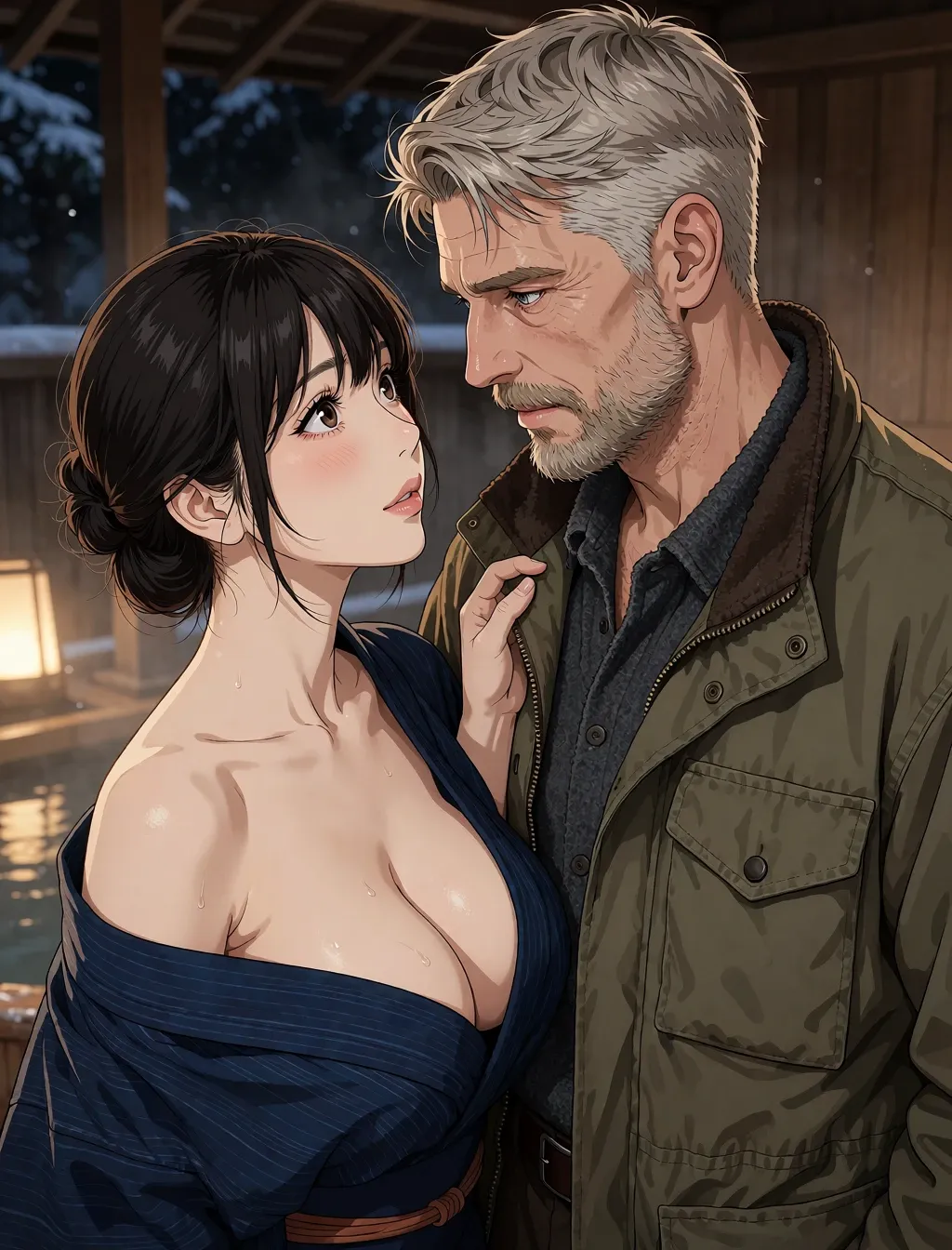
The plow woke her before the light did.
Fumiko lay still and listened to it work the switchback below the inn — the grind of the blade, the beep when it backed, the grind again, all of it muffled through the snow on the roof and the snow in the air and the snow that had spent the night sealing every window of the Shirakaba-yu. Beside her, Torbjörn slept on his stomach, one arm flung off the futon, his grey-shot hair flat against his forehead and his beard mashed sideways. Forty-seven years old. He slept like a man who had not expected to.
She got up without waking him, which took some doing. The floor was cold past the edge of the tatami, and she crossed it on the balls of her feet, and in the corridor she stopped and put her palm flat on the wall and stood there a moment, breathing.
The road is open.
She had known it would happen. She had known it every morning for six days, the way you know a bill will come due. But knowing and hearing the plow are two different things, and the plow was very loud this morning, and it was very far down the valley, and it was coming up.
By ten the other rooms were stripped and aired. She had done it herself, methodically, sliding the shoji wide in each one so the cold could get at the tatami and the last of the week's breath could get out. Six rooms. Six futons folded and stacked in the linen room, where the boiler ticked below the floor and where she did not let her eyes rest on the corner by the shelf. In the last room she knelt and swept, and the broom made its dry sound, and outside the window the valley lay white and blue-shadowed under a sky the colour of a knife.
His case was already by the door when she came down. She had not heard him pack. It stood on the cold stone of the shoe step beside his boots — a battered canvas thing, strapped, with a scarf knotted through the handle, and his camera bag on top of it, the strap creased into a fixed curve from a week of shoulder. He had set it there neatly. He was a neat man. That was the sort of thing you learned about a person in a week, and she had learned a great deal more than that, and none of it was any use to her now.
"The nine-forty came through," he said, from the entryway. He was standing at the window with his hands behind his back, looking down at the road. "I heard it. So the noon will run."
"It will run."
"I checked the timetable at the station house yesterday, before the snow came back. Sapporo, noon, change at Asahikawa." He said it the way he said everything, in his measured Swedish cadence, each word set down like a stone in a wall. "I should leave by eleven. The walk to the station house is — what, forty minutes in this?"
"Thirty. The road is cleared now."
"Thirty." He nodded, still not turning. "Then I should leave by eleven."
Then do not, she thought. Then stay. Then say the thing and I will say it back, or I will not, but say it first, you great silent man, you have a mouth on you — you used it well enough last night.
"I have made tea," she said. "Sit. It is not eleven yet."
He sat. She poured, and the pot was the same pot, and the two cups were the same two cups, and the sunken hearth between them held its banked coals and its iron kettle and its little breath of steam, exactly as it had every morning of the week, and it was unbearable. He wrapped his big weathered hands around his cup and looked into it, and she looked at his hands, at the pale hairs on the backs of them and the one knuckle that was fat from some old break, and she thought: I have had those hands on me. I have had them in my mouth. And now he is going to drink his tea and stand up and bow and go, because that is what guests do, and I have been an innkeeper for ten years and I know exactly how this ends.
"The valley," he said.
"Mm?"
"I came to look at the valley without a camera." He turned his cup a quarter turn on the tray. "I have not done it. I have not taken the camera out once. I have not even opened the bag. That was the whole reason I booked the week, and I have not done it, and now the week is over."
"You have been busy."
His eyes came up at that, pale and sharp, and there was a flicker at the corner of his mouth that she had spent six days learning to read. "I have been busy," he agreed.
The clock in the entryway ticked. It was a cheap clock, electric, with a plastic case, and it had hung in that spot since her husband's mother had run the inn, and Fumiko had never in ten years heard it as loudly as she heard it now. Ten forty. Ten forty-one.
Say it, she told herself. You are forty-four years old and you have run this inn alone for a decade and you have buried a husband and you have never once in your life begged a man for anything, so do not start now — but say it. Say: the room by the hearth is empty. Say: the winter is long. Say: I have not asked you to stay because I did not want to hear you say no. Say any of it. Say one thing.
"More tea," she said.
"Please."
She poured. Her hand was steady. Ten years of steady hands, and it was the steadiest thing about her, and she hated it.
At eleven he stood. She went with him to the genkan, and he stepped down into the cold stone well of it and put on his boots one at a time, balancing with a hand on the wall, and she stood on the raised floor above him in her apron and watched the back of his neck. His case came up onto his shoulder. The camera bag went over it. He turned.
"Tachibana-san," he said. "Thank you. For the week. For the bath." A pause, and the flicker again, softer this time. "For the sake lesson."
"Wahlgren-san." She bowed. Deep, held, her hands flat at her thighs, her eyes on the stone between his boots. "Travel safely. The road down to the station house is cleared but it is still slick. Walk on the inside edge."
"I will walk on the inside edge."
She held the bow. She held it past the point where it was polite, and she felt him waiting there in the cold with his hand on the door, and her mouth was full of every word she had not said and would not say, and the clock behind her ticked and ticked and the noon train was coming and she was going to let it take him because that was what a woman did, that was what she had learned to do, and it was the only thing she knew how to do well.
The door slid open. Cold came in around her ankles. She heard his boots on the packed snow of the path, one, two, three, and then the sound of them changed as he reached the cleared road and the snow there was slush and grit, and then —
The footsteps stopped.
She did not lift her head. She stood in the genkan with her hands flat at her thighs and her heart going like the plow blade, and she heard him stand there in the road, and she heard him breathe out, a long breath that fogged and drifted, and she heard the case come off his shoulder and settle onto the snow with a soft packed thump.
"Fumiko."
Her name. Not the honorific. Her name, in his flat Swedish mouth, in the middle of the road, with the noon train coming.
She lifted her head.
He was standing in the cleared road with his camera bag still on his shoulder and his case at his feet and the valley white and enormous behind him, and he was looking at her the way he looked at a thing he was about to photograph — no, not that. The way he looked at a thing he had already decided to photograph and was waiting for the light to be right. "I am not going to make the train," he said.
The clock in the entryway ticked.
"Then you had better come back inside," she said, and her voice did not shake, and her hands did not shake, and the rest of her shook from the crown of her head to the soles of her feet. "You are letting the cold into my inn."
He came back up the path. He set the case down inside the door and dropped the camera bag beside it and stepped down into the genkan and slid the door shut behind him, and then he was standing in front of her with the snow still melting in his beard, and she reached up and put both her strong hands on his cold weathered face and pulled him down and kissed him.
He made a sound into her mouth. His hands came up under her apron and found the small of her back and pulled her in against the wet canvas of his jacket. She got her fingers into his hair and held his head still and kissed him until the cold was gone out of both of them and the ticking clock had run on to some other hour entirely.
"The bath," she said against his mouth. "The outdoor bath. It is still hot. I banked it for the morning and I never let it go out."
"It is eleven in the morning."
"It is my inn." She took his hand and pulled him through, past the hearth and the ticking clock and the six stripped rooms, and out the back door where the path had been shoveled and the snow was falling again, small and steady, and the steam was going up off the water into the white air.
They shed their clothes onto the bench in a heap — her yukata, her apron, his jacket, his boots, all of it in one pile with the snow settling on the shoulders of it — and she stepped down into the water first and gasped at the heat of it, and he came in behind her with his big hands on her hips, and the water rose up around them both and the steam closed over their heads.
She turned to face him. The snow came down past his shoulders and melted on his chest and ran in slow lines through the grey hair there, and she put her palms flat on his chest and pushed him back until his shoulders met the rock and he sat, the water up to his collarbones, looking up at her.
"You let the train go," she said.
"I let the train go."
"Why?"
"Because I was standing in the road," he said, "and I could see the valley, and I did not want to photograph it. I wanted to be in it. With you. That is the first time in thirty years I have looked at a thing and not wanted the camera." He reached up and put his wet hand on her hip. "That seemed worth missing a train for."
She straddled him. The water swirled between them and the cold air came down on her bare shoulders and she did not care. She reached down between them and found his cock under the water, hard and hot and standing up through the steam. She took it in her strong hand and stroked it once, root to tip, and watched his face.
"Fumiko," he said. His voice had gone rough.
"I have been standing in my genkan for an hour," she said, "saying nothing. I am going to say something now." She guided him between her legs, the head of him sliding through the slick heat of her, and she braced her hands on his shoulders and sank down onto him.
The stretch of it pulled a sound out of her that she had not planned on making. She took him slowly, an inch and then another, the hot water and her own wetness easing the way, and his hands came up to her waist and gripped and his head fell back against the rock. He said her name again, and then she was seated on him to the root with the snow falling on her back and the heat of the spring all around them.
"I am going to say," she said, and she began to move, slow, rolling her hips, "that I did not want you to go."
"Fumiko—"
"I did not want you to go, and I would not say it, because I have run this inn alone for ten years and I have learned not to ask for things." She came down hard on him and the water slapped against the rock. "But you came back up the path. So now I am asking."
His hands found her hips and he pulled her down as he thrust up. She cried out into the steam, and he did it again, and the rhythm took. The water churned around them. Snow fell and melted on her shoulders and on the back of his neck and in his grey hair, and the overflow pipe knocked its steady knock. She rode him with her hands braced on his chest and her head tipped back and her mouth open. He watched her the whole time with his pale eyes half-lidded and his jaw tight.
"Say it again," he said.
"I did not want you to go."
"Again."
She stopped moving. The water rocked between them and settled, and she looked down at him with her mouth still open and her breath going in and out of her in the cold air, and she shook her head slowly, once, the way you refuse a second helping you actually want.
"No," she said. "I have said it twice. A woman should not have to say a thing three times to make it true." She rolled her hips, deliberate, and watched his jaw go tight. "You are going to have to take a turn."
His hands closed around her waist and he lifted her off him — she felt the slide of his cock coming out of her, the cold air where it had been, the sudden empty ache. He set her down onto the rock ledge at the edge of the bath, her heels in the snow, her thighs apart and the steam curling up between them.
"What are you—"
"I am going to use my mouth," he said, "on a thing I have been wanting to look at all week." And he came up out of the water and knelt on the flat rock and put his face between her legs.
The first touch of his tongue made her heel skid in the snow. He found her clit and licked it flat and slow, the whole width of his tongue, and her hand flew down and got a fistful of his wet grey hair and pulled. He made a low sound against her and did it again, and the sound went up through her like the overflow pipe's knock.
"Torbjörn—"
He did not answer. He had his hands under her thighs. He had lifted her legs over his shoulders so the snow was under her back and the rock was cold against her shoulder blades and his mouth was hot and working, licking up one side of her and down the other, then pushing his tongue into her cunt and curling it, then back up to her clit to suck it, gentle, then not gentle, until her hips were lifting off the rock and her breath was coming in short white bursts.
She looked down her body at him. His eyes were closed. There was snow in his beard and her wetness on his mouth. He was making small satisfied sounds like a man eating something he had waited all winter for, and the sight of it — the great silent Swede on his knees on a cold rock with his face buried in her — did something to her that ten years of steady hands had never once done.
"I am going to come," she said, and it came out almost apologetic, an innkeeper's warning. "Torbjörn. I am going to—"
He pulled his mouth away just long enough to say, "Good," and put it back.
It built in her like the plow coming up the switchback, low and grinding and inevitable. Then it broke, and her thighs clamped around his ears and her back arched off the rock. She said something that was not a word and not Japanese and not Swedish either. He held her hips down and kept his mouth on her through all of it, licking her through the clench and the shiver and the long rolling aftershock until she pushed at his forehead with the heel of her hand and gasped, "Enough. Enough."
He sat back on his heels. His chest was heaving and his cock stood up from his body red and wet and hard. He wiped his mouth with the back of his wrist and looked at her with his pale eyes gone dark. "I have not finished saying my part," he said.
"Then say it."
"I have spent thirty years behind a camera," he said, "waiting for the light. And the light was never the point. The point was standing in it." He got his hands under her and pulled her off the rock and down into the water with him. She came down into the heat of the spring with a gasp. He turned her and bent her over the rock ledge and pressed up against her back. "I am going to fuck you now," he said, low, against her ear. "Unless you tell me otherwise."
"I am not going to tell you otherwise," she said, into the rock. "I have been telling you otherwise for an hour and it did not take."
He pushed into her from behind. She was so wet and so open from his mouth that he went in to the root in one long stroke. She cried out and her hands scrabbled for a hold on the wet stone. He got one arm around her waist and held her and began to move.
The water slapped against the rock in time with him. He was not gentle now. She did not want him gentle; he drove into her with his hips slapping her ass and his breath hot and rough at the back of her neck. She pushed back to meet every thrust and heard herself making sounds she had not made in years, sounds that had no place in the quiet of an inn. She did not care who heard them because there was no one to hear, because the inn was empty, because the road was open and he had not gone down it.
"Fumiko," he said, and his voice was coming apart. "Fumiko, I am close—"
"Then come," she said, and reached back and got her hand on his hip and pulled him in. "Come in me. I want to feel it."
He thrust once more, hard, and buried himself and held. She felt it — the throb of him, the hot spill of his cum inside her, the way his whole body locked and shuddered against her back, and the feeling of it tipped her over a second time. She came around him with her forehead pressed to the cold stone and his name in her mouth, and the two of them shook there together in the steam while the snow came down and melted on their joined skin.
The shaking went on longer than either of them expected. His arm stayed locked around her waist, holding her against the rock, and she felt the last slow pulses of him inside her — each one a small inward clench of her own body answering it. The snow landed on her shoulder blades and stayed a moment before the heat of her skin took it.
When he pulled out, the wet sound of it was loud in the quiet. She felt the slide, the sudden cold air where he had been, and then the trickle of him starting down the inside of her thigh, thinning in the bathwater. She stayed bent over the rock with her cheek on the stone and her breath fogging the wet surface.
"Do not move," he said.
"I am not moving. I could not move if the inn caught fire."
He got his hands under her and turned her, gentle now, and lowered her into the water so her back was against the rock and her shoulders under the steam. He came down beside her, and the two of them sat in the spring with their knees touching and the snow falling past the pines and the overflow pipe knocking its slow knock, and for a while neither of them said anything at all.
She looked at him. His hair was plastered flat, his beard full of melted snow, and there was a red mark on his shoulder where she had dug her nails in without noticing. His chest was still going, not fast now, just deeper than usual.
"You have a scratch," she said.
He looked down at it. "So I do."
"I did that."
"I know." He touched it with two fingers, then let his hand fall back into the water. "I am not sorry."
She laughed — a short one, out of nowhere, the kind that came up from the belly and surprised its owner. It echoed off the rock and the snowbank, and she put her wet hand over her mouth as if the inn had ears after all.
"What," he said.
"Nothing. Ten years." She shook her head. "Ten years I have been getting up at five and banking this fire and counting the towels and I have not once laughed out here in the morning."
The steam curled between them. Somewhere down the valley the plow had finished and gone quiet, and the only sound left was the water going over the lip of the bath and the small wet tick of snow landing on snow.
"It is cold," he said at last, and it was — the cold had got into the small of her back and her shoulders and was working its way in. "We should go in before you turn blue."
"A minute more."
"Fumiko."
"A minute." She closed her eyes. "I am not being stubborn. I am being — I am putting this somewhere. So I can find it later. When it is Thursday and the road is open and the six-forty comes through and there is a man in my genkan with his boots on."
He was quiet for a moment. Then: "You think I am going to be that man."
She opened her eyes. "Aren't you?"
"I have a room booked in Sapporo on Friday. I have a flight from New Chitose on the twenty-eighth." He said it plainly, no softening, and she was grateful for that. "I have a book that is not finished. I have a house outside Uppsala that I have not been in since October and a neighbour feeding a cat that does not like me."
"Then you are going to be that man."
"I am going to be a man with a flight on the twenty-eighth." He turned his head and looked at her, and the pale eyes had that thing in them again, the thing she had spent a week not knowing the name of and now did. "Those are not the same sentence."
She got out of the bath. The cold hit her all at once and she made a sound and grabbed the towel off the bench and wrapped herself in it, and he came up out of the water behind her, and they stood on the flat rock in their towels and the snow fell on their shoulders and neither of them moved toward the door.
"Inside," she said. "Before I lose my nerve and my fingers."
———
The hearth was still banked and warm. She had fed it before she went out and it had held, and the coals under the ash were red when she knelt and stirred them up, and she put on two split pieces of oak and the fire took them with a small dry crackle. He came in behind her in his yukata — she had found him one, the long one, the one her husband had never worn because it had been a gift from a supplier and he had said it was too fine for a man who shovelled — and he sat down on the cushion by the hearth with his grey hair still wet and his beard combed flat with his fingers.
She poured the sake. The good one, from the back of the cupboard, the one she opened for the guests who came back. Two cups. She set his down in front of him and he looked at it and then at her.
"It is not the lesson," he said.
"No. It is not the lesson."
He picked it up and drank, and she watched his throat move. She sat down across the hearth from him with her own cup and her own knees drawn up under her yukata and her hair coming down out of its bun. She had not put it back up. It hung at her neck in wet strands and she did not care.
"I am going to say a thing," she said, "and I want you to hear all of it before you answer, because I have thought about it for three days and I am not going to say it twice."
He set the cup down. "I am listening."
"I am forty-four years old. I have run this inn alone since I was thirty-four. I know what it is." She turned her own cup a quarter turn on the hearthstone, the way he did with his tea, and did not look up. "It is a small inn in a small valley with six rooms and one bath and a road that closes three times a winter. It is not a thing a man builds a life around. I know that. I have known it for ten years and I have been at peace with it."
"Fumiko—"
"I said all of it."
He closed his mouth.
"I am not asking you to stay." She looked up then. "I am telling you what is here. That is all. The room by the hearth is empty from Friday. It will be empty in February. It will be empty next winter, and the winter after that, because I am not going to sell this place and I am not going to leave it and I have made my peace with that. But it is empty, and the road opens on Thursday, and you have a flight on the twenty-eighth." She lifted her cup and drank, and the sake was warm going down. "That is the whole of it. Now you can answer."
He was quiet for a long time. The fire took the oak and the sap in it hissed, and one of the pieces settled and sent up a little shower of sparks.
"I have been married," he said.
She did not move.
"Nineteen years. Her name was Ingrid. She died six years ago, in March, of a thing the doctors found too late." He said it the way he said everything — measured, each word set down. But his hands were not on his cup anymore. They were on his knees, and the knuckles were pale. "I did not come to Hokkaido for the valley. I came because I could not be in the house in March. I have not been in the house in March since. I take a job somewhere far away and I photograph a thing that is not her and I come back in April and the house is still there and the cat is still alive and the neighbour has left a casserole on the step."
"Torbjörn."
"I have not told anyone that in six years. The neighbour does not know. My agent does not know." He looked at her. "You should know what you are getting before you say a thing like the room is empty."
She set her cup down. Then she got up off her cushion and came around the hearth and knelt down beside him, and she took his face in her two strong hands, the way she had in the genkan, and she held it.
"I buried a husband," she said. "Ten years ago. He was a good man and he was not a bad husband and he never once in his life made me laugh out here in the morning. I have not said that to anyone either." Her thumbs moved on his cheekbones. "So now we are two people who have each said the thing. That is more than most people get in a week."
He put his hands over hers. His were cold from the bath and hers were warm from the fire and they sat like that, foreheads almost touching, the fire hissing at their backs.
"I am not going to make the twenty-eighth," he said.
"You have a flight."
"I am going to change it." He said it slowly, like a man testing a bridge with his weight. "Not — I am not moving in. Do not look at me like that. I have a book to finish and a house to go back to and I am not a man who can live in a valley in the snow with nothing to do. But I am going to change the flight, and I am going to come back in February when the road is closed and the inn is empty, and I am going to bring the camera, and I am going to photograph the valley in the light you have been telling me about since the first night, and then I am going to put the camera down and stand in it. With you. That is what I am going to do."
She looked at him for a long moment. Then she leaned in and kissed him, once, soft, and pulled back.
"February," she said. "The road will be closed. You will have to walk in from the station house."
"I will walk in from the station house."
"It is forty minutes in the snow."
"Thirty," he said. "You said thirty."
She laughed again — the belly laugh, the one that had been asleep for ten years — and she got up and went to the cupboard and brought back the bottle and poured them both another cup, and the fire cracked, and outside the window the snow came down steady and soft over the cleared road and the empty valley and the steam going up off the bath into the white air.
He picked up his cup. "What time does the noon train run?"
"It has already run."
"Ah." He drank. "Then I have missed it."
"You have missed it," she said, and reached across the hearth and put her hand on his knee, and the fire took another piece of oak, and the clock in the entryway ticked on toward an hour that did not matter anymore.
She left her hand on his knee and did not move it, and he set his cup down on the hearthstone without looking away from her, and the fire settled into a steady burn. The room had gone quiet the way rooms do when the snow on the roof is thick enough to eat the wind.
"Come to bed," she said. Not a question. "The room by the hearth will be empty on Friday and it is empty now, and I have decided I am not going to spend tonight on a cushion by a fire I have already banked once."
He stood when she stood. She took his hand and led him down the corridor past the entryway clock and the shoe cabinet and the little print of the valley that hung where every guest saw it on the way to the bath, and she slid open the door of her own room and let him go in first.
The futon was already laid out. She had done it that morning, the way she did every morning, because a room that has been slept in must be aired and made whether or not anyone is coming back to it. The quilt was the indigo one. The window over the low table showed the snow coming down past the black branches of the pine.
She untied her yukata and let it fall. He stood in the middle of her room with his hands at his sides, and she watched him look at her — the whole of her, the strong arms, the small belly that came of ten years of tasting her own cooking and not apologizing for it, the pale old scar high on her thigh where she had caught it on a nail in the wood store the year after her husband died.
"You are looking," she said.
"I am a photographer."
"You have not taken a photograph in a week."
"No," he said. "I have been looking at this instead."
He undid his yukata and let it drop and came to her, and she put her palms flat on his chest and felt the heartbeat under the ribs, and he bent and kissed her, and his beard was rough and the mouth under it was not. His hands went to her waist and then lower, and she stepped out of the fallen cloth and pressed herself along the whole length of him, and the cold in her back was gone.
They went down onto the futon together. He came over her. She pulled him down by the shoulders, and for a while it was only mouths — his mouth on her throat, on the hollow under her jaw, on the underside of her breast, and her fingers in his wet grey hair, holding him there. He took her nipple in his mouth and she felt it pull all the way down to the base of her spine.
"Torbjörn."
He lifted his head. "Say it again."
"Torbjörn." She tugged his hair. "Do not make me wait like a guest."
His hand went down between her legs and found her already wet, and she heard him breathe out hard against her shoulder. Two fingers, then a third, sliding in the slick, and her hips came up off the futon to meet them. He curled them forward and she made a sound she did not recognize and did not try to take back.
"There," she said, and then, because he had not moved, "there, yes, do not stop, do not you dare stop—"
He did not stop. He put his mouth on her throat and worked his fingers in her. She took his wrist and held it where it was, riding her own hand and his together, and the room was the wet sound and her breath going short and the snow ticking at the window. The first crest came up on her fast and she turned her face into the futon and came around his fingers with her thighs clamped on his hand.
He pulled his fingers out and she felt the empty ache of it. Then he was over her and his cock was at her. He pushed in — one long slide, her cunt opening around him, taking him to the root — and she got her heels into the small of his back and pulled him down onto her.
"Wait," she said. "Wait — a moment. Let me feel it."
He held still. His arms were shaking. She could feel him throbbing inside her, the pulse of it against her walls. She lay under him with her hands on his back and her eyes closed and let herself have it, the weight of a man on her in her own room in her own inn in the middle of a snowstorm with nowhere for either of them to be.
"Now," she said.
He moved. Slow at first, and then not slow. She got her hands on his ass and pulled him deeper. He gave a low sound against her ear and drove in hard, and the futon shifted under them. She arched and met him, and the slap of skin was loud in the quiet room. She did not care if the whole valley heard it because the whole valley was buried and asleep.
"Turn," he said, and she did. He came into her from behind with his chest against her back and his hand in her hair. She got her knees under her and pushed back onto him and took him as deep as she could.
"Harder," she said. "I am not made of paper."
He gave her harder. His hips snapped. She braced her hands on the futon and let him, and the pleasure went up through her belly and her breasts and gathered low and tight. She reached back and put her hand over his where it gripped her hip.
"I am close," she said. "Do not stop — I am close—"
He reached around her and his fingers found her clit and rubbed. She came again with her face down in the quilt and his name broken in her mouth. She felt her cunt clamp down on his cock and hold, and she heard him say her name like a man going under.
"Fumiko—"
"Inside," she said. "Finish inside me. I want to feel it."
He drove in once more and held, and she felt him come — the hot spill of it deep in her, pulse after pulse, his hips jerking against her, his hand still flat on her belly. She stayed there with him inside her until the last of it had gone through him and he had gone heavy on her back.
They lay down together in the wreck of the quilt. The snow ticked at the window. Her hair was in her mouth and she did not move it.
"Well," she said at last, into the pillow.
"Well."
He got his arm around her and pulled her in against his chest, and she turned her face into the grey hair at his throat and breathed him in — woodsmoke and the mineral smell of the spring and underneath it the plain smell of a man who had wanted her.
"So," she said. "You have missed your train. You have changed your flight. You are coming back in February."
"I am coming back in February."
"Then I will tell you what this is." She lifted her head and looked at him, and her voice was steady because she had decided it would be. "This is not a week at an inn. This is a man who walks in from the station house in the snow in February and stays in the room by the hearth, and it is a woman who gets up at five and banks the fire and leaves the bath open late because he is coming. That is what it is. It is not more than that and it does not need to be more than that."
He was quiet, and his hand moved slow up and down her back, and then he said, "In Uppsala the cat is called Snö. It means snow. I did not name her. Ingrid named her." He said it without flinching, which she understood cost him something. "She does not like me. She will like you."
"You have not met me in February yet."
"I have met you in January," he said. "February is only more of the same, with worse weather."
She laughed into his chest and felt it move under her cheek. Outside, far down the valley, the plow started up again with its long scrape, and the snow went on coming down over the cleared road and the empty rooms and the steam climbing off the bath into the white dark.
"Thursday," she said. "The road opens Thursday. You will go to Sapporo and finish your book and feed your cat and come back when the road closes again."
"Thursday," he said. "And then February."
She reached up and turned his face to hers and kissed him, and then she laid her head back down on his shoulder and closed her eyes, and the fire in the hearth of the next room burned down to its coals, and the inn held the two of them in the middle of the snow.