
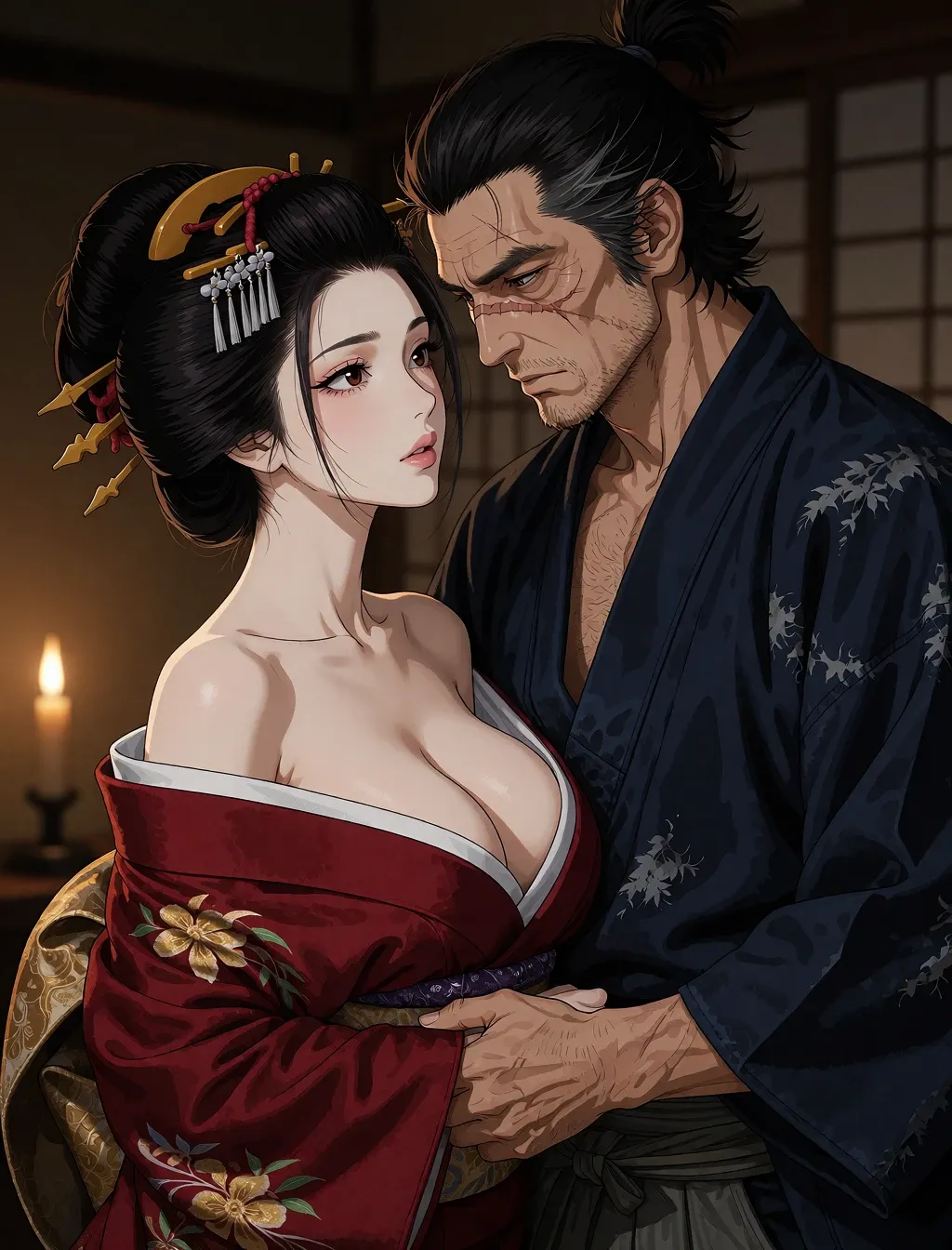
She was awake when the first board creaked.
Kiyonoe lay on her futon with her eyes open in the dark, and she had been awake a long while — since the rain stopped, since the house had gone quiet in the way a house goes quiet when every woman in it is pretending to sleep. Twelve years in the Willow Gate had taught her the sounds of her own corridor. The settling of old wood. The suck of damp air under the eaves. The distant, muffled shamisen from the teahouse two doors down, played badly and without joy by a girl who would never be more than a girl who played badly. What she heard now was none of those things. It was the weight of a foot placed with care, and then the same weight placed again a little further along.
She turned her head on the pillow. Through the lattice paper the corridor lantern threw a soft amber oblong across her floor, and in it, at the edge of the light, lay the long shadow of a man's arm and the curve of a shoulder that did not belong to her.
Then the second sound came, and it was heavier, and it was Gennosuke standing up.
She heard the whisper of a blade leaving its scabbard — that clean, terrible hiss that is the last sound many men hear — and heard it come from the corridor, not from her door, which meant the intruder had drawn first. She sat up. Her hand found the collar of her sleeping robe and drew it closed at her throat without her having decided to, and she did not rise, because a woman of her rank did not run into a corridor in the dark, and because some cold, clear part of her had been waiting a month to see what the man outside her door would do when it finally mattered.
"You have the wrong door," Gennosuke said. Low. Almost courteous.
The answer was not words. It was a grunt and a scuff and the flat crack of steel on steel, and then the whole corridor erupted — feet, breath, the skid of a straw sole on wet boards, another crack, a man's short cry bitten off. Kiyonoe watched her screen. Through the paper the shadows came and went in shapes that had no dignity to them: a shoulder thrown back, the black wedge of a sword lifted, two bodies colliding so hard the lattice rattled in its frame and a hairline split opened near the top and let in a thread of lantern light.
She counted the voices. Two men in the corridor, at least. Perhaps a third at the stair. Their breathing was rough and their footwork was not the footwork of soldiers; it was the footwork of men paid to do a thing quickly and badly and be gone before the quarter woke. She had known such men. She had poured sake for such men and smiled at them and remembered their faces for later.
A body struck her door hard enough that the screen bowed inward and she saw the shape of a back through it, pressed flat, and then peeled away. Gennosuke's voice came through the paper, not raised, only carrying.
"Kiyonoe-sama. Do not open this door."
"I had no intention of it," she said. Her own voice surprised her. Steady as a cup set down.
There was a sound then like a wet branch breaking, and a man screamed — a short, shamed, high sound — and something heavy went down on the boards and did not get up. The shadows thinned. One man was running, his geta clattering on the stair, and then the clatter stopped and there was only the rain-gutter dripping and the deep rough breathing on the other side of the paper, and under it, faintly, a second breathing that was not breathing so much as leaking.
She rose. She crossed the tatami without hurrying, and she put her hand flat on the door frame and said, "How many?"
"Two down. One gone over the wall." A pause, and the sound of him shifting his weight. "He will not come back tonight. He will have to tell someone he ran."
"And you?"
"I am well."
She slid the door open.
The corridor lantern had been knocked from its hook and lay on its side still burning, and by its light she saw him standing over a man who was not moving, his katana low and angled down and his left forearm held oddly, close to his body, with the sleeve gone dark from wrist to elbow. The other man lay further along by the stair, face down, a stain spreading out from under him into the grain of the boards. The smell reached her then — that flat, coppery, animal smell — and she had smelled it before, in this house, on other nights, and she did not step back from it.
"You are well," she said.
"It is a cut."
"It is a cut that has soaked your sleeve to the elbow, Hayama-dono." She looked at the two bodies and then at him and then at the split in her own screen. "Come inside. Before the whole quarter comes to look."
He did not move at once. He wiped his blade on the dead man's coat — three strokes, economical, the way a man does a thing he has done too many times to feel — and slid it home, and only then did he turn his scarred face to her, and she saw that the lantern light had found the sweat on his brow and the grey of his eyes and something behind the grey that had nothing to do with the men on the floor.
"Kiyonoe-sama," he said. "If I come inside this room, I do not come as your guard."
She held the door with one hand and looked at him a long moment, and the house around them held its breath — no music now, no footsteps, only the gutter dripping and somewhere a woman crying quietly into her sleeve and being hushed.
"I know what you come as," she said. "Come in."
He came in. He knelt on her floor by the low table, and set his sword down beside his knee with the edge turned away from her — she noticed that, the courtesy of it, even now — and she went to the corner for her wash basin and the folded cloths she kept for her brushes and her face, and she brought them back and knelt before him, and the water in the basin was cold and clear and she watched it go pink before she had even touched him.
"Give me your arm."
He turned it over. The cut ran from the back of his wrist up the inside of his forearm, deep enough at the middle that the flesh stood apart, and it had bled freely and was beginning to slow, and the hair on his arm was matted flat with it. She took the cloth and wet it and laid it on the wound, and his whole arm jumped under her hand, and he made no sound at all.
"You will need a physician in the morning."
"It will close."
"It will close whether or not it rots, Hayama-dono. Those are two different matters." She rinsed the cloth and pressed it again, and the water in the basin darkened. "Who sent them?"
"They did not say, and I did not ask."
"But you know."
He was silent. She looked up from his arm and found him looking at her — not past her, not through her, at her, in the low lamplight, with the scar pale across his brow and his jaw set and his eyes doing the thing she had seen them do a hundred times through a month of doorways, measuring, and this time not measuring her but measuring what he was permitted to say.
"A man with a grudge does not hire men to come at a woman's door in the dark unless he has been shamed and has no rank to answer it with," he said. "You refused someone. Recently."
"I refused a silk merchant named Ryōsuke four nights ago, and he wept, and I have refused better men than him without a scratch on my screens." She wound the cloth tight about his forearm, once, twice, drawing it firm, and he watched her hands. "But Ryōsuke is a merchant. He does not own men who carry swords into a licensed house. He would have to borrow them, and borrowed men run when one of them falls."
"The one who ran will talk."
"The one who ran will talk," she agreed, "and by morning the whole gate will know that a ronin killed two men on the Hanabishi stair, and the house will be fined, and the madam will weep, and someone will come to ask me whose fault it is." She tied off the cloth and tucked the end. "That is tomorrow. Tonight you will sit here and not bleed on my floor."
She rinsed her hands in what was left of the water, and the pink swirled and thinned, and she dried them on her sleeve because there was nothing else, and then she sat back on her heels and looked at him properly for the first time since he had come through the door. The lamplight was low and it was kind to no one, and it showed her what a month of doorways had not: the grey in his topknot at the temple, the deep seam of the scar where it crossed the bone, the way he held himself upright with an effort that had become a habit so old he no longer knew he was making it. His sword lay by his knee. His wound was bound. His hands rested on his thighs, and one of them had begun, very slightly, to shake.
"You are cold," she said.
"I am not cold."
"Your hand is shaking, Hayama-dono."
"It does that," he said, "when the fighting is over. Never during." He looked at the hand as though it belonged to someone he had once known. "It will stop."
She thought of the men on the corridor boards, and of the sound the steel had made, and of the way he had stood over her door and told her not to open it — not because he feared for himself, she understood now, but because he did not want her to see what he became in a corridor in the dark. And she thought of the month of silence, the month of a man kneeling at her threshold with his eyes down and his sword across his knees, and of the question she had asked him four nights ago that he had answered by rising from his knees and coming inside.
"Gennosuke," she said.
The name went into the room and stayed there. He did not move. His hand stopped shaking, or it stopped where she could see it, and his scarred face turned toward her in the lamplight and he looked at her as though she had set something down between them that neither of them could now pick up again.
He said nothing.
She let the silence stand. Outside, the last of the rain ran out of the gutter and the quarter slept on, and the lantern by her door guttered low, and she did not send him back out to the corridor.
Her hands were still on him. She had not meant them to be — she had tied the cloth and tucked the end and that should have been the end of it, but somewhere between the tying and the looking her palm had come to rest on the bare skin of his shoulder above the torn sleeve, and it stayed there, and the heat of him under her fingers was a different heat from the wound's. It was the heat of a man who had been running and fighting and was only now beginning to cool. She felt the muscle of it, hard and knotted under the skin, and the small involuntary shiver that went through him was not from cold, whatever he called it.
He did not pull away. That was the thing she would think of afterward — that a man who had spent a month keeping the width of a door between them did not pull away now, when her hand was on his skin and his sword lay on the tatami with the edge turned from her and there was nothing in the room but the two of them and the low lantern and the smell of blood going cold in the basin.
*She has said my name.* The thought sat in him like a stone in a shallow stream, everything else dividing around it. *Twelve years I have heard men call her Kiyonoe-sama and she has answered them all the same way, and she has just said mine.* He looked at the hand on his shoulder and could not look away from it, and the calluses on his own hands, the rope-burn and the sword-callus and the old scar where a blade had opened his palm in a year he no longer counted, seemed to him a coarse and ugly thing beside the pale fingers resting on him as though they had a right to rest there.
"You are wondering," she said, "why a house like this would hire a ronin cheap enough to take a wound for it." It was not quite a question. Her thumb moved once, a small absent stroke against the ridge of his collarbone, and she watched his jaw for what it did. "I have wondered it too. A month I have wondered it, and a month you have knelt at my door and given me nothing to wonder with."
"I was cheap," he said, "because a man with a face like mine is not hired to be looked at."
"And yet I have looked at it every day for a month," she said, "and you have kept your eyes on the boards every day for a month, and I have not once been able to decide whether that was courtesy or something else." She let her hand stay where it was. "The scar. It is old."
"Twenty years."
"It was a good blade that gave it to you, or you would not have lived to carry it." She said it the way she might appraise silk — without pity, which was the only way he could have borne it. "And you have carried it in front of every door you have guarded since, and every man who hired you got the use of it."
He was quiet a moment. The lantern by the door guttered and steadied. Somewhere in the house a woman's crying had stopped, and the hush that came after it was deeper than the silence before.
"Kiyonoe-sama," he said at last, and his voice had gone rough at the edges. "You should send me out. That is what a wise woman would do, and you are not a foolish one."
"I have not yet decided what I am," she said. Her hand lifted from his shoulder, and the place where it had been was cool, and he felt the coolness of it more than he had felt the warmth.