
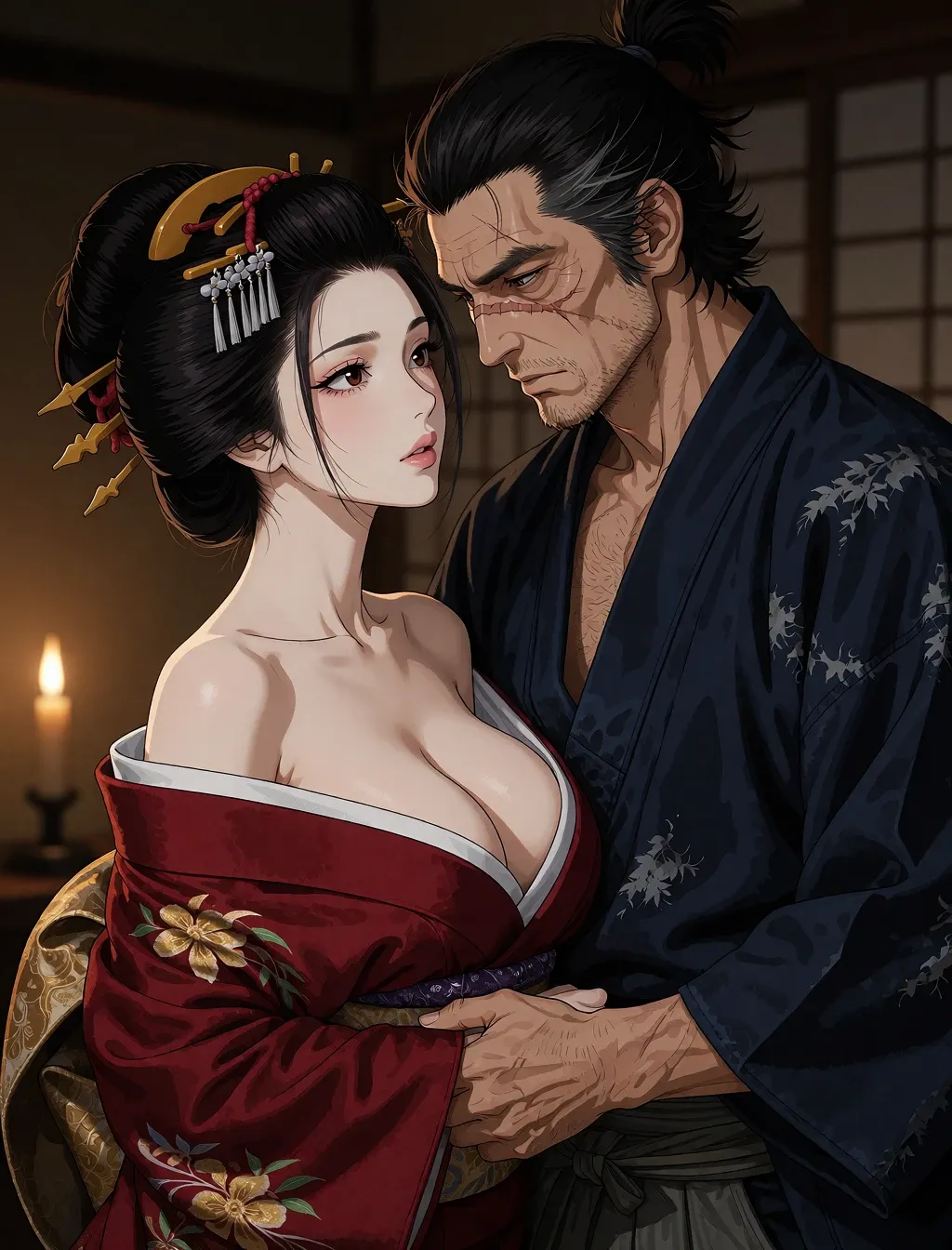
The rain had begun before dawn and had not stopped, and by the hour of the serpent it had settled into a steady, patient drumming on the eaves that turned the whole Willow Gate house inward, shutters closed, lanterns lit at midday, the world reduced to the smell of wet cedar and the hiss of water down the gutters. Kiyonoe, thirty-four years and twelve of them spent in this quarter, sat before her mirror with her hair half-dressed and listened to it, and did not call for her maid.
She had bought this day. That was the truth of it, and the truth had a price she could name to the monme: a whole day struck from her ledger, paid from the account that was to have freed her, a sum that would have bought a small house in the eastern wards. She had signed the house's book herself, watched the clerk's brush dry, and felt nothing she could call regret. Twelve years of other people's afternoons, and this one was hers. The rain was hers. The silence was hers.
On the tatami before her she had laid out the kanzashi one by one. The tortoiseshell comb first, because it had been her mother's and had no price. Then the gilt pin with the plum blossom, a gift from a Kyoto merchant who had wept when she refused to see him again. Then the long silver one, the one with the tiny bell that did not ring. She set each down with a small click against the mat, in an order only she understood, and when the row was complete she looked at it a while, the way a general looks at troops he is about to dismiss.
Beyond the shoji, the guard shifted his weight. She heard it — the creak of the corridor boards, the small dry settle of a scabbard against wood. He had been there since the rain began. He was always there. A month now of his back against the wall beside her door, his sword across his knees, and in all that month she had not once seen him sleep, though he must have; she had only ever seen him in the moment of waking to her, the grey eyes coming up out of the dark like something surfacing from deep water.
"Hayama-dono," she said, without turning. Loud enough to carry through the paper. "You are dripping on my corridor."
A pause. Then, his voice low and careful, the way he always spoke to her, as though she were made of something that might crack: "The eaves leak at the north end, Kiyonoe-sama. I moved to keep the rain off my sword."
"And off yourself?"
"The sword is worth more."
She smiled at her own reflection, and the reflection smiled back with the courtesan's mouth, and behind the paint of it something moved that was not the courtesan at all. She drew the pin from her hair — the last one, the plain ebony — and laid it down with the others, and her hair came loose and fell to the small of her back, black and heavy and warm from the heat of her head.
"Come in," she said.
The boards creaked. The shoji slid a hand's width, and stopped. She watched him in the mirror: the dark shape of him in the gap, the rain still beaded on his shoulders, the scar running pale through the brow and cheek, the eyes that went first to her hair and then, with an effort she could see him make, to the floor.
"Kiyonoe-sama. Your maid is below. I will send her up."
"My maid is below because I sent her below. Come in and close it. The rain is getting on the tatami."
He came in. He closed the shoji behind him and stood with his back to it, and she turned on her cushion to look at him properly for the first time in a month without a door between them. He was wet to the elbows. The worn kimono clung dark at his shoulders. His hand rested on the scabbard at his hip the way another man's hand might rest on a railing — not gripping, just certain of it. Forty-two years old, she thought. A man who had been a sword for so long he had forgotten he was also a body.
"Sit," she said, and when he did not move: "Hayama-dono. I have paid for this day out of my own ledger. Every hour of it is mine, and I find I do not wish to spend it being guarded from the inside of my own room. Sit down."
He sat. Knees together, back straight, sword laid precisely parallel to the edge of the tatami — a soldier's sit, a man bracing for inspection. The rain filled the silence. She let it. She had learned years ago that silence was the finest thing she owned, and that most men would pay any price to have it broken, and that the ones worth keeping were the ones who would sit inside it with her and wait.
He waited.
"You have not asked me why," she said at last.
"It is not my place to ask."
"No. It is your place to stand in the corridor and be dripped on." She reached for the loose collar of her kimono, where it had slipped from her shoulder while she dressed her hair, and drew it up — slowly, deliberately, watching his eyes follow the motion and then flinch away. "Do you know what I did before dawn this morning? I sat with the house's book and struck out a day. One day. It cost me more than your fee for a season. And the clerk asked me if I was unwell."
"And what did you tell him?"
"That I was very well indeed." She let the collar fall again. "You have a wife somewhere, Hayama-dono? A woman in a village who thinks you dead?"
The scarred brow lowered. "No."
"A man, then. A lord you failed. A brother."
"No." His hand had found the scabbard again without his knowing. "There was a house. It burned. That is all of it, and it was a long time ago, and I do not tell it well."
She did not press. A lesser woman would have pressed — would have taken the crack and widened it, because a man's grief was a kind of currency in this quarter, and she had spent a great deal of it in her time. But she had bought this day, and she found she did not want to buy him with it. She wanted something else, and the wanting of it had been sitting under her ribs for a month, patient as the rain.
"Then I will tell you something instead," she said, "and you will listen, and you will not bow."
She rose. The kimono was loosely knotted — she had never finished dressing, had never meant to finish — and as she came to her feet the sash slipped a finger's width and the silk slid from her shoulder and hung there, and she did not catch it. She crossed the tatami to the rain-window, the closed lattice with its paper glowing grey and watery, and set both palms flat against the wood and looked back at him over her shoulder, her hair falling loose down her back.
"Every man who has come through that door," she said, "has come to take something from the oiran. A song. A poem. An hour. My name in his mouth so he can say it in a teahouse and be admired. I have given all of it, and I have been paid, and the ledger is nearly clear, and when it is clear I will walk out of the Willow Gate and no one will remember my face by winter." Her voice did not change. "I am tired, Hayama-dono. Not of the work. Of being looked at and never seen. You look at me. You have looked at me for a month, and you think I have not noticed, and you think it is hidden behind that face of yours."
He had gone very still. The rain ran down the lattice in threads.
"Kiyonoe-sama," he said, and his voice had gone rough at the edges, "I am your guard."
"You are my guard," she agreed. "And I am the woman who decides who comes in." She turned from the window and let the kimono fall open the rest of the way, and watched his eyes go where they had been forbidden to go for a month — down the long pale line of her throat, the hollow at the base of it, the swell of her breast where the silk had parted, the shadow beneath. "So come in."
He came to his feet. Not fast — slowly, the way a man moves when he is afraid of what his own body will do, and she saw his hand start for the scabbard out of pure habit and then stop and fall away, empty. Two strides of the tatami and he was before her, close enough that she could smell the rain on him, wet wool and cold steel and beneath it the warm animal smell of a man who has stood in a corridor all morning.
"I do not know how to do this," he said. "It has been a long time. And you are—" His jaw worked. You are the most beautiful thing I have ever been permitted to look at, and I have been looking, and I am ashamed, and I am not sorry. "You are Kiyonoe-sama."
"Tonight," she said, "I am Kiyonoe." She took his scarred hand — the calluses rough as rope against her palm — and drew it to her waist, and held it there. "And you will not bow to me again until I have finished with you."
He kissed her. Not gently — she had half expected gentle, the careful reverence of a man who thought her made of porcelain, and she had been ready to be patient with it. But he kissed her like a man coming up out of deep water, his free hand finding the back of her neck, the other spread wide at her waist, and she made a sound into his mouth that she had not made in years and did not bother to be ashamed of. His mouth was warm and tasted faintly of tea, and there was a small scar at the corner of it she found with her tongue.
"The sash," she said against his mouth. "Slowly. There is no one coming, and I have paid for the day."
His hands found the knot. They were not steady — she felt the tremor in them, a swordsman's hands gone clumsy — and he worked it loose with a care that was almost agony, and the obi fell away and the kimono with it, and she stood in the grey rain-light with nothing between her skin and the cold air but the looseness of her own hair. He stepped back half a pace to look at her, and she let him, and the look on his scarred face was not the look of a patron. It was the look of a man who had forgotten there was anything in the world but this, and who was not certain he would survive remembering.
"You are shaking," she said.
"Yes."
"Good." She took his wrist and drew him to the rain-window, and turned her back to the lattice, and set her palms flat against the wood on either side of her. The paper was cold and the rain drummed behind it, and the light through it was the colour of a knife. "Now. Undress, and then come here, and I will show you how I like it. You have been told what to do your whole life by men who did not know. I am going to tell you, and you are going to listen, and you are not going to be gentle with me."
He undressed. She watched him do it, the wet kimono peeled off the corded shoulders, the lean hard length of him, the old scars on his ribs that he did not explain and she did not ask about. His cock stood up from the dark hair between his thighs, thick and flushed and already wet at the tip. He did not try to hide it or apologise for it, and she liked that more than she could say. He came to her and put his hands on her hips, and his palms were hot and rough and uncertain. She covered them with her own and moved them where she wanted them.
"Here," she said. "Hold me here. Harder. I am not glass, Hayama-dono."
His fingers tightened. She reached between them and took him in her hand — he made a sound, a low broken thing, his forehead dropping to her shoulder. She guided him to her cunt, already slick and open for him. She felt the blunt head of him press and then push and then the long slow stretch of him entering her. She let her head fall back against the lattice and breathed out the whole month of waiting in one breath.
"Ah," she said. "There. Stay. Let me feel you."
He stayed. He was trembling all over, his breath hot and ragged at her throat, and she felt him twitch inside her, felt the effort it cost him not to move. She held still a moment and let herself be filled, let the ache of it settle. Then she lifted her hips and rolled them down and took him deeper, and his hands clenched on her hips hard enough to bruise.
"Like this," she said. "You do not thrust. Not yet. I set the rhythm, and you follow it, and when I say faster you go faster. Do you understand me?"
"Yes," he said, muffled against her shoulder. "Kiyonoe-sama—"
"No." She caught his chin and lifted his face to hers. "Not that. Not now. Say my name."
"Kiyonoe."
"Again."
"Kiyonoe." His voice cracked on it, and something in her chest cracked with it, and she began to move.
The rain came down. She rode him against the lattice in a slow deep rhythm, her palms braced on the wood, the cold paper at her back and the hot length of him inside her, and she taught him with her body and her voice — harder, there, do not stop, wait — wait — now — and he learned, God, he learned, a swordsman's timing in his hips, the way he held her exactly where she put his hands and did not move them, the way he watched her face as though her pleasure were a text he had been forbidden to read his whole life and had just been handed.
"Faster," she said, and he obeyed, and the slap of their bodies came up under the drumming rain. "Faster. Do not — ah — do not you dare stop—"
"I will not," he said, and his voice had gone to gravel, and she felt the coil of it tightening low in her belly, the bright edge coming up to meet her, and she ground down onto him and took him as deep as he would go and let it break.
She came with her head thrown back against the lattice paper and his name — his true name, the one she had not used — torn out of her throat, and her cunt clenched hard around his cock in wave after wave, and she heard him say Kiyonoe like a man saying a prayer he had no right to, and felt him drive up into her once, twice, and then spill, hot and deep, his whole body shuddering against hers, his scarred cheek pressed to her loose hair.
The rain went on. Neither of them moved. She came back to herself by degrees — the cold paper at her back, the ache in her thighs, the weight of him leaning into her, still inside her, still hard, the wetness of him beginning to slide down the inside of her thigh. His hand had come up at some point and was flat against her lower back, holding her to him, and it did not move away.
"Kiyonoe," he said at last, into her hair. His voice was wrecked. "I cannot go back."
She did not answer. The lattice was cold against her shoulder blades and the rain ran down it in threads, and his hand stayed flat and warm at the small of her back, and beyond the paper the Willow Gate slept on in the wet grey afternoon, and the lantern in the corner had burned down to a stub.