
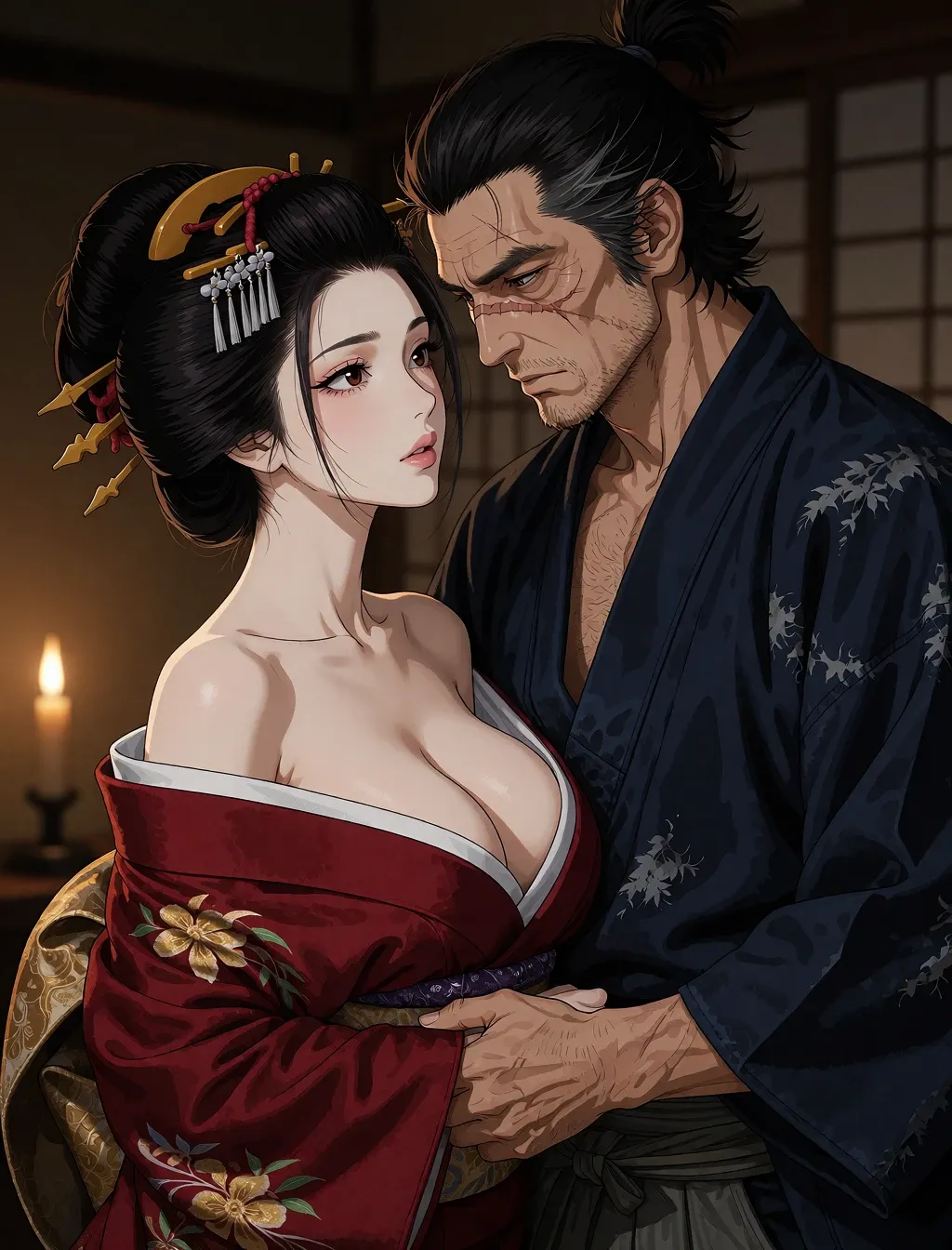
The last patron would not take the hint of the door.
Kiyonoe had given him three: the emptying of his cup without refilling it, the folding of her hands into her sleeves, the kiseru set down on its rest with the stem turned toward him—the courteous signal that a pipe, like a guest, has finished. He was a silk merchant named Ryōsuke, forty years old and soft about the jaw, and he had paid for the whole night and meant to have the whole of it. He talked about the price of raw silk in the western provinces as though the subject were a rope he could throw across the room and pull her in with. She had heard the same speech from better men and worse.
"The hour grows late, Ryōsuke-san," she said at last, and stood. The silk of her under-robe whispered against the tatami. "And my house rises early, even when I do not."
He looked up at her from the floor cushion, and she watched the arithmetic happen behind his eyes—the night already paid, the reputation of the House of Hanabishi, the oiran who had never once been seen to lose her temper. He was calculating whether her courtesy was a door or a wall. It was a wall. It had always been a wall. She had spent twelve years learning to make a wall look like an invitation, and the skill was beginning to tire her.
"Another cup," he said. It was not a question.
"No."
The word landed in the room like a dropped hairpin. Ryōsuke's mouth opened, then closed. She did not move from where she stood, and she did not soften her face, and after a long moment he began, with the wounded dignity of a man rehearsing a complaint for his friends, to gather his things.
She saw him to the threshold herself. It was a courtesy, and it was also a warning to the house that she had not needed to summon a maid to do it. The shoji slid back on the corridor, and the night air of the Willow Gate came in—wet stone, lamp oil, the far-off clatter of geta, a shamisen trailing from some house down the row. Ryōsuke stepped down into his sandals and turned to say something that would restore him.
She was already sliding the door shut.
The paper whispered across its frame. The latch clicked. The quarter outside became a painted thing, a glow of lanterns on the other side of rice paper, and the room closed around her in its own quiet. She stood with her hand flat against the shoji for a moment, breathing, letting the courtesan fall away from her shoulders the way a heavy outer robe falls.
Behind her, by the door, the ronin had not moved.
He knelt in the same posture he had held for a month—knees apart, spine straight, his katana laid across his thighs with the hilt to his right hand. Gennosuke Hayama, forty-two years old, with a scar running from his left brow down across the cheekbone and a grey-streaked topknot and eyes the color of a sea before a storm. He was a large man made quiet, the way a boulder in a stream is quiet. In a month he had called her Kiyonoe-sama perhaps forty times, and he had never once raised his eyes to her face. He looked at the floor, at the doorframe, at the middle distance where a man's gaze goes when he is listening for footsteps. He had looked at every part of her room except her.
She had noticed. Of course she had noticed. She noticed everything; it was the trade.
And she had wondered, in the idle hours between patrons, what it would take to make him look.
"Hayama-dono."
"Kiyonoe-sama."
"The merchant is gone."
"I heard him go."
"You heard him complain, which is not the same." She crossed the room, and the tatami gave softly under her steps. "He will tell his friends I was cold to him. He will say the oiran of Hanabishi has grown proud in her old age."
"He would be wrong," Gennosuke said, to the floor.
She stopped. "Wrong about which part?"
A pause. His hand, resting on the sword, did not move, but she saw the tendon in his wrist tighten, just once, the way a rope tightens when a weight is hung on it. "About the cold," he said.
Kiyonoe looked at the top of his bowed head—the neat grey-flecked knot, the broad line of his shoulders under the worn kimono, the sword worn smooth at the grip from years of a hand that knew it. A month of him at her door. A month of his silence and his vigilance and the way he placed himself between her and every threshold. The house had hired him because a lord with a grudge had sent word that the oiran of Hanabishi had slighted him. The lord had not come. The ronin had stayed.
He watches the street, she thought. He does not watch me. That is either discipline or it is something else.
"Look at me," she said.
He did not.
"Hayama-dono. Look at me."
Slowly—so slowly that she could hear the decision in it—his head came up. His eyes found hers, and she saw at once what the month of lowered gaze had cost him, because a man cannot hide a thing like that when he finally stops hiding it. His grey eyes were steady and they were not calm. They moved over her face as though reading a page he had been forbidden to open, and there was a hunger in them so carefully banked that it had left ash on everything.
"There," she said softly. "Was that so hard?"
"Yes," he said.
She smiled—not the courtesan's smile, the practiced one that opened like a fan and showed nothing, but something smaller and more dangerous that she had not used in years. "Good," she said. "I would not want it to be easy."
She turned her back to him. It was not the turning of a woman retreating; it was the turning of a woman who knew precisely what she was doing, and she felt his gaze land between her shoulder blades and stay there, hot as a lamp brought close. She walked to the low stand where the mirror stood, and she stood before it and looked at herself in the glass—the high black coil of her hair, the lacquered kanzashi thrust through it, the porcelain of her face, the deep brown of her eyes that the powder could not lighten. Thirty-four years old. The head of the quarter for twelve of them. A ledger in the strongbox nearly paid, and a freedom waiting at the end of it that she had begun to suspect would taste of nothing at all.
Her hand went up to the kanzashi.
She drew it free. The ornament came out of her hair with a small, deliberate sound, and the coil loosened at one side, a black lock slipping down against her cheek. She set the pin on the stand with a click. Then the next one, and the next, each drawn and laid down in its turn, and with every one the weight of her hair came further loose until it hung heavy down her back and she could feel the cool of the room against her neck.
Behind her, she heard him breathe.
It was a small thing. A man's breath, taken and held too long and let out too carefully. But she had spent twelve years reading the small things men could not help, and she heard in it the whole of the month—the discipline cracking along a seam she had not known was there until she pressed it.
She turned from the mirror.
"Hayama-dono," she said. "Your hand is on your sword."
"It is always on my sword."
"You are gripping it." She let her eyes travel down to where his knuckles had gone pale around the scabbard. "A man grips his sword like that when he is afraid, or when he is holding himself back from something. Which is it?"
His jaw worked once. The scar pulled white across his cheek. "Both," he said.
She came toward him. The room was not large—a courtesan's chamber of the first rank, the futon folded at the wall, the water basin in its corner, the lamp on its stand with the wick burning low and needing a trim—and it took her only a few steps to cross it. She stopped before him, closer than a courtesan stands to a guard, close enough that the hem of her robes brushed the tatami by his knees and the loose fall of her hair swung forward into the space between them.
"You have knelt at my door for a month," she said. "You have called me Kiyonoe-sama and looked at the floor. You have put your body between me and every door in this house, and you have not once asked me for anything. Why?"
"It is my duty."
"Duty is a word men use when they do not wish to say the true one." She looked down at him—at the broad shoulders, the callused hands, the grey eyes lifted now and unable to look away. "Say the true one."
He was silent. The lamp guttered, and the shadows in the room leaned and straightened. Somewhere out in the quarter a door slid shut and a woman laughed, and the sound was very far away, on the other side of a wall of rice paper and a world of rank.
"I cannot," he said at last, and his voice had gone rough. "Kiyonoe-sama—"
"You can." She reached down and laid her hand flat against his chest, over the worn silk, and felt his heart going under her palm like a fist against a door. He did not move. He did not breathe. "There is no one here to see. The house sleeps. The quarter sleeps. There is only the lamp and the door and you and I, and the door is closed."
His hand came up—not to her, but to the sword, and he lifted it from his knees and laid it aside on the tatami, slowly, with both hands, the way a man sets down the thing that has kept him alive. The blade whispered against the mat. He let go of it. His hands came back to his knees and stayed there, and she saw them tremble once before he stilled them.
"Now," she said, and her voice had gone low and warm and certain. "Now you may look at me as long as you like."
He looked. His eyes moved over her—the loose black fall of her hair, the pale column of her throat, the layered silk of her kimono still tied at the waist—and there was nothing disciplined left in the way he looked. It was the gaze of a man who had been dying of thirst and had just been shown water and did not yet believe it was permitted.
Kiyonoe stepped back. She found the knot of her obi by touch, the broad stiff band of figured silk at her waist, and she took the ends in her fingers and drew them.
The knot gave. The obi loosened, and she felt the whole architecture of her dress shift, the support of it going slack, the silk settling against her hips. She drew the band free and let it fall, and it pooled on the tatami in a long bright ribbon of color. Then the outer robe, which she opened and shrugged from her shoulders, and it slid down her arms and away. Then the under-robe, and the one beneath that, each layer parting and falling until the last of them hung open and she stood in the low lamp light with her hair down and the silk of her innermost robe loosened and slipping from one shoulder.
Behind her on the tatami, she heard his breath change again—a catch, a raggedness, the sound of a man's composure going.
She did not turn all the way. She turned only her head, so that her loose hair swung and her dark eye found him over her bare shoulder, and she let the silence hold—the lamp, the closed door, the two of them, the whole of the Willow Gate asleep outside.
"Come in, Hayama-dono," she said.
The room went still. The lamp burned. His lowered eyes lifted, and they were not lowered any longer, and there was nothing in them of the guard who had knelt at her door for a month—only the man, and the question he had been holding back so long that it had gone down into his bones, and the answer she had just given him standing open in the middle of the room.