
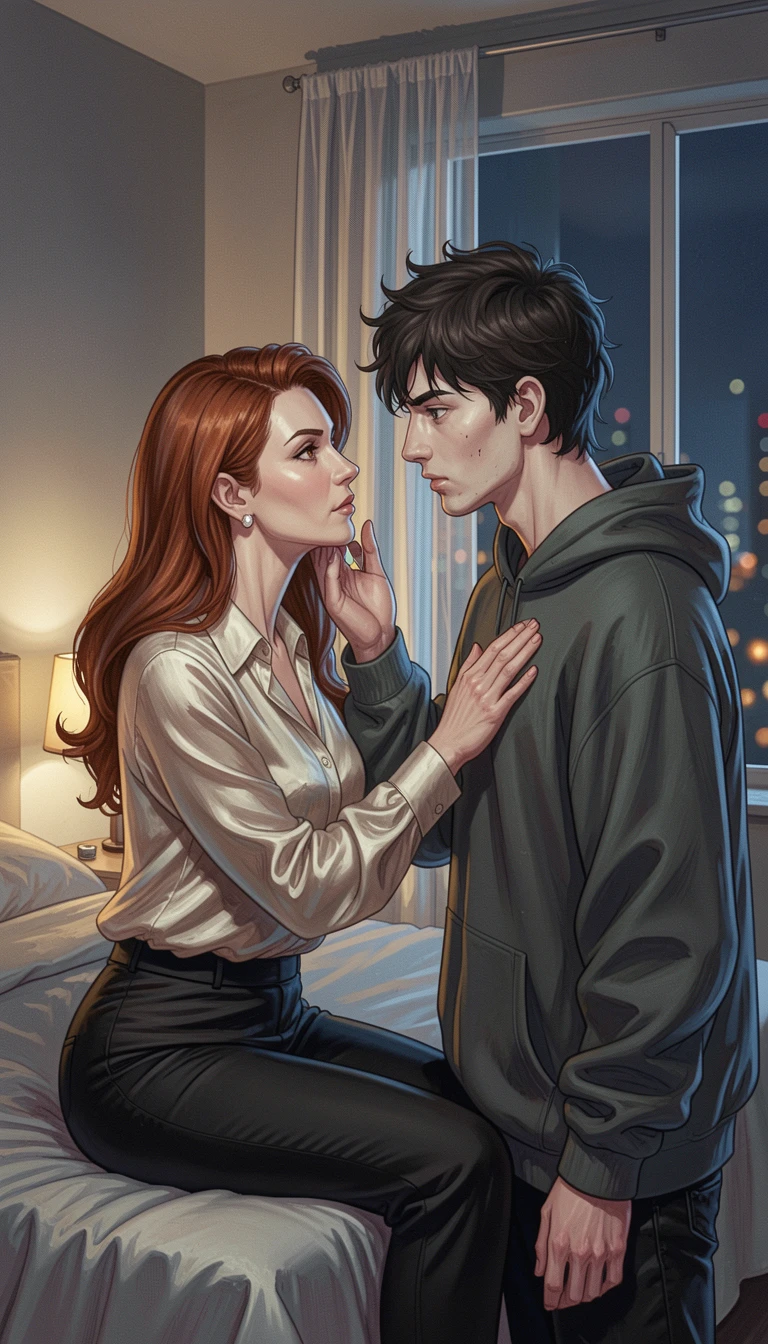
The alarm was not hers.
Vivienne surfaced from a sleep that had never quite arrived, dragged up through black water by a sound that didn't belong in her bedroom — a hard digital shriek, insistent, the kind of alarm a person sets when they mean to be obeyed by their own body. Her hand found the nightstand before her eyes found anything. Her phone. The screen burned white in the dark, and the number on it read 6:30, and she had not set it. She had never set an alarm for 6:30 in her life. She had staff for mornings.
She lay still for a moment with the phone in her hand, the shriek still going, and understood with a dull, spreading certainty that he had done this. That sometime in the night, while she stood behind a locked door listening to floorboards, he had reached into her life again — her account, her phone, the small machinery of her days — and set a bell to ring inside her skull at half past six.
She silenced it. The room went quiet, and the quiet was worse.
Her mouth tasted like copper and old wine, though she had drunk nothing. Her head ached behind the eyes, a thin wire drawn tight from temple to temple, the kind of hangover that came not from alcohol but from humiliation, which left a similar residue and no pleasant memory to soften it. She sat up. The silk of her robe had twisted around her waist in the night, and she pulled it straight without looking at herself, because looking at herself this morning was a thing she did not have the appetite for.
The house was still. Down the hall, the guest room door was closed, which meant he was already up — he never closed a door he was still behind. She knew that the way she knew the smell of her own kitchen. Two decades of reading rooms, and she had spent the last of them failing to read the one boy who had been reading her.
She washed her face in cold water. She did not look at the bruise. She had checked it once, in the bathroom mirror the night before, a faint shadow along her cheekbone that makeup would cover and that Harry would not be home to notice for another four days. Four days. She held the number in her mind like a stone in her pocket. Four days to find a way out from under this before her husband walked back through the door and the whole arrangement collapsed into a story she could not tell.
The robe slipped off her shoulder as she reached for the door. She caught it, tied it tighter, and went down.
The television was still muttering.
She heard it before she saw the kitchen — that thin electronic hiss, the cracked screen throwing its fractured light across the counter, a news anchor's voice shredded into static. She had thrown the remote at it. She remembered the throw more clearly than she wanted to, the way her arm had come up before she'd decided anything, the crack, the satisfaction that had lasted exactly one second before she understood what she'd done and who would make her pay for it.
Nate stood at the counter with his back to her.
He was in the same oversized hoodie he'd worn the night before, or an identical one, the shoulders of it swallowing the frame he'd grown into. His hair was wet at the edges, like he'd showered and not bothered to dry it. He was doing something with the coffee machine — her coffee machine, the Italian one Harry had shipped from Milan — and he did it without hurry, the way he did everything now, as if the house and everyone in it had been waiting for him to arrive at his own pace.
Sera sat at the island.
That stopped Vivienne in the doorway for half a second. Sera was never up this early. Sera was a girl who ran on ten hours of sleep and a granola bar eaten in the car, and here she was, ponytail already up, college sweatshirt on, a mug in both hands, watching her stepbrother make coffee like it was a program she'd tuned into and couldn't look away from.
Both of them looked up when she came in.
"Morning," Sera said. Her green eyes went to Vivienne's face and stayed there a beat too long, and Vivienne felt the bruise under her makeup like a coin pressed to her cheek.
"Morning," Vivienne said. Her voice came out level. She had spent twenty years learning how to make it come out level, and she was grateful for every year of it now.
Nate didn't say anything. He poured coffee into a mug — the plain one, the one he'd started using because he knew it was the one she hated to see in his hands — and he set it on the counter between them, and he slid it toward her without looking up from the pour.
"Viv drank too much last night," he said.
His voice was flat. He said it to the coffee, to the counter, to the room in general, and his eyes never left the mug, and that was how Vivienne knew it was a performance — because if he'd said it to Sera, he would have said it to Sera's face. He said it to the air so that Sera could hear it and Vivienne could hear that he was saying it to her.
Sera's head turned. Those green eyes slid from her stepmother to her stepbrother and back again, and a small line appeared between her brows, the one that showed up when she was doing arithmetic she didn't like.
"Did she," Sera said. Not quite a question.
"She was up late," Nate said. He picked up the mug and held it out, across the counter, toward Vivienne. "Weren't you."
The mug hung in the air between them. Vivienne looked at it, and then at his hand around it, and then — because there was no version of this morning where she did not take it — she walked the four steps to the counter and reached for the mug.
His fingers brushed hers.
It was the smallest thing. The pad of his thumb across the back of her hand, warm from the ceramic, a touch that lasted less than a second and that no one watching from the island could have seen. She felt it travel up her arm anyway, a thin line of heat that had nothing to do with the coffee, and her jaw set before she could stop it.
"Drink," he said.
Low. Private. Barely a sound, more a shape his mouth made, and if Sera had been looking at her phone she would have missed it entirely. But Sera was not looking at her phone. Sera was looking at the two of them, and her head tilted, just slightly, the way a bird's does when it hears a note it can't place.
Vivienne lifted the coffee to her lips.
It was too hot. It burned the tip of her tongue and the roof of her mouth, and she swallowed it anyway, and the burn went down her throat like something she deserved. She took a second sip. She did not look at Nate while she did it, because looking at him was a thing she could not afford this morning with Sera in the room, and because she already knew what she would see.
She knew because she could feel it. The attention on her, steady and patient, the way he'd watched her across the dinner table for years while she talked over him and around him and never once to him. He had been keeping score all that time. She had known it the way you know a draft in an old house — never quite locating it, never quite able to prove it, always cold.
Now she could locate it. It was standing at her counter in a wet-haired hoodie, watching her drink the coffee he'd made.
"There's no bread," Sera said, into the quiet. She was still watching them, but her voice had gone deliberately casual, the way it did when she'd decided to change a subject and was daring anyone to stop her. "How is there never bread in this house."
"I'll have Mrs. Ellis pick some up," Vivienne said. Her tongue throbbed. She set the mug down on the counter — not the coaster, she noticed herself noticing, and hated that she noticed — and turned toward the kettle, toward the ordinary machinery of a morning, toward anything that was not the two of them standing in her kitchen waiting for her to do the next thing.
"I can go," Sera said. "I'm taking the car anyway. The internship starts Monday, I need to do the drive once before I'm late on day one."
"You're not taking the car Monday," Vivienne said. "You're taking the train. I told you."
"The train is two hours and I have to leave at five—"
"The train is what we agreed."
"We agreed," Sera said, and there it was, the small flat echo of it, the way she did when she was annoyed — she repeated your word back at you and let it sit there. "Fine. The train." She stood up and carried her mug to the sink, and on her way past, she stopped.
She stopped right beside Vivienne, close enough that her shoulder nearly touched her stepmother's, and she looked at her. Up close, in the gray kitchen light, her green eyes were doing that thing they did — reading, adding, filing. Vivienne held her gaze and gave her nothing, which was a skill she had, and which had never once worked on this girl.
"You look tired," Sera said. Quietly. Not an accusation. Almost gentle, which was worse.
"I didn't sleep well."
"Mm." Sera's eyes flicked — just for an instant, just barely — to the bruise on Vivienne's cheek, and then away, and then back to her face. She didn't say anything about it. She didn't have to. She had seen it, and she had decided, in the space of that flick, not to ask. "I'm going to go get ready."
"Sera."
"I'm fine," Sera said, already moving, already at the doorway, and she said it the way people said it when they were not fine and knew that saying so would only make it true out loud. She paused in the frame with her back to them both. "Nate. You're up early."
"Couldn't sleep either," Nate said.
"Right." Sera's hand found the doorframe and she stood there a moment, and Vivienne watched her stepdaughter's shoulders — the set of them, the small tension in the line of her neck — and understood that Sera was standing in the doorway deciding something. Whether to turn around. Whether to say the thing that was sitting behind her teeth.
She didn't say it. She went.
Her footsteps went up the stairs, and the house settled back into its morning hum — the cracked television hissing in the corner, the refrigerator cycling on, water moving somewhere in the walls. Vivienne stood at the counter with her back to her stepson and her hands flat on the cold stone, and she waited, because she knew what was coming and there was no version of her life now where she got to leave the room first.
"She saw," Nate said.
"She saw nothing."
"She saw your face." He had moved. She hadn't heard him move, but he was closer now, at the end of the island, leaning against it with his arms crossed and his eyes on her — those gray eyes, flat and patient, the eyes of a boy who had spent years learning to watch from the edges and had finally found something worth watching up close. "She's not stupid, Viv. She's the only one in this house who isn't."
"Don't call me that."
"You let me call you that last night."
"Last night," Vivienne said, and she turned to face him, because the alternative was to keep her back to him and let him talk to her spine, and she had never in her life let anyone talk to her spine. "Last night you put your hands on me. That does not make us familiar."
"No," he agreed. "The account makes us familiar."
The word landed in the kitchen and sat there between them. Account. He said it the way you'd say the name of a dog that had bitten someone — mildly, as if it were a fact of the household, as if it had always been there.
Vivienne's hands stayed flat on the stone. She would not let them curl. She would not let him see the wire pulled tight behind her eyes go tighter. Eleven years. Eleven years she had built that account out of nothing, a little at a time, out of grocery money and birthday checks and the small, secret economies of a woman who had learned once, young, what it was to have the ground move under her feet and nothing to hold. Eleven years of a door only she knew about. And he had found it, and walked through it, and now he stood in her kitchen saying its name like he'd bought it at auction.
"What do you want," she said.
"I told you last night."
"You told me you wanted a television."
"I told you I wanted you to understand who's in charge." He pushed off the island and walked past her — close, too close, his shoulder passing within an inch of hers, and she did not step back, and she hated herself for the half-second it took to decide not to. He went to the coffee machine and poured himself a mug, unhurried, and the domesticity of it was the worst part. He belonged in this kitchen now. He had decided to belong in it. "The television's just the first thing."
"The first thing of what."
"Of you doing what I say." He turned, mug in hand, and looked at her over the rim. "It's not complicated, Viv. You have a life you like. A husband who thinks you're something. A daughter who thinks you're something. A house, a name, a face you put on in the morning. I have one text in my drafts that takes all of it." He drank. "So when I say do something, you do it. That's the whole arrangement."
"And if I go to Harry first."
"Go ahead." He said it without heat, and that was how she knew he'd thought about it, the way he'd thought about everything, for longer than she'd been paying attention. "Tell him his wife has a secret account she's been feeding for eleven years. Tell him where the money came from. Watch him do the math on what you were saving it for." He set the mug down. "You won't, though. Because you know what he'll hear. He won't hear 'my wife was afraid.' He'll hear 'my wife was planning something.'"
Vivienne said nothing. There was nothing to say, because he was right, and being right was the thing he did best, and she had spent years mistaking it for dullness.
"We're going to the mall today," he said. "After I pick the TV. You'll drive."
"I have a lunch."
"Cancel it."
"I have—"
"Cancel it, Viv." He picked up his mug again and walked to the table, and he sat down in Harry's chair — Harry's chair, at the head of the table, the one nobody sat in when Harry was home and nobody sat in when he wasn't, because it was understood to be his — and he put his feet up on the chair across from him and looked at her across the length of the table. "You're going to want to sit down. We should talk about what you're wearing."
"What I'm wearing."
"To the mall." His mouth moved — not quite a smile, a small adjustment of the lips, the way you'd taste something. "Something the dress you bought would go with. Since you're buying that too."
Vivienne stood at the counter and looked at him sitting in her husband's chair with his feet on her furniture, and she felt the morning tilt under her, the whole kitchen going slightly off its axis. The coffee had gone cold in the mug. Her tongue still throbbed from the burn. Somewhere above them, water ran — Sera's shower — and the cracked television hissed its static into the room, and the ordinary sounds of her house went on around her like nothing had changed, and everything had changed, and the worst part was that no one would ever be able to see it.
She walked to the table. She pulled out the chair across from him — not the one his feet were on, the one beside it — and she sat, because he had told her to and because she had already decided, sometime in the night, standing behind a locked door, that she was going to survive this, and surviving it meant choosing her battles with a patience that matched his.
"Fine," she said. "What am I wearing."
Nate lowered his feet off the chair and leaned forward, elbows on the table, and looked at her the way a man looks at a ledger he's about to balance. "Something short," he said. "You have good legs. You should use them."
Vivienne held his eyes and did not look away, and the wire behind her own eyes pulled tight, and she set her jaw, and she said nothing at all — because there was nothing to say that wouldn't be a surrender, and she had used up her surrenders for one morning, and the day was only just beginning.
The mug sat on the counter behind her, half-drunk, gone cold, the coffee she had swallowed because he told her to.
She drove because there was no version of the morning where she didn't. The keys were in her hand before she'd decided to take them, her body moving ahead of her will like it had learned something overnight that her mind was still refusing to admit. The garage door yawned open and the car's engine turned over with that smooth, expensive hum that Harry had picked out, and she pulled out of the drive without looking back at the house.
Nate sat beside her. Passenger seat. Not the back, not crowded up against her like he had been in the kitchen. Just there, in the seat where Harry sat when they went anywhere together, his hands loose on his thighs, his gray eyes tracking the houses they passed.
She kept her eyes on the road.
The morning was bright and ordinary. Lawns being watered. A jogger in neon. The world going about its business while she drove her stepson to buy a television with money he'd stolen from her, and the strangeness started somewhere around the third traffic light.
It wasn't a dizziness, exactly. More like the edges of things had gone soft. The road lines didn't blur, but they seemed to matter less. Her hands on the wheel felt like they belonged to someone else, or like they belonged to her but the connection between them and her brain had loosened a little, the way a knot loosens before it comes undone.
She blinked. Then blinked again.
The jogger was gone. The lawns were still there. The light turned green and she pressed the gas and the car moved, and all of it felt slightly dreamlike, slightly removed, like she was watching herself from a few feet behind her own shoulder.
"You're quiet," Nate said.
"I'm driving."
"Mm." He didn't look at her. He was watching the road too, and that was somehow worse — the two of them facing forward like a married couple on their way to brunch, like this was normal, like the word *account* hadn't been sitting in her kitchen an hour ago. "You feel it yet?"
Her hands tightened on the wheel. Then loosened. She noticed them loosening and felt a spike of cold fear go through the warm fog, and the fear was the first thing that had felt real since she'd pulled out of the driveway.
"Feel what."
"The coffee." He said it the way you'd mention the weather. "The mug I gave you."
The coffee. She'd swallowed it because he told her to, burned her tongue on it, stood at the counter with the heat in her throat and the static of the broken television hissing in the corner. And now the road was soft at the edges and her hands were loose on the wheel and she felt — she felt —
"What did you do to me." It came out flat. Not a question. A statement of horror, delivered in the voice she used to tell the gardener he'd trimmed the hedges wrong.
"I gave you something," Nate said. "To help you learn your place."
She took her foot off the gas. The car slowed. The road kept moving past them, and she heard her own voice come out thin and small, a voice she didn't recognize, a voice she'd never used in her life. "What did you give me."
"A roofie." He said it plainly, the way he'd said *account*. "The rape drug. You know what it does. It loosens your inhibitions. Makes you compliant. Makes you want to please." He turned his head and looked at her, and his gray eyes were patient and flat and utterly without apology. "I figured you'd need help relaxing. You're so tense all the time, Viv. All those years of holding yourself so tight."
Her foot found the brake. The car stopped in the middle of the road. A car behind them honked, a long angry blast, and she heard it as if from underwater.
"You drugged me."
"I did."
"You can't—" Her voice cracked. She heard it crack and hated herself for it, hated the break in her own composure, the way her hands were shaking now on the wheel. "You can't do that. That's—that's illegal, that's—"
"So is having a secret account your husband doesn't know about." He said it without heat. "So is the money you've been hiding for eleven years. So is what you did to me, every time you looked at me like I was something you'd scraped off your shoe." He paused. "You want to keep going down this road? You want to tell me what's illegal and what isn't?"
The car behind them honked again. Longer. Angrier.
Vivienne sat in her car in the middle of the road with her hands shaking on the wheel and the world gone soft at the edges, and she wanted to scream at him. She wanted to claw his face. She wanted to throw open the door and run, run until she couldn't run anymore, run until this whole morning was behind her and she was someone else, someone who hadn't been drugged by her stepson, someone who hadn't been spanked over his lap like a child, someone who still had a life that belonged to her.
She pressed the gas.
The car moved forward. The road unfurled. The honking faded behind them.
"Where are we going," she said, and her voice was flat now, dead, the voice of a woman who had decided to stop fighting and hadn't yet decided whether that was surrender or strategy.
"The hardware store first. The TV. Then the mall." He settled back in his seat. "You're doing good, Viv. See? You can learn."
She drove. The drugging warmth pushed at the edges of her mind, soft and insistent, and she let it, because fighting it was exhausting and she was so tired, so tired, and the road was so smooth and the morning was so bright and none of it felt real anyway.
The hardware store was a big box at the edge of a strip mall, all concrete and glass and fluorescent light spilling out onto the parking lot. She pulled into a space near the entrance and cut the engine, and the silence that flooded in was thick and heavy, broken only by the ticking of the cooling engine and her own breathing.
Nate got out. She watched him walk around the front of the car, and she thought about locking the doors, thought about sitting here in the quiet until the drug wore off, thought about any number of things she didn't have the will to do. Her door opened.
He stood there, holding it open, and then he reached down and took her hand.
His fingers closed around hers. Warm. Dry. His palm was bigger than she'd expected, broader, the hand of a man who'd grown into his frame without her noticing, and he clasped her hand in his like it was the most natural thing in the world, like they were a couple, like she belonged to him.
"Let go of me."
He didn't. He just stood there, holding her hand, and the fluorescent light from the store spilled out over him and she saw his face clearly for the first time since the kitchen — the hollow cheeks, the dark circles, the jaw that was still sharpening into something harder. He looked patient. He looked like he could stand here all day.
"I said let go—"
She tried to pull her hand free. Clumsy. The drug had made her slow, made her fingers feel thick and stupid, and she fumbled at his grip, tried to work her fingers loose, and she saw his face change — the patience flickering, the jaw tightening — and then his hand came up and slapped her across the face.
Hard.
The sound of it echoed in the parking lot. Her head snapped to the side and she tasted blood where her teeth had cut the inside of her cheek, and she stood there, frozen, her hand still caught in his, the sting of the slap blooming hot across her face.
"Behave," he said. Quietly. Evenly. The voice of a man explaining the rules to a dog. "Or I'll punish you right here. In the middle of the parking lot. In front of whoever walks past." He leaned in, close enough that she could smell the coffee on his breath, the same coffee he'd drugged her with. "You want that, Viv? You want to find out what I'll do when you embarrass me in public?"
She didn't answer. She couldn't. Her face was burning and her hand was trapped in his and the world was still soft at the edges and she was standing in a parking lot with her stepson's hand wrapped around hers and there was no version of this where she got to walk away.
She let her hand go limp in his.
"Good girl," he said, and he led her toward the store.
The sliding doors opened and the fluorescent light washed over them, cold and white, and the store swallowed them whole. Aisles of tools and paint and lumber stretched out in every direction, and the air smelled of sawdust and cardboard and that particular flat scent of big-box retail, and Nate led her through it all with her hand clasped in his like they were on a date.
She felt the eyes on them. A man in an orange apron looked up as they passed. A woman with a cart of potting soil glanced at their joined hands and then at her face — at the bruise on her cheek, the one Sera had seen, the one Nate had put there — and then looked away, because that was what people did, they looked away, they didn't want to see what they were seeing.
The TV section was at the back of the store. A wall of screens, all of them glowing, all of them showing the same looped footage of a nature documentary — a lion, a waterfall, a bird in slow motion — and Nate stopped in front of them and let go of her hand, and she watched his face change.
He looked like a child. A kid in front of a wall of candy, his gray eyes gone wide, his mouth slightly open, his whole body leaning forward like he wanted to climb inside the screens. He drifted along the wall, touching the bezels, reading the little white tags, and for a moment — just a moment — she saw the boy he'd been before he'd learned to watch from the edges, before the girls had started looking through him, before he'd started collecting ammunition.
Then he stopped in front of one. A big one. Fifty-five inches, the tag said. 4K. Smart. The screen showed a lioness padding through golden grass, and Nate stood in front of it with his hands in his pockets and his head tilted, and he looked like he was making a decision he'd been waiting years to make.
"This one," he said.
Vivienne looked at the price tag. Two thousand four hundred and ninety-nine dollars. She heard herself say it before she could stop herself, the words coming out in her old voice, the voice she used to use on contractors and salespeople and anyone else who thought they could take advantage of her.
"Out of the question."
Nate turned. His face had changed again — the child gone, the watcher back, those gray eyes flat and patient and utterly without mercy. He walked toward her, and she didn't step back, because she'd decided, sometime in the night, that she would not let him see her flinch, and he came to a stop an inch from her and leaned in close.
"Start behaving," he said. Quietly. His voice low enough that only she could hear it. "Or you'll get punished all night. And I don't think you want that, Viv. I don't think you want to find out what I can do when I have a whole night to work with."
*Punished.* The word sat in her stomach like a stone. Like she was a child. Like she needed correcting. Like she was his to correct.
"Excuse me," said a voice behind them. "Can I help you with anything?"
Vivienne turned. A woman stood there — thirties, probably, in the orange apron, with a name tag that said *Dana* and a polite retail smile. She was looking at them the way retail workers looked at customers who'd been standing too long in front of a big-ticket item, trying to gauge whether they were serious or just browsing.
Nate moved before Vivienne could speak. His arm came around her lower back, hand settling on her hip, pulling her against his side, and she felt the warmth of his palm through the silk of her blouse like a brand. He smiled at the clerk — an easy, boyish smile, a smile she'd never seen on his face — and said, "Just checking out the TVs with my girlfriend."
*Girlfriend.*
The word hit her like a physical thing. Her stomach turned. She felt the nausea rise up her throat, hot and acidic, and she stood there with his arm around her and the clerk smiling and the word *girlfriend* hanging in the air between them like a lie she couldn't correct.
"Oh, that's sweet," the clerk said. "You two are a cute couple." She looked at Vivienne — at her face, at the bruise, at the silk blouse and the pearl earrings and the diamond ring on her left hand — and then she smiled and walked away, heading back toward the front of the store.
Vivienne stood there. His arm around her. The word *girlfriend* burning in her chest. The clerk's retreating back growing smaller and smaller, and with it the last chance to say *I'm not his girlfriend, I'm his stepmother, I'm married, I'm forty-four years old and he drugged me and I'm not—*
She felt the hate building. It was a physical thing, a hot pressure behind her eyes, a clenching in her jaw, and she felt it grow and grow until she thought she might choke on it, and she turned her face toward him and let him see it. Let him see every ounce of it. Let him see what she was going to do to him the moment she got free.
He saw it. And he smiled.
Then his hand came up and slapped her lightly across the face. Not hard — a little slap, a humiliating tap, the kind of slap you'd give a bratty child. "Who's in charge?" he asked.
She clenched her teeth. The word *you* sat on her tongue, and she refused to say it, refused to give him the satisfaction, and he saw that too, and his hand came down and slapped her across the ass.
Hard.
The sound of it cracked through the TV section, sharp and unmistakable, and she gasped — a short, sharp gasp of shock more than pain, and she felt her face flood with heat, felt the eyes of strangers on her, felt the world tilt and swim at the edges.
His hand caught her jaw. Fingers digging into the soft flesh under her chin, forcing her face up to his, forcing her to meet his eyes. "I asked you a question," he said. "Who's in charge?"
She looked at him. The hate was still there, burning behind her eyes, but there was something else too — something that felt like a floor giving way under her feet, something that felt like the last door in a long hallway slamming shut. She was in the middle of a hardware store with her stepson's hand on her jaw and his eyes on hers and there was no one coming to save her, no one who would even think to look for her, no one who knew she was here except the man holding her face and waiting for her to answer.
"You," she said.
It came out flat. Dead. The voice of a woman who had run out of fight.
"Louder."
She opened her mouth. The word *louder* hung between them, and she felt the hate surge up her throat, hot and thick, and she wanted to spit it at him, wanted to scream it until the whole store turned to look, wanted to tell him exactly what he was and what she was going to do to him the moment she got free.
But the drug was still in her. She could feel it, a warm blanket wrapped around the sharp edges of her fury, softening everything, making the hate feel distant and dull, like something that had happened to someone else a long time ago. And his hand was still on her jaw, and his eyes were still on hers, and the clerk was gone and the store was quiet and there was no one here to see, no one here to care, no one here who would do anything but look away.
"You," she said again. Louder. The word came out of her mouth and she heard it, heard herself saying it, heard the surrender in her own voice, and she hated herself for it, hated the way the word just slid out of her like it had been waiting there all along.
Nate smiled. A slow, satisfied smile, the smile of a man who had just won something he'd been working toward for a long time. His hand left her jaw and came up to cup her cheek — gently, almost tenderly, his palm warm against the sting of the slap — and he said, "Good girl."
Then he slapped her again. A little tap, the same humiliating tap as before, a pat on the cheek like you'd give a dog that had done a trick. She felt her face flush with heat and she stood there, frozen, her hands at her sides, the word *you* still hanging in the air between them.
"Now," he said, and his voice was light, almost cheerful, the voice of a man who had just gotten what he wanted and was in a good mood because of it. "Let's go pay for this."
He turned and grabbed the cart. The TV sat in it, a huge black rectangle in a cardboard box, and he started pushing it toward the front of the store, and she stood there for a moment, watching him go, feeling the sting on her cheek and the warmth of the drug in her veins and the weight of everything she had just given up.
Then she followed.
She walked behind him through the aisles, past the tools and the paint and the lumber, past the man in the orange apron who didn't look up this time, past the woman with the cart of potting soil who was gone now, and she watched his back, the broad shoulders under the oversized hoodie, the way he walked with a confidence she'd never seen in him before, and she thought about all the years she'd spent looking through him, dismissing him, treating him like a nuisance she had to tolerate.
She thought about the way he'd looked at her across the dinner table, hungry and patient, and the way she'd turned away, disgusted, refusing to acknowledge what she saw in his eyes.
She thought about the photo. The one he had. The one that could destroy everything.
The checkout lane was empty. A teenage boy with acne and a name tag that said *Marcus* stood at the register, and he looked up as they approached, his eyes flicking from Nate to Vivienne to the TV in the cart and back again.
"Found everything okay?" he asked, and his voice was bored, the voice of a kid who had said the same words a thousand times and would say them a thousand more.
"Yeah," Nate said. He pulled out his phone and held it up. "I'll pay with this."
Vivienne watched him. Her phone. The one he'd taken. The one with the banking app on it, the app that had once been hers, the account that had once been hers, all of it his now, all of it just a few taps away on a screen he held in his hand like it was nothing.
The boy scanned the box. The screen on the register blinked and the total came up — $2,499.00 — and Nate tapped his phone and held it over the reader, and there was a beep and a chime and the transaction went through, and the boy said, "You're all set," and Nate smiled and said, "Thanks, man," and grabbed the cart and started pushing it toward the exit.
Vivienne followed.
The sliding doors opened and the sunlight hit her, bright and warm, and she blinked against it, feeling the drug still in her system, feeling the world still soft at the edges, feeling like she was watching herself from a few feet behind her own shoulder as she walked across the parking lot with her stepson and the television he'd bought with her money.
He loaded the TV into the trunk. She stood by the passenger door and watched him, watched the way he handled the box, careful and efficient, and she thought about how different he was from the boy she'd known, the boy who'd slouched in the corner and stared at his phone and never met anyone's eyes. This version of him was someone else. Someone she didn't recognize.
He closed the trunk and turned. "You okay?"
She didn't answer. She couldn't. She just stood there, looking at him, feeling the sun on her face and the sting on her cheek and the drug in her veins, and she felt something shift inside her, something she couldn't name, something that felt like the floor giving way under her feet.
"Get in the car," he said. "We still have to go to the mall."
She got in the car.
He slid into the passenger seat beside her and she started the engine and pulled out of the parking lot, and the road unfurled in front of them, bright and ordinary, and she drove toward the mall with her stepson in the seat beside her and the television in the trunk and the word *girlfriend* still burning in her chest.
She drove.
The road to the mall ran flat and straight through the commercial belt, a four-lane with strip malls on either side and the sun coming in low off the windshields of the cars going the other way, and Vivienne kept both hands at ten and two and her eyes on the lane ahead, and she did not look at him. She could feel him in the seat beside her the way you feel a wasp in a room — not by sight, by the small static of it, the way the air changed around the shape of him.
"Thanks for the TV," Nate said.
She didn't answer. Her jaw was set so hard it had started to ache at the hinge, and she kept her eyes on the road, and she let the silence do the talking, because the silence was the only thing left in her that was still entirely hers.
"I mean it," he said. "It's a good one. Fifty-five inch. I've been looking at that model for like six months."
"You've been looking at it for six months," she repeated, flat.
"On my phone. In my room. At night." He said it without any shame at all, like it was a normal thing to confess, like a boy who'd saved up for something and finally got it. "I didn't think I'd ever actually have it. I figured I'd just look at it forever."
The light ahead turned red and she eased off the gas and stopped, and she turned her head and looked at him for the first time since they'd left the parking lot. He was watching the road. His hands were loose on his thighs. He looked, for all the world, like a kid on the way home from a good day out.
"You didn't buy it," she said. "I bought it."
"Yeah." He nodded, agreeable. "Thanks."
The light went green. She pressed the gas harder than she needed to and the car surged forward, and she felt the hate come up through her chest and into her face, hot and unmistakable, and she let it. She let him see it. She turned her head and let him have the whole of it — the set of her mouth, the flat of her eyes, everything she'd spent twenty years learning to keep off her face, offered to him now like a hand of cards laid down.
"Don't call me your girlfriend," she said.
He looked over at her. Something moved behind his eyes — not surprise, exactly. Interest. The way a man looks at a number he hadn't expected.
"In the store," she said. "In front of that woman. Don't ever do that again."
"Why not."
"Because it's not true." Her voice stayed level. She was proud of that. She held the wheel and kept her voice level and let the hate sit in her face where he could read it. "I don't care about the money. Take the money. Take the account. I have spent eleven years building something and you have walked into it and I am telling you now, plainly, that the money is not what I care about. What I care about is that you put your arm around me in a hardware store and called me your girlfriend in front of a stranger, and that is not a thing you get to do. That is not a thing anyone gets to do. I am forty-four years old. I am your father's wife. And I will not—"
"Park the car."
She kept driving.
"Viv." His voice had changed. She heard it change — the flatness going out of it, something harder coming in underneath, the way a floor changes when you step off the rug onto the boards. "Park the car on the side of the road."
"No."
"Pull over."
"I said no." She didn't look at him. The road ran on ahead of her and she held her lane and her speed and she felt, for the first time since the coffee, a thin thread of something that might have been control, and she held it. "You don't get to order me around in a moving car. You don't get to—"
"NOW."
The word came out of him like a hand slamming a table. It was the loudest thing he'd ever said in that house, in that car, in her life — a single syllable with all the patience stripped off it, and it filled the whole cabin and left no room for anything else. And then his hand came across the console and turned his phone toward her, and she looked at it, because she couldn't not, and she saw the screen.
Harry's name at the top of the message thread. The draft box open. A paragraph of text sitting there, grayed out and waiting, the cursor blinking at the end of it like a pulse. She caught three words before she had to look back at the road — *your wife* and *account* — and that was enough. That was all she needed. One push of his thumb and it was gone, sent, done, and her husband would read it on a plane somewhere over the Atlantic and the whole architecture of her life would come down in a single notification.
She pulled over.
The car rolled onto the gravel shoulder and stopped, and the turn signal clicked itself off, and the engine idled, and out the window a field of dry grass ran away toward a line of trees. Somewhere behind them a truck went past and the car rocked with it and then the road was quiet.
"There," she said. "I've pulled over. Now listen to me, because I am going to say this once and you are going to hear it. I am a grown woman. I am not a child and I am not your—"
His hand caught her across the face.
Hard. Harder than the parking lot. Her head snapped sideways into the headrest and the world went white at the edges and her ear rang with a high thin note, and she sat there with her cheek burning and her eyes streaming from the impact and her mouth open on the end of a sentence she would never get to finish.
She got her hands up. Instinct — both palms to her face, covering, the way you cover a wound, and she felt the heat of her own cheek through her fingers and she heard herself make a small sound she didn't authorize.
Then his hand closed in her hair.
He gathered a fistful of it at the back of her head and pulled, and she came across the console with a yelp, dragged sideways out of her seat, her hands still up over her face, her knees catching on the gearshift, and he hauled her over his lap like a sack of laundry and pinned her there.
She was lying across him. Face down. Her hip on his thighs, her legs in the passenger footwell, her cheek against the leather of the seat, and his hand left her hair and found both of her wrists and brought them up behind her head and held them there, crossed, one fist around both, and she was bent over him with her arms pulled back and her face pressed to the seat and she could not move.
"Let me go," she said. Her voice came out muffled and furious. "Let me go. You cannot do this. You cannot *punish* me — I am not a child, I am a responsible adult, I am a grown woman and you cannot put your hands on me because you don't like what I—"
His free hand came down on her ass.
Hard. The crack of it filled the car, and the gasp came out of her before she could stop it — a short, sharp, humiliated sound — and her whole body jerked against his lap.
He did it again.
Again.
Four, five, six, in a steady rhythm, no faster and no slower, his palm landing flat and full across the seat of her skirt, and each one drove the air out of her in a little grunt and made her writhe, and she twisted against his grip and kicked her legs and tried to get her wrists free and got nothing for it but the same flat hand coming down again, and again, and again, and her skirt was thin and her skirt was not enough and she could feel every one of them through the silk.
"Stop," she gasped. "Stop it. Stop—"
He didn't stop.
She bucked. She got one knee under her and pushed, trying to lever herself off his lap, and his fist tightened around her wrists and hauled them up higher behind her head and she went flat again, her arms pulled back until her shoulders ached, her face mashed into the seat, and she heard herself breathing hard through her nose and felt the heat building in her backside in a wide, spreading bloom.
Then his hand left her ass.
She felt it go, and she felt the pause, and she felt something worse than the slaps — the anticipation, the not knowing, the air on the back of her thighs. And then his fingers found the hem of her skirt.
He pulled it up.
Slow. Deliberate. The silk slid up over the backs of her thighs and over the curve of her ass and he folded it up at the small of her back and left her there, bent over his lap with nothing but her underwear between her skin and his hand, and she felt the air of the car on the backs of her legs and the cold wash of it was nothing compared to the cold wash of the understanding.
"What are you doing," she said. Her voice had gone thin. She heard it go thin and she hated it. "Stop. Stop — what are you *doing*—"
He didn't answer. His hand came down on her ass and rested there. Palm flat. Warm. Not slapping — just resting, the weight of it spread across her, and then it moved. He wandered it. He dragged his palm in a slow circle over the silk of her underwear, over the swell of one cheek and then the other, and the touch was so light and so wrong that she thrashed against him harder than she had at any of the slaps, twisting and kicking and hauling at her wrists, and none of it moved him an inch.
"Let me *go*—"
His hand lifted.
And came down on her bare skin.
He'd hooked his thumb under the edge of her underwear and pulled it down as he lifted, and the slap landed on flesh — on the actual flesh of her, no silk, no barrier — and the sound of it was different, wetter, louder, and the sting of it was a completely different animal. It bit. It bloomed. It went through her like a shock and she gasped, a big open gasp, and her body arched over his lap and her hands clenched in the air behind her head.
"Stop!"
He slapped her again. Bare. The same spot, the same flat weight, and she gasped again and her legs kicked out and her toes found the floor mat and pushed.
"*Stop*—"
Again.
The car filled with the sound of it, skin on skin, and with her gasps, and with the small involuntary grunts that came out of her with every blow, and she stopped counting somewhere around twelve because counting was a thing her mind could do and her mind had stopped being in charge. Her wrists were still crossed in his fist behind her head. Her face was still pressed to the leather. Her skirt was still folded up at her back and her underwear was still down around her thighs and her ass was on fire, a wide band of heat that ran from the top of her cheeks to the crease of her thighs, and every new slap laid another stripe on top of the heat.
She tried to say something. It came out as a sound.
Twenty. Twenty-five. Her gasps got bigger. They started to come out with a little catch at the top, a high thin edge, and she heard it happen and she hated it and she couldn't stop it. Thirty. The thrashing slowed. Not because she'd given up — because her body had stopped being able to do two things at once, and the thing it was doing now was taking the blows and answering them, and the answering was a sound she had never made in her life.
Thirty-eight. Forty. She was crying. Not sobbing — leaking, the tears running sideways off her face into the leather, and she didn't know when that had started and she didn't care, because the crying was somewhere far away from the heat and the heat was all there was.
Fifty. The whimpers started. Small ones. High in her throat. The kind of sound a person makes when the pain has stopped being an event and become a condition, and she heard herself make them and she pressed her face into the seat and tried to swallow them and couldn't.
Sixty.
Sixty-one.
Sixty-two.
His hand stopped.
It came to rest on her ass — flat, warm, covering the whole of one burning cheek — and stayed there. She lay over his lap and shook. Her wrists were still crossed in his other fist behind her head. Her breath came in short, ragged pulls through her nose and out through her mouth, and the whimpers kept coming even though the hand had stopped, little aftershocks of sound, and she could not make them stop.
"Who's in charge?"
She didn't answer. She couldn't. Her mouth was open against the leather and there was nothing in her head but heat and the sound of her own breathing.
"Viv." His hand moved on her ass — a slow caress, palm dragging over the swollen skin, and the touch was somehow worse than the slaps, worse than anything, because it was gentle and she could feel every place he'd hit her under it. "Who's in charge?"
She got her mouth working. "You."
"Do you feel sorry about your behavior?"
The whimper came out before the words did. She felt it climb up her throat and out and she hated it and she let it go, and then she tried to answer, and the answer wouldn't come, because there were two answers and she could feel both of them sitting in her chest and she didn't know which one would come out if she opened her mouth.
His hand kept moving on her. Slow. Circular. Over the burning skin.
"Do you need more?" he asked. "Or do you feel sorry?"
She lay over his lap with her arms pulled back and her skirt up and her ass on fire and her face wet against the seat, and she felt his palm go still on her, waiting, the weight of it settled on the welts he'd raised, and she understood that whatever came out of her mouth next was going to be the truest thing she'd said all day.