
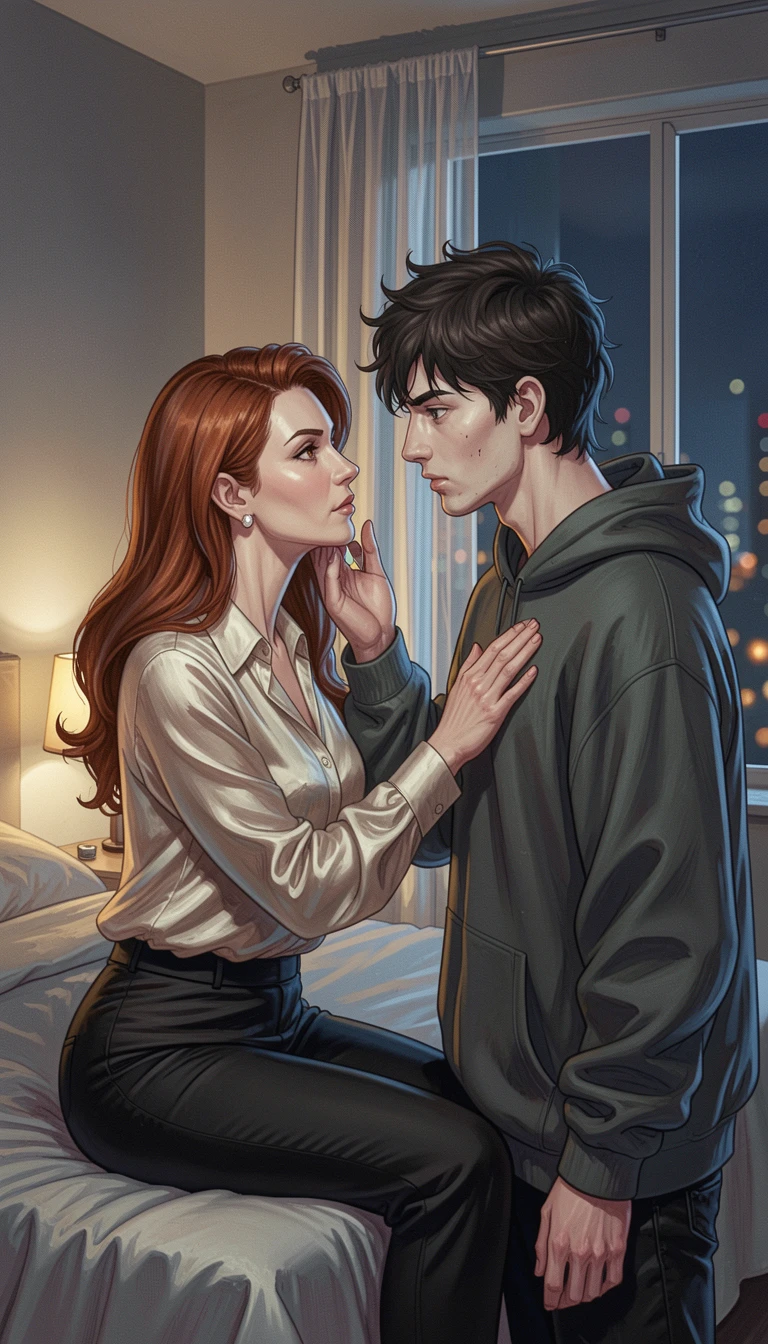
The living room was warm in a way that felt deliberate, the fireplace cold but the heat cranked up anyway, as if he'd wanted to make sure she couldn't blame the chill for the shaking in her hands. Vivienne stood in the doorway with her purse still pressed to her ribs and her coat still on, and she could feel the sweat gathering at the back of her neck, could feel the evening pressing against her like a hand on her chest.
Nate was on the couch. He had the remote in his hand, and he was watching something on the muted television — a sitcom, all bright colors and exaggerated faces, the laugh track burbling along without any sound to anchor it. He didn't look up when she came in. He didn't look up when she stood there, breathing hard through her nose, waiting for him to acknowledge that she existed at all.
She waited. That was the thing — she waited, because some part of her still believed he would look up and see her standing there and understand, on his own, what he had done. Some part of her still believed she could stand in a doorway and command a room by sheer presence alone, the way she had done for twenty years, the way she had done before he was ever born.
He didn't look up.
"You," she said. Her voice came out thinner than she wanted. She cleared her throat and tried again. "You. What did you do?"
The laugh track swelled. The remote clicked in his hand — he wasn't even changing the channel, just pressing the button, the volume going up and down in meaningless increments. He was playing with it. He was playing with her.
"Nate." Her voice sharpened, found its edge. "I'm talking to you."
He finally looked up. Gray eyes, flat and patient, the same eyes that had watched her across the dinner table for years, the same eyes that had made her skin crawl with their hungry, knowing stillness. But there was something different in them now. There was no hunger. There was no longing. There was just — patience. The patience of a man who had already won and was simply waiting for her to realize it.
"I heard you," he said. "I was just deciding whether to answer."
The words hit her like a slap. She took a step into the room, her heels clicking on the hardwood, and she felt the anger surge up her throat like bile, hot and unstoppable. "You — you took my account. You took my money. You went into my private account and you took my money and you bought — you bought that dress, you transferred my own money to pay for a dress I never wanted, and now you have a message on your phone —"
She was shaking. She could feel it in her hands, in her knees, in the wobble of her voice that she couldn't quite control. She clutched the purse tighter, pressed it against her sternum like a shield, and kept going.
"— a message to your father, a message that would — do you understand what that would do? Do you understand what that would cost me? I built that account from nothing, I saved for eleven years, I put money away every month so that I would have something of my own, and you — you just —"
"You're repeating yourself."
His voice was flat. Calm. He didn't raise it. He didn't even seem particularly interested in what she was saying. He just sat there on the couch with the remote in his hand and watched her, and the laugh track burbled on, and Vivienne felt the words die in her throat.
"What?"
"You said 'you took my money' twice. You're repeating yourself." He tilted his head, considering her. "You're not usually this sloppy. It's almost like you're scared."
The word landed like a blow. She opened her mouth to deny it, to tell him she wasn't scared of him, that she had never been scared of him, that he was a nineteen-year-old boy in an oversized hoodie and she was a grown woman and he couldn't touch her — but the words wouldn't come. They stuck in her throat, thick and useless.
He set the remote down on the arm of the couch. The click of it against the wood was small, almost delicate, but it cut through the laugh track like a gunshot.
"You know what I think?" he said, standing up. "I think you've been waiting your whole life for someone to call your bluff. And I think you've been so sure no one ever would that you forgot what it feels like to actually be called."
He crossed to her in three slow strides. She didn't move. She couldn't move. Her body had locked up, her purse still pressed to her chest, her breath caught somewhere between her lungs and her mouth, and she watched him come and she told herself to move, to step back, to say something — but she didn't.
His hand came up. She saw it coming, saw the pale skin and the long fingers and the way his sleeve hung loose around his wrist, and she thought he was going to take her purse, or grab her arm, or —
The slap cracked across her cheek like a whip.
Her head snapped sideways. Her ear rang. Pain bloomed hot and immediate across her face, and she gasped — a sharp, indignant sound that she couldn't stop, that she would never have let him hear if she'd had a single second to prepare for it. Her purse slipped from her fingers and hit the floor with a dull thud, and she stood there with her head turned, her cheek burning, her eyes wide and staring at the wall.
"You —" Her voice came out hoarse. She turned back to him, and the outrage flooded through her, hot and righteous. "You can't — you can't do that. You cannot —"
His hand came up again. This time she saw it, and she flinched — she actually flinched, her whole body jerking back, her eyes closing — and the slap landed anyway, open-palmed, harder than the first, snapping her head the other way. Her vision blurred. Her ear rang louder. She heard herself make a sound, a small wounded thing, and she hated herself for it.
"Shut up."
His voice didn't rise. It was flat, calm, the same voice he used to ask for the salt at dinner. He stood there looking at her, his hand still raised, his gray eyes patient and empty, and Vivienne stood there with her face burning and her breath coming in short, sharp gasps, and she had nothing to say.
Nothing. Not one word. Twenty years of commanding rooms and she stood there with her mouth open and nothing in her head but the ringing in her ears and the heat on her cheek and the terrible, impossible fact that he had just — he had just —
He took her wrist.
His grip was firm, not rough, his thumb pressing into the delicate skin on the inside of her wrist, and he pulled her forward. Her heels stumbled on the hardwood. She made a sound — protest, confusion, she didn't know — and he didn't acknowledge it. He just walked her to the couch and sat her down, and she went, because her body had stopped listening to her, because she was still reeling from the slaps, because she didn't know what to do.
She sat. He sat beside her. He let go of her wrist and picked up the remote and turned the volume up, and the laugh track swelled, filling the room, and Vivienne sat there with her purse on the floor and her coat still on and her cheek burning and her hands shaking in her lap.
And then his hand found her wrist again.
His thumb stroked the inside of her wrist. Slow. Deliberate. In time with the laugh track — she could feel it, each brush of his thumb landing on the beat of the audience's laughter, and she realized with a sick lurch that he was doing it on purpose. He was sitting there watching the television like nothing had happened, like he hadn't just slapped her twice, like he hadn't just led her to the couch like a dog, and his thumb was tracing a slow circle on the inside of her wrist, and she was letting him.
She was letting him.
Her cheek throbbed. She could feel the heat of it, the tenderness, the place where his hand had landed. She could feel the ghost of the second slap, the way her head had snapped sideways, the sound she had made. She could feel his thumb on her wrist, stroking, stroking, stroking, and she did not pull away.
The laugh track swelled again. The sitcom's studio audience howled at something on the screen, and Vivienne sat frozen beside her stepson, her purse still on the floor, her coat still on, her cheek still burning, her mind a blank wall of shock.
She had no idea what the hell was going on.
The remote sat on the arm of the couch where he'd left it. She kept looking at it, kept waiting for him to pick it up again, to do something that would make sense of the last five minutes. But he didn't. He just sat there beside her, close enough that she could feel the warmth of his leg against her thigh through the silk of her trousers, his thumb still moving in that slow, deliberate circle on the inside of her wrist.
The sitcom was still playing. Some woman in a bright yellow dress was gesturing wildly at a man in a sweater, and the audience was losing their minds, and Vivienne sat beside her stepson and watched the muted chaos and felt the absurdity of it pressing against her chest like a physical weight. She had been slapped. Twice. She had been led to the couch like a dog. And now his thumb was stroking her wrist in time with the laughter of strangers, and she was sitting here, and she was letting him.
She should pull away. She should stand up, pick up her purse, walk out of this room and up the stairs and lock her bedroom door and call the bank and the police and her lawyer, in that order, and she should never speak to him again. She had done harder things. She had built a life from nothing, she had survived her first husband's death and her second husband's absences and a decade of watching this boy watch her like she was a thing to be consumed. She had done harder things than standing up.
She didn't stand up.
Her cheek throbbed. She could feel the heat of it radiating across her face, could feel the tenderness spreading toward her jaw, and she knew there would be a mark. She could picture it already — the red flush of his handprint blooming against her pale skin, the bruise that would darken by morning. She would have to explain it. Harry would ask, and Sera would ask, and she would have to say something, would have to lie, and the thought of it made her stomach turn.
"You're thinking about the bruise."
His voice was quiet, almost conversational, and she felt herself go still. She didn't turn to look at him. She stared at the television, at the woman in the yellow dress, at the audience still howling at something she couldn't hear.
"It'll fade," he said. "In a few days. You can cover it with makeup. You're good at that."
The words landed somewhere between her ribs and her spine. She opened her mouth, and nothing came out, and she hated herself for it. She hated the way her voice had abandoned her, the way her body had stopped listening, the way she was still sitting here with his thumb on her wrist like she had nowhere else to be.
He shifted beside her. Not much — just a small adjustment, a settling of his weight on the cushions. But his leg pressed more firmly against hers, and she felt the contact all the way up her side, a line of heat that she couldn't explain and didn't want to name.
"You're not going to hit me back," he said. It wasn't a question.
She turned to look at him then, and the words were on her tongue — I could, I should, you have no idea what I'm capable of — but they died when she saw his face. He wasn't smug. He wasn't triumphant. He was just looking at her, gray eyes patient and empty, like he had already accounted for every possible version of her and none of them scared him.
"I could," she said, and her voice came out thin and useless.
"You could," he agreed. "But you won't."
His thumb kept moving. She could feel the circle it was tracing, the same path over and over, and she realized with a sick lurch that she had started to anticipate it. She could feel the rhythm of it, the way it landed on the beat of the laugh track, and her body had begun to settle into it, to wait for it, and that was worse than anything else he had done tonight.
The laugh track swelled again. The studio audience howled. And Vivienne sat beside her stepson with his thumb on her wrist and her cheek burning and her purse still on the floor, and she did not pull away.
The remote was in her hand before she knew she'd reached for it.
She didn't think about it. That was the thing she would come back to later, in the dark, in the hours she couldn't sleep — that she hadn't thought about it at all. Her arm just moved, and the remote left her fingers, and it flew across the room in a flat, wobbling arc and struck the television screen dead center.
The glass didn't shatter. It spidered — a white bloom of cracks spreading outward from the impact, the picture underneath still playing, the woman in the yellow dress still gesturing, but fractured now, cut into a hundred bright shards by the broken screen. The remote clattered to the floor. The sound of the laugh track kept coming out of the speakers, warped and tinny, and Vivienne sat there with her arm still extended and her chest heaving and her cheek still burning from the slaps he'd already given her.
She turned to look at him.
"There," she said. Her voice shook, but she got the word out. "There. Now you have something to tell Harry about. Go ahead. Tell him I broke the television. Tell him I threw a remote like a — like a —" She couldn't finish it. She was breathing too hard. "I don't care. I don't care what you tell him. I'm done being —"
His hand caught her across the face before she finished the sentence.
This one was different. The first two had been open-palmed, almost measured, the way you'd correct a dog. This one had weight behind it. Her head snapped so hard her neck cracked, and she felt the ring of it all the way down into her teeth, and she tasted something coppery at the corner of her mouth. She fell sideways against the arm of the couch, her hand coming up to her face, and for a moment the room went white and soundless and she couldn't find the television or the remote or him.
When it came back, his hand was in her hair.
He fisted it at the back of her skull, close to the roots, and he pulled. Not a tug — a haul, the kind of grip that lifted her half off the cushion, and she made a sound she didn't recognize, a raw animal yelp, and her hands flew up to claw at his wrist, and it did nothing. He dragged her forward across the couch and down, and her body folded because it had no choice, her knees hitting the floor on one side, her hands catching the cushion on the other, and then he pushed her down over his lap.
She landed across his thighs with her hips at the edge of the cushion and her chest hanging down toward the floor, her hands braced on the seat on one side and her knees on the hardwood on the other, and her skirt was rucked up around her waist and she could feel the cool air of the room on the backs of her thighs and she could not believe — she could not believe —
"Let me go." Her voice came out muffled against the cushion. She tried to push herself up. His hand stayed in her hair, pressing her head down, and she couldn't get the leverage. "Let me go, Nate. Let me — this is — you can't do this, I'm your —"
He yanked her hair again, hard enough that her scalp screamed, and her whole body jerked forward.
"Shut up."
The flatness of his voice was worse than shouting. She went still. Her hands were flat on the cushion and her knees were on the floor and her head was pressed down and she could see, out of the corner of her eye, the broken television still flickering its fractured picture, the audience still laughing at something she couldn't make sense of.
Then his free hand came down on her ass.
The slap was loud. Louder than the slaps to her face, because it landed on the thin silk of her trousers and the sound cracked through the room and her body jolted forward on his lap. The sting bloomed a half-second later, hot and wide across her right cheek, and she gasped and bucked and tried to rise, and his hand in her hair pushed her back down.
"Did I say you could move?"
"You —" She was already talking, already arguing, because that was what she did, that was the only thing she had left. "You can't — you can't order me around, I'm not a — I'm your stepmother, I'm a grown woman, I'm —"
His hand came down again. Left cheek this time. Same loud crack, same bloom of heat, and her words broke off in a yelp she couldn't swallow.
"You're not listening," he said.
Another slap. Right cheek. Then left. Then right, right, left, and he wasn't hurrying, he was setting a rhythm, a slow steady pace like he had all night, and each one landed a little lower or a little higher and the heat was spreading across her whole ass now, a wide band of sting from the tops of her thighs to the small of her back, and she was squirming on his lap and her hands were still flat on the cushion and she was still telling him to stop.
"Stop — stop it, that's — that's enough, you've made your point, you've —"
Slap. Slap. Slap.
"I said stop." Her voice cracked on the word. "Nate. Nate, stop."
He didn't stop. He kept going, steady and unhurried, and she realized with a lurch of something cold in her stomach that he wasn't going to stop, that her voice wasn't doing anything, that she had been talking this whole time like her words still meant something and they didn't, they didn't mean anything to him at all.
She tried to block him. She twisted on his lap and brought her right hand back, palm up, to catch his wrist before the next one landed, and for a second it worked — her fingers closed around his forearm and she held it, and she felt the muscle under his sleeve, and she thought maybe, maybe —
His hand left her hair.
Before she could react, he had caught her right wrist, and then her left, and he pulled both of them up and back and crossed them together behind her head, and his hand closed around both of them at once, pinning them there. Then his hand came back down into her hair, fisting it again at the roots, and now he had her wrists and her hair in one grip, and she was bent over his lap with her arms pulled up behind her head and her face pressed down toward the cushion and there was nothing she could do with her hands at all.
She was completely under his control.
The realization hit her somewhere below the ribs. She tested the grip — pulled, twisted, tried to free one wrist — and his hand didn't move. His fingers were wrapped around both her wrists like a cuff, and his other hand was above her ass, and her knees were on the floor and her hips were over his thighs and she could not move, she could not move at all, and he was going to keep going.
He kept going.
"Stop," she said. Quieter now. "Stop."
Slap. The heat was a solid thing across her ass now, a burn that didn't fade between strikes because there was no time between strikes, and she could feel the fabric of her trousers clinging to her skin, and she could feel the individual lines of each slap layered over the ones before it.
"Please stop."
The word was out of her mouth before she could catch it. Please. She heard herself say it and she hated it, hated the sound of it, but the slaps kept landing and the heat kept building and her arms were pinned behind her head and she couldn't block him and she couldn't get up and she couldn't do anything but lie there and take it, and the next one pulled another please out of her, and then another.
"Please. Nate, please, please stop —"
He didn't answer. He didn't say anything at all. He just kept his rhythm, steady as a metronome, and she could hear the sound of his hand landing on her ass echoing off the walls of the living room, and underneath it the warped laugh track still playing from the broken television, and her own voice getting smaller and smaller.
By the time she stopped counting — somewhere past thirty, she'd lost track, the numbers had blurred — she was crying.
Not sobbing. Not the way a child cries. This was something else, something quieter and more terrible: tears running sideways down her face and into the cushion, her breath hitching in her throat, her body shaking on his lap with each new slap. She was crying the way a woman cries when she understands, all at once, that she is not going to talk her way out of this. That it is not going to stop because she asks it to. That she has spent twenty years being the one who decides, and tonight she is not the one who decides, and there is nothing she can say or do or be that will change that.
That was the part that broke her open. Not the pain. The understanding.
She kept crying. He kept spanking her.
Somewhere around the fortieth, she went quiet.
The tears kept coming — she couldn't stop those — but the sounds stopped. The pleading stopped. She lay limp over his lap with her wrists crossed behind her head and her face turned against the cushion, and she stopped fighting the grip, and she stopped trying to count, and she just lay there and let him finish. Her ass was on fire. She could feel the heat of it radiating up her back and down her thighs, and she could feel the wetness of her own tears soaking into the cushion under her cheek, and she could feel his hand still landing, steady, unhurried, like he had all the time in the world.
She thought, distantly, that she should be more ashamed than she was.
The fifty-odd slaps blurred into one long burn, and then, without warning, his hand stopped.
The silence was enormous. The laugh track was still playing, warped and tinny, but it sounded very far away now, like it was coming from another house. She lay there over his lap, breathing in shallow hitching breaths, and she didn't move, because she didn't know if moving was allowed.
His hand left her hair, opened and let go of her wrists, and her arms dropped loose to her sides, and she stayed exactly where she was, bent over his lap, because she didn't know what else to do.
He took her by the shoulder and yanked her backwards.
She came up off his lap and landed on her knees on the floor in front of him, and he caught her chin with one hand and turned her face up toward his, and she let him, because her neck was too tired to resist. She could feel the tears still wet on her cheeks, could feel the swollen heat of her own face where he'd slapped her, could feel her ass throbbing against the backs of her thighs where she was kneeling on it. She looked up at him and he looked down at her, gray eyes steady, and he studied her face for a long moment like he was reading something written there.
"Have you learned your lesson?"
She didn't answer. The words were there somewhere, but her mouth wouldn't form them. She just knelt there looking up at him with her ruined face and her heaving chest and her hands limp at her sides, and something in her — some last stubborn ember — refused to give him the word.
His hand came down across her face one more time.
It wasn't hard. It was almost gentle compared to the others, a flat open-palmed crack that turned her head maybe two inches and stung the already-burning skin of her cheek, and she closed her eyes and made a small sound and opened them again, and he was still looking at her, patient, waiting.
"Do you understand who's in charge now?"
She swallowed. Her throat was raw from crying. She could feel the answer sitting in her chest like a stone, and she knew, with a clarity that felt almost peaceful, that she was going to say it. Not because she believed it. Because she understood that not saying it would only make this longer, and she had nothing left to spend on making it longer.
"Yes," she said. Her voice was hoarse and small. "Yes. I understand."
He looked at her for another moment. Then he let go of her chin.
"Go clean yourself up."
She stayed on her knees for a second, not sure if she was dismissed, and he tilted his head toward the stairs, and that was enough. She got her feet under her. Her legs were shaking. Her hands were shaking. She bent and picked up her purse from where it had fallen on the floor, and she didn't look at the broken television, and she didn't look at him, and she walked out of the living room and up the stairs with her skirt still rucked and her ass on fire and her face wet with tears.
In the bathroom she locked the door and stood at the sink and looked at herself in the mirror.
The woman who looked back at her was a stranger. One cheek was red and beginning to purple where his hand had landed; the other was flushed with crying. Her auburn hair had come loose from its sleek curtain and hung tangled around her face. Her blouse was twisted. There was a smear of something at the corner of her mouth that she wiped away with a shaking hand, and it came away faintly pink.
She ran the cold tap and pressed a wet washcloth to her face and stood there breathing while the water ran, and she thought about Harry in Frankfurt, and she thought about Sera out with friends, and she thought about the account, and the draft message, and the fact that she was going to walk back downstairs in a few minutes because he had told her to.
She thought about that for a long time. The cold water ran over her wrists and she thought about it, and she couldn't find a way around it. She could leave. She could walk out the front door right now, in her ruined clothes, with her bruised face, and drive to a hotel and call a lawyer and be done with all of it. She could do that. She knew she could do that.
She turned off the tap and dried her face and smoothed her hair and did not leave.
Downstairs, the broken television was still flickering. She could hear it as she came down the stairs — the warped, tinny laugh track still looping, the audience still laughing at the woman in the yellow dress, and she walked past the doorway of the living room and into the kitchen without looking in, and she opened the cabinet where the popcorn lived and took down the box.
Her hands were still shaking. She measured the kernels into the pot and put it on the stove and stood there watching it while it heated, and the first few popped and rattled against the lid, and she thought about how ordinary this was, how many nights she had stood at this stove making popcorn, and how none of them had felt like this.
When it was done she poured it into the big ceramic bowl — the good one, the one Harry had brought back from Portugal — and she stood there for a moment holding it, the warmth of it against her palms, and then she carried it back through the hall and into the living room and set it down on the coffee table in front of him.
He was sitting where she'd left him, on the couch, the remote in his hand — the remote she'd thrown, retrieved from the floor, the battery cover missing now — and he looked up at her over the bowl of popcorn, and he didn't say thank you.
He just moved the remote to the other arm of the couch, and he patted the cushion beside him.
She sat.
The cushion was still warm from him, and she hated that, hated the small animal fact of it — his heat under her thighs, the dip in the foam where his weight had pressed. She sat with her spine straight and her knees together and her hands folded in her lap like a woman waiting for a verdict, and she did not look at him. She looked at the bowl of popcorn. The good bowl. Portugal.
He took a handful. Chewed. The television flickered its broken blue at the wall and the laugh track looped and looped, and he watched it for a while like there was something on it worth watching.
"Eat something."
"I'm not hungry."
"I didn't ask if you were hungry."
Her jaw set. She could feel the muscle working in it, the same muscle she used in boardrooms and at dinner parties and in the back of cars when Harry's business partners said something stupid — the clench that meant I am deciding not to say the thing I want to say. She reached into the bowl and took three kernels. Put them in her mouth. Salt and butter and the faint char of the ones that had caught, and her stomach turned over once, and then — because she hadn't eaten since a piece of toast at eight that morning, because her body was a body and not a monument to her pride — it growled. Loud enough for him to hear it.
He didn't laugh. That was worse than if he had.
She took another handful and ate it properly this time, and she told herself it was strategy. A woman who faints is a woman who loses. A woman who eats is a woman who is still thinking. She chewed and swallowed and stared at the warped blue of the screen and told herself the popcorn was making her feel steadier, and it was, and she hated that too, hated that a bowl of corn could do anything for her at all.
"Tomorrow," Nate said, "we're going to get a new TV."
She stopped chewing.
"You broke this one." He gestured at it with the remote, a small lazy flick of the wrist. "So you're buying the replacement. Big one. Whatever I pick."
"With whose money?"
He looked at her. Just looked, gray eyes flat, and she felt the answer land in her chest before he said it.
"With your money, Vivienne. The money in the account you don't want your husband to know about."
She set her handful of popcorn back in the bowl. Slowly. One kernel at a time, like she was putting something back on a shelf.
"You can't just —"
"I can." He ate another handful. "I did. The dress was the first one. This is the second. There'll be more. That's how it works."
The laugh track swelled. The woman in the yellow dress said something Viv couldn't hear over the ringing in her own ears.
"And after," Nate said, "if you're good — if you behave tomorrow, in the store, the whole time — we might go to the mall. Walk around. Get lunch." He said it the way you'd say it to a child. A treat. A reward for good behavior. "You'd like that, wouldn't you. Getting out of the house."
She said nothing. There was nothing to say that wouldn't be a lie or a surrender, and she was too tired to sort one from the other.
He wiped his hands on his jeans and reached down beside the couch and came up with his laptop, and he opened it on his knees and the screen lit his face pale and blue, and he turned it toward her.
"Find something."
"What?"
"A movie. We're watching one." He nodded at the broken television, still flickering its broken blue at the wall. "Since you killed that one."
She stared at the laptop. Then at him. Then at the laptop again. The absurdity of it sat in her throat like a swallowed stone — this boy, this boy, ordering her to pick a film so they could watch it together on his laptop like teenagers at a sleepover, after what he had just done to her on this couch, after the fifty-odd slaps still burning under her skirt. She wanted to laugh. She wanted to scream. She wanted to take the laptop and break it over his head and she wanted, in some small and shameful corner she would not look at directly, to do exactly what he said so that this would not get worse.
She took the laptop. It was warm from his knees. She scrolled.
Her hands were still not quite steady, and the cursor jumped, and she scrolled past the recommendations, past the things she'd watched with Harry on the good TV in the den — period dramas, that French thing about the monastery, the one about the painter — and none of them were right, none of them were possible, she couldn't sit here and watch a woman in a corset long for a man across a ballroom with Nate's arm around her. She scrolled until she found something old and black-and-white and slow, a noir, some detective with a hat and a cigarette and a city full of rain, and she clicked it because it was the least like her life of anything on the screen.
"That one," she said.
He looked at the title. "Fine."
He took the laptop back and set it on the coffee table, angled so they could both see, and he hit play, and the black-and-white city started to rain in silence because the laptop speakers were tinny and low.
"Get comfortable," he said.
And then he stood — she flinched, she couldn't help it, her whole body braced — but he only stood to pull his hoodie over his head. The gray fabric came up over his flat stomach and his chest and his shoulders and off, and he dropped it on the floor beside the couch, and he was wearing a t-shirt underneath, thin and dark, and his arms were paler than she'd expected, long and lean, and she looked away before she'd finished seeing them.
He sat back down and bent and peeled off his socks, one, then the other, and dropped them on top of the hoodie. Bare feet on the rug. He stretched his toes out and flexed them and looked at her.
"Your turn."
"I'm fine."
"You're not." He nodded at her feet. "Socks off. And your hair — take it down. It's been up all day."
She looked at him. He looked back, patient as weather.
She bent and took her socks off. Her ankles were cold; the rug was cold under her bare soles; the whole house felt colder than it had an hour ago. She folded the socks and set them on the arm of the couch and did not look at him while she did it.
The hair was harder. She reached up and found the pins, and her hands — still not steady — fumbled the first one, and she had to try twice. The second came easier. The third. Her hair came down around her shoulders in a heavy auburn curtain, and it smelled like her shampoo, and it fell across her face and she left it there, a screen, a small dark room she could hide inside.
"Better," he said.
On the laptop, the detective was walking down a wet street. Rain on the windshield of a car. A woman in a doorway with a cigarette.
Nate lifted his arm and laid it along the back of the couch, behind her neck. Not touching. Just there, a weight in the air behind her, a line drawn around her that she was now inside.
"Lean on me."
She didn't move.
"Vivienne."
"I heard you."
"Then do it. Put your head on my shoulder." His voice was quiet and even, the same voice he'd used to tell her to eat, to find a movie, to take her socks off. "We're watching a film. Lean on me and watch it."
She thought about the door. She thought about her keys in her purse on the floor by the couch, the car in the drive, the hotel six miles away with a credit card that would still work because it was Harry's and Harry's money was not the money in the account. She thought about all of it, the whole clean exit, and she sat there with her hair down and her feet bare and her ass still on fire under her skirt and she did not take it.
Because the account. Because the draft message. Because he had shown her tonight, on this couch, that he would do exactly what he said he would do and that there was no version of her that could stop him, and the only thing she had left was the shape of her own obedience, and she was going to keep it as neat as she could.
She leaned.
Her shoulder found his side, and her head came down onto his shoulder, and his arm settled behind her neck, warm and heavy, and she could feel the rise and fall of his breathing under her cheek and the hard line of his collarbone through the thin dark shirt, and she could smell him — soap and something underneath, skin and boy — and she closed her eyes for one second and opened them again.
"You're a fucking piece of shit," she said. Out loud. Quiet, flat, into his shoulder, the words pressed into the fabric of his shirt.
She felt his chest move. Not a laugh, exactly. Something under it. A breath through the nose.
"I know," he said.
On the screen, the detective lit a cigarette and the rain kept coming down, and the laptop speakers tinny and small, and the broken television flickered its blue at the wall beside them like a second, worse moon. Her head was on his shoulder. Her hair was down. Her socks were folded on the arm of the couch. Her ass was still hot under her skirt and would be hot tomorrow and she knew, with the flat certainty of a woman reading a balance sheet, that she would get up in the morning and get dressed and get in the car with him and buy him a television with money her husband didn't know she had, and that the mall, if it happened, would not be a treat.
She watched the movie. She didn't take her head off his shoulder. His thumb, behind her neck, moved once — slow, back and forth, along the top of her spine — and she let it, and she said nothing, and the rain on the laptop screen kept falling on a city that wasn't this one.
The movie was slow and black-and-white and full of men in hats saying things she couldn't quite hear over the laptop's cheap speakers, and she found after a while that she had stopped following it entirely. She was following his breathing instead. The rise and fall under her cheek. The small hitch when he shifted his weight. The way his thumb had stopped moving along her spine and just rested there, a warm weight at the base of her neck, keeping her exactly where she was.
Her neck began to ache. She didn't move.
On the screen, the detective kissed the woman in the doorway and the woman slapped him and the detective laughed, and Viv thought, with a dull, distant clarity, that she had never in her life been so tired. Not the tired of a red-eye flight or a board meeting that ran to midnight. This was a different animal. This was the tired of a woman who had spent four hours holding her spine straight and her face still while a boy dismantled her, and who had run out of the strength to keep holding anything.
"You're heavy," Nate said.
She stiffened. Started to lift her head.
"I didn't say move." His arm tightened behind her neck, not hard, just enough to make the point, and she settled back against his shoulder with her jaw locked and her eyes on the screen and her heart going too fast for a woman sitting still. "You're heavy because you're not relaxed. You're holding yourself up. Stop doing that."
"I'm not—"
"You are. You've been holding your own head off my shoulder for twenty minutes like it's a job." He reached over with his free hand and took another handful of popcorn and ate it, and the crunch of it was loud in the quiet room. "Let go. I've got you."
The words landed somewhere under her ribs and sat there, wrong and warm, and she hated him for them. I've got you. As if he were doing her a kindness. As if the arm behind her neck were anything but a leash, as if the whole house weren't a cage he'd built around her one small command at a time.
But her neck hurt. And she was tired. And the movie was black-and-white and far away and nothing in it could touch her.
She let her head go heavy.
His shoulder took the weight and his arm adjusted to hold it, and something in her spine unknotted all at once, a long slow release she hadn't known she was holding, and she made a small sound in the back of her throat before she could stop it. Not a word. Barely a breath. But he heard it — she felt his chest move under her cheek, that same not-quite-laugh — and she closed her eyes so she wouldn't have to see the screen or the room or the broken television flickering its blue at the wall.
"There," he said. Quiet. Almost gentle. "That's better."
She kept her eyes closed. The movie murmured on. Rain on a windshield. A phone ringing in an empty office. Somewhere in the house a pipe ticked, the way old pipes do, and she counted the ticks the way she used to count the seconds between lightning and thunder when she was a girl, waiting to see how close the storm was.
"You're going to be sore tomorrow," Nate said.
She opened her eyes.
"Your ass." He said it flatly, no heat in it, like a man reading a weather report. "You're going to feel it every time you sit down. In the car. In the store. At lunch, if we go." A pause. "You'll think about tonight every time you sit down tomorrow."
"Is that the point?"
"Part of it."
She turned her head just enough to look up at him, and from this angle his jaw was sharp and his eyes were on the screen and the blue light from the laptop sat on his cheekbones like something borrowed, and she thought — not for the first time, but sharper now, with her head on his shoulder and her hair down and her feet bare — that she did not know this boy at all. She had lived in a house with him for six years. She had signed his school forms and bought his clothes and set a plate for him at a thousand dinners. And she had never once, until tonight, seen him look like this. Like a man who had been waiting a long time and had finally, quietly, begun.
"Why me," she said. It came out before she'd decided to say it. She regretted it immediately.
He didn't answer right away. On the screen, the detective drove through the rain. The wipers went back and forth. Back and forth.
"You know why," he said finally.
"I don't."
"You do." He looked down at her then, and there was nothing soft in it, nothing boyish, just that flat gray patience that had been in his face all night. "You've known for years. You just decided it was beneath you to notice."
She said nothing. There was nothing to say that wouldn't be a lie, and she was too tired to lie well, and he would know anyway. He always knew. That was the thing about him — the thing she had never let herself see until tonight — he watched. He had been watching her for years, cataloguing every curl of her lip, every time she'd looked through him at the dinner table, every time she'd said Nathaniel, please in that tone, the tone you use on a dog that's gotten on the furniture. He had been keeping score, and now he had come to collect, and she had handed him the ledger herself, years ago, one small cruelty at a time.
Her stomach turned over. She reached for the popcorn bowl on the coffee table — his side of it, closer to him — and took a small handful, and ate it, and the salt was good, and she hated that too.
"Hungry now," he said.
"Shut up."
He didn't. He took a handful of his own and ate it and watched the movie, and for a while neither of them said anything, and the rain kept falling on the screen and the broken television kept flickering and the house kept being empty around them, and Viv sat with her head on her stepson's shoulder and her bare feet on the cold rug and ate popcorn out of the bowl he'd told her to eat from, and thought about how strange it was that a body could do all of this — sit, eat, watch, breathe — while the woman inside it was somewhere else entirely, standing very still in a room with no doors.
The movie ended the way old movies end, with a kiss and a fade and a swelling of strings the laptop speakers couldn't quite carry, and the screen went dark, and the room was suddenly very quiet.
Nate closed the laptop with one hand. The blue light died. The broken television was still flickering on the wall, the only light left in the room, and in it she could see the shape of her own hair down her back and the shape of his arm around her and the two of them sitting there like something out of a photograph she would never want taken.
"Bed," he said.
She lifted her head off his shoulder. Slowly. Her neck ached where it had rested against him, and her hair was tangled from being down, and her feet were cold, and she felt like a woman who had been ill for a long time and was only now sitting up.
"I'll lock up," she said. It came out as a reflex — the last small piece of the woman who ran this house, the one who checked the doors and set the alarm and turned off the lights before bed. She clung to it.
"No." He stood, and the couch released him, and she felt the loss of his weight beside her like a draft. "You go up. I'll do the doors."
She looked up at him. Standing over her with the television flickering behind his head, he looked taller than he was, and older, and she had the sudden, disorienting thought that she had spent six years thinking of him as a boy and had been wrong the whole time, and that the wrongness of it was somehow worse than anything he had done to her tonight.
"Go on," he said. "You've got a long day tomorrow."
She stood. Her skirt was creased from sitting, and she smoothed it down without thinking, a habit from a hundred years of being watched, and then stopped, because his eyes had followed the movement of her hands and she did not want to give him that. She picked up her socks off the arm of the couch and her purse off the floor and she walked to the stairs, and she did not look back, and she felt his eyes on her the whole way — on her back, on her hips, on the bare skin of her ankles above her heels — and she climbed the stairs with her spine straight and her chin up because that was the only thing left in the house that was still hers.
At the top of the stairs, in the dark, she stopped. She could hear him below her, moving through the house — the click of the front door lock, the beep of the alarm panel, the small sounds of a man closing up for the night. Her house. Her locks. Her alarm. And a boy she had raised, in her kitchen, turning off her lights.
She went to her room and closed the door and stood in the dark with her hand still on the knob, and she did not turn on the light, and she did not cry, because she had not cried in eleven years and she was not going to start tonight, in her own house, over a boy who had learned to read her better than her husband ever had.
Behind the door, down the hall, the floorboards creaked once. Then again. He was coming up.
She turned the lock.
The click of it was very small in the dark, and she stood there listening to it, and she knew — with the same flat certainty she had felt on the couch — that it wouldn't matter. That a lock was a thing you could open, and a door was a thing he had already walked through, and that the woman who had spent twenty years commanding every room she entered had just locked herself into the smallest one in the house.