
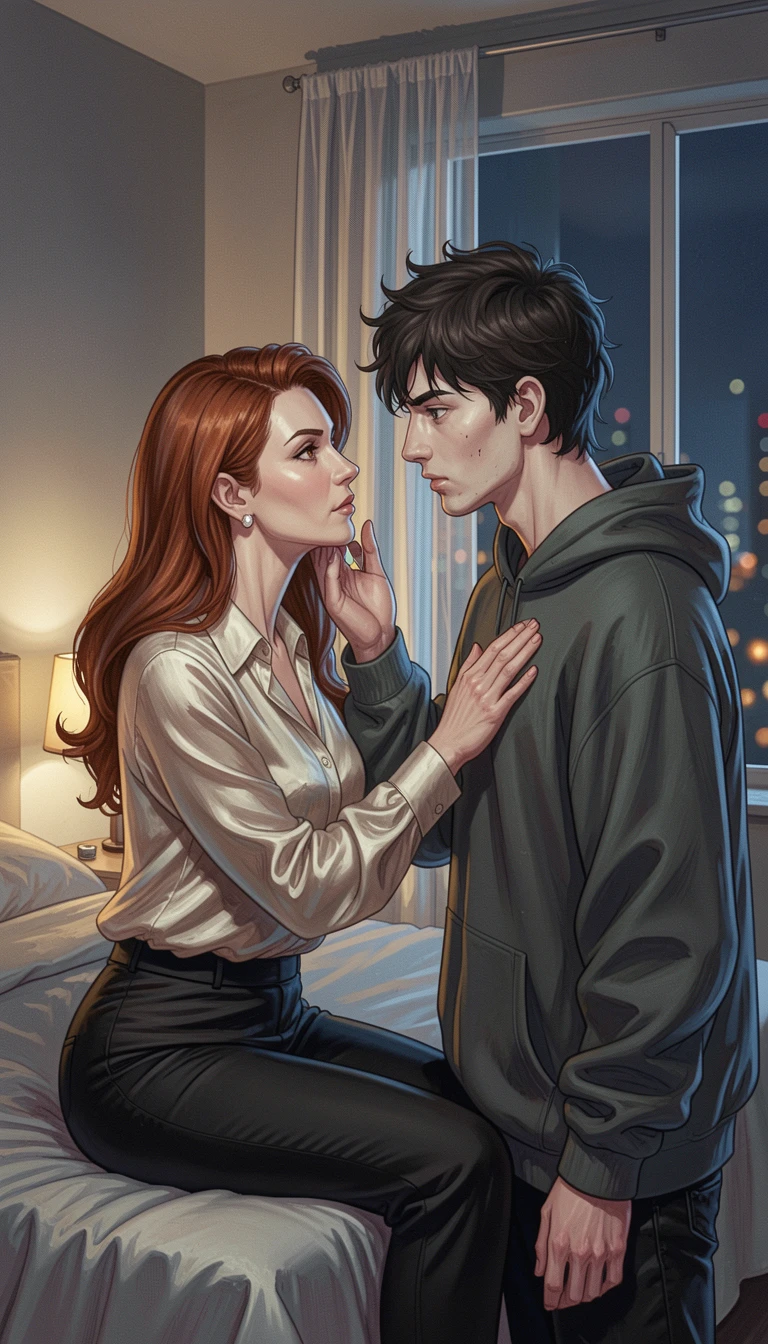
The first thing was the cold. Tile against her cheek, the whole side of her face pressed flat to the floor, and a smell like copper and lemon polish, and somewhere above her a light was on and no one had turned it off. Sera's eyes opened onto the baseboard of the front hall, the little scuff marks her father never noticed, the dust that gathered in the seam where the wood met the wall.
She lay there a while before she understood that she was lying there. Her jaw felt wrong. Not broken — she could work it, could feel her teeth meet — but wrong, hot and thick on the left side, like the bone had been packed with wet cotton. When she pushed herself up onto one elbow the floor tilted and she put her palm down flat and waited for it to stop.
The house was quiet in the way it got after midnight, when the refrigerator was the loudest thing in it. She got her knees under her, then her feet. Her tote bag had spilled — a pen, a hair tie, the edge of a notebook — and she gathered them without thinking about why they were on the floor, because thinking about it brought the rest of it up toward her throat.
She remembered his hand. Not the words — she couldn't get the words back yet, only the shape of them, the way he'd said something and she'd said something back — but she remembered his hand, coming from the side, and the small clean sound it made against her face, and then the floor rising up to meet her.
The stairs looked longer than they ever had. She took them one at a time with her hand on the rail, and at the top of the landing she stopped and looked down the hall at the two closed doors — hers, and past it the master, and past that his — and the whole hallway was dark except for the strip of light under her own door, which she hadn't left on.
She went into her room and shut the door and stood with her back against it and let herself breathe. The window was open the way she'd left it and the room smelled of her perfume and the trapped heat of the day, and it was so ordinary that for a second she thought she might have dreamed the whole thing, the way you dream a fall and wake with your heart going.
Then she caught her reflection in the dark glass and turned her face to the light, and there it was. A red bloom over her cheekbone, the skin already going tight and shiny, the color of something left too long in the sun. She touched it and hissed and pulled her hand away.
Her phone was in her pocket. Eleven-forty. She'd come home at nine. She'd been on the floor for two hours, maybe more, and no one had come.
She sat down on the edge of the bed and the mattress gave under her and she looked at the wall and tried to put it in order. Viv, on the stairs, in the black camisole, her hair pinned up in that way she'd been wearing it — and her face. Sera had seen it and stopped dead, because Viv's face was the face of a woman who had been hit, and Sera had known that face in the instant she saw it, the way you know a smell.
And she'd asked. She'd asked who did this. And Viv had looked at her with something in her eyes that Sera couldn't name then and couldn't name now — not fear exactly, not shame exactly, something that had gone very still — and then he'd come up behind her and said her name in that flat voice, and she'd turned, and—
She pressed her palm to her cheek again, harder this time, letting it hurt, because the hurt was the only part of it she could hold.
A knock. Two knuckles on the wood, soft, unhurried, the way you'd knock on a door you already knew would open.
"Sera."
Her whole body went tight. She didn't answer. She looked at the door and the light under it and the two dark shapes of his feet that weren't there, and she thought about the lock, and how it was the kind of lock you turned from the inside, and how she hadn't turned it.
"I know you're up. I saw your light." A pause. "Can I come in? I want to talk to you."
"Go away." Her voice came out wrong — small and scuffed, like the word had been dragged along the floor. She cleared her throat. "Nate. Go away."
"I'm not going away." He said it without heat. That was the thing about him, the thing that had always made her skin crawl a little, even before any of this — he never raised his voice. He said terrible things in the same tone other people used to ask for the salt. "I did something I shouldn't have. I want to say it to your face."
She stared at the door. Every part of her wanted to tell him to go to hell and mean it. But there was another part — the part that had grown up in this house, the part that had a father who was somewhere over the Pacific right now or nowhere at all, the part that had spent two hours on the cold tile — and that part wanted to know. It wanted the story. It wanted someone to make the last three hours into something that fit.
She got up and turned the lock. Then, because it felt like too much and too little at once, she opened the door and stood back.
He came in and stopped a few feet from her, and he looked terrible. That was the first thing. His eyes were sunken and red-rimmed, his hair flat on one side like he'd been lying down or pulling at it, and he was still in yesterday's clothes, the gray hoodie with the frayed cuff. He looked at the mark on her face and flinched — actually flinched, his whole face moving — and she watched him do it and didn't trust a second of it.
"Jesus," he said. "Sera."
"Don't." She crossed her arms. "You don't get to do that. You don't get to look at it like you didn't put it there."
"I know." He put his hands in his pockets and then took them out again, like he didn't know where to put them. "I'm sorry. I am. I've never — I've never hit a girl in my life. You know that. You know me."
"Do I?"
He let that land. He didn't argue with it, which surprised her. He just stood there in the middle of her room with his ruined face and let her have it, and she found she didn't know what to do with a Nate who didn't argue.
"Sit down," he said finally. "Please. Just — sit down, and let me tell you what happened, and then if you want me out, I'm out. I'll sleep in the basement. I don't care."
She didn't sit on the bed next to where he'd sit. She took the chair by the desk, turned it to face him, and sat with her arms still crossed. The chair was hard and the position was stiff and she wanted it that way. "Talk."
He sat on the edge of the bed, elbows on his knees, and looked at the floor between his feet for a long moment. Then he said, "It's about Viv."
"Obviously it's about Viv. I saw her face."
"No." He shook his head slowly. "You saw her face, but you don't know what you saw. That's why I'm here. Because I've been — I've been covering for her, Sera. For weeks. And I can't do it anymore. Not after tonight."
The words went into her like water into a crack and she didn't feel them yet. "Covering for her."
"Dad's money." He said it quietly, like it cost him. "The private account. The one he keeps for the — the things he doesn't put in the joint. She's been moving it. Out. In pieces. Since before he left." He looked up at her then, and his gray eyes were wet, and his mouth was pulled down at the corner. "I found out because I saw a statement. She left it on the desk in his office, and I — I shouldn't have looked. But I looked."
"That's not — " Sera stopped. She was trying to find the hole in it and her mind was full of cotton. "Viv wouldn't. She has her own money. She had a whole life before Dad."
"She had a whole life before Dad and she's been bleeding it dry for years and Dad's the one who kept it going." His voice stayed low and even. "You know she doesn't work. You know the Pilates and the hats and the serum and the — the whole thing. Where do you think it comes from? It comes from him. And when he's gone—" He stopped and pressed the heel of his hand against his eye. "When he's gone, what does she have? She's forty-four and she has nothing of her own. So she started taking it. Before the plane. Before any of this. That's the part that kills me, Sera. It started before."
She sat very still in the hard chair. The window was open and a car went by somewhere down the block and she heard it and didn't hear it.
"And tonight," Nate said. "Tonight I told her I knew. That's what happened. I told her I knew, and I told her I was going to report her, and she — " He shook his head. "She lost it. She said I was lying, that I was trying to — you know what she thinks of me. You've heard her. She thinks I'm garbage. She said I was making it up to get at her, and she came at me, and I pushed her off me, and she went down on the stairs."
"She didn't go down on the stairs." Sera heard her own voice come out flat. "She was standing there when I came in. She was fine."
"She was fine because she's good at it." He said it without cruelty, which somehow made it worse. "She's been doing this her whole life, Sera. She's the one who told you I was looking at her. She's the one who made you think I was — the weird one. Ask yourself who's been feeding you that."
And that was the part that got under her skin, because it was true that Viv had said it. At the dinner table, in the kitchen, in the car — little remarks, little looks, *Nate's been in the hall again,* *does he have to sit so close,* and Sera had taken them in and believed them the way you believe your own mother's weather report. She had believed them because they came from Viv, and because some part of her had wanted them to be true.
"Then why did you hit me," she said. "If it's all her. If you're the good one. Why did you hit me."
He didn't answer right away. He looked at her and his face did something complicated — the wet eyes, the working jaw — and when he spoke it was slower, like he was choosing every word. "Because you came down the stairs and you looked at me like I was the thing that had done it. Like her. And I'd just spent an hour trying to get her to stop screaming, and you were standing there calling me a — and I snapped. I'm not saying it's okay. It's not okay. I'm saying it wasn't about you. It was never about you."
"That's not better."
"No. It's not." He wiped his face with the flat of his hand. "I'm sorry, Sera. I'm sorry I hit you. I'll say it as many times as you want. But you needed to know what's actually going on in this house, because right now you're the only other person in it, and if I'm the only one who knows, then she wins."
Sera looked at him across the little space of her room, at the boy in the too-big hoodie with the hollow cheeks and the red eyes, and she tried to find the Nate she'd grown up beside — the one who ate cereal standing up at the counter, who never had friends over, who flinched when their father clapped him on the shoulder. She could find him. That was the problem. He was right there. He was sitting on her bed with his hands hanging between his knees, looking like a kid who'd been up all night.
"If she stole from Dad," Sera said slowly, "then when he — when we know — you tell the lawyers. You don't tell me in my bedroom at midnight. You don't hit me in the hall."
"I know." He nodded, and kept nodding, like he was agreeing with himself. "And I will. That's what I'm going to do. But I wanted you to hear it from me first, because when it comes out — and it's going to come out — she's going to tell you a different story. She's already telling herself a different story. She'll say I did this to her. She'll say I've been — " He stopped, and something moved behind his face. "She'll say things about me. And I wanted you to have the real one first."
Sera sat with that. The real one. She thought about the mark on her own cheek, hot and tight, and she thought about Viv's face on the stairs, that terrible stillness, and she thought about how those two things did not fit together the way Nate wanted them to. But she was tired, and her jaw hurt, and her father was missing over an ocean, and the story he was telling was a story, and she wanted a story.
"Get out," she said.
He stood up. For a second he stood over her chair and she thought he might reach for her, and her whole body went cold, but he didn't. He just looked down at her with those wet gray eyes and said, "Lock your door tonight. Not because of me. Just — lock it."
"Get out, Nate."
He went. The door clicked shut behind him and she heard his feet on the hall floor, going away, past the master bedroom, to his own room at the end, and then his door closed too, and the house went quiet again.
She sat in the hard chair for a long time. Then she got up and turned the lock, and stood with her hand on it, and looked at the door the way you look at a door you've just locked against something you can't name.
The light under her door was still on. She turned it off and stood in the dark, and through the wall, faint, she could hear the television still going in the living room downstairs, some late-night voice talking about the search area, the deep water, the debris. She stood there and listened to it and tried to decide what she believed, and found that she couldn't, and that the not-knowing was its own kind of cold.
Down the hall, past the master bedroom where the door was shut and the light was off, there was a room where a woman lay on her side on a bed with her eyes open, not sleeping, and Sera did not know that, and would not know it, and would lie down on her own bed in her own room with her cheek throbbing and her phone in her hand, thumb hovering over her father's name, and not press it, because there was no one on the other end to answer.
She lay on her back because her cheek hurt against the pillow. The ceiling was white and blank and she stared at it. Somewhere in the house a floorboard creaked, and then nothing, and she lay in the dark and listened to the quiet and did not sleep.
She woke before her alarm, which almost never happened. The room was gray at the edges and the ceiling was still there, white and blank, and for a second she didn't know why her face hurt. Then she turned her head on the pillow and the left side of her jaw lit up, and it all came back — the floor, the baseboard, the small clean sound of his hand — and she lay still and let it settle over her like a wet blanket.
Her phone said six-forty. She hadn't slept more than an hour at a stretch. Every time she'd drifted off, she'd jerked awake at some noise that wasn't there — a creak, a door, footsteps in the hall — and lain listening with her heart going until she'd decided it was nothing and started the whole thing over again. Now the light was coming up and the house was doing its early-morning sounds: the furnace ticking, a bird going off in the cedar hedge, the far-off hiss of the neighbor's sprinkler.
She got up and went to the mirror over the desk and looked at herself in the flat gray light. It was worse than last night. The red had gone purple in the middle and yellow at the edges, a bruise the size of a plum, and the skin over her cheekbone was puffed so that her eye on that side sat a little lower than the other. She touched it and it hurt and she didn't stop touching it. She stood there turning her face one way and then the other, cataloguing it the way she'd catalogue a stain on a shirt, and what she felt wasn't sadness exactly. It was a kind of cold clarity, like the moment before a test when you know you haven't studied and you also know there's no more time to start.
She sat down on the edge of the bed and pulled her tote bag into her lap and started to pack. Not for a trip. For good. She didn't let herself think about it in those words — she just moved her hands, and her hands knew what they were doing. The internship was in the city, eight weeks, she'd been putting off the housing because it was easier to commute and because some part of her had wanted to be home when her father came back. Her father wasn't coming back. The internship started Monday. There was a room in the program housing, a shared apartment near the campus, and she'd been offered it and turned it down and she could un-turn it down with one phone call, and she made the phone call standing at the window with her voice low.
She packed the way you pack when you don't want to be seen doing it: the duffel from under the bed, clothes off the hangers in armfuls, the laptop, the charger, the little box of her mother's things she'd never once moved since she was twelve. She didn't go down the hall for anything. She didn't need anything from down the hall. When the duffel was full she sat on it to zip it and then stood it by the door and looked around the room at what she was leaving — the desk, the chair she'd sat in last night with her arms crossed, the bed where he'd sat and told her the story — and she felt nothing about any of it, which she understood was its own kind of answer.
She wrote the note at the desk with a pen from her bag, and it took her three tries, because the first one said too much and the second one said too little. The third one she wrote fast, in her real handwriting, the way she'd write a note to a roommate. Went to the city for the internship. Back in eight weeks. Don't call, I'll be busy with orientation. — S. She read it once. It was a note you'd leave for people you expected to see again, and she wasn't sure that was true, and she left it anyway, flat on the kitchen island next to the fruit bowl where they'd both walk past it before noon.
She took the duffel down the back stairs, the ones off the kitchen, because they came out by the mudroom and the mudroom door opened onto the driveway and the driveway was the shortest distance between this house and her car. She didn't look at the living room. She didn't look at the couch or the rug or the dark mouth of the front hall where the baseboard was. She set the duffel down on the mat and pulled on her sneakers standing up, one hand braced against the wall, and the wall was cold and ordinary under her palm and she hated it for being ordinary.
Upstairs, water was running. The shower, or the tap, some small domestic noise through the floorboards, and she stood in the mudroom with one shoe on and listened to it and understood that one of them was awake. Her heart did something stupid and fast. She finished tying the shoe and took the keys off the hook — her keys, her car, the little silver fob her father had given her when she turned eighteen and he'd said drive safe, kiddo in the airport voice he used for everything — and she opened the mudroom door as quietly as a door can be opened and stepped out into the gray morning.
The air smelled like cut grass and wet stone. The neighbor's sprinkler was still hissing over the fence, a fine mist catching the low sun, and somewhere a dog was barking at nothing the way dogs do. Her car sat where she'd left it, dew on the windshield, and she put the duffel in the trunk and stood for a second with her hand on the lid and looked back at the house. Two stories of quiet windows. The kitchen light was off. The master bedroom window was dark. Nate's window, at the end, had the blind pulled down, and she looked at it and felt her cheek throb as if it had been waiting for her to look.
She got in and started the engine and backed out slow, the way you back out when you don't want anyone to hear you leave, and the tires crunched on the gravel and then she was on the street and the house was in the mirror, getting smaller, and she didn't cry, which surprised her, and she didn't feel the thing she'd expected to feel. She felt like a person who had taken one step off a moving train and was watching it go, and the not-crying sat in her chest like a swallowed stone. At the corner she almost stopped. Her thumb found the blinker and didn't push it, and she sat at the stop sign with the engine idling and the whole house behind her in the mirror, and she thought about the note on the island, flat next to the fruit bowl, and how they would find it, one or the other of them, and how neither of them would call, because the note said don't, and because — she understood this now, sitting at the corner with her jaw aching — because they wouldn't want to.
She turned left, toward the highway, and the house went out of the mirror and the road opened up and the sun came over the trees on her right and lay across the hood in a long gold bar. Her phone sat in the cupholder, face up, and she watched it the whole way to the on-ramp, half expecting it to light up with a name, and it didn't, and by the time she merged onto the highway and the city started to show itself in the distance, gray and stacked against the sky, she had stopped watching it and was just driving, both hands on the wheel, her mother's box in the trunk and eight weeks in front of her and nobody in the house behind her knowing which way she'd gone.