
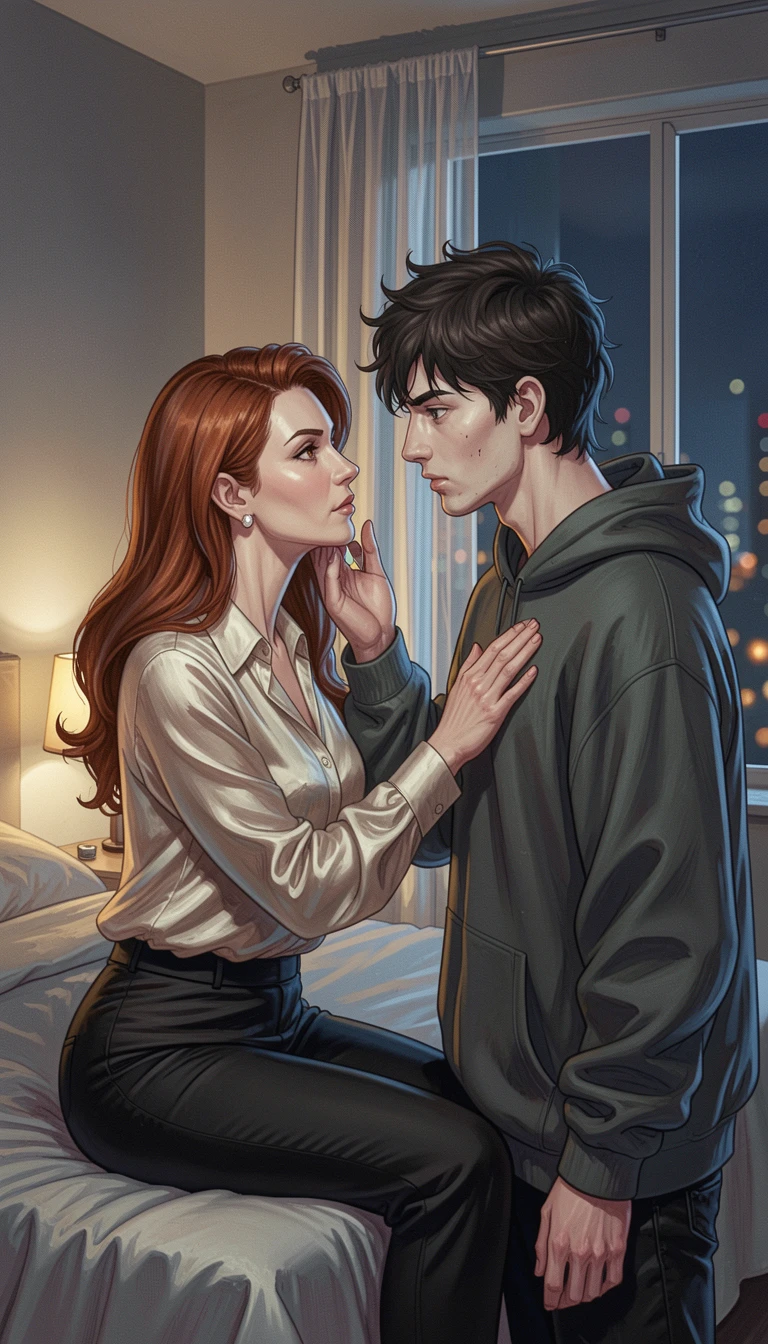
The kitchen tiles were cold under her bare feet. That was the first thing she registered, standing in the doorway with her hand still on the frame, the wood cool and solid against her palm. Six-forty in the morning and the house was already awake, already lit, the overhead light burning in the kitchen when it should have been dark this early, when she should have been the one to turn it on. But there he was. Nate, at the table, in a clean shirt she didn't recognize—pale blue, ironed, buttoned to the collar—his dark hair still damp at the ends, and a fresh cup of tea in front of him with steam still rising off the surface.
He looked up when she came in. Not startled, not caught. Just looking, the way he'd been looking at nothing since dawn yesterday, except now there was something in his eyes that wasn't nothing. She stood in the threshold and watched him, and the silence stretched long enough that she heard the refrigerator hum and the pipes groan somewhere upstairs where Sera was still asleep.
"You're up early," she said. Her voice came out rough, unused.
He didn't answer right away. His hands were flat on the table on either side of the cup, palms down, fingers spread, and she noticed how still they were. Too still. The kind of stillness that took effort.
"Nate."
"They stopped the searches."
The words landed flat, without inflection, like he was reading them off a piece of paper. She stood in the doorway and felt the cold come up through the soles of her feet, through her ankles, up into her shins, and she didn't move.
"What?"
"They stopped the searches." He said it again, the same flat tone, the same dead cadence, and she understood what he was doing—trying to make it true by saying it twice, as if repetition could hammer it into the world. "No survivors. No bodies. Just the deep Pacific."
She should have crossed the room. She should have sat down. Instead she stood in the threshold, her hand still on the frame, and watched his hands on the table, those still, too-still hands, and she thought about how a person's hands gave them away. How Harry's hands had always been moving—gesturing, reaching, patting her shoulder, picking up his phone. How she'd watched those hands across a hundred dinner tables, a thousand airport goodbyes, and never once thought to memorize them.
"When?" she heard herself ask.
"Last night. The announcement came out around three. I saw it on my phone." He didn't look at her. His eyes were on the cup of tea, the steam still rising, untouched. "They're calling it a recovery operation now. Not a search."
Recovery. The word sat in the air between them like something heavy, something that had fallen and could not be picked up. She thought about what recovery meant. What you recovered. What you brought back from the bottom of the Pacific, four hundred miles off the search grid, in water so deep the light never reached it.
"Did you sleep?" she asked.
He shook his head.
"Did you—" She stopped. Started again. "Have you told Sera?"
"Not yet." His voice cracked on the word, just barely, and he cleared his throat and looked down at his hands. "I thought—I didn't know how to say it. I kept hearing myself say it and it didn't—" He stopped, and his jaw worked, and she watched him swallow. "It doesn't sound real. Even saying it doesn't make it real."
The kettle sat on the counter, cold. The smell of burnt coffee hung in the air from yesterday, layered under the sharp, clean scent of bleach someone had used on the counters—she didn't remember doing it, must have done it in that shapeless stretch of afternoon, must have scrubbed something until it shone because she needed her hands to do something. The tea in front of Nate was fresh, made recently, made by him, and she tried to picture him standing at the counter in the dark before dawn, filling the kettle, waiting for it to boil, pouring the water over the bag with those still, too-still hands.
She crossed the kitchen without deciding to.
Her bare feet on the linoleum, the cold sharp against her arches, and she felt the length of the room as if it were longer than it was, as if she were crossing something larger than a kitchen. The counter passed on her left, the refrigerator on her right, the light overhead burning down on her, and then she was at the table, pulling out the chair across from him, sitting down.
He didn't look up.
The tea sat between them. Steam rose off it in a thin, wavering column. She looked at his hands and then at his face, and she saw the hollows under his eyes, the way his jaw was set, the way he was holding himself like a boy trying not to fall apart because there was no one else left to hold it together.
"Nate."
He shook his head, a small motion, almost involuntary. "I keep thinking he's going to call. I keep—" He stopped. His voice came out thinner. "I keep hearing the phone."
She knew the feeling. She knew it in her bones, in the base of her skull, in the way her body had been braced since two-forty-five yesterday afternoon, waiting for a ring that never came. She'd spent a year as a widow learning that feeling, the way the body keeps waiting for a sound that will not come, the way the silence becomes a thing you can't stop listening to.
He was nineteen. He shouldn't know that feeling yet. He should be sleeping in, scrolling on his phone, complaining about a class he didn't want to take. He should not be sitting at a kitchen table at six-forty in the morning in a clean shirt with his father at the bottom of the Pacific.
She reached across the table and took his wrist.
It wasn't a decision. Her hand moved without her telling it to, and then her fingers were around his wrist, around the bone, around the pulse that beat against her thumb, and she felt him go still—not the too-still of before, but a different stillness, a surprised one, a held breath.
His skin was warm. That was what she noticed. Warm and dry, and the bone under her fingers was fragile in a way she hadn't expected, a boy's wrist, a boy's body, even if he was broader than her now, even if he loomed over her in doorways. Under her hand he was just a boy who might have just lost his father.
He looked up.
His eyes met hers, and there was no mask in them. No angle, no performance, no careful patience, none of the things she had learned to brace against in the last nine days. Just the raw edge of something too big to hold, a boy standing at the lip of a hole he hadn't seen coming, and she felt the hate in her chest crack.
Just a little.
Just enough to feel it.
She held his wrist and did not let go. The pulse beat against her thumb, steady and quick, a boy's heart working too hard under too-still skin. She could feel the bone, the sharp jut of it, and she thought about how thin he'd gotten in the last days. She hadn't noticed before. She'd been too busy counting the hours until Harry came home, too busy hating the shape of the boy across from her to see that the shape had changed.
"You ironed it," she said. The words came out before she knew she was speaking. "The shirt. You ironed it."
He blinked. Looked down at his own sleeve as if seeing it for the first time. "I couldn't sleep. I thought—" He stopped, and his jaw worked again, that same hard swallow. "I thought if I did something normal, it would feel normal. Stupid."
"It's not stupid."
She said it too fast, and she felt the truth of it land between them, unexpected. She looked at the shirt again—pale blue, buttoned to the collar, creases sharp along the sleeves—and she pictured him in the dark of the laundry room at four in the morning, the iron hissing, steam rising, his hands moving over the fabric because they had to move over something. Because stillness was worse.
"How long were you up?" she asked.
He shook his head. "I don't know. Three. Maybe earlier. I kept—" He stopped, and his voice came out thinner, younger. "I kept checking my phone. Every time I put it down I'd pick it up again. Like something would have changed in the thirty seconds since I last looked."
She knew that too. She knew it in the ache behind her eyes, in the way her own phone had become a thing she couldn't stop reaching for, a thing she hated and needed at the same time. The screen was dark now, face-down on the counter, and she hadn't checked it since she came downstairs. She hadn't needed to. Whatever it said, it would say the same thing.
"What did you do," she said, "when you weren't checking your phone?"
He was quiet for a long moment. His thumb moved against the rim of the cup, a small, unconscious motion, the first thing he'd done that wasn't still. "I sat in the living room. On the couch. I thought about—" He stopped. Swallowed. "I thought about the last thing I said to him."
She felt something move in her chest, a shift she didn't have a name for. "What was it?"
"He called. Before he got on the plane." Nate's voice was very quiet now, very careful, like he was carrying something breakable. "He asked if I wanted anything from Singapore. I said no. That was it. I said no, and he said he'd bring me something anyway, and I—" His voice cracked again, and he looked down at his hands. "I was in the middle of a game. I was trying to get to a checkpoint. I told him I had to go."
The words sat between them, small and terrible. She thought about all the ways she'd ended calls with Harry—the distracted goodbyes, the I'll-call-you-laters, the thousand small dismissals that had seemed so ordinary, so full of tomorrow. She thought about how you never knew which one would be the last. How you never got to choose.
"He knew you loved him," she said. "He knew."
Nate looked up at her, and there was something raw in his eyes, something he couldn't hide. "How do you know?"
She didn't have an answer. She had a feeling, a bone-deep certainty that had nothing to do with evidence, but she understood that wasn't what he needed. He needed something to hold onto. She thought about Harry's hands, always moving, always reaching. She thought about the way he'd looked at his son across dinner tables, the quiet pride in his eyes that he never quite knew how to say out loud.
"Because he talked about you," she said. "Every trip. He'd come home and tell me about something you said, something you did. He was proud of you, Nate. He was always proud of you."
His face crumpled, just for a second, just enough for her to see it before he looked down and pressed the heel of his hand against his eyes. She felt the tremor run through his wrist, the one she was still holding, and she didn't let go. She didn't pull away. She sat there in the too-bright kitchen with the cold linoleum under her bare feet and the steam rising off the untouched tea, and she held his wrist like it was the only thing keeping him tethered to the earth.
The refrigerator hummed. Somewhere upstairs, a pipe groaned. The house was waking up around them, indifferent, and she thought about how strange it was that the world kept going. That the sun would rise and set and rise again, that the kettle would boil and the tea would go cold, that somewhere in the North Pacific the water would keep moving over a place where a plane had fallen, and none of it would stop because a man she loved was gone.
She didn't know when she'd started thinking of Harry in the past tense. It had happened somewhere between the doorway and this chair, between the flat words and the still hands. She felt it settle in her, a weight she couldn't put down, and she looked at the boy across from her and saw that he was carrying the same weight, too young for it, his shoulders bowing under something he hadn't asked for.
"Nate," she said.
He lowered his hand. His eyes were red-rimmed, but he wasn't crying. He was holding it together the way she'd held it together a decade ago, one breath at a time, one minute at a time, waiting for the shape of her life to re-form around the hole in it.
"I don't know how to do this," he said. The words came out bare, stripped of everything. "I don't know how to be the one who—" He stopped, and his hand turned under hers, his fingers closing around her wrist the way hers were closed around his. "You did this before. You know how."
She felt the weight of his hand on her skin, warm and dry, and she didn't pull away. She looked at the place where their wrists were locked together, two people holding onto each other in a kitchen that was too bright, too early, too quiet.
"I don't know how," she said. "I just did. One day at a time. Sometimes one hour."
He nodded, a small motion, and she watched him take a breath and let it out. She felt the crack in her chest widen, just a little, and she didn't try to close it. She didn't know what to do with the boy across from her, the boy who had done terrible things to her, the boy who was now just a boy, holding her wrist like she was the only thing left.
She held on.
His wrist was warm under her fingers, the pulse tapping steady against her thumb, and for a long moment neither of them moved. The tea steamed between them. The house creaked overhead. Somewhere a pipe knocked twice and went quiet. She looked at his hand wrapped around her wrist—his fingers had closed there without her noticing, sometime in the last minute, and now they were both holding on, two people in a kitchen that smelled of burnt coffee and bleach, neither of them saying the thing that sat in the room with them.
She didn't know what made her do it. Maybe it was the exhaustion. Maybe it was the flat, dead way he'd said recovery operation, like the words belonged to someone else. Maybe it was that she'd spent nine days hating him and now there was nothing left in her chest but a hole where the hate had been, and the hole was so big that anything could fall into it.
Or maybe it was simpler than that. Maybe it was that he'd stopped being the boy who put his hand on her, and become just a boy. And a boy could be asked a question.
"Nate," she said.
He didn't look up.
"Nate. Look at me."
He did. His eyes were red-rimmed and dry, and there was a rawness in them she hadn't seen before—not the careful patience she'd learned to brace against, not the flat calculation that ran under everything he did. Just tired. Just young.
She let go of his wrist. She pulled her hand back into her own lap, and she looked at him across the table, and she made herself say it.
"The money."
He blinked.
"My account," she said. "The one you took. I want it back."
For a second—one second—nothing happened. He just looked at her. His face didn't change. His hands stayed flat on the table, palms down, and the steam kept rising off the tea, and she thought, absurdly, that she'd said it wrong, that he hadn't heard her, that she'd have to say it again.
Then his jaw tightened.
"What?"
"My money," she said. "You've had it for nine days. Harry's gone. There's no one to—"
"You're asking me now."
His voice came out low, almost quiet, but something in it had changed. The boy was gone. The boy who'd ironed his shirt at four in the morning was gone, and in his place was the thing she'd been living with for nine days, the thing that had put its hand on her and held her down and made her say she was his.
"Nate—"
"You're asking me now." He said it again, and this time it wasn't a question. His hands came off the table. "My father is at the bottom of the Pacific. I haven't slept. I haven't eaten. I sat in this house all night waiting for a phone call that isn't coming, and you—" He stopped. His chest was moving too fast. "You waited. You sat there holding my wrist and you waited for your moment, and then you asked me for your money."
"That's not—"
"That's exactly what you did."
He was up out of the chair before she could finish. The chair scraped back across the linoleum, a hard ugly sound, and then he was around the table and his hand was in her hair.
She didn't have time to flinch. His fist closed at the back of her skull, in the hair she'd pinned up to hide the shaved strip, and he yanked—hard, hard enough that her scalp screamed and her neck wrenched and her feet came up off the floor, and she was being dragged, stumbling, half-falling, out of the kitchen and into the living room.
"Nate— Nate —"
He didn't answer. He threw her down onto the couch and she landed on her side, the breath knocked out of her, and by the time she'd gotten her elbows under her he was already sitting, already pulling her across his lap, already taking her wrists in one hand.
"I'm sorry," she said. The words came out fast, automatic, before she'd even decided to say them. "I'm sorry, I shouldn't have—I wasn't thinking, I just—"
He pinned her wrists together behind her head, one hand wrapped around both of them, and his other hand came down on her ass.
The first slap landed through her nightgown, thin cotton, and it cracked across the whole of her left cheek. She jerked. The second landed on the right, same force, same flat crack, and she felt the heat bloom up through the fabric.
"You think," he said, "that because I'm—" He stopped. His hand came down again. "Because I'm grieving —"
Slap. Slap. Slap.
"That I'd just—"
He wasn't counting. She could tell he wasn't counting—there was no rhythm to it, no deliberate spacing, none of the careful measured cruelty of the fitting room or the car. This was something else. This was his hand coming down again and again, fast, hard, on whatever part of her it found, and his breath was coming rough and uneven above her, and his grip on her wrists had gone white-knuckled.
"I sat with you," he said. "I sat at that table and I told you about my father and you—"
Slap.
"You held my wrist and you asked me for money."
Slap. Slap. Slap.
Her nightgown had ridden up. The next one landed on bare skin and the sound changed—sharper, wetter, a crack that rang off the walls—and she yelped, and he hit her again, and again, and again, and the heat built so fast it stopped being heat and became something else, a bright burning that spread out from each point of impact and merged into one continuous sheet of pain across her whole ass.
"I'm sorry," she gasped. "Nate, I'm sorry, I'm sorry—"
"You're sorry." His voice was shaking. His hand didn't stop. "You're sorry. You're sorry now, because I've got my hand on you, but you weren't sorry when you sat across from me and decided that was the moment."
Slap. Slap. Slap. Slap.
She tried to twist away and couldn't—his hand on her wrists held her bent over his lap, her arms wrenched back behind her head, and every time she pulled he just tightened his grip and hit her harder. Her feet kicked against the couch cushions. She got one knee up and he shoved her back down with his forearm across her shoulders, pinning her flat, and kept going.
"That was below the belt," he said. "That was—you knew what you were doing. You knew exactly what you were doing."
"I didn't—"
Slap. Slap.
"You did."
She started crying. She didn't mean to—she'd held it together through the fitting room, through the car, through the salon, through every one of the nine days—but it came up out of her now, a sob that tore out of her chest, and once it started it wouldn't stop. She sobbed into the couch cushion and her whole body shook with it and her ass was on fire, a solid wall of pain from the top of her cheeks to the crease of her thighs, and he kept hitting her.
"Please," she gasped. "Please, Nate, please stop—"
He didn't stop.
Slap. Slap. Slap. Slap. Slap.
His breath was coming hard above her. She could hear it, ragged and fast, and she could feel the tension in his thighs under her stomach, and she understood—dimly, through the pain—that this wasn't punishment anymore. This was something else. This was him taking the last nine days and the last thirty hours and his father at the bottom of the ocean and putting all of it into his open palm and hitting her with it, over and over, because she was there, because she was the only thing in the house he could hit.
"You want your money," he said. Slap. "You want your money." Slap. Slap. "You want to sit at my table and hold my wrist and ask me for your money while my father is—"
He couldn't finish it. His voice broke, and he hit her harder, and she screamed into the cushion, and he hit her again.
Minutes. It went on for minutes. She lost track of them. The pain stopped being individual slaps and became one long continuous thing, a burning that never let up, that got worse with every hit and never got better in between because there was no in between, there was no pause, there was just his hand coming down and coming down and coming down. Her ass was beyond red. She could feel it—the skin swollen and hot and tight, the heat radiating off it like a fever, and somewhere in the back of her mind she knew it would be purple by morning, knew she wouldn't be able to sit for days, knew that whatever she'd thought she understood about this boy had been wrong.
She stopped begging.
She didn't decide to. It just happened. Somewhere in the middle of it, her voice gave out, and the sobs went quiet, and she stopped trying to twist away, stopped trying to pull her wrists free, stopped kicking. She went limp across his lap. Her arms hung loose in his grip. Her feet slid down off the cushions and dangled. She lay there with her cheek on the couch and her eyes open, staring at nothing—at the baseboard across the room, at the shadow under the television stand, at a single thread of dust hanging off the corner of the rug—and she waited for it to end.
He kept going.
She didn't know how long. Long enough that the light in the room changed, the gray of early morning warming toward something brighter, the sun coming up somewhere behind the cedar hedge and pushing a thin gold line across the floor. Long enough that her body stopped registering each hit as a separate event and just registered the ongoing fact of being hit. Long enough that she started to feel something strange and distant, a kind of floating, a place her mind could go while her body stayed where it was.
Then his hand stopped.
The silence was enormous. She lay across his lap with her ass burning and her wrists still pinned and her cheek still pressed to the cushion, and she listened to him breathe. Rough. Fast. He didn't move. His hand rested on her lower back, just above the waistband of her nightgown, and she could feel the heat of his palm through the fabric, and neither of them said anything.
He let go of her wrists.
She didn't move them. She could have—there was nothing holding them anymore—but she just let them fall, one sliding down off the edge of the couch, the other landing limp against her own back, and she stayed exactly where she was. Staring at the baseboard. Breathing shallow. Trying, in some small animal way, not to exist.
His hand found her hair.
He took a fistful of it at the back of her skull and pulled—slowly this time, not the hard yank from the kitchen, but slow, deliberate, drawing her head up off the cushion until her neck arched and her face came around and she was looking at him. Upside down. Her eyes met his from below, and she saw his face above her, and there was nothing in it she recognized. No satisfaction. No triumph. Just something flat and hard and tired, a boy who'd hit her for an hour and gotten nothing out of it.
"From now on," he said, "you call me master."
She looked at him. Her eyes were wet and her face was swollen from crying and her ass was a solid sheet of pain, and she didn't say anything. She couldn't. There was nothing in her to say it with—no defiance left to refuse, no fear left to comply. Just the exhaustion, the deep bone-tired emptiness of a body that had been pushed past its last reserve.
He held her hair a moment longer. Waiting. She could feel him waiting, could feel the pressure of his grip, the slight upward pull that said say it, and she looked at him and said nothing, and after a long moment his fingers opened and her head dropped back down onto the cushion.
He got up.
The couch shifted under her as his weight left it, and she heard his footsteps cross the floor, and she didn't lift her head to watch him go. She lay where he'd left her—bent over the arm of the couch, one arm hanging off the edge, her nightgown bunched around her waist, her ass exposed and purple and burning—and she listened to him walk up the stairs. The floorboards creaked over the kitchen. The bathroom door clicked shut. A moment later, water started running.
She stayed there.
The sun came up over the hedge and laid a long gold rectangle across the rug. The refrigerator hummed in the kitchen. Somewhere upstairs, Sera's alarm went off—a faint electronic chirp, three rooms away—and then stopped. The shower ran. The house held its breath around her.
She lay on the couch with her face against the cushion and her eyes open, and she didn't move, and she didn't cry, and she didn't think about the money anymore. She thought about the baseboard. She thought about the dust thread on the corner of the rug. She thought about how quiet the house was, and how the water in the pipes sounded like someone very far away, and how if she stayed perfectly still, perfectly limp, perfectly empty, maybe she could stop being a person at all, and just be furniture, just be a thing on the couch that the sun came up on and the shower ran over and the day went past.
The water kept running.
She didn't move.
The light moved across the rug. A slow gold inch, then two. She watched it and did not lift her head. Her cheek was wet against the cushion and her own breath came back at her off the fabric, warm, sour, and she lay bent over the arm of the couch with one arm hanging off the edge and her nightgown bunched at her waist and the whole of her ass a single pulsing sheet of heat. She could feel her heartbeat in it. That was new. She had never felt her heart in her ass before, but there it was, thudding away in the swollen skin like a second pulse, and she lay still and let it beat.
Somewhere above her the shower stopped.
She heard the pipes knock. She heard a door, and footsteps on the landing, and then the creak of the stairs—Sera's tread, lighter than his, quicker—and she did not move. It did not occur to her to move. Moving was a thing a person did, and she had set that down somewhere, put it on the floor with the money and the hate and the rest of it, and she was not going to pick it back up.
The footsteps stopped at the bottom of the stairs.
"Viv?"
She looked at the baseboard. There was a scuff on it, low down, a gray smear where someone had kicked the wall and never painted it over. She had asked Harry to have it done. He had said he would get to it.
"Viv—oh my God."
Then Sera was there, dropping down in front of the couch, and her face came into Vivienne's field of vision and blocked the baseboard. Honey-blonde hair, still damp at the temples from her own shower, the ponytail half-pulled. Green eyes going wide and then wider. Her hand came up and hovered over Vivienne's shoulder, over the bare skin of her arm, and did not land.
"What—" Sera's voice came out high, thin. "What happened? What happened to you?"
Vivienne looked at her. She could see her, the freckles across the bridge of her nose, the tennis bracelet on her wrist, the small gold charm she never took off. She could see all of it. But it was as if there were a pane of glass between them, and the glass had been there a long time and she had only just noticed.
"Viv, you're—" Sera's eyes went past her, down her body, to where the nightgown was rucked up over her hips, and Vivienne watched the girl's face change. Watched the confusion turn to something else, something colder, watched her mouth open and then close. "Your—your—" She couldn't say it. Her hand finally landed, on Vivienne's forearm, and it was warm and it was shaking. "Who did this? Viv. Viv, who did this?"
Vivienne blinked. Slowly. The question was there, hanging in the air in front of Sera's face, and she understood it, and she did not have the energy to hold it.
"He punished me," she said.
Her voice came out flat. Not a whisper. Not a sob. Just flat, the way the floor was flat, the way the light on the rug was flat. She said it and then she looked past Sera's shoulder, back at the baseboard, because the baseboard did not want anything from her.
Sera went very still.
"He—" Her hand tightened on Vivienne's arm. "He? Who's he? Viv, look at me. Look at me."
Vivienne did not look at her. She looked at the scuff on the baseboard and she thought, distantly, that she should probably be ashamed. There was a girl kneeling in front of her, a girl she had raised for eight years, a girl who had cried on the kitchen floor just the other day over her father, and that girl was looking at her bare, beaten ass, and somewhere in the back of Vivienne's mind there was a version of her that would have died before letting this happen. That version was not here. That version had been left on the floor with the rest of it.
"Viv." Sera's voice cracked. "Viv, please. Say something else. Say something real."
Above them, the bathroom door opened.
Sera's head came up. Vivienne watched her do it—watched the whole of her go rigid, spine straightening, the hand on Vivienne's arm going tight enough to hurt—and then Sera was up off her knees and turning toward the stairs and Vivienne lay on the couch and listened.
" You. "
Footsteps on the landing. Bare feet. A towel, maybe. Vivienne could picture it without turning her head—Nate at the top of the stairs with his hair wet and a towel around his waist, steam still coming off him, and Sera at the bottom looking up at him with her face already wrecked.
"What did you do?" Sera's voice rang off the walls. "What the hell did you do to her?"
"Sera—"
"Don't. Don't you dare say my name like that." She was moving—Vivienne could hear it, the quick slap of her bare feet crossing the hall, stopping at the foot of the stairs. "I saw her. I saw her back. What is wrong with you? What is wrong in your head?"
A pause. Water dripping somewhere. The refrigerator humming in the kitchen like nothing at all was happening.
"She's fine," Nate said.
"She is not fine! She's lying on the couch with her—" Sera's voice broke and came back louder. "She said you punished her. She said you. Do you hear yourself? Do you hear what you're saying? She's our mother —"
"She's not my mother."
"She's Dad's wife and you put your hands on her—"
"Sera."
"—and Dad is—" The word came out and then stopped, and Vivienne heard the girl swallow it, heard her breath catch, heard her start again smaller. "Dad is gone, Nate. Dad is at the bottom of the ocean and you're—you're doing this? Today? Today? "
Silence.
Vivienne lay with her cheek on the cushion and listened to the silence, and it was a different silence than the one before. It had weight in it. She could feel it from the other room, the way you could feel a storm before it broke, the air going tight and close.
"Say something," Sera said. Quieter now. Almost pleading. "Say something and tell me I'm wrong. Tell me I'm seeing things. Tell me she fell. Tell me anything and I'll—"
"Go to your room."
"What?"
"Go to your room, Sera."
"I'm not going anywhere —"
And then the sound.
Vivienne heard it before she understood it. A crack—flat, sharp, the same sound his hand made on her skin, but higher, and lighter, and wrong in a way that went straight down her spine. It was followed by a small, soft thud. Fabric on wood. Something hitting the floor and staying there.
The house went quiet.
Vivienne lay on the couch and looked at the baseboard, and her body did not move, and her mind did not move either, and for a long moment she simply lay there in the gold light with the scuff on the wall in front of her and listened to nothing. The refrigerator hummed. The pipes ticked. Somewhere outside, a dog barked twice and stopped, and the cedar hedge stood between the yard and the neighbor's and did not care about any of it.
She thought, distantly, that Sera had gone quiet.
She thought that Sera had been shouting, and now she was not shouting, and that the difference was the thud. But the thought arrived and did not take hold, the way a thought arrives in a dream and dissolves before you can turn it over. She was very tired. Her ass was a low steady burn now, no longer spiking, just there, like a coal in a grate. Her arm had gone numb where it hung off the edge of the couch. She could feel the blood pooled in her fingertips.
Footsteps crossed the hall. Slow. Unhurried. Toward the stairs, and then up them, and then along the landing, and then a door closed—his door, the one at the end of the hall—and the click of it was small and ordinary and final in the way a light switch is final.
Vivienne lay on the couch.
The sun kept moving across the rug. It reached the far edge of the pattern and began to climb the leg of the coffee table, and she watched it climb and did not move, and the house held still around her, and she waited—for what, she could not have said. For the next thing. For the hand. For the voice telling her to get up, to clean herself, to make breakfast, to be a person again. She lay bent over the arm of the couch with her nightgown around her waist and her eyes open and unfocused, and she waited, and she did not exist, and the morning went on without her.
She did not know how long she lay there. The light climbed the coffee table leg and reached the tabletop and began to spread across the wood, and she watched it do that, and at some point the refrigerator cycled off and the house got quieter, and at some point it cycled back on. Time was happening. She was not.
Then a sound.
A small one. Not footsteps. A scrape—something soft dragging on the hardwood, fabric, a body. It came from the hall, from the direction of the stairs, and it was followed by a breath. A long, thin breath, the kind a person takes when they have been holding it and cannot hold it anymore.
Vivienne's eyes moved. She did not turn her head. But her eyes moved, sliding along the baseboard toward the hall, and in the corner of her vision, at the edge of the doorway, there was a shape on the floor.
Honey-blonde hair. A ponytail half-pulled, the elastic hanging loose. One arm folded under her, one arm out, the tennis bracelet bright against the dark wood. Sera lay on her side at the foot of the stairs with her cheek against the floor and her eyes closed and her mouth slightly open, and she was not moving.
Vivienne looked at her for a long time.
The shape of her did not change. The arm did not move. The breath did not come again. There was a small red mark blooming on the girl's cheekbone, faint and new, the color of something that would be purple by evening, and Vivienne looked at it and understood, in a slow distant way, that it had not been there before.
She should get up.
The thought arrived, complete, and lay in her mind like a stone in a stream, and the stream went around it and did not move it. She should get up. She should go to the girl. She should—what? Put a hand on her shoulder. Say her name. Call someone. There was a phone somewhere. There was a phone in the kitchen, on the wall, and there was a phone in her own pocket, in the nightgown she was not wearing, in the bedroom upstairs where the door was locked from the outside.
She should get up.
Her arm was still hanging off the edge of the couch. Her fingers were numb and heavy. She looked at them, at the pale crescents of her nails, at the way the blood had pooled and made them dark, and she thought about lifting the arm, about the whole long chain of it—shoulder, elbow, wrist—and the thought was so far away, so much like something she had read in a book once, that she let it go.
She looked back at the girl on the floor.
She had raised her. Eight years. She had taught her to use a coaster and to say please and to sit up straight at the table, and she had driven her to tennis practice in the rain and sat in the car with the engine running and watched her serve, and none of that had anything to do with anything now. The girl was on the floor. The girl was not moving. And Vivienne lay on the couch with her nightgown around her waist and watched her, and the watching was all she had.
Above them, a door opened.
She heard it—the click, then the creak, then footsteps on the landing. He was coming down. She knew his tread now, the way you knew a song after hearing it too many times, the particular weight of it on the third stair where the wood gave. He came down slow. Unhurried. The way he did everything.
He reached the bottom and stopped.
Vivienne could not see him from where she lay. The arm of the couch was between them, and the doorway, and the girl on the floor. But she could hear him stop, and she could hear the silence that came after the stopping, and it was a different silence than the one before—it had a shape in it, the shape of a man looking at something he had not expected to still be there.
A long breath. His.
"Sera."
Nothing. The girl on the floor did not move.
"Sera."
Louder. Still nothing. And then his feet on the hardwood, quick now, crossing the hall, and the sound of him going down—knees on the floor, a towel slipping, a hand on her shoulder. Vivienne heard him say her name a third time, and heard the small shake in it, and heard him shake her, gently at first, and then harder, and then stop.
"Hey. Hey. Wake up. Wake up. "
The girl did not wake up.
Vivienne lay on the couch and listened to her stepson's breathing go wrong. It started to come in short, hard pulls, the way a person breathes when they are holding something heavy, and she heard him shift on the floor, and she heard the towel drag, and she heard him say something under his breath that she could not make out.
She closed her eyes.
It was easier with them closed. The light on the rug went away. The scuff on the baseboard went away. There was only the dark behind her lids and the low steady burn in her skin and the sound of him breathing, and she lay in it and waited, because waiting was the only thing left that she knew how to do.
Somewhere out in the yard, a sprinkler came on. The hiss of it, the slow tick of the rotor, water hitting the cedar hedge. It was the kind of sound that belonged to a Saturday. It belonged to a house where nothing had happened, where a man was home and a girl was at tennis and a woman was making coffee in a robe. Vivienne listened to it and did not open her eyes.
Then the footsteps came back toward her.
Slow. Heavier than before. She felt the air change as he came into the room, felt him stop at the end of the couch, and she kept her eyes closed and her body still and her nightgown where it was, because she did not have it in her to cover herself and she did not have it in her to care.
"Get up."
His voice was low and flat. Not angry. Not anything. She had heard him angry before—she had heard the crack of his palm and the calm after it—and this was not that. This was a voice with nothing behind it, a voice that had run out of whatever it ran on.
She did not move.
"Viv." A pause. "Get up. Go to your room."
Her eyes came open. Slowly. The light on the rug was there again, gold and indifferent, and the coffee table leg, and the scuff on the baseboard, and above them all the shape of him standing at the end of the couch with a towel knotted at his waist and his hair still wet and his face—she looked at his face, and it was gray. Gray the way it had been at the kitchen table yesterday, gray the way it had been when he told her about the debris. His jaw was set and his eyes were flat and there was a small red mark on the side of his hand, on the heel of it, where the girl's cheekbone had been.
She looked at the mark on his hand and then she looked past him, at the doorway, at the girl on the floor.
"Sera," she said.
"She's fine."
Vivienne looked at him.
"She's fine," he said again, and his voice cracked on it, just a little, just at the end, and he turned his head away and looked at the wall. "She's going to wake up. She'll wake up and she'll be fine and she'll go to her room and we'll—" He stopped. He pressed the heel of his hand—the marked one—against his eye, and held it there, and did not finish the sentence.
Vivienne lay on the couch and watched him do it.
She thought about the girl on the floor. She thought about the mark on his hand. She thought about the way he had said we'll, as if there were a we, as if the two of them were a thing that could make a plan. And she thought, with a clarity that came up through the fog like a fish rising to the surface of dark water, that she should hate him for this. She should hate him more than she had ever hated anything. She should get up off this couch and go to that girl and put her hands on her and call her name until she opened her eyes, and then she should take her and leave, walk out the front door and down the street and never come back to this house.
She did not get up.
Her body would not do it. Her body lay on the couch with the burn in its skin and the blood pooled in its fingers and did not move, and she understood then, in a way she had not understood before, that the body and the wanting were two different things, and that the body had learned something the wanting had not.
"Go to your room," Nate said again. He had taken his hand away from his eye. He was looking at her now, and his face was doing something she had not seen it do—it was trying, and failing, to hold itself together. "Please."
The word landed in the room and sat there.
Vivienne looked at him for a long moment. Then she pushed herself up off the couch, slowly, one arm at a time, and the nightgown fell back down over her hips, and she stood on the rug with the gold light on her bare feet and the burn settling into her skin, and she did not look at the girl in the doorway and she did not look at him either.
She walked past them both.
The stairs were slow. Each one pulled at the welts, a hot line down the back of her legs, and she climbed them one at a time with her hand on the rail and her eyes on the landing, and at the top she turned and went down the hall to her room, and the door was still locked from the outside, and she stood in front of it with her hand flat on the wood.
Behind her, down the stairs, she heard him move. The towel. The floor. A voice, low, saying the girl's name again.
She did not turn around.
She stood in front of her own bedroom door with her hand flat on the wood, and the lock was on the wrong side. It had been on the wrong side for days. She could still remember the first time she'd tried it—standing here in the dark, turning the knob and finding it wouldn't move, and understanding that he had come up while she was downstairs and done it, flipped the mechanism, so that the door she had locked against him was now a door she couldn't open at all. She had stood here that night too. She stood here now.
The wood was cool. She could feel the grain of it under her palm, the small raised seam where the paint had cracked along a knot. Somewhere behind her, down the stairs, there was a voice. Low. Not words. Just the shape of a voice, the rise and fall of it, and she didn't turn around to hear it better because she already knew what it sounded like when he said Sera's name, and she didn't need it again.
She pushed the door. It gave—it wasn't locked, not this time, he'd left it open—and she stepped into her room and closed it behind her and stood in the dark with her back against it.
The curtains were still drawn from the night before. Thin gray light came in around the edges, enough to make shapes: the bed, the nightstand, the lamp she hadn't turned on in nine days, the armchair by the window where she used to sit with her coffee and her phone and the morning news. Her room. Her things. The place she had built for herself inside a house that wasn't hers, the one corner of it she had made into a room that smelled like her—the serum on the dresser, the cedar sachet in the drawer, the sheets she'd chosen because Harry had said they were too expensive and she'd bought them anyway.
She walked to the bed and sat down on the edge of it.
The mattress gave under her and the movement pulled at the welts, a long hot line down the back of her thighs and up across her ass, and she made a small sound in her throat and then stopped making it. She sat very still and let the burn settle, and she looked at the wall across from her—the blank wall above the dresser, the one she'd never hung anything on because she'd never decided what belonged there—and she waited.
Waiting. She had gotten good at it. Nine days of it, and before that a year of it, and before that a whole life of it, if she was honest, waiting for her first husband to come home and then waiting for the phone to ring and then waiting for the shape of her grief to settle into something she could carry. She was a woman who had spent her life organizing the waiting, arranging it, making it neat. And now she sat on the edge of her own bed with her nightgown twisted around her hips and her ass on fire and she waited for the boy who had done it to come up the stairs.
She didn't know what she was waiting for. That was the thing. She turned it over in her mind the way she turned over a problem—the way she'd turned over the bank statements, the way she'd turned over the logistics of a dinner party, the way she'd turned over Harry's itinerary when he'd called to say he was landing at two—and there was no answer in it. He'd told her to go to her room. She had gone. And now the waiting was its own thing, with no shape to it, and she sat in it and did not know what came next.
She thought about Sera.
The girl on the floor. The red mark blooming on her cheekbone. The way she had gone quiet—the way the shouting had stopped, and the thud had come, and then nothing. Vivienne sat on the bed and looked at the wall and tried to make herself get up. Tried to make herself go back down the stairs and kneel on the floor beside the girl and put a hand on her shoulder and say her name. Her body did not move. Her body sat on the edge of the bed with its hands in its lap and its eyes on the blank wall, and it did not get up, and she understood—in the distant, underwater way she had understood everything since the couch—that she was not going to.
There was a part of her that wanted to. There was a part of her that was still the woman who had driven Sera to tennis practice in the rain and sat in the car with the engine running. That woman was in there somewhere, and she was screaming, and the scream was very far away.
She thought about the punishment.
Not the way she'd thought about the others—not the cold accounting, the fitting room, the car, the counting of strokes. This one was different. This one had no count in it. He hadn't been measuring. He hadn't been teaching her anything. He had just hit her, over and over, until her body gave out and went limp across his lap, and she had lain there and stopped begging and stopped twisting and stopped being a person, and he had kept going anyway.
She knew, sitting there, that part of it had been earned. That was the thing she couldn't put down. She had asked him for the money. She had sat across from him at that table with his father at the bottom of the Pacific and she had held his wrist and waited for the crack in his grief and then she had put her hand in it and asked for her account back. It had been a calculation. It had been a cold one. She had done it because she was a woman who did calculations, because she had spent twenty years learning that the moment to ask was the moment the other person was weakest, and she had seen the weakness and she had gone for it. And he had felt it. He had felt her hand in the crack, and he had known exactly what she was doing, and that was why he hadn't stopped.
But that was only half of it. She knew that too. The other half had nothing to do with her at all. The other half was a boy who had lost his father and couldn't cry and had ironed a shirt at four in the morning because his hands needed something to do, and she had been the only thing in the house he could hit. She had been there. She had been available. And he had taken the last thirty hours and the last nine days and his whole gray hollowed-out self and he had put all of it into his open palm and brought it down on her until he couldn't lift his arm anymore.
That was the part she couldn't stop turning over. Not the pain—the pain was just pain, she had learned to carry pain. It was that she had seen him. She had seen the boy at the table, the boy who said I keep hearing the phone, the boy whose wrist was warm under her fingers and whose pulse had beat against her thumb like something small and frightened. She had seen him, and she had felt the hate in her chest crack, and she had thought—for one stupid, soft, exhausted moment—that there might be something else between them now. Something that wasn't this.
And then he had dragged her out of the chair by the hair.
She sat on the edge of the bed and looked at the wall and felt the burn in her skin and did not cry. She had cried on the couch. She had sobbed into the cushion until her voice gave out. There was nothing left in her for it now. There was just the waiting, and the wall, and the low steady heat of her own body, and the sound of the house around her—the pipes, the refrigerator, the sprinkler ticking somewhere out in the yard, indifferent.
The doorknob turned.
She heard it before she saw it—the small metal click, the give of the latch, the door swinging in on its hinges. She did not turn her head. She kept her eyes on the blank wall and her hands in her lap and her body very still on the edge of the bed, and she listened to him come in.
He closed the door behind him. She heard the latch catch. Then footsteps—bare feet on the hardwood, slow, crossing the room—and the mattress dipped at the foot of the bed as he sat down.
Neither of them said anything.
She could see him in her peripheral vision, a shape at the end of the bed, and she did not look at him directly. He was sitting with his back to her, she thought, or turned half away—she couldn't tell without turning her head, and she was not going to turn her head. She looked at the wall and listened to him breathe, and his breathing was not the ragged thing it had been on the couch. It was slower now. Steadier. The breathing of a person who had stood in a shower for a long time and come out the other side something else.
Then he sighed.
It was a long sigh, a deflating, and she felt the mattress shift with it, felt the weight of him settle. And in the silence after it, she braced—for the voice, for the order, for the hand on her hair again. She braced the way she had learned to brace, the way she'd braced in the fitting room and the car and the salon, the whole of her going tight and still and ready.
What came out of his mouth was not any of the things she had braced for.
"I'm sorry."
She did turn her head then. She couldn't help it. She turned and looked at him, and he was sitting at the foot of the bed with his back half to her, his elbows on his knees, his wet hair dark against his neck, and he was looking at the floor between his feet.
She did not say anything. She did not have anything to say. She looked at the side of his face and waited for the rest of it, because there had to be a rest of it, because an apology from this boy was not a thing that stood on its own.
"I didn't mean to hurt you that much." His voice was low and flat, the same flatness as the kitchen, but there was something under it now, something worn. "I lost it. I—" He stopped. His jaw worked. "With everything going on. I just lost it. Same with Sera. I didn't—" He stopped again, and this time he didn't finish.
Vivienne looked at him. The word Sera had landed in the room and sat there, and she looked at him and thought about the girl on the floor, the red mark, the arm that had not moved.
"Sera," she said. Her voice came out rough, unused, the first thing she'd said since the couch. "What about her? What happens to her?"
He was quiet for a moment. He rubbed his thumb along the seam of his own knee, a small motion, and he did not look at her.
"Not now," he said. "I'll deal with her. I'll apologize. She wasn't—" He stopped, and his voice did something at the edge of the words, a small catch he swallowed. "She wasn't the one I was angry at."
Vivienne felt it land.
She felt it land the way a slap lands—flat, precise, and in a place she hadn't braced. She wasn't the one I was angry at. Which meant there had been one. Which meant the girl on the floor had been a mistake, a collateral, a thing that happened because she was in the way—and the thing he had actually been angry at was sitting on the edge of this bed with her hands in her lap and her ass on fire.
She looked at him and did not say it out loud. She did not say so it was me. It was always going to be me. She held it in her chest and let it sit there, and it sat there like a stone, and she looked at the side of his face and understood that she had been the target all along. That the girl had just gotten in the way of it. That he had come up here now not to apologize to her but to make sure she knew her place in what had happened, which was at the center of it, which was the reason any of it had happened at all.
She took a breath.
"I'm sorry too," she said.
He turned his head. Just slightly. Just enough to look at her from the corner of his eye, and she saw something flicker across his face—surprise, maybe, or suspicion, or both.
"I shouldn't have asked you for the money," she said. "Not then. Not like that. It was—" She stopped, and she made herself keep going, because she had decided to say it and she was going to say it. "I was overwhelmed. With Harry. With all of it. And I didn't think. I just—I saw a moment and I took it, and I shouldn't have. It was the wrong moment."
He held up one finger.
Just one. A single index finger, raised in the air between them, and she stopped talking. She stopped the way you stop at a raised hand, the way you stop at the edge of a step in the dark, and she looked at the finger and then at his face and waited.
He held it there for a moment. Long enough that she understood it was deliberate, that he was doing it on purpose, that the finger was a thing he had decided to do to show her he was staying civilized. That he could have done something else. That he was choosing not to.
Then he lowered it.
"I understand," he said. "The moment was wrong."
She nodded. Slowly. She didn't know why she nodded. It wasn't agreement, exactly. It was something smaller than agreement, something that just wanted the conversation to keep moving forward and not stop.
He looked at her for a long moment. Then he looked away, back at the floor, and his voice changed—it went lower, flatter, and she felt the room change around the sound of it.
"Harry," he said.
He said the name and his voice cut on it. Just a little. Just enough that she heard it—a small break at the back of the word, the way a wire breaks, and then the flatness again, like he'd stepped over the break and kept walking.
"Harry not coming home doesn't change anything."
Vivienne looked at him. She did not move.
"It doesn't change the money. It doesn't change—" He stopped, and his hand came up and gestured vaguely, at the room, at her, at the two of them sitting on the edge of a bed in a house with a girl unconscious on the floor downstairs. "It doesn't change this. Nothing changes."
She felt the cold come up through the floor. She had been sitting on the edge of the bed with her hands in her lap and her body still, and she felt it come up through her feet and into her ankles and up into her shins, the same cold as the kitchen, the same cold as the doorway at six-forty in the morning.
"If you want to stay out of jail," he said, "for stealing my father's money—"
"I didn't—"
"You did." He said it without heat. Just a fact. "You moved it. You hid it. You've been moving it for years, and I have the records, and if I hand them over, that's what it is. Stealing from your husband. From a man who's now—" He stopped. The break came again, at the back of the word, and he swallowed it and kept going. "From a man who isn't here to defend himself. That's what it looks like. That's what it is."
Vivienne sat very still.
She thought about the account. She thought about the years of it—the small transfers, the quiet accumulation, the thing she had built in the dark because her first husband had died and left her with nothing and she had sworn she would never be left with nothing again. She thought about the way she had hidden it, the way she had told herself it wasn't stealing, it was insurance, it was the only thing in this house that was actually hers. And she thought about how it would look, laid out on a table, in front of a man with a lawyer and a grief he could point at.
It would look exactly like what he said.
"So you stay here," he said. "With me. And you behave."
She looked at him. He was still looking at the floor, his elbows on his knees, his hands loose between them, and he was not looking at her and he was not raising his voice and he was not doing any of the things he had done on the couch. He was just sitting there, telling her the terms, in the flat gray voice of a person reading a contract.
"There's going to be a new rule," he said. "Every day. One rule a day."
She waited.
"Today's rule." He turned his head and looked at her then, fully, for the first time since he'd come in. His eyes were red-rimmed and flat and tired, and there was nothing in them she could read—no anger, no triumph, no satisfaction. Just the tired flatness of a boy who had decided something and was going to say it. "From now on, you call me Master."
She looked at him.
"Not Nate," he said. "Master. Every time. When you answer me, when you ask me something, when you say my name at all—it's Master."
She did not say anything. She sat on the edge of the bed with her hands in her lap and her body still and her eyes on his face, and she did not say anything, because there was nothing in her to say it with. She had said I'm yours on a couch nine days ago. She had said you're in charge, Nate in a dark living room with his hand still stinging on her skin. She had said a hundred small things in nine days, each one smaller than the last, and she had thought she had run out of the things she could be made to say.
She had been wrong.
"If you don't," he said, "you get punished."
He said it the way he'd said everything else—flat, even, without heat—and then he stood up off the bed, and the mattress rose under her, and she watched him cross the room and put his hand on the doorknob.
He stopped there. With his hand on the knob, his back to her, his wet hair dark against his neck.
"Sera's going to wake up," he said. "I'll deal with her. She'll be fine."
He opened the door.
"Get some sleep," he said. And then he was gone, and the door clicked shut behind him, and she heard his footsteps cross the landing and go down the hall toward his room, and then the click of his own door, and then nothing.
Vivienne sat on the edge of the bed.
She sat there for a long time. The gray light came in around the edges of the curtains and made shapes on the floor, and she looked at the shapes and did not move, and she listened to the house around her—the pipes, the refrigerator, the sprinkler ticking out in the yard, indifferent. Somewhere downstairs, the girl on the floor was waking up, or not waking up, or being dealt with, and Vivienne sat on the edge of her bed and did not go down to her.
She thought about the word.
Master. She turned it over in her mind the way she turned over a problem, and it sat there and did not resolve, and she looked at the blank wall above the dresser and said it in her head. Just once. Just to hear the shape of it. Master. And it was a small word, an ugly word, a word that belonged in a different house in a different life, and she said it in her head and then she stopped saying it, because saying it in her head was already a kind of obedience, and she was not going to give him that.
Not yet.
She lay back on the bed. Slowly, on her side, because her ass would not take her weight, and the welts pulled and burned as she settled, and she lay with her cheek on the pillow and her eyes open and looked at the curtain and the gray light coming through it and the small shapes the light made on the floor. Her nightgown was still twisted around her hips. She didn't fix it. She lay there with the burn in her skin and the word in her head and the girl somewhere downstairs, and she did not sleep, and she did not cry, and she waited.
Outside, the sprinkler ticked.
Somewhere in the house, a door opened and closed.
She lay on her side with her eyes open and did not turn to listen.