
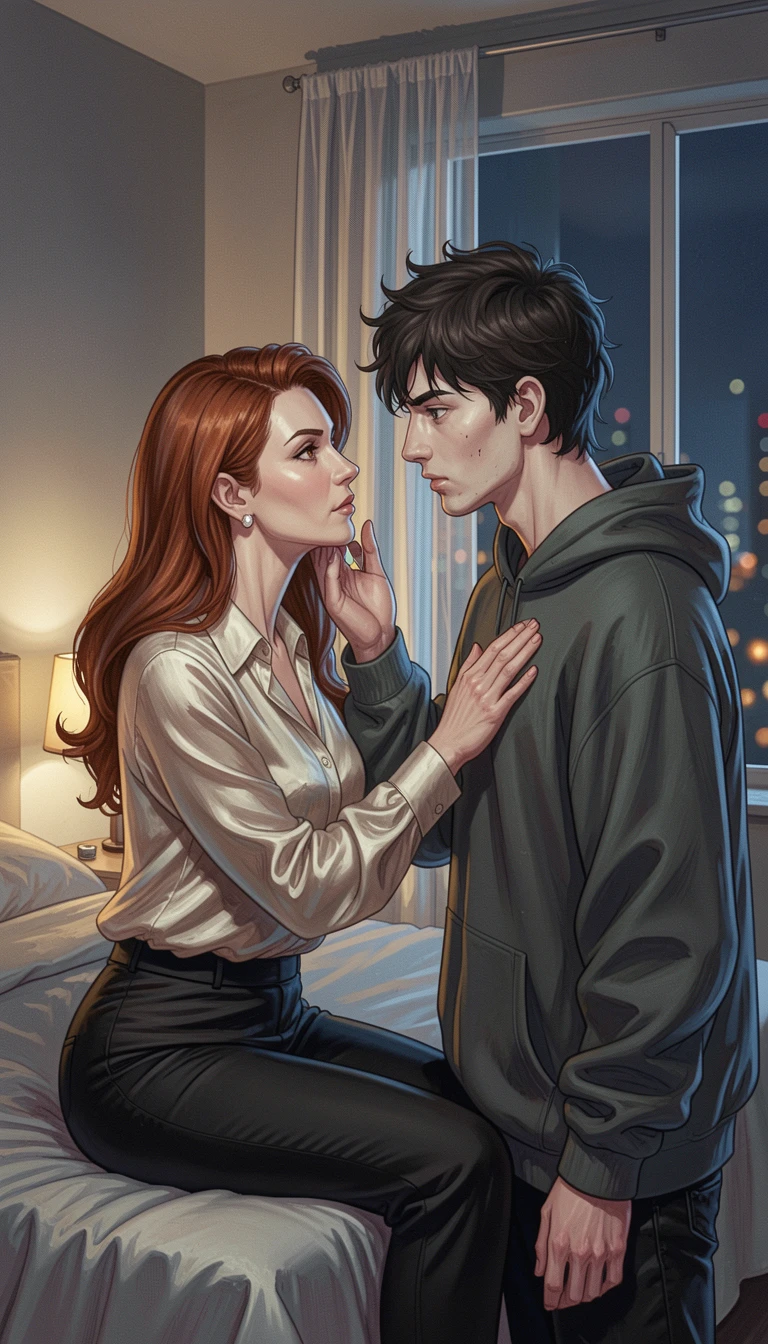
The roast had been resting nineteen minutes. Vivienne knew because she had set the timer herself, because the timer sat on the counter beside the stove where she could see it, because she had learned in the first year of this marriage that a dry roast was a thing Harry would never mention and never forget. She had also learned, in that same year, that the children ate at seven whether their father was home or not, and that the long table looked obscene with only three places set at its head.
She carved at the sideboard, her back to the room, the blade catching the chandelier light in a long silver stroke. The meat parted under the knife in thin, even slabs. Pink at the center. She laid each slice onto the platter in a fan, the way her mother had done, the way she had done for twenty years of dinners that ended in silence or in arguments she won.
"Sera, the potatoes."
"Already on it." Her stepdaughter's voice came from the kitchen, bright and quick. Sera had come in from tennis with her ponytail damp at the ends and her cheeks still flushed, and she had washed her hands without being asked, which was one of the small things Vivienne had decided to notice and not to praise. Praise made Sera self-conscious. Sera was the only one in this house who did things right without needing to be told twice.
The other one sat already. He had been sitting when Vivienne came down, which was unusual, and he had not said a word about it, which was more unusual. Nate sat at his place to her left, his hands flat on the table on either side of his empty plate, his oversized hoodie sleeves pushed up to his elbows. He had not changed out of the clothes he'd worn all day. His dark hair fell over his brow in a way that made her want to reach across the table and push it back — not out of tenderness. Out of a desire for order. She had given up on that particular correction a year ago, after he'd simply stared at her until she stopped talking.
Vivienne brought the platter to the table and set it down. The silver rang against the mahogany. She took her seat at the head, smoothed the napkin across her lap, and looked at the two of them in turn.
"How was the day."
Not a question. A call to order.
"Fine." Sera dropped into her chair with the boneless grace of a girl who had spent two hours chasing a ball and was now prepared to eat like she'd been starved. "Actually, more than fine. I got the internship. The one at the gallery, the one I told you about."
"The one in the city."
"Yes. Three days a week, starting next month. I'll need to take the train, but it's fine, I've got the schedule worked out already—"
"You'll take the car." Vivienne lifted the serving spoon. "I'm not having you on the platform at nine at night."
"Mom—"
"Vivienne." She said it without heat, the correction of a name that Sera had never quite gotten out of the habit of using, and Sera rolled her eyes but let it go, reaching for the potatoes. Vivienne watched her pile them on without comment. Sera had her father's appetite and her mother's metabolism, and Vivienne had long since decided that some blessings were not to be questioned.
She turned to the other end of the table.
"And you."
Nate had not touched his food. His fork lay beside his plate, the tines pointed at nothing. He looked up when she spoke, and for a moment his gray eyes were exactly where they always were — on her face, on her mouth, on the small movement of her throat as she swallowed. She had grown used to it the way one grows used to a draft from a badly fitted window. You stopped feeling the cold. You just knew, always, that it was there.
"Nothing much," he said.
"Nothing much."
"Went to the library. Came back."
"That's two things."
He blinked. "I guess."
Sera snorted into her water glass. "God, Nate. Do you have to be like this every single night?"
"Like what."
"Like a hostage." She said it cheerfully, the way she said everything, and reached for the bread. "Vivienne asks you a question and you answer like you're being interrogated. It's dinner. It's not the police."
Nate's mouth moved — not quite a smile, not quite anything. He picked up his fork. He cut a piece of roast and put it in his mouth and chewed, slowly, his eyes on his plate.
Vivienne watched him chew. There was something different tonight. She couldn't name it, and she did not like things she couldn't name. For three years she had read this boy like a poorly printed menu — the sullen silences, the hooded stares, the way he left a room when she entered it and entered it again when he thought she wasn't looking. She had catalogued his habits the way she catalogued everything: the late nights, the closed door, the laptop angled away from the hallway. She had decided, somewhere in the second year, that he was harmless in the way that all lonely boys were harmless, which was to say: harmless until they weren't, and then someone else's problem.
But tonight he was chewing like a man who had already eaten.
"The roast is good," Sera said, around a mouthful.
"Don't talk with your mouth full."
"Sorry." She swallowed. "It's good."
"Thank you." Vivienne lifted her wine glass and took a sip. The wine was a Bordeaux Harry had brought back from a trip in the spring, and it was too good for a Tuesday, but she had opened it anyway, because the house felt too large tonight and the wine made it feel smaller. She set the glass down and circled the rim with one finger, listening to the small ringing sound it made against the crystal.
"You know what I was thinking about today," Nate said.
Vivienne's finger stopped.
He didn't usually start conversations. He answered them, when he had to, and then he disappeared. Sera looked up from her plate, fork suspended, the same surprise flickering across her face that Vivienne felt behind her own.
"What," Sera said, when Vivienne didn't.
Nate cut another piece of meat. He did it carefully, the knife sawing in small, precise strokes, and Vivienne found herself watching his hands the way she watched the hands of anyone who handled a blade. His knuckles were pale. His fingernails were clean. He was, she realized, a boy who had been taught to hold a knife properly and had never quite stopped being grateful for it.
"Money," he said.
"Money."
"Yeah." He put the piece in his mouth. Chewed. Swallowed. "How useful it is. How it kind of — solves things. You know?"
Vivienne set her fork down. She did it slowly, deliberately, the way she did everything, and the sound of the tines against the china was the loudest thing in the room.
"That's a strange thing to think about over dinner."
"Is it?" He looked up. His eyes were gray and flat and very steady. "I was reading about it. In the library. There's this whole — I don't know — philosophy of it. How money isn't just stuff. It's options. It's the ability to do what you want and not have to explain yourself."
"That's a very cynical way to look at it."
"Is it cynical?" He tilted his head. "I think it's just true. Dad's money is why we live here. It's why Sera can take the train to her internship and not worry about the fare. It's why you don't have to work."
The last sentence landed in the middle of the table like a dropped glass.
Sera's fork clinked against her plate. "Nate."
"What? It's true. I'm not saying anything bad about it. I'm saying it's useful." He looked at Vivienne. He did not look away. "It's useful to have money. It's useful to be the person who has it. And it's — I don't know — interesting. To think about what people do when they don't have it. Or when they're scared of losing it."
Vivienne's hand had found her wine glass again. She did not remember reaching for it. Her fingers closed around the stem, and she felt the cool of the crystal against her palm, and she thought, with a clarity that surprised her, that she had been wrong about this boy. He was not harmless. He was patient. And patience, in her experience, was the most dangerous thing a person could have.
"Nathaniel," she said.
"Yeah."
"What exactly are you trying to say."
The question came out lower than she intended. Measured. She had spent twenty years learning to make her voice do that — to drop an octave when the room got loud, to slow down when she wanted to be heard. It had worked on boardrooms and on caterers and on Harry, when Harry needed to be managed. It had never once worked on this boy, who had spent three years watching her use it and had never seemed impressed.
Nate set his knife down. He set it down carefully, parallel to the fork, the way you set down a tool you intend to pick up again. Then he folded his hands on the table in front of him, and he looked at her, and for the first time all evening he smiled. It was a small smile. It did not reach his eyes.
"I'm not trying to say anything," he said. "I'm just making conversation."
"You don't make conversation."
"Maybe I'm trying to start."
Sera pushed her chair back. The legs scraped the floor, and she stood, her napkin falling from her lap to the carpet. "Okay, I'm going to go do my reading. This is — this is weird. You're being weird."
"Sera."
"No, I mean it." She looked at Nate, and then at Vivienne, and there was something in her green eyes that Vivienne did not want to name — a flicker of something older than her years, a recognition of a shape she had seen before and did not like. "You're being weird, Nate. You've been weird all week. And you—" she turned to Vivienne, and stopped, and whatever she had been about to say died in her mouth. "Never mind. I'm going upstairs."
She left. Her footsteps crossed the hall and climbed the stairs, and then the house was quiet, and the chandelier hummed, and the roast sat cooling on the platter between them.
Vivienne did not move. She did not look at her wine. She looked at her stepson across the corner of the table, at his folded hands and his flat gray eyes and the small, patient smile that had not moved, and she felt — for the first time in a very long time — the specific, cold sensation of a room that had stopped being hers.
"Eat your dinner," she said.
"I'm not hungry."
"I didn't ask if you were hungry."
"No," Nate said. "You didn't."
He picked up his fork. He cut another piece of meat. He put it in his mouth, and he chewed, and he watched her over the rim of his plate, and Vivienne sat at the head of her own table with her hand wrapped around a glass of Bordeaux and understood, without being able to say how, that the evening was not over. That it had barely started. That the boy across from her had been waiting for something for a long time, and that tonight, for whatever reason, he had decided to stop waiting.
She took a sip of the wine. It tasted like nothing.
"You should finish your plate," she said, and her voice did not tremble, and she was proud of that, and she hated that she was proud of it. "And then you should clear. I'll be in the study."
"Sure."
She rose. She gathered her glass and her napkin and her dignity, and she walked out of the dining room with her back straight and her heels clicking on the hardwood, and she did not look back, because she had learned long ago that looking back was how you lost.
Behind her, in the long room with the humming chandelier, Nate sat alone at the table with his knife and his fork and the cooling roast, and he watched the doorway she had passed through for a long moment after she was gone.
Then he picked up his fork again and finished his dinner.
Vivienne closed the study door behind her and stood for a moment in the dark, her back against the wood, listening to the house. The dishwasher hummed in the kitchen. Somewhere above her, the floorboards creaked under Sera's weight. And below it all, the low, steady thrum of the chandelier in the dining room, which she had never once been able to find the switch for and had stopped asking about years ago.
She crossed to the desk and sat down. The leather chair sighed under her. She did not reach for the lamp. She sat in the half-dark with her hands flat on the blotter, and she breathed, and she made herself count — four in, hold, four out — the way a therapist had taught her after Richard died, back when the whole world had felt like a room that had stopped being hers and she had needed something to grip.
It didn't work tonight. The counting only made her think about the boy at the table, the way he had folded his hands, the way he had said Dad's money is why we live here as if he were reading it off a card.
She opened the laptop.
It was a stupid thing to do. She knew it was stupid while she was doing it. But she had spent twenty years learning that the cure for a bad night was a small, expensive, entirely unnecessary purchase, and she was not about to unlearn it now. The screen bloomed to life and threw her face back at her in the dark glass, and she typed the address of the boutique she'd been circling for a week — the one on Madison, the one with the window she always slowed down for.
The site loaded. The dress was on the front page. It had been on the front page for six days.
She had seen it first in the window, walking past with Harry on their way to dinner, and she had stopped without meaning to. Deep green silk. A bias cut that would fall like water. Sleeves to the elbow, a neckline that showed the collarbone and nothing else, the kind of dress that made a woman look like she had never once been surprised by anything. Harry had said, You'd look good in that, the way he said things, and she had said, Mm, and they had kept walking, and she had thought about it every day since.
"Oh," she said, out loud, to the empty room. "There you are."
She clicked it. The dress filled the screen, and the model wearing it was twenty-two and had no idea what the dress was for, and Vivienne looked at it anyway, at the way the light moved across the silk, and she felt the small, private pleasure of wanting something that was hers to want. This was hers. This was the one thing in this house that had nothing to do with Harry's money or Nate's gray eyes or the roast cooling on the platter. This was a dress.
"Emerald," she said, to no one. "Not green. Emerald."
She scrolled down. Size four. She knew her size. She had known her size for fifteen years and it had not changed, which she considered a kind of achievement, and she clicked it, and the button turned from gray to black, and she reached for her card without having to look for it because it lived in the same slot in her wallet it had lived in for a decade.
She typed the number. She typed the security code. She hit complete purchase.
The page spun. A little gray wheel, turning. She watched it the way you watch a kettle.
Then the screen changed, and the words came up in a box the color of a bruise.
Insufficient funds.
Vivienne looked at it. She read it twice. She read it a third time, the way you read a word in a language you thought you spoke until suddenly you didn't.
"That's — " she said, and stopped, and laughed, a short, flat sound with nothing in it. She went back. She re-entered the number, all sixteen digits, slowly, deliberately, the way she entered numbers when she wanted a clerk to know she was watching. She hit the button again.
Insufficient funds.
"What the fuck," she said.
She said it quietly, because the walls in this house were thin in the places you least expected, but she said it, and she heard her own voice do it, and the sound of it in the dark study was worse than the words on the screen. Vivienne Ashford did not say what the fuck. Vivienne Ashford said goodness and for heaven's sake and, on the rare occasions she was truly furious, this is unacceptable. She had built a whole life out of not saying what the fuck, and here she was, saying it, alone, at nine-forty at night, to a laptop.
She closed the browser and opened the bank.
The login page came up. She typed her username — she had chosen it herself, vashford44, because she liked the way the number sat at the end of it like a signature. She typed her password. She hit enter.
The information you entered does not match our records.
She sat back. She looked at the screen. Then she leaned forward and typed it again, more slowly, watching each character land, because she had typed this password four hundred times and it had never once been wrong, and there was no version of the world in which she had forgotten it.
The information you entered does not match our records.
"No," she said. "No, that's not — "
She hit the forgot password link. The page asked her to confirm her identity. It asked for the last four of her social, and she gave them. It asked for her mother's maiden name, and she gave it — Whitlock — and she gave it with a small, absurd flare of pride, because her mother's maiden name was the kind of name that made people sit up, and she had never once minded being asked for it.
The page thought about it.
We are unable to verify your identity at this time. Please contact your local branch.
Vivienne stared at the words. Her hand had gone cold on the mouse. She looked at the clock in the corner of the screen — 9:47 — and then at the actual clock on the mantel, the little brass one Harry had brought back from London, and they agreed with each other, which somehow made it worse. Nine forty-seven. The bank closed at five. The bank had closed at five four hours and forty-seven minutes ago, and there was no one at the end of a phone who could fix this, because there was never anyone at the end of a phone after five, that was the entire point of banks.
She called anyway.
The number was on the back of the card. She dialed it with the speaker on, and she listened to the hold music — something smooth and faceless, saxophone over a drum machine — and she waited, and she tapped her nail against the desk, and after four minutes a woman's voice came on and asked for her account number, and Vivienne gave it, and the woman asked for her name, and Vivienne gave that too, and there was a pause, and then the woman said, in a voice that had been trained to sound like it cared,
"I'm sorry, ma'am, I'm not showing an active account under that number."
"That's — " Vivienne's jaw tightened. "That's not possible. I've banked there for nineteen years. My husband has banked there for thirty."
"I understand, ma'am. I'm just not seeing it on my end. It may be a system issue. You'd want to speak with your branch directly."
"And when do they open?"
"Nine o'clock."
"Nine o'clock," Vivienne repeated, and she heard herself do it, and she hated the way it came out — not a question, not a command, just a woman in a dark room saying a time back to a stranger because she could not think of anything else to say.
"Is there anything else I can help you with tonight?"
"No," she said. "No, there isn't."
She hung up. The saxophone cut off mid-phrase, and the study went quiet, and the dishwasher in the kitchen finished its cycle with a long, mechanical sigh, and Vivienne sat in her chair with the dead phone in her hand and her heart going too fast under her silk blouse.
She made herself think.
It was a system issue. That was the obvious answer. The bank's systems went down all the time — she had read about it, some ransomware thing in the spring, half the country's accounts frozen for a day. It happened. It was boring. It was the kind of thing that would be fixed by a phone call at nine-fifteen tomorrow morning and a woman at a desk saying so sorry for the inconvenience, Mrs. Ashford, and Vivienne would say quite all right and go buy the dress and that would be the end of it.
Except the password.
The password was the part that didn't fit. A system outage did not change your password. A system outage did not tell you your mother's maiden name was wrong. Someone had gone into her account and changed the password, or the bank had, and either way it meant a person, and a person meant a reason, and Vivienne had spent her whole life being very good at knowing when a room had turned against her.
She thought about Nate.
She did not want to think about Nate. She pushed the thought away the way you push a door shut with your hip, and it came back anyway, the way that kind of thought always does. Money. How useful it is. What people do when they're scared of losing it. He had said it at dinner. He had said it to her face, over the roast, with his knife and fork set parallel like a man who intended to pick them up again.
But that was absurd. He was nineteen. He was a boy in an oversized hoodie who couldn't look a girl at his college in the eye. He did not have access to her bank. He did not have her password. The idea was — it was the kind of idea you had at nine-fifty at night in a dark room, and it was not the kind of idea you had in the morning.
She would go to the branch. First thing. Before the coffee. She would stand at the counter and she would ask for the manager by name — Mr. Ellery, she had known him for years, he had handled the mortgage on the first house — and she would sit in his office and she would not leave until someone explained to her, in plain English, why a woman with her name and her history and her husband's money could not buy a dress.
She closed the laptop. The screen went dark, and her face disappeared with it, and the study was just a room again, with a desk and a chair and a brass clock ticking on the mantel.
She stood. Her legs were steady. She was pleased about that, in a small, private way, the way she was pleased about her size staying a four. She gathered her wine glass — still half full, the Bordeaux gone flat and warm — and she carried it out of the study and up the stairs, and she did not look at the dining room as she passed it, and she did not look at the light still on under Nate's door at the end of the hall, and she went into her bedroom and closed the door and locked it, which she had never once done in nine years of marriage, and which she did tonight without letting herself think about why.
She set the glass on the nightstand. She sat on the edge of the bed and looked at the wall, at the framed photograph of her and Harry in Santorini, both of them squinting into the sun, and she thought, with the flat clarity of exhaustion, that tomorrow she would fix this. Tomorrow she would go to the bank, and it would be a system issue, and she would buy the dress, and none of this would have happened.
She lay down in her clothes. She did not turn off the lamp.
Down the hall, the light under Nate's door stayed on for a long time after hers did.
She woke to light that was wrong.
Too bright. Too high in the sky. The kind of light that belonged to a day already half over, and Vivienne lay in it for a long moment with her eyes half open, watching dust turn in the beam that fell across her pillow, trying to place the feeling in her chest. It was the feeling of waking up in a hotel room you didn't remember checking into. The feeling that something had happened while you were asleep, and the world had moved on without telling you.
She turned her head. The lamp was still on, burning pale and useless against the noon. She had not turned it off. She had not undressed. She was still in last night's silk blouse, crushed and damp against her skin, and the Bordeaux glass sat on the nightstand with its last inch gone flat and warm.
She sat up too fast. The room tilted, settled. She grabbed her phone off the charger and looked at it.
12:07.
Twelve-oh-seven. She had not slept past seven in — she could not remember the last time. She was a woman who woke at six, who did her Pilates before the house stirred, who had her coffee and her quiet hour before the day could make its demands. She was not a woman who slept until noon in her clothes with the lamp on.
She sat on the edge of the bed and pressed the heels of her hands into her eyes until she saw color. The bank. She had to get to the bank. Mr. Ellery, she thought, the manager, the one who had handled the mortgage on the first house, and she clung to the name like a handhold.
She stood. Her legs were steady. She walked to the bathroom and ran the shower hot and stood under it with her palms flat on the tile, letting the water beat the night off her, and she did not let herself think about the password. She did not let herself think about the words on the screen, the information you entered does not match our records, because she had a plan now, a simple plan, and a plan was a thing you executed, not a thing you worried at like a loose tooth.
She dressed in cream linen. Wide-legged trousers, a sleeveless shell, her good watch, the small diamond studs. She put on her face — concealer where the night had left its marks, a sweep of mascara, the lipstick she wore when she wanted a clerk to look at her mouth while she spoke. She looked at herself in the full-length mirror and she saw Vivienne Ashford, and the sight of her steadied something that had been loose all night.
The kitchen smelled of coffee.
She stopped in the doorway. Nate sat at the island with his back to the window, his laptop open in front of him, a mug in his hand. He had not showered. His dark hair hung in his face, and his oversized hoodie had a stain on the cuff, and he looked up when she came in with the slow, unsurprised look of a man who had been waiting for her.
"Morning," he said.
Vivienne did not answer. She walked past him to the espresso machine and set about making her coffee with her back to him, the way you turn your back on a dog you don't want to engage. She heard him take a sip. She heard the soft click of the mug against the marble.
"You're up late," he said.
"I'm not in the mood, Nate." She did not turn around. "I need to get to the bank."
"Money."
The word landed in the room and hung there. It was not a question. It was not even a statement. It was a word he had been holding in his mouth since last night, and he set it down on the counter between them like a key.
Vivienne's hand stopped on the machine. She turned. "What does that mean?"
Nate shrugged. He was looking at his screen, scrolling with one thumb, unhurried. "You can go to the bank if you want. It won't change anything."
"I'm sorry?"
"It won't change anything," he said again, and there was something in his voice now, a patience that did not belong in a nineteen-year-old, a patience that belonged in a man who had already won and was simply waiting for you to catch up.
"You piece of shit," she said.
The words came out of her before she could stop them. They came out hot and low and they were not words she had ever said in this house, to anyone, and she heard herself say them and she did not take them back. She stood there in her cream linen with her coffee half made and her whole body shaking with a fury she had not let out in years.
Nate smiled.
It was a small smile. It did not reach his eyes. It was the smile of a boy who had been collecting ammunition for a long time and had just fired the first round.
"That's not very ladylike," he said. "What would the neighbors think?"
"What the hell did you do?"
"I took control of your account." He said it simply, the way you'd say I took out the trash. "Your account. Not Harry's."
The room went very quiet. The espresso machine hissed. Somewhere in the house a clock ticked.
Vivienne felt the blood drain out of her face. She felt it go, felt the heat leave her skin in a rush, and she stood there in her kitchen in her cream linen and she understood, in the flat, clear way you understand a thing you have been avoiding for years, that he was not talking about the joint account. He was not talking about the account Harry's salary went into, the one she and Harry both drew from, the one that paid for the house and the cars and the private schools that were already done.
He was talking about the other one.
The one Harry did not know about. The one Harry could not know about. The one she had opened eleven years ago, in her maiden name, at a different bank, with a different address, and fed a little at a time — a percentage here, a skim there, money she told herself was insurance, was independence, was the thing that would keep her from being a gold digger who had to ask her husband for permission to buy a dress. The account that was hers and hers alone, that no one in the world knew about except her and the tax software and now, apparently, the boy in the stained hoodie sitting at her kitchen island.
"You can't," she said. Her voice came out thin. "You can't do that. That's — I'm your stepmother."
Nate's smile widened. It was the first genuine smile she had ever seen on his face, and it was the worst thing she had ever seen.
"I know," he said. "It makes it so much more perfect."
She moved before she thought. She crossed the kitchen in three steps, her hand coming up, her palm open — she was not going to hurt him, she was not the kind of woman who hit people, but she was going to slap him, she was going to slap the smile off his face, she was going to make him understand that there were lines and he had crossed every one of them —
His hand caught her wrist.
It happened so fast she did not see it. One moment her arm was swinging, the next his fingers were locked around her wrist, and he was standing, and he was taller than she had let herself remember, and his grip was not the grip of a boy in an oversized hoodie. It was the grip of a man who had been waiting for this exact moment, who had rehearsed it, who had thought about what he would do when she finally swung.
"Stop," he said.
The word was quiet. It was not loud. It was the quietest word she had ever heard him speak, and it stopped her cold, because it was not a request. It was not a plea. It was an order, and her body heard it before her mind did, and her body obeyed.
He did not let go of her wrist. He held it, not hard, not soft, just there, his thumb pressing into the thin skin over her pulse, and she could feel her own heart going under his fingers, going fast and trapped, and she knew he could feel it too.
"I'll remember this," he said. "You trying to hit me. That's — that's going to be a thing we come back to."
"Let go of me."
"No."
"Nathaniel."
"No." He said it again, and his gray eyes held hers, and there was nothing in them that she recognized. "What do you want," she said, and her voice broke on the last word, and she hated it, hated that she had let him hear it break. "What the hell do you want from me?"
He smiled again. It was the same smile. It was the smile of a boy who had been watching from the edges for years, cataloging every disgusted glance, every curled lip, every time she had looked through him like he was furniture. And now he was not furniture. Now he was the only thing in the room.
"You'll do what I tell you," he said.
He let go of her wrist. She stood there, frozen, her hand still half raised, and he reached over and closed his laptop with a soft click. He picked it up under his arm. He looked at her for a long moment, and then he said, as if it were nothing, as if it were the most natural thing in the world,
"I sent you the funds for the dress."
The dress.
The dress she had been looking at when she opened the browser. The dress she had been about to buy when the card was declined. The dress she had looked last night, alone, in her study, with no one watching — except he had been watching. He had been watching the whole time.
"Don't go to the bank," he said. "I'll know."
He walked past her. He walked out of the kitchen, and the house was very quiet, and she heard his footsteps on the stairs, and then she heard his door close down the hall, and she stood alone in her kitchen with her coffee half made and her wrist still warm where his hand had been.
The espresso machine hissed again.
Vivienne looked down at her wrist. There was a red mark where his thumb had pressed, a thin crescent of pressure against her skin, and she touched it with her other hand and it was tender, and she stood there in her cream linen in her kitchen at noon and she understood, with a clarity that felt like falling, that she was not going to the bank. She was not going anywhere. She was going to stand here in this kitchen and make her coffee and pretend that her life had not just been picked up and turned over like a rock, and she was going to do it because there was nothing else she could do.
She made the coffee. Her hands were steady. She took it to the island and she sat where he had been sitting, and she opened her phone, and she looked at her bank balance.
The funds were there. Enough for the dress. Enough for a hundred dresses. He had sent her the money from her own account, the one he had taken, and the notification was dated this morning, and it was addressed to her, and it said, in the dry language of banking, that the transfer had been completed successfully.
She sat in his chair and drank her coffee and looked at the number on the screen, and she did not feel like Vivienne Ashford. She felt like a woman in a borrowed body, sitting in a kitchen that was no longer entirely hers, wearing cream linen that suddenly felt like a costume.
Down the hall, his door was closed. The house was silent. Somewhere a clock ticked, and the coffee went cold, and Vivienne sat there a long time, holding her phone like a hand grenade, and did not move.
She didn't change. That was the first thing. She stood up from his chair with her coffee still in her hand, walked it to the sink, poured it down the drain, rinsed the cup, set it in the rack. She wiped the island where his laptop had sat. She straightened a bowl of lemons that didn't need straightening. Then she went upstairs, and she took off the cream linen, and she put on the black Chanel jacket and the pencil skirt and the heels that made a sound like a gavel on hardwood, and she did her face in the mirror — base, powder, the lipstick that cost more than his phone — and she looked at herself the whole time she did it.
That's what he doesn't understand, she thought. He thinks he's holding a leash. He's holding a photograph. A photograph is a thing you can take away from a boy.
Her purse was on the bench by the door. Keys inside. She checked for them twice, the way she checked for them before a flight — passport, wallet, keys, the little ritual that had gotten her through two marriages and one funeral and every boardroom she'd ever walked into. The house was quiet. His door was still closed down the hall, and she walked past it without slowing, and she did not look at it, and her heels went tock, tock, tock across the foyer tile like a woman who owned the place.
The garage smelled of gasoline and cedar. Her car was the black one, the sedan, the one Harry had bought her for their fifth anniversary with the bow still on it in the driveway and a card that said For all the driving you do for this family. She got in. The seat was cold through the skirt. She pressed the button, and the engine turned over, and the garage door went up with a groan that sounded, for one second, like the house trying to hold her back.
Then she was on the road, and the road was hers.
It was eleven minutes to the bank. She knew because she'd driven it a thousand times — the branch on Chestnut, the one she'd chosen eleven years ago precisely because it was eleven minutes from the house and nobody in her life had ever had a reason to go there. The light at the corner was red. She sat through it with both hands on the wheel, ten and two, the way she'd been taught at sixteen by a driving instructor who'd told her she had excellent posture, and she felt, for the first time since the kitchen, something that was almost like calm. Not calm. The other thing. The thing that comes over you when you've decided.
She was going to walk in there and she was going to sit down with the branch manager — what was his name, the bald one, the one who always offered her water — and she was going to say that there had been a security breach on her account, that a member of her household had obtained her credentials without authorization, that she wanted the account frozen and the access revoked and a fraud report filed, and she was going to say it in the voice she used on contractors and caterers and the woman who'd once tried to seat her at the wrong table at the country club, and it was going to work, because things worked when she said them in that voice.
The light went green.
Her phone buzzed in the cup holder.
She didn't look. She drove. The bank was two blocks ahead, the glass front catching the noon sun, and she pulled into the lot and parked in the shade of the building like she always did, and she sat for a second with her hands on the wheel and then she picked up the phone because she was not a coward and she was not going to let a text message sit there like a spider in a cup.
Nate: Come home.
Nate: For every minute you're not back, I'm spending a hundred dollars of your money.
She read it twice. Then she put the phone in her purse, and she got out of the car, and she walked across the lot with her chin up and her purse on her arm and her heels making that sound on the asphalt, and she did not write back.
Let him. Let him spend it. It was her money, and it was going to be her money again in twenty minutes, and a hundred dollars a minute was a child's idea of a threat. She'd spent more than that on a facial. She'd spent more than that on the dress he'd just bought her with her own money, and the thought of the dress made her jaw tighten, and she pushed it down where she pushed everything.
The doors slid open. The air inside was cold and smelled like carpet shampoo and money. There was a line at the teller windows — four people, a man in a delivery uniform, a woman with a toddler on her hip — and a seating area to the left with four upholstered chairs and a low table with a stack of brochures and a carafe of water and those little paper cones. Vivienne took a chair by the window. She crossed her legs at the ankle. She set her purse on her lap, and she looked at the receptionist's desk, and the receptionist — a girl, twenty-two, twenty-three, with a headset and a name tag that said BRITTANY — looked up and smiled the smile they were trained to smile.
"I'm here to see Mr. Okafor," Vivienne said. "I don't have an appointment."
"Of course, ma'am. I'll let him know you're waiting."
"Thank you."
She sat back. The chair was upholstered in a gray fabric that had been chosen by someone with no opinions. The brochures were about retirement planning and home equity. The toddler was crying in a tired, winding way, and the mother was bouncing him and saying shhh, shhh, and Vivienne looked at the window and the sun on the hood of her car and she waited.
Any minute now.
Her phone buzzed again.
She let it. She counted to ten. She counted to twenty. Then she opened her purse, and she took it out, and she looked.
It was a screenshot.
She stared at it. It took her a moment to understand what she was looking at — the gray bubbles, the little icons, the name at the top of the thread. It was a message thread. It was Nate's phone. And the name at the top of the thread was Dad.
The message was still there. Not sent. Not yet. It was sitting in the compose field at the bottom of the screen, typed out and waiting, and the screenshot had been taken with the cursor still blinking after the last word. It read:
Dad, I don't know how to say this, but I think you should know about an account Viv has that you don't—
The rest was cut off. It didn't matter. She didn't need the rest. She sat in the gray chair in the cold lobby with the brochures and the crying toddler and the receptionist's headset and she read those words four times, and each time they landed a little deeper, like a nail being tapped in.
He hadn't sent it. That was the thing. The little gray arrow was still hollow. The message was still his, still private, still in his hand. He was holding it the way you hold a knife against something you haven't decided to cut yet.
Harry.
Harry, who was in Frankfurt. Harry, who checked his phone at the airport bar and in the back of cars and between meetings, who answered texts with one word and a thumbs-up and never asked a second question because he trusted her, because he had always trusted her, because she had spent eleven years making sure he had no reason not to.
Harry, who did not know about the account. Who would not understand why there was an account. Who would look at a number on a statement and see eleven years of a woman quietly moving money out of the life he had built for her, and who would not hear insurance or independence or the thing that keeps me from being a gold digger — he would hear only the fact of it, and the fact of it was enough. The fact of it was a divorce lawyer's wet dream. The fact of it was the prenup he'd never asked her to sign suddenly mattering, was the house, was the cars, was the life she had organized down to the spice rack, all of it hanging on one hollow gray arrow.
He hadn't sent it.
He was waiting.
She understood, then, in the cold lobby, with the toddler finally going quiet and the receptionist saying something into her headset and the sun moving across the hood of her car, that he had never intended for her to sit down with Mr. Okafor. He had intended for her to get in the car. He had intended for her to drive here. He had intended for her to feel, for eleven minutes, like a woman in control of her own life — and then he had intended to take it away, at the exact moment she had her hand on the door.
The phone buzzed in her hand.
Nate: He's about to land. He checks his phone when he lands.
She looked at the message. She looked at the screenshot behind it. She looked at the receptionist, who was just then lifting the phone receiver and turning her head toward the seating area, her mouth already opening around the shape of a name.
"Mrs. Ashford? Mr. Okafor can see you n—"
Vivienne stood up.
She stood up too fast, and the purse slid off her lap and hit the carpet with a soft thud, and she bent and picked it up, and her face was hot, and her hands were not steady anymore, and she could feel the girl behind the desk watching her, the way people watch a woman who has just remembered something she forgot.
"I'm sorry," Vivienne said. Her voice came out perfectly. That was the miracle of it — her voice came out like poured cream, like it always did. "I've just had a call. I have to go."
"Of course, ma'am. Would you like to reschedule?"
"No." She was already moving. "No, thank you."
She walked out through the sliding doors and the heat hit her like a hand, and she stood on the sidewalk in the noon sun with her purse clutched against her ribs and her heart going like a bird in a box, and she pulled out her phone and she typed with her thumb, fast, her lipstick pressed thin between her teeth.
Vivienne: I'm on my way back.
The reply came in four seconds. She watched the little bubble appear, the three dots, the pause — he was taking his time, even now, even with her standing on a sidewalk with her life in his hand — and then it came.
Nate: Good girl.
She stared at it.
Good girl. Two words. The words you used on a dog. The words you used on a child who'd finally put her shoes on the right feet. He had typed them with his thumbs, in his room, in his stained hoodie, and he had sent them to her, and she was standing on the sidewalk outside a bank she had chosen eleven years ago because nobody in her life had ever had a reason to go there, and she read them and her stomach turned over like a fish on a dock.
Not shame. She had expected shame. What she got was worse. It was hatred — clean, bright, clarifying hatred, the kind she hadn't felt since she was twenty-six and buried her first husband and found out what his business partner had done with the money. She had forgotten she could still feel it. She had spent two decades being pleasant. And here it was, in the noon sun, with her car keys in her hand and a message from a boy in a hoodie calling her a good girl.
She got in the car. She put the phone in the cup holder and she backed out of the space without checking the mirror, which she never did, and a horn blared somewhere behind her and she didn't care, and she drove out of the lot and onto Chestnut with her hands at ten and two and her jaw set so hard her back teeth ached.
Eleven minutes. She had eleven minutes to think of something. She spent the first three of them doing nothing but driving, the way you do when the only thing in your head is a white noise and the road, and then she started, because she was Vivienne Ashford and she did not sit in white noise for long.
He hadn't sent it. That was her leverage, and it was the only leverage she had. The message was still in his drafts, still his to send or not to send, which meant there was still a version of the world in which Harry never saw it — and if there was still a version of the world in which Harry never saw it, then she was not, yet, a woman with nothing. She was a woman with something. She just didn't know what it was worth.
He would want something. He always wanted something. He had sent her the money for the dress before he'd even asked her for anything, which meant the dress was not the price. The dress was the hook. The dress was him showing her, before he asked, that he could put money into her account and take it out and put it back and she would never know which way it was going until he told her.
The light at the corner was red again. She sat through it. She looked at her own hands on the wheel — the diamond on her ring finger, the manicure, the thin crescent of red on her wrist where his thumb had pressed an hour ago, still there, still faintly tender. She touched it with her thumb, the way she had in the kitchen. It was still there. It was going to be there for a while.
The light went green.
She drove the rest of the way home with the radio off and her mind going in circles, and when she turned into the driveway the garage door was already open, which meant he had opened it, which meant he had been watching for her — the app, the camera, whatever it was, he had been watching the driveway and he had opened the door for her like a valet, and she pulled in and killed the engine and sat there in the dark of the garage with her hands on the wheel and the engine ticking as it cooled.
The house door was open. Light spilled down the two steps into the garage. She could hear, faintly, the sound of the television from the living room — something with a laugh track, something stupid — and under it, the low hum of the refrigerator, and under that, nothing. No footsteps. No door. Just the house, waiting, with its door open and its lights on, like a mouth.
She got out of the car. She straightened her jacket. She checked her lipstick in the mirror on the visor, and then she closed the visor and she walked up the two steps and into the house, and she did not know yet what she was going to say to him, and she was going to say it anyway.