

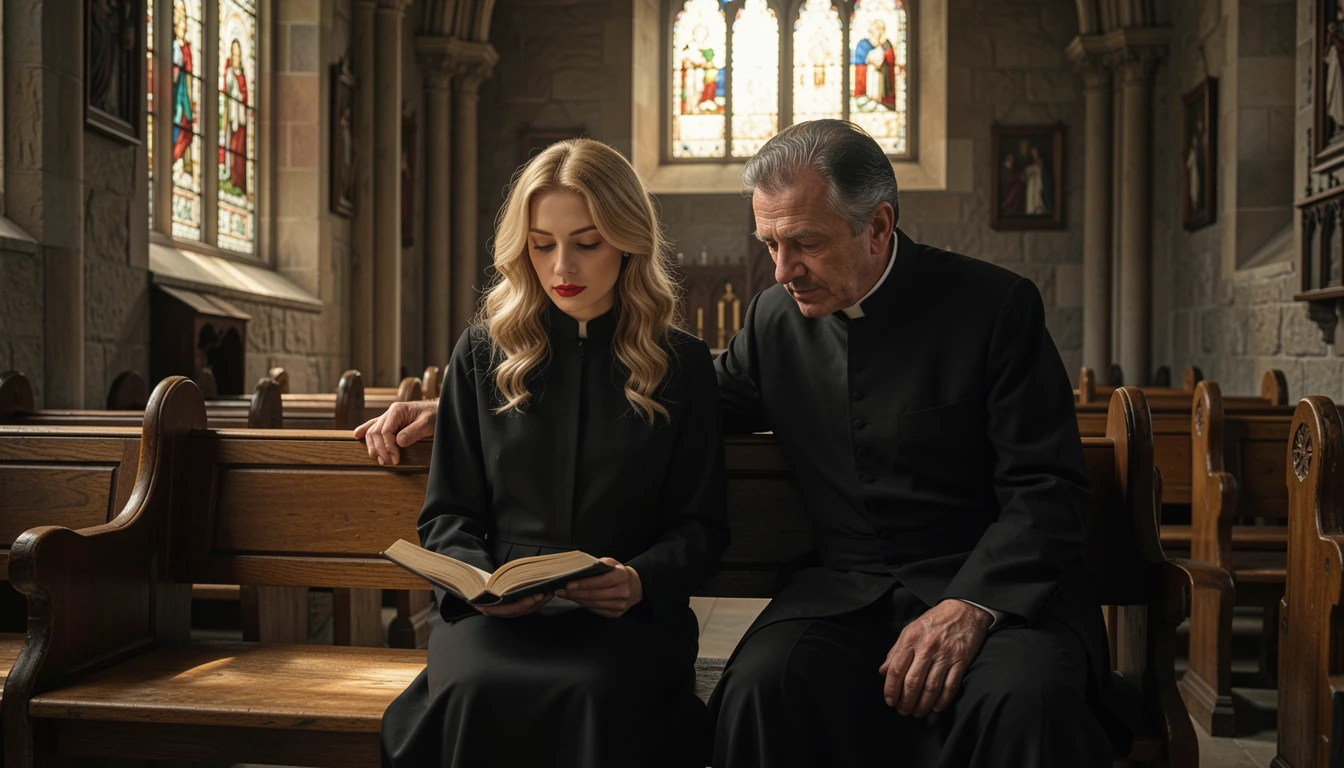
I sat in the front pew of the chapel, the worn cover of Story of a Soul open in my lap. The cold, dusty air prickled my skin, and the single votive candle flickered over the worn stone and polished mahogany, casting shadows that danced like living things. Father Alexei settled beside me, his presence quiet as snowfall, his eyes on the page where Thérèse wrote of doing small things with great love.
"I can't be a cloistered nun," I said, my voice low in the sacred silence. "But I want to know what it is to live a holy life—here, with Dmitri and Irina, with these children in my belly."
He was quiet a moment, the way he always was, letting my words settle into the space between us like stones dropped into still water. His fingers rested on the page, tracing the words as if he could feel the love Thérèse had poured into them a century ago.
"Holiness is not in the size of the act, Isabella," he said finally. "It is in the love you pour into the ordinary."
I looked down at my hands. They were soft now, cared for, the hands of a woman who had been oiled and painted and displayed. But I remembered what they had been—a man's hands, calloused from work I no longer remembered clearly, hands that had never learned to pray. I still wasn't sure I believed what he was telling me. The words felt too simple, too gentle for a life that had been so brutal.
"Tomorrow, when you pour Irina's tea," he added, "when you let Dmitri hold you, when you pray the rosary—that is your little way."
The twins stirred in my belly, a flutter of movement that made me catch my breath. They were getting stronger now, more present. I could feel them pressing against the walls of my womb, demanding space in a world that was still strange to me.
"But how do I know I'm doing it right?" I asked.
Father Alexei smiled, and the candlelight caught the lines of his face, deepening them into a map of kindness. "You don't. You just keep doing it, and let God do the rest."
I wanted to argue. I wanted to tell him that I had spent my whole life—both of my lives—trying to do things right, to perform perfectly, to be what was wanted of me. The idea of simply... letting God do the rest felt like standing on the edge of a cliff and being told to fall backward into darkness.
But the twins stirred again, and I felt something shift in my chest. Not belief, not yet. But a willingness.
"I've never been good at letting go," I admitted.
"No," he agreed. "But you are learning. That is what this season is for."
I closed the book, running my thumb over the worn leather cover. "What if I don't feel the love? What if I'm just going through the motions, pouring tea and praying words I don't understand?"
Father Alexei turned to face me fully, and I saw something ancient in his eyes, something that had watched a hundred souls wrestle with the same question. "Then you pour the tea anyway," he said. "You pray the words anyway. The feeling comes after the doing, Isabella. Not before."
The chapel was silent around us, the candle flame steady now, as if it too was listening.
"Saint Thérèse called it her little way," he continued. "She wasn't a great missionary or a martyr. She was a young woman in a cloister who did small things—mending habits, sweeping floors, smiling at sisters she found difficult—and she did them with so much love that her ordinary life became extraordinary."
I thought of Irina's tea, the porcelain cup with the gold rim that she favored in the mornings. I thought of Dmitri's arms around me in the dark, the weight of his body against mine, the way he held me like I was something precious instead of something useful.
"I'm not sure I know how to love like that," I said. "I've spent so long performing love. Pretending it. Selling it."
"And yet," Father Alexei said gently, "you are here. You have chosen to stay. You have chosen to marry a man who has confessed his sins to you. You have chosen to carry these children, even though you did not choose to conceive them."
I felt the tears prick at my eyes, unwanted and sudden. I blinked them back, the way I had learned to do in the brothel, where crying was a luxury that cost extra.
"Those are not small things, Isabella," he said. "Those are the foundations of a holy life."
The twins moved again, a stronger kick this time, and I placed my hand on my belly, feeling the life beneath my palm. Two sons. Two boys who would never know the man I had been, who would only know the mother I was becoming.
"I'm afraid," I whispered. "Afraid I'll fail them. Fail Dmitri. Fail Irina. Fail God."
"Good," Father Alexei said, and I looked up at him, startled. "Fear is honest. It keeps us humble. It reminds us that we are not in control."
I let out a shaky breath. "That's supposed to comfort me?"
He laughed, a low, warm sound that seemed to fill the chapel. "No. But it should free you. You carry the weight of perfection, Isabella, as if you could earn your salvation by getting everything right. But you cannot. None of us can. That is the point."
I looked down at the book in my lap, at the small, precise handwriting of a woman who had died young, who had promised to spend her heaven doing good on earth. I had read her words last night, curled in my bed with the candle burning low, and something in them had reached into my chest and squeezed.
"She was so young," I said. "Twenty-four. The same age I am now."
"And she did more with her short life than most do with eighty years," Father Alexei said. "Not because she accomplished great things, but because she loved greatly in small things."
The chapel door creaked open, and I turned to see Irina step inside, her dark hair pulled back in its severe bun, her simple black dress modest and elegant. The gold collar at her throat caught the candlelight, and for a moment she looked like a saint from an icon, severe and beautiful and untouchable.
"I thought I might find you here," she said, her voice soft in the sacred space. "Dmitri is looking for you. He has news."
I felt my stomach clench. News could mean anything in this world—a threat, a rival, a complication. I had learned that the quiet moments were never truly quiet for long.
"What kind of news?" I asked, and I heard the wariness in my own voice, the old habit of a woman who had learned to expect the worst.
Irina's expression softened, and she crossed the chapel to sit in the pew in front of us, turning to face me. "Good news, I think. He received a reply from Luca."
My heart stopped. Then started again, too fast, pounding against my ribs like a caged bird.
Luca. The name felt like a wound that had barely begun to heal. I had written to him, forgiven him, invited him to my wedding—and I had told myself I was ready to let him go. But the thought of his reply, of his words reaching me across the distance, made my hands tremble.
"What does he say?" I asked, and my voice came out smaller than I intended.
Irina reached out and took my hand, her fingers cool and steady. "He is coming. He wants to see you before the wedding. To speak with you."
I felt the book slip from my lap, landing on the stone floor with a soft thud. Father Alexei bent to pick it up, his movements unhurried, giving me time to compose myself.
"When?" I managed.
"Tomorrow," Irina said. "He will arrive tomorrow afternoon."
Tomorrow. The word echoed in my head, too close, too soon. I had imagined Luca reading my letter, perhaps feeling regret, perhaps moving on with his life in Milan, surrounded by his paintings and his beautiful things. I had not imagined him coming here. Coming to me.
"Is that... is that wise?" I asked, and I hated how uncertain I sounded. "Dmitri—does he know?"
Irina's grip on my hand tightened. "Dmitri knows. He agreed to it. He said that if you are to marry him, you must be at peace with your past."
I stared at her, at the calm certainty in her dark eyes. "He's not jealous?"
A ghost of a smile crossed Irina's face. "He is a man, Isabella. Of course he is jealous. But he is also a man of faith now, and he believes that hiding from the truth only gives it power."
I thought of Dmitri in the chapel, kneeling before the altar, confessing the murder of a rival and the suicide of a pregnant wife. I thought of the weight he had carried for thirty years, finally released in the presence of God and of me.
"He's braver than I am," I said quietly.
Irina shook her head. "No. He is simply further along the path. You will catch up."
Father Alexei handed me the book, and I took it, feeling the worn leather warm against my palm. "It seems your little way is about to become more complicated," he said, and there was no judgment in his voice, only acknowledgment.
I laughed, a hollow sound. "My whole life is complicated."
"Then you have plenty of opportunity for small acts of love," he said. "Complications are where love learns to grow."
Irina stood, smoothing her dress. "Come. Dmitri is in the study. He wants to speak with you before dinner."
I rose, tucking the book under my arm, and followed her out of the chapel. The cold air of the hallway hit me, and I realized I had been warm in there, warmed by the candle and by something else—something I was still learning to name.
The study was warm, a fire crackling in the hearth, and Dmitri stood by the window, looking out at the grey Moscow sky. He turned when we entered, and his face softened at the sight of me, the hard lines of his features easing into something almost tender.
"Isabella," he said, crossing the room to take my hands. "Irina told you?"
"About Luca," I said. "Yes."
He searched my face, his dark eyes reading me the way he had learned to read me over these weeks. "Are you angry that I agreed to his visit?"
I shook my head. "No. I'm... afraid. But not angry."
He lifted my hands to his lips, kissing my knuckles with a tenderness that still surprised me. "You have nothing to fear. I will be with you when you see him. You will not have to face him alone."
I felt the tears threaten again, and this time I didn't blink them back. "Why are you so good to me?" I whispered. "I don't deserve it."
"You deserve everything," he said simply. "And I intend to give it to you."
Irina had moved to the sideboard, pouring three glasses of wine. She brought one to me, one to Dmitri, and kept one for herself. "To the little way," she said, raising her glass, and I saw the glint of humor in her ebony eyes.
I laughed, despite myself. "You've been talking to Father Alexei."
"I have," she admitted. "He tells me that I should find joy in small things. Like watching you learn to accept love."
I took a sip of the wine, letting the warmth spread through my chest. The twins stirred, responding to the sweetness, and I placed my free hand on my belly.
"They're active tonight," Dmitri observed, stepping closer to rest his hand beside mine. I felt the movement beneath his palm, a kick that seemed to greet him, and his face lit with wonder.
"They know their father," I said.
He looked at me, and there was something raw in his eyes, something vulnerable. "Do you think they know?" he asked. "That I love them already?"
"I think they know," I said. "I think they can feel it."
Irina set down her glass and came to stand beside us, her hand joining ours on my belly. For a moment, the three of us stood there, connected by the life growing inside me, and I felt a peace I had not known was possible.
"What will you say to Luca?" Irina asked quietly.
I considered the question, turning it over in my mind like a stone I had found on a beach. "I don't know," I admitted. "I forgave him in the letter. I told him I still love him. But I don't know what I'll feel when I see him."
"You don't have to know," Dmitri said. "You just have to be honest."
"And if I don't know what honesty looks like anymore?" I asked. "I've spent so long performing, I'm not sure I remember how to just... be."
Dmitri's hand moved from my belly to my face, cupping my cheek with a gentleness that made my chest ache. "Then I will help you remember," he said. "Every day, for the rest of our lives, I will help you remember."
I leaned into his touch, closing my eyes, letting myself feel the warmth of his palm against my skin. In the background, I heard Irina move away, giving us space, and I was grateful for her grace.
"I'm scared," I whispered.
"I know," he said. "So am I."
I opened my eyes, surprised. "You?"
"Of course," he said. "I am marrying a woman who was born a man, who was remade by magic, who carries my children, who has seen the darkest parts of my soul and chosen to stay. I would be a fool not to be afraid."
"But you're not running," I said.
"No," he agreed. "I am staying. That is what love does, Isabella. It stays."
The words settled into me, warm and solid, and I felt something shift in my chest—a lock clicking open, a door swinging wide.
"I want to marry you," I said. "I want to be your wife. I want to raise these children with you and Irina. I want to learn what it means to be holy, not because I'm performing it, but because I'm living it."
Dmitri's eyes glistened, and he pulled me into his arms, holding me against his chest. I felt his heart beating beneath his shirt, steady and strong, and I let myself rest there, in the warmth of him.
"That is all I have ever wanted," he murmured into my hair. "To give you a life worth living."
We stood there for a long moment, the fire crackling, the wine warming on the sideboard, the twins quiet in my belly. And I thought of Thérèse, of her little way, of the small acts of love that made up a holy life.
Pouring Irina's tea. Letting Dmitri hold me. Praying the rosary.
Maybe that was enough. Maybe it was all I needed to do—just keep doing the small things, and let God do the rest.
Tomorrow, Luca would arrive. I would face him, and I would be honest about what I felt. And then I would come home, to this house, to these people, to the life I was building one small act of love at a time.
I pulled back from Dmitri, looking up at him, and I saw my own reflection in his eyes—a woman I was still learning to know, but a woman I was beginning to believe deserved to be loved.
"Will you pray with me?" I asked. "Before dinner?"
He nodded, and we walked together to the small chapel, where the candle still burned, where Father Alexei still sat in the front pew with the worn book open in his lap. He looked up as we entered, and there was no surprise in his eyes, only welcome.
"I thought you might return," he said.
I slid into the pew beside him, Dmitri on my other side, and I reached for both their hands. The twins stirred, a gentle flutter, and I felt the peace settle over me like a blanket.
"Teach me the prayer," I said. "The one Thérèse prayed. Teach me to do small things with great love."
Father Alexei smiled, and in the candlelight, he looked young and old at once, a man who had seen a thousand souls find their way home.
"It is not a prayer you say," he said. "It is a prayer you live."
And so we sat there, the three of us, in the silence of the chapel, and I began to learn what it meant to live a prayer—one small act of love at a time.
The silence in the chapel held us for a long moment, the way it always did when Father Alexei was about to speak something heavy into the air. I felt the weight of it coming before he opened his mouth, a shift in his stillness that I had learned to read in the weeks since he had first taken my confession.
"There is another saint I want to tell you about," he said, his voice low and careful, like a man handling something fragile. "Before you meet Luca tomorrow. Before you face what is coming."
I felt Dmitri's hand tighten around mine, a quiet anchor. Irina had settled onto the pew across from us, her dark eyes fixed on Father Alexei with the same attention she gave the scriptures.
"Her name was Maria Goretti," he said. "She was eleven years old."
The age landed in my chest like a stone dropped into deep water. Eleven. A child. I thought of the twins in my belly, of the lives growing there, and I felt something cold move through me.
"She lived in a small village in Italy, near the marshes of Nettuno," Father Alexei continued. "Her family was poor. Sharecroppers. They worked the land for a man named Serenelli, and they lived in the same building as his family—his wife, his son."
He paused, and I saw something pass across his face, a shadow of the weight he carried from a lifetime of hearing confessions.
"The son's name was Alessandro. He was twenty years old."
The candle flickered, and I felt the cold air of the chapel settle deeper into my bones. I knew where this story was going. I had heard versions of it before, in the brothel, whispered between girls who had been younger than Maria when they learned what men could take from them.
"Alessandro had been troubling Maria for some time," Father Alexei said. "Following her. Watching her. Cornering her when she was alone. She told her mother, and her mother told her to stay close to the house, to avoid him when she could. But there was only so much avoiding a child could do when they shared the same stairwell, the same yard, the same fields."
I felt my throat tighten. I knew the geometry of that trap. The way a girl could be surrounded by people and still be utterly alone with a man's wanting.
"One day, in the summer of 1902, Maria was sitting on the stairs outside her home, watching over her baby sister. Alessandro came home from work. He called her into the house—said he had something to show her. And she went, because she was a good girl, because she had been taught to obey, because she had no reason yet to understand what his eyes meant when they rested on her."
Father Alexei's voice dropped, and the chapel seemed to grow darker around us, the candle struggling against the weight of the story.
"He locked the door behind her. And he attacked her."
I felt Dmitri's hand clench around mine, and I knew without looking that his jaw was tight, that the old rage was rising in him—the rage of a man who had done terrible things and was now learning to feel the weight of them.
"She fought him," Father Alexei said. "She was eleven years old, and she fought him with everything she had. She told him no. She told him that what he wanted to do was a sin. She told him that God would not forgive him."
I felt the tears prick at my eyes, and this time I did not blink them back. I thought of all the girls I had known in the brothel, the ones who had learned too early that no was a word that only worked if a man chose to hear it.
"He had a knife," Father Alexei said. "A long, sharp knife, the kind used for cutting the reeds in the marsh. And when she would not stop fighting, when she would not stop saying no, he stabbed her. Fourteen times."
The number hung in the air, brutal and precise. I felt the twins move in my belly, a flutter of life against the weight of death, and I placed my hand over them, grounding myself in the warmth of their presence.
"She was taken to the hospital in Nettuno. She survived for twenty hours. And in those twenty hours, she did something that has echoed through the Church ever since."
Father Alexei leaned forward, his eyes finding mine in the candlelight, and I saw the gravity of what he was about to say written in the lines of his face.
"She was asked if she forgave her attacker. And she said yes. She said she forgave Alessandro Serenelli with her whole heart, and she prayed that God would forgive him too. She said she wanted him to be with her in heaven."
I felt the breath leave my body. The words seemed impossible, monstrous almost—a child forgiving the man who had carved her open with a knife. It violated every instinct I had, every lesson I had learned about survival and self-preservation.
"How?" I whispered. "How could she—"
"She was dying," Father Alexei said gently. "And she had been taught that forgiveness was not about the other person. It was about freeing herself. She did not forgive him because he deserved it. She forgave him because she refused to carry the weight of her hatred into eternity."
I shook my head, the tears spilling over now, hot against my cold cheeks. "I don't understand. He took everything from her. Her life. Her childhood. Her—" I stopped, the word catching in my throat.
"Her innocence," Father Alexei finished for me. "Yes. He took all of it. And she gave him something anyway. She gave him her forgiveness. Not because it was easy, but because it was the only thing she had left to give."
I thought of Luca. Of the way he had bought me, trained me, shaped me into the woman I had become. Of the way he had held me and told me he loved me even as he was preparing to hand me over to another man. I thought of the rage I had carried, the hatred I had nurtured like a small, poisonous flower.
"I don't know if I can do that," I said. "I don't know if I can forgive the men who used me."
"You don't have to forgive them all today," Father Alexei said. "But there is more to Maria's story. And I think it is the part you need to hear."
He paused, and I felt Dmitri's hand leave mine, only to land on my shoulder, warm and steady. Irina had moved closer, her hand finding my knee, and I felt surrounded by their presence, held up by their silence.
"Alessandro was sentenced to thirty years in prison. He was a young man, barely twenty, and he was filled with rage and hatred. He refused to repent. He refused to acknowledge what he had done. For years, he was considered unreachable, a lost soul."
Father Alexei's voice softened, and I heard something in it that I had not heard before—a tenderness, a reverence.
"Then one night, in his cell, he had a dream. He saw Maria. Not as she had been in life, but as she was in heaven—radiant, beautiful, at peace. She was holding a bouquet of white lilies, and she reached out to him, offering them."
I felt the hair on my arms stand up, the cold of the chapel pressing against me like a living thing.
"She told him that she had forgiven him. That God had forgiven him. That he was not lost."
Father Alexei leaned back, his eyes distant, as if he were seeing the scene himself. "When Alessandro woke, he was changed. He wept for the first time in years. He confessed his crime. He sought out Maria's mother and begged her forgiveness, and she gave it to him—the same forgiveness her daughter had given him with her dying breath."
I felt the tears streaming down my face now, unchecked, unashamed. I thought of the weight of my own past, the men who had used me, the things I had done to survive. I thought of the hatred I had carried, the bitterness that had curdled in my chest like old milk.
"He was released from prison after twenty-seven years," Father Alexei said. "He became a gardener at a monastery. He lived a quiet, holy life. And every year, on the anniversary of Maria's death, he would go to her grave and pray."
He looked at me, and his eyes were bright with tears, a mirror of my own.
"The girl he killed saved him. Not in death, but in forgiveness. She reached across the divide of violence and hatred and offered him her hand. And he took it."
I sat in the silence, the story settling into me like water into dry earth. I thought of Luca, of the way he had shaped me, used me, sold me. I thought of the anger I had felt when I learned the truth—that I was not his final prize but his next placement.
But I also thought of the way he had held me. The way he had taught me to want things for myself. The way he had looked at me in the garden, his eyes full of something that had looked, for a moment, like love.
"I don't know if I can forgive him," I said again, my voice barely a whisper. "He lied to me. He used me. He—"
"He gave you to another man," Father Alexei finished. "Yes. But Isabella—you are not the same as Maria. You are not eleven years old, helpless and innocent. You are a woman who has survived. And that survival has given you something Maria never had."
I looked at him, questioning.
"Choice," he said. "Maria forgave Alessandro because she had nothing left. She was dying, and forgiveness was the only gift she could give herself. But you—you are alive. You are building a life. You are choosing to marry a man who loves you, to raise children, to find God. And in the middle of all that choosing, you can also choose forgiveness."
He reached out and took my hand, his fingers warm and dry against mine.
"Not because Luca deserves it," he said. "But because you do. Because you deserve to be free of the weight of what he did to you."
I felt the words land in me, heavy and light at once. I thought of the letter I had sent, the words of forgiveness I had written before I had truly understood what they meant. I had said I forgave him. But I was not sure I had believed it.
Tomorrow, he would arrive. He would stand before me, and I would have to look into the eyes of the man who had made me and unmade me. And I would have to decide what I wanted to carry forward.
"What happened to Alessandro?" I asked, my voice small. "In the end?"
Father Alexei smiled, a gentle, knowing thing. "He lived to be an old man. He died in the monastery, surrounded by the brothers who had come to love him. And his last words were of Maria—of the girl who had saved him with her forgiveness."
He squeezed my hand. "He spent the rest of his life trying to become worthy of her gift. And I believe, in the end, he did."
The candle flickered, and I felt the twins move in my belly, a flutter of life against the weight of the story. I looked down at my hands, at the soft, cared-for hands of the woman I had become, and I thought of the hands that had held a knife, the hands that had done violence, the hands that had reached out to me in the darkness of a brothel and offered me escape.
"I'm afraid," I said, the words coming out before I could stop them. "Afraid that if I forgive him, it will mean what he did was okay. That it will mean I'm saying yes to what he took from me."
Father Alexei shook his head slowly. "Forgiveness is not approval, Isabella. It is release. It is saying, 'What you did was wrong, and it mattered, and I will not let it define me.' It is not about him. It never was."
I felt Dmitri's hand on my shoulder, warm and steady, and I leaned into it, letting myself be held.
"I don't know if I can do it," I said. "I don't know if I'm strong enough."
"You are stronger than you know," Dmitri said, his voice low and rough. "I have seen you survive things that would have broken lesser women. And I will be beside you tomorrow. Whatever you decide, I will be beside you."
I turned to look at him, at the man who had confessed his sins to me, who had knelt before me in this very chapel and called me holy. He was not the man I had expected him to be. He was something more—something I was still learning to understand.
"What if I can't forgive him?" I asked. "What if I see him and all I feel is rage?"
Dmitri's eyes held mine, dark and steady. "Then you feel rage. And you let it pass through you without letting it take root. And you try again the next day."
Irina moved closer, her hand finding mine. "Forgiveness is not a single act," she said softly. "It is a practice. Like prayer. Like the little way. You do it imperfectly, day after day, and eventually it becomes part of who you are."
I looked at the three of them—Father Alexei with his gentle eyes, Dmitri with his steady strength, Irina with her quiet wisdom—and I felt something shift in my chest. Not forgiveness, not yet. But a willingness to try.
"I don't want to hate him," I said, the words surprising me as they left my mouth. "I don't want to carry that weight anymore. I want to be free."
"Then you are already on the path," he said. "The wanting is the first step."
I sat in the silence of the chapel, the story of Maria Goretti settling into me like a seed planted in dark soil. I thought of the eleven-year-old girl who had forgiven her murderer with her dying breath, and I felt a shame at my own reluctance—and then a grace, a release from that shame.
"She was so young," I said. "And she had so much faith."
"She had a mother who taught her," Father Alexei said gently. "A mother who told her about God's love when she was small enough to believe it without question. She did not have to unlearn a lifetime of doubt."
I felt the weight of that—the years I had spent not believing, not trusting, not hoping. The long road that had brought me to this chapel, to this moment, to these people who had chosen to love me.
"I want to learn," I said. "I want to believe like she did. I want to forgive like she did."
Father Alexei reached into his pocket and pulled out a small, worn card, its edges soft with age. He handed it to me, and I looked down at it in the candlelight.
It was a prayer card, yellowed with years, with an image of a young girl on it—Maria Goretti, her face serene, a lily in her hands. Below the image, in faded ink, were the words of her prayer.
"Take it," Father Alexei said. "Pray it tonight. Pray it tomorrow, before you meet Luca. And when you feel the rage rising, pray it again."
I looked at the card, at the face of the girl who had forgiven the unforgivable, and I felt something stir in my chest—a small, fragile thing, like a candle flame in a draft.
"What does it say?" I asked.
Father Alexei took the card from me and held it to the light, reading the faded words.
"Lord Jesus, I offer You my heart. I offer You my fears, my doubts, my anger. I offer You the wounds I carry, and I ask You to heal them. Give me the grace to forgive as I have been forgiven, to love as I have been loved, and to see Your face in those who have hurt me. Amen."
The words settled into me, simple and profound, and I felt the tears threaten again—not from pain, but from something else. Something like hope.
"I'm not sure I can pray that," I said honestly. "Not yet. Not with my whole heart."
"Then pray it with the part of your heart that can," Father Alexei said. "The rest will follow."
I took the card from him, holding it in my hands like something precious, and I felt the weight of the story settle into me—the story of a girl who had given everything and received everything in return.
Tomorrow, Luca would arrive. I would face him, and I would have to decide what I wanted to carry forward. But tonight, in this chapel, with these people around me, I felt something I had not felt in a long time.
I felt ready.
Dmitri's hand found mine again, and I looked up at him, at the man who had promised to be my lamp, and I felt the fear loosen its grip on my chest.
"Will you stay with me?" I asked. "Tonight? I don't want to be alone with my thoughts."
He nodded, his eyes soft in the candlelight. "I will stay as long as you need me."
Irina rose, smoothing her dress, and I saw the understanding in her eyes—the grace of a woman who knew when to give space.
"I will walk Father Alexei to his rooms," she said. "Take your time."
They left together, their footsteps soft on the stone floor, and I was alone with Dmitri in the chapel, the candle still burning, the prayer card warm in my hand.
I looked at the image of Maria Goretti, at the serenity in her young face, and I felt a question rise in me—a question I was not sure I was ready to ask.
"Do you think she was afraid?" I asked. "When she was dying? When she forgave him?"
Dmitri was quiet for a moment, his hand warm around mine. "I think she was terrified," he said finally. "I think she was in pain, and she was scared, and she was just a child who wanted her mother. But I think she was also brave. Braver than most of us will ever be."
I looked down at the card, at the faded ink, at the words I was not sure I could pray.
"I want to be brave like that," I said. "I want to forgive Luca. Not because he deserves it, but because I want to be free."
Dmitri lifted my hand to his lips, kissing my knuckles with a tenderness that made my chest ache. "Then you will be," he said. "In your own time. In your own way."
I leaned into him, resting my head against his shoulder, and I felt the peace settle over me—a fragile thing, but real. A seed planted in dark soil, waiting for the light.
Tomorrow, Luca would arrive. And I would face him with Maria's prayer in my pocket and Dmitri's strength beside me.
And maybe, just maybe, I would be enough.
I slept in Dmitri's room that night. Not in his bed—Irina had made it clear there were boundaries to respect, lines of propriety that mattered even in a house like this one. But he had a chaise by the window, and he had pillows brought in, and when I woke in the gray hour before dawn, he was sitting in the armchair beside me, watching me with those dark, patient eyes.
"You didn't sleep," I said, my voice rough with the night.
"I slept enough."
"You're lying."
A ghost of a smile crossed his face. "Perhaps a little." He reached out and took my hand, his thumb tracing the lines of my palm. "I wanted to be here when you woke. In case you needed to remember where you were."
The twins stirred in my belly—a flutter, then a stronger kick. I pressed my palm against the swell and felt one of them push back, a small, insistent hello.
"They're awake too," I said.
"They know something important is happening today." He leaned forward, his voice dropping. "They can feel your tension. They are learning from you, Isabella. Even now. Even before they are born."
I sat up slowly, the weight of the day settling onto my shoulders like a cloak I wasn't sure I could carry. Luca was coming. Today. In a few hours, he would walk through these doors, and I would have to look at his face and decide what I wanted to carry forward.
"I need to ask you something," I said. "Both of you."
Dmitri's eyes held mine, steady and patient. "Ask."
"When he comes—when I meet with him—I don't want to do it alone. I need you and Irina to stand with me. Not to speak for me. Not to fight my battles. Just to be there. So I don't forget who I am."
He was quiet for a long moment, and I watched something move behind his eyes—something careful and tender and fierce all at once.
"You are asking me to witness," he said. "To stand at your side while you face the man who made you. That is not a small thing you are asking."
"I know."
"It is a holy thing." He lifted my hand to his lips, pressing a kiss to my knuckles. "Yes, Isabella. I will stand with you. I will stand at your side and I will not move unless you ask me to."
I felt the tears threaten, and I blinked them back. "Irina—"
"She will be there. I will speak to her." He paused. "She loves you, you know. In her way. She would not let you face this alone."
I nodded, not trusting my voice. The twins kicked again, and I placed both hands on my belly, feeling the weight of them, the reality of them. I was carrying life. I was carrying hope. I was carrying a future that had nothing to do with the brothel or the training or the man who had sold me like a painting.
Today, I would face Luca. And I would not be alone.
---
Irina found me in the kitchen an hour later, dressed in a simple gray dress that draped over my growing belly, my hair pulled back from my face. She stood in the doorway for a moment, watching me, and then she crossed the room and took my hands in hers.
"Dmitri told me," she said. "About Luca. About today."
"I should have told you myself. I'm sorry."
"No." She squeezed my hands. "You are not sorry. You are scared. And that is different."
I looked down at our joined hands—her skin pale and smooth, mine still carrying the faint calluses of a life I had left behind. "What if I can't do it? What if I see him and I fall apart?"
"Then you fall apart," Irina said simply. "And we will be there to help you put the pieces back together." She released one of my hands and reached up to touch the silver cross at my throat—her mother's cross, the one she had given me. "You are not the woman he made, Isabella. You are the woman God is making. And she is stronger than you know."
I felt the weight of her words settle into me, and I nodded slowly. "Will you stand with me? When I meet him?"
"I would stand with you against an army." She said it simply, without drama, and I believed her.
---
The morning passed in a haze of small tasks—breakfast that I barely touched, a walk through the garden that Irina insisted on, a prayer in the chapel that I stumbled through with Father Alexei's prayer card clutched in my hand. The words of Maria Goretti's prayer ran through my mind on a loop, a litany I clung to like a lifeline.
Lord Jesus, I offer You my heart. I offer You my fears, my doubts, my anger.
I offered Him my anger. I offered Him the years of being used, the months of being trained, the days of being sold. I offered Him the man who had painted me naked on a chaise and called me his masterpiece, who had given me to another man and called it love.
Give me the grace to forgive as I have been forgiven.
I wasn't sure I could pray that. Not yet. Not with my whole heart.
But I prayed it with the part of my heart that could.
---
The call came at noon.
I was in the sitting room with Irina, pretending to read a book of Russian poetry that I couldn't focus on, when a servant appeared in the doorway.
"The Milanese gentleman has arrived," she said. "He is asking to see the mistress."
I felt the blood drain from my face. Irina's hand found mine, squeezing hard.
"Show him to the study," Irina said, her voice calm and commanding. "Tell him we will be with him shortly."
The servant nodded and disappeared. I sat frozen, the book forgotten in my lap, my heart pounding so hard I could feel it in my throat.
"I can't—" I started.
"You can." Irina turned to face me, her dark eyes fierce. "You are not the woman who left his house in Milan. You are not the concubine he trained. You are Isabella Volkov, the mother of sons, the bride of Dmitri, the sister of Irina. You are holy. And he cannot touch that."
I wanted to believe her. I wanted to feel the truth of her words in my bones. But all I could feel was the fear—the old, familiar fear of the man who had owned me, who had shaped me, who had sold me.
"Dmitri—"
"He is waiting for us." Irina stood, pulling me gently to my feet. "Come. We will walk together."
I let her lead me out of the sitting room, down the long hallway toward the study. My legs felt like they belonged to someone else, my feet moving without my permission. The twins stirred in my belly, restless, as if they could feel my fear.
We reached the study door, and I stopped.
Through the crack in the door, I could see him.
Luca Bianchi stood by the window, his back to us, his salt-and-pepper hair catching the light. He wore a tailored gray suit—the same suit he had worn the day he bought me, or one just like it. His leather notebook was tucked under his arm, and I watched him open it, flip through the pages, close it again.
He was nervous.
The realization hit me like a physical blow. The man who had trained me, who had sold me, who had called me his finest acquisition—he was nervous.
Dmitri was standing near the fireplace, his arms crossed, his face unreadable. He looked up as we entered, and something in his eyes softened when he saw me.
Luca turned.
Our eyes met, and I felt the world tilt.
He looked older. Thinner, maybe, or just tired. There were shadows under his hazel eyes that hadn't been there before, lines around his mouth that I didn't remember. He looked at me, and I watched his face shift—surprise, then something that might have been pain, then a careful, practiced neutrality.
"Isabella." His voice was rough. "You look—" He stopped, swallowed. "You look beautiful."
I felt Irina's hand on my back, steadying me. I felt Dmitri's eyes on me, warm and constant. And I felt the weight of the three tokens at my throat—Irina's cross, Dmitri's medal, Luca's amber pendant.
I reached up and unclasped the pendant.
Luca's eyes followed the movement, and I saw something flicker in them—a loss, a recognition.
"I believe this is yours," I said. My voice was steadier than I felt.
I held out the pendant, the amber catching the light, and Luca stared at it like it was a snake.
"It was my mother's," he said. "I gave it to you because—" He stopped.
"Because you wanted me to have something that was mine," I finished. "But it was never mine. It was always yours. And I need to give it back."
The room was silent. I could hear my own heartbeat, the crackle of the fire, the distant sound of traffic outside.
Luca took the pendant from my hand. His fingers brushed mine, and I felt the old familiar spark—the pull of the man who had taught me pleasure, who had shown me what my body could feel. But it was fainter now, muted by everything that had come after.
"I read your letter," he said quietly. "I read it a hundred times."
"And?"
"And I don't know what to say." He laughed, a broken sound. "I've spent my whole life knowing what to say. Knowing how to shape words into weapons or gifts. But you—" He shook his head. "You've always been different."
"Different how?"
"Different in a way that made me want to be better. And I wasn't. I was the same man I'd always been. I sold you, Isabella. I trained you and I sold you, and I told myself it was for your own good."
"It was," I said. The words surprised me. "You gave me to Dmitri. You gave me a future. You gave me—" I touched my belly. "You gave me these children."
Luca's eyes dropped to my hands, to the swell of my belly, and I watched him process it—the reality of what he had done, the life he had set in motion.
"Are they—" He stopped. "Are they well?"
"They're healthy. Strong. Dmitri has already chosen their names."
"Good." He nodded, his jaw tight. "Good."
The silence stretched between us, heavy with everything unsaid. I felt Dmitri move closer, his hand finding the small of my back, a warm, steady presence.
"I'm getting married," I said. "To Dmitri. In the chapel here."
Luca's eyes flickered to Dmitri, then back to me. "I know. Your letter said."
"I want you to come."
The words hung in the air, and I watched Luca's face shift—surprise, confusion, something that might have been hope.
"You want me—" He stopped. "After everything I did to you, you want me at your wedding?"
"Yes." I took a step toward him, and I felt Irina's hand on my arm, steadying me. "I'm not asking you to be my friend, Luca. I'm not asking you to pretend that what happened between us didn't happen. But you were a part of my story. You helped make me who I am. And I don't want to carry hatred into my marriage."
"You forgive me?" His voice cracked.
"I'm trying to." I reached into my pocket and pulled out the prayer card, worn and soft at the edges. "Father Alexei gave me this. It's a prayer of Saint Maria Goretti—a girl who forgave her murderer as she was dying. I've been praying it every day, trying to find the grace to forgive you."
Luca stared at the card, and I watched something break in his face.
"I don't deserve your forgiveness," he said.
"No. You don't." I tucked the card back into my pocket. "But that's not the point. The point is that I deserve to be free of the anger. I deserve to move forward without carrying you with me."
He was quiet for a long moment. Then he said, "I never meant to hurt you."
"I know." And I did know. I knew that he had believed he was doing the right thing, in his own twisted way. I knew that he had cared for me, in the only way he knew how. "But you did hurt me. And I'm learning to live with that."
Dmitri's hand tightened on my back, a silent reminder that I wasn't alone. I leaned into him slightly, drawing strength from his presence.
"I'll come to your wedding," Luca said finally. "If you want me there."
"I do."
He nodded, and I watched him tuck the amber pendant into his pocket. "I'll keep this safe," he said. "In case you ever want it back."
"I won't."
Something flickered in his eyes—pain, maybe, or acceptance. "No. I suppose you won't."
Irina stepped forward, her voice gentle but firm. "Would you like to stay for lunch? We have plenty."
Luca looked at her, then at me, then at Dmitri. "I—" He stopped. "I don't think that would be appropriate."
"Perhaps not," Irina agreed. "But you are welcome nonetheless."
He hesitated, and for a moment I thought he might stay. Then he shook his head. "I should go. I have a gallery to run, and—" He stopped, a wry smile crossing his face. "And I think I've done enough damage for one day."
He turned to leave, and I felt something rise in my chest—a question I hadn't known I needed to ask.
"Luca."
He stopped, looking back.
"Why did you come? You knew I was getting married. You knew I was with Dmitri. Why did you come?"
He was quiet for a long moment. Then he said, "Because I needed to see you. To see if you were happy. To see if I had—" He stopped, swallowed. "To see if I had broken you."
"And?"
"You're not broken." A sad smile crossed his face. "You're the strongest woman I've ever known, Isabella. And I'm sorry it took me so long to see it."
He left without another word.
I stood in the study, Dmitri's hand on my back, Irina's hand on my arm, and I felt the tears come—not from pain, but from release. The weight I had been carrying, the anger I had been nursing, it all seemed to lift, just a little, just enough to let me breathe.
"You did well," Irina said softly.
"I didn't do anything," I said. "I just—I let him go."
"That was everything." Dmitri turned me to face him, his dark eyes searching mine. "Are you all right?"
I thought about it. I thought about the man who had just walked out of my life, the man who had shaped me and sold me and set me free. I thought about the prayer card in my pocket, the words of a girl who had forgiven the unforgivable. I thought about the twins in my belly, the future I was carrying, the life I was building.
"I think I am," I said. "For the first time in a long time, I think I'm going to be all right."
Dmitri pulled me into his arms, and I rested my head against his chest, feeling his heartbeat under my ear. Irina's hand found mine, and I held it tight.
Tomorrow, I would pray the prayer again. Tomorrow, I would try to forgive a little more. But tonight, I would rest in the arms of the people who had chosen to love me, and I would let myself believe that I was worthy of that love.
I was not the woman Luca had made.
I was the woman God was making.
And she was enough.
That night, I dreamt of the brothel.
Not the way it had been—the chandeliers, the silk, the practiced smiles. I dreamt of it the way it truly was, beneath the polish. The damp smell of the hallway. The way the floorboards creaked under the weight of men who never removed their shoes. Mama Rosa's voice, singsong and sharp, calling me tesoro while her eyes counted the bills in her palm.
And Luca was there, but not the Luca who had left today. He was the Luca of the studio, the one who painted me naked on a chaise and called me his masterpiece. He stood in the corner of the room, watching me with those hazel eyes, and when I opened my mouth to speak, no sound came out.
I woke with my heart pounding, my hand pressed flat against my belly. The twins were still—a rare moment of stillness—and for a terrifying second I thought something was wrong. Then one of them kicked, a sharp, insistent jab against my ribs, and I exhaled.
The room was dark. Dmitri's chaise was empty, the armchair beside it vacant. The fire had burned down to embers, casting long shadows across the walls. I sat up slowly, my back aching from the unfamiliar bed, and I realized I was alone.
Not alone in the house—I could hear the distant sounds of servants moving in the kitchen, the low murmur of voices somewhere below. But alone in the dark, with nothing but the memory of Luca's face and the weight of everything I had done today.
I reached for the cross at my throat—Irina's cross, the one she had given me. My fingers closed around the cool silver, and I held it tight, feeling the engraved letters press into my palm. Nadezhda. Hope.
I had given back the pendant. I had let him go. I had done the thing I had been afraid to do, and I had survived it.
So why did it still hurt?
The door opened, and I looked up, expecting a servant. But it was Irina, her dark hair loose around her shoulders, a silk robe wrapped over her nightgown. She crossed the room without a word and sat on the edge of the bed, her hand finding mine.
"You're awake," she said softly.
"I had a dream."
"About him?"
I nodded. "About the brothel. About the way it was before."
Irina's thumb traced circles on the back of my hand. "Those memories will fade," she said. "In time. They will lose their sharp edges."
"Will they?" I looked at her, searching her face for the truth. "You've never been to a brothel, Irina. You've never been bought or sold. How do you know?"
She was quiet for a moment. Then she said, "I know what it is to be trapped in a life you did not choose. I know what it is to wake up every morning and wonder if this is all there is. I know what it is to be so desperate for love that you let someone shape you into what they want, and then to look in the mirror and not recognize the face staring back."
I stared at her. In all the weeks I had known her, she had never spoken of her own past with such raw honesty.
"What do you mean?" I asked.
She shook her head, a small, sad smile crossing her face. "I was not always Dmitri's wife. I was not always the mistress of this house. I was a girl from a village in Siberia, sent to Moscow at sixteen to work in a factory. And I was—" She paused, choosing her words carefully. "I was taken advantage of. By a man who promised me a better life and gave me nothing but shame."
The words hung in the air between us, heavy and fragile.
"Irina—"
"I do not speak of it often," she said. "Dmitri knows. He was the one who saved me from it. He found me in a house not unlike the one you were kept in, and he brought me out. He gave me a name, a home, a purpose." Her voice cracked. "He gave me everything I had ever wanted. Except a child."
I felt the tears threaten, and I blinked them back. "I'm sorry," I whispered. "I didn't know."
"No one knows." She squeezed my hand. "That is why I know what it is to be remade, Isabella. That is why I know that the woman you were before is not the woman you are now. And that is why I know that you will survive this."
I looked down at our joined hands—her pale skin against mine, the silver cross at my throat catching the faint light of the embers. And I felt something shift inside me, a loosening of the knot I had been carrying for so long.
"Thank you," I said. "For telling me."
"You are my sister," she said simply. "And sisters carry each other's shame."
We sat together in the dark, the silence a comfort rather than a weight. And when I finally lay back down, Irina stayed, her hand resting on the swell of my belly, feeling the twins stir beneath her palm.
"They are strong," she murmured. "Like their mother."
I closed my eyes, and this time, when sleep came, the dreams were gentle.