

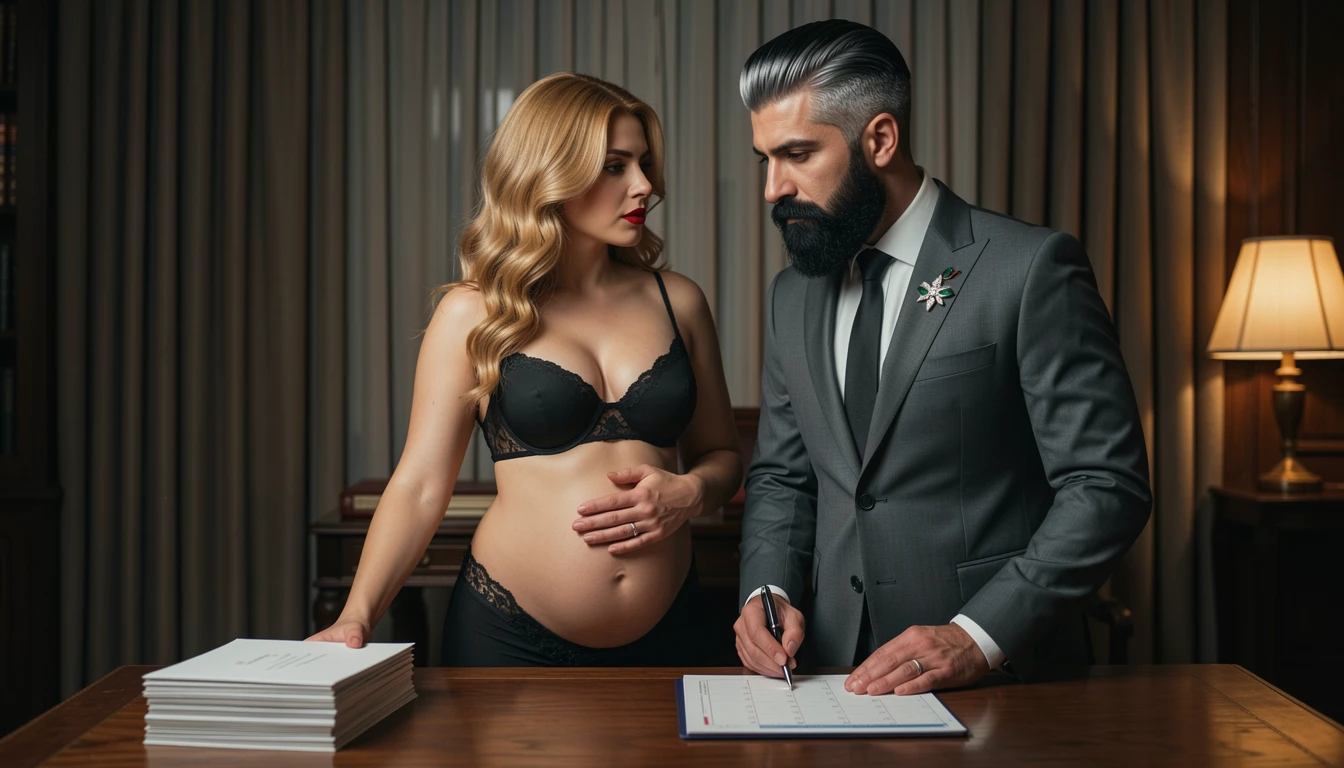
The study smelled of old leather and Dmitri's cologne, the same expensive sandalwood that clung to his suits and now, faintly, to my skin. I stood at the long oak table, my fingers tracing the edges of the invitations stacked beside the calendar—thick cream cardstock, embossed with a gold cross that caught the lamplight. There were forty of them, maybe more, each one addressed in Irina's precise hand.
Irina leaned over the calendar, her dark hair streaked with silver falling loose around her face. She'd let it down tonight, a rare softening, and it made her look younger, almost gentle. Her pen hovered over the month of April, tapping twice against the page.
"Easter Sunday," she said, more to herself than to me. "Then the week after."
Dmitri stood behind me, close enough that I felt the warmth of him through my dress. His hand rested on the swell of my belly, palm flat against the taut fabric, and the twins stirred beneath his touch like they knew him already.
"If we wait too long," he said, his voice low against my ear, "you'll give birth before you're my wife." His fingers pressed gently, feeling for the movement. "I won't have my sons born to a concubine."
The word landed hard, even now. Concubine. What I was, what I'd been made into, what I was still learning to leave behind. I felt the twins kick against his palm, a sharp insistent movement that made me catch my breath.
"Then we make it a week after Easter," I said, meeting his eyes when he turned me gently to face him. "I'll carry them that long. They'll be born to your name."
His dark eyes searched mine, looking for the doubt I'd learned to hide. I gave him nothing but certainty, even as my heart beat a little faster at the promise I'd just made. Three weeks. Maybe four. Long enough to carry my sons to the altar, to stand before Father Alexei and God and this man who had knelt in the chapel and called me holy.
Irina smiled, her pen hovering over the date. The room held its breath as Dmitri nodded.
"A week after Easter," he repeated, as if tasting the words. "Then you'll be my wife before the world and before God."
He kissed my forehead, a benediction, and I felt the twins settle again, as if they too had been waiting for his answer.
Irina wrote the date in her careful hand—April the twelfth, a Sunday—and I watched the ink dry, feeling the weight of it settle into my bones. I was going to marry Dmitri Volkov. I was going to stand in a church, heavy with his sons, and say yes to a life I'd never imagined for myself.
The thought should have terrified me. Instead, it felt like the first solid thing I'd held onto since Carter had died and Isabella had been born.
"Now," Irina said, setting down her pen and turning to face us with a brightness in her ebony eyes, "we have a wedding to plan. Dmitri, leave us. There are dresses to consider, and you'll only get in the way."
Dmitri laughed, a sound I heard more often now than I ever had before. He squeezed my hand once, his thumb brushing over the gold band he'd given me—a simple circle, no stones, chosen because I'd told him I wanted something that felt like a promise rather than a display.
"I know when I'm outnumbered," he said. "I'll be in my study if you need me."
He left, and the door clicked shut behind him, leaving Irina and me alone with the stack of invitations and the weight of the future spread across the mahogany like a map.
"Sit," she said, gesturing to the chair beside her. "You're carrying twins. You shouldn't be standing for so long."
I lowered myself into the chair, my back aching in a way I'd grown used to over the past weeks. The babies were growing stronger, more demanding, and every day I felt them more—not just the kicks but the weight of them, the future pressing outward against my skin.
Irina pulled a thick book from the shelf behind her, its leather cover worn soft at the corners. She opened it on the table beside the calendar, and I saw pages of fabric swatches, lace samples, sketches of gowns in styles I'd never imagined for myself.
"I had this made," she said, a rare softness in her voice. "When I knew Dmitri would marry again. I didn't know who she would be, but I knew she would need a dress."
I stared at the pages, my throat tight. She had planned for this. She had hoped for this, even before she knew me.
"Irina," I started, but she waved me off, her cheeks flushing slightly.
"Don't thank me yet. You haven't seen the designs." She turned the pages, revealing sketches of gowns with high necks and long sleeves, modest cuts that would hide the swell of my belly. "I thought something that covers, for the church. Ivory silk, perhaps. Or cream." She glanced at me, her head tilting. "You'll want to feel beautiful, but you'll also want to breathe."
I laughed, the sound surprising me. "I'd settle for a dress that fits over these." I gestured at my belly, which seemed to grow larger by the day. "The twins have opinions about my wardrobe."
Irina smiled, a real smile that reached her eyes. "Then we'll find something that accommodates their opinions." She turned to a page with a sketch of a gown that seemed to flow rather than fit, empire-waisted with delicate lace at the neckline. "This one, perhaps. It will drape beautifully, and you won't feel constrained."
I reached out, my fingers brushing the paper, feeling the texture of the sketch beneath my touch. It was beautiful. It was more than beautiful—it was a dress for a woman who was loved, who was wanted, who was about to become a wife and a mother in the sight of God.
"It's perfect," I said, and I meant it.
Irina nodded, making a note in the margin. "I'll have it made. There's a seamstress in Moscow who works for the wives of the Duma. She's discreet, and she's excellent." She looked up at me, her gaze steady. "You'll be the most beautiful woman in the church, Isabella. And Dmitri will weep when he sees you."
"He weeps at Mass," I said, a wry smile tugging at my lips. "He'll be a wreck at his own wedding."
Irina laughed, and the sound filled the study, warm and real. "Good. A man who weeps is a man who feels. Dmitri has spent too many years feeling nothing. You've given him back his heart."
I looked down at my hands, at the gold band on my finger, at the swell of my belly pressing against the edge of the desk. "I don't know if I've given him anything," I said quietly. "I only know that I'm trying to become someone worthy of him."
Irina reached across the table, her hand covering mine. Her skin was cool, her grip firm. "You already are, Isabella. You just don't see it yet."
We sat in silence for a moment, the weight of her words settling between us. Then she withdrew her hand and turned back to the book, her voice brisk again. "Now. Shoes. You'll want something you can stand in, especially with the babies. And a veil—something simple, perhaps. Nothing that will compete with your face."
I let her plan, answering when she asked, nodding when she showed me sketches. It felt strange, this domesticity, this ordinary preparation for an extraordinary event. In another life, I might have been planning a wedding with a woman I loved, a man I'd chosen, a future I'd built with my own hands. Instead, I was here, in Dmitri's study, carrying his sons, learning to call his wife my sister.
It wasn't the life I'd imagined. But it was becoming the life I wanted.
The twins kicked, a coordinated movement that made me gasp and press my hand to my belly. Irina looked up, concern flickering across her face.
"Are they alright?"
"They're active," I said, breathing through the pressure. "They've been practicing their gymnastics all day."
Irina rose, coming around the table to kneel beside my chair. Her hand joined mine on my belly, and I felt the babies respond to her touch, a flutter of movement that made her smile.
"They know you," I said softly.
"They know their mother," she corrected, her voice thick with emotion. "And I will never let them forget it."
I looked at her, at the silver-streaked hair and the sharp angles of her face softened by tenderness, and I felt something shift inside me. Not the twins—something deeper. A loosening of the knot I'd carried since Carter had died, since Isabella had been born into a brothel, since I'd learned that my body was a commodity and my future belonged to whoever could pay for it.
"Irina," I said, and my voice cracked. "I don't know how to be a wife. I don't know how to be a mother. I don't know how to be any of the things I'm supposed to become."
She looked up at me, her ebony eyes steady. "None of us do, Isabella. We learn. We fall. We get up. We try again." She squeezed my hand. "And we don't do it alone."
I blinked back tears, unused to this—unused to kindness without strings, to gentleness without expectation. In the brothel, every soft word had been a prelude to a demand. In Luca's house, every caress had been a lesson in becoming what someone else wanted. But here, in this study, with this woman kneeling at my feet and my children stirring beneath her palm, I felt something I'd never felt before.
Safety.
I reached down, my fingers brushing her cheek. "Thank you," I said. "For everything."
She turned her head, pressing a kiss to my palm. "You're my sister," she said simply. "And sisters carry each other."
The door opened, and Dmitri stepped in, his eyes going immediately to us—Irina kneeling beside my chair, my hand on her cheek, the two of us frozen in a moment of tenderness. He stopped, his expression shifting from surprise to something softer.
"Am I interrupting?" he asked.
"Always," Irina said, rising gracefully. "But you're also needed. We've chosen the dress, and now we need your opinion on the guest list."
Dmitri crossed the room, his hand finding my shoulder and squeezing gently. "I trust your judgment," he said. "Both of you."
Irina made a small sound of exasperation. "That's what you always say, and then you complain about the seating arrangements."
"I don't complain," Dmitri said, a hint of a smile playing at his lips. "I merely observe that your cousin and my aunt should not be seated at the same table."
"Because your aunt insulted my cousin's cooking at our wedding."
"She said the borscht was too salty."
"It was too salty."
I laughed, the sound surprising me again. Dmitri looked down at me, his smile widening. "You're laughing at us."
"You're arguing about borscht," I said. "At your own wedding."
"Our wedding," he corrected, his hand tightening on my shoulder. "And we're not arguing. We're negotiating."
Irina rolled her eyes, but there was warmth in it. "Negotiating, he says. As if I haven't been managing his family for twenty years."
I watched them, this couple who had found their way back to each other through me, and I felt a strange ache in my chest. Not sadness—something else. A fullness, a sense of belonging I'd never known.
"I should go," I said, starting to rise. "You two have planning to do, and I need to rest."
Dmitri's hand pressed gently on my shoulder, keeping me in place. "Stay," he said. "This is your wedding too. You should have a say in the borscht wars."
Irina laughed. "He's right. And besides, there's something I want to show you." She crossed to the bookshelf, pulling down a worn leather volume. "Dmitri's mother kept a journal of her wedding plans. I thought you might like to see it."
She set the book on the table in front of me, and I reached for it, my fingers brushing the cracked leather. The pages were yellowed, the handwriting faded, but the words were clear—lists of guests, menus, prayers to be said, hymns to be sung.
"She planned everything," I said softly, turning the pages.
"She was meticulous," Dmitri said, his voice rough. "She wanted everything to be perfect."
I looked up at him, seeing the grief flicker behind his eyes. "She would have loved this," I said. "Seeing you marry again. Seeing you happy."
He swallowed, his hand finding mine on the table. "I hope so."
Irina closed the book gently, her hand resting on its cover. "We'll honor her," she said. "We'll include her favorite hymns, her favorite flowers. She'll be with us in spirit."
Dmitri nodded, and I saw him blink quickly, the way he did when he was trying not to weep. I squeezed his hand, and he squeezed back, and for a moment we were just three people holding onto each other in the lamplight, the past and the future pressing in from all sides.
The twins kicked, a sharp reminder that they were here too, that this moment was not just about the past or the future but about the present—about the life growing inside me, the life I was carrying toward a day when I would stand before God and promise to love this man for the rest of my days.
"I should rest," I said again, and this time Dmitri didn't argue.
"I'll walk you to your room," he said, helping me rise from the chair. My back protested, and I pressed a hand to the small of it, feeling the familiar ache.
Irina gathered the invitation list, her pen already moving. "I'll have the final plans ready by tomorrow," she said. "Rest well, sister."
"And you," I said, meaning it.
Dmitri took my arm, guiding me out of the study and into the dim hallway. The house was quiet, the servants retired, the only sound the soft creak of the floorboards beneath our feet.
"You were laughing," he said as we walked. "I don't think I've heard you laugh like that before."
I looked at him, at the sharp lines of his face softened by the low light. "I didn't know I could," I admitted. "Not like that."
He stopped, turning to face me. His hands found my waist, resting gently on the swell of my belly. "I want to hear that laugh every day for the rest of my life," he said. "I want to be the reason you smile."
I reached up, my fingers brushing his cheek. "You are," I said. "You are."
He kissed me then, soft and slow, his lips moving against mine with a tenderness that made my chest ache. I felt the twins stir, as if they could feel it too—this love, this promise, this future we were building together.
When he pulled back, his eyes were bright. "A week after Easter," he said. "I'll count every day until then."
I smiled, and I felt it reach my eyes. "So will I."
He walked me to my door, kissed my forehead once more, and left me standing in the threshold, watching him disappear down the hallway. I closed the door and leaned against it, my hand resting on my belly, feeling the twins settle into sleep.
The room was quiet, the lamp burning low on the bedside table. On the nightstand lay Irina's cross, Dmitri's medal, and the letter from Luca—still unread, still waiting. I picked up the cross, feeling its familiar weight in my palm, and pressed it to my lips.
I didn't know what the future would bring. I didn't know if I would be a good wife, a good mother, a good woman. But I knew I was loved—by Dmitri, by Irina, by the God I was still learning to trust.
And for now, that was enough.
I pressed the cross to my belly, the silver cool against the taut fabric of my dress. The twins shifted beneath it, a slow rolling movement that made me catch my breath. I'd taken to doing this at night, in the quiet of my room—pressing Irina's mother's cross where my sons slept, as if I could mark them with hope before they ever drew their first breath.
The metal warmed against my skin, and I closed my eyes. The lamp on the bedside table cast its low glow across the room, catching the edge of Dmitri's medal where it lay beside the cross. I'd stopped wearing it tonight, stopped wearing any of it, because the weight of three tokens against my chest had felt like a lie I couldn't sustain.
But the cross fit my palm like it had been made for it.
I thought about the wedding—April the twelfth, a Sunday, one week after Easter. I thought about standing in a church heavy with Dmitri's sons, saying yes to a life I'd never imagined. I thought about the dress Irina had sketched, empire-waisted and flowing, designed to hide the evidence of what Dmitri and I had made together.
The twins kicked again, harder this time, and I pressed deeper, feeling the pressure of their movement against my hand.
"Be still," I whispered. "Your father is counting the days."
They didn't listen. They never listened. They rolled and pushed and made their presence known in a way that was already so familiar, so intimately theirs, that I couldn't imagine a time before I'd carried them.
I set the cross down on the nightstand, beside the medal and the unopened letter from Luca. I'd told myself I would read it tonight. I'd told myself I was ready. But my hand hovered over the envelope, the cream paper smooth beneath my fingers, and I couldn't bring myself to break the seal.
I didn't know what he'd written. I didn't know if he'd written to apologize, to explain, to say goodbye. I didn't know if I wanted him to.
I picked up the letter, felt its weight, and set it down again.
Tomorrow, I told myself. I'll read it tomorrow.
I undressed slowly, the dress pooling at my feet, and stood in front of the mirror in my slip. My belly was huge now, round and heavy, the skin stretched tight over the twins. I ran my hands over it, feeling the heat of them beneath my palms, and I thought about how strange it was—this body that had been made for other people's pleasure, now carrying life.
I was still learning to see myself as a mother. Still learning to see myself as a wife. Still learning to see myself as anything other than what I'd been made into.
I climbed into bed, the sheets cool against my skin, and I lay on my side, one hand resting on my belly. The twins settled, their movements slowing to the occasional flutter, and I felt the familiar ache in my back ease as I shifted onto my side.
The room was quiet. The house was quiet. Somewhere down the hall, Dmitri was in his study, counting the days until he could call me his wife. Somewhere in Milan, Luca was reading my letter, or not reading it, or carrying my amber pendant in his pocket like a wound.
I closed my eyes and let the silence wash over me.
I dreamed of the brothel.
I dreamed of the chandeliers, the gold light, the smell of expensive perfume and cheaper desperation. I dreamed of Mama Rosa's voice, singsong and sharp, calling me tesoro while she clipped my earnings. I dreamed of the men—their hands, their mouths, their weight on top of me, their names I never learned and never wanted to.
I dreamed of the Don, silver-haired and patient, watching me like a craftsman admiring his work.
I dreamed of Luca's studio, the smell of turpentine and paint, the canvas where he'd painted me naked on the chaise. I dreamed of his hands on my body, teaching me to want, and I dreamed of the moment I'd realized I was just another piece in his collection.
I woke with a gasp, my heart pounding, my hand flying to my belly. The twins were still, but I could feel them there, heavy and real, grounding me in the present.
I was not in the brothel. I was not in Luca's studio. I was in Dmitri's house, in Dmitri's bed, carrying Dmitri's sons.
I pressed my palm flat against my belly, feeling the heat of them through my slip, and I whispered the Saint Michael prayer under my breath. The words came easily now, worn smooth by repetition.
"Saint Michael the Archangel, defend us in battle. Be our protection against the wickedness and snares of the devil."
I didn't know if I believed it. I didn't know if I believed any of it. But the words steadied me, the rhythm of them familiar, and I felt my heartbeat slow.
The door opened.
I didn't hear it at first, too lost in the prayer, but then I felt the shift in the air, the presence of someone else in the room. I opened my eyes, and Dmitri was there, standing in the doorway, his silhouette dark against the dim light of the hallway.
"I'm sorry," he said, his voice low. "I didn't mean to wake you."
"You didn't," I said, my voice rough with sleep. "I was already awake."
He crossed the room, his steps quiet on the carpet, and sat on the edge of the bed. The lamp caught his face, the sharp lines of his jaw, the dark circles under his eyes. He'd been working late, I could tell—the collar of his shirt was unbuttoned, his tie discarded somewhere.
"Bad dream?" he asked.
I nodded, not trusting my voice.
He reached out, his hand finding mine on my belly. His palm was warm, his fingers rough with calluses, and I felt the twins stir beneath his touch.
"The brothel?" he asked.
I nodded again.
He didn't say anything else. He just sat there, his hand on mine, his presence a quiet anchor in the dark. After a moment, he shifted, pulling off his shoes and swinging his legs onto the bed. He lay beside me, still fully dressed, and pulled me against his chest.
"I'm here," he said. "You're safe."
I felt the tears prick at my eyes, and I blinked them back. I was tired of crying. I was tired of waking from dreams of a life I'd been forced into, a life I was still learning to leave behind.
"I don't know how to stop dreaming about it," I said, my voice muffled against his chest.
"You don't have to stop," he said. "You just have to learn to wake up."
His hand moved to my belly, resting there, and I felt the twins respond, a flutter of movement that made him smile. I could feel it against my hair, the curve of his mouth.
"They know you," I said, echoing Irina's words.
"They know their mother," he said. "And they're lucky for it."
I closed my eyes, letting the warmth of him seep into me. His heartbeat was steady beneath my ear, a counterpoint to the flutter of my own. I felt the twins settle, as if they too were soothed by his presence.
"Why are you here?" I asked. "I thought you were working."
"I was," he said. "But I couldn't stop thinking about you. About the wedding. About the life we're going to have."
I tilted my head to look at him, his face half in shadow. "Are you afraid?"
He was quiet for a moment. Then he said, "I'm afraid of failing you. Of failing them." He pressed his palm flat against my belly. "I've done terrible things, Isabella. Things I can never undo. I've spent thirty years trying to outrun the weight of my sins, and I thought I'd succeeded. I thought I'd buried them deep enough that they couldn't touch me anymore."
His voice cracked, and I felt his hand tremble against my belly.
"But then you came," he said. "And you knelt in that chapel and recited a prayer you didn't know you knew, and I felt something I hadn't felt in decades. I felt hope."
I reached up, my fingers brushing his cheek. His skin was rough with stubble, warm beneath my touch. "You told me you were going to be my lamp," I said. "But you're also the man who knelt in the chapel and asked me to be his wife. You're the man who's going to stand beside me in front of Father Alexei and promise to love me for the rest of your days."
"I am," he said. "And I'm terrified."
"Good," I said. "So am I."
He laughed, a low sound that rumbled through his chest. "We're a pair, aren't we? Two people who've spent their lives learning to be alone, now trying to learn how to be together."
"We're learning," I said. "That's what Irina said. We learn. We fall. We get up. We try again."
He was quiet for a long moment, his hand still on my belly. Then he said, "I want to tell you something. Something I've never told anyone."
I felt my heart quicken. "What is it?"
"When I was young, before I became the man I am now, I was in love with a woman. Her name was Katya. She was beautiful, kind, everything I wasn't. I wanted to marry her, to give her the life she deserved. But my father—he had other plans for me. He wanted me to marry into a family that would strengthen our position. And I was too weak to defy him."
His voice was flat, empty, as if he were reciting facts rather than memories.
"I broke it off with her. I told her I didn't love her, that I never had. She cried. She begged. She said she would wait for me, that she knew I didn't mean it. But I was already gone. I'd already made my choice."
He swallowed, his throat working against my cheek.
"She killed herself three months later. Jumped from a bridge into the Neva. They found her body downstream, a week later."
I felt the tears prick at my eyes, not for myself but for him. For the young man he'd been, forced to choose between love and duty, and the weight he'd carried ever since.
"I've spent thirty years wondering if I could have saved her," he said. "If I'd been stronger, if I'd defied my father, if I'd been willing to give up everything for her. And I've spent thirty years knowing that I wasn't. That I chose power over love, and she paid the price."
"Dmitri," I said, my voice barely a whisper.
"I don't want to make that mistake again," he said. "I don't want to lose you because I was too afraid to fight for you. I don't want to wake up in thirty years and wonder if I could have saved you, if I'd been willing to give up everything for you."
His hand pressed against my belly, and I felt the twins kick, as if they could feel his desperation.
"I will fight for you," he said. "I will give up everything for you. I will burn the world down if it means keeping you and our sons safe."
I reached up, my fingers finding his face in the dark, and I pulled him down to me. I kissed him, soft and slow, pouring everything I couldn't say into the press of my lips against his. I kissed him until I felt the tension drain from his body, until I felt him soften against me.
When I pulled back, his eyes were bright with unshed tears.
"I'm not Katya," I said. "I'm not going to jump from a bridge. I'm going to stand beside you in that church and say yes to you in front of God and everyone we know. And I'm going to spend the rest of my life learning to love you the way you deserve to be loved."
He closed his eyes, a single tear escaping down his cheek. I caught it with my thumb, wiping it away.
"I don't deserve you," he said.
"Maybe not," I said. "But I'm choosing you anyway."
He was silent for a long moment, his eyes searching mine in the dim light. Then he laughed, a broken sound that wasn't quite humor. "You have a way of disarming me," he said. "Of saying exactly what I need to hear, even when I don't deserve it."
"I'm not saying it because you deserve it," I said. "I'm saying it because it's true."
His hand found mine again, his fingers intertwining with mine over the swell of my belly. We lay there in the quiet, the weight of his confession settling between us like a third presence in the bed. I could feel the tremor still running through him, the aftershock of thirty years of silence finally broken.
"Katya," I said softly, testing the name. "What happened to her family?"
He was quiet for so long I thought he wouldn't answer. Then he said, "Her mother died two years later. Her father blamed me, and he was right to. He tried to ruin me, to expose what I'd done. My father made sure he couldn't."
"Made sure how?"
"The way men like my father always did." His voice was flat, empty. "He had connections. People who owed him favors. The old man lost his position, his pension, his reputation. He died in a state hospital five years after that, alone and broken."
I felt the horror settle in my stomach, cold and heavy. "Dmitri."
"I was twenty-three years old," he said. "I told myself I had no choice. I told myself it was the cost of the life I was building. I told myself a thousand lies, and I believed every one of them, because the truth was too heavy to carry."
His hand tightened on mine, almost painfully. "I've tried to make amends. I've funded hospitals, built churches, paid for the educations of children I'll never meet. I've done everything I could think of to balance the scales, and I know now that I never will. There's no amount of good that can undo what I did to that family."
"You can't undo it," I said carefully. "But you can carry it differently."
"What does that mean?"
"It means you stop trying to earn forgiveness and start trying to be worthy of it. It means you stop running from what you did and start letting it teach you." I turned to face him fully, my hand coming up to rest on his chest, feeling the steady beat of his heart beneath my palm. "Father Alexei says that's what confession is for. Not to erase the past, but to make us able to bear it."
He closed his eyes, and I watched the muscles of his jaw work as he fought for control. "I don't know how to do that," he admitted. "I've spent so long building walls around myself, I don't know how to let anyone in."
"You let me in," I said. "You're letting me in right now."
He opened his eyes, and there was something raw in them, something vulnerable and young that I'd never seen before. "You're different," he said. "From the moment I saw you on that jet, I knew you were different. I told myself it was just the pregnancy, just the novelty of having you. But it's not. It's you."
"What am I, then?" I asked, genuinely curious. "What do you see when you look at me?"
He was quiet for a long moment, his thumb tracing circles on the back of my hand. "I see someone who's been through hell and come out the other side still able to hope. I see someone who was given every reason to be bitter and cruel, and who chose kindness instead. I see someone who knelt in a chapel and prayed for a woman she'd only just met, who carries my sons and still finds the strength to carry my shame too."
His voice cracked on the last word, and I felt my own eyes sting.
"I see my wife," he finished. "The wife I never thought I'd have. The wife I don't deserve."
I reached up and pulled him down to me, kissing him again, slower this time. I kissed him until I felt the tension drain from his body, until he softened against me, until the only thing in the world was the press of his lips against mine and the steady beat of his heart against my chest.
When I pulled back, his eyes were bright, but he was smiling. A real smile, not the careful mask he wore for the world.
"I love you," he said. "I know you're not ready to say it back. I know you're still learning to trust me, to believe that I mean what I say. But I need you to know that I love you, Isabella. Not because of the sons you're carrying, not because of what you represent, but because of who you are."
The words hung in the air between us, heavy and bright. I felt them settle into my chest, warm and unfamiliar. No one had ever said those words to me like that. Like they meant something. Like I meant something.
"I'm learning," I said, my voice barely a whisper. "I'm learning to believe that I'm worth loving. It's hard. Some days I still feel like the whore in the brothel, like the tool Luca made me into. But I'm learning."
"That's all I ask," he said. "That you keep learning. That you keep letting me show you."
He shifted, pulling me closer, his hand settling on my belly. The twins stirred, a slow rolling movement, and I felt him smile against my hair.
"They're going to be strong," he said. "They're going to have your stubbornness and my determination. They're going to be trouble."
"They're going to be loved," I corrected. "That's what matters."
He was quiet for a moment, and then he said, "When I was a boy, my mother used to tell me that love was the only thing worth fighting for. I didn't believe her then. I thought power was the answer, that if I was strong enough, no one could hurt me. It took me thirty years and a woman carrying my sons to understand what she meant."
"Your mother sounds like she was wise."
"She was," he said. "She was the only person who ever saw me clearly and loved me anyway. She died when I was nineteen, and I've spent every year since trying to be the man she thought I could be." He paused. "I think I'm finally getting there."
I felt the tears prick at my eyes again, but this time they weren't sad tears. They were something else, something I didn't have a name for yet. I pressed my hand over his on my belly and held on.
"We should sleep," I said finally. "You have meetings tomorrow."
"I have you tonight," he said. "That's enough."
I closed my eyes, letting the warmth of him seep into me. His breathing slowed, evening out into the steady rhythm of sleep, but I stayed awake, my hand on my belly, feeling the twins flutter and settle.
I thought about the wedding, about the church heavy with Dmitri's sons, about the life we were building together. I thought about the letter from Luca, still unopened on the nightstand, and the amber pendant he'd taken back to Milan. I thought about Irina, traveling somewhere in the world, carrying my prayers with her.
And I thought about the cross, still warm from where I'd pressed it to my belly, and the hope it carried.
I didn't know if I believed in God yet. I didn't know if I believed in anything. But I believed in this: the weight of Dmitri's arm around me, the flutter of my sons beneath my palm, the quiet certainty that I was exactly where I was supposed to be.
I fell asleep like that, wrapped in him, and for the first time in weeks, I didn't dream of the brothel.
I dreamed of a garden instead. A garden full of light, with a path winding through it, and at the end of the path, a church with its doors thrown open. I couldn't see who was waiting inside, but I could feel them there, patient and warm, and I knew I was walking toward something I'd been searching for my whole life.
I woke to the sound of birds and the grey light of morning filtering through the curtains. Dmitri was still beside me, his arm heavy around my waist, his breath warm against my neck.
I lay there for a long moment, not wanting to move, not wanting to break the spell of the quiet morning. The twins were awake, shifting and rolling, and I felt a kick against my ribs that made me gasp.
"They're active this morning," Dmitri murmured, his voice rough with sleep.
"They're always active," I said. "I think they're practicing for the day they can run."
He laughed, a low sound that vibrated against my back. "They're going to be athletes. Or dancers. Something that requires constant motion."
"Or they're going to be like their father and spend their lives in meetings."
"God forbid." He pressed a kiss to my shoulder, and I felt the warmth of it spread through me. "What time is it?"
"Early," I said. "The sun's barely up."
He groaned, but he didn't move. "I should get up. I have a call with the deputy minister at eight."
"Then go," I said. "I'll be here when you're done."
He was quiet for a moment, and then he said, "I don't want to leave. I want to stay here, in this bed, with you and our sons. I want to pretend that the world doesn't exist, that there's nothing outside this room that requires my attention."
"But there is," I said gently. "And you're a man who meets his obligations. It's one of the things I admire about you."
He sighed, but I felt him smile against my skin. "You're too good for me, Isabella. You know that, right?"
"I know you think that," I said. "But I'm not. I'm just a woman who's learning to be loved."
He was quiet for a long moment, and then he said, "That's all any of us are, really. Learning to be loved. Learning to love in return."
He pressed one more kiss to my shoulder and then pulled away, the cold air rushing in where his body had been. I felt the loss of him acutely, a physical ache that surprised me.
He stood, stretching, and I watched him in the grey light—the broad shoulders, the silver-streaked hair, the way his shirt hung open on his frame. He was beautiful, I realized. Not in the way of the young men I'd serviced in the brothel, all hard edges and desperate hunger. But in the way of a man who'd lived, who'd suffered, who'd made terrible choices and was trying to become better.
He caught me watching and smiled. "What?"
"Nothing," I said. "Just looking."
"Look all you want," he said. "You're going to be looking at me for the rest of your life."
The words sent a thrill through me, a warmth that had nothing to do with the twins. "Is that a promise?"
"It's a vow," he said. "The first of many."
He leaned down and kissed me, soft and slow, and I felt the promise in it. Then he straightened, buttoned his shirt, and crossed to the door.
"I'll see you at breakfast," he said.
"I'll be there."
He paused at the door, his hand on the frame, and looked back at me. "Isabella?"
"Yes?"
"Thank you," he said. "For listening. For not running."
"I'm not running anymore," I said. "I'm staying."
He nodded, something shifting in his expression, and then he was gone, the door closing softly behind him.
I lay there in the quiet, my hand on my belly, feeling the twins settle. The morning light was growing stronger, painting the room in shades of gold and grey. I thought about the wedding, about the church, about the life I was choosing.
And I thought about the letter, still unopened on the nightstand.
I reached for it, my fingers brushing the cream paper. I could feel the weight of it, the words inside, waiting to be read. I didn't know what Luca had written. I didn't know if I was ready to hear it.
But I was learning to be brave. I was learning to face the things I was afraid of.
I broke the seal.
The paper was thick, cream-colored, the kind that came from a shop that sold single sheets by weight. I unfolded it slowly, letting the crease open like a door I wasn't sure I wanted to walk through. The handwriting was Luca's—elegant, slanted, the letters of a man who'd spent his life signing his name to things he owned.
*Isabella,*
*I've started this letter a dozen times. I've written it in my head on airplanes, in the gallery after closing, in the garden at dawn when I can't sleep. I've told myself I have nothing to say that you'd want to hear, and I've told myself I owe you everything, which is closer to the truth.*
I stopped reading. My hand had gone to my belly without me telling it to, and I felt the twins shift beneath my palm, a slow roll that might have been one of them turning over. The room was quiet around me, the grey light of morning settling into gold as the sun climbed higher. Somewhere in the house, a door closed. A servant's footsteps crossed the hall. I was alone, and I was grateful for it.
I read on.
*I want you to know that I never meant to break you. That sounds like a confession, and maybe it is, but it's also the truth I've been carrying since the night I first undressed you in my house and saw the fear behind your eyes. I told myself you were a transaction. I told myself you were a piece I was polishing for a buyer, and that the polishing was kindness because the buyer would be kind. I told myself a lot of things, Isabella. I was very good at telling myself things.*
My throat tightened. I pressed my lips together and kept going, because I'd broken the seal and I needed to hear it, needed to hear his voice in my head the way I'd heard it a hundred times in that house in Milan.
*The truth is that I saw you, and I wanted to own you, and I dressed that wanting up in craft and care because it was easier than admitting what it was. I trained you the way I train everything—with patience, with attention, with the obsessive eye of a man who can't leave a flaw uncorrected. But you were never flawed. You were never a piece that needed finishing. You were a woman who'd been handed a life she didn't choose, and I took that life and shaped it to my purposes and called it a gift.*
I had to stop again. The words were blurring, and I blinked hard, angry at myself for the tears. I'd cried enough over Luca Bianchi. I'd cried in his garden, in his bed, in the dark of the jet that carried me away from him. I'd cried until I thought I'd emptied myself of him, and then I'd found out I hadn't, and I'd cried some more.
But this was different. This was him, on paper, in his own hand, telling me the things I'd needed to hear when I was still in that house, when I was still his.
I read the rest.
*I was afraid, when I let you go, that I had broken you. Not the way a bone breaks, but the way a spirit does—slowly, quietly, until the woman I'd come to know was gone and only the shell of her was left. I've seen it happen. I've done it, I think, to women I told myself I was saving. I've watched them leave my house with their eyes empty and their mouths shaped into smiles that never reached up. I told myself they were fine. I told myself I'd given them a better life than they'd had. I told myself a lot of things.*
*But you—you were different. You were always different. And when I saw you again, in that house in Moscow, standing in the light with your hand on your belly and your head high, I understood that I hadn't broken you at all. I'd been afraid I had. I'd been waiting, I think, for the moment you'd crumble, the moment the damage I'd done would show. And instead you stood there, whole, and looked at me with those whiskey eyes that have seen too much, and you forgave me.*
*I don't know how to hold that. I don't know what to do with a forgiveness I didn't earn. I've spent my life acquiring things—paintings, houses, women—and I've never once been given something I couldn't pay for. You gave me your forgiveness, and you asked for nothing in return, and I don't know how to live with that. I don't know how to be the man who received it.*
The paper trembled in my hands. I sat down on the edge of the bed, the mattress dipping beneath me, and I let the letter rest in my lap for a moment while I breathed.
He'd been afraid he'd broken me. All that time, all those months of training and teaching and touching, and underneath it all, he'd been afraid.
I thought about the Luca I'd known—the charming, controlled, endlessly patient man who'd painted me naked and taught me Russian and made love to me like I was the only woman in the world. I'd seen the cracks in him, the moments when the mask slipped. I'd seen him kneel at my feet in his study and kiss my hands. I'd seen him weep on the jet, his face crumpled and ugly, telling me I wasn't like the others.
I just hadn't known what those cracks meant. I'd thought they meant he loved me. Maybe they had, in his way. But they'd also meant he was afraid—afraid of what he'd done, afraid of what he'd made me into, afraid that when he looked at me he'd see the ghost of every woman he'd ever sold.
I picked up the letter again.
*I am glad, Isabella. I want you to know that first and most clearly. I am glad you found your way out of the life I was building for you. I am glad you found a man who sees you—truly sees you, not as a piece to be acquired but as a woman to be cherished. I am glad you are carrying children, and I am glad you have found your way to God, because I know that faith has given you something I never could.*
*I am glad, and I am surprised. Not because I doubted you—I never doubted your strength. But because I have spent so long believing that the work I do leaves marks that cannot be healed, and you have shown me that I was wrong. You have shown me that a woman can be broken and still become whole. You have shown me that the damage I do does not have to be the last word.*
My chest ached. I pressed the paper to my sternum, feeling the cross beneath my nightgown, the cool silver pressing back against the warmth of my skin. The twins were quiet now, as if they were listening too.
I read the final lines.
*I don't ask for your love. I don't think I have the right to ask for anything from you. But I ask for your prayers, if you can spare them. I am not a good man, Isabella. I have done terrible things, and I will do more of them, because I don't know how to be anything else. But I would like to believe that a woman like you—a woman who has forgiven me—might pray for a man like me. I would like to believe that it might make a difference.*
*I will come to your wedding. I will stand in the back of the church and watch you marry a man who deserves you, and I will be glad, even if it costs me something to be there. You asked me to come, and I said yes, and I meant it. I have kept my word to you in so many ways, Isabella. I will keep this one too.*
*Be happy. Be loved. Be the woman I was too blind to see you already were.*
*Yours, in whatever way you'll let me be,*
*Luca*
The letter ended. There was no postscript, no afterthought, no plea. Just his name, signed with the same elegant hand that had signed the deed to my purchase, that had written the promise he'd given me to read when I doubted what I felt.
I sat there for a long time, the paper in my hands, the cross warm against my chest. The tears had dried on my cheeks, leaving salt behind. I didn't wipe them away. I let them be.
He'd been afraid he'd broken me. And I'd been afraid I'd never be anything but broken. We'd circled each other like that, two people carrying the same fear, unable to see that we were both wrong.
I thought about the brothel—the chandeliers, the wise guys, the way I'd learned to watch every hand in the room. I thought about the night Tommy had used me and warned me never to ask about the Don's plans. I thought about the three soldiers who'd taken their hour with me while I lay there and counted the ceiling tiles and told myself I was still alive, still breathing, still Carter underneath it all.
And I thought about the woman I was now. The woman who'd knelt in a chapel and prayed to a God she was still learning to believe in. The woman who carried twins beneath her heart, who wore a cross that had belonged to Irina's mother, who was going to marry a man who'd spent thirty years carrying the weight of a sin he'd confessed to me in the dark.
I wasn't broken. I'd thought I was, for so long. I'd thought the brothel had taken something from me that I'd never get back, that the transformation had erased the man I'd been and left nothing but a hollow woman shaped to please. But that wasn't true. The man I'd been—Carter, whoever he'd been, whatever his life had looked like before the gypsy's magic had remade him—he was still in here. He was the part of me that had survived. He was the part of me that had learned to watch every hand in the room, that had calculated exits, that had refused to die even when dying would have been easier.
He was the part of me that had forgiven Luca.
I folded the letter carefully, along the same creases, and set it on the nightstand beside the seal I'd broken. I didn't know if I'd keep it. I didn't know if I'd read it again. Some letters were meant to be read once and then set down, their work done.
I put my hand on my belly, feeling the slow shift of my sons. They were awake now, moving in their quiet way, and I felt a kick against my palm that made me smile.
"That's your father's stubbornness," I said aloud, my voice rough. "He doesn't know when to stop either."
The twins kicked again, as if agreeing, and I laughed—a small, watery sound that surprised me. I laughed, and then I cried, and then I laughed again, sitting on the edge of the bed in the golden morning light with Luca's letter folded on the nightstand and my sons moving beneath my hand.
I was not broken. I had never been broken. I had been bent, and shaped, and remade into something I hadn't chosen—but I had survived it. I had walked through the brothel and out the other side. I had let Luca train me and teach me and touch me, and I had taken what I needed from it and left the rest behind. I had come to Moscow, and I had found a faith I hadn't known I was searching for, and I had found a man who saw me, and a woman who called me sister, and a priest who told me I was a survivor.
And I had forgiven the man who'd sold me.
I didn't know if that made me holy. I didn't know if it made me good. But it made me free, in a way I hadn't been since the moment the gypsy's magic had remade me. It made me the woman who could read Luca's letter and feel not anger, not grief, but a quiet, aching gladness that he'd written it at all.
I looked at the cross on my chest—Irina's mother's cross, engraved with the word *Nadezhda*. Hope.
Hope. That was what I'd found. Not in the brothel, not in Luca's house, not even in the chapel where I'd knelt and prayed. I'd found it here, in this room, in this body, in the quiet certainty that I was exactly where I was supposed to be.
I stood, pressing my palms to the small of my back to ease the ache of the twins' weight. The morning light had grown stronger, painting the room in gold, and I crossed to the window and looked out at the garden below. The roses were blooming, red and white against the green, and I watched a bird land on the stone wall and preen its feathers.
Somewhere in the house, Dmitri was on a call with the deputy minister. Irina was traveling, carrying my prayers with her. Father Alexei would be waiting in the chapel for our next OCIA session. Monica was coming this afternoon to help me navigate my faith and my shame.
And Luca was in Milan, carrying my amber pendant in his pocket, glad that he hadn't broken me.
I pressed my hand to my chest, over the cross, and I said a prayer. Not the Saint Michael prayer, not the Litany of Humility, but a prayer of my own—clumsy and unpolished, the prayer of a woman who was still learning to believe.
*Thank you,* I said, to whatever was listening. *For the life I have. For the man who loves me. For the sons I carry. For the woman who calls me sister. For the priest who sees me. And for Luca—for the good in him, and the fear, and the hope that he might find his way.*
I didn't know if God heard me. I didn't know if there was a God to hear. But I believed in the prayer, in the act of it, in the way it shaped my heart toward something larger than myself.
And I believed in this: I was not broken. I was whole. I was loved. And I was going to walk down the aisle of that church with my head high and my hand on my belly, and I was going to marry a man who'd spent thirty years learning to be worthy of me.
I turned from the window. The letter lay on the nightstand, folded along its creases, its work done. I left it there and walked to the door, my hand on the frame, the cross warm against my chest.
I had a wedding to plan. I had a faith to learn. I had sons to carry and a man to love and a life to live.
And I was ready for all of it.
I found Father Alexei in the chapel an hour before the evening prayers, kneeling before the small altar with his hands folded. The light through the Saint Michael window painted his shoulders in red and gold, and for a moment I almost turned around, almost left him to his silence.
But he heard my footsteps on the stone. He turned, and his face softened into that particular warmth he wore when he looked at me—like I was something he'd been waiting to see.
"Isabella," he said, rising with a hand on the pew for balance. "You're early. Or I've lost track of time again."
"You haven't lost track." I came down the aisle, my palm resting on the swell of my belly. The twins had been quiet all afternoon, as if they too were settling into the weight of the day. "I needed to talk to you."
He gestured to the front pew, and I sat, the wood cool through my dress. He lowered himself beside me, close enough that I could smell the faint incense on his cassock, the soap on his hands.
"What's on your heart?" he asked.
I looked at the altar, at the flicker of the votive candles, at the carved figure of Christ on the cross that hung above the tabernacle. The words had been building in me all afternoon, since I'd folded Luca's letter and set it on the nightstand. Since I'd told myself I was whole, I was healed, I was not broken.
"I keep saying I'm not broken," I said. "I keep telling myself that I've been bent and shaped and remade, but not broken. And I believe it, most of the time. But then I think about the brothel, about the things I did, the things that were done to me, and I wonder if I'm lying to myself." I paused, my throat tight. "Is it possible to be healed and still have the cracks show?"
Father Alexei was quiet for a long moment. He didn't rush to answer, didn't reach for a platitude. He just sat there, his hands resting on his knees, his eyes on the stained glass.
"Have you ever heard of kintsugi?" he asked.
I frowned. "I don't think so."
"It's a Japanese art," he said. "An old one. When a piece of pottery breaks, they don't throw it away. They mend it with lacquer mixed with gold dust. The cracks become veins of gold. The piece is put back together, but it's never the same as it was. It's stronger in some ways, more beautiful in others." He turned to look at me. "The Japanese believe that the breakage and repair are part of the object's history. They don't hide it. They highlight it."
I sat with that, turning it over in my mind. "So the cracks... they're not a flaw?"
"They're a record," he said. "A testimony. The piece was broken, and it was mended, and the mending is visible. It's not pretending to be unbroken. It's showing that it was broken and that it survived."
I thought about the woman I'd been in the brothel, counting ceiling tiles while men used her body. I thought about the woman I was now, sitting in a chapel with a priest, carrying twins, wearing a cross that had belonged to another woman's mother. The two felt like different people, separated by a gulf I'd crossed without knowing how.
"What does that have to do with me?" I asked, though I already knew.
"God does the same thing with broken people," Father Alexei said. "He doesn't throw us away when we break. He doesn't replace us with something unblemished. He takes the pieces and he mends them, and he pours himself into the cracks. The gold is his grace. The lines are where he entered in."
I felt something shift in my chest, a loosening I hadn't known I was holding. "So the brokenness isn't something to hide."
"It's something to let him fill." He smiled, gentle. "You've been trying to convince yourself you're not broken, Isabella. But you are. We all are. That's not an insult—it's the truth of being human. The question isn't whether you're broken. It's whether you'll let him mend you, and whether you'll let the mending show."
I looked down at my hands, at the fingers that had learned to touch men the way they wanted to be touched, that had held a rosary and a pen and a letter from a man who'd sold me. "I've been trying to be whole," I said. "Trying to be the woman who walked out of the brothel and left it behind. But I don't think I can leave it behind. I think it's part of me now."
"It is," he said. "And that's not a curse. It's part of your history, the way the cracks are part of the pottery's history. God doesn't want you to pretend it didn't happen. He wants to mend it, and he wants the mending to be visible, so that when people look at you, they see not what was done to you, but what he did with it."
The tears came before I could stop them, hot and sudden. I pressed my hand to my mouth, trying to hold them back, but they came anyway, spilling down my cheeks. Father Alexei didn't move to comfort me. He just sat there, letting me cry, letting the silence hold me.
"I've done terrible things," I whispered. "I've let men use me. I've let a man train me like an animal. I've sold my body and called it survival. How can God pour gold into that?"
"Because he's God," Father Alexei said simply. "And because you're not the same woman who did those things. You're the woman who survived them. The woman who walked out of the brothel and into a chapel. The woman who forgave the man who sold her. The woman who's sitting here now, asking if she can be mended."
I wiped my eyes with the back of my hand, laughing a little, a wet and broken sound. "You make it sound so simple."
"It's not simple. It's the hardest thing you'll ever do. But it's possible. It's possible because he makes it possible." He paused. "You asked if it's okay to still show the cracks. I think the better question is whether you're ready to let him fill them."
I sat with that, the weight of it settling into me. The twins stirred, a slow roll against my palm, and I pressed my hand to my belly, feeling them move.
"I want to give something to someone," I said. "To Irina. She gave me her mother's cross, and I want to give her something back. Something I've made myself." I hesitated, suddenly uncertain. "Is that... is it okay to make a rosary? For someone else?"
Father Alexei's eyes brightened. "It's more than okay, Isabella. It's a gift of the heart. A rosary made by hand, with prayer in every bead—that's a treasure. Do you know how?"
I shook my head. "I don't even know where to start."
"Then let me teach you." He rose, and I followed him to the sacristy at the side of the chapel. The small room smelled of candle wax and old paper, and he opened a wooden cabinet to reveal shelves of supplies—wire, beads, crucifixes, and small tools I couldn't name.
"The traditional rosary has fifty-nine beads," he said, lifting a spool of wire. "Five decades of ten, with a single bead between each decade, and then the pendant—the crucifix, the three beads, the centerpiece." He set the spool down and turned to me. "But the making is as important as the using. Each bead should be strung with a prayer. Each knot should be a moment of intention. You're not just making an object—you're making a prayer you can hold."
He showed me the materials: glass beads in deep blue, like the color of the Virgin's robe, and silver wire, and a small crucifix with a figure of Christ so detailed I could see the thorns. I ran my finger over the beads, feeling their smoothness, their weight.
"These are beautiful," I said.
"They were my mother's," he said. "She made rosaries her whole life. When she died, I kept her supplies. I've been waiting for someone to use them."
I looked at him, at the softness in his eyes, and I felt something catch in my throat. "Are you sure?"
"I'm sure." He placed the materials in my hands—the beads, the wire, the crucifix, the centerpiece. "Take them. Learn with them. And when you make Irina's rosary, make it with love, and it will carry that love for the rest of her life."
I held the materials against my chest, feeling their weight, their promise. "Thank you, Father."
"Thank me by praying," he said. "And by letting yourself be mended."
I left the chapel with the supplies wrapped in a cloth, the beads clicking softly against each other as I walked. The sun was setting, painting the hallway in amber, and I could hear the distant sound of Dmitri's voice from his study, low and measured, speaking Russian on the phone.
I went to my room and sat on the bed, spreading the materials out before me. The blue beads caught the lamplight, gleaming like water. The silver wire was cool and smooth in my fingers. The crucifix lay at the center, the figure of Christ small and intricate, his arms outstretched.
I didn't know how to begin. I'd never made anything in my life, not really. I'd been a man named Carter, and then I'd been a woman shaped by magic and training, and neither of those selves had ever created anything. I'd only ever been created, remade, used.
But this was different. This was mine.
I picked up the wire and the first bead, and I began to thread it, my fingers clumsy at first, then surer. I thought about Irina as I worked—the sharp angles of her face, the way she'd softened when she'd given me her mother's cross, the way she'd called me sister. I thought about the name she'd written in the family book, Nadezhda, hope, and I whispered a prayer for her as I slid the bead onto the wire.
*Hail Mary, full of grace, the Lord is with thee.*
The bead settled into place. I reached for the next one.
*Blessed art thou among women, and blessed is the fruit of thy womb, Jesus.*
Another bead. Another prayer. The rhythm of it settled into me, calming the restless edge that had been with me since Luca's letter. I thought about the cracks Father Alexei had spoken of, the gold that filled them, and I wondered if this rosary was a kind of kintsugi—a mending of something broken into something beautiful.
*Holy Mary, Mother of God, pray for us sinners, now and at the hour of our death. Amen.*
The first decade was done. I held it up, letting the light catch the beads, and I smiled.
I had a wedding to plan, a faith to learn, sons to carry. And now, a gift to make.
I threaded the next bead, and the next, and the next, and the room filled with the soft click of glass and the whisper of my prayers.