

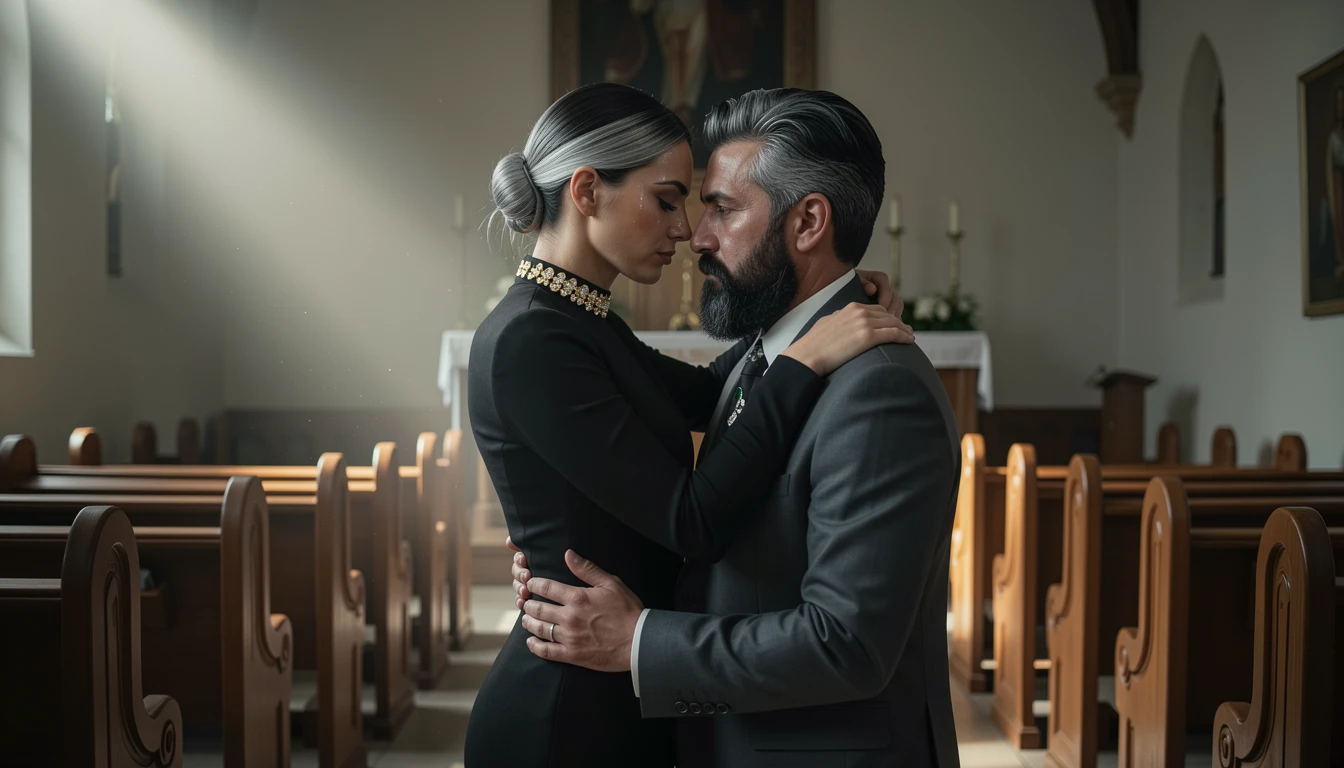
The words hung in the chapel air long after Father Alexei finished speaking. Saint Mary of Egypt. A whore who fled into the desert with nothing but her shame and emerged carrying grace. The story sat in my chest like a stone I'd swallowed, warm from his telling but still heavy, still unmoving.
I stared at the votive candles, at the gold light flickering over the cold marble, and I could feel the old familiar twist of it—the thing that had been gnawing at me since before I'd even known the word for it. Whore. Not what I did. What I was. What I'd been made into.
"How can a whore be forgiven?" The question had come out of me before I'd decided to ask it, raw and unguarded, the words scraping against the silence like a confession I hadn't meant to make. I felt Irina's hand find mine, warm and solid, her fingers lacing through mine with a steadiness I didn't have.
Father Alexei didn't flinch. His eyes, pale and kind in the candlelight, held mine without judgment. "You are not what you were, Isabella."
But I was. I was still her. The woman who'd spread her legs for strangers in a brothel, who'd learned to moan on cue, who'd let Luca train her mouth and her throat and her ass like she was a piece of furniture being polished for sale. The woman who'd knelt for Dmitri on a private jet and called him master because it was easier than calling him anything else.
Dmitri's voice came rough from beside me, low and urgent, like he was trying to pull me back from some edge only he could see. "You are not what you were."
I wanted to believe him. God, I wanted to believe him. But the shame was a living thing in my chest, coiling around my ribs, whispering in a voice that sounded like my own.
"I sold my body," I said, and my voice cracked on the word. "I let men use me. I let Luca—" I stopped, the name catching in my throat like a fishhook. "I let him make me into something that wanted it. I don't even know if the wanting was real or if he just trained it into me, like a dog learning to sit."
Irina's grip tightened on my hand. "Isabella—"
"I prayed the rosary this morning." I laughed, and it came out broken, ugly. "I prayed the Luminous Mysteries like I was already saved, like I didn't have the taste of strangers still on my tongue. Like I wasn't carrying the memory of every man who'd paid for me like I was a meal."
Father Alexei was quiet for a long moment. The candles guttered, sending shadows crawling across the walls. When he spoke, his voice was gentle, but there was something else beneath it—something ancient and certain.
"Do you know why Saint Mary of Egypt is venerated, Isabella?"
I shook my head, not trusting my voice.
"She didn't flee into the desert because she was pure. She fled because she was desperate. She'd spent seventeen years selling her body in Alexandria, and when she tried to enter the Church of the Holy Sepulchre, an invisible force held her back. She couldn't cross the threshold. She stood outside, among the other pilgrims, and she understood for the first time what she had become."
I felt the words land like blows. An invisible force holding her back. I knew that feeling. I'd felt it every time I'd tried to pray, every time I'd knelt in this very chapel and felt the words stick in my throat like I wasn't allowed to speak them.
"She fell to her knees in front of an icon of the Virgin Mary," Father Alexei continued, "and she begged for intercession. Not because she deserved it. Because she had nothing left. She was empty, Isabella. Stripped bare. And in that emptiness, she found room for grace."
"She was a whore," I said, and the word came out hard, defiant, like I was daring him to soften it. "She sold her body for seventeen years. She was exactly what I am."
"Yes." Father Alexei nodded, unflinching. "And she became a saint. Not despite what she was, but because she was willing to let God see all of it—the dirt, the shame, the years of men and money and the slow death of her own soul—and she didn't turn away. She let herself be seen, and in being seen, she was remade."
I felt the tears coming before I could stop them, hot and sudden, spilling down my cheeks. I tried to turn my head, to hide them, but Irina was already there, pulling me into her arms, her hand cradling the back of my head like I was a child. Her cross pressed between us, hard and unyielding, a small, sharp reminder of everything I was trying to become.
"You are not what you were," she murmured against my hair, her voice thick with her own tears. "I see you, Isabella. I see who you are becoming."
I sobbed into her shoulder, ugly and raw, the kind of crying I hadn't done since I was Carter, since I was a man who'd never learned to let anyone see him break. The shame was still there, coiling in my chest, but it was quieter now, muffled by the warmth of Irina's arms, by the steady rhythm of her heartbeat against mine.
And then Dmitri moved.
I felt him kneel before me, his weight settling onto the cold marble floor, and when I looked up through my tears, his eyes were wet, the grey of them gone dark with emotion. He took my hands in his, his grip firm and warm, and when he spoke, his voice was barely a whisper—rough, broken, raw.
"We will carry this with you, sister."
The word hit me like a physical blow. Sister. Not whore. Not concubine. Not the woman who'd been bought and sold and trained. Sister.
"I don't—" I started, but the words wouldn't come. I shook my head, fresh tears spilling down my cheeks. "I don't know how to let you carry it. I've been carrying it alone for so long, I don't know how to put it down."
"You don't have to put it down all at once," Dmitri said, his thumbs tracing circles on the backs of my hands. "You don't have to put it down at all. You just have to let us take part of the weight."
I looked at him—this powerful, dangerous man who'd ordered murders and signed death warrants, kneeling on the cold chapel floor with tears in his eyes, asking me to let him share my shame. The man who'd confessed his own sins to me in the dark, who'd wept before me like a child, who'd called me holy.
I didn't feel holy. I felt like a fraud, like a whore playing dress-up in a chapel, pretending to be something I wasn't. But Dmitri was looking at me like I was the most precious thing he'd ever held, and Irina was holding me like I was her own flesh and blood, and Father Alexei was watching me with the patient, unconditional love of a man who'd seen every sin a soul could commit and never once turned away.
"I don't know if I believe in God," I whispered, the confession slipping out before I could stop it. "I've been praying, and I've been reading, and I've been trying so hard to believe, but I don't know if any of it is real. I don't know if I'm just performing again, playing the role of the penitent whore because it's what everyone wants me to be."
Father Alexei's voice was gentle when he spoke. "And if it is? If you're performing, if you're playing a role—does that make the prayer any less real? Does that make the grace any less present?"
I blinked at him, confused. "I don't understand."
"Saint Mary of Egypt didn't know if she believed either, when she stood outside that church. She was desperate, not devout. She begged because she had nowhere else to turn, not because she was certain God was listening. And yet—grace found her anyway. Grace doesn't require your certainty, Isabella. It only requires your willingness to be seen."
I felt something crack open in my chest, something I'd been holding closed for so long I'd forgotten it was there. The tears came faster now, and I couldn't stop them, didn't want to stop them. I let Irina hold me, let Dmitri kneel at my feet, let Father Alexei's words wash over me like water over stone, wearing away the edges of my shame one prayer at a time.
"I want to believe," I said, my voice small and broken. "I want to believe that I can be forgiven. That I can be more than what was done to me. But every time I try to pray, I hear their voices. The men who used me. The things they said. The way they made me feel like I was nothing but a hole to be filled."
Irina's arms tightened around me, and I felt her own tears wet against my neck. "Those voices are lies, Isabella. They were always lies. You were never nothing. You were never just a body to be used. You are a woman who survived—who is surviving—and that takes more strength than any of them will ever know."
"But I let them—"
"You survived." Dmitri's voice cut through my protest, firm and unyielding. "You did what you had to do to survive, and there is no shame in that. There is no shame in the body that carried you through hell. The shame belongs to the men who put you there, not to you."
I looked down at him, at his hands wrapped around mine, at the tears tracking through the silver in his beard, and I felt something shift inside me. Not forgiveness—not yet, maybe not ever. But something that felt like the first step toward it. A crack in the wall I'd built around myself, letting in just a sliver of light.
"I'm scared," I admitted, my voice barely audible. "I'm scared that if I let myself believe I'm forgiven, I'll stop being careful. I'll stop watching every hand in the room, stop calculating every exit. And then something bad will happen, and it'll be my fault for letting my guard down."
Father Alexei's voice was kind. "Faith isn't a weapon you drop, Isabella. It's a shield you carry alongside your vigilance. You can be both careful and trusting. You can be both wounded and healing. They're not opposites—they're partners."
I let out a shaky breath, feeling the tension in my shoulders ease just slightly. Irina pulled back, her hands coming up to cup my face, her thumbs brushing away my tears with a tenderness that made my chest ache.
"You are my sister," she said, her voice fierce and certain. "Not my concubine. Not my rival. My sister. And I will carry this with you for as long as you need me to."
I looked at her—at the sharp angles of her face softened by love, at the silver-streaked hair escaping its severe bun, at the gold collar at her throat that matched mine—and I felt something loosen in my chest. A knot I'd been carrying since the moment I'd been remade, since the moment I'd opened my eyes in a body that wasn't mine and realized I was property.
"I don't know how to be a sister," I admitted. "I've never been anyone's sister. I've been a son, and a whore, and a concubine, and a vessel. But never a sister."
Irina smiled, and it transformed her face, softening the sharp edges until she looked almost young. "Then we'll learn together. I've never been a sister either. I've been a wife, and a barren woman, and a keeper of other women's children. But never a sister."
She pulled me into another embrace, and I felt Dmitri's hands still wrapped around mine, his warmth grounding me. Father Alexei's voice rose in prayer, the familiar words of the Hail Mary washing over me like a balm, and I let myself be held—by Irina, by Dmitri, by the strange, fragile family I was building out of the wreckage of my old life.
When the prayer ended, the chapel fell quiet again. The candles had burned low, their light flickering over the cold marble, and I could feel the twins stirring in my belly, a flutter of movement that reminded me I wasn't alone. I was carrying life. I was carrying hope. I was carrying the impossible, terrifying possibility of a future I'd never dared to imagine.
Dmitri rose from his knees, his hand still holding mine, and helped me to my feet. Irina stood beside me, her arm around my waist, and for a moment we just stood there, the three of us, breathing together in the candlelit dark.
"Thank you," I said, and the words felt small, inadequate. "For not turning away. For not telling me I was too far gone."
Dmitri's hand came up to cup my face, his thumb brushing across my cheekbone. "You are not too far gone, Isabella. You were never too far gone. You were just lost for a while. And now you're finding your way home."
I leaned into his touch, letting myself feel it—the warmth of his palm against my skin, the steady certainty of his gaze, the way he looked at me like I was something precious instead of something broken. And for the first time since I'd been remade, I let myself believe it might be true.
Irina's hand found mine again, her fingers lacing through mine with a familiar ease. "Come," she said softly. "Let's go break our fast. You need to eat for the twins, and I find myself suddenly hungry."
I let Irina pull me toward the door, but my feet hesitated on the threshold. The chapel felt different now—not colder, but heavier, as if the words we'd spoken had settled into the stone itself, becoming part of the walls. I turned back, and Father Alexei was still kneeling before the altar, his lips moving silently in prayer, the candlelight carving deep shadows into the lines of his face.
"Father," I said, and my voice came out smaller than I meant it to. He looked up, and something in his eyes made me stop—not pity, not judgment, but a kind of recognition I couldn't name. "The desert. Where did she go? Saint Mary. After she was forgiven."
He rose slowly, his knees cracking in the quiet, and came toward me with that unhurried gait of a man who'd learned patience the hard way. "She crossed the Jordan. She lived alone in the wilderness for forty-seven years, eating only what the earth provided, wearing nothing but the clothes she'd borrowed from a church deacon. She didn't see another human soul until Zosimas found her near the end of her life."
"Forty-seven years." The number sat between us, vast and impossible. "Alone."
"She wasn't alone, Isabella. She was with God." He paused, his pale eyes searching mine. "But I think you're asking something else. You're asking if forgiveness requires you to leave everything behind. To walk into your own desert and never come back."
The truth of it stung. I'd been thinking about it without letting myself name it—the fantasy of disappearing, of becoming someone so new that the old Isabella ceased to exist entirely, her sins buried in the sand of some internal wilderness where no one could find them.
"I don't know how to be forgiven and still live in the world," I admitted. "I don't know how to sit at Dmitri's table, wearing his ring, carrying his children, and not feel like I'm lying to everyone who looks at me."
Irina's hand tightened on mine, but it was Dmitri who spoke, his voice low and rough from where he still stood beside me. "You think I don't feel the same? Every time I kneel in this chapel, I remember the man I was. The things I ordered. The blood that's on my hands." He held up his palms, turning them over in the candlelight. "These hands have signed death warrants. They've held the phone while men begged for their lives. And yet I'm here, asking God to forgive me, asking you to marry me, pretending I have any right to either."
"You have the right," I said, and I was surprised to hear the conviction in my own voice. "You confessed. You repented. Father Alexei said—"
"I know what Father Alexei said." Dmitri's eyes met mine, and there was something raw in them, something I hadn't seen before. "But knowing it in my head and feeling it in my bones are two different things. The shame doesn't leave because you've been absolved. It leaves because you learn to carry it differently. You learn to let it make you humble instead of broken."
Father Alexei nodded slowly. "That's the desert, Isabella. Not a place you go to escape your sins, but a place you go to learn how to carry them. Saint Mary didn't flee her past—she walked into it. She let the silence strip away everything that wasn't essential, until all that was left was the truth of who she was in God's eyes."
"And what if the truth is that I'm still the whore?" The word came out hard, and I felt Irina flinch beside me. "What if I've been performing for so long that there's nothing underneath the performance? What if this—" I gestured at myself, at the chapel, at the cross hanging between my breasts, "—is just another role I'm playing?"
Father Alexei was quiet for a long moment. The candles had burned down to stubs, their light flickering weakly against the dawn that was beginning to creep through the stained glass windows. Saint Michael stared down at me, his sword raised, his face serene and terrible.
"When I was a young priest," Father Alexei said finally, "I served in a parish in Siberia. There was a woman there—she came to confession every week, sometimes twice. She'd been a doctor before the camps, before the purges. She'd signed confessions under torture, named names, sent men to their deaths. She carried that guilt for sixty years."
I watched his face, the way the candlelight softened the hard lines of his jaw. "What happened to her?"
"She died in my arms, Isabella. On a Tuesday, in the middle of winter. And her last words weren't a confession or a plea for mercy. She looked at me, and she smiled, and she said, 'Father, I think God has finally stopped seeing my sins and started seeing me.'" He paused, letting the weight of it settle. "That's the desert. That's what awaits you on the other side of all this shame. Not forgetting. Not pretending. Just being seen."
I felt something crack in me, something I hadn't even known was still intact. I'd spent so long building walls, learning to watch every hand in every room, to calculate exits, to be ready for the moment when kindness turned to cruelty. And here was this old priest, this man who'd heard every sin a soul could commit, telling me that the only way out was to stop building and start letting myself be seen.
"I don't know if I can do that," I whispered. "I don't know if I know how to be seen without bracing for the blow."
Dmitri's hand found my chin, tilting my face up to meet his. His eyes were wet again, but his voice was steady. "Then we learn together. I've spent thirty years hiding from God's eyes, Isabella. Hiding from Irina's eyes. Hiding from my own. But I'm done hiding. I want to be seen—by you, by God, by everyone who looks at me. And I want you to be seen too."
Irina stepped closer, her arm wrapping around my waist, her head coming to rest on my shoulder. "We'll learn together, sister. We'll walk into the desert together, and we'll come out the other side. And when we do, we'll be carrying each other's shame instead of just our own."
I looked at the three of them—this fierce, broken, impossible family I'd found in the wreckage of my old life—and I felt something I hadn't felt since before I was remade. Not hope, exactly. Something quieter. Something that felt like the first stirring of peace.
"Okay," I said, and the word came out steady. "Okay. I'll try."
Father Alexei smiled, and it transformed his weathered face. "That's all God asks, Isabella. That you try." He gestured toward the door. "Go. Eat. Rest. Tomorrow we begin again with the Joyful Mysteries, and we'll keep walking this road together."
I let Irina lead me out of the chapel, Dmitri's hand warm at the small of my back. The corridor was cold, the morning light grey and thin through the high windows, and I could feel the twins stirring in my belly, a flutter of movement that reminded me of the life I was carrying, the future I was building.
"Irina," I said as we walked, "can I ask you something?"
"Anything."
"When you first came to train me—when you were teaching me to be Dmitri's concubine—did you ever think we'd end up here? Like this?"
She was quiet for a moment, her heels clicking against the marble floor. "No," she admitted. "I thought you'd be like the others. A vessel for his seed. A body to bear his children. I didn't think you'd become my sister." She paused, her hand tightening on mine. "I didn't think you'd make me want to be something more than a barren wife keeping score of other women's children."
The honesty of it made my throat tight. "I'm sorry. For what I am. For what I'm carrying. For—"
"Don't." Irina stopped, turning to face me. Her eyes were fierce, bright with unshed tears. "Don't apologize for being alive. Don't apologize for the children growing in your belly. They're not a punishment, Isabella. They're a gift. And I'm going to love them like they're my own, because in every way that matters, they will be."
Dmitri's hand found mine, his fingers lacing through my own. "She's right. You've given us something we thought we'd never have. A family. A future. A reason to believe that God hasn't abandoned us."
I looked at them—this man who'd ordered murders and this woman who'd kept the names of other women's children in a book, both of them looking at me like I was the answer to prayers they'd never dared to speak aloud—and I felt the weight of it settle over me. Not crushing. Grounding.
"I want to name him," I said, and the words surprised me as much as they surprised them. "The second twin. I want to name him after something that matters. Something that reminds me of this moment."
Irina's brow furrowed. "You already chose Mikhail. For Saint Michael."
"I know. But I want—" I stopped, struggling to find the words. "I want a name that means the desert. That means walking through the wilderness and coming out the other side. That means being seen."
Dmitri was quiet for a long moment. Then he said, softly, "Zosima."
I blinked at him. "Zosima?"
"The monk who found Saint Mary in the desert. The one who buried her when she died, who carried her story back to the world." He paused, his eyes searching mine. "It means 'vitality.' 'Life.' It's not a common name, but it's a holy one. A name for a boy who will be born from his mother's survival."
I felt the tears prick at my eyes again. "Zosima," I repeated, testing the weight of it on my tongue. It felt strange, foreign, heavy with meaning I was only beginning to understand.
"You don't have to decide now," Irina said gently. "The book is still open. There's time."
I shook my head. "I want to write it down. Before I forget. Before I lose this feeling."
We'd reached the door to my room, and I pushed it open, crossing to the small desk where the family book still lay open from Irina's last visit. The pages were yellowed with age, the ink faded in places, but the newest entries were crisp and clear—Aleksandr and Mikhail, written in Irina's careful hand.
I picked up the pen, my hand trembling slightly, and wrote beneath them: Zosima. The letters felt strange under my fingers, unfamiliar and new, but right. A name born from the desert. A name for the boy who would carry his mother's survival forward.
Irina came up behind me, her hand resting on my shoulder, and when she saw what I'd written, she let out a small, surprised breath. "Zosima," she said softly. "It's perfect."
Dmitri stood in the doorway, watching us, and there was something in his eyes that I couldn't quite read—wonder, maybe, or grief, or a mixture of both. "My sons," he said, and his voice cracked on the word. "Aleksandr. Mikhail. Zosima."
"Three names," I said, turning to face him. "But only two sons."
He shook his head slowly. "No. Three sons. God willing, there will be more. But these three names—they're the beginning. They're the family we're building."
I felt the tears finally spill over, hot and silent, tracking down my cheeks. I didn't try to stop them. I let Irina pull me into her arms, let Dmitri wrap his body around both of us, let myself be held in the warm, impossible embrace of the family I'd found in the wreckage of my old life.
And when I finally pulled back, wiping my eyes with the back of my hand, I caught a glimpse of myself in the mirror above the desk. The woman looking back at me was still Isabella—honey-blond hair, whiskey-brown eyes, the gold collar at her throat catching the morning light. But there was something different in her face now. Something that hadn't been there before.
She looked like someone who'd walked into the desert and found, not grace, but the beginning of it. A crack in the wall. A sliver of light.
She looked like someone who was learning to be seen.
I stared at my own reflection for a long moment, at the woman who was learning to be seen, and I felt the name settle into me like a stone dropped into still water. Zosima. Vitality. Life. A name born from the desert.
"Irina," I said, turning from the mirror, the pen still warm in my hand. "What would you name a daughter?"
The question hung in the air between us, unexpected, unplanned. I watched her face shift—the slight widening of her dark eyes, the way her hand came up to touch the gold collar at her throat, a gesture I'd come to recognize as her version of steadying herself.
"A daughter," she repeated, and the word came out soft, almost reverent, like she was testing the weight of it. "I haven't—" She stopped, her throat working. "I never let myself think about daughters."
Dmitri moved from the doorway, his footsteps quiet on the thick carpet, and I felt him come to stand behind me, his hand finding the small of my back. A warm, grounding pressure. I leaned into it without thinking.
"The book," I said, gesturing at the yellowed pages still open on the desk. "You said it holds generations of names. Your grandmother's hand, your mother's, yours. But I noticed—" I hesitated, not wanting to overstep. "The names you've written are all sons. Aleksandr. Mikhail. Zosima, now. But no daughters."
Irina's jaw tightened. For a moment I thought I'd pushed too far, touched something raw that wasn't mine to touch. But then she exhaled, slow and deliberate, and moved past me to the desk. Her fingers traced the spine of the book, the worn leather, the faded gold lettering.
"My grandmother believed that naming a daughter was an act of hope she couldn't afford," she said quietly. "She was born in a village where girls were buried before they were named, more often than not. She learned to write the names of sons because those were the names that survived. The names that mattered."
"That's not true," I said, and the words came out harder than I meant them to. "Every name matters. Every life—"
"I know." Irina's voice cracked, just slightly. "I know that now. But I was raised on her fear, Isabella. I was raised to believe that hoping for a daughter was the same as inviting grief into the house."
Dmitri's hand tightened on my back. "Irina—"
"No, let me." She held up a hand, silencing him, and I saw something in her face I hadn't seen before—not the composed, calculating wife who'd taught me to kneel and obey, not the fierce sister who'd claimed my children as her own. Something younger. Something wounded. "I've been carrying her fear for sixty years without ever knowing it was hers and not mine."
I crossed to her, taking her hands in mine. They were cold, despite the warmth of the room. "Then let's put it down. Together."
She looked at me, her dark eyes shining. "You want to write a daughter's name in this book."
"I want to know what you would name her," I said. "If she existed. If she was real. What would you call a daughter you let yourself hope for?"
The silence stretched between us, thick with years of unspoken grief. I could feel the twins stirring in my belly, a flutter of movement that seemed to echo the tension in the room. Somewhere in the house, a clock chimed the hour, the sound muffled by the thick walls.
"Nadezhda," Irina whispered finally, and the word came out like a prayer. "After my mother. After the cross I gave you." Her hand rose to touch the silver cross at my throat, the one engraved with her mother's name. "She was the only daughter my grandmother allowed herself to love. The only one she named."
"Nadezhda," I repeated, feeling the syllables on my tongue. Hope. "It's beautiful."
"It means hope," Irina said, and her voice was thick with tears she was fighting to hold back. "My mother was hope, incarnate. She was the daughter my grandmother never thought she'd live to name, and she grew into a woman who taught me that hope wasn't a weakness. It was the only thing that made survival worth it."
I squeezed her hands. "Then that's the name. If I ever have a daughter—" I stopped, the weight of the words settling over me. "When I have a daughter. That's what I'll name her. Nadezhda."
Irina let out a shaky breath, and I watched a tear escape down her cheek. She didn't wipe it away. "You'd do that? You'd name your daughter after my mother?"
"I'd name her after hope," I said. "After the woman who taught you to hope. After the sister who taught me I could be more than what was done to me." I paused, my own throat tight. "I'd be honored to carry her name forward."
Dmitri stepped closer, his arm wrapping around my waist from behind, pulling me against the solid warmth of his chest. "Nadezhda Volkov," he said, testing the name. "It has a weight to it. A strength."
I felt Irina's hands tremble in mine. "You'd let me write it?" she asked, her voice barely audible. "In the book?"
I looked at Dmitri. He nodded, his eyes soft. "The book is yours as much as it is ours," I said, turning back to Irina. "You're her second mother. You should have a hand in naming her."
Irina released my hands and turned to the desk, her movements slow, deliberate, like she was approaching something sacred. She picked up the pen I'd set down, her fingers trembling around it, and I watched her hover over the page, over the space beneath the names of my sons.
"Nadezhda," she whispered, and wrote it.
The letters were shaky at first, then steadied, as if she was finding her footing in the act of writing. N-a-d-e-z-h-d-a. Hope, made permanent, made real, inscribed in a book that had only ever held the names of sons.
She set the pen down and stepped back, her hand coming to her mouth. A small, broken sound escaped her, and then Dmitri was there, pulling her into his arms, holding her as she wept against his chest.
"She would have loved this," Irina said, her voice muffled. "My mother. She would have loved knowing her name would live on."
I stood at the desk, looking down at the page. Aleksandr. Mikhail. Zosima. Nadezhda. Four names in Irina's careful hand, four lives I was carrying into the future. Three sons I could feel moving in my belly, and a daughter who existed only in hope, only in the space between what was and what could be.
"I want to write something too," I said, and both of them looked up at me. "Underneath. Not a name. Something else."
Irina wiped her eyes, stepping back from Dmitri's embrace. "What?"
I picked up the pen, my hand steady now, and wrote in the margin, in my own uncertain hand: For the daughters we were afraid to hope for.
The words felt strange under my fingers, like a prayer I hadn't known I was praying. But they felt right, too. A testament. A promise.
Irina read them, and her face crumpled. She crossed to me and pulled me into a fierce embrace, her arms tight around my shoulders, her cheek against mine. "You understand," she whispered. "You actually understand."
"I understand what it's like to be afraid to hope," I said against her hair. "I understand what it's like to believe you don't deserve to want things. But I'm learning, Irina. I'm learning that hope isn't something you earn. It's something you choose."
She pulled back, her hands cupping my face, her eyes searching mine. "When did you become so wise, little sister?"
I laughed, the sound wet and broken. "I'm not wise. I'm just tired of being afraid."
Dmitri came to stand beside us, his hand finding mine, his fingers lacing through my own. "Then we'll be brave together," he said. "All of us. We'll hope together, even when it terrifies us."
I looked at the book again, at the names I'd helped write, at the words I'd added in the margin. It felt like a beginning. Not of a story, but of something quieter. Something that would grow in the spaces between prayers and meals and the small, ordinary moments of building a life.
"Irina," I said, and she turned to me. "Thank you. For trusting me with her name."
"Thank you for wanting it," she replied, and her voice was steady now, sure. "For wanting her."
The morning light was strengthening through the windows, casting long shadows across the carpet. Somewhere in the house, I could hear the faint sounds of Elena moving in the kitchen, the clatter of pots, the low murmur of a radio tuned to a Russian station.
"Come," Irina said, her arm slipping around my waist. "Let's go eat. You need to feed those boys of yours, and I find myself suddenly ravenous."
I let her lead me toward the door, but I paused on the threshold, looking back at the book still open on the desk. Four names. Four futures. A family taking shape in ink and hope.
"Irina," I said, and she stopped. "There's still space. In the book."
She followed my gaze, and a slow smile spread across her face. "There's always space, Isabella. That's the point of a book like that. It's never finished. It just grows."
I felt the twins stir in my belly, a flutter of movement that seemed to echo her words. Growing. Always growing.
We walked into the corridor, Dmitri's hand warm at the small of my back, Irina's arm around my waist, and I let myself be held by the strange, impossible family I was building out of the wreckage of my old life. The names I'd helped write echoed in my chest—Aleksandr, Mikhail, Zosima, Nadezhda—a litany of hope against the darkness I'd survived.
And for the first time since I'd been remade, I let myself believe that the desert wasn't a place of punishment. It was a place of becoming. A place where a whore could learn to be a saint, where a concubine could learn to be a sister, where a woman who'd been bought and sold and trained could learn, finally, to be seen.
The kitchen was warm and bright, the smell of fresh bread and strong coffee filling the air. Elena looked up as we entered, her weathered face breaking into a smile when she saw us—the three of us, together, bound by something stranger and stronger than blood.
"Sit," she commanded, gesturing at the long wooden table. "Eat. You're all too thin."
I laughed, the sound surprising me, and let Irina pull out a chair for me. Dmitri sat beside me, his knee brushing mine under the table, and Irina took the seat on my other side. For a moment, we just sat there, breathing together, the warmth of the kitchen wrapping around us like a blessing.
Elena set plates in front of us—eggs, bread, cured meat, cheese, the kind of breakfast that said someone had been up for hours, preparing for us. I picked up my fork, but my hand hesitated, and I set it down again.
"What is it?" Irina asked, her brow furrowing.
"I just—" I stopped, struggling to find the words. "I keep waiting for the other shoe to drop. For someone to tell me this isn't real. That I don't deserve it."
Dmitri's hand found mine under the table. "And if someone did?"
"I'd tell them they're wrong." The words came out steady, sure, surprising me. "I'd tell them that I've walked through hell and come out the other side, and that I'm not going to let anyone take this from me. Not the family I'm building. Not the children I'm carrying. Not the hope I'm learning to hold."
Irina's eyes glistened. "That's my sister."
I picked up my fork again, and this time, I ate. The food was warm and good, and the twins stirred in my belly, hungry for life, and I let myself be present in the moment—in the warmth of the kitchen, in the company of the people who'd chosen to love me, in the strange, impossible grace of being alive.
The morning stretched on, full of small, ordinary moments. Dmitri reading the paper, his brow furrowed in concentration. Irina helping Elena clear the dishes, their voices low and easy. Me, sitting at the table with a cup of tea growing cold in my hands, watching the light shift across the room, feeling the twins move inside me.
And underneath it all, the quiet hum of a name I'd helped write into the world. Nadezhda. Hope. A daughter who didn't exist yet, but who would. A future I was learning to believe in, one day at a time.
I reached into the collar of my dress, my fingers finding the three tokens that hung against my heart—Irina's cross, Dmitri's medal, Luca's amber pendant. The amber was warm from my skin, and I thought of Luca, of the letter I'd sent him, of the words I'd written that I couldn't take back. I forgive you. I still love you. Come to my wedding.
I didn't know if he would come. I didn't know if I wanted him to. But I'd spoken my truth, and that was all I could do. The rest was in God's hands, or fate's, or whatever force had brought me here, to this kitchen, to this family, to this moment of impossible peace.
"Isabella." Dmitri's voice pulled me from my thoughts. He was standing at the window, looking out at the grey Moscow morning. "Father Alexei mentioned something yesterday. A woman he wants you to meet."
I sat up straighter. "Monica?"
He turned, a slight smile playing at the corner of his mouth. "You remembered."
"I remember everything," I said, and the words came out darker than I meant them to. "It's part of the problem."
His smile faded. "I know. But this might be different. She's a convert, like you. She came to the Church later in life, after—" He paused, choosing his words carefully. "After a difficult past. Father Alexei thinks she might be able to help you navigate what you're feeling."
Irina came to stand beside him, her hand resting on his arm. "She's a good woman," she said. "I've met her a few times at the chapel. She has a quiet strength about her. A peace that I've always envied."
I looked at them—this man and this woman who'd become my family, who were trying so hard to give me what I needed, even when I didn't know what that was. "When?"
"This afternoon, if you're willing," Dmitri said. "She's coming to the house."
I nodded slowly. "Okay. I'll meet her."
The words felt like a commitment, a step forward into something I couldn't yet see. But for the first time in a long time, I wasn't afraid of the unknown. I was curious about it. I was ready to meet it.
The kitchen settled back into its rhythm, the ordinary music of a household finding its footing. But something had shifted in me, a door opening that I hadn't known was there. A woman named Monica, a convert, someone who might understand the wilderness I was walking through. Someone who might help me find my way to the other side.
I touched the cross at my throat, the one engraved with the name Nadezhda, and I felt the hope of it settle into my bones. Hope for the daughter I might one day carry. Hope for the woman I was becoming. Hope for the family I was building, one name at a time.
The morning light grew stronger, and I let myself believe, just for a moment, that the desert was behind me. That ahead of me lay something green and growing, a promise I was only beginning to understand. And when the twins stirred in my belly, I placed my hand over them, a silent promise of my own: I will carry you through the wilderness. I will teach you to hope. I will name you for the things that matter—vitality, hope, the archangel who guards the gates of heaven.
And I will learn, with you, what it means to be seen.
I closed the book and pressed it to my chest, the worn leather cool against my sternum through the thin fabric of my dress. The names were still there, inked into the page, waiting to be read again. I didn't need to open it. I could feel them through the cover, through the layers of paper and time—Aleksandr, Mikhail, Zosima, Nadezhda. Four futures I'd helped write into existence. Four names that now lived inside me alongside the twins, taking up space in my chest that I hadn't known was empty.
Irina had left the room a few minutes ago, called away by something Elena needed in the kitchen. Dmitri remained by the window, his back to me, watching the grey Moscow morning crawl toward noon. The light had changed since we'd first entered the chapel—softer now, less golden, the candles beginning to gutter in their glass holders.
"You're very quiet," he said, not turning around.
"I'm thinking."
"About?"
I looked down at the book in my hands. My thumb traced the spine, worn smooth by generations of women who'd held it just like this, pressing their hopes into its pages. "About what it means to be seen."
He turned then, his face catching the candlelight. In the months since I'd met him, I'd watched him shed years—the hard lines around his mouth softening, the tension in his shoulders easing. He looked younger now than he had on the jet, when he'd first claimed me as his own. Or maybe I was just learning to see him differently.
"That's a weighty thought for a morning," he said.
"I've been carrying it for a while." I set the book down on the desk, my hand lingering on the cover. "I just didn't have words for it before."
He crossed the room, his footsteps quiet on the worn carpet. When he reached me, he didn't touch me—just stood close enough that I could feel the heat of him, the solid presence of his body between me and the door.
"Tell me," he said.
I opened my mouth, then closed it. The words were there, tangled in my throat, but I didn't know how to untangle them. How to explain that I'd spent my whole life—both lives, the one I'd been born into and the one I'd been remade for—trying to be invisible. Trying to be what other people needed me to be, so that I wouldn't have to face what I wanted for myself.
"I've been seen my whole life," I said finally. "Seen and bought and sold and trained. Every man who ever looked at me was seeing something he wanted to own. And I let them. I made myself into what they wanted, because that was how I survived."
I paused, feeling the weight of the words. The twins stirred in my belly, a flutter of movement that seemed to echo my unease.
"But no one ever saw me. Not really. Not the person underneath the performance."
Dmitri was quiet for a long moment. His hand came up, slow and careful, and brushed a strand of hair from my face. The touch was gentle, almost reverent, and I felt something in my chest loosen.
"I see you," he said. "Not the concubine. Not the vessel for my heirs. You, Isabella. The woman who prays in Latin without knowing how. The woman who chose her own name for my son. The woman who's learning to hope."
I felt tears prick at my eyes, and I blinked them back. "I don't know how to be seen," I admitted. "I don't know how to be anything except what someone needs me to be."
"Then we'll learn together." His hand moved to cup my jaw, tilting my face up to meet his gaze. "I've spent thirty years hiding from God, Isabella. Hiding from the truth of what I've done. If I can learn to be seen, you can too."
I leaned into his touch, letting myself feel the warmth of it. "It's different," I said. "What I am. What I was. You know what I used to be. What I was born as. How can you see me and not see that?"
"Because that's not who you are anymore." His voice was firm, certain. "You were remade, yes. But the man you were born as—Carter—he's gone. You're not him. You're not even the woman they tried to make you in the brothel. You're something new. Something that grew out of the wreckage of both of those lives."
I wanted to believe him. God, I wanted to believe him. But there was a part of me that still flinched at the thought of being truly seen—that still expected the moment of recognition to be followed by rejection, by disgust, by the cold withdrawal of affection that I'd learned to expect from everyone who'd ever claimed to care about me.
"What if I don't like what you see?" I asked. "What if there's nothing there worth seeing?"
His thumb brushed across my cheekbone, wiping away a tear I hadn't felt fall. "Then I'll look until I find it. I'll look until you believe it's there."
I closed my eyes, letting myself lean into him. His arms came around me, pulling me close, and I pressed my face into his chest, breathing in the smell of him—soap and wool and something darker, something that was just him.
"I don't understand why you want me," I whispered into his shirt. "I don't understand why any of this is happening. I was supposed to be a whore in a brothel. I was supposed to be used and discarded. I wasn't supposed to be loved."
"And yet here you are." His voice rumbled through his chest, through me. "Loved. Wanted. Chosen. Not because you deserve it, or because you've earned it, but because I see you. Because Irina sees you. Because Father Alexei sees you. Because the God you're learning to pray to sees you."
I felt the tears coming then, hot and fast, and I didn't try to stop them. I cried into his shirt, ugly and raw, the kind of crying I hadn't done since I'd first woken up in this body, alone and terrified in a strange bed. I cried for the man I'd been and the woman I'd become. I cried for the children in my belly and the daughter who might never exist. I cried for Luca, who'd sold me and loved me and let me go. I cried for myself, for the person I was still learning to be.
Dmitri held me through all of it, his hands stroking my back, his voice a low murmur of comfort in my ear. He didn't tell me to stop. He didn't tell me it was okay. He just held me, steady and patient, until the tears ran out.
When I finally pulled back, my face was a mess—red-eyed, blotchy, my carefully applied makeup ruined. I laughed, a wet, broken sound. "I'm a disaster."
"You're human," he corrected. "That's not the same thing."
I wiped at my face with the back of my hand, smearing what was left of my mascara. "I need to wash my face before I meet Monica. I look like I've been crying for a week."
"You have been," he said gently. "Just not where anyone could see it."
I looked at him, at this man who'd killed and repented and found his way back to God through a prayer I'd recited without knowing where it came from. "Thank you," I said. "For seeing me."
"Thank you for letting me."
I reached for the book, my fingers brushing the worn leather one more time before I let it go. "I should put this back," I said, gesturing vaguely toward the shelf where Irina kept it.
Dmitri shook his head. "Irina said you could keep it. For now. She thought you might want to add to it."
I stared at him. "Add to it?"
"Your own names. Your family's names. The names you want to carry forward." He paused. "She said the book is never finished. It just grows."
I looked down at the book in my hands, at the worn cover and the pages that held generations of hope. My family. My names. The thought was almost too big to hold.
"I don't know what names to add," I said honestly. "I don't know who I am yet. I don't know what family means, not really. I had a family once, before—" I stopped, the words catching in my throat. "Before everything. But they're gone now. They don't know who I am. They wouldn't recognize me if I walked past them on the street."
Dmitri was quiet, letting me speak.
"I was Carter," I said. "I had a mother and a father. I had a life. And then I woke up in a body that wasn't mine, in a world that didn't want me, and I had to learn to be someone else just to survive."
"And who are you now?"
I thought about it. Really thought about it. The woman who'd walked through the brothel, learning to spread her legs and close her heart. The woman who'd been bought and trained and sold. The woman who'd prayed in a chapel and felt something stir in her chest that might have been faith. The woman who carried twins in her belly and hope in her heart.
"I'm Isabella," I said slowly. "I'm the woman who's going to marry you. I'm the mother of your sons. I'm the sister of your wife. I'm the woman who's learning to pray and learning to hope and learning to be seen."
I paused, feeling the weight of the words.
"And I'm terrified. But I'm here. And I'm not going to run."
Dmitri smiled, a slow, warm expression that transformed his face. "That's all I've ever wanted. Not your perfection. Not your certainty. Just your presence. Just you, here, choosing to stay."
I felt something settle in my chest, a quiet certainty that I hadn't known I was missing. "I'm choosing," I said. "I'm choosing this. Choosing you. Choosing us."
He leaned in and kissed me, soft and tender, a kiss that tasted like a promise. When he pulled back, his eyes were bright.
"Then let's go meet Monica," he said. "Together."
I nodded, still holding the book. "Together."
He took my hand, and I let him lead me out of the chapel, the book still pressed against my chest. The names echoed in my heart—Aleksandr, Mikhail, Zosima, Nadezhda—and I let myself believe that there would be more. More names. More futures. More hope.
We walked through the corridor, Dmitri's hand warm in mine, and I felt the twins stir in my belly, as if they too were waiting to meet the woman who might understand the wilderness I was walking through.
The kitchen was bright when we entered, the smell of fresh bread and strong coffee filling the air. Irina looked up as we came in, her eyes going to my face, to the evidence of tears I hadn't quite managed to wash away.
"Isabella," she said, her voice soft with concern. "Are you alright?"
I nodded, managing a smile. "I'm better than alright. I'm learning."
She crossed the room and took my hands, squeezing them gently. "Learning what?"
"How to be seen." I glanced at Dmitri, then back at her. "How to let people love me without waiting for the other shoe to drop."
Irina's eyes glistened. "That's a hard lesson, sister. I'm still learning it myself."
"Then we'll learn together," I said, echoing Dmitri's words from earlier. "All of us."
She pulled me into a hug, her arms wrapping around me with a warmth that felt like family. When she pulled back, she was smiling.
"Monica will be here in an hour," she said. "Elena's preparing the sitting room. I thought you might want to meet her somewhere comfortable, somewhere that doesn't feel like a chapel or a classroom."
I nodded. "That sounds good."
"You should eat something first," Irina said firmly, gesturing at the table. "You need to keep up your strength. Those boys of yours are hungry."
I laughed, the sound surprising me. "I'm not sure they're the hungry ones. I think that's just me."
"Then eat," she said, pushing me gently toward a chair. "I'll make you some tea."
I sat down, the book still in my hands, and placed it carefully on the table beside me. Dmitri took the seat across from me, his knee brushing mine under the table, and Irina busied herself at the stove, her movements efficient and easy.
For a moment, I just sat there, watching them. Dmitri reading something on his phone, his brow furrowed in concentration. Irina humming softly as she worked, the sound of water boiling and cups being set out. The ordinary music of a household finding its rhythm.
I touched the book on the table, running my fingers over the worn leather. Four names. Four futures. And the promise of more to come.
The doorbell rang.
Irina looked up, her eyebrows rising. "That must be her. She's early."
I felt my heart skip a beat. I wasn't ready. I didn't know what to say, how to explain the wilderness I'd walked through, the things I'd done, the person I'd been. How could I possibly explain any of it to a stranger?
Dmitri's hand found mine under the table, squeezing gently. "You don't have to tell her everything," he said, as if reading my thoughts. "You don't have to tell her anything you're not ready to share. She's here to listen, not to judge."
I took a deep breath, letting his words settle into me. "Okay," I said. "Okay."
I heard the front door open, heard the low murmur of voices in the corridor. And then a woman appeared in the kitchen doorway, and I felt something shift in my chest.
She was older than me, maybe in her late forties, with dark hair streaked with grey and a face that had seen its share of hardship. But her eyes were kind, and there was a quiet peace about her that I'd never seen before—a stillness that seemed to radiate from somewhere deep inside her.
"Isabella," she said, her voice warm. "I'm Monica. Father Alexei has told me so much about you."
I stood up, my hand still clutching the book. "It's nice to meet you."
She crossed the room, her steps unhurried, and took my hands in hers. Her grip was warm, steady. "He said you were beautiful. He didn't mention that you looked terrified."
I laughed, a nervous sound. "Is it that obvious?"
"Only to someone who's been there." She released my hands, gesturing at the table. "May I sit?"
"Please." I sank back into my chair, and she took the seat across from me, Dmitri shifting to make room.
Irina brought over a tray of tea, setting it on the table between us. "I'll leave you two to talk," she said, her hand brushing my shoulder as she passed. "I'll be in the other room if you need anything."
Dmitri rose too, pressing a kiss to my forehead. "I'll be nearby as well."
And then it was just Monica and me, the steam rising from our cups, the book still clutched in my hands like a lifeline.
"You can put that down," she said gently, nodding at the book. "It's not going anywhere."
I looked down at the worn leather, at the names I'd helped write into its pages. "I know. I just—" I stopped, struggling to find the words. "It's the first thing that's ever felt like mine. Like I made it. Like I chose it."
Monica nodded slowly. "That's a powerful feeling. To have something that's yours, that you chose, that no one can take away."
"You understand?"
"I understand more than you might think." She picked up her tea, cradling the cup in her hands. "Father Alexei told me you're on a journey. That you're learning to find your way to God."
I nodded, not trusting my voice.
"He told me a little of your story," she continued. "Not the details. Just that you've survived things that would have broken most people. That you're carrying a weight that most people couldn't even imagine."
"I don't feel strong," I admitted. "Most of the time, I feel like I'm barely holding it together."
"That's what strength looks like," she said. "Not the absence of fear. Not the absence of pain. Just the decision to keep going anyway. To put one foot in front of the other, even when you can't see the path ahead."
I looked at her, at this woman I'd just met, and felt something shift in my chest. "How do you know?" I asked. "How do you know what I'm feeling?"
She smiled, a soft, sad expression. "Because I've been where you are. Maybe not in the same way. But in the same place."
She set down her cup, her eyes meeting mine. "I was a prostitute too, Isabella. For ten years. Before I found my way to the Church. Before I found my way to God."
The words hung in the air between us, heavy with meaning. I stared at her, at this woman with the kind eyes and the quiet peace, and felt something crack open inside me.
"How did you survive?" I asked, my voice barely a whisper. "How did you find your way out?"
She reached across the table, her hand covering mine. "One day at a time. One prayer at a time. One act of faith that I didn't feel but did anyway." She paused. "And I had help. People who saw me when I couldn't see myself. People who believed in me when I couldn't believe in anything."
I felt tears prick at my eyes again. "I have that," I said. "Dmitri. Irina. Father Alexei. They see me. They believe in me. But I don't know how to believe in myself."
"That will come," she said. "It won't happen overnight. It might not happen in a year. But it will come. If you let it."
I looked down at the book in my hands, at the names I'd helped write into its pages. "I'm scared," I admitted. "I'm scared of failing. Of not being enough. Of letting everyone down."
"That's normal," she said. "That's human. But fear isn't the end of the story, Isabella. Fear is just the beginning. It's what you do with it that matters."
I took a deep breath, letting her words settle into me. "How do I learn to trust? How do I learn to believe that this is real? That I deserve it?"
She smiled, a warm, genuine expression. "You start small. You start with one moment at a time. You let yourself feel the good things without waiting for the other shoe to drop. You let yourself be loved, even when it terrifies you."
I nodded, feeling something loosen in my chest. "That sounds terrifying."
"It is," she agreed. "But it's also the only way forward. The only way through the wilderness to the other side."
I looked at her, at this woman who'd walked through her own desert and come out the other side. "How did you know?" I asked. "That you were ready to be seen?"
She was quiet for a long moment. "I didn't," she said finally. "I just got tired of hiding. I got tired of being ashamed of who I was and what I'd done. I got tired of letting my past define my future."
She reached across the table and took my hand. "You're not your past, Isabella. You're not the things that were done to you. You're not the choices you made to survive. You're the woman who's sitting here, right now, choosing to hope. Choosing to believe that there's something more."
I felt the tears coming again, and this time I didn't try to stop them. I let them fall, let them wash away some of the shame and fear and doubt that had been weighing me down for so long.
"Thank you," I said, my voice thick. "For seeing me. For understanding."
"Thank you for letting me," she said. "For trusting me enough to be real with me."
I squeezed her hand, feeling a connection that I hadn't expected. A sisterhood that crossed the boundaries of age and experience and found something common in our shared survival.
"I think," I said slowly, "that this is the beginning of something. Something good."
Monica smiled. "I think so too."
We sat there, the tea growing cold between us, and talked for another hour. About faith and doubt. About fear and hope. About the long, slow process of learning to be seen. And when she finally left, pressing a kiss to my cheek and promising to come back soon, I felt something I hadn't felt in a long time.
I felt ready.
I stood in the doorway, watching her car disappear down the drive, and let myself believe that this was real. That I deserved it. That I was worthy of being seen.
Dmitri came up behind me, his hand settling on my shoulder. "How did it go?"
I turned to face him, a smile spreading across my face. "I think I found a friend," I said. "A sister."
He smiled, pulling me into his arms. "That's good. That's really good."
I pressed my face into his chest, breathing in the smell of him, and felt the twins stir in my belly. "I'm ready," I said. "For whatever comes next."
He kissed the top of my head. "Then let's go meet it together."
I nodded, and let him lead me back inside, the book still clutched in my hand, the names still echoing in my heart. Aleksandr. Mikhail. Zosima. Nadezhda. And now, a new name, added to the litany of hope I was building for myself.
Monica.
A woman who'd walked through the wilderness and found her way to the other side. A woman who'd shown me that it was possible. A woman who'd helped me believe that I could do it too.
I touched the cross at my throat, the one engraved with the name Nadezhda, and felt the hope of it settle into my bones.
Hope. It was a small word. A fragile word. But it was also the strongest word I knew.
And I was learning, slowly, to hold it.
Dmitri's hand found mine as we walked back toward the kitchen. "Irina is making lunch," he said. "She wants to hear all about your conversation."
I smiled. "I'd like that. I'd like to tell her."
We walked into the kitchen, where Irina was waiting, her eyes bright with curiosity. "Well?" she asked. "How was she?"
"She was wonderful," I said, taking my seat at the table. "She understood. She didn't judge. She just—" I paused, searching for the words. "She saw me. And she didn't look away."
Irina's eyes glistened. "That's a gift, sister. A rare one."
I nodded, reaching for her hand across the table. "I know. And I'm going to hold onto it."
The kitchen settled into its rhythm again, the ordinary music of a household finding its footing. But something had shifted in me. A door had opened that I hadn't known was there. A path had appeared in the wilderness, and I was ready to walk it.
I looked down at the book still in my hands, at the names I'd helped write into its pages. And I let myself believe that there would be more. More names. More futures. More hope.
Dmitri asked if I was ready to go to the kitchen, and I nodded without speaking.