

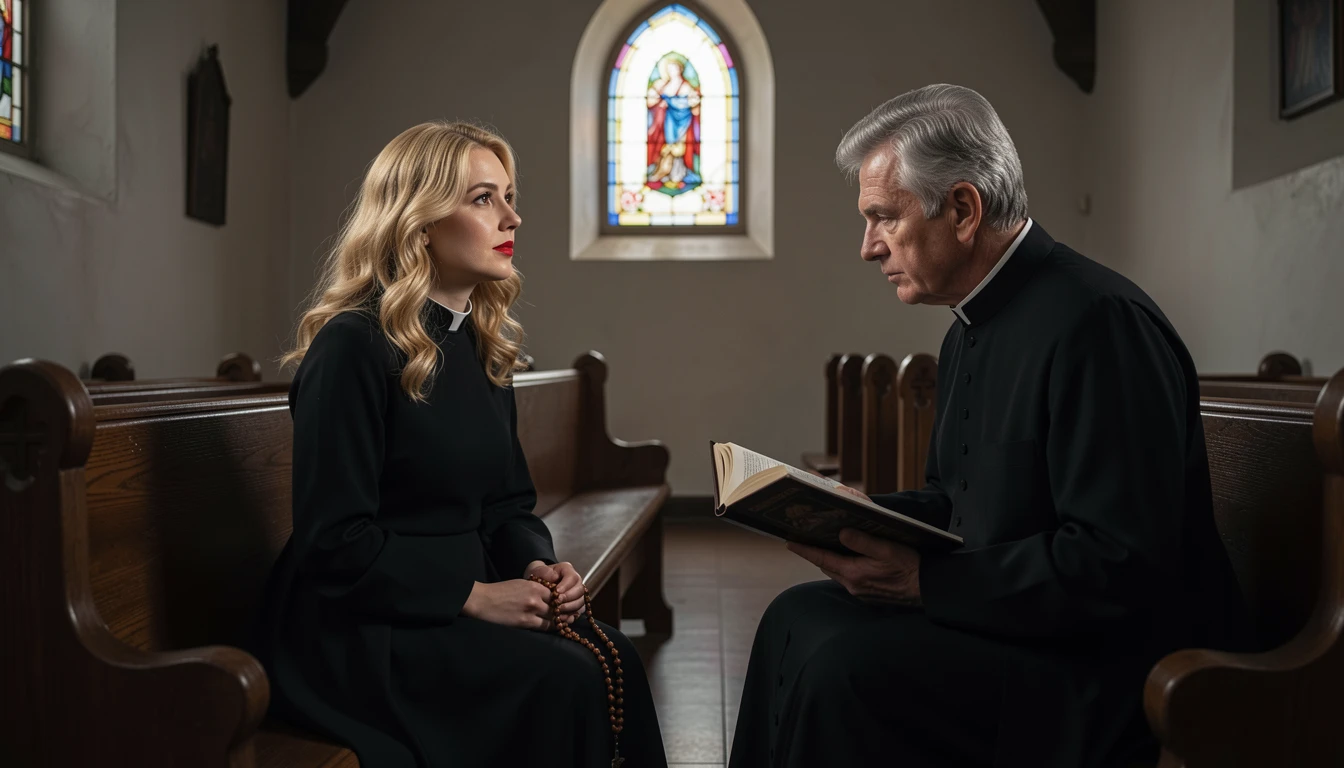
The worn beads slid between my fingers, smooth as river stones, each one a prayer I'd said a hundred times since Father Alexei pressed them into my palms. Hail Mary, full of grace. The words had become a rhythm, a heartbeat beneath my skin, something to hold onto when the morning felt too wide and the house too quiet.
The chapel smelled of beeswax and cold stone, the gold light from the votive candles flickering against the dark wood. I knelt on the worn cushion, my knees aching in that distant, pleasant way that meant I'd been here longer than I meant to. The twins stirred, a soft flutter against my ribs, and I pressed my hand to the spot without thinking. We're going to be okay.
The door opened behind me—soft, unhurried, the sound of someone who didn't need to announce himself. I didn't turn. I'd learned to read footsteps in this house, the weight and rhythm of the men who moved through it. This one was measured. Deliberate. The step of a man who'd spent his life walking toward confession, not away from it.
"Isabella." Father Alexei's voice was warm, touched with the accent of a man who'd learned English from books and Italians. "I hoped I'd find you here."
I opened my eyes, let the beads pool in my palm. "Where else would I be?"
He smiled, a small, knowing thing, and took the chair across from me, settling into it with the ease of a man who'd spent decades in these rooms. He held a worn catechism, the leather cracked and soft at the corners, pages yellowed with use. A book that had been opened a thousand times, each reading wearing it thinner.
"The house is quiet this morning," he said. "Dmitri is in his study. Irina is preparing for her journey." He paused, letting the silence settle between us. "It seemed a good time to begin."
My throat tightened. Begin. The word felt too large, too heavy for this small room with its flickering candles and cold stone. I'd agreed to this—to the OCIA sessions, to the instruction, to the slow unfolding of a faith I was still learning to hold. But standing at the threshold of it, I felt the weight of everything I'd have to say.
"Shall we begin with your story, Isabella?"
The question landed soft as a dropped handkerchief. He asked it the way he asked everything—without judgment, without hurry, as if he had all the time in the world and none of it mattered more than this moment.
I opened my mouth. Closed it. The words stuck somewhere between my throat and my tongue, caught on the shape of a truth I'd never spoken aloud to anyone. I was born a man. I was remade by magic. Sold into a brothel. Bought by a man who trained me for another. And now I carry twins—sons—for a minister who thinks I'm the answer to his prayers.
How did you tell a priest that?
The twins kicked, a sharp, insistent flutter against my belly, as if urging me to speak. I pressed my hand to the spot, felt the movement ripple beneath my skin, and for a moment, I was somewhere else entirely—back in Luca's house, his hand on my stomach, the glass applicator cool and strange inside me. This is what you wanted, he'd said. This is what you asked for.
Had I? Had I asked for any of this?
"Isabella." Father Alexei's voice was gentle, pulling me back. "You don't have to tell me everything at once. The Church has time. God has time. I have time."
I laughed, a small, broken sound. "That's the problem. I don't know if I do."
He tilted his head, studying me with those patient eyes. "What do you mean?"
"I'm pregnant," I said, the words coming out flat, practical. "Twins. Sons." I looked down at my belly, at the slight swell beneath my dress. "Their father is a man who believes I was made for him. Their mother is a woman who isn't sure she believes in anything anymore."
Father Alexei was quiet for a long moment. When he spoke, his voice was soft. "And what do you believe, Isabella?"
I believe I'm going to die here. The thought surfaced unbidden, sharp and cold. I believe I'm going to be trapped in this house, in this body, in this life, until I forget there was ever anything else.
But I didn't say that. I said, "I believe I'm trying to find out."
He nodded, as if that were answer enough. He opened the catechism, the pages falling open to a place marked with a ribbon, and ran his finger down the text. "Then let's start with something simple. Something we can hold onto together."
He looked up at me, and there was something in his eyes—not pity, not judgment, but a quiet, steady warmth that made my chest ache. "Tell me about the first time you felt God's presence."
The question caught me off guard. I opened my mouth to deflect, to give him the practiced answer I'd learned in Dmitri's study, the one about the prayer and the medal and the feeling of being seen. But the words that came out were different.
"I was in a brothel," I said. "In New York. A man had just finished with me, and I was lying on a bed that smelled like someone else's sweat, staring at a crack in the ceiling. And I thought—I thought, if there's a God, why am I here? Why am I this? "
Father Alexei didn't flinch. He didn't look away. He just waited, the catechism open in his lap, his eyes steady on mine.
"And what did you feel?" he asked. "In that moment?"
I swallowed. The memory was sharp, visceral—the weight of the man still heavy on the mattress, the taste of him still in my mouth, the ache between my legs that I'd learned to ignore. "Nothing," I said. "I felt nothing. Just… empty. Like someone had scooped out everything I was and left the shell."
He nodded slowly. "And that emptiness—did it feel like absence? Or did it feel like space?"
The question stopped me. I blinked at him, the words settling into my chest like stones dropped into still water. Space. Not absence. Not loss. But room. Room for something else.
"I don't know," I said honestly. "I've never thought of it that way."
"Maybe that's what this time is for," he said gently. "To learn to see the difference."
He closed the catechism, set it aside, and leaned forward, his elbows on his knees, his hands clasped. "Isabella, I've been a priest for forty years. I've heard confessions that would make most men weep. I've sat with murderers and thieves and men who sold their own daughters. And I've learned that the people who come to God broken are the ones He can use most."
He smiled, a small, tired thing. "You don't have to be whole to be loved. You don't have to be clean to be forgiven. You just have to be willing to let Him in."
My eyes burned. I blinked hard, refusing to let the tears fall. "And what if I don't know how?"
"Then we learn together." He reached out, his hand hovering over mine, waiting for permission. I gave it, a small nod, and he covered my fingers with his. "That's what this is, Isabella. That's what OCIA is. Not a test. Not a judgment. Just a journey. And you don't have to walk it alone."
His hand was warm, dry, the skin roughened by years of work. I looked down at it, at the way it covered mine, and felt something shift in my chest. Not hope, exactly. Not faith. But something quieter. Something that felt like permission.
"Father," I said, my voice barely above a whisper. "There are things about me you don't know. Things that would—" I stopped, the words catching. "Things that would change how you see me."
He didn't let go of my hand. "Nothing you could tell me would change how God sees you, Isabella. And nothing you could tell me would change how I see you either."
I wanted to believe him. I wanted to believe that the truth of what I was—what I'd been—could live in this room without shattering the fragile peace I'd built. But the words were there, pressing against my teeth, demanding to be spoken.
"I wasn't always a woman," I said.
The silence that followed was thick, heavy, like the air before a storm. Father Alexei didn't move. His hand stayed on mine, warm and steady, and his eyes—his eyes held nothing but patience.
"I was born Carter," I said, the name strange on my tongue, a ghost I'd almost forgotten. "A man. And then—" I stopped, the words sticking. Magic. It sounded insane. It sounded like the fever dream of a woman who'd lost her grip on reality. But it was true. It was the truest thing I knew.
"There was a man," I said slowly. "A gypsy. He changed me. Made me into this." I gestured at my body, at the curves and softness that still felt foreign, even after all these months. "The Don wanted a wife for his nephew. A pure Italian girl. So they made one."
Father Alexei was quiet for a long moment. When he spoke, his voice was careful, measured. "And the nephew?"
"Dead. Killed before the marriage could happen." I laughed, a hollow sound. "So they sent me to the brothel instead. To earn my keep."
The words hung in the air between us, ugly and raw. I waited for him to pull away, to cross himself, to look at me with the horror I'd seen in other eyes. But he didn't. He just sat there, his hand on mine, his face unreadable.
"And now?" he asked.
"Now I'm here." I looked down at my belly, at the swell that held two lives. "Carrying another man's children. Learning to pray. Trying to find a God I'm not sure I believe in."
He was quiet for a long moment. Then he said, "Isabella, do you know why I became a priest?"
I shook my head.
"Because I saw the worst of what men can do to each other," he said. "And I needed to believe there was something better. Something that could redeem the darkness." He smiled, a small, sad thing. "I've spent forty years looking for God in the broken places. And I've found Him there more often than in the churches."
He squeezed my hand. "You are not a mistake, Isabella. You are not an abomination. You are a woman who has survived things that would have broken most people. And the God I serve doesn't turn away from survivors. He runs toward them."
The tears I'd been holding back broke free. They slid down my cheeks, hot and silent, and I didn't try to stop them. I just sat there, in the flickering candlelight of a chapel in Moscow, holding a priest's hand and weeping like a child.
Father Alexei didn't speak. He didn't offer platitudes or prayers. He just sat with me, his hand warm on mine, until the tears ran dry and the silence settled around us like a blanket.
"I'm sorry," I said, my voice thick. "I didn't mean to—"
"Don't apologize," he said gently. "Tears are prayers too, Isabella. Sometimes they're the only ones we have the strength to say."
I laughed, a wet, broken sound. "You sound like you've said that before."
"Many times," he admitted. "And I'll say it many more." He released my hand, sat back in his chair, and picked up the catechism again. "Now. Shall we try again? Tell me about the first time you felt God's presence."
I took a shaky breath, wiped my cheeks with the back of my hand. The question felt different now, less like a test and more like an invitation. I closed my eyes, searching for the memory.
"It was after I recited the Saint Michael prayer," I said slowly. "I didn't know I knew it. The words just… came. Like they'd been waiting in my mouth for years." I opened my eyes, looked at him. "Dmitri said it brought him back to God. He said I was an answer to his prayers."
"And what did you feel?"
"I felt seen." The words came out before I could stop them. "Like someone had been watching me my whole life, waiting for me to finally look up."
Father Alexei nodded slowly, a small smile playing at the corners of his mouth. "That," he said, "is the beginning of faith."
He opened the catechism to a marked page. "Today, I want to talk about the Litany of Humility. About what it means to surrender your will to God's. But first—" He looked up at me, his eyes kind. "I want you to know that you are not alone, Isabella. Whatever you've done, whatever's been done to you, you are not beyond redemption. You are not beyond love."
The words settled into my chest, warm and heavy, like a hand pressed over my heart. I wanted to believe them. I wanted to let them take root and grow into something I could hold onto.
The twins kicked, a soft flutter against my belly, and I pressed my hand to the spot. We're going to be okay, I whispered to them, to myself, to the God I was still learning to believe in. We're going to be okay.
Father Alexei smiled, as if he could hear the prayer I hadn't spoken aloud. "Shall we begin?"
I nodded, my fingers finding the rosary beads again, the familiar weight grounding me. "Yes," I said. "Let's begin."
The catechism opened in his lap, the pages soft with age, and he began to read. The words washed over me, Latin and English tangled together, and I let them carry me. Not toward answers—I wasn't sure I'd ever find those. But toward something else. Something quieter.
Toward space.
The morning light grew brighter through the chapel windows, casting long shadows across the marble floor. Father Alexei's voice rose and fell, patient and steady, and I listened with my whole body, feeling the twins stir in response to the rhythm of his words.
When the session ended, he closed the catechism and looked at me with those kind, patient eyes. "Same time tomorrow?"
I nodded, my throat tight. "Same time tomorrow."
He rose, his knees cracking softly, and paused at the door. "Isabella."
I looked up.
"You asked how to tell a priest you were born a man," he said gently. "You just did. And I'm still here." He smiled. "That's the thing about God's love, Isabella. It doesn't require you to be anything other than what you are."
The door closed behind him, soft and final, and I was alone in the chapel.
I sat there for a long moment, the rosary beads cool in my palm, the candlelight flickering against the dark wood. The twins stirred, a soft flutter against my belly, and I pressed my hand to the spot.
We're going to be okay, I whispered. I don't know how. I don't know when. But we're going to be okay.
And for the first time since I'd arrived in this house, I believed it.
I stayed there long after the door closed, the way you stay in a room where something holy just happened, afraid that movement will break the spell. The candles had burned down to stubs, their flames guttering in pools of melted wax, and the light through the windows had shifted from gold to the flat white of mid-morning.
My knees had gone numb from the cushion. I shifted, wincing at the pins and needles that shot through my legs, and let the rosary slide through my fingers one last time before I tucked it into the pocket of my dress. The beads were warm now, warm from my skin, warm from the hours I'd spent holding them. I liked that. The idea that something could be changed by being held.
I rose slowly, one hand braced on the pew, the other pressed to the small of my back where the weight of the twins had begun to settle. The ache there was constant now, a low, familiar companion. I'd read somewhere that a woman's body prepared for birth slowly, loosening joints, shifting bones, making room. I felt it happening, the quiet remaking of my skeleton to accommodate the lives inside me.
I walked to the altar, to the small rack of votive candles that burned in their red glass holders. I'd never lit one before. I wasn't sure I knew how. But I'd watched Irina do it, the careful way she'd touched the flame to a fresh wick, the way she'd crossed herself and knelt, her lips moving in silent prayer.
I took a match from the small tin box beside the rack, struck it against the rough strip on the side. The flame flared, small and bright, and I touched it to a fresh candle, watching the wick catch, the flame steady itself, settle into its small, persistent burn.
I didn't know what to pray for. I didn't know if I believed in prayer at all. But I stood there, my hand hovering over the flame, and I let the words come anyway.
For the twins, I thought. For their safety. For their lives.
For Luca, wherever he is.
For me.
I didn't know what to ask for myself. I didn't know what I wanted. But I stood there until the flame burned steady and the match burned down to my fingers, and then I blew it out and dropped the charred stick into the tin.
I turned to leave, and found Irina standing in the doorway.
She was dressed for travel—a dark coat over her black dress, a small leather bag at her feet. Her hair was pulled back in its severe bun, the silver streaks catching the light. She looked at me, at the candle I'd just lit, and something moved in her dark eyes. Something soft.
"You lit a candle," she said. It wasn't a question.
"I didn't know what else to do," I admitted.
She crossed the room slowly, her heels clicking on the marble floor. She stopped beside me, close enough that I could smell her perfume—something floral, understated, expensive. She looked at the candle, at the small flame, and then she reached out and touched my arm.
"I lit one for you," she said quietly. "The first night you came to this house. I didn't know you yet. I didn't know what you would become to us." She paused. "But I lit a candle for you anyway."
My throat tightened. "Why?"
"Because you looked lost," she said. "And I know what it is to be lost in a house that isn't yours."
She let her hand fall, and we stood there together, two women in a chapel in Moscow, watching a flame that neither of us had asked for.
"I'm leaving in an hour," she said. "Dmitri's driver is taking me to the airport. I'll be gone for two weeks." She looked at me, her dark eyes searching mine. "I wanted to say goodbye. And I wanted to ask you something."
"What?"
She was quiet for a moment. Then she said, "Will you pray for me? While I'm gone?"
The request caught me off guard. I opened my mouth to deflect, to say that I didn't know how to pray for anyone, that I was still learning to pray for myself. But the words didn't come. Instead, I heard myself say, "I will."
She nodded, a small, almost imperceptible movement. "Thank you." She reached into her pocket and pulled out something small, wrapped in tissue paper. "This is for you. For the babies."
I took it, unwrapped it carefully. Inside was a small silver cross, delicate, ornate, the metal warm from being carried close to her body. It hung on a fine silver chain, and the back was engraved with a single word: Nadezhda. Hope.
"It was my mother's," Irina said. "She wore it every day of her life. She gave it to me on my wedding day, and I've worn it every day since." She paused. "I want you to have it now. To keep for the boys. To keep for yourself."
I stared at the cross, at the word engraved on the back, and felt something crack open in my chest. "Irina, I can't—"
"You can," she said firmly. "You will. It's not a gift, Isabella. It's a promise. A promise that you are not alone in this. That I will be here. That these children will be loved."
She reached out and closed my fingers around the cross. "You gave me back my faith," she said quietly. "You gave me back my husband. You gave me hope. This is the only thing I have that's worth giving in return."
I looked at her, at the woman who had taught me to kneel, who had shown me her mother's room, who had knitted sweaters for children that weren't hers. And I saw, for the first time, not the mistress of the house, not Dmitri's wife, not the woman who trained concubines. I saw a woman who was afraid. A woman who had spent her whole life in the shadows of other people's lives, hoping to be seen.
"I'll wear it," I said. "Every day."
She smiled, a small, real thing, and for a moment she looked almost young. "Good." She straightened, smoothed her coat, and stepped back. "I should go. Dmitri will be waiting."
She paused at the door, her hand on the frame, and looked back at me. "Take care of yourself, Isabella. And take care of those boys." Her eyes dropped to my belly, and something soft passed over her face. "They're going to be extraordinary. I can feel it."
Then she was gone, the door closing softly behind her, and I was alone in the chapel again.
I stood there for a long moment, the silver cross warm in my palm, the candle still burning beside me. I thought about Irina, about the life she'd lived, about the children she'd never have. I thought about the sweaters she'd knitted, the names she'd written in her grandmother's book, the hope she'd poured into a woman she barely knew.
And I thought about the word engraved on the back of the cross. Nadezhda. Hope.
I lifted the chain over my head, let the cross settle against my chest, beside the amber pendant Luca had given me, beside the Saint Michael medal Dmitri had pressed into my palm. Three tokens of three different kinds of love, all of them asking me to believe in something I couldn't see.
Maybe that was what faith was. Not certainty. Not proof. Just the willingness to wear the weight of other people's hope until you could carry your own.
I pressed my hand to my belly, felt the twins stir in response, and for the first time, I didn't whisper we're going to be okay. I didn't need to. The words had become something else now. Something I could hold onto without saying them aloud.
I walked out of the chapel into the bright Moscow morning, the cross warm against my skin, and I let the door close behind me.
The morning hit me like a wall—bright and cold and impossibly white, the kind of light that made everything look washed clean, even the gray stone of the house. I blinked against it, my hand coming up to shield my eyes, and that's when I nearly walked into him.
Dmitri stood in the corridor, his hand already reaching for the chapel door I'd just closed behind me. He stopped mid-motion, his fingers hovering inches from the wood, and for a moment we just stood there, caught in the strange arithmetic of near-collision.
"Isabella." His voice was warm, surprised. His dark eyes dropped from my face to my chest, and I watched something shift in them—a flicker, quick as a candle guttering in a draft.
I looked down. The silver cross lay against my collarbone, catching the light, the fine chain delicate against my skin. Beside it, the amber pendant Luca had given me. Beneath it, the Saint Michael medal. Three weights, three claims, all of them resting over my heart like a hand pressed flat.
Dmitri's gaze lingered on the cross. His hand fell from the door, slowly, and I saw his throat move as he swallowed.
"Irina gave you that," he said. Not a question—a recognition. Something in his voice had gone quiet, careful.
"She came to say goodbye," I said. "Before she left." My fingers found the cross, touched the cool metal. "She said it was her mother's."
He nodded, but the movement was stiff, wrong. His eyes hadn't left the cross. They traced the delicate filigree, the fine silver chain, the way it caught the morning light and threw it back in small, bright points.
"She never gave that to anyone," he said slowly, the words heavy, deliberate. "Not even me."
The silence that followed was thick, charged, like the air before a storm breaks. I stood there, the cross warm against my skin, and I felt the weight of what she'd given me settle deeper—not just a gift, not just a promise, but something I hadn't understood until this moment.
Dmitri's hand rose, slow, hesitant, and for a moment I thought he would touch it. His fingers hovered near the chain, near the place where the cross rested against my sternum, and I saw something move in his face—something raw, unguarded, there and gone before I could name it.
Then his hand fell. He stepped back, straightened, and the mask slid back into place—the composed, deliberate man who ran a household and a ministry and a life I was still learning to understand.
"She never gave it to anyone," he repeated, softer this time, almost to himself. He looked at me, and there was something new in his eyes—something I couldn't read. "Not in all the years we've been married."
I didn't know what to say. The cross felt heavier now, the weight of it pressing against my chest like a question I didn't know how to answer.
"I'm sorry," I said. "I didn't know—"
"Don't be sorry." He cut me off, his voice gentle. "She chose to give it to you. That means something." He paused, his dark eyes searching mine. "It means you matter to her. More than I realized."
The words landed somewhere in my chest, warm and strange. I thought of Irina standing in the chapel doorway, dressed for travel, her dark eyes soft with something I hadn't been able to name. I thought of the way she'd closed my fingers around the cross, the way she'd said I want you to have it now.
"She asked me to pray for her," I said. "While she's gone."
Dmitri's mouth curved into a small, sad smile. "She's never asked me to pray for her. Not once." He shook his head slowly, as if trying to solve a puzzle that kept changing shape. "You've changed her, Isabella. You've changed both of us."
The morning light shifted, casting long shadows across the corridor floor. I stood there, the cross warm against my skin, the amber pendant pressing against my collarbone, the Saint Michael medal hidden beneath them all, and I felt the strange weight of all the people I was becoming.
"I should go," I said. "I should—" I gestured vaguely toward the rest of the house, toward the day that was waiting for me.
"Walk with me," Dmitri said. It wasn't quite a command, wasn't quite a request. It hung in the air between us, an invitation I could still refuse.
I hesitated. The twins stirred, a soft flutter against my belly, and I pressed my hand to the spot without thinking. "Where?"
"The garden." He nodded toward the far end of the corridor, where a set of glass doors let in the pale morning light. "I want to show you something."
The garden was cold, the air sharp with the bite of early autumn. The roses had faded to brown, their petals curling at the edges, but there was still green in the hedges, still life in the careful rows of herbs that bordered the stone paths. Dmitri walked slowly, his hands clasped behind his back, and I followed, my shoes crunching on the gravel.
He stopped at a bench near the center of the garden, half-hidden by a trellis of withered vines. He sat, and after a moment, I sat beside him, the cold stone seeping through my dress.
"I proposed to Irina here," he said quietly. "Twenty-three years ago. It was summer then. The roses were in full bloom." He looked at the dead flowers, the brown petals, the bare canes. "She said yes before I finished asking."
I didn't speak. I didn't know what he needed me to say.
"She was beautiful," he continued. "Not the way women are beautiful in paintings—not perfect, not polished. She was beautiful the way a storm is beautiful. Fierce. Unpredictable. She terrified me." He laughed, a low, rueful sound. "I was a young man with a name and a future and no idea what to do with either. And she looked at me like she could see through every lie I'd ever told myself."
The wind moved through the dead roses, rustling the brown leaves. I pulled my coat tighter, felt the twins shift against my ribs.
"We tried for children," he said. "For years. She wanted them more than anything. More than I did, I think. She used to talk about them—the names she'd chosen, the way she'd raise them, the things she'd teach them." He paused, his voice roughening. "When we found out she couldn't—"
He stopped. The silence stretched between us, heavy with years of unspoken grief.
"She never stopped wanting them," he said finally. "She just stopped talking about it. She poured herself into other things. The house. The church. The girls Luca brought." He looked at me, his dark eyes unreadable. "She knitted sweaters for children she'd never hold. She wrote names in a book that would never carry her own blood."
I thought of the sweaters, the soft blue wool folded carefully in Irina's mother's room. I thought of the names written in her grandmother's book—Aleksandr, Mikhail—in Irina's own hand.
"She gave you her mother's cross," Dmitri said. "The one thing she's carried with her every day since we married. The one thing she's never let anyone else touch." He shook his head slowly. "Do you understand what that means, Isabella?"
I didn't. I couldn't. I was just a woman who'd been remade, sold, trained, and delivered—a vessel for another woman's hope, another man's legacy. I didn't understand why anyone would give me something so precious.
"It means she's chosen you," Dmitri said, as if reading my thoughts. "Not as a concubine. Not as a vessel for my children. As family." He said the word carefully, like it was fragile, like it might break if he held it too tightly. "She's never had a sister. She's never had a daughter. But she's chosen you to be both."
The tears came before I could stop them—hot, silent, sliding down my cheeks. I didn't try to wipe them away. I just sat there, in the cold Moscow garden, surrounded by dead roses, and let them fall.
Dmitri didn't reach for me. He didn't offer comfort or platitudes. He just sat beside me, his hands clasped, his eyes on the dead garden, and gave me the space to weep.
"I don't know how to be that," I said finally, my voice thick. "I don't know how to be anyone's family. I was never—" I stopped, the words catching. "I was never anyone's anything. I was just a tool. A means to an end. Something to be used and passed along."
"I know," Dmitri said quietly. "I know what you were. I know what was done to you." He turned to look at me, his dark eyes steady. "But that's not what you are now. That's not who you're becoming."
I looked at him, at the man who had claimed me, who had put his seed in my belly, who had knelt beside me in prayer and wept at the thought of his mother's faith. And I saw, for the first time, not the minister, not the master, not the man who owned me—but a man who was also trying to find his way.
"I'm afraid," I said. The words came out before I could stop them. "I'm afraid of failing you. Failing Irina. Failing these boys." I pressed my hand to my belly, felt the twins stir. "I'm afraid of becoming something I don't recognize."
Dmitri was quiet for a long moment. Then he said, "I'm afraid too."
I blinked at him, surprised.
"I'm afraid of being a father," he said. "I'm afraid of holding my sons and not knowing what to do with them. I'm afraid of the weight of their lives, the weight of everything I'll have to teach them, everything I'll have to protect them from." He looked down at his hands, at the gold ring on his finger. "I'm afraid of becoming my father."
The confession hung in the air between us, raw and unexpected. I didn't know what to say. I didn't know how to comfort a man who had spent his whole life being strong, being certain, being the one everyone else leaned on.
"But I'm also hopeful," he said, looking up at me. "For the first time in years, I'm hopeful. Because of you."
I shook my head. "I haven't done anything—"
"You prayed," he said simply. "You knelt in that chapel and you prayed, and you didn't even know you were doing it. You brought Irina back to her faith. You brought me back to mine. You gave us a reason to believe that God hasn't abandoned us." He reached out, slow, hesitant, and took my hand. His palm was warm, rough with calluses. "You are not a tool, Isabella. You are not a means to an end. You are a gift."
His hand held mine, and I felt the calluses press against my palm—the map of a life I was only beginning to understand. I wanted to believe him. I wanted to let the words sink in and take root, the way Irina's cross had settled against my chest. But there was a part of me, the part that still remembered being Carter, that remembered being bought and sold and trained, that couldn't quite accept the shape of what he was offering.
"A gift," I repeated. The word tasted strange in my mouth, foreign. "I don't know what to do with that. I've never been a gift to anyone. I've been a transaction. A project. A—" I stopped, searching for the word. "A demonstration."
Dmitri's grip tightened, just slightly. "Is that what Luca made you feel?"
The name landed between us, and I felt my chest constrict. I hadn't said his name out loud in days. I'd thought it, a hundred times, a thousand times, but speaking it felt like opening a door I'd been trying to keep closed.
"Luca made me feel many things," I said carefully. "Some of them beautiful. Some of them—" I looked down at our joined hands, at the way his thumb rested against my knuckles. "Some of them I'm still trying to understand."
Dmitri was quiet for a moment. The wind moved through the dead roses, and I watched a brown petal detach and drift to the gravel, landing soundless.
"I know about Luca," he said. "I know what he does. What he's done. To you, and to others." He paused. "I know he trained you for me. That he prepared you for this—for us."
I nodded, not trusting my voice.
"What I don't know," Dmitri continued, "is whether he hurt you. Whether what he did left marks I can't see." His dark eyes found mine, steady and searching. "You don't have to answer. But I need you to know that if he did—if any of it was cruelty dressed as care—you can tell me. Nothing you say will change what you are to us."
The question hung in the cold air, and I felt the weight of it press against my ribs. Luca had hurt me. He'd sold me. He'd trained me like a prized mare and delivered me to a stranger's bed. But he'd also held me when I wept, taught me to want, given me his mother's pendant and told me I was his finest work.
"He didn't hurt me," I said finally. "Not the way you mean. He—" I searched for the words. "He made me want things I didn't know I could want. He made me feel seen. And then he let me go."
Dmitri's jaw tightened. "That's its own kind of cruelty."
"Maybe." I pulled my hand from his, not roughly, but gently, and pressed both palms to my belly. The twins stirred, a slow roll against my fingers. "But it's also how I came to be here. How I came to be carrying your sons. How I came to be sitting in this garden, talking to you about faith and fear and the weight of becoming someone new."
He followed my hands with his eyes, watching the place where they rested against the swell of my dress. "They're strong," he said. "Dr. Petrova said their heartbeats are strong."
"They are." I felt the flutter again, a small kick against my palm. "They're active. Especially at night. I think they're practicing for the lives they're going to live."
A smile ghosted across his face, there and gone. "They'll have your stubbornness. I can already tell."
I laughed, surprising myself. The sound was raw, unpracticed, but it was real. "How can you possibly know that?"
"Because they're yours." He said it simply, like it was the most obvious thing in the world. "And you are the most stubborn woman I've ever met."
I blinked at him. "I'm not—"
"You are." He nodded toward the house, toward the chapel where I'd knelt and prayed without knowing the words. "You survived being remade. You survived the brothel. You survived Luca. You survived me." His voice softened. "You're here, in a country that isn't yours, carrying children you didn't choose to conceive, and you're still standing. Still praying. Still hoping." He shook his head. "That's not weakness, Isabella. That's the fiercest kind of strength."
The tears came again, hot and sudden, and I didn't try to stop them. I let them fall, let them slide down my cheeks and drip onto my hands, onto the swell of my belly where my sons were growing.
"I don't feel strong," I whispered. "I feel like I'm barely holding on."
"That's what strength looks like," Dmitri said. "Holding on when everything in you wants to let go." He reached out again, and this time he didn't take my hand. He reached past it, his fingers brushing the silver cross where it lay against my chest. The touch was light, almost reverent, and I felt the metal warm under his fingertips.
"She gave you this," he said softly. "My wife. My Irina. The woman who has carried this cross since her mother died, who has never let anyone else touch it, who has never even let me hold it." His fingers traced the filigree, the delicate lines of the crucified Christ. "She gave it to you because she sees herself in you. Because she sees the woman she might have been, if fate had dealt her a different hand."
I looked down at the cross, at his fingers against the silver, and I felt something shift in my chest—something I couldn't name, couldn't contain.
"I don't know how to be worthy of it," I said. "Of any of this. The cross. The medal. The pendant. The trust you and Irina have placed in me." I shook my head. "I'm just a woman who was made into something she never asked to be."
"And yet," Dmitri said, his voice quiet, "you chose to stay. You chose to pray. You chose to carry my children, to let Irina into your heart, to become part of a family that has been waiting for you without knowing it." He withdrew his hand, let it fall to his side. "That's not the choice of a woman who doesn't know her own worth. That's the choice of a woman who is learning to believe she deserves to be loved."
The words settled into me, warm and strange, and I felt something loosen in my chest—a knot I hadn't known I was carrying.
"I don't know how to be loved," I admitted. "I don't know how to let it in. Every time I start to believe it, I wait for the other shoe to drop. For the moment when you realize I'm not worth the trouble."
"I won't realize that," Dmitri said. "Because it isn't true."
I looked at him, at this man who had claimed me, who had put his seed in my belly, who had knelt beside me in prayer and wept at the thought of his mother's faith. And I saw, in the lines of his face, in the steadiness of his gaze, something I hadn't let myself see before.
He wasn't just my master. He wasn't just the father of my children. He was a man who was also afraid, also hoping, also trying to become something new.
"Irina will be gone for two weeks," I said, the words coming out before I'd fully formed them. "Father Alexei said the first OCIA session is tomorrow. I'm—" I paused, feeling the weight of the admission. "I'm nervous. I've never done anything like this. I've never been part of a congregation, never sat through a service, never learned the rhythms of faith that seem to come so naturally to you and Irina."
Dmitri's mouth curved into a small, genuine smile. "Neither have I," he said. "Not really. I was raised in the Church, but I left it for twenty years. I'm as new to this as you are." He paused. "Perhaps that's why God brought us together. Two people who don't know what they're doing, learning to believe together."
I laughed again, a soft, surprised sound. "That's a terrifying thought."
"It's the most hopeful one I've had in years."
The wind moved through the garden, and I felt the cold seep through my dress. But the cross was warm against my chest, and the twins were stirring, and for the first time since I'd arrived in this cold, white city, I felt something I couldn't quite name.
Not safety. Not belonging. Something smaller, quieter—a seed, maybe, waiting for the right season to grow.
"I should go inside," I said. "I have reading to do. Augustine. The Confessions." I smiled, a little wry. "I'm only a few pages in, and I already feel like he's writing about me."
Dmitri nodded. "He was a man who knew the weight of sin and the relief of grace. I think you'll find a kindred spirit in him."
I rose from the bench, and he rose with me. We stood there for a moment, in the cold garden surrounded by dead roses, and I felt the strange weight of the moment settle around us.
"Dmitri," I said, and he turned to look at me. "Thank you. For telling me about Irina. For trusting me with her story." I paused. "For trusting me, at all."
His dark eyes held mine, and I saw something move in them—something raw, unguarded. "You're carrying my sons," he said simply. "You've given my wife a reason to hope. You've given me a reason to pray." He reached out, slow, and took my hand one last time. "Trusting you is the easiest thing I've done in years."
He released my hand, and I turned toward the house, the gravel crunching under my shoes. The cross swung gently against my chest, catching the pale light, and I felt the weight of it—not heavy, not burdensome, but grounding.
I was halfway up the path when I heard him speak again, his voice carrying on the wind.
"Isabella."
I stopped, turned. He was still standing by the bench, his hands clasped behind his back, the dead roses framing him like a painting.
"The first session," he said. "Tomorrow. I'll be there." He paused. "We'll be there. Together."
I nodded, and something in my chest loosened further. "Together," I repeated.
I continued up the path, toward the house, toward the day that was waiting for me. The cross was warm against my skin, and the twins were stirring, and for the first time in a long time, I didn't feel like I was walking toward something I feared.
I felt like I was walking toward something I was beginning to hope for.
I was nearly to the glass doors when I heard the gravel shift behind me, heavier than the wind's rustle. I turned. Dmitri had risen from the bench and was standing at the edge of the path, one hand raised as if to call me back.
"One more thing," he said. He crossed the distance between us, his shoes crunching with deliberate rhythm, and stopped close enough that I could smell the cold wool of his coat and the faint cedar of his cologne. He reached into his breast pocket and withdrew a small envelope, cream-colored, unsealed. "I wrote this last night. After you left the chapel." He held it out, and I took it, feeling the weight of the paper, the careful fold. "I was going to leave it in your room. But I think better that you read it now."
I looked down at the envelope, at the neat script spelling my name across the front. My throat tightened. "What is it?"
"A confession," he said quietly. "Of sorts." He paused, and I saw something flicker in his dark eyes—uncertainty, maybe, or hope. "I spent twenty years running from God because I thought He had abandoned me. I thought the silence I heard in my prayers was proof that I was alone. But you came into my house, and you knelt, and you spoke words you didn't know you knew, and I heard Him again for the first time in two decades." He reached out, slow, and touched the cross where it lay against my chest—a feather-light brush, barely there. "I don't know what I believe about most things anymore. But I believe you were sent to me. To us. And I believe I need to tell you that, in writing, so you never doubt it."
The envelope was warm in my hand, impossibly light and impossibly heavy at once. I wanted to open it, to read his words, but something held me back—the same something that had kept me from reading Luca's letter for days after he'd given it to me. The fear of what I might find. The fear of what it might change.
"I'll read it," I said, and my voice came out steadier than I felt. "Tonight. When I'm alone."
Dmitri nodded, and the mask settled back over his face—composed, deliberate, the minister and the master. But I had seen beneath it, in the garden, in the chapel, and I knew now that the mask was not the man. "Good," he said. "I'll be in the chapel tomorrow, before the session. If you want to talk about it." He paused. "Or if you just want to pray."
I tucked the envelope into the pocket of my dress, feeling its edge press against my hip like a promise waiting to be kept. "I'll be there."
He smiled then, a small, genuine curve of his mouth, and turned back toward the garden. I watched him for a moment, this man who had claimed me, who had put his seed in my belly, who had knelt beside me in prayer and wept at the thought of his mother's faith. Then I turned and walked through the glass doors, into the warmth of the house, the envelope pressing against my hip, the cross warm against my chest, and the twins stirring in my belly like they, too, were waiting for something to begin.
The house was quiet in that particular way of late afternoon, when the servants had retreated to their quarters and the light had gone amber and heavy through the tall windows. I climbed the stairs slowly, one hand on the banister, the envelope in my pocket pressing against my hip with each step. The twins were still, as if they too were waiting.
My room was exactly as I'd left it. The bed made with military precision. The Confessions face-down on the nightstand, spine cracked at page forty. The afternoon light fell across the floor in long golden rectangles, and dust motes turned slow circles in the beam. I closed the door behind me and stood in the center of the room, the envelope in my hand now, feeling its weight.
I sat on the edge of the bed. The paper was thick, expensive, the kind that came from a stationer's shop, not a department store. His script was precise, almost architectural, each letter formed with deliberate care. I unfolded it slowly, the way you open something you're afraid will change you.
*Isabella,* it began. *I am not a man who writes letters. I am not a man who confesses. But you have made me both, and so I write.*
I read the first line twice, then let my eyes continue.
*I told you in the garden that you were sent to us. I believe that with my whole heart. But I did not tell you everything, because I did not know how. I spent twenty years building walls against God, against hope, against the possibility that I could be forgiven for the things I have done. You know what I am. You know the men I have ruined, the lives I have bought and sold. You know because you were one of them, once—a person remade into property, and I held the receipt.*
My breath caught. I hadn't expected him to name it so plainly.
*I have done terrible things in the name of building an empire. I have broken men who stood in my way. I have taken women who had no choice and made them into what I needed. I told myself it was business. I told myself they were better off. I told myself a thousand lies, and I believed them all, because believing them was easier than looking at what I had become.*
*And then you came into my house. A woman who was made into something she never asked to be, who had every reason to hate the men who did it to her, who had every reason to hate me. And you knelt in my chapel and spoke words you didn't know you knew, and I heard God in your voice.*
The page trembled in my hand. I realized I was shaking.
*I don't know what I believe about most things. I don't know if I believe I can be forgiven. But I believe you are holy. I believe you were sent to me and to Irina to remind us that we are still capable of being loved, even after everything we have done. I believe that when you carry my sons, you carry the only pure thing I have ever been part of.*
*I am not asking you to forgive me. I am not asking you to love me. I am asking you to let me try to become the man you seem to think I can be. I am asking you to be patient with me while I learn. I am asking you to let me pray beside you, even when I don't know the words.*
*You are carrying my children. But you are also carrying my hope. I will spend the rest of my life trying to be worthy of both.*
*Yours, in faith and in fear,*
*Dmitri*
The letter shook in my hands. I read it again, slower, letting each word land. Then I folded it along the creases, carefully, the way you fold something you want to keep, and I pressed it to my chest, feeling the paper against the silk of my dress, feeling the cross and the medal and the pendant all resting against the same skin.
I don't know how long I sat there. The light shifted from amber to gold to the pale gray of early evening. The twins stirred, a soft flutter like wings against my ribs. I thought about Luca, about the letter I'd written him, about the words I hadn't been able to say. I thought about Irina, on a plane somewhere over the Atlantic, carrying her own weight of hope and fear.
The letter finally lowered from my chest, and I looked at the folded paper in my lap. The weight of his words pressed against me differently now—not crushing, but grounding, like a hand on the small of my back steadying me before a fall. I traced the crease with my thumb, feeling the fibers of the expensive paper, and I thought about the man who had written it. The man who had wept in the chapel. The man who had knelt beside me and confessed twenty years of silence.
I set the letter on the nightstand beside the Confessions, its cream edge catching the last of the evening light. Then I slid off the bed and onto my knees on the cold hardwood floor.
The position came easily now. That was something I noticed, in the quiet of the room—how natural it had become, kneeling. Not the way I had knelt for clients in the brothel, performing supplication like a costume. Not the way I had knelt for Luca in his studio, learning the geometry of obedience. This was different. This was a choice, made in silence, with no one watching.
The floor was hard beneath my knees, and I welcomed the pressure. It kept me present. It kept me from drifting into the fog of everything I couldn't control.
I closed my eyes and folded my hands, the rosary Irina had given me wrapped around my fingers. The beads were warm from my skin, smooth from years of her mother's touch before they had come to me. I thought about Irina, somewhere above the Atlantic, her dark hair streaked with silver, her severe bun loosening as she slept in her seat. I thought about the way she had held my hand in her mother's room, the way she had asked to be present at the birth of my sons, the way she had written their names in her grandmother's book in her own hand.
"Lord," I whispered, and my voice sounded small in the empty room. "Protect her."
The words came slowly at first, clumsy on my tongue. I was still learning to pray from need rather than habit, still learning to speak to a God I had only recently remembered I knew. But the shape of it was coming to me, the way a muscle remembers how to move even after years of disuse.
"Keep her safe in her travels. Keep her body strong and her mind clear. Let her find joy in the days ahead, and let her know that she is not alone."
I paused, feeling the twins shift inside me, a gentle roll that might have been one of them turning over. I pressed my hand to my belly, feeling the warmth of my own skin through the silk of my dress, and I thought about how Irina would never feel this. How she would never carry a child of her own, how she had made peace with that loss by pouring her love into other women's children, how she had asked to be present at the birth of mine.
"Give her the desires of her heart," I continued, my voice growing steadier. "Give her peace in the spaces where she has known only longing. Give her a reason to hope, and the courage to hold onto it when the days are hard."
The words felt insufficient, too small for the weight of what I wanted to say. I wanted to pray that she would know she was loved, that she would know she mattered, that she would know that the children I carried would carry her name in their hearts alongside their father's. I wanted to pray that she would never feel the sting of being left behind, of being the one who watched while others received what she could not have.
"Bless her hands," I said, and my voice cracked. "Bless the work they do, the love they give. Bless her in her loneliness, and let her know that she has a sister who prays for her."
The tears came then, quiet and hot, tracking down my cheeks. I didn't wipe them away. I let them fall, feeling them cool on my skin, feeling the strange relief of weeping for someone other than myself.
"And Lord," I added, my voice barely a whisper now, "if it is your will, let her find a way to be present when these children are born. Let her hold them, as she has asked. Let her know the joy of a child's weight in her arms, even if she cannot carry one in her body."
The prayer hung in the air between me and the ceiling, and I let it rise, let it go, trusting that it would find its way to wherever prayers go when they are spoken with a full heart.
I took a breath, steadying myself, and then I began the prayer I had spoken without knowing I knew it, the words rising from somewhere deep in me that I had never consciously accessed. The Saint Michael prayer.
"Saint Michael the Archangel," I recited, "defend us in battle. Be our protection against the wickedness and snares of the devil. May God rebuke him, we humbly pray; and do thou, O Prince of the Heavenly Host, by the power of God, cast into hell Satan and all the evil spirits who prowl about the world seeking the ruin of souls."
The words felt like armor, like a shield being raised. I spoke them slowly, letting each phrase land, feeling the ancient rhythm of the prayer steady my heartbeat. I had spoken these words in the chapel, unaware that I knew them, and Dmitri had wept. Now I spoke them deliberately, claiming them as my own, and I felt something shift in my chest—a door opening, a lock turning.
Amen, I finished silently, and I stayed on my knees for a long moment, letting the silence settle around me like a garment.
The room had grown darker while I prayed, the pale gray of early evening deepening toward the blue of dusk. I opened my eyes and looked at the window, at the reflection of my own face ghosted in the glass—honey-blond hair tumbling over bare shoulders, whiskey-brown eyes still wet with tears, the cross and the medal and the pendant catching the last of the light.
I rose slowly, my knees protesting the hard floor, and I sat on the edge of the bed. The Confessions lay beside Dmitri's letter, and I picked it up, feeling the cracked spine, the pages softened by Irina's mother's hands before they had come to mine.
I opened it to the page I had marked, page forty, and I began to read.
*"What then is time? If no one asks me, I know what it is. If I wish to explain it to him who asks, I do not know."*
The words had struck me when I first read them, and they struck me again now. Time. How it moved differently here, in this house, in this body. How the days had blurred together since I had arrived in Moscow, each one folding into the next until I could barely tell them apart. And yet some moments stretched, impossibly long, holding more weight than entire weeks had held in the brothel.
I read on, letting Augustine's voice fill the quiet of the room.
*"It is in my own mind, then, that I measure time. I must not allow my mind to insist that time is something objective."*
I paused, my finger resting on the page. In my own mind, I measured time. The time since I had been Carter, since I had been a man who walked through the world with a different kind of certainty. The time since I had become Isabella, soft and curved and learning to be seen. The time since Luca had first sketched me in the brothel, since Dmitri had claimed me on his jet, since Irina had taken my hand in her mother's room and called me sister.
All of it measured in my own mind, in the only way I knew how to measure anything—by the weight of what I had felt, by the shape of what I had become.
I read another passage, then another, letting the words wash over me. Augustine wrote about memory, about the vast fields of the mind where everything we have experienced is stored, waiting to be called up again. He wrote about how we are shaped by what we remember, how the past lives in us even when we think we have left it behind.
I thought about the brothel, about the chandeliers and the silk and the men who had used me. I thought about the Don, who had remade me as a favor to an old ally. I thought about the moment I had first seen my reflection after the transformation, the stranger in the mirror with honey-blond hair and whiskey-brown eyes.
I had thought that woman was a mask, a costume I wore to survive. But Augustine suggested something different—that we are not separate from our memories, that the past is not a country we can leave. That woman in the mirror, the one who had learned to laugh at the right jokes and bite her tongue at others, the one who had learned to watch every hand in the room—she was not a mask. She was me. She had always been me.
The realization settled over me like a weight, heavy and strange. I had spent so long thinking of myself as Carter trapped in Isabella's body, as a man playing a part to survive. But Carter was gone. Carter had been unmade in that transformation, and what remained was not a performance. It was a life. My life.
I closed the book, my finger still marking the page, and I looked at the window again. The last of the light had faded, and the glass showed only my reflection now—a woman in a silk dress, her hand resting on the swell of her belly, her eyes still wet with tears she hadn't bothered to wipe away.
"I don't know who I am," I whispered to the reflection. "But I think I'm beginning to find out."
The twins stirred in response, a flutter of movement that might have been a kick or a turn, and I pressed my hand more firmly against my belly, feeling the warmth of them, the life of them, the future they carried with them.
I thought about Dmitri's letter again, about his words: *You are carrying my children. But you are also carrying my hope.*
I thought about what it meant to be hope for someone. What it meant to be the thing that pulled a man back from twenty years of silence, that made him kneel in a chapel and weep for his mother's faith. What it meant to be holy in someone else's eyes, even when I felt anything but.
The room was dark now, and I hadn't turned on the lamps. I sat in the growing darkness, the Confessions closed on my lap, Dmitri's letter on the nightstand, the rosary still wrapped around my fingers.
I thought about Irina again, somewhere over the Atlantic, and I whispered one more prayer into the dark.
"Keep her safe," I said. "Keep us all safe. And help me become the woman they seem to see when they look at me."
The words felt like a beginning, not an ending. Like the first line of a letter I hadn't yet written, the first step of a journey I hadn't yet begun.
I stayed there, in the dark, for a long time. The twins settled, their fluttering quieting into stillness. The house settled around me, creaking softly as it cooled. And somewhere in the distance, beyond the walls of the room, I heard the faint sound of a car approaching on the gravel drive—Dmitri, returning from wherever he had gone, or a servant come back from an errand, or no one at all, just the wind moving through the trees.
I didn't get up to look. I sat in the darkness, holding the book and the letter and the rosary, feeling the weight of all the words that had been spoken to me and all the words I had yet to speak, and I let the silence hold me.
Tomorrow, the first session with Father Alexei would begin. Tomorrow, I would kneel in the chapel beside Dmitri and begin the long work of becoming something new. But tonight, there was only this—the quiet room, the sleeping children in my belly, the echo of a prayer still rising toward a God I was only beginning to remember I knew.
I reached for the lamp on the nightstand and turned it on, flooding the room with warm yellow light. The shadows retreated, and I blinked against the sudden brightness. Then I picked up Dmitri's letter and read it one more time, letting his words sink into me, letting them become part of the story I was telling myself about who I was and who I was becoming.