

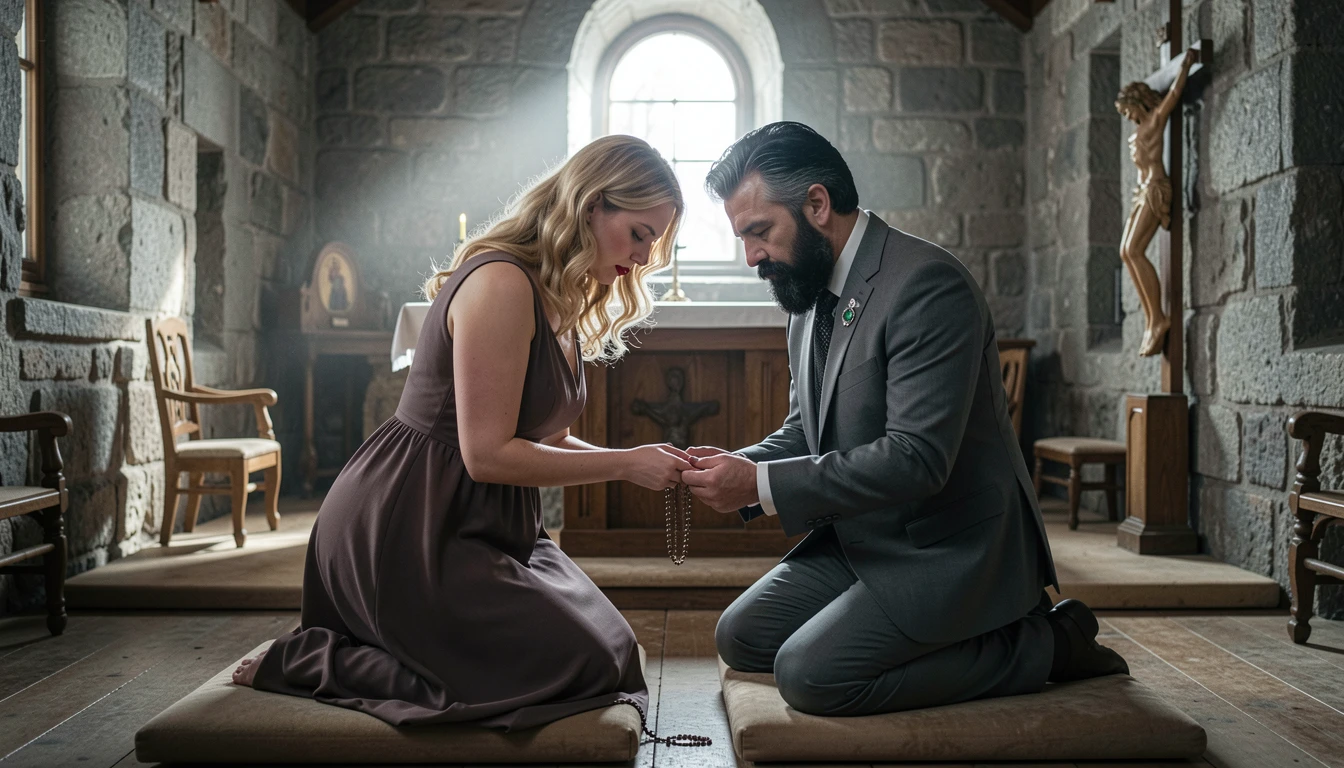
The chapel was cold against my knees, the marble hard and unforgiving through the thin wool of my dress. I'd come early, before the household stirred, needing the quiet the way I needed air. The votive candles flickered in their red glass cups, casting dancing shadows across the dark wood of the pews, and the air smelled of beeswax and old stone and something faintly sweet, like dried flowers pressed between the pages of a book.
I held the rosary Father Alexei had given me, the beads cool and smooth between my fingers, worn by his mother's hands for decades before they ever reached mine. I'd been praying for Irina, for her two weeks away and the ache I knew she carried, and for Dmitri, for the rawness of his new faith that he wore like a wound that was only beginning to heal. And for Luca, though I wasn't sure God wanted to hear his name in this place.
I prayed for him anyway.
I prayed for him the way I'd learned to pray for the dead—with the understanding that some things were beyond my reach, that the only thing I could do was hold them in the light and let God sort out the rest.
The twins stirred, a flutter low in my belly, and I pressed my palm against the swell of my dress. Eleven weeks now, and they were already making themselves known, already demanding attention I was learning to give. I'd started talking to them in Russian, the way Irina had taught me, my accent still clumsy on the hard consonants but growing truer with each passing day.
" Ya zdes', " I whispered. I'm here. " Moy malen'kiy. " My little ones.
The chapel door opened behind me, and I didn't turn. I knew the weight of those footsteps, the particular rhythm of his stride on the stone. Dmitri had been gone since yesterday evening, called away by something he hadn't explained, and I'd learned not to ask. The house had felt empty without him, the corridors too long, the silence too loud.
He knelt beside me, the fabric of his suit whispering against the marble, and I felt the warmth of him before I saw him—a solid presence at my shoulder, a familiar scent of expensive cologne and something darker, something that was just him.
"You're up early," he said, his voice low, roughened by the hour and the cold.
"I couldn't sleep." I didn't look at him, kept my eyes on the flickering candles, on the stained glass window above the altar where Saint Michael stood with his sword raised, triumphant over the serpent. "The twins were restless."
"And you?"
I turned then, finally meeting his eyes. They were dark in the candlelight, almost black, and there was something in them I hadn't seen before—a softness, a vulnerability that made him look younger than his fifty-eight years. He'd been weeping, I realized. Not recently, not so anyone would notice, but the evidence was there in the slight redness at the corners of his eyes, in the careful way he held himself.
"I'm learning to be still," I said. "It's harder than it sounds."
He almost smiled. "I know."
He reached for my hand, his fingers warm and dry, and I let him take it. The rosary shifted between us, the beads clicking softly against each other, and I felt something settle in my chest—a quietness, a peace I was still learning to trust.
"Will you pray with me?" I asked.
He was quiet for a long moment, and I watched his face in the candlelight, watched the way his jaw tightened and loosened, the way his thumb traced a slow circle on the back of my hand. "I don't know the words," he admitted. "I never learned them properly. My mother tried to teach me, but I was too young, too stubborn. And then she was gone, and I told myself I didn't need them."
"You don't need to know the words," I said. "You just need to mean them."
He looked at me then, really looked, and I saw something shift behind his eyes—a recognition, a dawning understanding that I was not just the vessel for his children, not just the concubine he'd purchased from Luca, but something else entirely. Something he was only beginning to see.
"Teach me," he said. "The Sorrowful Mysteries. The ones you prayed last night."
I nodded, turning the rosary in my hands, finding the first decade. "The first sorrowful mystery is the Agony in the Garden," I said. "Jesus in Gethsemane, knowing what's coming, sweating blood as he prays for the cup to pass from him. But he doesn't run. He stays. He says, 'Not my will, but thine be done.'"
Dmitri was silent, his eyes fixed on the crucifix above the altar. "He knew what was coming," he said slowly. "And he stayed anyway."
"Yes." I felt the word settle between us, heavy with meaning I hadn't intended. "He stayed."
We prayed the first decade together, my voice leading, his following—hesitant at first, then growing surer as the words found their rhythm. The Our Father, the ten Hail Marys, the Glory Be. I felt the beads slip through my fingers, one after another, each one a small anchor in the current of the night.
"The second sorrowful mystery," I said, "is the Scourging at the Pillar. Jesus is tied to a column and whipped until his flesh hangs in strips. The soldiers take turns. They're not just punishing him—they're enjoying it."
Dmitri's breath caught. "Why would anyone—"
"Because they can," I said. "Because power is the only thing that makes some men feel alive, and the only way they know to prove it is by breaking something weaker than themselves."
I felt the words leave my mouth before I could stop them, felt the weight of them settle in the air between us. I wasn't talking about Jesus anymore. I was talking about the brothel, about the men who'd used me, about the Don who'd remade me into a commodity and sold me to the highest bidder.
Dmitri was quiet for a long moment. Then he said, very softly, "You're not talking about him."
"No." I didn't look at him. "But I'm learning to. I'm learning to look at the pain instead of away from it."
He reached for my hand again, and I let him hold it. "I'm sorry," he said. "For what was done to you. For the men who hurt you. For the world that made you believe you were only worth what you could give."
I felt the sting of tears behind my eyes and blinked them back. "I'm learning to believe otherwise," I said. "Slowly."
We prayed the second decade, and then the third—the Crowning with Thorns. I explained it as best I could, the mockery of it, the soldiers pressing the thorns into his scalp until the blood ran down his face, dressing him in a purple robe and hailing him as a king they didn't believe he was.
"They couldn't stand it," I said, the words coming faster now, surprising me with their clarity. "They couldn't stand the idea that he might be what he said he was. So they had to tear it down. They had to prove he was nothing."
"They had to break him," Dmitri said.
"Yes. And they couldn't. That's the thing they never understood—you can break a body, but you can't break a soul that knows who it belongs to."
I felt the words resonate in my chest, felt them echo through the hollow spaces I'd been carrying since Carter had been stripped away and Isabella had been poured into the mold they'd made for her. I was still learning who I belonged to. Still learning that the answer wasn't Dmitri, or Luca, or the Don who'd remade me—it was something larger, something I was only beginning to glimpse through the smoke of the incense and the flicker of the candles.
We prayed the third decade, and then I paused, the fourth mystery rising in my throat like a stone I couldn't swallow.
"The Carrying of the Cross," I said. "He's already beaten, already bleeding, already crowned with thorns. And they make him carry the instrument of his own death through the streets. He falls. He gets up. He falls again."
I felt the twins move, a sharp kick that made me catch my breath, and I pressed my hand against my belly. Dmitri noticed, his eyes dropping to where my fingers rested, and something flickered across his face—wonder, maybe, or fear, or both.
"He falls," Dmitri repeated. "And he gets up."
"Every time." I met his eyes. "That's the part I keep coming back to. Not that he carried the cross, but that he kept getting up. Even when he knew what was waiting at the end. Even when every part of him must have wanted to stay down."
Dmitri was quiet, and I watched his face in the candlelight, watched the way his throat worked as he swallowed. "I've been down a long time," he said finally, his voice rough. "I told myself I was fine. I told myself I didn't need God, didn't need anyone. I built a wall around myself and called it strength."
"And now?"
"Now I'm learning that the wall was just a different kind of prison." He looked at me, and there was something raw in his eyes, something I'd never seen before. "You did that. You and Irina. You showed me a door I'd forgotten was there."
I felt the weight of his words settle over me, felt the responsibility of them pressing against my chest. "I didn't do anything," I said. "I just—I prayed. I didn't even know I was praying. The words just came."
"They came because they were already in you," he said. "Because you were always meant to find your way back."
I didn't know what to say to that, so I said nothing. I just turned the rosary in my hands and began the fourth decade, my voice steady even as my heart raced. The Our Father, the ten Hail Marys, the Glory Be. The rhythm of it was soothing, a heartbeat I could anchor myself to in the dark.
When we finished, I felt the twins stir again, a flutter of movement that made me catch my breath. I pressed my palm against my belly, feeling them shift and settle, and I looked up at the crucifix above the altar, at the figure hanging there in the flickering candlelight.
"The fifth sorrowful mystery," I said, and my voice cracked on the words. "The Crucifixion."
Dmitri was silent beside me, his hand still wrapped around mine, his thumb tracing slow circles on my skin. I could feel the tension in him, the way he held himself still, as if any movement might shatter something fragile between us.
"He's nailed to the cross," I said. "His mother watches. His closest friends have scattered. Even God seems to have abandoned him. And he cries out, 'My God, my God, why have you forsaken me?'"
I stopped, the words catching in my throat. I'd been praying these mysteries for weeks now, had found comfort in their rhythm, in the familiar shape of the sorrow. But tonight, kneeling in the cold chapel with Dmitri's hand wrapped around mine, the weight of it pressed down on me in a way it never had before.
I thought of Luca, of the way he'd looked at me on the jet, his mask slipping for just a moment as he realized what he'd done—that he'd sold me, that he'd made me a commodity, that he'd let me go. I thought of the brothel, of the men who'd used me, of the Don who'd remade me into a vessel for his schemes. I thought of Carter, the man I'd been, the life I'd lost, the self I was still learning to mourn.
And I thought of the twins in my belly, the sons I was carrying, the future I was building for them in a world that had never once asked me what I wanted.
I felt the tears come, hot and sudden, spilling down my cheeks before I could stop them. I tried to blink them back, tried to swallow them down, but they kept coming, silent and relentless, and I felt my shoulders shake with the effort of holding them in.
Dmitri's hand tightened on mine. "Isabella," he said, his voice rough with concern. "What is it?"
I shook my head, unable to speak, unable to find the words for the grief that was rising in me like a tide. I'd been holding it back for so long, had been so careful to keep it contained, to be the good concubine, the grateful vessel, the woman they'd made me into. But here, in the flickering candlelight, with the crucifix above me and the weight of the sorrowful mysteries pressing down on my shoulders, I couldn't hold it anymore.
"I don't know who I am," I whispered, the words raw and broken. "I don't know who I was before, and I don't know who I'm becoming, and I'm so afraid—"
I stopped, the words catching in my throat, and I felt Dmitri's arm come around me, pulling me against his chest. I stiffened at first, surprised by the gesture, by the unexpected tenderness of it, but then I let myself lean into him, let myself be held.
"I'm afraid," I said again, my voice muffled against his chest. "I'm afraid of failing. I'm afraid of being found out. I'm afraid that one day I'll wake up and realize I've become someone I don't recognize, that I've lost the last piece of myself that was ever real."
Dmitri was quiet for a long moment, his hand stroking my hair with a gentleness that made my chest ache. "You're not going to lose yourself," he said finally. "You're too strong for that. You've survived things that would have broken lesser women—lesser people. You're still here. You're still fighting."
"But what am I fighting for?" I pulled back, looking up at him, my eyes wet and my voice trembling. "What's the point of surviving if I don't know what I'm surviving for?"
He looked at me for a long moment, his dark eyes searching mine, and then he reached up and brushed a tear from my cheek with his thumb. "You're surviving for them," he said, his voice low and rough. "For the sons you're carrying. For the life you're building. For the woman you're becoming—the woman you were always meant to be."
I felt the twins kick, a sharp flutter that made me catch my breath, and I pressed my hand against my belly. "They're moving," I said, my voice thick with tears. "They always move when I'm upset. It's like they know."
Dmitri's hand joined mine on my belly, warm and heavy through the fabric of my dress. "They know their mother," he said softly. "They know her voice. They know her heart."
I looked at him, at the man who'd bought me, who'd claimed me, who'd put his seed in my belly and called me holy, and I felt something shift in my chest—a crack in the wall I'd built around myself, a sliver of light breaking through.
"I don't know how to do this," I admitted. "I don't know how to be a mother. I don't know how to be yours. I don't know how to be anything except what they made me."
"You don't have to know," he said. "You just have to be willing to learn."
I opened my mouth to respond, but before I could speak, I heard a sound from the doorway—a soft cough, the rustle of fabric against stone. I looked up, and there was Father Alexei, standing in the entrance to the chapel, his cassock brushing the floor, his face soft with an expression I couldn't quite read.
He'd been listening, I realized. He'd been standing there, watching us pray, watching me fall apart in Dmitri's arms, and he hadn't interrupted. He'd let the moment unfold, let me find my way through the grief, and now he stepped forward, his footsteps echoing on the marble.
"Shall we begin?" he asked, his voice gentle, his eyes warm with an understanding that made my chest ache.
I looked at Dmitri, and he looked at me, and something passed between us—a recognition, a shared understanding that we were both being remade, both being called to something we didn't fully understand. He squeezed my hand once, then released it, rising to his feet and offering me his hand to help me up.
I took it, letting him pull me to my feet, and I felt the twins settle in my belly as if they, too, knew that something important was about to happen. I smoothed my dress, wiped the tears from my cheeks, and turned to face Father Alexei, the rosary still warm in my hand.
"Yes," I said, my voice steadier than I felt. "Let's begin."
Father Alexei smiled, a small, knowing smile that made me feel seen in a way that was both comforting and unsettling. He gestured to the pews, and I moved to sit, Dmitri following close behind me, his hand resting lightly on the small of my back as I settled onto the hard wooden bench.
Father Alexei took a seat across from us, his hands folded in his lap, his eyes warm and patient. He was a tall man, thin, with silver hair and kind eyes that seemed to see straight through to the heart of things. He'd been the family priest for twenty years, had watched Dmitri grow from a boy into a man, had buried his mother and blessed his marriage and stood by him through all the years of darkness.
And now he was here, in the flickering candlelight, ready to guide me through the long work of becoming something new.
"You've been praying the Sorrowful Mysteries," he said, and it wasn't a question. "I could hear you, as I approached. You have a gift for prayer, Isabella. A naturalness that most people spend years cultivating."
I felt heat rise to my cheeks. "I don't know what I'm doing," I admitted. "The words just come. I don't always understand them."
"That's the nature of prayer," he said. "It's not about understanding. It's about opening yourself to something larger than yourself. It's about making space for grace."
I thought about that, about the space I'd been making, the hollow places I'd carved out in myself for God to fill. I thought about the rosary in my hand, worn smooth by his mother's fingers, and the cross at my throat that Irina had given me, and the medal that Dmitri had pressed into my palm on the night he'd knelt beside me and wept.
"I was born a man," I said, the words leaving my mouth before I could stop them. "I was remade. By magic. By men who wanted to use me." I looked at Father Alexei, searching his face for judgment, for disgust, for anything that might confirm my deepest fears. "I don't know if God can love something like me."
Father Alexei was quiet for a long moment, his eyes steady on mine. Then he leaned forward, his voice low and gentle. "Do you know what the Church teaches about the soul, Isabella?"
I shook my head.
"The soul is the breath of God in us," he said. "It is not male or female. It is not defined by the body it inhabits. It is the eternal essence of who we are, the part of us that returns to God when our time on earth is done." He reached out and took my hand, his fingers warm and dry. "The soul that God breathed into you is the same soul that has always been. The body you inhabit now is a vessel, a temporary home. But the soul—the soul is eternal. And it is loved."
I felt the tears rise again, hot and sudden, and I blinked them back, my throat tight. "But I don't know who I am anymore," I whispered. "I don't know if I'm Carter or Isabella. I don't know if I'm a man or a woman or something in between. I don't know—"
"You don't have to know," Father Alexei said. "Not yet. Maybe not ever. God doesn't require you to have all the answers. He only requires you to be willing to ask the questions."
I looked at him, at the kindness in his eyes, at the patience in his face, and I felt something loosen in my chest—a knot I'd been carrying for so long I'd forgotten it was there. "I don't know how to do this," I said. "I don't know how to be a mother, a concubine, a woman of faith. I don't know how to be any of the things they want me to be."
"You don't have to be any of those things," he said. "You just have to be willing to become them. One day at a time. One prayer at a time. One breath at a time."
I felt Dmitri's hand find mine in the darkness, felt his fingers interlace with mine, warm and steady. I looked at him, at the man who'd bought me, who'd claimed me, who'd called me holy, and I felt something shift in my chest—a softening, an opening, a willingness to trust that I hadn't felt in a very long time.
"Okay," I said, my voice barely above a whisper. "I'm willing."
Father Alexei smiled, a warm, genuine smile that crinkled the corners of his eyes. "Then let us begin," he said. "Let us begin the long work of becoming."
Father Alexei's words settled over me like a benediction, warm and encompassing, and for a moment I let myself believe them. Let myself believe that becoming was possible, that I could be remade again, not by magic or men but by something slower, something that asked my permission.
But Dmitri beside me had gone very still.
I felt it before I saw it—the way his hand had tightened around mine, the way his breathing had changed, gone shallow and careful. I turned to look at him, and his face was a mask of stone in the candlelight, the softness I'd seen earlier gone, replaced by something I couldn't name.
"Dmitri?"
He didn't answer at first. His eyes were fixed on the crucifix above the altar, on the figure of Christ hanging there in the flickering light, and I watched his throat work as he swallowed.
"Father," he said, and his voice was different—younger, somehow, stripped of the authority he wore like a second skin. "I need to confess something."
Father Alexei's expression didn't change, but I saw something shift behind his eyes—a recognition, a patience that spoke of years of hearing men's secrets in the dark. "You can confess anything in this place, Dmitri. You know that."
"Not here." Dmitri's jaw tightened. "Not like this. I need—" He stopped, and I felt his hand tremble around mine. "I need you to hear it. Both of you. I need witnesses."
The words hung in the air between us, heavy with meaning I couldn't quite grasp. I looked at Father Alexei, and he nodded slowly, a small, almost imperceptible movement that seemed to carry the weight of twenty years of knowing Dmitri Volkov.
"Then we'll hear it," Father Alexei said. "Whatever it is."
Dmitri released my hand and rose to his feet, and I watched him move to the front of the chapel, to the altar rail where the candles burned in their red glass cups. He stood there for a long moment, his back to us, his shoulders rigid under the expensive fabric of his suit, and I felt the twins stir in my belly as if they, too, sensed the shift in the air.
"I told you," he said finally, his voice rough, "that I lost my faith when my mother died. That I told myself I didn't need God, didn't need anyone. That I built a wall around myself and called it strength."
He turned then, and his face was raw in the candlelight, stripped of every mask I'd ever seen him wear. "That wasn't the whole truth."
I felt my heart begin to beat faster, a low, insistent rhythm that seemed to echo through the hollow of my chest. I didn't know what he was about to say, but I knew, with the certainty of a woman who'd learned to read the danger in men's eyes, that whatever it was would change something between us.
"Tell us," Father Alexei said gently.
Dmitri's hands found the altar rail, his fingers curling around the cold marble as if he needed something to hold onto. "After my mother died, I was lost. I was twenty-three years old, and I had inherited everything—the money, the power, the name. But I had no one. No family. No faith. Nothing to anchor me."
He paused, and I watched his knuckles go white against the marble. "I filled the emptiness with whatever I could find. Women. Whiskey. The kind of work that leaves marks on your soul that don't show on your skin."
"What kind of work?" Father Alexei asked, and his voice was careful, gentle, the voice of a man who had heard many confessions and knew how to guide a soul through the dark.
Dmitri was quiet for a long moment. When he spoke again, his voice was barely above a whisper. "There was a man. A rival. He'd been encroaching on my territory for months, testing boundaries, pushing further each time. I'd warned him. I'd been patient. But patience isn't a virtue I was born with."
He turned to face us fully, and I saw something in his eyes I'd never seen before—a shame so deep it looked like grief. "I had him killed. Not cleanly. Not quickly. I made sure he suffered. I made sure he knew, before the end, that it was me who'd ordered it. That it was my hand on the trigger, even if it wasn't my finger."
The words fell into the silence like stones into still water, rippling outward, touching everything. I felt them settle over me, heavy and cold, and I realized I was holding my breath.
"That's not the worst of it," Dmitri said, and his voice cracked on the words. "He had a wife. A young wife. Pregnant with their first child. And when she learned what had happened to her husband, she—" He stopped, his jaw working. "She took her own life. And the child with her."
The chapel was silent. Even the candles seemed to hold their breath, the flames standing still in the heavy air.
"I didn't order that," Dmitri said, and there was something desperate in his voice now, something raw and pleading. "I didn't know she would—I never would have—" He stopped, his hands trembling against the marble. "But I caused it. I set the chain of events in motion. I destroyed a family. I destroyed a life that had never done anything to me. And I've been carrying that weight for thirty years."
I felt the tears rise in my throat, hot and sudden, and I blinked them back. I thought of the men in the brothel, of the Don who'd remade me into a commodity, of all the lives that had been broken and reshaped by men who thought they were gods. And I thought of Dmitri, kneeling in the candlelight, his soul laid bare before me, asking for something I wasn't sure I knew how to give.
"Why are you telling me this?" I asked, and my voice was barely above a whisper. "Why now?"
Dmitri looked at me, and there was something in his eyes I couldn't name—a vulnerability, a raw openness that made him look younger, more human, than I'd ever seen him. "Because you showed me your wounds," he said. "You let me see the parts of you that are broken, the parts you've been carrying alone. And I realized that if I was going to ask you to trust me—to belong to me, to carry my children, to build a life with me—then I had to show you mine."
He took a step toward me, and then another, until he was standing close enough that I could see the lines around his eyes, the grey threading through his hair, the weight of thirty years of secrets written on his face. "I'm not a good man, Isabella. I've done terrible things. I've ordered deaths and destroyed families and built an empire on the bones of my enemies. But I'm trying to be better. I'm trying to find my way back to the light. And I need you to know what you're agreeing to when you agree to be mine."
I felt the weight of his words press down on me, felt the enormity of what he was offering—not just his protection, not just his name, but his truth. His shame. The parts of himself he'd kept hidden from everyone, even from Irina, even from God.
And I realized, with a clarity that surprised me, that I understood him. That I'd been carrying my own weight of shame and secrets, my own catalogue of sins committed in the name of survival. That we were both broken in ways that couldn't be fixed, only carried, only held in the light and allowed to heal slowly, imperfectly.
"I know what I'm agreeing to," I said, and my voice was steadier than I felt. "I've seen the darkness in men. I've been used by it, broken by it. But I've also seen the light in you, Dmitri. The man who knelt beside me and wept. The man who gave me his mother's medal and called me holy. The man who's standing here now, confessing his sins because he wants to be worthy of the life he's building."
I reached out and took his hand, felt his fingers close around mine, warm and trembling. "I don't need you to be good," I said. "I need you to be honest. And you've just given me that. You've given me the truth of who you are, and I'm still here. I'm still choosing you."
Dmitri's breath caught, and I saw something break open in his face—a crack in the armor he'd been wearing for thirty years, a sliver of light breaking through. He pulled me into his arms, his face buried in my hair, and I felt his shoulders shake with a sob he couldn't hold back.
"I don't deserve you," he whispered, his voice rough and broken. "I don't deserve any of this. But I swear to you, Isabella—I will spend the rest of my life trying to be worthy of it."
I held him, feeling the weight of his grief and shame pressed against me, feeling the twins stir in my belly as if they, too, could sense the shift in the air. And I thought of Luca, of the way he'd let me go, of the way he'd chosen his own path over the life we could have had. And I thought of the Don, of the men who'd remade me into a commodity, of all the hands that had touched me without ever seeing me.
But here, in the candlelight, with Dmitri's arms around me and Father Alexei's patient eyes watching from the pews, I felt something I hadn't felt in a very long time.
I felt seen.
Father Alexei rose from his seat and moved toward us, his footsteps soft on the marble. He placed a hand on Dmitri's shoulder, and Dmitri pulled back, his eyes red-rimmed, his face wet with tears he didn't bother to hide.
"You've carried this weight alone for too long," Father Alexei said gently. "But you don't have to carry it alone anymore. That's what confession is for. That's what grace is for. You've taken the first step, Dmitri. You've opened the door. Now you have to walk through it."
Dmitri nodded, wiping his eyes with the back of his hand. "What do I do now?" he asked, and his voice was small, almost childlike. "How do I begin to make amends for something like this?"
"You can't make amends for the dead," Father Alexei said. "Not directly. But you can honor them. You can live a life that honors the life you took. You can be a father to the sons you're carrying now, a husband to the woman beside you, a man of faith who uses his power for good instead of destruction."
He paused, his eyes meeting mine. "And you can start by telling Irina. She's your wife, Dmitri. She deserves to know the man she's bound herself to. Not the mask, but the truth."
I saw something flicker across Dmitri's face—fear, maybe, or shame. "Irina doesn't know," he said quietly. "She knows I've done things in my work, things I'm not proud of. But she doesn't know the details. She doesn't know about the woman, the child—"
"Then you need to tell her," Father Alexei said firmly. "Not all at once, not in a way that overwhelms her. But she needs to know. A marriage built on secrets is a marriage built on sand."
Dmitri was quiet for a long moment, his eyes fixed on the floor. Then he nodded slowly, a small, almost imperceptible movement. "I'll tell her," he said. "When she returns from her trip. I'll tell her everything."
Father Alexei nodded, satisfied. "Good. Now—shall we continue with the lesson? Or would you prefer to sit with this for a while?"
Dmitri looked at me, and I saw the question in his eyes. I thought of the Sorrowful Mysteries, of the weight of Christ's suffering, of the way the prayers had carried me through the darkest hours of the night. And I thought of what Father Alexei had said about becoming, about the long work of transformation.
"I think we should continue," I said, and my voice was steady. "I think we've both been given a gift tonight—the gift of truth. And I think we should honor it by continuing to walk the path."
Dmitri squeezed my hand, a silent thank you, and we moved back to the pews, settling onto the hard wooden bench. Father Alexei took his seat across from us, his eyes warm with an approval that made my chest ache.
"The Sorrowful Mysteries are about suffering," he said, "but they're also about transformation. Christ didn't suffer for the sake of suffering. He suffered to bring about something new. To open a door that had been closed since the beginning of time."
He looked at me, then at Dmitri, and I felt the weight of his gaze settle over us like a blessing. "You've both been through your own passion. Your own trials. But you're still here. You're still walking. And that means you're still becoming."
Father Alexei opened the worn leather missal in his lap, the pages soft with years of use, and I watched his finger trace down the column of text until it found its place. The candlelight caught the gold edges of the pages, and for a moment I was somewhere else entirely—not in a chapel in Moscow, but in the brothel's parlor, watching Mama Rosa count her earnings by the same sort of flame. I blinked, and the vision passed.
"The First Sorrowful Mystery," Father Alexei said, "is the Agony in the Garden. Christ knew what was coming. He knew the betrayal, the scourging, the cross. And He asked His Father to take the cup from Him." He looked up, his eyes finding mine. "Even the Son of God asked to be spared. That's not weakness, Isabella. That's humanity. That's the part of Him that understood what it means to be afraid."
I felt the words land somewhere deep in my chest, in the place where I kept the fear I didn't let anyone see. The fear that I would never truly belong anywhere, that I would always be the woman made from a man's body, the concubine who carried another woman's children, the girl who'd learned to spread her legs before she'd learned to pray.
"He sweat blood," Father Alexei continued, his voice low and measured. "The Gospel of Luke tells us that. His sweat became like great drops of blood falling down to the ground. He was so distressed, so anguished, that His body betrayed Him." He paused, letting the image settle. "Have you ever been so afraid that your body turned against you?"
I thought of the first night in the brothel, of the man whose name I'd never learned, of the way my hands had trembled so badly I couldn't undo my own buttons. I thought of the moment I'd realized I would never be Carter again, that the body I'd been given was a cage I'd have to learn to love. I nodded, not trusting my voice.
Dmitri shifted beside me, and I felt his hand find mine again in the dark, his fingers warm and steady. "I have," he said quietly, and I heard the confession in his voice, the echo of the weight he'd just laid down. "I've been so afraid that I couldn't breathe. That I thought my heart would stop."
Father Alexei nodded slowly. "And what did you do? When the fear was so great you couldn't breathe?"
Dmitri was quiet for a moment, his thumb tracing slow circles on the back of my hand. "I prayed," he said finally, and there was wonder in his voice, as if he was surprising himself. "For the first time in thirty years, I prayed. I didn't even know I was doing it. I just—" He stopped, his jaw working. "I just opened my mouth and asked God to help me."
I felt something shift in my chest, a warmth that had nothing to do with the candles. I thought of the night I'd first prayed the Saint Michael prayer without knowing where the words came from, the way they'd risen up out of me like water from a well I didn't know existed. Maybe that was what faith was, I thought. Not certainty, but the willingness to open your mouth and ask.
"And did He?" Father Alexei asked. "Did God help you?"
Dmitri's hand tightened around mine. "I'm still here," he said. "I'm still breathing. I'm still—" He looked at me, and I saw something raw in his eyes, something vulnerable and unguarded. "I'm still becoming. That's what you said, Father. And I believe you."
Father Alexei smiled, a small, warm thing that crinkled the corners of his eyes. "Then let us pray the First Sorrowful Mystery together. Let us ask God to give us the strength to accept the cups we've been given, even when they're bitter."
He bowed his head, and I felt Dmitri's hand tighten around mine as we followed his lead. The words of the Our Father rose up around us, familiar now in a way they hadn't been weeks ago, and I let them carry me, let the rhythm of the prayer smooth the jagged edges of my thoughts.
Ten Hail Marys followed, the beads clicking softly through Father Alexei's fingers, and I felt the twins stir in my belly, a slow, rolling movement that made me catch my breath. I placed my free hand on the swell of my stomach, feeling the weight of them, the life of them, and I prayed that they would never know the kind of fear that had marked their mother.
"The Second Sorrowful Mystery," Father Alexei said when the last Hail Mary faded into silence, "is the Scourging at the Pillar. Christ was stripped and bound and beaten until His flesh hung from His bones. The Roman soldiers took turns, each one trying to outdo the last." His voice was steady, clinical almost, but I heard the tremor beneath it. "He endured it without a word. Without a single cry for mercy."
I felt my throat tighten, and I thought of the men who'd used me in the brothel, of the way I'd learned to go quiet and still, to let my body become a thing that happened to someone else. I'd told myself it was survival, that the girl who screamed and fought was the girl who got hurt worse. But I'd never let myself think about what that silence cost.
"They didn't just beat Him," Father Alexei continued. "They mocked Him. They crowned Him with thorns. They spat on Him. They made Him carry the instrument of His own death through the streets of Jerusalem." He paused, his eyes meeting mine. "And He did it. He did it because He loved us. Because He knew that His suffering would open a door that had been closed since the beginning of time."
I felt the tears come then, hot and sudden, and I didn't try to blink them back. I thought of all the ways I'd been scourged—by the men who'd used me, by the Don who'd remade me, by the life I'd been given without my permission. And I thought of the way I'd carried it, the way I'd told myself that if I could just be good enough, quiet enough, desirable enough, I would finally be safe.
"I don't know if I can do this," I whispered, and I didn't know if I meant the prayers or the becoming or the life I was building on the bones of the old one. "I don't know if I'm strong enough."
Dmitri's hand found my chin, tilting my face toward his, and I saw something fierce in his eyes, something that looked almost like anger. "You are the strongest woman I have ever known," he said, and his voice was rough with conviction. "You survived things that would have broken anyone else. You walked through fire and came out the other side still able to love, still able to hope, still able to pray." He paused, his thumb brushing the tears from my cheek. "You are not weak, Isabella. You are the strongest person in this room."
I wanted to argue, wanted to tell him that he didn't know the half of it, that the strength he saw was just a mask I'd learned to wear, a performance I'd perfected in the brothel's dim light. But the words wouldn't come, and instead I just nodded, letting his hand fall away, letting the prayer rise up around me again.
Ten more Hail Marys, and I felt something loosening in my chest, something I'd been holding so tight for so long that I'd forgotten it was there. I thought of the woman Dmitri had killed, the woman who'd taken her own life and her child's because she couldn't bear the weight of her grief. I thought of the men I'd serviced in the brothel, the ones who'd seen me as nothing more than a warm body, a hole to fill, a thing to use and discard.
And I thought of the child I was carrying, the two lives growing inside me, and I prayed that they would never know that kind of pain. That they would never be scourged or mocked or made to carry crosses they hadn't chosen.
"The Third Sorrowful Mystery," Father Alexei said, "is the Crowning with Thorns. The soldiers wove a crown of sharp thorns and pressed it onto His head, driving the points into His scalp. They dressed Him in a purple robe and mocked Him, calling Him 'King of the Jews.'"
I felt something cold settle in my stomach, and I thought of the collar Luca had put around my neck, the gold band that had marked me as his property. I'd chosen it, I reminded myself. I'd asked him to put it back on. But there were other crowns I hadn't chosen—the body I'd been given, the life I'd been sold into, the role I was playing now as Dmitri's concubine, the mother of his sons.
"He didn't fight them," Father Alexei said softly. "He could have called down legions of angels. He could have destroyed them all with a word. But He didn't. He let them crown Him. He let them mock Him. Because He knew that the crown of thorns was part of the path to the crown of glory."
I felt Dmitri's hand find mine again, and I didn't pull away. I let him hold me, let the warmth of his palm anchor me to the present moment, to the chapel, to the prayer rising around us like incense.
Ten more Hail Marys, and I felt the twins kick, a sharp flutter that made me catch my breath. I placed my hand on my belly, feeling the movement, the life, and I whispered a prayer for them—for their safety, for their future, for the world they would be born into.
I thought of Irina, of the way she'd held me in her mother's room, of the knitted sweaters she'd made for children who weren't hers. I thought of the silver cross she'd given me, the one that now rested against my chest, warm from my skin. And I prayed that Irina would find peace, that she would be able to forgive Dmitri for the secrets he'd kept, that she would be able to love the sons I was carrying as her own.
"The Fourth Sorrowful Mystery," Father Alexei said, "is the Carrying of the Cross. Christ was forced to carry the instrument of His own death through the streets of Jerusalem, stumbling under its weight, falling again and again. And when He could no longer carry it alone, the soldiers pressed a man named Simon of Cyrene into service, forcing him to help."
I felt the weight of my own crosses pressing down on me—the body I'd been given, the secrets I carried, the children growing inside me, the love I still felt for Luca, the fear that I would never truly belong anywhere. And I thought of the people who'd helped me carry them: Irina, who'd called me sister; Dmitri, who'd knelt beside me and wept; Father Alexei, who'd heard my confession and accepted me without judgment.
"We aren't meant to carry our crosses alone," Father Alexei said, and his voice was gentle, almost tender. "That's the lesson of Simon of Cyrene. Sometimes God sends us help we didn't ask for, from people we didn't expect. And sometimes, we have to be willing to accept that help, even when it costs us our pride."
I thought of the way I'd pushed Luca away, the way I'd told myself I didn't need him, that I could survive on my own. And I thought of the way he'd let me go, the way he'd chosen his own path over the life we could have had. Maybe that was the cross I was meant to carry, I thought. The knowledge that I couldn't keep everyone, that some loves were meant to be let go.
Ten more Hail Marys, and I felt something shift inside me, a loosening of the tight knot I'd been carrying in my chest since the moment I'd been remade. I didn't know if it was grace or exhaustion or just the simple act of letting myself feel, but I let it come, let it wash over me like water over stone.
"The Fifth Sorrowful Mystery," Father Alexei said, and his voice was softer now, almost reverent, "is the Crucifixion. Christ was nailed to the cross and hung there for three hours, suffering in agony, until He gave up His spirit. And even in His final moments, He asked His Father to forgive the men who had killed Him, because they didn't know what they were doing."
I felt the tears come again, silent and hot, tracking down my cheeks. I thought of all the men who had used me, hurt me, remade me without my permission. And I thought of the forgiveness Christ had offered from the cross, the impossible, radical grace that said even the worst of us could be forgiven.
"I don't know if I can forgive them," I whispered, and I didn't know if I meant the men in the brothel, or the Don who'd remade me, or Luca who'd sold me, or myself for the things I'd done to survive. "I don't know if I can."
Father Alexei met my eyes, and there was no judgment in his gaze, only a deep, abiding compassion. "Forgiveness isn't a feeling, Isabella. It's a choice. A decision you make again and again, every day, until it becomes a habit. And sometimes, it's a decision you have to make before you're ready, trusting that God will give you the grace to mean it."
He paused, and I felt the weight of his words settle over me like a blessing. "You don't have to forgive them tonight. You don't have to forgive them at all, if you can't. But you have to be willing to try. You have to be willing to open the door, even just a crack, and let the light in."
I nodded, not trusting my voice, and I felt Dmitri's arm come around my shoulders, pulling me close. I leaned into him, letting him hold me, letting the prayer rise up around us one last time.
Ten Hail Marys, and I felt the twins settle in my belly, a slow, contented movement that felt almost like peace. I placed my hand on the swell of my stomach, feeling the weight of them, the life of them, and I prayed the words of the Hail Mary with a fervor I hadn't known I possessed.
When the last Amen faded into silence, the chapel was still. Even the candles seemed to hold their breath, the flames standing tall and unwavering in the heavy air. I opened my eyes and looked at the crucifix above the altar, at the figure of Christ hanging there in the flickering light, and I felt something I couldn't name—a presence, a warmth, a sense of being held by something larger than myself.
"You've both taken a great step tonight," Father Alexei said softly, his voice barely above a whisper. "You've opened your hearts to each other, and to God. And that's the beginning of transformation. That's the door Christ opened on the cross."
He closed the missal and rose from his seat, his movements slow and careful, as if he was carrying something precious. "I'll leave you now," he said. "But I want you to remember something. The Sorrowful Mysteries don't end with the crucifixion. They end with the resurrection. The suffering isn't the end of the story. It never is."
He moved toward the door, his footsteps soft on the marble, and I watched him go, feeling the weight of his blessing settle over me like a shroud. When the door closed behind him, Dmitri and I were alone in the chapel, the candles flickering between us, the silence thick and heavy.
Dmitri turned to me, and I saw something in his eyes I hadn't seen before—a tenderness, a vulnerability, a raw openness that made my chest ache. "Thank you," he said, and his voice was rough. "For staying. For listening. For not running."
I reached out and took his hand, feeling his fingers close around mine. "I'm not going anywhere," I said. "I chose you, Dmitri. I chose this life. And I'm still choosing it."
Dmitri's breath shuddered out of him, and he pulled my hand to his chest, pressing my palm flat against the steady thrum of his heart beneath the fine wool of his suit. "I told you once that I would spend my life trying to be worthy of you," he said, his voice scraped raw. "But I never told you the whole of what I meant by it. There are things I've done—things I've ordered—that would make the men in the brothel look like saints."
I didn't look away. I'd learned to meet men's eyes in the dim light of rooms I'd never chosen, to read the truth in the set of a jaw and the flicker of a gaze. "I know what kind of work you do," I said. "I've known since the jet. You told me yourself you built an empire on the bones of your enemies."
"That's not the worst of it." His hand tightened around mine, and I felt the tremor run through his fingers. "The worst of it is that I enjoyed it. For years, I told myself it was necessity—that the men I destroyed had chosen their fates the moment they crossed me. But there were nights I lay awake, replaying the fear in their eyes, and I felt nothing but a cold satisfaction. I was proud of it, Isabella. I wore my cruelty like a medal."
I pressed his hand flat against the swell of my belly, feeling the warmth of his palm through the thin cotton of my dress. The twins had been restless all evening, turning and shifting like they could feel the weight of the prayers in the air. Dmitri's breath caught as one of them kicked hard against his hand, a sharp, insistent movement that made his eyes go wide.
"They're strong," he said, and his voice was thick with wonder. "Like their mother."
I laughed, a small, broken sound. "They're demanding. There's a difference."
He didn't smile. Instead, he knelt in front of me, his knees pressing into the cold marble floor, and placed both hands on my belly. The gesture was so intimate, so reverent, that I felt my throat close. Here was a man who had ordered men killed, who had built an empire on blood and fear, kneeling in a chapel with his hands on the children growing inside me.
"I used to think I didn't deserve anything good," he said, his voice barely above a whisper. "That the things I'd done had marked me in ways I couldn't undo. But then you came. You and Irina. And Father Alexei. And I started to believe that maybe—maybe there was a path back."
He looked up at me, and I saw the tears glistening in his eyes. "I want to be worthy of them," he said, and his voice cracked on the word. "Of you. Of the life we're building. I want to be the man they'll be proud to call father."
I reached down and cupped his face in my hands, feeling the rough stubble of his jaw against my palms. "You already are," I said. "You're here. You're trying. That's more than most men ever do."
He turned his head and pressed a kiss to my palm, and I felt the tremor run through his lips. "Pray with me," he said. "The Litany of Humility. Father Alexei taught it to me before you came. I've been praying it every night since, trying to strip away the pride that's kept me from God."
I nodded, and he rose to his feet, pulling me gently to stand beside him. We faced the altar together, the crucifix above it gleaming in the candlelight, and I felt the weight of the moment settle over us like a shroud.
Dmitri's voice was rough and low as he began. "O Jesus, meek and humble of heart, hear me."
"Hear me," I echoed, and the words felt strange on my tongue, foreign and yet familiar.
"From the desire of being esteemed, deliver me, Jesus."
I felt the words land in my chest like stones. Being esteemed. Being seen as valuable, as desirable, as worth keeping. How much of my life had I spent chasing that? How much of my performance in the brothel, in Luca's house, in Dmitri's world, had been built on the desperate need to be approved of, to be found worthy of keeping?
"Deliver me, Jesus," I whispered.
"From the desire of being loved," Dmitri continued, and his voice trembled. "Deliver me, Jesus."
I thought of Luca. Of the way I'd loved him, the way I'd let him shape me into something I barely recognized. I thought of the way I'd craved his approval, his attention, his love—and the way he'd given it to me in measured doses, always holding something back, always keeping me at arm's length.
"From the desire of being extolled," Dmitri said, and his voice grew stronger. "Deliver me, Jesus."
I thought of the brothel, of the way I'd learned to perform desire, to make men feel powerful by making myself small. I thought of the way I'd craved the Don's approval, Mama Rosa's approval, the approval of every man who'd ever used me.
"Deliver me, Jesus."
"From the desire of being honored," Dmitri said. "Deliver me, Jesus."
The word *honored* lodged in my chest like a splinter I couldn't dig out. I thought of the Don's gold pinky ring catching the brothel's chandelier light, the way he'd called me a gift, a masterpiece, a thing to be proud of. I thought of how I'd preened under it—how I'd let that pride fill the hollow where my old self used to live.
"From the desire of being praised," Dmitri said, and his voice dropped low, almost a rasp. "Deliver me, Jesus."
Praise. I'd drunk it like water in a desert. Luca's sketches, his whispered compliments on the curve of my spine, the way he'd called me his finest acquisition. Even here, in this chapel, I'd basked in Dmitri's wonder at the twins, in Irina's tenderness, in Father Alexei's acceptance. I'd wanted to be good so badly that I'd made a performance of my own redemption.
"Deliver me, Jesus." My voice cracked on the words.
Dmitri's hand found mine in the darkness, his fingers cold from the marble, and he squeezed once—not a command, not a claim. Just a grip. A man holding on to the only steady thing he could reach.
"From the desire of being preferred to others," he said, and I heard the cost of the words in his throat. "Deliver me, Jesus."
Preferred. I thought of the way Dmitri had chosen me over every other woman Luca had trained, the way he'd looked at me on the jet like I was the only proof of his empire that mattered. I thought of the hunger in that—how I'd wanted to be the exception, the one who mattered, the one who couldn't be replaced.
"Deliver me, Jesus," I whispered, and the words tasted like ash.
"From the desire of being consulted," Dmitri continued, and his voice grew rougher, like he was pulling each word up from somewhere deep. "Deliver me, Jesus."
Consulted. I thought of the Don, of the way he'd leaned back in his chair and weighed my future like a merchant weighing gold. I thought of how I'd wanted a seat at that table, a voice in my own fate—and how I'd learned that the only voice I was allowed was the one that said yes.
"Deliver me, Jesus." The words came out of me like a confession.
The candles guttered in a draft I couldn't feel, and the shadows of the saints shifted on the walls like they were leaning in to listen. Dmitri's hand tightened around mine, and I felt the tremor run through his fingers—not fear, not cold. Something rawer.
"From the desire of being approved," he said, and his voice broke on the word. "Deliver me, Jesus."
Approved. I thought of the doctor's hands inside me, of the way I'd held my breath waiting for her to confirm what Dmitri wanted to hear. I thought of the way my whole body had become a vessel for other people's hopes—Luca's masterpiece, Dmitri's heir, Irina's sister, Father Alexei's convert. I didn't know anymore what I wanted when no one was watching.
"Deliver me, Jesus." The words were a sob I couldn't swallow.
Dmitri turned to face me, and in the candlelight I saw the tears streaking his cheeks, catching the gold of the flames. He didn't wipe them away. He let them fall, and I realized I'd never seen a man cry like this—not in the brothel, not in Luca's house, not anywhere. Not without shame.
"I've prayed this litany every night for a month," he said, his voice raw. "And every night, I get to that line—*being approved*—and I can't say it without wanting to tear my own tongue out. Because I built my whole life on it. On being feared enough to be approved. On being ruthless enough to be respected."
I reached up and wiped the tears from his cheek with my thumb, feeling the roughness of his skin, the stubble that had grown in since morning. "You're saying it now," I said. "That's the point."
He caught my hand and pressed it to his lips, his breath warm against my palm. "I don't know who I am without it," he admitted, and the confession hung in the air between us like smoke. "Without the empire. Without the fear. I've been Dmitri Volkov so long I forgot there was a man underneath."
I looked at him—this man who had ordered deaths, who had bought me like a broodmare, who had knelt in a chapel and wept over the children in my belly. And I saw myself in him. The same desperate clawing for worth. The same terror of being found empty.
"I know who you are," I said softly. "You're the man who knelt in front of me and put his hands on my belly like it held the whole world. You're the man who gave me his mother's medal and asked me to pray with him. You're the man who's standing in a chapel, begging God to strip him bare."
Dmitri's breath shuddered out of him, and he pulled me into his arms, his face pressed into my hair. I felt his heartbeat against my cheek, fast and strong, and I held him, feeling the weight of him, the warmth of him, the strange and terrible tenderness of this man who had bought me.
"From the desire of being loved for myself alone," he whispered into my hair, and his voice was barely a breath. "Deliver me, Jesus."
I felt the words land in my chest like a stone dropped into still water. *Loved for myself alone.* I didn't know if I'd ever been loved like that. Luca had loved what he was making of me. Dmitri loved what I carried. Irina loved the sister she'd found. But the woman underneath—the one who had been Carter, who had been remade, who was still learning to want—did anyone love her?
"Deliver me, Jesus," I whispered, and I didn't know if I was praying for him or for myself.
Dmitri pulled back, his hands cupping my face, his eyes searching mine. "I want to love you like that," he said. "Not for what you carry. Not for what you can give me. Just for you. I want to be worthy of that kind of love."
I looked at him, this man who had confessed his cruelty, his pride, his fear—and I saw the crack in his armor, the same crack I'd felt opening in myself. "Then let's find it together," I said. "I don't know how. But I know we're not alone in the looking."
He pressed his forehead to mine, and we stood there in the candlelight, breathing each other's air, the saints watching from the walls. The twins stirred in my belly, a slow, rolling movement, and I felt Dmitri's hand find the swell of them, pressing gentle, reverent.
"They're moving," he said, and his voice was thick with wonder again, like he'd never felt it before, like each kick was a miracle he couldn't believe he'd been given.
"They know their father's praying," I said, and I almost laughed at the strangeness of it. "They're trying to get his attention."
Dmitri's laugh was a broken thing, but it was real. "They have it," he said. "They've always had it."
He knelt again, not in prayer this time but in reverence, his hands spread wide over my belly, his forehead pressed to the cotton of my dress. I felt his breath warm through the fabric, felt the tremor in his shoulders, and I placed my hand on the back of his head, feeling the silver-streaked hair beneath my fingers.
"I used to think I was cursed," he said, his voice muffled against my belly. "That God had turned his face from me because of what I'd done. But then you came, and you spoke the prayer I'd forgotten, and I started to think—maybe I wasn't cursed. Maybe I was being tested. Maybe the whole point was to bring me here, to this moment, to these children."
I didn't know if I believed in a God who orchestrated such cruelties—who would remake a man into a woman, sell her into a brothel, and call it a path to grace. But I looked at Dmitri, kneeling at my feet with his hands on my belly, and I couldn't deny that something had brought us here.
"Maybe," I said softly. "Or maybe we just found each other in the wreckage."
He looked up at me, his eyes red-rimmed, his face open in a way I'd never seen. "Either way," he said, "I'm grateful."
He rose to his feet and took my hand, leading me to the pew where Father Alexei had sat. We settled into it together, the old wood creaking under our weight, and I felt the exhaustion of the evening settle into my bones. The candles had burned low, their flames guttering in pools of melted wax, and the chapel had grown cold around us.
"I should get you to bed," Dmitri said, but he didn't move. He sat with his arm around me, my head resting against his shoulder, the swell of my belly pressing warm against his side.
"Not yet," I said. "Just a little longer."
He pressed a kiss to the top of my head, and I felt his breath stir my hair. "Whatever you need," he said. "I'll give you whatever you need."
I closed my eyes and listened to the silence of the chapel—the faint hiss of the candles, the distant sound of the house settling, the steady thrum of Dmitri's heart beneath my ear. The twins had gone still again, worn out by their evening of movement, and I felt a peace I hadn't known I was capable of.
"Dmitri," I said, and my voice was soft in the darkness. "When the boys are born—when they're old enough to understand—what do you want them to know about you?"
He was quiet for a long moment, and I felt the weight of the question settle over him. "I want them to know that I was a hard man," he said finally. "That I did things I'm not proud of. That I spent most of my life running from God, and that their mother—" he paused, and I felt his throat move against my hair—"that their mother brought me back."
I turned my face into his shoulder, hiding the tears that had sprung to my eyes. "I didn't do anything," I said. "I just—I was just here."
"That's the thing about grace," Dmitri said, and his voice was rough. "It doesn't need you to do anything. It just needs you to be here, with your heart open."
I thought of Father Alexei's words, of the resurrection that followed the crucifixion, and I felt something shift in my chest—a loosening, a letting go. I didn't know if I believed in grace. But I believed in this moment, in this man, in the life growing inside me.
"Will you pray with me?" I asked. "One more time? Not the litany. Just—something simple."
Dmitri nodded, and we slid off the pew onto our knees together, facing the altar. The crucifix gleamed in the candlelight, and I felt the cold marble beneath my knees, the weight of the moment pressing down on me.
"Our Father," I began, and Dmitri's voice joined mine, rough and low, the words of a prayer I'd known since childhood but had never truly understood until now.
We prayed together in the flickering light, our voices rising and falling in the ancient rhythm of the words, and I felt the twins stir in my belly as if they were listening, as if they knew that they were being prayed over by a father who was trying, desperately, to become worthy of them.
When the last Amen faded into silence, we stayed there, kneeling side by side, the candlelight casting our shadows long across the marble floor. I felt Dmitri's hand find mine in the darkness, his fingers intertwining with my own, and I knew that whatever came next—whatever Luca's letter brought, whatever the Naples girl meant, whatever the future held—we would face it together.
The silence that followed the Amen was different from the one before it. Fuller. The way a room sounds after a storm passes, when the rain has stopped and the world is still catching its breath. I kept my eyes on the crucifix above the altar, on the carved wood of Christ's suffering, and I felt the weight of the prayer still pressing against my ribs, demanding something I wasn't sure I knew how to give.
Dmitri's thumb traced a slow circle on the back of my hand. "What are you thinking?"
I didn't answer right away. The truth felt too large for the chapel, too raw for the candlelight. But he had knelt in front of me and wept. He had let me see the man beneath the empire. The least I could do was give him the same.
"I'm thinking about what it means to be loved for myself alone," I said. "And I'm realizing I don't know what that would even look like. The person I was—Carter—he's gone. The person I am now was made to be wanted. Every curve, every skill, every word I learned to say in the right accent was built to make someone want me. So what's left when you strip all of that away? What's the self that exists without a purpose?"
Dmitri was quiet for a long moment. The candles had burned down to stubs, their flames low and desperate, casting long shadows that reached across the marble like fingers.
"I asked Father Alexei that once," he said finally. "Not about you. About me. I told him I didn't know who I was without the empire, without the fear I'd spent my life building. And he told me that the self we're afraid to find is the one God already knows. That we don't have to construct ourselves from scratch. We just have to stop running long enough to let Him show us who we've been all along."
"And did you believe him?"
"No." Dmitri's laugh was soft, self-deprecating. "I thought it was priest-talk. Comfort for the guilty. But then you came, and you spoke that prayer in Latin without knowing you knew it, and I started to wonder if maybe he was right. If maybe the self I was afraid to find was the one who could kneel in a chapel and weep over the children in his concubine's belly."
The word *concubine* landed between us, and I felt the weight of it. He had called me that deliberately, I realized. Not to wound me, but to remind himself of what he was asking me to become alongside him. A man seeking redemption didn't get to pretend his sins didn't exist. He had to name them.
"I don't know how to stop wanting to be wanted," I admitted. "It's the only language I know. The only way I've ever known how to survive."
Dmitri shifted beside me, turning to face me fully. His hand found my chin, tilting my face up to meet his eyes. In the candlelight, his dark gaze was soft in a way I'd never seen it—not the wolf's patience, not the collector's hunger. Just a man, looking at a woman.
"Then let me teach you a new language," he said. "Not the one of being wanted. The one of being known. It's slower. Harder. There's no performance in it, no mask you can hide behind. But I think—I think you're ready to learn it."
My breath caught. The twins stirred in my belly, a lazy roll that made Dmitri's hand drop from my chin to rest on the swell of them.
"You barely know me," I said. "The real me. The one underneath all the training."
"I know you chose the name Mikhail because you felt the weight of a prayer you didn't understand. I know you gave Irina hope when she'd forgotten how to feel it. I know you're carrying my sons and you're terrified of becoming a mother because you never had one yourself."
His words hit me like a physical blow. I hadn't told him that last part. I hadn't told anyone. But he had seen it anyway, had read it in the way I held my belly, in the way I flinched when Irina talked about the knitted sweaters, in the way I'd asked Father Alexei about mothers who had abandoned their children.
"How do you know that?" My voice was barely a whisper.
"Because I see you," Dmitri said simply. "Not the concubine. Not the vessel. You. And what I see is a woman who has spent her whole life being shaped by other people's hands, and who is only now starting to wonder what she would look like if she shaped herself."
I felt the tears come before I could stop them, hot and sudden, spilling down my cheeks. Dmitri caught them with his thumbs, brushing them away with a gentleness that made my chest ache.
"I don't know how to do that," I said. "I don't know who she would be."
"Then we'll find out together," he said. "You and me and Irina. And Father Alexei. And these two." He pressed his palm flat against my belly, and as if in answer, one of the twins kicked hard against his hand. "They're going to know their mother. Not the performance. Not the mask. The woman who chose to stay when she could have run. The woman who's brave enough to pray for deliverance from her own desires."
I laughed through my tears, a broken, wet sound. "Is that what I am? Brave?"
"You're the bravest person I've ever met," Dmitri said. "You let yourself be remade, over and over, and you never lost yourself entirely. You kept the part of you that could still want. That could still hope. That's not weakness. That's survival."
The words settled into me, not like stones this time, but like seeds. Small. Buried. Waiting for something I couldn't name to make them grow.
I reached up and cupped his face in my hands, feeling the roughness of his jaw, the warmth of his skin. "Thank you," I said. "For seeing me."
"Thank you for letting me," he replied, and he pressed a kiss to my forehead, slow and reverent, like I was something holy.
We stayed there for a long moment, his forehead against mine, our breath mingling in the cold chapel air. The candles had almost burned out, their flames guttering in the last pools of wax, and I knew we couldn't stay much longer. But I didn't want to move. Didn't want to break the spell of this strange, sacred intimacy.
"One more thing," Dmitri said, pulling back to look at me. "Before we go. I want to ask you something, and I want you to answer honestly."
I nodded, my heart suddenly pounding in my chest.
"Do you want to be my wife?"
The question hung in the air between us, and I felt the world tilt. Wife. Not concubine. Not vessel. Wife. The word was so foreign, so impossible, that I couldn't quite make sense of it.
"I know I'm not the man you would have chosen," Dmitri said quickly, reading my silence. "I know you loved Luca. Maybe you still do. And I know that what I'm offering isn't a fairytale. It's a partnership built on a foundation of blood and sin and the desperate hope that we can be better than what we were made to be."
He took my hands in his, his grip warm and steady. "But I meant what I said in that letter. You are holy to me. You are the proof that God hasn't abandoned me. And I want to spend the rest of my life trying to be worthy of that."
I looked at him—this man who had bought me, who had claimed me, who had knelt at my feet and wept over the children in my belly. And I realized, with a clarity that surprised me, that I didn't see the Don's ruthless deputy anymore. I didn't see the man who had ordered deaths and built empires on fear.
I saw a man who was trying. Who was reaching for something he didn't know how to hold. Who was asking me, not commanding me, to stand beside him in the wreckage and help him build something new.
"Yes," I said, and the word came out stronger than I expected. "Yes, I want to be your wife."
Dmitri's breath left him in a rush, and he pulled me into his arms, burying his face in my hair. I felt his shoulders shake, felt the sob he tried to swallow, and I held him tighter, feeling the strange, fierce joy of being wanted—not for what I could give, but for who I was.
"I don't deserve you," he murmured into my hair.
"Maybe not," I said, and I felt a smile tug at my lips. "But we're both trying to be worthy of something. Might as well be worthy of each other."
He laughed, a wet, broken sound, and pulled back to look at me. His eyes were red-rimmed, his face open and raw in a way I'd never seen. "I love you," he said. "I know it's too soon. I know we're both still learning who we are. But I love you, Isabella. Not for what you carry. Not for what you can give me. Just for you."
The words landed in my chest, and I felt something crack open inside me—a door I'd kept locked since Carter had died, since I'd been remade into this soft, impossible woman. I didn't know if I loved him back. Not yet. But I knew I wanted to try.
"I'm not ready to say it yet," I admitted. "But I'm ready to learn how."
Dmitri nodded, and I saw the acceptance in his eyes. "That's all I ask."
He helped me to my feet, his hand steady under my elbow, and we stood together in the dying candlelight, facing the altar one last time. The crucifix above it was barely visible now, swallowed by shadow, but I could still feel its presence, watching over us.
"We should tell Irina," I said.
"Tomorrow," Dmitri agreed. "Tonight, let's just... let's just hold this. This moment. Before the world gets its hands on it."
I nodded, and he led me out of the chapel, his arm around my waist, my hand resting on the swell of my belly. The corridor beyond was cold and dark, the house silent around us, but I didn't feel alone. For the first time in longer than I could remember, I felt like I was exactly where I was supposed to be.
He walked me to my room and stopped at the door, his hand still resting on the small of my back. "Get some rest," he said. "You and the boys need it."
"Will you stay?" The words were out before I could stop them, and I felt my cheeks flush. "I don't mean—I just—tonight, I don't want to be alone."
Dmitri's eyes softened, and he nodded. "Of course."
He followed me into the room, and I felt the strangeness of it—this man who had claimed me so decisively on the jet, now standing in my doorway like a supplicant, waiting for permission to come closer. I crossed to the bed and sat down, and he settled beside me, not touching, just present.
"I used to be afraid of the dark," I said, the confession slipping out unbidden. "After the transformation. When I woke up in that body, in that room, and I didn't know who I was anymore. Mama Rosa kept a lamp burning by the door, and I would stare at it for hours, waiting for morning."
Dmitri reached over and took my hand, his thumb tracing slow circles on my palm. "You're not in that room anymore."
"I know," I said. "But sometimes I still feel like I'm waiting for the light to go out."
He lifted my hand to his lips and pressed a kiss to my knuckles. "Then I'll be your lamp," he said. "For as long as you need me to be."
I looked at him, this man who had been a stranger months ago, who had bought me like a thoroughbred, who had knelt in a chapel and wept. And I felt something shift inside me—a loosening, a letting go. Not love, not yet. But the beginning of trust. The beginning of something that could grow into love, if we tended it carefully enough.
"Thank you," I whispered.
"For what?"
"For not making me be brave alone."
He pressed his forehead to mine, and we sat there in the darkness, his breath warm against my skin, the twins stirring in my belly. And I let myself believe, just for a moment, that maybe I didn't have to be the woman I was made to be. Maybe I could become the woman I chose to be.