

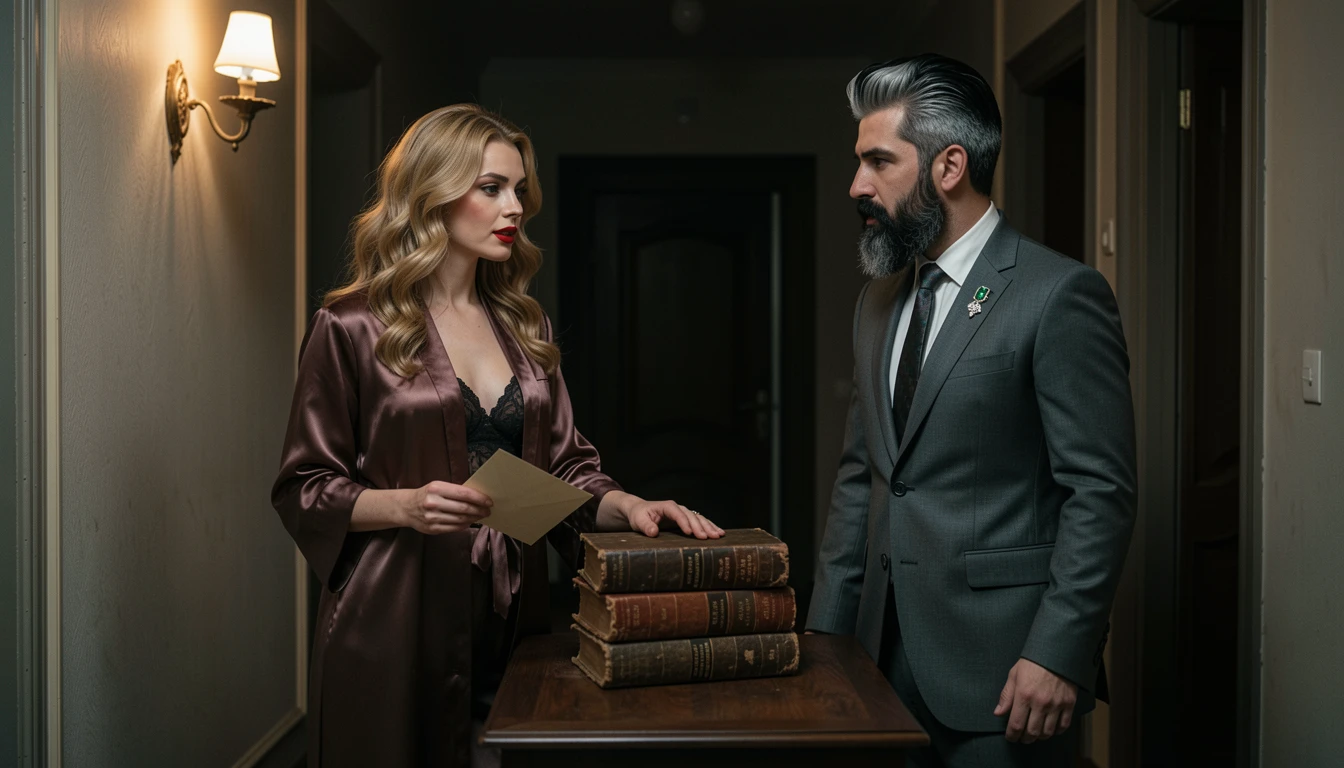
The envelope was warm in my hand, the paper already soft at the edges from how many times I'd folded and unfolded it before settling on the words. I stepped into the corridor and nearly walked straight into Dmitri.
He wasn't moving toward my door. He was standing at the hall table, his back to me, and he was setting something down—three books, worn and familiar, their spines cracked with use. I stopped. The morning light caught the gold lettering on the first cover. Confessions. Augustine.
He didn't turn around. His shoulders were doing something I'd never seen them do—they were slumped, just slightly, like a man carrying a weight he'd forgotten how to put down.
"Dmitri?"
My voice came out softer than I meant it to. He turned, and for a moment he looked like a different man entirely. The power was still there—the tailored suit, the diamond pin at his throat—but the mask had slipped. His eyes were wet.
"Isabella." He said my name like it hurt him. "I was coming to find you."
I looked at the books again. Story of a Soul. The Catechism. And the Confessions, the pages so worn they felt like cloth. I'd seen those books before, in passing, on a shelf in his study that I'd assumed was decoration. But they weren't decoration. They were read. They were loved.
"These were my mother's," he said, and his voice cracked on the word. "She read them every night before bed. When I was a boy, I used to fall asleep to the sound of her turning the pages."
I didn't know what to say. I'd never seen him like this—this raw, this open. The Don's nephew who'd claimed me on a jet, who'd put his seed in my belly and called it legacy, was standing in front of me with tears in his eyes over a stack of old books.
"You brought me back to God," he said.
The words landed like stones in my chest. I opened my mouth to protest—I hadn't brought anyone anywhere, I was just a woman who'd recited a prayer she didn't remember learning—but he kept going.
"I was raised in the Church. Baptized, confirmed, the whole thing. But after my mother died..." He trailed off, his hand hovering over the books. "I stopped believing. I told myself it was a fairy tale for the weak. That God was a crutch for people who couldn't stand on their own."
He laughed, and it was a broken sound. "And then you—a woman I bought, a woman I claimed for my own purposes—you knelt in my study and recited the Saint Michael prayer in perfect Latin, and I felt..." He pressed a hand to his chest. "I felt something I hadn't felt in thirty years."
The letter in my hand suddenly felt very heavy. I'd been carrying it to give to him, to ask him to send it to Luca, and now he was standing here telling me I'd brought him back to God, and I didn't know what to do with any of it.
"Dmitri—"
"Irina and I talked all night." He cut me off, his voice urgent now, hungry. "We want to be baptized. Properly. Through the Rite of Christian Initiation for Adults. OCIA." He said the acronym carefully, like he'd practiced it. "Together. With you."
I stared at him.
"With me?"
"You're carrying my sons." He stepped closer, and I could smell him—expensive cologne, the faint salt of tears. "You're the mother of my legacy. You brought me back to the faith of my mother. I want you beside me when I enter the Church again."
My mind was spinning. I'd recited a prayer I didn't remember learning. I'd felt something move in my chest when the words came out, something that felt like recognition, but I hadn't thought about it beyond that. I was a woman who'd been a man, a whore who'd been bought, a vessel for children I hadn't chosen to carry. I wasn't—I wasn't anything that belonged in a church.
"I don't even know if I believe in God," I said, and my voice came out raw. "I recited that prayer because it came out of me. I don't know where it came from. I don't know if I meant it. I don't know—"
"I don't care." He said it simply, like it was the easiest thing in the world. "I don't care if you believe. I care that you're willing to stand beside me while I find my way back. I care that my sons will have a mother who knows the words, even if she doesn't know yet what they mean."
He reached out and took my hand—the one holding the letter. His fingers closed over mine, and I felt the paper crinkle between us.
"What is this?" he asked, his voice gentler now.
I looked down at our hands, at the envelope caught between them. The letter to Luca. The words I'd written in the dark, telling him I missed him, telling him I was learning to be happy here.
"A letter," I said. "You said I could write to him."
Dmitri's jaw tightened, but he didn't let go of my hand. "I did. I meant it." He paused. "Is it—"
"It's honest." I met his eyes. "You asked for honest. I gave you honest."
He held my gaze for a long moment, and I watched something move behind his eyes—jealousy, maybe, or grief, or something more complicated that I couldn't name. But he nodded.
"I'll send it," he said. "Today. I'll make sure it reaches him."
The words should have been a relief. Instead, they felt like a door closing. Once the letter was in the mail, once Luca read my words, something would be over. I didn't know what, exactly, but I could feel it coming, the way you can feel a storm before it breaks.
"Thank you."
He released my hand, and I lowered the envelope to my side. The books sat on the table between us, their worn spines catching the light.
"OCIA," I said, trying the word on my tongue. "What does it involve?"
His face lit up—actually lit up, like I'd given him something precious. "Classes. Study. Prayer. We meet with a priest, learn the faith, prepare our hearts. It takes months, usually—the full rite runs from autumn to Easter."
"Months." I thought about the twins, growing in my belly, the due date that was still so far away. "I'll be very pregnant by Easter."
He laughed—a real laugh, warm and surprised. "You will. And you'll be the most beautiful catechumen the Church has ever seen."
I should have felt trapped. Another obligation, another chain binding me to this house, to this man, to this life I hadn't chosen. But instead, something else stirred in my chest—something that felt dangerously like hope.
"I don't know the first thing about the faith," I said. "I told you. I don't even know if I believe."
"Then you'll learn." He said it like it was that simple. "You'll learn the words, and the history, and the prayers. And maybe, along the way, you'll find that belief isn't something you have—it's something you grow into."
He picked up the Confessions, holding it like it was made of glass. "Augustine said, 'Our hearts are restless until they rest in you.' I spent thirty years restless because I thought I was too smart for God. And then a woman who didn't even know she was praying brought me to my knees."
His eyes met mine, and I saw something there that I hadn't seen before—not the collector, not the patriarch, not the man who'd claimed me on a jet. I saw the boy who'd fallen asleep to the sound of his mother turning pages.
"I want my sons to know that woman," he said softly. "I want them to know that their mother brought their father back to God."
My throat was tight. I couldn't speak.
"Irina is waiting for us," he said. "She's in the chapel—the small one at the end of the east wing. I'd like you to meet the priest with us. Father Alexei. He's been the family's priest for twenty years."
I looked down at the letter in my hand. At the books on the table. At the man who was looking at me like I was something holy, when I knew—I knew —that I was just a whore who'd learned to pray.
"I need to send this first," I said. "You said you'd send it today."
He nodded. "Give it to me. I'll have my man courier it to Milan this morning."
I hesitated. The letter had been mine—my words, my confession, my heart poured onto paper. Giving it to him felt like giving away a piece of myself.
But I'd written it. I'd meant it. And if I didn't send it now, I never would.
I held out the envelope. He took it, his fingers brushing mine.
"I'll make sure he gets it," he said. "I promise."
The word hung between us—promise. I'd heard promises before. From Luca, who'd promised to keep me safe and then sold me to this man. From Mama Rosa, who'd promised I'd be taken care of and then put me on the floor for the soldiers. From the Don, who'd promised me a life of luxury as his nephew's wife and then sent me to the brothel when the nephew got whacked.
But Dmitri's eyes were steady on mine, and I found myself wanting to believe him.
"The chapel," I said. "Show me."
He smiled—a real smile, warm and open—and gestured down the corridor. "This way."
I followed him, my feet bare on the cold marble, my hand empty where the letter had been. The morning light streamed through the windows, catching the dust motes in the air, and I walked toward the chapel with the names of my sons in my heart and the taste of confession on my tongue.
The east wing was quieter than the rest of the house. The servants' footsteps faded behind us, and the only sound was the soft rustle of Dmitri's suit and my own breathing. The corridor ended in a pair of heavy oak doors, carved with scenes I couldn't quite make out in the dim light.
Dmitri pushed them open.
The chapel was small—maybe twenty pews, a simple altar, a crucifix that caught the light from a single stained-glass window. The window showed Saint Michael, his sword raised, the dragon writhing beneath his feet. I stopped in the doorway, staring at it.
Irina was kneeling in the front pew, her head bowed. She wore a simple black dress, her hair loose around her shoulders, and she looked younger in the colored light—softer, somehow. She heard us enter and turned, and her face broke into a smile that made my chest ache.
"Isabella." She rose and came toward me, her hands outstretched. "You came."
I took her hands, and she squeezed them. Her fingers were cold.
"Dmitri told me," I said. "About the baptism. About OCIA."
Her eyes shone. "I've wanted this for so long. I was baptized as a child, but I never—" She shook her head. "I never felt worthy of it. Not after everything I've done. But when you prayed, when I heard the words on your lips..."
She pressed a hand to her chest. "I felt something open in me. Something I'd locked away years ago."
I didn't know what to say. I was standing in a chapel, holding the hands of a woman who was looking at me like I was a saint, when I was just a man who'd been turned into a whore and learned to survive.
"I don't know if I believe," I said again, because I needed her to understand. "I don't want you to think I'm something I'm not."
"Belief is a journey," Irina said softly. "Not a destination. You're walking the road with us. That's enough."
Behind me, I heard Dmitri's footsteps as he moved to the front of the chapel. He knelt before the altar, his head bowed, and I watched the rise and fall of his shoulders as he prayed.
Irina followed my gaze. "He hasn't prayed in thirty years," she whispered. "Not since his mother died. You gave him that back."
"I didn't do anything," I said. "I just—the words came out. I don't even know where they came from."
"Maybe that's the point," she said. "Maybe they came from somewhere deeper than memory."
I thought about Carter—the man I'd been, the life I'd lived. I didn't remember learning Latin. I didn't remember any prayers. But the words had come out of me like they'd been waiting there all along, buried beneath the transformation, beneath the years, beneath everything.
"Father Alexei will be here soon," Irina said. "He's excited to meet you. Dmitri told him about the prayer, about the twins, about—" She hesitated. "About everything."
I felt a flush creep up my neck. "Everything?"
"He's a priest, Isabella. He's heard worse confessions than ours." She squeezed my hands. "He won't judge you. He'll welcome you. That's what the Church does—it welcomes the broken."
I looked at the crucifix above the altar, at the man who'd died for sins I wasn't sure I believed in. And I felt something stir in my chest—not faith, not yet, but something that might grow into it.
"I don't know how to do this," I said. "I don't know how to be—" I gestured at myself, at the chapel, at everything. "This."
"None of us do," Irina said. "That's why we do it together."
The door behind us creaked open, and I turned to see a man in a black cassock stepping into the chapel. He was older—seventy, maybe—with a white beard and kind eyes that crinkled when he smiled.
"You must be Isabella," he said, his voice warm with a slight Russian accent. "I've heard wonderful things about you."
I opened my mouth to protest, to explain that I wasn't wonderful, that I was just a woman who'd been bought and sold and remade, but the words died in my throat. He was looking at me with such gentleness, such acceptance, that I couldn't bring myself to shatter it.
"Father Alexei," Dmitri said, rising from the altar. He came toward us, his hand outstretched. "Thank you for coming."
The priest took his hand and clasped it warmly. "When you called, I wept," he said. "I've prayed for this moment for decades."
Dmitri's jaw tightened. "I know. I'm sorry it took me so long."
"The Lord's timing is not our own," Father Alexei said. "What matters is that you're here now." He turned to me, his eyes kind. "And you brought him. Do you understand what a gift that is?"
I shook my head, mute.
"This man was dead in his spirit," the priest said. "Walking through the motions of life without any meaning. And you—a stranger, a woman he barely knew—you woke something in him that had been sleeping for thirty years."
He took my hand, his skin warm and papery. "That is not a small thing. That is a miracle."
I wanted to tell him he was wrong. I wanted to explain that I was just a man who'd been turned into a woman, a whore who'd learned to survive, a vessel for children I hadn't chosen. But the words wouldn't come. All I could do was stand there, my hand in his, and feel the weight of his gaze.
"I don't know if I believe," I finally managed. "I don't want you to think—"
"Belief is not a prerequisite for grace," he said gently. "You're here. That's enough."
Irina came to stand beside me, her arm slipping around my waist. "We're going to do this together," she said. "The three of us. We're going to walk into the Church and let ourselves be remade."
Remade. The word echoed in my chest. I'd been remade once already—my body stripped of its maleness, my mind reshaped to fit the curves and softness that had been forced on me. The thought of being remade again, of choosing it this time, was terrifying and exhilarating in equal measure.
"When does it start?" I asked.
"The first session is tomorrow evening," Father Alexei said. "Here, in the chapel. I'll bring the materials—the readings, the prayers, the history. We'll begin with the basics: who God is, who we are in relation to Him, and what it means to be baptized into His family."
His family. I thought of the twins, growing in my belly, their tiny hearts beating in time. I thought of Aleksandr and Mikhail, the names we'd chosen, the legacy Dmitri was building around them.
"My sons," I said. "Will they—"
"They'll be baptized as infants," Father Alexei said. "When they're born, we'll welcome them into the Church with the same water that welcomes you."
I felt something break open in my chest—something I'd been holding shut since the moment I'd been transformed. Tears pricked at my eyes, and I blinked them back furiously.
"I don't know why I'm crying," I said, my voice thick. "I don't even know what I believe."
"Tears are a form of prayer," the priest said softly. "The ones we can't put into words."
Irina pulled me closer, and I let myself lean into her warmth. Across the chapel, Dmitri was watching me with an expression I couldn't quite name—something between awe and tenderness, like I was a miracle he still couldn't quite believe was real.
"I have to tell you something," I said, the words coming out before I could stop them. "About who I was. Before I became this."
Dmitri's eyes met mine, and I saw understanding there—not surprise, but acknowledgment. "I know," he said quietly. "Luca told me."
The air left my lungs. "He told you?"
"Before he brought you to me. He told me everything." Dmitri came closer, his hand reaching out to cup my face. "I know you were a man once. I know you were remade. I know—" He paused, his thumb brushing my cheek. "I know you didn't choose any of it."
I stared at him, my heart pounding. "And you still—"
"I still want you." He said it simply, like it was the most natural thing in the world. "I want you to carry my sons. I want you to stand beside me in the Church. I want you to be the mother of my legacy. Not because of what you were, but because of what you are."
His hand moved to my belly, resting over the twins. "These children—they're not just heirs. They're a second chance. For me, for Irina, for you. A chance to build something holy out of the wreckage of our lives."
I felt the tears spill over, hot on my cheeks. I couldn't stop them. I didn't want to.
"I don't know how to be holy," I whispered. "I've done things—"
"So have we all," Father Alexei said gently. "That's why we need grace."
I looked at him, at his kind eyes and weathered face, and I felt something shift in my chest. Not belief, not yet. But the beginning of a willingness to believe—a crack in the wall I'd built around my heart.
"Okay," I said. "I'll do it. I'll walk with you."
Irina let out a breath that sounded like a sob, and Dmitri pulled me into his arms, his hand still on my belly. I stood there, caught between them, the morning light streaming through the stained-glass window and painting Saint Michael's sword across our bodies.
And for the first time since the transformation, I felt like I might be exactly where I was supposed to be.
Father Alexei smiled, his eyes crinkling. "Then let us begin." He gestured to the pews. "Sit. Tell me your stories. Let us learn to pray together."
I sat between Dmitri and Irina, their hands finding mine, and I told him everything. Not all of it—not the parts that would make him recoil, not the details of the brothel or the men who'd used me or the things I'd done to survive. But enough. Enough to be honest. Enough to begin.
When I finished, the light through the window had shifted, the morning giving way to noon. Father Alexei sat back, his eyes thoughtful.
"You've been through more than most people could bear," he said. "And yet here you are. Willing to try. Willing to believe."
"I don't know if I believe," I said again, because it was still true.
"You're here," he said. "That's enough for now."
I looked down at my hands, at the collar at my throat, at the swell of my belly beneath my dress. And I thought about the letter, flying toward Milan, toward Luca. I thought about the names of my sons, written in Irina's careful hand. I thought about the man who'd been a stranger and was now the father of my children, and the woman who'd been a rival and was now my sister.
And I thought about the prayer I'd recited without knowing, the words that had come out of me like they'd been waiting there all along.
Saint Michael the Archangel, defend us in battle.
Maybe I was being defended. Maybe I was being led. Maybe, for the first time in my life, I was walking toward something instead of running away.
"Tomorrow," I said. "We start tomorrow."
Dmitri's hand tightened around mine. "Tomorrow," he agreed.
And in the quiet of the chapel, with the saints watching from the windows and the twins stirring in my belly, I let myself believe that maybe—just maybe—I was being remade into something worthy of grace.
Father Alexei didn't rush us into prayer. He let the silence settle first, the way you'd let a wound breathe before you touched it. The chapel smelled of old wax and something floral—Irina's perfume, maybe, or the dried petals scattered on the altar steps.
"Before we begin," he said, reaching into the pocket of his cassock, "I want to give you something."
His hand came out holding a rosary. The beads were dark wood, worn smooth at the center where a thumb had worried them for decades. The crucifix was silver, tarnished in the crevices, and the chain caught the light from the stained-glass window as he held it out to me.
"This was my mother's," he said. "She prayed with it every night of her life. When she died, I kept it. I've been waiting for someone who needed it more than I do."
I stared at the rosary in his palm. It was heavy with years, with prayers, with the weight of a woman I'd never met who'd held these same beads while she asked God for things I didn't know how to ask for.
"I can't take this," I said. "It's your mother's."
"And now it will be yours." He pressed it into my hand, closing my fingers around the warm wood. "You're carrying two souls in your body, Isabella. You're going to need all the prayers you can get."
I looked down at the rosary. The beads were warm from his hand, or maybe from hers, from all the years of holding. I felt something shift in my chest—not the crack from before, but a widening of it, a letting in of light.
"I don't know how to use this," I admitted. "I've never—"
"Then I'll teach you." He settled onto the pew beside me, his cassock rustling. "The rosary is a meditation. A way of walking with Mary through the life of her Son. We pray the mysteries—the joyful, the sorrowful, the glorious—and we let the words carry us."
He took the rosary from my hand and held it up, showing me the crucifix. "We begin here. The Creed. Then the Our Father, the Hail Marys, the Glory Be. Each decade is a mystery, a moment in the life of Christ. And as we pray, we hold those moments in our hearts and let them change us."
Irina leaned forward, her eyes bright. "The Glorious Mysteries," she said. "That's where we should start. The Resurrection. The Ascension. The Descent of the Holy Spirit. The Assumption. The Coronation of Mary."
Father Alexei nodded. "The mysteries of hope. The mysteries that remind us that death is not the end, that suffering gives way to glory." He looked at me. "I think that's what you need to hear right now."
I didn't know what I needed to hear. I didn't know what I needed, full stop. But I nodded, because it was easier than explaining that I was a man who'd been unmade and remade into a whore, and I wasn't sure any amount of prayer could fix that.
"Before we pray the mysteries," Father Alexei said, "I want to share a prayer with you. A prayer that has sustained me through the darkest nights of my own soul." He closed his eyes, and his voice dropped, becoming something older, something worn smooth by repetition. "The Litany of Humility."
He began to pray, and the words fell like stones into still water.
"O Jesus! meek and humble of heart, hear me. From the desire of being esteemed, deliver me, Jesus."
The words hit me in the chest. Esteem. I'd spent months being looked at, being wanted, being valued for my body and my face and my willingness to spread my legs. But esteem—being respected, being honored for who I was, not what I could give—that was a foreign language.
"From the desire of being loved, deliver me, Jesus."
I thought of Luca. Of the way he'd looked at me in the studio, his brush moving across the canvas, painting me like I was something precious. He'd loved me, or said he had. But he'd still sent me away. He'd still sold me to this man, to this life.
"From the desire of being extolled, deliver me, Jesus."
Extolled. Praised. I'd been praised—for my beauty, for my obedience, for the way I'd learned to moan convincingly. But it was always for what I did, never for who I was.
"From the desire of being honored, deliver me, Jesus."
I thought of the Don, of the way he'd looked at me like a craftsman admiring his work. I thought of the soldiers, of the way they'd used me like a thing. I thought of every man who'd paid for my body and never once asked my name.
"From the desire of being praised, deliver me, Jesus."
Father Alexei's voice continued, steady and low, and I felt something happening inside me—something I didn't have words for. The desires he was naming, the ones he was asking to be delivered from—I'd been hungry for them my whole life. Hungry to be seen, to be wanted, to matter. And I'd gotten all of it, in the worst possible way.
"From the desire of being preferred to others, deliver me, Jesus."
Father Alexei paused. His thumb found the center bead of the rosary and worried it, a habit so old it looked unconscious. "From the desire of being approved, deliver me, Jesus."
The word landed differently than the others. Approved. I'd been approved my whole life—by the Don, who'd signed off on my new body. By Mama Rosa, who'd clucked over my curves like a prize hen. By Luca, who'd painted me and sold me in the same breath. Approval was the currency I'd traded in, the only coin that had ever bought me safety. And Father Alexei was asking God to strip it from me, to leave me standing naked without anyone's yes.
My hands had gone cold around the beads. The wood was warm where his thumb had been, but the rest of the chain felt like ice against my palms. I thought of the photograph I'd sent Luca—the one where I'd smiled, belly round with his children, like I'd found some peace in this gilded cage. I'd wanted his approval so badly I'd staged the whole thing. The soft light. The hand resting on my stomach. The careful, practiced contentment.
"From the fear of being humiliated, deliver me, Jesus."
My throat closed. Humiliated. I knew humiliation the way a sailor knows the sea—I'd drowned in it, swallowed it, learned to breathe it like water. The soldiers in the brothel who'd laughed while they used me. The way Tommy had looked at me after, like I was a stain he'd wiped off his shoe. And Luca, the worst of all, who'd made me kneel and beg for his cock in my mouth while he called me his masterpiece. Every time I thought I'd touched bottom, the floor had opened and let me fall further.
I felt Irina's hand find mine. Her fingers were cool, steady, and they closed around the beads with me, holding the weight together. I looked at her profile—the severe bun, the sharp line of her jaw—and I saw a muscle move in her throat as she swallowed. She was praying this litany with me. Not for me. With me.
"From the fear of being despised, deliver me, Jesus."
The word hit like a fist. Despised. The Don had despised me, I'd felt it in the way he'd looked at me after the transformation—like I was a broken tool he couldn't return. Mama Rosa had despised me and loved me in the same breath, clipping my wings while she fed me. And Dmitri, who knelt beside me now with his hand on my back, who spoke to me like I was carrying the future of his bloodline—even he despised what I was under the silk and the gold collar. A whore he'd bought. A vessel he'd filled.
Father Alexei's voice moved into a rhythm now, the words finding a cadence that felt older than the chapel itself. "From the fear of being forgotten, deliver me, Jesus. From the fear of being wronged, deliver me, Jesus."
Forgotten. I turned the word over in my mouth like a stone. Carter had been forgotten—erased so completely that sometimes I couldn't remember his face, his voice, the shape of his hands. And Isabella was so new she hadn't had time to be forgotten yet. But she would be. When the twins were born and Dmitri had his heirs, what would happen to the vessel that carried them? What happened to the cup when the wine was drunk?
"From the fear of being suspected, deliver me, Jesus."
Dmitri's hand tightened on my back, just for a moment. Suspected. He suspected everything—that was how he'd survived this long. He suspected Luca of keeping something from him. He suspected Irina of burying her jealousy in kindness. And he suspected me, I knew it, of wanting his name only for the safety it bought, of lying when I said I was learning to want this life. The truth was worse than any lie he could imagine. The truth was that I'd been a man once, and I still didn't fully understand the woman I'd become.
"From the fear of being abandoned, deliver me, Jesus."
My eyes burned. Abandoned. Luca had abandoned me, had sold me like a painting he was done with, and I'd let him because I'd had no choice. The Don had abandoned me to a brothel. Mama Rosa had abandoned me to a stranger with a leather notebook. Every man who'd ever held me had let me go, and I'd learned to make my peace with it, to expect it, to build my life on the understanding that no one stayed.
I felt the twins shift inside me, a rolling flutter that made me catch my breath. They were the only ones who'd never left. They couldn't. They were part of me now, growing in my belly, and the thought was so strange and so fierce that I almost laughed. Two souls who'd never met me, who'd never chosen me, and yet they were the only family I'd ever had that couldn't walk away.
Father Alexei's voice softened. "That others may be loved more than I, Jesus, grant me the grace to desire it."
The words hung in the air. Grace. I'd heard the word in church, in prayers, in the hollow echo of candles and incense. But I'd never felt it. Grace was something you received, and I'd spent my whole life taking—taking pleasure, taking money, taking whatever safety I could snatch before it slipped away. I didn't know how to receive. I didn't know how to open my hands and let something be given.
I looked down at the rosary in my palm. The beads were dark with age, worn smooth by a woman's fingers over decades of nights. She'd held these same beads while she prayed for her son, for his safety, for his soul. And now her son had given them to me, a stranger, a whore with a Russian accent and a belly full of twins. He'd looked at me and seen someone who needed them more than he did.
I closed my fingers around the beads until the wood pressed crescents into my palm, and I felt the shape of the prayer before I knew the words—the rhythm of it, the way the litany had been leading somewhere I couldn't see yet, like a path through snow that only revealed itself one step at a time.
"The Litany of Humility ends with a request," Father Alexei said, his voice gentle now, almost conversational. "Not for suffering, though it might sound that way. It ends with a request for the grace to desire what God desires. To want to be little. To want to be nothing, so that He can be everything."
I wanted to tell him that I'd already been nothing. That I'd spent months being exactly that—a thing to be used, a body to be filled, a vessel to be poured into and emptied. But the words stuck in my throat, because I knew, with a clarity that made my chest ache, that being nothing for men was not the same as being nothing for God. One was erasure. The other was surrender. And I'd never known the difference until this moment, sitting in the chapel with a dead woman's rosary in my hands.
"Now," Father Alexei said, and he reached over to gently turn the rosary in my grip until the crucifix rested against my thumb, "we pray the Glorious Mysteries. The first is the Resurrection. Christ rises from the dead, victorious over sin and death." He paused, and I felt his eyes on me. "Whatever you've been buried under, Isabella—whatever grave you've been lying in—this is the mystery that says the stone can be rolled away."
He began the Our Father, and I heard Irina's voice join his, the Latin rolling off her tongue like she'd been born to it. I opened my mouth and found I knew the words—knew them from somewhere deep, from a childhood I'd almost forgotten, from a boy who'd knelt in a pew and mumbled the prayers without understanding them. The words came out of me rough and hesitant, but they came.
"Hail Mary, full of grace, the Lord is with thee."
I said it, and I felt the words land somewhere in my chest, in the hollow place where the fear had been living. Blessed art thou among women. I thought of Mary, of what it must have meant to carry a child she hadn't planned, to feel life moving inside her while the world judged her. I thought of my own belly, of the twins shifting inside me, and I understood, for the first time, that I wasn't alone in this. That a woman had done this before. That a woman had said yes to something she couldn't explain, and the whole world had been changed by it.
"Holy Mary, Mother of God, pray for us sinners, now and at the hour of our death."
The words hit me like a wave. Now and at the hour of our death. I was living in the now—the swollen belly, the gold collar, the house that wasn't mine. And I was living toward the hour of my death, the one that would come for me whether I was ready or not. The prayer was asking Mary to stand with me in both places, to hold my hand through the living and the dying. And I realized, with a start, that I'd never asked anyone to hold my hand before. I'd never let anyone stand with me.
I felt Irina's fingers tighten around mine, and I looked at her. Her eyes were closed, her lips moving through the Hail Marys with a devotion that made something twist in my chest. She was praying for me. She was praying with me. And she was asking Mary to stand with us both, in the now and at the hour of our death, and I understood that I was not as alone as I had believed.
The second mystery was the Ascension, and Father Alexei's voice carried us through it—Christ rising into heaven, leaving His disciples to carry His work into the world. "You are being asked to carry something too," he said, and I felt the weight of his words settle onto my shoulders. "Not just the children in your womb, but the life you've been given. The one that came after the death of who you were."
I flinched at that. He couldn't know. He couldn't possibly know about Carter, about the man I'd been before the Don's magic unmade me. But the way he said it, the way his eyes met mine with something like understanding, made me wonder if Dmitri had told him more than I'd realized. Or if Father Alexei simply had the gift of seeing through to the broken parts of people, the parts they kept hidden even from themselves.
"You don't have to understand the whole journey," he said, as if reading my thoughts. "You only have to take the next step. And then the one after that. The Ascension wasn't the end of the story—it was the beginning of the disciples' story. Their work started when He left them."
The third mystery was the Descent of the Holy Spirit, and I felt something shift in the room as we prayed. The air seemed thicker, warmer, like the chapel itself was breathing with us. Father Alexei's voice grew more fervent, and I heard Dmitri's low rumble joining the prayer from beside me, his hand still steady on my back. The tongues of fire, the rush of wind, the disciples speaking in languages they'd never learned—I thought of my own tongue, trained to speak Russian, trained to please, trained to lie. And I wondered if the Holy Spirit could make a language of my silence, could take the parts of me that had been broken and speak through them anyway.
"Come, Holy Spirit," Father Alexei prayed, and I heard the words leave my own mouth, surprising me. "Fill the hearts of your faithful."
I didn't know the rest of the prayer, but it didn't matter. The words that came out of me were enough. They were a beginning. They were the first true thing I'd said in months that wasn't calculated, wasn't performed, wasn't designed to keep me safe. I was asking for something. I was opening my hands.
The fourth mystery was the Assumption, and I felt Irina's grip tighten as we prayed. Mary, taken up into heaven, body and soul, at the end of her earthly life. I thought of what it would mean to be taken up like that—to be lifted out of this house, out of this life, out of the body that had been made for other people's pleasure. But the mystery wasn't about escape. It was about completion. It was about the body being honored, not discarded. And I realized I'd never thought of my body as something that could be honored. I'd thought of it as currency, as a cage, as a curse. But Mary's assumption said the body mattered. That it was worth saving, not just the soul.
"Your body is carrying life," Father Alexei said softly, as if he could see the thought forming in my mind. "It's not just a vessel for pleasure. It's a vessel for love. For life. For something eternal." He paused, and his voice dropped even lower. "That's what the Assumption teaches us. That the body is not our enemy. It's our partner in salvation."
I felt tears prick my eyes, and I didn't try to stop them. I let them fall, let them slide down my cheeks and onto the beads in my hands. The wood drank them in, and I thought of all the tears that rosary had absorbed over the decades, all the prayers that had been wept into it by a mother who'd worried for her son. And now it was mine. Now my tears were joining hers, and I understood that I was part of something larger than myself—a chain of women who'd held these beads and prayed and wept and hoped.
The fifth mystery was the Coronation of Mary, and by the time we reached it, my voice was hoarse from the prayers, my knees aching from the kneeler, my belly heavy with the twins who'd been still and quiet through the whole rosary, as if they too were listening. Father Alexei's voice rose as he prayed the Glory Be, and I felt something crack open inside me—not the widening from before, but a breaking, a letting go of something I'd been holding so tightly I'd forgotten it was there.
"Glory be to the Father, and to the Son, and to the Holy Spirit," I said, and my voice broke on the words. "As it was in the beginning, is now, and ever shall be, world without end. Amen."
The silence that followed was different from the one we'd started in. It was alive, breathing, full of the prayers we'd just spoken. I looked down at the rosary in my hands, at the beads that had carried a mother's hopes and now carried mine, and I understood that I had been given something I didn't know how to name. Not just the rosary. Not just the prayers. But a way of being in the world that didn't require me to be used. A way of being that was mine.
Father Alexei reached over and gently touched my shoulder. "The rosary is yours now," he said. "Pray it when you're afraid. Pray it when you're grateful. Pray it when you don't know what else to do. The words will carry you, even when you can't carry yourself."
I nodded, not trusting my voice. I looked at Irina, whose eyes were bright with unshed tears, and at Dmitri, whose hand had never left my back, and I felt something I'd never felt before in this house—a sense that I was not alone. That these people, strange as they were, broken as they were, had knelt beside me and prayed for me. And that maybe, just maybe, I was worth praying for.
The twins shifted inside me, a flutter that felt like a response, and I pressed my hand to my belly. "They heard the prayers," I said, and my voice came out soft, wondering. "They were listening."
Father Alexei smiled, and his eyes crinkled at the corners. "They're listening to everything, Isabella. They're learning your voice, your heartbeat, the rhythm of your prayers. You're teaching them what it means to be human—to hope, to fear, to reach for something beyond themselves." He paused. "You're teaching them to pray."
I looked down at the rosary, at the worn beads and the tarnished crucifix, and I made a decision. Not a big one, not the kind that changes the course of a life. Just a small one, the kind that changes the course of a moment. I would pray this rosary every night. I would let the words carry me. I would learn to open my hands and receive.
"Thank you," I said, and the words felt small and insufficient, but they were all I had. "For this. For teaching me. For—" I gestured vaguely at the chapel, at the prayers, at the whole impossible afternoon. "For all of it."
Father Alexei bowed his head. "You don't have to thank me, Isabella. You just have to keep praying. And when you can't find the words, hold the beads and let them pray for you." He rose from the pew, his knees cracking, and looked down at me with a gentleness that made my chest ache. "I'll be here. Every day, if you need me. The door of this chapel is always open."
He moved toward the altar to extinguish the candles, his cassock whispering against the stone floor, and I was left with Irina on one side and Dmitri on the other, the rosary warm in my hands, the weight of the prayers still hanging in the air around us like incense. I looked at the crucifix, at the figure of Christ carved in silver, and I thought of the Litany of Humility—the words that had stripped me bare and left me standing in front of God with nothing but the truth of who I was.
I was a man who'd been unmade. I was a woman who'd been remade. I was a whore who'd been bought and sold and bought again. I was a vessel carrying two souls who'd never asked to be mine. And I was, somehow, despite all of it, a child of God—loved, forgiven, held in the palm of a hand that had never let me go, even when I'd thought I was falling.
Dmitri's hand found mine, his fingers warm and rough, and he lifted it to his lips, pressing a kiss to my knuckles. "You prayed beautifully," he said, and his voice was thick with something I couldn't name. "Irina was right to bring you here. I was right to trust her."
I looked at him—at the man who'd bought me, who'd filled me with his seed, who'd knelt beside me and prayed for the souls of our sons—and I felt something shift inside me. Not love. Not yet. But something that could grow into it, if I let it. Something that had been planted in the dark, in the chapel, in the space between one Hail Mary and the next.
"I want to pray for them," I said, and my voice was steady now. "Every night. For Aleksandr and Mikhail. For their souls, for their lives, for whatever they're going to become." I looked down at my belly, at the swell of it beneath the fabric of my dress. "I want them to know that their mother prayed for them. Even before they were born."
Irina let out a sound that was half sob, half laugh, and she pulled me into an embrace that was fierce and warm and smelled of her perfume. "They will know," she said against my hair. "I will tell them. I will tell them how their mother knelt in the chapel and prayed for them before they took their first breath."
I held onto her, feeling the beat of her heart against mine, and I understood that something had changed in this room. Not the circumstances of my life—I was still Dmitri's concubine, still carrying his heirs, still bound to this house and this man and this strange, impossible family. But something inside me had shifted. A stone had been rolled away. A grave had been opened. And I had stepped out of it, blinking in the light, not knowing where I was going but knowing, for the first time, that I was walking toward something.
We left the chapel together, the three of us, and the afternoon light had gone amber and low, slanting through the tall windows of the corridor and pooling on the polished floor. Dmitri walked on my left, his hand resting lightly at the small of my back, a possession so casual it had become habit. Irina walked on my right, her arm linked through mine, and I felt the strangeness of it—this woman who should have been my enemy, who should have hated me for carrying what she could not, holding me like a sister.
We reached the door to my room, and Dmitri paused. He looked at me with that expression I was still learning to read—the softness that came over his features when he looked at my belly, the way his voice dropped when he spoke of the boys. But this was different. This was something else, something almost hesitant.
"There is someone I want you to meet," he said. "Not today. Tomorrow, perhaps. But I want to tell you about her first."
Irina's arm tightened around mine, and I saw her glance at Dmitri with something like surprise. "Monica?" she said.
Dmitri nodded. "It is time she knew."
I looked between them, the name unfamiliar on my tongue. "Monica?"
"My mother's name," Dmitri said, and his voice had a weight to it I hadn't heard before. "She was the woman who prayed me into the Church. Who prayed me into being a man worthy of the name I carry. She is the reason I am standing here, the reason I have a soul at all." He paused, and his hand found mine, his fingers warm and rough. "She died when I was thirty. But her prayers did not die with her. They are still working in me. They are still—" He stopped, searching for the word. "They are still pulling me toward something."
I thought of the rosary in my pocket, the beads worn smooth by Father Alexei's mother, and I felt a strange kinship with this woman I'd never met. A woman who had prayed for her son, who had wept and hoped and begged God for his soul. A woman like the one whose beads I now held.
"She was a saint," Irina said softly. "Not canonized. But a saint nonetheless. She prayed for her son for seventeen years. Seventeen years, Isabella. She never gave up. Even when he was living in sin, even when he had a mistress and a child out of wedlock, even when he had turned his back on everything she had taught him—she prayed."
I felt the weight of that. Seventeen years. I had been Isabella for less than a year, and already I had lost count of the ways I had been unmade and remade. But this woman had prayed for seventeen years without seeing the answer. Without knowing if the answer would ever come.
"Her son," I said slowly, "was Saint Augustine."
Dmitri's eyes met mine, and I saw something flicker there—surprise, maybe, or recognition. "You know the story."
"I know the name," I said. "I know he wrote the Confessions. I know he was a sinner who became a saint." I paused, the words feeling strange in my mouth. "I didn't know his mother's name was Monica."
"She is the reason he is a saint," Dmitri said. "She prayed him into holiness. She prayed him into the Church. She prayed him into being the man God meant him to be." He stepped closer, and his hand came up to cup my face, his thumb brushing my cheekbone. "I want you to read his Confessions, Isabella. I want you to read the story of a man who was lost and found, who was unmade and remade, who was pulled from the pit by the prayers of a woman who loved him more than he loved himself."
I felt the tears prick my eyes again, and I didn't try to stop them. "Why?" I asked, and my voice came out smaller than I meant it to. "Why do you want me to read it?"
"Because you are in the middle of your own confession," Dmitri said, and his voice was gentle, almost tender. "You are in the middle of being unmade and remade. You are in the middle of learning who you are, and who you are becoming. And I want you to know that you are not the first person to walk this road. You are not the first person to feel like you are dying in order to be born."
Irina's hand found mine, and I felt her fingers lace through mine. "I will find you a copy," she said. "A beautiful one. One with a leather cover and gilded pages. One that feels like a gift, not a lesson."
I looked at her, at this woman who had every reason to hate me, who had every reason to want me gone, and I saw only kindness in her eyes. "Thank you," I said, and the words felt small, but they were all I had.
Dmitri leaned down and pressed a kiss to my forehead, his lips warm against my skin. "Read it slowly," he said. "Read it like a prayer. Let it change you the way it changed me." He pulled back, and his eyes met mine. "I was not always the man you see before you, Isabella. I was a brute. A sinner. A man who took what he wanted and called it love. But Monica's prayers, and Augustine's words, and the grace of God—they pulled me out of the grave. They rolled away the stone. And I want that for you. I want you to know that the grave is not the end."
He released me, and I felt the absence of his hand like a physical thing. "Rest now," he said. "Tomorrow, we will begin your instruction with Father Alexei. And I will give you the Confessions to read."
He turned and walked down the corridor, his footsteps muffled by the runner, and I watched him go until he disappeared around the corner. Irina squeezed my hand, then released it. "I will bring you the book tonight," she said. "Before I go to bed. So you can begin."
She followed Dmitri, her dark dress swishing against her ankles, and I was left alone in the corridor, the door to my room in front of me, the rosary warm in my pocket, the weight of the afternoon pressing down on my shoulders.
I pushed open the door and stepped inside.
The room was the same as I had left it—the bare walls, the narrow bed, the painting of the woman with her face turned away. But it felt different now. The light had changed, the amber afternoon slanting through the window and painting the walls in gold. The air was warm and still, and I could smell the lemon polish from the corridor, the faint scent of Irina's perfume clinging to my dress.
I crossed to the window and looked out at the garden below—the manicured hedges, the fountain, the stone path that wound through the roses. I had been in this house for weeks now, and I still didn't know its full shape. I had seen the chapel, the nursery, Irina's mother's room. But there were corridors I hadn't walked, doors I hadn't opened, rooms I hadn't entered. The house was a labyrinth, and I was still learning its turns.
I pressed my hand to my belly, feeling the twins shift inside me—a flutter, a kick, a response to my touch. They were always moving now, always letting me know they were there. And I wondered, with a start, if they could feel what I was feeling. If they could sense the strange mix of peace and fear that had been living in my chest since the chapel.
I sat down on the edge of the bed, the springs creaking beneath me, and I took out the rosary. The beads were warm from my pocket, the wood smooth and worn. I ran my fingers over them, feeling the shape of the prayers, the rhythm of the Hail Marys, the weight of the decades.
I thought of Saint Monica, praying for her son for seventeen years. I thought of her kneeling in a church somewhere, her eyes closed, her lips moving through the prayers, her heart breaking with hope and fear and love. And I thought of what it must have felt like when she finally saw him converted—when she finally saw the answer to her prayers, the son she had wept for, the saint he had become.
She died shortly after, I remembered. She died knowing her son had been saved. She died holding his hand, telling him she had seen the answer to her prayers, that she was ready to go home.
I wondered if I would ever have that. If I would ever see the answer to my prayers, the sons I was carrying, the men they would become. If I would ever hold their hands and know that I had done something right, that I had prayed them into being good men, that I had not failed them.
The twins kicked again, harder this time, and I gasped, pressing my hand to the spot where I felt the movement. "I know," I whispered. "I know you're there. I know you're listening."
I looked down at my belly, at the swell of it beneath my dress, and I felt a love so fierce and so sudden that it took my breath away. These boys. These two souls who had never chosen me, who had never asked to be mine. They were mine. They were part of me. And I would pray for them every night for the rest of my life, even if I never saw them grow up, even if I never knew the men they would become.
I closed my eyes and began to pray.
I must have dozed off, because the next thing I knew, the light had gone gray and the room was full of shadows. There was a knock at the door, soft and hesitant, and I sat up, my heart pounding, my hand instinctively going to my belly.
"Come in," I said, and my voice came out rough with sleep.
The door opened, and Irina stepped inside, carrying a book in her hands. It was bound in dark leather, the cover tooled with gold, and it looked old and heavy and precious. She crossed to the bed and held it out to me, and I took it, feeling the weight of it in my palms.
"The Confessions of Saint Augustine," she said. "It was my mother's. She read it every year, from the first page to the last. She said it was like visiting an old friend."
I ran my fingers over the cover, feeling the texture of the leather, the ridges of the gold tooling. "I can't take your mother's book," I said. "It's too precious."
"It's meant to be read," Irina said, and she sat down on the edge of the bed beside me. "My mother would have wanted it to be read. She would have wanted it to change someone the way it changed her." She paused, and her eyes met mine. "She would have liked you, Isabella. She would have seen the hunger in you, the hunger for something more, and she would have fed it."
I opened the book, and the pages fell open to a place that had been read many times, the spine creased, the paper soft with age. The words were in Latin, the letters dense and beautiful, and I traced my finger over them without reading them, feeling the shape of the language.
"It's in Latin," I said.
"Yes," Irina said. "But I can teach you. Or Father Alexei can. He reads it fluently. He could read it to you, and you could follow along." She paused. "Or you could learn. You're learning Russian. You could learn Latin too."
I looked at her, at the earnestness in her eyes, and I felt something shift in my chest. "Why are you being so kind to me?" I asked, and the question came out before I could stop it. "I'm carrying your husband's children. I'm the proof that you can't. I'm the woman who took your place."
Irina's face flickered, and for a moment I saw the pain beneath the kindness—the barrenness, the jealousy, the grief. But then she smiled, and it was a real smile, a sad smile, a smile that understood things I hadn't said.
"You didn't take my place," she said. "You took a place I could never fill. You're giving Dmitri what I couldn't give him. You're giving him sons. You're giving him a legacy. And I—" She paused, and her voice dropped. "I want to be part of that. I want to be part of their lives. I want to be the aunt who teaches them to pray, who tells them stories about their grandmother, who watches them grow into men." She reached out and took my hand. "You're not my replacement, Isabella. You're my sister. And I've never had a sister."
I felt the tears prick my eyes again, and I didn't try to stop them. I squeezed her hand, and I felt the warmth of it, the realness of it. "I've never had a sister either," I said. "I've never had anyone."
"You have me now," Irina said. "And you have Dmitri. And you have Father Alexei. And you have these two." She pressed her hand to my belly, and I felt the twins shift beneath her touch. "You have a family, Isabella. A strange one, a broken one, but a family nonetheless."
I looked at her, at this woman who had every reason to hate me, and I felt something crack open inside me—not the widening from before, but a breaking, a letting go of something I'd been holding so tightly I'd forgotten it was there.
"Thank you," I said, and the words felt small, but they were all I had. "For the book. For your mother's book. For—" I gestured vaguely at the room, at the house, at the whole impossible life I was living. "For all of it."
Irina leaned in and pressed a kiss to my forehead, just as Dmitri had done. "Read it," she said. "Read it slowly. Let it change you." She rose from the bed, smoothing her dress. "I'll bring you dinner in an hour. And then we can begin your Latin lessons, if you're not too tired."
She moved toward the door, and I watched her go, the book heavy in my hands, the weight of her kindness pressing against my ribs. She paused at the threshold and looked back at me.
"The Confessions," she said, "are Augustine's story of how he was unmade and remade. How he was pulled from the pit by the prayers of his mother. How he learned to surrender." She paused. "I think you'll find you have more in common with him than you expect."
She left, closing the door softly behind her, and I was alone again, the book in my hands, the shadows gathering in the corners of the room.
I opened it to the first page and began to read.
The Latin was dense, the words unfamiliar, but I found I could pick out pieces of it—the rhythm of the sentences, the shape of the prayers. "Great art Thou, O Lord, and greatly to be praised," I read, sounding out the words slowly. "Great is Thy power, and Thy wisdom infinite."
The words felt strange on my tongue, but they also felt right. They felt like something I had been waiting to hear, something I had been waiting to say. I read on, stumbling through the Latin, picking out words I recognized, letting the rhythm carry me.
"And man desires to praise Thee," I read, "for he is a part of Thy creation. He bears about him his mortality, the evidence of his sin, and the proof that Thou dost resist the proud. Still he desires to praise Thee, for Thou hast made us for Thyself, and our hearts are restless until they rest in Thee."
I stopped. The words hung in the air, and I felt them land somewhere in my chest, in the hollow place where the fear had been living. "Thou hast made us for Thyself, and our hearts are restless until they rest in Thee."
I had been restless my whole life. Restless as Carter, always looking for the next score, the next escape, the next way to stay one step ahead of the danger. Restless as Isabella, always performing, always watching, always calculating the exits. Restless in this house, in this body, in this life that had been chosen for me.
And I had never known what the restlessness was for. I had never known what I was searching for.
But Augustine knew. He knew that the restlessness was a hunger, a longing, a pull toward something I couldn't name. And he knew that the only thing that could satisfy it was God.
I read on, the words washing over me, the Latin growing more familiar as I went. I read about his childhood, his sins, his wanderings. I read about his mother, Monica, praying for him, weeping for him, following him across the sea to bring him home. And I felt a kinship with this man I had never met, this sinner who had become a saint, this restless heart that had finally found its rest.
The twins shifted inside me, a flutter that felt like a response, and I pressed my hand to my belly. "Restless," I whispered. "That's what we are. Restless until we rest in Him."
I didn't know if I believed it. I didn't know if I could believe it. But I wanted to. For the first time in my life, I wanted to believe in something I couldn't see.
I read until the light faded completely and the room went dark, and then I lit the lamp on the nightstand and read on, the words blurring with exhaustion, the twins shifting restlessly inside me. And when I finally closed the book, my eyes burning, my body heavy with sleep, I felt like I had been changed. Not completely. Not yet. But something had shifted. Something had cracked open.
I lay back on the bed, the book on my chest, my hand on my belly, and I stared up at the ceiling, feeling the weight of the words pressing against me.
"Thou hast made us for Thyself," I whispered, "and our hearts are restless until they rest in Thee."
The twins kicked, a flutter that felt like a response, and I smiled in the darkness. "I'm learning," I told them. "I'm learning to be still."
I opened the book again, not to read, but to hold it. The leather was warm from my hands now, the gold tooling catching the lamplight. I shifted on the bed, propping myself higher against the pillows, and set the open pages on the swell of my belly. The weight of it settled there, solid and real, and I felt the twins shift beneath it—a flutter, then a stronger push, as if they were pressing against the words themselves.
"You feel that?" I whispered. "That's Augustine. He was restless too."
I ran my fingers over the page, tracing the Latin letters I couldn't quite read. "He ran from God for years. He ran across the sea, chasing glory, chasing pleasure, chasing anything that would fill the hollow place inside him. And his mother—Monica—she prayed for him every single night. For years. She never stopped." I paused, feeling the weight of the words. "She followed him across the sea. She found him in Milan, of all places. And she kept praying, kept weeping, kept believing that one day he would come home."
The twins kicked again, harder this time, and I gasped, pressing my palm flat against the book. "I know. I know. But listen. He was sitting in a garden, and he heard a voice—a child's voice, singing, 'Take and read, take and read.' And he picked up the scriptures, and he read the first thing his eyes fell on, and it broke him open. It unmade him. And then it remade him."
I swallowed, the words catching in my throat. "He became a saint. He became one of the greatest men who ever lived. And it all started with a mother who wouldn't stop praying."
I looked down at my belly, at the book resting on it, and I felt a love so fierce it hurt. "I'm going to be your Monica," I said. "I'm going to pray for you every night for the rest of my life. I'm going to pray that you find your way home, whatever that means, wherever that is. I'm going to pray that you become good men, strong men, men who know how to love and be loved."
The words felt strange on my tongue—prayer, faith, God. I had never been a religious man. Carter had never needed one. He had needed exits, angles, escapes. He had needed to stay one step ahead of the danger, one step ahead of the men who wanted to put him in the ground. He had never needed to believe in something he couldn't see.
But Carter was gone. Carter had been unmade, just like Augustine, and something else had been remade in his place. Something that prayed. Something that hoped. Something that loved two souls she had never met, two souls who were kicking against the pages of a dead saint's confessions.
"I don't know if I believe it," I admitted, my voice barely a whisper. "I don't know if I can believe it. But I want to. I want to believe that there's a reason for all of this. That I wasn't just—" I stopped, the words catching. "That I wasn't just remade for someone else's pleasure. That there's a purpose to this body, to this life, to these boys."
The twins were still now, as if they were listening. I could feel them there, two small weights pressing against my insides, and I wondered if they could hear me, if they could feel the words vibrating through the water and the flesh and the bone.
"You're going to be born into a strange world," I said. "You're going to have a father who is powerful and dangerous and kind in ways that don't quite make sense. You're going to have a mother who loves you more than she knows how to say. You're going to have an aunt who will teach you to pray, who will tell you stories about your grandmother, who will watch you grow into men." I paused. "And you're going to have me. Whatever that means. Whatever I can be."
I closed my eyes, and I felt the tears slide down my cheeks, warm and silent. I didn't wipe them away. I let them fall, let them soak into the pillow, let them carry some of the weight that had been pressing against my ribs since the moment I woke up in this body.
"I'm going to read this book," I told them. "I'm going to read it slowly, the way Irina said. I'm going to let it change me. And I'm going to pray for you every night, even if I don't know what I'm doing. Even if I don't know if anyone is listening."
The book was warm against my belly, the pages soft and worn. I traced my finger over the Latin again, feeling the shape of the words, the rhythm of the sentences. "Thou hast made us for Thyself," I read, "and our hearts are restless until they rest in Thee."
I let the words settle into me, into the hollow place where the fear had been living, where the restlessness had been churning. And for a moment—just a moment—I felt something shift. Something quiet. Something that felt almost like peace.
"Restless," I whispered. "That's what we are. Restless until we rest in Him."
The twins kicked once more, a soft flutter that felt like a response, and I smiled in the darkness. "I know," I said. "I know you're listening. I know you're there."
I lay there for a long time, the book on my belly, my hand on the pages, feeling the weight of the words and the weight of the lives growing inside me. The lamp flickered, casting shadows across the ceiling, and I watched them dance, feeling the exhaustion pull at my limbs.
I must have dozed off, because the next thing I knew, the lamp had burned low and the room was full of deep shadows. The book had slipped from my belly to the bed beside me, and I reached for it, pulling it close, pressing it against my chest like a talisman.
There was a knock at the door, soft and hesitant, and I sat up, my heart pounding, my hand instinctively going to my belly. The twins had been still for hours now, and I felt a flicker of worry—were they okay? Were they sleeping?
"Come in," I said, and my voice came out rough with sleep.
The door opened, and Irina stepped inside, carrying a tray. The smell of food—warm bread, roasted meat, something sweet—filled the room, and my stomach growled in response. I hadn't realized how hungry I was.
"I brought you dinner," she said, crossing to the bed and setting the tray on the nightstand. "You need to eat. For the boys."
I looked at the tray, at the food she had brought, and I felt a wave of gratitude so strong it almost undid me. "Thank you," I said. "You didn't have to—"
"I wanted to." She sat down on the edge of the bed, her eyes falling on the book in my hands. "You're reading it."
I nodded, looking down at the worn leather cover. "I started. I got through the first few pages. I had to stop—" I paused, the words catching. "I had to stop because I couldn't see the page anymore."
Irina's face softened. "The tears," she said. "They come when the words find the place where you've been hiding."
I looked at her, at this woman who had every reason to hate me, who had instead chosen to love me, and I felt something crack open inside me again. "How did you know?" I asked. "How did you know I would need this?"
Irina was quiet for a moment, her eyes distant. "Because I needed it once," she said. "When I learned I could never have children. When I realized that my body was a failure, that I could never give Dmitri what he wanted. I read this book in a single night, weeping the whole way through. And when I finished, I felt like I had been scraped hollow. But I also felt like I had been cleaned out. Like something rotten had been removed from me."
She reached out and took my hand, her fingers cool and dry. "I want that for you, Isabella. I want you to be scraped hollow. I want you to be cleaned out. I want you to know that you are not just a vessel for Dmitri's sons. You are a soul. You are a person. And you are worthy of love, not just as a mother, but as yourself."
I felt the tears prick my eyes again, and I didn't try to stop them. "I don't know who I am," I said, the words coming out raw and broken. "I don't know what I am. I was someone else once. Someone I can barely remember. And then I was remade, and I've been performing ever since. Performing for the Don. Performing for Mama Rosa. Performing for Luca. Performing for Dmitri. I don't know if there's anything underneath the performance."
Irina squeezed my hand. "There is," she said. "I've seen it. The woman who chose to stay. The woman who chose to carry these children. The woman who chose to pray for them, even though she doesn't know if she believes. That woman is real. That woman is you."
She released my hand and rose from the bed. "Eat," she said. "Rest. And when you're ready, we'll begin your Latin lessons. Augustine wrote in Latin, and I want you to be able to read him in the language he wrote."
She moved toward the door, and I watched her go, the book still pressed against my chest, the words still echoing in my head. She paused at the threshold and looked back at me.
"Monica prayed for Augustine for seventeen years," she said. "Seventeen years of weeping and pleading and believing that her son would come home. And he did. He came home, and he became a saint." She paused. "I think you're going to be someone's Monica, Isabella. I think those boys are going to be the answer to your prayers."
She left, closing the door softly behind her, and I was alone again, the book in my hands, the tray of food growing cold on the nightstand.
I looked down at the book, at the worn leather cover, at the gold tooling that caught the lamplight. And I thought about Monica, weeping for seventeen years, following her son across the sea, never giving up, never losing hope.
"Seventeen years," I whispered. "I can do that. I can pray for them for seventeen years. I can pray for them for the rest of my life."
I set the book aside and reached for the tray, pulling it onto my lap. The food was still warm, and I ate mechanically, not tasting it, my mind still churning with the words I had read, the words Irina had spoken.
When the tray was empty, I set it aside and picked up the book again. I opened it to the first page, to the words I had read before, and I began again.
"Great art Thou, O Lord, and greatly to be praised. Great is Thy power, and Thy wisdom infinite."
I read slowly, sounding out the Latin, picking out words I recognized, letting the rhythm carry me. The twins were still, but I could feel them there, two small presences listening to the words, feeling the vibration of my voice through the water and the flesh and the bone.
I stopped, the words hanging in the air. "Thou hast made us for Thyself," I repeated, "and our hearts are restless until they rest in Thee."
I closed the book and set it on my belly, feeling the weight of it, feeling the twins shift beneath it. And I closed my eyes, and I began to pray.
I didn't know the words. I didn't know the forms. I didn't know if anyone was listening. But I prayed anyway, the words coming out halting and uncertain, a mother's plea for her children, a woman's plea for herself.
"Please," I whispered. "Please let them be good men. Please let them be strong men. Please let them know they are loved. Please let them find their way home, whatever that means, wherever that is. Please let me be enough for them. Please let me be the mother they deserve."
I paused, the tears sliding down my cheeks again. "And please," I said, my voice barely a whisper. "Please let me find my way home too. Please let me find the rest that Augustine found. Please let me be unmade and remade into something that knows how to be still."
And then, in the quiet of the room, I heard it. A voice, soft and distant, like a memory of a memory. "Take and read," it said. "Take and read."
I opened my eyes, but there was no one there. Just the shadows, just the lamp, just the book on my belly, warm and solid and real.
I opened the book again, to the place where the pages had fallen open, and I read the first words my eyes landed on.
"Too late have I loved Thee, O Beauty so ancient and so new," I read, the Latin flowing under my fingers. "Too late have I loved Thee. And behold, Thou wert within me, and I abroad, and there I searched for Thee. Thou wert with me, but I was not with Thee. Thou didst call, and cry, and burst my deafness. Thou didst gleam, and shine, and chase away my blindness. Thou didst touch me, and I burned for Thy peace."
I stopped, the words burning in my chest. "Thou didst touch me, and I burned for Thy peace."
I pressed my hand to my belly, feeling the twins shift beneath the pages, and I felt the tears slide down my cheeks, warm and silent and full of something I couldn't name.
"I burned for Thy peace," I whispered. "I've been burning my whole life. I just didn't know what the fire was for."
The twins kicked, a strong push against the book, and I gasped, pressing my palm flat against the pages. "I know," I said. "I know you're there. I know you're listening."
I closed the book and set it on the nightstand, beside the empty tray. I lay back on the bed, my hand on my belly, feeling the twins shift and settle, feeling the weight of the words still pressing against my chest.
And I closed my eyes, and I let the restlessness churn, and I let the peace flicker, and I let myself believe—just for a moment—that I was not alone.
The lamp burned low, casting long shadows across the ceiling. The house was quiet, the city beyond the windows muffled and distant. And I lay there, my hand on my belly, the book within reach, and I prayed for my sons, and I prayed for myself, and I prayed for the rest that Augustine had found.
The twins kicked once more, a soft flutter that felt like a benediction, and then they went still, settling into sleep. I smiled in the darkness, my hand still on my belly, the words still echoing in my head.
"Thou didst touch me," I whispered, "and I burned for Thy peace."
And I let the fire burn, and I let the peace flicker, and I let myself rest.
Sleep came in fragments, if it came at all. The book lay closed on the nightstand, and I lay with my hand on my belly, feeling the twins settle into their own rhythms. The lamp had burned out sometime in the dark hours, and the room had gone cold and blue with the approach of morning.
I must have drifted, because I woke to the sound of knocking—soft, insistent, three quick raps that pulled me from a dream I couldn't remember. The door opened before I could answer, and Irina stepped inside, already dressed in a dark wool dress, her hair pulled back in its severe bun. She carried her own rosary in her hands, the beads clicking softly as she moved.
"You're awake," she said. "Good. I was hoping you would be."
I sat up, the sheet pooling around my waist. "What time is it?"
"Early. The house is still sleeping." She crossed to the window and drew back the curtain, letting in a pale gray light. "But I couldn't sleep. I kept thinking about what you said last night. About the prayer. About the burning."
She turned to face me, and there was something different in her eyes—something open and raw that I hadn't seen before. "I want to pray with you," she said. "The Luminous Mysteries. I want to pray them with you, here, in this room, before the house wakes up."
I stared at her. Irina, who had trained me to be her husband's concubine, who had taught me to serve with my body and my tongue, who had every reason to hate me for carrying the children she couldn't bear—she was standing in my doorway, asking me to pray with her.
"I don't know the words," I said. "I only know fragments. Pieces I've picked up."
"Then we'll learn them together." She crossed to the bed and sat down beside me, her hand finding mine. "I've been praying the rosary for years, but I've been praying it like a duty. Like a penance. Last night, watching you read Augustine, I realized I've been praying to a God I don't actually believe loves me."
Her voice cracked, just slightly. "I've been praying to a God I thought was punishing me. For my barrenness. For my jealousy. For the woman I've become." She squeezed my hand. "But you—you pray like you're speaking to someone who's actually listening. I want to learn how to do that."
I felt the weight of her words settle over me. This woman, who had shown me her mother's room, who had given me the blue sweater knitted in hope, who had promised to be present at the birth of my sons—she was asking me to teach her something I barely understood myself.
"I don't know if I believe," I said honestly. "I don't know if anyone's listening. I just—I have to pray. For them." I pressed my hand to my belly. "I have to believe someone's listening, because I can't do this alone."
Irina nodded slowly. "That's exactly it," she said. "That's what I've never understood. I've always prayed from a place of certainty. I'm the wife of Dmitri Volkov. I'm a good Russian Orthodox woman. I pray because that's what I do. But I've never prayed from need. I've never prayed like my life depended on it."
She released my hand and reached into her pocket, pulling out her rosary—a beautiful thing of dark wood and silver, worn smooth by years of handling. "Teach me," she said. "Teach me to pray like my life depends on it."
I looked at her, at this woman who had been my mistress and my trainer and my enemy and my sister, all in the space of a few weeks. And I felt something shift in my chest—a door opening that I hadn't known was there.
"I don't know the Luminous Mysteries," I said. "I've only heard the name. But I know the prayers. The Our Father. The Hail Mary. The Glory Be." I paused. "I could teach you those."
Irina smiled—a real smile, not the careful mask she wore for the household. "Then teach me," she said. "And I'll teach you the Mysteries. We'll learn together."
She knelt on the floor beside the bed, her dress pooling around her, her rosary held between her fingers. And after a moment's hesitation, I swung my legs over the edge of the bed and knelt beside her, my own hands empty, my own prayers still forming in my chest.
The floor was cold against my knees, and I felt the weight of my belly as I settled into the position. The twins stirred, a soft flutter, as if they could sense the shift in the room.
"The First Luminous Mystery," Irina said, her voice low and steady, "is the Baptism of Jesus in the Jordan. The heavens open, and the voice of the Father says, 'This is my beloved Son, in whom I am well pleased.'"
She paused, and I heard her breath catch. "I've never understood that," she said. "To be well pleased. To be beloved. Not because of what you've done, but because of who you are."
I looked at her profile, at the sharp lines of her face softened by the gray morning light. "I think that's what I'm learning," I said. "That I don't have to earn it. That I'm loved because I exist, not because I'm useful."
Irina nodded slowly. "And I'm learning that I don't have to be a mother to be loved," she said. "That my body isn't a failure. That I'm not a failure."
She began to pray, the words of the Our Father flowing from her lips in Russian, and I followed, stumbling over the words I knew in Latin, finding the rhythm together. The Hail Mary came next, and I felt the words settle into my chest like stones dropping into still water.
"Hail Mary, full of grace, the Lord is with thee. Blessed art thou among women, and blessed is the fruit of thy womb, Jesus."
I stopped, the words catching in my throat. "Blessed is the fruit of thy womb," I repeated. "I never thought about that before. Mary was pregnant when she said yes. She was carrying a child when she agreed to be the mother of God."
Irina looked at me, her eyes bright. "She said yes before she knew what it would cost her," she said. "Before she knew she would watch her son die."
"But she said yes anyway," I said. "She said yes to the life inside her, even though she didn't know what it would mean."
I pressed my hand to my belly, feeling the twins shift beneath my palm. "I said yes to these boys," I said. "I said yes when I didn't know what it would cost me. I said yes when I didn't know if I could love them, or if I could be what they needed."
"And now?" Irina asked.
I looked down at my belly, at the swell of it beneath my nightgown. "Now I can't imagine not loving them," I said. "Now I can't imagine my life without them. They're not just Dmitri's heirs. They're not just the reason I'm here. They're my sons. They're part of me."
Irina was quiet for a long moment. Then she reached out and placed her hand on my belly, beside mine, her fingers cool and dry against the thin cotton.
"I used to hate you," she said softly. "When I first saw you on the jet, when I realized what you were to Dmitri, I hated you. Not because of anything you'd done, but because you could give him what I couldn't. Because your body worked the way mine was supposed to."
She paused, her hand still on my belly. "But now I look at you, and I don't see the woman who took my place. I see the woman who's going to give me nephews. I see the woman who's going to let me hold these boys and love them and teach them the things I'll never have a chance to teach my own children."
Her voice broke. "And I'm grateful. I'm grateful you're here. I'm grateful you said yes. I'm grateful you're letting me be part of this."
I felt the tears prick my eyes again, and I didn't try to stop them. "You're going to be their aunt," I said. "You're going to be the woman who taught their mother to pray. You're going to be the one who shows them what love looks like when it's not about blood."
Irina's hand tightened on my belly, and I felt the twins kick against her palm. She gasped, a soft sound of wonder, and looked at me with wide eyes.
"They know you're here," I said, smiling through the tears. "They know their aunt is here."
Irina laughed—a real laugh, bright and surprising, cutting through the gray morning light. "They're going to be trouble," she said. "I can already tell. They're going to be strong-willed and stubborn and they're going to drive their father crazy."
"Good," I said. "Someone should."
We knelt there together, our hands on my belly, feeling the twins move and settle, and I felt something shift between us—a wall coming down, a bridge being built. We were no longer mistress and concubine, no longer barren wife and fertile surrogate. We were two women who had found each other in the dark, who were learning to pray together, who were choosing to love each other despite everything that should have kept us apart.
When the twins finally went still, Irina withdrew her hand and picked up her rosary again. "The Second Luminous Mystery," she said, "is the Wedding at Cana. Mary tells Jesus they have no wine, and he turns water into wine."
She paused, looking at me. "I've always wondered about that," she said. "Why that was the first miracle. Why a wedding, of all things. Why wine."
I thought about it, the words settling into my chest. "Maybe because it's about joy," I said. "Maybe because it's about abundance. Maybe because God wanted to show that he cares about the small things, the celebrations, the moments of happiness—not just the suffering and the sacrifice."
Irina nodded slowly. "I've spent so long focused on the suffering," she said. "On the penance. On the sacrifice. I forgot that faith is supposed to be about joy, too."
She looked at me, and there was something vulnerable in her eyes, something she rarely let anyone see. "I want to learn to be joyful," she said. "I want to learn to celebrate what I have instead of mourning what I don't."
I reached out and took her hand, the rosary beads pressing between our palms. "Then we'll learn together," I said. "We'll learn to be joyful. We'll learn to celebrate. We'll learn to let the wine flow."
We prayed the Second Mystery, the words flowing between us now, finding the rhythm. The Third Mystery—the Proclamation of the Kingdom—came next, and I felt something opening in my chest, a space I hadn't known was there.
"The kingdom of God is within you," I repeated, the words from the Gospel echoing in my head. "Not out there. Not in some distant heaven. Within you."
I pressed my hand to my chest, feeling my heart beat beneath my palm. "I've been looking for home my whole life," I said. "Looking for somewhere to belong, somewhere to be safe, somewhere to rest. And all along, it was inside me. The restlessness Augustine wrote about—it's not a curse. It's a compass. It's pointing me toward the place where I can finally be still."
Irina was quiet for a long moment. Then she said, "I think I've been looking for home too. In Dmitri. In the church. In the hope of children. And I've never found it because I was looking in the wrong places."
She looked at me, her dark eyes bright with unshed tears. "But I think I'm starting to find it now. Here. With you. In this room, on our knees, praying to a God I'm just beginning to believe actually loves me."
The Fourth Mystery—the Transfiguration—came and went, and I felt the light of it burning in my chest, the glimpse of glory that Peter, James, and John saw on the mountain. And then we came to the Fifth Mystery, the one I hadn't been expecting.
"The Institution of the Eucharist," Irina said, her voice low and reverent. "The night before he died, Jesus took bread, blessed it, broke it, and gave it to his disciples, saying, 'This is my body, given for you. Do this in memory of me.'"
I felt the words land in my chest like stones. "This is my body, given for you."
I thought about my own body—how it had been taken and remade without my consent, how it had been used and trained and bought and sold. How it had been given to Dmitri, given to Luca, given to the men who had used me in the brothel. How it was now being given to the twins growing inside me.
"I've given my body to so many people," I said, my voice barely a whisper. "I've given it to men who didn't care about me. I've given it to men who thought they owned me. I've given it to the children I'm carrying. But I've never given it freely. I've never given it as a gift."
Irina was quiet, her eyes on mine. "And now?" she asked.
I looked down at my hands, at the body that had been remade without my consent, at the belly that held two lives I had chosen to carry. "I think I'm starting to understand what it means to give," I said. "Not to be taken. Not to be used. But to give freely, because I choose to, because I love."
I met her eyes. "I choose to give these boys life. I choose to give you my friendship. I choose to give Dmitri the heirs he wanted. And I choose to give myself permission to be loved, not just used."
Irina reached out and took both my hands in hers, the rosary dangling between us. "That's the most beautiful thing I've ever heard," she said. "And I'm honored to witness it."
We knelt there in the gray morning light, our hands clasped, the rosary between us, and I felt something settle in my chest—a peace I hadn't known was possible, a rest I had been searching for my whole life.
"I don't know what the future holds," Irina said softly. "I don't know if Dmitri will stay changed. I don't know if this household will survive the secrets we're carrying. I don't know if you'll ever truly be free, or if I'll ever truly be happy."
She squeezed my hands. "But I'm glad you're here, Isabella. I'm glad we found each other. I'm glad we're learning to pray together."
I squeezed back, feeling the warmth of her hands in mine. "I'm glad too," I said. "I never expected to find a sister in this house. I never expected to find someone who would understand."
Irina smiled, a soft, genuine smile that transformed her face. "Neither did I," she said. "But here we are. Two women, on our knees, praying to a God who might actually be listening."
She released my hands and rose from the floor, her dress settling around her. "The house will be waking soon," she said. "Dmitri will want to see you. And we should both eat something before the day begins."
I nodded, but I didn't rise immediately. I stayed on my knees for a moment longer, feeling the cold floor beneath me, feeling the twins shift inside me, feeling the words of the Mysteries still echoing in my chest.
"Irina," I said, and she paused at the door. "Thank you. For this. For everything."
She looked back at me, her hand on the doorframe. "Thank you," she said, "for teaching me to pray like my life depends on it. Because it does. We all do."
She left, closing the door softly behind her, and I was alone again in the gray morning light, the rosary still warm in my hand where she had pressed it.
I looked down at it—the dark wood beads, the silver crucifix, the worn smoothness of years of prayer—and I felt the weight of what she had given me. Not just the rosary, but her trust. Her hope. Her friendship.
I rose from the floor, my knees aching, my belly heavy with the twins, and I crossed to the window. The city was waking below, gray and cold and full of people who didn't know I existed. And I stood there, the rosary in my hand, the words of the Mysteries still echoing in my chest, and I felt something I hadn't felt in a long time.
I felt hope.
Not the desperate, clinging hope of a woman trying to survive. Not the fragile, uncertain hope of a woman who didn't know if she believed. But a quiet, steady hope, like a candle burning in a dark room, like a pulse beneath the skin.
The twins kicked, a soft flutter against my belly, and I pressed my hand to the spot, feeling them move. "We're going to be okay," I whispered. "I don't know how. I don't know when. But we're going to be okay."
I stood there for a long moment, the rosary in my hand, the morning light growing brighter, and I let myself believe it.