

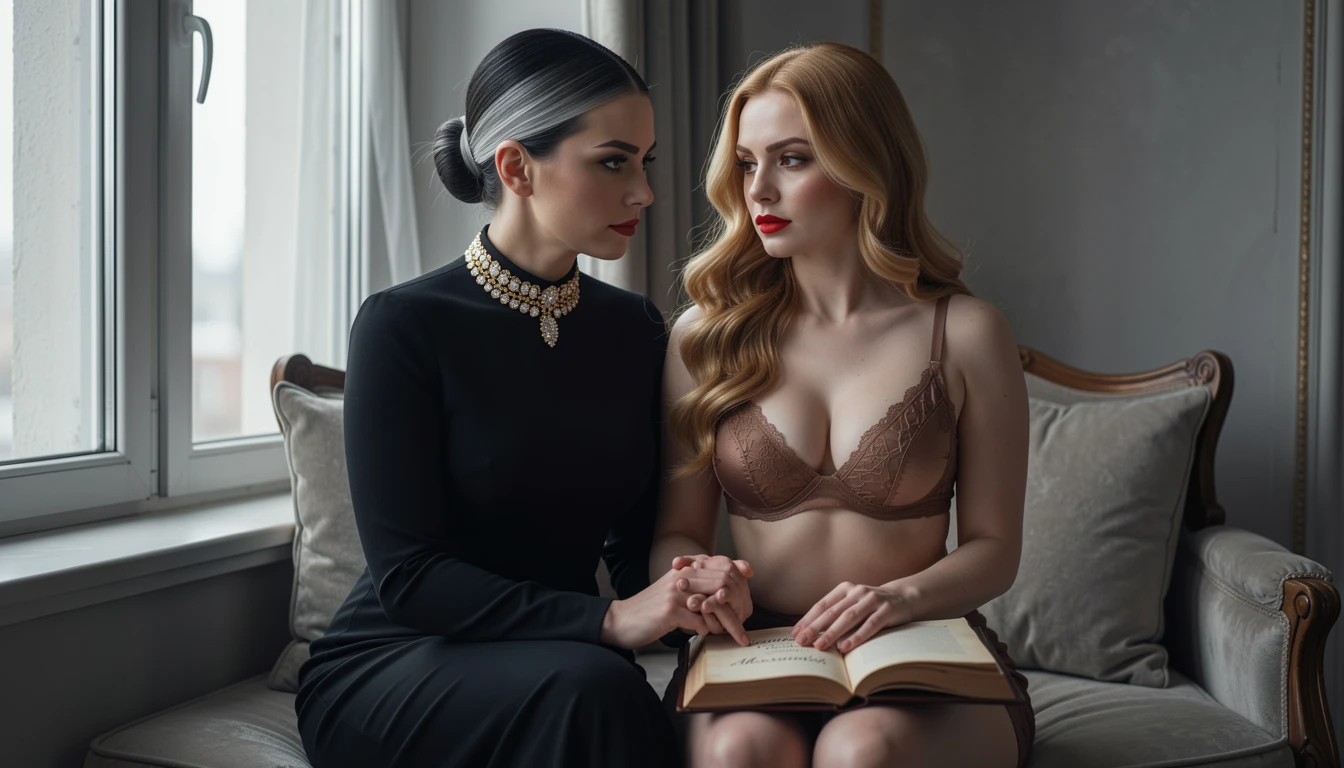
The book lay open in Irina's lap, its leather cover worn soft at the corners, the pages yellowed and dense with names written in a dozen different hands. She'd found me at the window, still watching the gray dawn bleed into gold, and she hadn't spoken—just settled onto the sill beside me, her shoulder finding mine like it belonged there.
"For the boys," she said, and her voice was quiet in a way I hadn't heard before. Not the sharp-edged instrument she used with servants, not the measured tones she used with Dmitri. Something softer. Provisional.
I looked down at the page she'd opened. The handwriting was elegant, looping Cyrillic that I was still learning to read without sounding out each letter. Names. Generations of them, stretching back into a past I couldn't fathom.
"This was my grandmother's book," Irina said. "She started it when she married my grandfather. Every child born into the family, written down in her hand. Then my mother's. Then mine."
Her finger traced a line near the bottom of the page. The ink was fresher there, darker, the strokes less practiced.
"I thought I would fill these pages myself." She paused, and I felt the weight of what she didn't say. "Instead, I write the names of other women's children."
The words sat between us, heavy as stones. I didn't know what to offer her—comfort felt presumptuous, silence felt cruel. So I let my hand find hers on the page, my fingers brushing the names she'd written.
Aleksandr. The letters were careful, deliberate. A name chosen with hope.
"Dmitri chose that one," Irina said. "His grandfather's name. The man who built the family's fortune after the war."
I traced the letters again, feeling the shape of them. Aleksandr Volkov. It sounded like a monument. Like something carved into marble, not a name for a squalling infant who would kick and cry and demand to be fed at three in the morning.
"It's a strong name," I said, because it was expected. Because Dmitri had chosen it, and Dmitri's choices were not mine to question.
Irina turned the page, and there were more names, more generations, more history pressing down on the two small lives inside me. I felt them stir, as if they could sense the weight of what awaited them.
"And for the second?" Irina asked. "Dmitri said he would leave the choice to you."
I blinked. "He did?"
"He wants you to feel that this is your child too. That you have a stake in his future." She looked at me sideways, something unreadable in her dark eyes. "He is trying, Isabella. In his way."
I didn't know what to say to that. Dmitri's way was velvet over iron, generosity with strings attached, tenderness that came with expectations. But he had given me this—a choice, however small. A name I could claim as mine.
The names swam before me. I thought of the boys growing inside me, their heartbeats strong and swift, fighting for space in a body that still felt borrowed. They deserved names that meant something. Names that would carry them through a world that would expect so much of them.
And then the words came.
Not in English. Not in the halting Russian I was still learning. Latin—old, formal, a language I had never spoken, rising from somewhere I couldn't name.
"Sancte Michael Archangele, defende nos in proelio..."
The prayer fell from my lips like a memory I never lived. Saint Michael. Defender in battle. Protector against the darkness.
I stopped, my hand pressed to my mouth. Irina was staring at me, her face gone still.
"Where did you learn that?" she asked, and her voice was strange. Almost reverent.
I shook my head. "I don't know. I've never—" I stopped, trying to find the words. "It just came. Like I'd always known it."
The truth of it unsettled me. I had been Carter once, a man who had never set foot in a church, who had no use for prayers or saints. And yet the words had risen from my throat as naturally as breathing, ancient and certain.
Irina's hand found mine, squeezing hard. "Mikhail," she said, and her voice cracked on the name. "Saint Michael's namesake. It suits him."
"Mikhail," I repeated, testing the weight of it. Mikhail Volkov. It was softer than Aleksandr, less monumental. A name that could bend without breaking.
The twins kicked in unison, a hard double thump against my ribs, and I laughed—a startled sound that surprised us both. "They approve," I said.
Irina's eyes glistened, and she looked away quickly, blinking. When she turned back, her composure was intact, but I had seen the crack in it. The raw edge of feeling she kept hidden behind her severe bun and her high-necked dresses.
"We will make them a home," she said, and her voice was thick, barely steady. "A real one. Not a house full of servants and silences, but a home. With laughter, and noise, and life."
She took both my hands in hers, and I felt the tremor in her fingers.
"We will be sisters in this," she said. "Not mistress and concubine. Sisters."
I looked at her—this woman who had trained me with iron discipline, who had shown me her mother's room and the sweaters she had knitted in secret, who had confessed her barrenness like a wound she'd carried for decades. And I believed her.
"Sisters," I said, and the word felt strange on my tongue. I had never had a sister. I had never had anyone, really, not in the way she meant.
Irina pulled me into an embrace, her arms fierce around my shoulders, and I felt her breath hitch against my hair. The gold collar at her throat pressed cold against my cheek, the diamonds catching the pale morning light.
"Mikhail and Aleksandr," she murmured. "They will know their names. They will know who they are."
She pulled back, and her eyes were red-rimmed but dry. She smoothed her dress, straightened her spine, and became the composed wife of Dmitri Volkov once more. But something had shifted between us, some wall I hadn't known was there, and I felt the absence of it like a cool breeze through an open door.
"I should go," she said. "Dmitri will be wanting breakfast, and Elena will have questions about the nursery." She paused at the door, her hand on the handle. "Isabella—thank you. For the names. For—" She stopped, unable to finish.
I nodded, not trusting my voice.
The door closed behind her, and I was alone again with the morning light and the book of names still open on the windowsill.
I looked down at the page. Aleksandr and Mikhail, written in Irina's careful hand. The names looked right together, I thought. Balanced. Like brothers should be.
I placed my palm on my belly, feeling the flutter of movement that was already becoming familiar. "You have names now," I whispered. "Aleksandr and Mikhail. Don't let them be too heavy for you."
The twins kicked again, softer this time, as if settling into the idea of themselves.
I thought about Luca, about the way his hand had rested on my belly that last night in Milan, the seed settling warm inside me. He would never know their names. He would never know the two small lives he had helped create, the legacy he had set in motion with a glass applicator and a vial of another man's seed.
I pushed the thought away. It was too sharp, too painful, and I had work to do. Dmitri's world ran on schedules and expectations, and I was learning to move within them.
I dressed carefully, choosing a soft grey dress that fell to my ankles, modest and warm against the Moscow chill. The amber pendant Luca had given me hung at my throat, warm against my skin. I touched it, feeling the weight of it, the memory of his hands fastening it there.
The collar was next. It was lighter than I remembered, or perhaps I was just growing accustomed to it. Dmitri had chosen it himself—gold, set with small diamonds, elegant enough to pass for jewelry to anyone who didn't know what it meant. I fastened it at my throat, feeling the familiar weight settle against my pulse.
I was Dmitri Volkov's. The collar said so. The child in my belly said so. The room I slept in, the clothes I wore, the language I was learning to speak—all of it said so.
But the names were mine. Aleksandr and Mikhail. I had chosen one of them, and the other had been chosen for me. And somehow, in the choosing, I had made them real.
I walked to the window and looked out at the city below. The clouds had cleared completely, and the sun was rising proper now, gilding the rooftops and the spires of distant churches. Somewhere out there, a man I had loved was waking to a world without me in it, training another girl to take my place.
I pressed my hand to my belly, feeling the small lives stirring inside me, and I let myself feel the ache of it. The loss. The grief that I had no right to, that I carried anyway like a stone in my chest.
And then I let it go.
There was no room for it here. No room for Luca's memory, for the softness of his hands or the hunger in his eyes when he looked at me. There was only the future—Aleksandr and Mikhail, Irina's fragile friendship, Dmitri's expectations, the life I was building in this cold, beautiful city.
I turned from the window and crossed to the door. Elena would be in the kitchen, preparing breakfast. There were questions to answer about the nursery, decisions to make about the boys' future.
I opened the door and stepped into the hallway, the collar warm at my throat, the pendant warm at my chest, the names warm in my heart.
Mikhail and Aleksandr. My sons. Dmitri's heirs.
The morning light followed me down the corridor, and I walked toward whatever came next.
Elena was in the kitchen, as I'd known she would be—a solid woman with grey-streaked hair and hands that had been feeding Volkovs for decades. She looked up when I entered, her eyes moving over me with the practiced assessment of someone who had seen every kind of woman pass through this house.
"The mistress told me about the names," she said, not bothering with pleasantries. "Mikhail and Aleksandr." She pronounced them carefully, the Russian rolling off her tongue like she'd been saying them her whole life. "Good names. Strong names."
I nodded, settling onto a stool at the counter. The kitchen was warm in a way the rest of the house wasn't—steam rising from a pot on the stove, the smell of bread and something sweet baking. It was the only room in this cold mansion that felt lived-in.
"Tea?" Elena asked, already reaching for the kettle.
"Please."
She worked in silence, her movements efficient and sure. I watched her hands—the same hands that had kneaded dough and chopped vegetables and, I suspected, held secrets that would curl my hair. She set a cup in front of me, the porcelain delicate and painted with tiny blue flowers.
"The mistress cried," Elena said. It wasn't a question.
"A little."
"She hasn't cried in years. Not since—" She stopped, shaking her head. "It doesn't matter. What matters is that she cried for you. For your children."
I wrapped my hands around the warm cup, letting the heat seep into my fingers. "She wants to be there when they're born."
"Of course she does." Elena's voice was matter-of-fact. "She's been waiting her whole life to hold a baby. Yours are the closest she'll ever get."
The words were blunt, almost cruel, but there was no malice in them. Just truth, served straight like everything else in this house.
"Is that why she's been so kind to me?" I asked. "Because I'm carrying the children she can't have?"
Elena turned to face me, her hands on her hips. "She's kind to you because you're the first woman who's ever looked at her like she matters. Not like a barren wife to be pitied or a mistress to be feared. Like a person." She paused. "And yes, because you're carrying the children she can't have. Both things can be true."
I stared into my tea, watching the steam curl and dissipate. I had been so focused on my own cage—the collar at my throat, the life I hadn't chosen—that I hadn't fully seen Irina's. A woman trapped in a marriage that had no room for her, in a house that echoed with children who would never be hers.
"She gave me the book," I said. "Her grandmother's book of names."
Elena's eyebrows rose. "That book has been in her family for three generations. She never even let Dmitri look at it."
"She wrote their names in it." My voice came out strange, thick. "Mikhail and Aleksandr. In her own hand."
Something shifted in Elena's face—a softening I hadn't seen before. "Then she's given you more than she's ever given anyone. More than she's ever given herself." She turned back to the stove, her voice gruff. "Don't waste it."
The kitchen fell into silence, broken only by the simmer of the pot and the distant sound of a car engine in the drive. I sipped my tea, letting the warmth spread through me, feeling the twins stir in response.
"Elena," I said, and she turned, a wooden spoon in her hand. "What was she like? Before—" I gestured vaguely, not sure how to finish the sentence.
"Before Dmitri?" Elena's mouth tightened. "Bright. Fierce. She had a laugh that could fill a room. She used to ride horses in the countryside, bareback, her hair flying behind her like she was trying to outrun the world."
"What happened?"
"Dmitri happened." Elena's voice was flat. "Her father owed him money—a debt from before the collapse. Dmitri offered to forgive it in exchange for her hand. She was nineteen."
I felt something cold settle in my stomach. "She didn't love him."
"She learned to." Elena turned back to the stove, her shoulders rigid. "That's what women do in this world. They learn to love the men who own them, because the alternative is too terrible to contemplate."
The words hung in the air between us, sharp as broken glass. I knew exactly what she meant. I had learned to love Luca, hadn't I? Had learned to want his hands on me, his voice in my ear, even knowing he was selling me to another man. Even knowing I was just another acquisition, another painting to be hung on someone else's wall.
"Is that what I'm doing?" I asked, the words slipping out before I could stop them. "Learning to love Dmitri because the alternative is too terrible?"
Elena was quiet for a long moment. When she spoke, her voice was softer than I'd ever heard it. "You're carrying his children. You're wearing his collar. You're sleeping in his house, eating his food, wearing his clothes." She turned to face me, her eyes holding mine. "Whether you love him or not, you're his. The only question is whether you'll fight it until it breaks you, or find a way to make peace with it."
I opened my mouth to answer, but a sound from the doorway stopped me. I turned, and Dmitri was there—tall and silver-haired, his tailored suit immaculate even at this hour. He looked at me, then at Elena, something unreadable passing across his face.
"Isabella," he said, and his voice was warm in a way I hadn't expected. "I was looking for you."
I set down my teacup, my heart suddenly pounding. "I was just—"
"Elena, leave us." His tone was gentle but brooked no argument. Elena nodded, wiping her hands on her apron, and disappeared through the back door without a word.
Dmitri crossed the kitchen, his steps measured, and stopped in front of me. He reached out, his fingers brushing the collar at my throat, tracing the line of gold with a tenderness that made my breath catch.
"Irina told me about the names," he said. "Mikhail and Aleksandr." He said the words like they were sacred, like he was testing the weight of them on his tongue. "You chose well."
"Mikhail was Irina's idea," I said, my voice barely above a whisper. "The prayer—it just came to me. Saint Michael."
Dmitri's eyes darkened, something flickering in their depths. "My mother used to pray to Saint Michael. Every night, on her knees, before she went to bed." He paused, his thumb tracing the line of my jaw. "She died when I was twelve. I haven't heard that prayer since."
I didn't know what to say. The coincidence felt too heavy, too loaded with meaning I couldn't parse. Dmitri's hand moved from my jaw to my belly, resting there with a possessiveness that made my skin prickle.
"You've given me sons," he said. "You've given me a legacy. And now you've given me back my mother's prayer." His voice cracked, just slightly, on the last word. "I don't know what I've done to deserve you, Isabella. But I intend to spend the rest of my life trying."
I stared at him, this man who had bought me and claimed me and put his seed in my belly, and I saw something I hadn't expected. Vulnerability. A crack in the iron facade that he showed the world.
"I'm not—" I started, but he pressed a finger to my lips, silencing me.
"You're carrying my children," he said. "You're wearing my collar. You're living in my house, eating my food, breathing my air. You're mine, Isabella. And I intend to make sure you never regret it."
He leaned down and kissed me—soft, almost reverent, nothing like the claiming kisses he'd given me on the jet. This was something else. Something that felt almost like tenderness.
When he pulled back, his eyes were bright, and I realized with a shock that they were wet.
"Thank you," he said, and the words seemed to cost him. "For the names. For the prayer. For—" He stopped, unable to finish.
I reached up and touched his face, my fingers tracing the lines around his eyes. "You're welcome," I said, and I meant it.
Dmitri took my hand and pressed it to his lips, then straightened, the mask sliding back into place. "I have meetings this morning. But I'll be back for lunch. We have a nursery to plan."
He turned and walked out of the kitchen, leaving me alone with the steam from my cooling tea and the echo of his words.
I sat there for a long moment, my hand resting on my belly, feeling the twins stir inside me. Dmitri Volkov had just thanked me. Had just shown me a crack in his armor, a glimpse of the man beneath the Don's mask.
And I wasn't sure if that made things better or worse.
I sat there for a long moment after Dmitri left, the kitchen settling into silence around me. The tea had gone cold in its delicate cup, the steam long since vanished. My hand rested on my belly, feeling the faint flutter of movement—the twins responding to the morning's drama in their own small way.
I should go to the nursery. Elena would have questions. There were decisions to make about cribs and colors and all the trappings of a life I still couldn't quite believe was mine.
But my feet carried me back to my room instead, drawn by something I couldn't name. The book of names still lay open on the windowsill, Irina's careful handwriting catching the morning light. I crossed to it, my fingers tracing the fresh ink—Aleksandr and Mikhail, side by side like they already knew each other.
I didn't hear Dmitri return. One moment I was alone with the book and the sunlight; the next, his presence filled the doorway like a change in pressure. I turned, and he was watching me with an expression I couldn't read—something softer than possession, stranger than tenderness.
"Isabella." He said my name like it was a prayer. "Kneel."
The command was gentle, almost an invitation. Still, my body responded before my mind caught up—weeks of training had made obedience reflexive. I sank to my knees on the cold floor, the silk of my dress pooling around me, my hands resting on my thighs. I looked up at him, waiting.
And then Dmitri Volkov, the man who owned half of Moscow's underworld, the man who had bought me like a painting and put his seed in my belly—Dmitri Volkov knelt in front of me.
The breath left my lungs in a rush. He was eye level with me now, his silver-streaked hair catching the light, his dark eyes holding mine with an intensity that made my skin prickle. His knees pressed into the same cold floor where mine rested.
"I have spent my life taking what I wanted," he said, his voice low and rough. "I have never once asked for anything. Not from God. Not from men. Not from the women who shared my bed." His hand rose, hovering near my face without quite touching. "But I am asking you now."
I didn't understand. "Asking what?"
"To pray with me."
The words hung between us, strange and heavy. I thought of the prayer that had risen from my lips earlier—the Latin words I'd never learned, the Saint Michael prayer that had come to me like a memory I didn't own. I thought of Carter, who had never set foot in a church, who had no use for God or saints or the rituals of faith.
And yet.
"Bring your hands together," Dmitri said, and his voice was softer than I'd ever heard it. "Like this."
He demonstrated, his long fingers lacing together, his thumbs resting against his chest. I copied the gesture, my hands feeling clumsy and small in the shape of prayer. The gold collar at my throat pressed against my skin as I bowed my head.
Dmitri's voice rose, low and certain, filling the space between us. "Pater noster, qui es in caelis, sanctificetur nomen tuum. Adveniat regnum tuum. Fiat voluntas tua, sicut in caelo et in terra."
The Latin rolled off his tongue like he'd been born speaking it. I knew the words—knew them in a way that made no sense, the same way I'd known the Saint Michael prayer. They rose in my chest like something long buried, surfacing at last.
"Panem nostrum quotidianum da nobis hodie," I heard myself say, my voice joining his. "Et dimitte nobis debita nostra, sicut et nos dimittimus debitoribus nostris."
Dmitri's eyes met mine, and something passed between us—a spark of recognition, of surprise. He hadn't expected me to know the words. Neither had I.
"Et ne nos inducas in tentationem," we said together, our voices twining. "Sed libera nos a malo."
The prayer ended, and the silence that followed was thick with something I couldn't name. Dmitri's hands were still clasped, his head bowed, and I saw his shoulders rise and fall with a breath that seemed to cost him something.
Then he began again, and this time I knew the words before he spoke them. The Saint Michael prayer, the one that had risen from my throat like a ghost. I joined him without thinking, our voices rising and falling together in the ancient language.
"Sancte Michael Archangele, defende nos in proelio, contra nequitiam et insidias diaboli esto praesidium."
My voice cracked on the words, and I felt something hot and sharp behind my eyes. I didn't know why I was crying. I didn't know why this man, this stranger who owned me, was kneeling in front of me praying in a language neither of us should have spoken so easily.
"Deus imprecamur, supplices orantes, et tu, Princeps militiae caelestis, Satanam aliosque spiritus malignos, qui ad perditionem animarum pervagantur in mundo, divina virtute, in infernum detrude."
The words fell from my lips like stones dropping into still water. I felt them settle somewhere deep in my chest, in the space where Carter used to live, in the hollow where Luca's memory still ached.
Amen.
The word hung between us. I opened my eyes, and Dmitri was looking at me with an expression I couldn't parse—something raw, something almost broken. His hand rose again, and this time he touched my face, his thumb tracing the tear that had escaped down my cheek.
"I have not prayed since my mother died," he said, and his voice was thick. "I buried her in this house's chapel, and I swore I would never kneel again. Not for God. Not for anyone." He paused, his eyes searching mine. "But you brought her back to me. Her prayer. Her faith. Her—" He stopped, unable to finish.
I didn't know what to say. I didn't know what I had done to deserve this—this strange, tender reverence from a man who had claimed me like territory.
Dmitri reached into his jacket and withdrew something small, something that caught the light. A medal on a silver chain, worn smooth with age. He held it up, and I saw the image stamped into the metal—Saint Michael, sword raised, dragon writhing beneath his feet.
"This was my mother's," he said. "She wore it every day of her life. When she died, I took it off her neck and I have carried it in my pocket ever since." He turned it over in his fingers, the chain sliding through his grip. "I want you to have it."
I shook my head, the word rising before I could stop it. "I can't—"
"You can." His voice was firm, brooking no argument. "You gave me back my mother's prayer. You named my sons. You carry my legacy in your belly." He reached for the clasp. "This is the least I can give you in return."
I bowed my head, and he fastened the chain around my neck. The medal settled against my chest, cool and heavy, resting beside the amber pendant Luca had given me. Two chains, two men, two claims on my body and my heart.
Dmitri's fingers lingered at the nape of my neck, warm against my skin. "You will wear this always," he said. "It will protect you. It will remind you that you are watched over."
I touched the medal, feeling the raised image of Saint Michael under my fingertips. The dragon. The sword. The triumph of light over darkness.
"Thank you," I whispered, and the words felt inadequate, too small for the weight of what he'd given me.
Dmitri rose, pulling me to my feet with him. He stood close, his hands on my shoulders, his eyes searching my face like he was looking for something he'd lost long ago.
"There is something else," he said. "Something I should have done days ago."
He crossed to the small writing desk in the corner of my room—the one I'd barely touched, the one that held paper and pens and all the tools of a life I hadn't yet learned to live. He opened the drawer and withdrew a sheet of cream-colored paper, thick and expensive, and a fountain pen.
"You will write to Luca," he said, and my heart stopped.
"What?"
"You will tell him how you are doing." Dmitri set the paper on the desk, the pen beside it. "You will tell him about the twins. About the names. About the prayer." He paused, something flickering in his eyes. "You will be honest."
I stared at him, my mind reeling. "Why?"
"Because he deserves to know." Dmitri's voice was even, measured. "Because you deserve to tell him. Because I am not a cruel man, Isabella, whatever you may think of me. I took you from him. I put my seed in your belly. But I will not pretend that he does not exist, or that what you felt for him was nothing."
I didn't know what to say. The paper sat on the desk like an accusation, the pen a weapon I didn't know how to wield.
"He will want to know that you are well," Dmitri continued. "That you are safe. That the children you carry are healthy." He paused. "And he will want to see you. To know that you are real, that this is real, that you are not just a memory he invented."
"I don't have a picture," I said, my voice barely above a whisper.
"Then you will take one." Dmitri reached into his jacket again and withdrew a small camera—sleek and silver, the kind that fit in a pocket. He set it on the desk beside the paper. "You will take a picture of yourself, and you will send it with the letter."
I looked at the camera, at the paper, at the pen. The tools of a confession I hadn't asked to make.
"I don't know what to say to him," I admitted. "I don't know how to explain—" I gestured at myself, at the room, at the collar at my throat. "Any of this."
Dmitri's hand found my chin, tilting my face up to meet his eyes. "You do not need to explain. You need only to be honest. Tell him how you are feeling. Tell him about the babies. Tell him—" He paused, something softening in his gaze. "Tell him that you are learning to be happy here."
I wanted to argue. I wanted to tell him that I would never be happy, not really, not the way I had been happy in Luca's garden with his hands in my hair and his mouth on mine. But the words died in my throat, because I wasn't sure they were true anymore.
The morning light had warmed. The twins were stirring in my belly. And Dmitri Volkov, the man who owned me, was looking at me like I was something precious instead of something purchased.
"I'll write to him," I said.
Dmitri nodded, a single, sharp movement. "Good." He released my chin, stepping back. "I will leave you to it. Take your time. Be honest." He paused at the door, his hand on the handle. "And Isabella—"
"Yes?"
"When you take the picture, smile." A ghost of something crossed his face—not quite a smile, but close. "Let him see that you are not broken."
The door closed behind him, and I was alone with the paper, the pen, and the camera.
I crossed to the desk and sat down, my fingers trembling as I touched the blank page. The medal at my throat caught the light, Saint Michael's sword glinting. I touched it, then the amber pendant beside it, the two chains tangling together like the two lives I was trying to hold.
I picked up the pen.
The ink flowed onto the paper in a language I was still learning, the Cyrillic letters unfamiliar and strange. I wrote slowly, carefully, sounding out each word. And then I stopped, because I didn't know how to say what I needed to say.
Dear Luca, I wrote. I am in Moscow now. I am well.
The words felt like lies. I was not well—I was pregnant with another man's twins, wearing another man's collar, living another man's life. But I was also not broken, not the way I had feared I would be. There was something growing in me besides the children—something that felt almost like hope.
I wrote about the twins. About Aleksandr and Mikhail, the names Irina had written in her grandmother's book. About the prayer that had risen from my lips like a ghost, the Saint Michael prayer that had brought Dmitri to his knees. I wrote about Irina, about the sweaters she had knitted, about the way she had held me and called me sister.
I wrote about the kitchen, about Elena's blunt truths and warm tea. I wrote about the nursery we were planning, the cribs and the colors and the future that was taking shape around me.
And then I stopped, because there was one thing I hadn't written. One thing I didn't know how to say.
I miss you.
The words sat in my chest like a stone. I wanted to write them. I wanted to tell him that I thought about his hands on my belly, his voice in my ear, the way he had looked at me that last night in Milan like he was memorizing my face. I wanted to tell him that I still loved him, that I would always love him, that even now, with another man's seed in my belly and another man's collar at my throat, he was the one I dreamed about.
But I couldn't. Because Dmitri had given me this—this chance to be honest—and I didn't know if honesty would set me free or destroy me.
I set down the pen and picked up the camera. The lens was cold against my fingers. I raised it, pointed it at my reflection in the window, and pressed the button.
The flash caught me mid-blink, my mouth half-open, my hair a mess. I looked at the image on the small screen—a woman with honey-blond hair and whiskey-brown eyes, a gold collar at her throat, a silver medal resting against her chest. A woman who had been a man once, who had been a whore, who had been a masterpiece and a commodity and now, somehow, a mother.
I took another picture. Then another. I adjusted the collar, smoothed my hair, tried to find the smile Dmitri had asked for.
The woman in the photographs looked back at me, and I didn't recognize her. She was beautiful, yes. She was pregnant, yes. But she was also someone I didn't know, someone I was still learning to be.
I set down the camera and picked up the pen again. The letter sat half-finished on the desk, the words I'd written staring up at me like accusations.
I took a breath. And then I wrote the truth.
I miss you, Luca. I miss your hands and your voice and the way you looked at me like I was the only woman in the world. I miss the garden and the studio and the way you held me that last night, your hand on my belly, your breath in my hair.
I am learning to be happy here. Dmitri is kind to me, in his way. Irina has become something like a sister. The twins are healthy and strong, and they kick me awake every morning like they're already demanding to be fed.
But I think about you. I think about the life we could have had, if things had been different. If you had kept me. If I had been brave enough to stay.
I don't know if I will ever stop loving you. I don't know if I want to.
I signed my name—Isabella—and set down the pen. The letter felt too heavy, too honest, too much. But it was done. The words were on the page, and I couldn't take them back.
I folded the paper carefully, sliding it into an envelope. I chose one of the photographs—the one where I was almost smiling, my hand resting on my belly, the collar and the medal both visible at my throat. I slipped it into the envelope beside the letter.
I sat there for a long moment, my hands resting on the paper, feeling the weight of what I'd written. Somewhere in Milan, Luca was waking to a world without me in it. He would read my letter and see my face, and he would know that I was alive, that I was safe, that I was carrying his children even if he would never call them his.
The medal at my throat caught the light, and I touched it—Saint Michael, defender in battle. Protector against the darkness.
I didn't know if I believed in God anymore. I didn't know if I believed in anything, except the small lives growing inside me and the strange, fragile hope that was taking root in my chest.
But I believed in this: that I was alive. That I was strong. That I would survive whatever came next.
I rose from the desk, the envelope in my hand. Dmitri would know how to send it. He would make sure Luca received it, would make sure the words I'd written found their way across the miles that separated us.
I walked to the door and opened it, stepping into the corridor. The morning light followed me, warm and golden, and I walked toward whatever came next with the letter in my hand and the names of my sons in my heart.
Aleksandr and Mikhail. My children. My future.
And somewhere, in a city I would never see again, a man I had loved was reading my words and learning to let me go.