
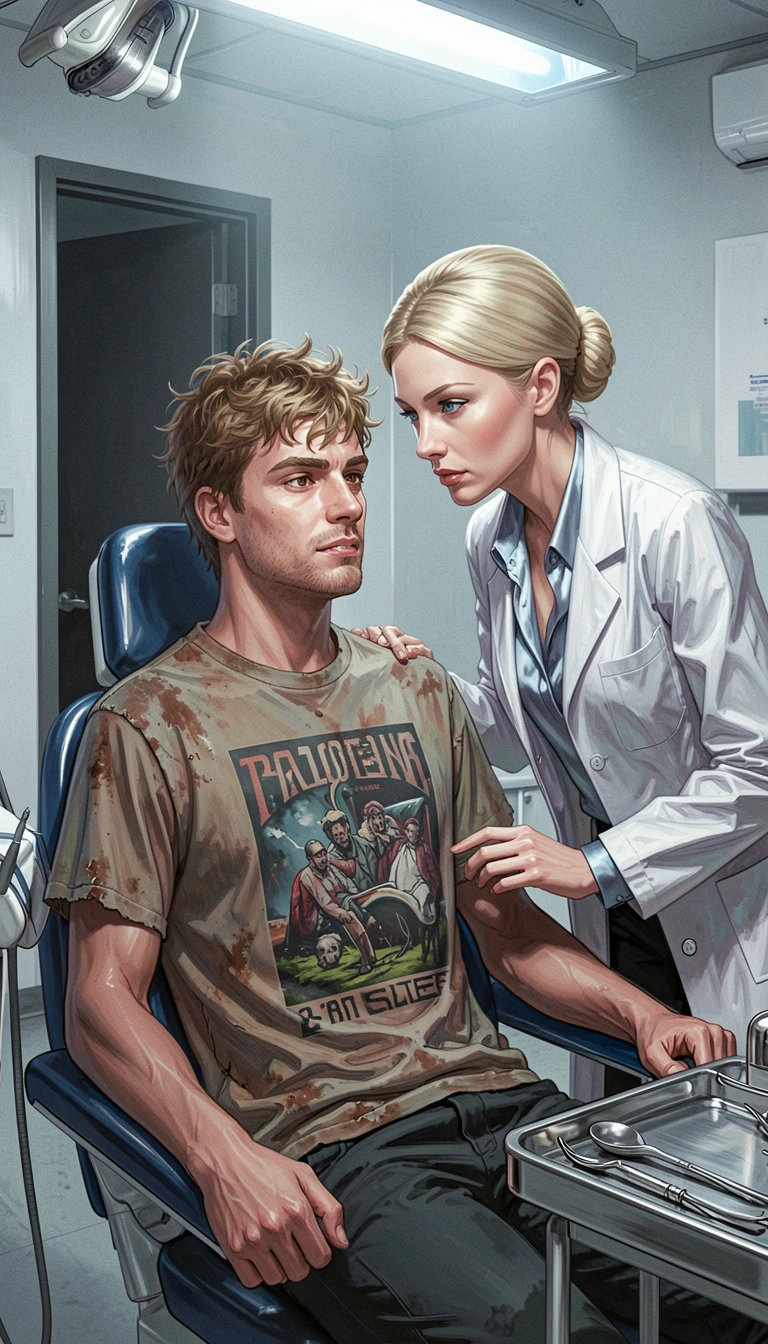
The window had gone from gray to a deeper gray to something that was almost black, and Tyler had watched every shade of it change. There was a tree out there, just the shape of one, and he had counted its branches so many times he knew them the way he knew the cracks in the ceiling above the chair. The bulb hummed. The concrete was cold through the stirrups where his bare feet rested. The canvas jacket held him across the chest, and he had stopped testing the buckles an hour ago, or maybe two, because testing them only told him what he already knew.
The cart sat at the edge of his vision. He could turn his head just enough to see the instruments laid out on the steel tray, and the broach lay among them, the thin length of it catching the bulb's light, the fine tip of it making that small white point he had stared at until his eyes watered. He had tried to look away from it. He had looked at the ceiling, at the window, at the stain on the floor beneath the chair. But his eyes kept finding their way back to the cart, to that one thin instrument, the way a tongue finds a cracked tooth.
His jaw ached. Not the sharp, live pain of the molar he'd come in with — that was gone, dead, replaced by something stranger. This was a deep ache in the bone behind the tooth, a remembering where the nerve used to be. The hole in his tooth was open. He could feel it with his tongue if he tried, the rough edge of it, the hollow space where the burr had gone down. He had been trying not to do that. He had been trying not to do a lot of things.
The floorboard took a step above him. He had heard that sound so many times today that he had stopped counting them, but this one was different. This one was followed by another, and then another, and then the lock on the door at the top of the stairs turned with a sound that was almost too quiet to hear, and Tyler stopped breathing.
The door opened. Light fell down the stairs, a pale yellow rectangle that spilled across the concrete and reached almost to his feet. And then the light was blocked by a shape, and the shape was Dr. Mack, and she came down the stairs without hurrying, one hand on the rail, her white coat catching the light.
She didn't look at him. She crossed the basement to the cart, her heels clicking on the concrete, and she stood there with her back to him for a long moment, looking down at the instruments. Tyler watched the back of her head, the severe bun, the way her shoulders were perfectly still. The silence stretched. The bulb hummed.
Then she reached down and picked up the broach.
She held it up, turning it in the light, and Tyler could see the full length of it now — the handle, the thin shaft, the fine tip that caught the light and made that small white point. She looked at it the way a person looks at a pen before they write, checking it, testing it. Then she turned, and she looked at him, and she held the broach up where he could see it, and she didn't say anything.
The broach was longer than he had thought. Longer than the instruments she had used before, the burr, the files. It was thin, impossibly thin, and it had a slight curve to it near the tip, and Tyler looked at that curve and felt something in his chest go tight and cold.
Dr. Mack set the broach back down on the tray. It made a small click against the steel. And then she came to the chair.
He could smell her as she got close — the antiseptic of the clinic, the faint perfume underneath, something floral that didn't belong in this concrete room. She stopped beside the chair and looked down at him, and he looked up at her, and neither of them said anything for a long moment.
Then she reached for the first buckle on the canvas jacket.
Her fingers worked it open with practiced ease. The buckle released with a sound that was louder than it should have been in the quiet of the basement, and Tyler felt the pressure across his chest ease by a fraction. She moved to the next buckle, and the next, working her way down the front of the jacket, and with each one the canvas loosened, the weight of it settling differently against him.
He could feel his own breathing change. The jacket had held him so tightly for so long that he had forgotten what it felt like to breathe without it. Now, with each buckle, the air came easier, and his chest rose and fell more freely, and he realized he had been holding himself still inside the jacket, braced against it, the way you brace against a weight you can't put down.
The last buckle opened. Dr. Mack took the edges of the jacket in her hands and drew them apart, and the canvas fell away from his chest, and the cool air of the basement touched his skin where the fabric had been pressed against it. He was shirtless beneath the jacket. He had been shirtless for a long time now, he couldn't remember how long, and his skin was damp with sweat where the canvas had held him.
She folded the jacket and set it on the cart, on top of something, he didn't see what. Then she came back to the chair and looked down at him, and her pale blue eyes were flat and calm, the way they always were, and she said, "Keep your hands on the armrests."
It wasn't a question. It wasn't even a request. It was the kind of instruction you give to a dog that already knows the command, and Tyler's hands, which had been resting loose in his lap, moved to the armrests without him deciding to move them. His fingers wrapped around the cold steel, and he held on, and he looked up at her.
She reached for his face. Her hand came up, and her thumb pressed against his jaw, just below the hinge of it, and she pushed. His mouth opened. It opened easily — it had been held open so much today that the muscles had given up resisting, and his jaw dropped, and the ache in the bone behind his dead tooth flared at the motion.
She held his jaw open with her thumb and looked into his mouth. He could feel her breath on his face, faint and cool, and he could smell the coffee on it, and the antiseptic, and he watched her eyes move, studying the open tooth, the hole the burr had left, the dark center of it.
"Good," she said. She took her thumb away, and his jaw started to close, and she said, "Keep it open."
He kept it open. His jaw trembled with the effort, the muscles burning, and he watched her turn to the cart and pick up the bite block. It was the same one she had used before, the hard rubber wedge with the strap attached, and she brought it to his mouth and slid it between his teeth, and he bit down on it automatically, and she drew the strap around his head and buckled it behind his skull.
The bite block held his jaw open, wide, too wide. He could feel the spit starting to gather in the back of his throat, and he swallowed against it, and the motion of his throat made the ache in his jaw flare again. Dr. Mack stood back and looked at him, checking the strap, checking the block, the way she had done before, and then she turned to the cart.
She picked up the broach.
He watched her hand close around the handle. She held it the way she had held it before, turning it in the light, and then she came back to the chair, and she stood over him, and she looked down into his open mouth.
"This is going to feel strange," she said. Her voice was quiet and level, the same voice she used to tell him to open wider, to hold still, to breathe. "The tooth is dead. You won't feel the tooth. But the bone underneath it remembers where the nerve was, and the broach is going to find that memory."
She brought the broach to his mouth.
The tip of it touched his lower lip first, cool and metallic, and then it passed into the opening of his mouth, and he felt it against his tongue, thin and light, and then it moved past his tongue, toward the back of his jaw, toward the dead tooth.
He couldn't see it. He could only feel it, the thin steel moving inside his mouth, and he heard his own breathing, loud and ragged, and he felt the spit pooling around the bite block, and he held his hands on the armrests because she had told him to.
The tip of the broach found the hole in his tooth.
It touched the edge of it, and Tyler felt it — not in the tooth, the tooth was dead, but in the bone behind it, a deep pressure that was almost a sound, a vibration that ran down his jaw and into his skull. The broach slid into the hole, and the pressure deepened, and Tyler's hands tightened on the armrests.
It went in slow. She worked it in with a careful, turning motion, like a key finding a lock, and with each turn the pressure in his jaw changed, shifted, deepened. He could feel the thin shaft of it moving down through the dead tooth, down through the space where the nerve used to be, down toward the bone.
And then it found something.
The pressure changed. It became a pull, a deep, wrong grip in the bone behind the tooth, and Tyler felt it in his whole head, in his eyes, in the base of his skull. It was like something had reached into his jaw and taken hold of a string that ran all the way down into his chest, and it was pulling, gently, steadily, and his whole body went still.
He couldn't have moved if he'd wanted to. The pull held him the way the jacket had held him, but deeper, inside, in a place he hadn't known existed until this moment.
Dr. Mack was watching his eyes. The broach was seated in the canal, the handle of it protruding from his mouth, and she held it steady with two fingers, and she looked at him, and she said, "That's it. Hold still."
And Tyler held still. He held still because he couldn't do anything else, because the pull in his jaw held him the way a hook holds a fish, and he lay in the chair with the broach in his tooth and her eyes on his, and the basement was quiet around them, and the bulb hummed, and somewhere upstairs a floorboard settled.