
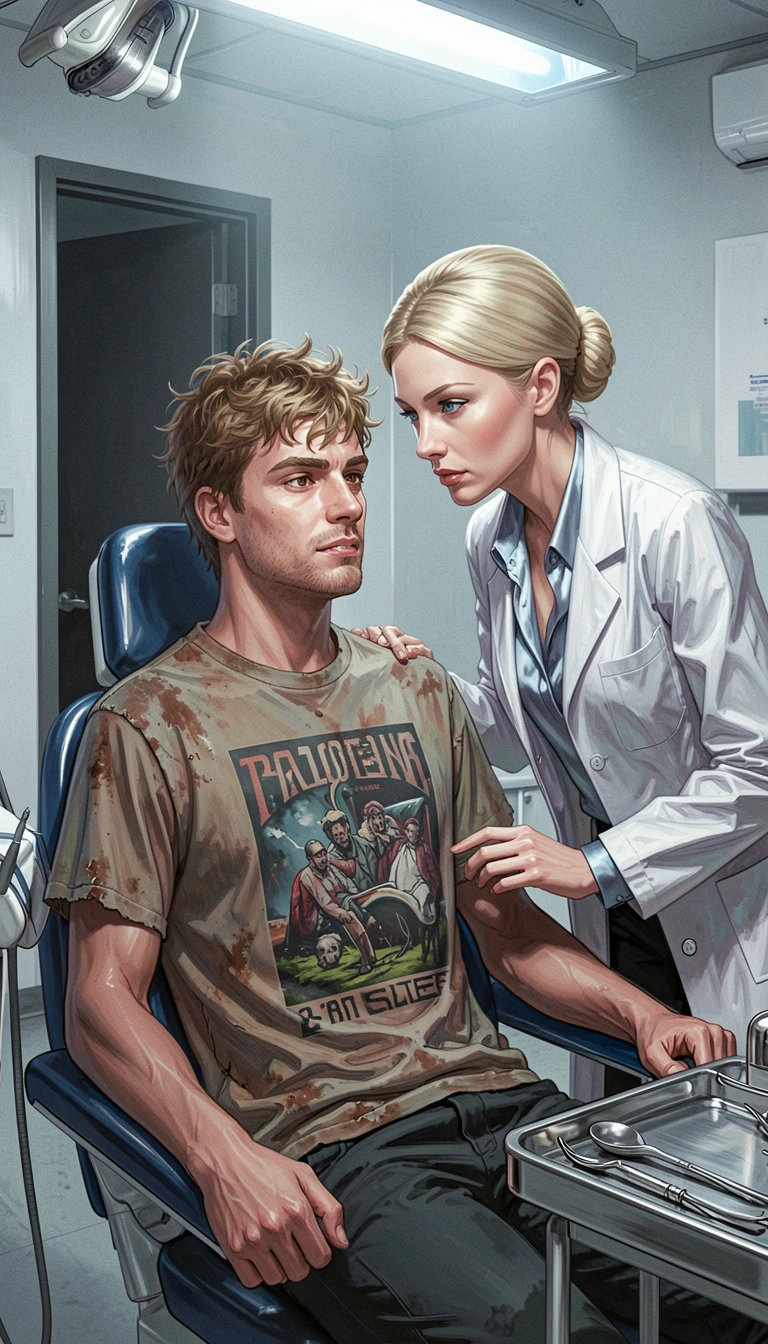
Renata looked up at Dr. Mack and nodded, once, and got off him. The weight of her came away slow, and Tyler felt the cold air move in where she'd been, and the wet of her on his thighs going cold too. She found her scrubs on the floor by the cart and stepped into them, and she pulled the tie out of her hair and put it back up while she walked, and she didn't look at him again.
Her feet went up the stairs. The door at the top opened and closed, and the lock turned over, and then the basement was quiet.
The bulb hummed. That was all. The bulb, and the chair, and his own breathing coming through his nose because his mouth was still open around the bite block, still strapped, still cranked wide enough that his jaw had started to ache at the hinge. The drug was going. He could feel it going the way water goes down a drain, slow at first and then all at once, and where it had been there was a raw place left behind.
Dr. Mack came back to the chair.
She didn't say anything. She stood over him and put her hands on the canvas jacket at his chest, and her fingers walked down the line of buckles one at a time. The first one, across his sternum, she pulled and it held and she let it go. The second, under his ribs. The third, at his belly. She tested each one the way a person tests a knot, not to undo it, just to know it was there, and Tyler lay still under her hands because there was nothing else to do with his body, and the buckles were all closed, and he knew it.
"You're going to want to fight these," she said, to the jacket, not to him. "Later. When the ache comes back. You'll pull against them and they won't give, and you'll pull anyway, and that's fine. I'd rather you pull than go quiet. The quiet ones are the ones I have to worry about."
Her hands found the strap at his shoulder and tightened it half a hole, and the canvas bit into the top of his arm. "Not that one," she said. "Not yet. But you should know the sound it makes when it goes tight."
Then she took his jaw in her hand.
Her thumb went into the soft place under his chin and her fingers spread along the side of his face, and she tilted his head back against the headrest until his throat was long and his open mouth pointed up at the bulb. The light went straight down into him. He felt it on his tongue, on his teeth, on the hole.
She leaned in and looked. Not at his eyes, at his mouth. Her face was close enough that he could see the fine lines at the corners of her eyes and the way her jaw was set, and her breath came slow and even, and she studied the tooth the way she'd studied it up at the clinic, with the flat attention of a woman reading a chart she'd already memorized.
"There it is," she said. "Still open. Good. I want it to stay open."
Her thumb moved, just a little, along the line of his jaw, and the pressure found the tooth and the ache came up through it like a struck bell. Tyler's whole body pulled against the cuffs. It was the first real pain since the amber fluid, the first honest thing his jaw had said to him all night, and it said it loud.
She held his face through it. Didn't let go. Waited until he settled, and he did settle, because there was nowhere for the pain to go and nothing to do but let it ring itself out, and when his breathing came back down she let go of his jaw and stood straight.
"That's the drug leaving," she said. "It doesn't take the pain away. It just moves you downstream from it for a while. You're back upstream now, sweetheart. Get used to it. It's going to be your weather for the rest of the day."
She walked to the cart, and he heard the tray move, the steel of it sliding on the steel of the cart, and she came back with something in her hand. She held it low enough that he had to look down his own body to see it, past the canvas and the straps and his own bare chest, and the bulb found it.
It was long. Longer than the burr, longer than anything that had been in his mouth so far, and thin, thin as a wire almost, with a handle at one end that was worn smooth and a tip at the other that was finer than a needle. It looked like something a watchmaker would own. It looked like something that went into places that weren't meant to be entered.
"This is a barbed broach," she said. "It goes down the canal and it grips. It pulls things out that don't want to come out. The pulp, the nerve, whatever's left in there that shouldn't be. The last one, when I got to this part, I had to go slow. Very slow. Because the broach goes in fine and it comes out with teeth."
She turned it in the light so the length of it caught. "Tonight," she said, "when I come back down, you're going to hold still for this. Without the jacket. I'm going to take it off you and put you in the chair and you're going to lie there with your hands free and your mouth open, and you're not going to reach up and you're not going to make me chase you. You're going to hold still because I told you to, and because you know what happens if you don't, and because by then you'll have had all day to think about what it means that you said yes."
She set the broach back on the tray, and she set it down gently, the way you set down something that mattered, and she turned back to him and her face was still and calm and there was nothing in it he could read.
"The rest of the day's spoken for," she said. "Not for the chair. Not for us. For you. You're going to learn what your body is for now, and you're going to learn it alone, because that's the only way it sticks."
She reached up and her fingers found the collar at his throat, and she ran them along the inside of it where it met his skin, and it was stiff and it chafed and she knew it chafed, and she didn't loosen it. "That's somebody else's wear on that canvas," she said. "You can probably smell it. They wore it a long time. Longer than they wanted to. You'll wear it longer."
She picked up the tray and carried it to the cart and set it down, and she crossed to the stairs, and her hand found the rail, and she stopped with one foot on the first step and looked back at him across the room.
"Don't fight the cuffs too hard at first," she said. "You'll want to. Don't. You'll wear yourself out before the pain even gets going, and then you'll have nothing left for the part that matters. Save it. Sit in it. Let it be quiet down here."
"Dr. Mack—" His voice came out wrong, cracked and small around the bite block, and he didn't know what he was going to say after her name, and it didn't matter, because she was already going up.
"I'll be back tonight," she said, not turning. "Be ready."
Her shoes went up the stairs, one, two, three, and the light through the door at the top was gray and then it was gone, and the door closed, and the lock turned over, and then there was nothing but the bulb and the chair and the sound of his own breath through his nose.
He lay still for a while. He didn't know how long. The bulb didn't move and the gray light in the little window didn't change and there was no clock down here, and time went sideways on him, and the only thing that told him it was passing was his jaw.
It came up slow. First at the hinge, a dull throb where the bite block had been holding him open so long, and then in the tooth itself, a hot bright point that got brighter, and then the bone under it, the deep ache that had nowhere to go and no end to it. He tried to breathe through it. He tried to count. He got to eleven and lost the thread and started over and got to seven.
The collar chafed. He turned his head against it and it chafed somewhere new, and the canvas at his shoulders was stiff with somebody else's sweat and somebody else's time, and he could smell it, old and sour and faint, and he couldn't get away from it because it was on him.
He pulled at the cuffs. Just to know. The leather went tight around his wrists and held, and the chain found its length and stopped, and the chair didn't move because the chair was bolted to the floor. He pulled harder, and his heels found the floor and his back came up off the vinyl and the whole chair creaked and held and he held and then he let himself down.
The ache came back the moment he stopped. It had been waiting.
He lay there and looked at the tray on the cart. He could see the broach from here, the thin length of it lying still on the steel, and the light found the tip of it and made a small white point, and he looked at it for a long time because there was nothing else to look at and because, he understood, it was the thing he was going to have to hold still for.
His hands were free in the cuffs. Not free. But loose enough to move, and he moved them, and he found the buckles on the jacket with his fingers, one at a time, and he tested them the way she had. They held. All of them held.
He let his hands fall and lay still and the bulb hummed and his jaw rang like a struck bell and the gray light in the window didn't change, and somewhere upstairs a floorboard took a step and then another, and then it was quiet again, and the day went on without him.
He counted to eleven and lost the thread.