
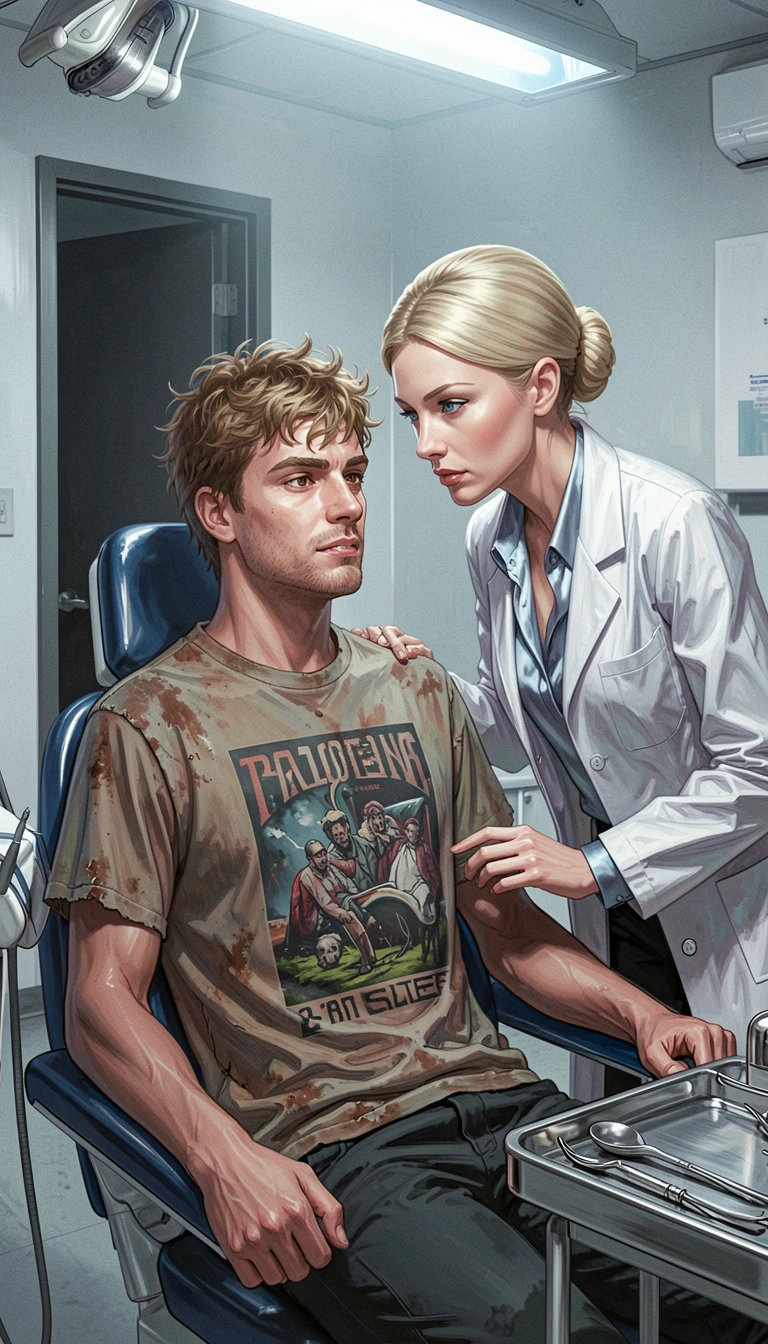
The broach turned. Counterclockwise, a quarter turn, and the grip in the bone loosened — not a snap, not a tear, just a slow give, the way a knot gives when you find the right end of it. Tyler's whole body came off the chair. His shoulders lifted, his heels dug into the steel stirrups, and the gasp that came out of him was strangled by the bite block, a wet, high sound that had nowhere to go.
Dr. Mack held the handle steady until the spasm passed. She had learned, years ago, that the hand that pulled away at the first convulsion was the hand that broke a root. So she waited, two fingers on the broach, and watched his eyes above the block — wide, wet, fixed on the ceiling as though the answer to all of it might be printed up there on the concrete.
"There," she said. "That's the last of the grip. The bone lets go when it's ready. Not when you are."
She turned it again — a half turn this time, easy, the canal slick and open under her hand — and drew it out. The broach came free with a faint suck, a sound she had always liked, small and wet and final. She laid it on the cart. Metal touched metal, a clean bright note, and then she wiped her fingers on a gauze square and looked at the thin dark smear the instrument had carried up out of him.
The basement was quiet. The bulb overhead hummed its one flat note. The concrete floor gave up its smell — damp earth, antiseptic, the iron of old blood that had soaked into the grout years ago and never fully left. Tyler's breath sawed around the block. His chest rose and fell too fast, and the straps across his shoulders caught each rise, held it, let it go.
She set the gauze down and turned back to him.
"You're ours now, Tyler."
The words came out flat. She did not say them like a threat, because they were not a threat. They were a fact she had verified, the way she verified a bite, a margin, an x-ray. She looked at him lying there in the chair bolted to her floor, and her pale eyes did not move, and her voice did not rise.
"You won't leave this house."
Nothing answered. The broach lay still on the cart. Tyler's breath tore in and out around the block, and his eyes slid from the ceiling to her face, and she watched him understand it — watched the understanding arrive in stages, the way it always did, first the words, then the meaning, then the weight. His hands curled against the cuffs. The canvas of the jacket creaked.
She had seen this moment before. It was the moment she had built the clinic for, the hour-long drive for, the fine print on the ad for. She had learned to recognize it the way a surgeon recognizes the moment the anesthetic takes: the patient lets go. She waited for it.
Tyler didn't let go. His jaw worked around the block. His eyes stayed on hers, and there was something in them she hadn't counted on — not defiance, not yet, but a stubborn, stupid refusal to be finished.
She reached down and unbuckled the block's strap. It came away from his face with a wet click, and he worked his jaw, and the first thing he did with his freed mouth was not beg.
"You can't keep me down here."
"I can." She set the block on the cart beside the broach. "I am."
"People will—" He stopped. His tongue found the open tooth, the hole, and he winced, and she watched the wince travel. "My mother. My boss. I didn't tell anyone where I was going. They'll—"
"They'll what, honey." She said it without cruelty, which was the cruelty. "Look for a boy who didn't tell anyone where he was going. That's the trouble with boys who don't tell anyone. They're very hard to find."
He was quiet. She could see the arithmetic going on behind his face — the hour of the drive, the dead phone, the turnout where he'd parked and touched himself thinking of this basement. No one had seen him turn off the highway. He had made himself invisible for them, and he had done it with his own two hands.
"The car," he said, and it came out thin. "The Corolla. It's out front."
"It's in the barn. Has been since Friday." She turned to the cart and began laying out what she would need. "Marcus moved it. Marcus moves everything."
The name landed the way she had meant it to. Tyler's face changed — he had seen Marcus, once, in the doorway of the sink room, that great quiet bulk in the tactical jacket. The memory of him sat in the room now like a third body.
"What do you want from me."
"You know what I want." She turned back. "You've known since the first Friday. You want to pretend you didn't, and I'll let you pretend a while longer, because pretending is good for the heart rate. But you and I both know why you came back through that side door."
His throat moved. The open tooth sat in his jaw like a small dark room with the light left on.
"You said I could leave," he said. "You said it four times. You said—"
"I said you could leave. I never said I'd make it easy." She walked around the chair, and her heels clicked on the concrete, and she came to a stop at his shoulder. "You said yes. In the exam room. At the door. When you lay down. When you stayed. Four yeses, Tyler. I keep records. You know I keep records."
He pulled at the cuffs. The steel didn't care. The chair didn't care. It was bolted into the floor with four half-inch anchor bolts she had set herself, and it had held heavier men than him.
"This is—" He stopped. "This isn't a cavity. This isn't a tooth. This is—"
"This is the rest of the treatment."
She let the silence do the work. It was a good silence, the kind she had learned to build in the years since she stopped explaining herself. The bulb hummed. Somewhere upstairs, the house settled, one floorboard letting go of a nail it had been holding all day.
Then, from the dark at the edge of the bulb's reach, a shadow moved.
Renata came out of it slowly, and the smile she wore in the clinic was gone. Not hidden — gone, the way a light is gone when it's switched off. Her ponytail hung still. Her pastel scrubs looked wrong in this room, a bright thing in a place that had been scrubbed of bright things. She walked to the foot of the chair and stood looking down at Tyler with an expression Dr. Mack recognized because she had put it there, years ago, on a younger face.
"You thought it was a game," Renata said. Her voice was not warm. It was the voice of someone who had been holding a door open for a long time and had finally let it close. "The chair. The drill. Me on top of you. You thought you were getting away with something."
"Renata—"
"I called you a good boy and you believed me." She tilted her head. "That's the trouble with boys who believe things."
Tyler's chest hitched. Dr. Mack watched his face go through it — the betrayal, the cold, the slow dawning that the warmth had never been warmth at all. It was a tool she had watched Renata use a hundred times and never once seen her fumble.
"You're going to be here a long time," Renata said. "It's easier if you stop counting the days."
His hands were white on the cuffs. And then Dr. Mack saw it — the thing she had been waiting for without knowing she was waiting for it. Under the canvas jacket, under the fear, his cock had begun to fill. It lay along his thigh, half-hard, lifting, and it had nothing to do with any of the words. It was the broach. It was the pull in the bone, the nerve bundle that ran from the jaw down through the whole body like a wire with both ends live. She had known it would happen. She had counted on it.
Renata saw it too. She looked down at him, and something moved across her face that was not disgust, and she reached out and closed her hand around him.
"There he is," she said softly.
She stroked him once. Slow. Base to tip, her thumb dragging over the head, and Tyler's whole body arched against the straps and a sound came out of him that was not words. His eyes were wet. His mouth was open. The open tooth caught the light.
"You see?" Renata said, not to him. "He doesn't even know which way to go."
"He'll learn," Dr. Mack said.
She watched Renata's hand move on him — once, twice, the rhythm she had taught her, the rhythm that kept a patient's heart rate up without letting it peak. Tyler's head rolled back. His hips lifted as far as the straps would allow. He was watching Renata's hand, watching it, and his breath had gone shallow and quick, and he had stopped counting the days, and that was the moment Dr. Mack reached for the mask on the cart.
It was a simple thing — molded rubber, a strap, a length of tubing that ran to a small tank she kept under the cart. She had used it before. She fitted it over his nose while his attention was all in his lap, and the strap went around the back of his head, and by the time he felt the rubber on his face it was already seated.
He jerked. His eyes came up to hers, wide, and the first breath he took through it was a gasp, and the gas went down into him sweet and cold and wrong, and she watched the fight go out of his shoulders one strap at a time.
"Breathe," she said. "Slow. There's no hurry. There's never any hurry down here."
Renata's hand kept moving. Tyler's eyes were on Dr. Mack's, and they were going dim, and the last thing they did before they went was look at her — not with hate, not with pleading, but with the same stubborn refusal to be finished. It was the look she would remember. It was the look she would write down.
"Good boy," Renata said, and her voice was warm again, and that was the worst thing in the room.
Dr. Mack turned the valve a quarter turn and watched his chest slow. The basement was quiet. The bulb hummed. On the cart, the broach lay where she had set it, and the gauze beside it was dry now, and the night upstairs was still a long way from over.