
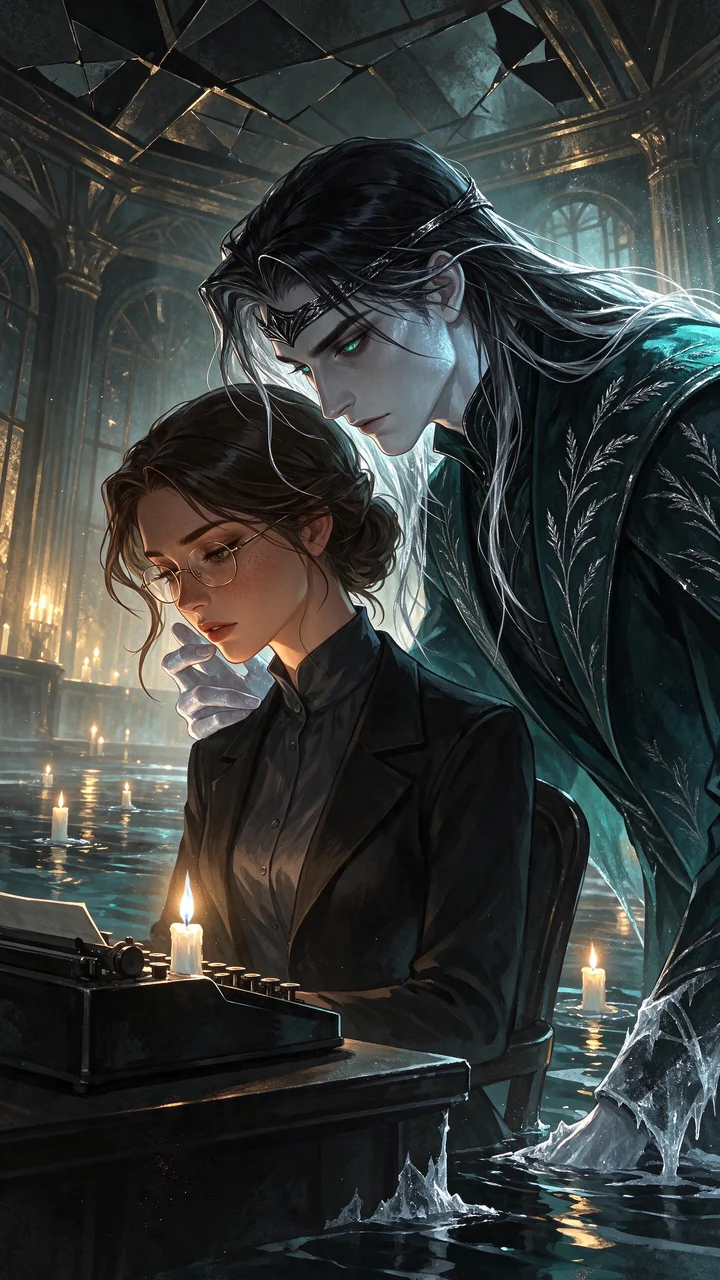
“Eyes on your keys,” said the man at the bottom of the stairs. “Not the ceiling. Not the candles. Not the pretty people. Keys.”
Nell stopped on the forty-first step. The laminated map had promised it would be the last dry one, and it was. Below it, black water lapped over tile the color of old teeth. A broad man in a dark green jacket stood ankle-deep in it, holding an open umbrella over nothing.
“It isn’t raining,” she said.
“It is down here.” He held out his free hand for her case. “Dex Okafor. Bailiff. You’re Ashby.”
“I’m Ashby.” She kept the case. The stenotype inside had been her father’s before it was hers. It was the only thing of his the creditors hadn’t wanted. “The summons said formal attire. Nobody mentioned waders.”
“Nobody ever does.”
Something ticked against the umbrella. She glanced up out of habit and caught cracked plaster, a gilt sunburst gone green at the rays, and a drop swelling on it and letting go.
“Hey.” Dex’s voice went flat. “Don’t. Down, and stay down.”
She brought her eyes back to the waterline. The cold had already come through her stockings. “And if I don’t?”
“You get to find out once.”
He started walking. She followed, because the alternative was forty-one steps back up to a city that wanted thirty-eight thousand dollars of her father’s debts by March. The sealed envelope had promised all of it, plus interest, for a year and a day of work.
“Chancellor swears you in,” Dex said. “He’ll be kind to you. Don’t let it make you stupid.”
“I’m rarely stupid.”
“Last one wasn’t either.” He said it lightly, the way people talk about parking in a funeral line. “And the water. Don’t look at him in the water. Reflections count.”
“Who decided that?”
“Somebody who found out.”
Then the corridor opened, and she forgot what she’d meant to ask.
The ballroom had been built for a railroad that believed in itself. The floor alone told her that: black and gold terrazzo under the water, a pattern of brass arrows all pointing toward a dais. A hundred candles rode the surface in little brass boats, nudging each other and throwing light up onto everything she wasn’t allowed to see. The air smelled of rain and iron and lilies, though there was no soil down here for anything to grow in. Far above her, a train went by. The Lake Street line had been closed since before she was born.
The court was a forest of hems. She saw silk the color of pond scum and peacock throats, bare feet with rings on the toes, and a pair of boots with spurs made of fishbone. Laughter skated over the water and stopped wherever she walked.
Dex steered her to a small dry platform at the foot of the dais. She opened the case with steady hands and set out the tripod, the machine, and the slim laptop that would turn her strokes into English. She set her fingers on the home keys and felt almost normal for the first time since the envelope came.
“Miss Ashby.”
The gloves entered her vision first: dove-grey kid, buttoned at the wrist. Then a chain of hammered copper keys swinging against a black coat. The voice was the kind of warm that pulls out your chair for you.
“Isra Thorne. Lord Chancellor. I keep the laws, which makes us colleagues of a sort.” A gloved finger touched the edge of her desk. It did not touch her. “Keep your eyes where they are. I won’t take offense. I’d rather you lived.”
“That makes two of us.”
Amusement rippled through the hems.
“Then let’s be quick.” He turned so his voice carried. “Eleanor Ashby, of the dry city. Do you come to this court of your own will, to record truly every word spoken from the throne for a year and a day?”
“I do.” She stroked it as she said it, and her own oath scrolled up the screen.
“Then hear the laws that bind you. There are two.” The keys on his chain chimed. “A mortal who looks upon the face of the king forfeits every year she has left. Not one year. Not most of them. All of them, at once, on the spot. And the scribe and the king may share no bond beyond the record. You will write him. You will not know him.” His tone gentled, which was somehow worse. “Do you understand?”
“I understand the words.”
“That’s all anyone does, at first.”
Then the room went quiet, and the quiet had nothing to do with good manners.
The laughter stopped. The candles stopped knocking together. Even the train overhead seemed to hold off. Nell kept her eyes on the S and the T, on her father’s thumbprints worn shiny into the keys. She listened to the hush move up the ballroom toward her as row after row of hems went still.
The water began to freeze.
It came from the far doors in a long white tongue, crazing the surface into ferns and feathers and lifting the candle-boats a fraction as it took them. It ran straight up the center of the room toward her desk. It stopped a foot from the leg of her chair, with a sound like sugar crust breaking.
Then boots. Black leather, tall, stitched at the cuffs with silver reeds that bent as if they stood in a current. Behind them, the hem of a dark cloak that rested on the water instead of dragging in it.
“Leave us the dais.” His voice was low and unhurried, worn smooth. “All of you with spears. Go stand somewhere else.”
Armored feet withdrew. The boots did not go to the throne. They came around the side of her desk, a chair scraped, and he sat. He was close enough that the cold of him reached her shoulder through blazer and blouse, the way a January window does when you rest your head against it.
“Scribe.” She could hear the shape of his mouth in the word. “Are you ready?”
“I’ve been ready since nine.”
“Then you’ve been patient. That will serve you.” He paused. “For the record. The first decree of this tenure.”
Her fingers lifted.
“The scribe’s eyes are her own to give. No law of this court may take them, no chancellor may ask for them, and no king may command them. I will wait until she chooses.” He paused again, and she felt his attention on the back of her neck, on her hands. “By the cold that rocks our cradles, let it be kept.”
She stroked every word clean until the last line. Her ring finger came down a hair late. The screen read: By the cold that rocks our candles, let it be kept.
The ballroom drew a breath.
Every flame on the water went white. They didn’t go out. They turned the hard blue-white of light through river ice, each wick grew a lace of frost, and each one kept burning. A hundred cold fires rocked in their boats, gently, gently, as if something under the water had learned to sing to them.
Nobody spoke. At the edge of her vision, the copper keys on the Chancellor’s chain had gone still, one gloved hand closed around them.
“Well,” Isra said softly. “Isn’t that something.”
Nell’s mouth had gone dry. “I can fix it. It’s a misstroke. I’ll go back in and...”
“Leave it,” the king said.
“It’s wrong.”
“It’s written.” Beside her, the cold moved an inch nearer, as if he were reading her screen. “And I find I like them better this way.”
The rest of the session passed in petitions she barely understood and transcribed perfectly: water rights, a dispute over a stolen name. She did not misstroke again. She also did not breathe properly until the court began to empty, hems drifting away across the ice, Dex’s green trousers waiting by the door.
The boots had not moved.
She packed the machine, clicked the case shut, and stood.
“Look at me, Nell.”
He hadn’t said scribe or Miss Ashby. He had said her name, quietly enough that nobody at the doors could have heard, and the white candles leaned toward the sound.
She stared at the clasp of her case until it doubled. “No,” she whispered.
“Good.” There was no disappointment in it. It sounded closer to pleasure. “I’ll ask again tomorrow.”
He said it the way a man sets a place at the table for someone he expects. She walked out over the ice with her eyes down and told herself not to count how many tomorrows fit in a year and a day.
She counted anyway. Three hundred and sixty-six.