
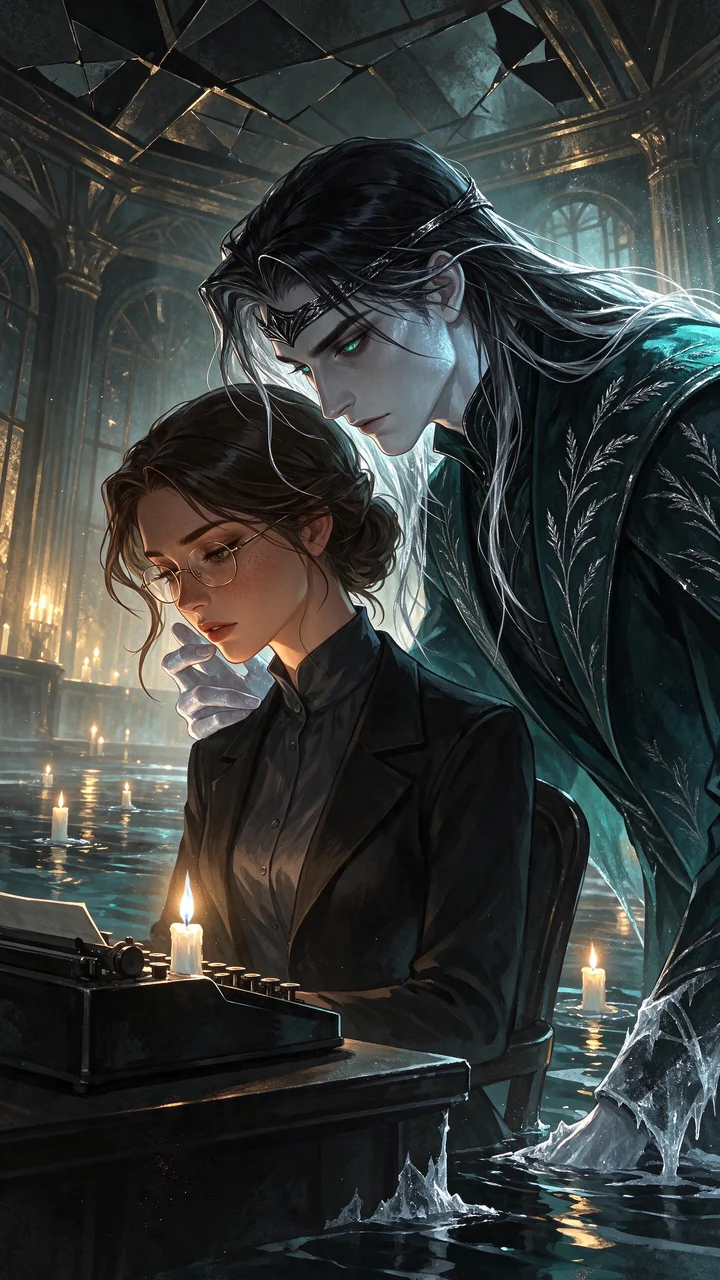
“Strike that,” the king said. “No. Leave it. Let them know I was wrong about the eels.”
“For the record,” Nell said, stroking it, “you were extremely wrong about the eels.”
“You aren’t in the record, scribe.”
“Then nobody can hold me to my opinions.”
He laughed, low, from the dark beyond her space heater. It was the eleventh night. She had begun to know that laugh the way she knew the sticky K on her machine: something she’d learned to work around and would miss if it were fixed.
The archive lay behind the ballroom, through a door that had once said EMPLOYEES ONLY. Its shelves sagged under books swollen fat as loaves, their leather spines split and furred with silt. Glass jars of river-weed glowed on every ledge, a slow green that pulsed when he spoke. The heater was hers: forty dollars at Menards, orange coils, and a tip-over switch she had to keep kicking. On the first night his hands had paused at the sight of it, and he’d said, “You brought your own sun.”
“You keep it at forty degrees in here,” she’d said.
He hadn’t turned the cold down. He had moved his chair closer to the heater instead.
On the second night he dictated the founding of the Drowned Court, the winter the engineers turned the Chicago River backward and the old courts of the lake lost their road home. On the fourth, it was a treaty with the Calumet marsh-folk: three hours of it, and then, unasked, the color of the marsh-queen’s hair. On the sixth night he gave her a law against singing on the Wells Street bridge, then a long silence, and then: “Put in that I was quiet.”
Every night ended the same way. She packed the case and stood.
“Look at me, Nell.”
“No.”
On the ninth night the no came half a second late. On the tenth she heard herself breathe in before it. Neither of them mentioned this. Both of them, she was fairly sure, had noticed.
Now it was the eleventh night, and her hands had stopped working.
It happened in the middle of the eels. Her fingertips went white and then slow. The chords came out mushy, she dropped a stroke, then another. She shook her hands and blew into her cupped palms like a kid at a bus stop.
“Your hands,” he said.
“They’re fine.”
“They’re blue. I can see them from here.” The long fingers resting on the far edge of the desk drew back an inch. “I’d like to warm them. I’d have to touch you to do it. You can say no.”
“You’re made of ice.”
“Mostly.” He paused. “Not entirely.”
She looked at his hands. That much was allowed. They were long, with frost silvering the nail beds and a ring of blackened silver on the smallest finger. She thought about the law, which said no bond beyond the record. She thought about her fingers, which she needed to pay rent.
“Yes,” she said.
He didn’t reach across. He waited until she laid her hands palms-up on the scarred wood. Then he folded them between both of his.
For a moment the cold was enormous. Then it wasn’t. Something beneath it gave, slowly, the way a frozen pipe gives, and underneath there was heat. Real heat, his own. It went into her knuckles and her wrists and up the soft inside of her forearms, until her whole body had leaned toward it without asking her first.
Water ran over her wrists.
She stared at it. The frost on his fingertips was melting and dripping onto the desk in small dark coins. His thumb moved once across the back of her hand, then stopped, as if he’d caught himself.
“Huh,” she said, because her voice wouldn’t manage more.
He let go first. She hadn’t expected that.
. . .
He sat in the green dark with his wet hands open on his knees and did not trust himself to close them.
Six hundred and twelve years, and the frost had not left his skin since before this city had a name. Kings had tried to warm him. So had lovers, early on, before he stopped permitting them. So had fire. Then a small, stubborn mortal with a pen tucked behind her ear had put her hands in his because he asked, and the ice had simply gone.
He listened to her heart. It was fast. His was faster.
“Again,” she said, eyes on her keys. “From the eels.”
He gave her the eels. Afterward, he could not remember a single word he had said.
. . .
The vending machine at the top of the service stairs took quarters, dimes and, Dex claimed, small lies. Its coffee tasted of pennies and was never quite hot.
“Imogen,” Dex said, handing her a cup. “Since you keep not asking.”
“I wasn’t not asking. I was working up to it.”
“Eleven nights of working up.” He leaned against the machine. His scarf was lumpy, oatmeal and green, the kind of thing nobody buys. “She was here when I came on. Sharp. Did the crossword in pen to annoy the Chancellor. She fell for him. Everybody could see it. She’d come up these stairs pink to the ears.”
“And?”
“One night she went down and didn’t come up. Next morning there’s a royal seal on her record. Nobody reads it. Not the Chancellor, not me.” He drank. “His order.”
The coffee had gone cold in her hands. “He told me to keep the eels.”
“I’m sure he did.” Dex’s laugh lines didn’t move. “You come up these stairs pink, Ashby, and I’ll carry you to the L myself.”
“Is that a threat?”
“It’s a bailiff’s courtesy.” He crumpled his cup. “Same thing.”
. . .
The Chancellor was waiting on the landing where the water began.
“You look tired, Miss Ashby.” Grey gloves, copper keys, and a scent of cloves. “He keeps you late.”
“It’s a long reign.”
“It is.” He stepped aside to let her pass, which meant she had to pass close. “Thirty-eight thousand, four hundred and twelve dollars. Your father borrowed against the house twice. I’m sorry. Grief and banks make poor neighbors.”
She stopped.
“I could make that number zero,” Isra said gently. “Tonight. All I’d need is one sentence, entered in your hand during an ordinary session. It’s housekeeping.”
“What sentence?”
He told her as though reciting a poem he’d written about her. “In any hour the king cannot guard himself, the guard of his person passes to the Chancellor’s hand.”
“That doesn’t sound like housekeeping.”
“It’s succession. Every court has it. Ours simply forgot to write it down.” His gloved fingers touched her sleeve, exactly where Auren’s hands had been. “You’d be doing us all a kindness.”
She looked at the glove, and only the glove. “No.”
“You haven’t heard the interest I’d forgive.”
“I don’t need to.” She stepped off the landing into the water. “My father taught me to read the whole contract, Chancellor. You’ve only shown me the part with the money.”
Behind her he laughed softly. It was not an angry laugh, and that frightened her more than anger would have.
. . .
The king was where she had left him. The heater ticked and the jars glowed.
She sat, set her fingers on the keys, and didn’t wait for him.
“For the record,” she said. “A question from the scribe.”
His silence had a texture she hadn’t heard before. “The scribe doesn’t ask questions.”
“Show me the law that says so.”
The silence went on. “There isn’t one.”
“Then.” She stroked the header herself. “Has anyone ever looked at you?”
His hand came to rest on the desk beside hers. It wasn’t touching. It was an inch away, maybe less, close enough that she could feel it no longer being cold. She didn’t move hers. Neither did he.
“Once,” he said.
Her fingers wrote it. “What happened to her?”
His hand stayed exactly where it was, waiting. She understood that whatever he said next would become law the moment she typed it.
“Ask me tomorrow,” said the king.