
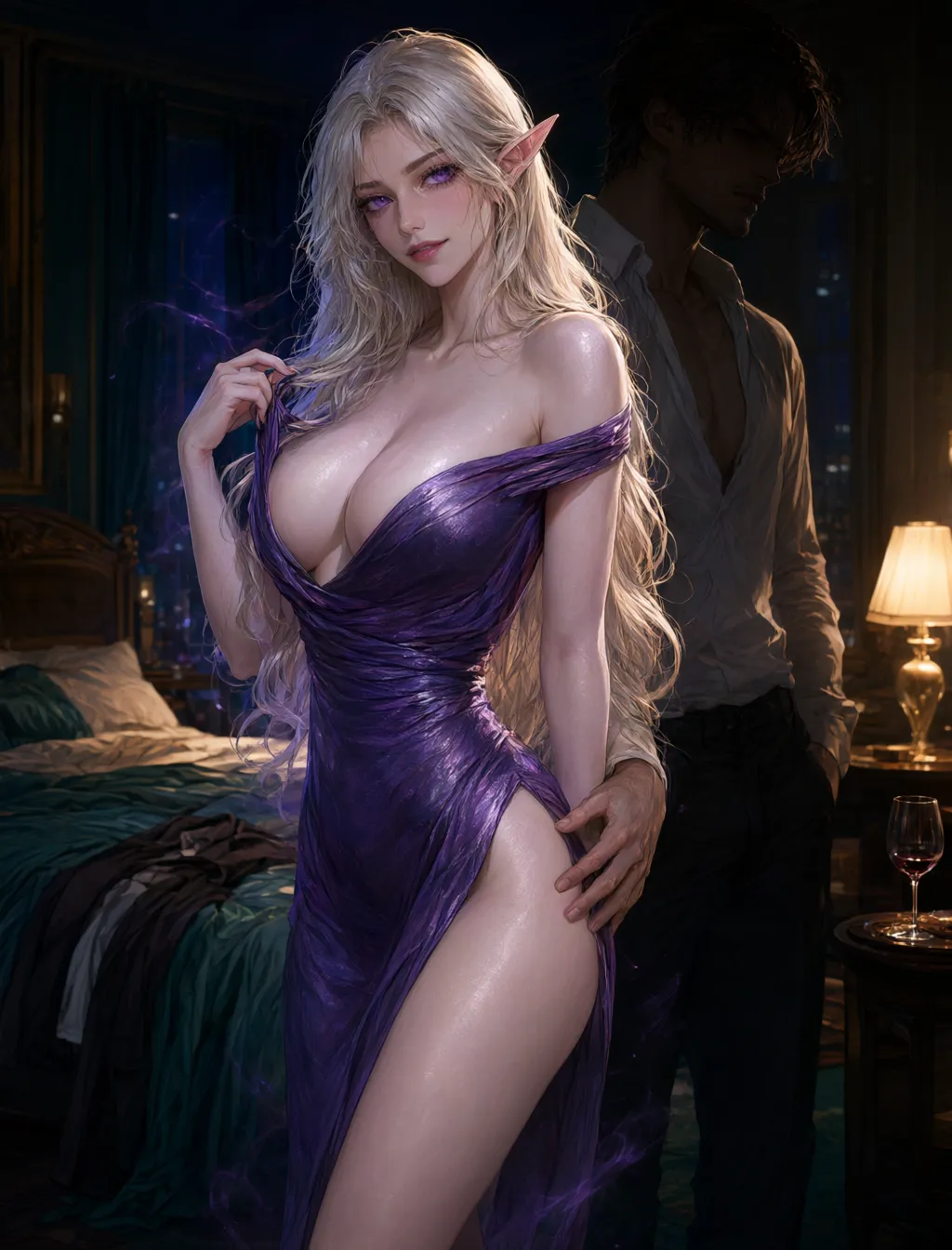
Gareth's hand lands light on her elbow, the pressure of a man who has spent six hundred years learning how not to startle anyone. "A word," he says, and it isn't a question, though he shapes it like one. He steers her along the wall past the great hearth, where the fire has burned down to a bed of orange coals, and through a low door she hadn't noticed — the stone lintel cut so close she has to duck, and she does, and her ears brush the cold rock on the way through, and she files that away: this hall was built by men who never once considered that anyone taller than a Saxon would need to come this way.
The room beyond is small and warm and smells of beeswax and old paper. A table, four chairs, a single candle already lit and guttering at the center like it's been waiting. Aethelred is already seated, his hands folded on the wood, and Galahad stands by the far wall with his arms crossed, and the woman in gray wool is in the third chair with her notebook open and a pen across the page, and Aria understands in the space of one breath that this is not a reception and never was — this is the part of the evening where the real questions get asked, and they have been waiting for her to be tired enough to answer them.
"You don't sleep," the woman says. Not a question either. "Not like they do. You put your body down for a few hours and you come back sharper than you went in. Gareth watched you on the flight — four hours, a blink, and you were in peak form again while your wives were still on their first coffee. So." She taps the pen twice against the page, a small dry sound in the small dry room. "Sit down, Mistress Silverleaf. Tell us what else you've been keeping in your pocket."
Aria pulls the fourth chair out and sits, and the chair is old enough that it complains. She crosses her ankles under the table, lays her hands flat on the beeswax-smelling wood, and looks at each of them in turn — the notebook woman, Aethelred with his folded hands, Galahad against the wall, Gareth just inside the door with his arms at his sides like a man who isn't sure he's allowed to sit. "Ask me anything you want," she says. "All of you. I'll answer as straight as I can, and if I don't know, I'll say I don't know instead of making something up to sound impressive." She lets that sit a beat, then turns her head toward the door. "In exchange, I want one thing back. Gareth spent the whole flight looking at my throat like it was going to open back up on its own. The bite healed before we left Indiana. So. Why does it still matter to you?"
Gareth doesn't answer right away. He looks at the woman in gray, and she gives him the smallest nod — permission, or maybe just the absence of a refusal — and he steps away from the door and finally sits. "It isn't the wound," he says. "It's the mark. A bite from one of them, taken to the throat and survived, isn't a scar. It's a signature. Armand put his mouth on you because he wanted to taste whether you could carry, and when he tasted yes, he signed for the whole family. Every old thing that reads blood the way we read paper will smell his claim on you from across a room now. The Order has spent six hundred years keeping a list of things like him, and not one of them has ever been invited to a table like this one. You walked in tonight wearing a Cabal brand on your neck and forty people in that hall were close enough to smell it." He folds his hands, mirroring Aethelred without meaning to. "So the question isn't why I was concerned. The question is what you intend to do about the fact that half the dark in Europe now knows you can be bred."
The woman in gray writes something down, one short line, and doesn't look up. "And when you say anything," she says, pen still moving, "what does that include? The bite. The three bodies in your yard. The thing you did to that vampire's fangs. What you are, exactly, and where you came from. Start wherever you like. I have all night, and so, apparently, do you."
Aria laughs — a real one, short and warm, the kind that fills a small stone room better than the candle does. She turns her head toward the door without hurrying, lets the laugh settle into the beeswax, and looks at Gareth with one eyebrow up. "We'll have to get back to that one," she says. "She's got a whole notebook of questions and she's been holding them in since the flight. I'd hate to waste the build."
Then she looks back at the woman across the table, and the smile doesn't leave her face, but something in it sharpens — the same tilt her chin takes when she's about to ask for something and knows she's going to get it. "Before I answer any of them, though." She folds her hands on the wood, and the candle flame leans toward her like it's being read to. "Can I get your name? You've been writing in that thing all night and I still don't know what to call you. And I've learned the hard way that the person holding the pen is usually the one who matters."
The pen stops. For a breath the woman in gray doesn't move at all, and Aria watches her decide — the small calculation behind the glasses, the way her thumb finds the edge of the page and holds it flat. Across the table, Aethelred's folded hands tighten by a fraction; by the wall, Galahad turns his head just enough to see her face. Gareth, at the door, says nothing, but his jaw sets, and that tells Aria more than any answer would have.
The woman in gray holds the page flat with her thumb for one more breath, then lifts the pen and lays it across the notebook like a knife set down at the end of a meal. "Evelyn," she says. "Evelyn Marsh. I've kept the minutes for this hall since 1961, and in sixty-four years nobody has ever asked me that." She says it without warmth and without complaint — just a fact, set down next to the others. "So. You've had my name for four seconds and it hasn't bought you anything. Answer the question."
A
Aria cocks her head, the candlelight sliding along the point of one ear. "I'm not sorry for asking, but that was a little curt, Evelyn." She says the name like she's weighing it, then lets it go and settles back in the complaining chair. "I'll answer anyway. Armand's fangs — I broke them with my eldritch blast. The violet bolts, the ones I put through the ceiling in the arena. Three of them, that night, all at once." She holds up three fingers and counts them off against the tabletop, tap, tap, tap. "One to his chest, because he was on top of me and I wanted him off. One to the fangs themselves, because I'd decided I was done being bitten. And one to his thigh as he ran, low and through the muscle, to slow him if the others didn't finish him. They didn't, so it was the right call."
She lets her hand fall flat on the wood. "Each bolt carries about the same force as a twelve-gauge slug at close range. Very accurate — I don't miss what I'm aiming at. So when I say I broke his fangs, I don't mean I cracked them or knocked one loose. I mean I put a slug's worth of force directly into the teeth he'd just used on my throat, and what came out of his mouth was gravel." She turns her head toward Gareth, who has gone very still against the doorframe. "That's what your Order has been smelling on me all night. Not a claim. A receipt."
Evelyn's pen is up again, but she hasn't written anything — she's looking at Aria the way the hall looked at Marcus when he named the blade. Aethelred's folded hands have come apart. It's Galahad, still against the far wall, who moves first: he uncrosses his arms, and the old chalice on his tabard catches the candle as he steps forward and sets a small iron key on the table between them, square in the middle, where all four of them can see it. "The warded chamber," he says, to Evelyn, not to Aria. "If she can do that on command and to order, we don't file her under the mark. We file her under the answer." Aria looks at the key, then at the four faces arranged around it, and understands the evening has just turned a corner she didn't plan — the questions aren't going to be about what she *is* anymore. They're going to be about what she'll agree to do next.
Galahad's finger stays on the key, and he does not sit, and Aria watches him choose his words the way a man chooses a step across a frozen pond. "Armand's mark is a claim on paper and a claim in the nose, and you are right that a claim dies with the claimant — but only the smell of it dies. The knowledge does not. He tasted a fertile thing and he told his family before he ever put his mouth on you, because that is what their kind does: they share the good news first and take the prize second. Kill him tonight and the scent fades in a week. The word 'fertile' walks out of every throat that heard it and never comes back." He lifts the key and turns it once in the candlelight, iron catching a wet orange shine. "So the chamber is not a cure for the mark. It is a place to prove what you are before the rest of them come to smell you for themselves. A room that holds what it holds and lets nothing out. We ward it, we put you in it, and we test the thing that broke his teeth — on our terms, on our floor, with a record. Then when the next family sends a courier, the Order answers with paper instead of panic."
Aria reaches across the table and puts two fingers on the key, not to take it — just to hold it still against the wood, because the old knight is still turning it and she wants him to feel the weight of her hand on the thing he's offering. "You answered the question I didn't ask," she says. "I asked what the chamber entails. You told me what it's for." She looks up at him, and her ears angle back a degree, the way they do when she's listening past a person's mouth to the room behind it. "So let me try the one you dodged. If I walk into that room and you test the bolts, whose record is it? Evelyn's? Gareth's? Yours? Because I've read enough history to know that a documented miracle becomes somebody's property the moment it's written down, and I didn't fly six hours to hand the Order a deed to my hands." She lifts her fingers off the key and lets it sit where it landed, square between the four of them, and doesn't look away from Galahad's face while she says the next part. "And whatever we do about the chamber, we do it with my party in the room. All four of them. Sera, Dani, Marcus, Mike. They don't need to understand the wards. They need to be standing where they can see me, because I've built exactly one thing in six months that I trust completely, and it isn't a stone room under Cornwall."
Galahad's finger comes off the key. He doesn't take it back — just lifts his hand and lets it hang in the air between them, the way a man does when he's been outmaneuvered and is deciding whether to be annoyed about it. "Evelyn's," he says finally. "The minutes are hers. They have been since 1961. If she writes it down, it belongs to the hall, and the hall belongs to no one man, which is the closest thing to safe this Order has ever managed." He looks at the woman in gray, and she gives him the same small nod she gave Gareth earlier — no warmth in it, just permission. "Your party in the room," he adds. "All of them. The Champion is welcome. I'd like to see him work a blade that isn't dull."
Aria nods once, slow, and lets the key sit where it landed. Then she leans back in the complaining chair and folds her arms, and something shifts in her face — the same tilt her chin takes when she's about to hand someone a thing they didn't ask for and watch them decide what to do with it. "Fine. Evelyn gets the record, my five stand in the room, and the Order answers the next courier with paper." She counts it off on her fingers, tap, tap, tap, like she did the bolts. "But you asked what I've been keeping in my pocket, and I've been answering the small ones. So here's the big one, and I want all four of you to sit with it before you start writing anything down." She lets the candle gutter once, leans forward, and sets both hands flat on the beeswax-smelling wood. "The bolts are the polite spell. I have one that no chamber you own can hold — not warded, not sunk in bedrock, not under a mile of Cornwall granite. It calls down a storm of burning rock from the sky, and it doesn't care what's underneath it. Every five square feet of whatever I point it at gets a stone the size of a fist, moving fast enough to go through a roof and keep going. I can shrink the circle to a hundred feet, or open it to a mile. The density doesn't change. A mile of it is a mile of it."
Evelyn's pen stops moving. For a long moment nobody in the small room says anything, and the candle flame stands straight up in the dead air like it's listening too. Aethelred's folded hands have gone white at the knuckles. Gareth, just inside the door, has stopped breathing through his mouth and started breathing through his nose, slow and deliberate, the way a man does when he's recalculating something he thought he already had the number for. It's Galahad who speaks first, and his voice has dropped half an octave from where it was when he was talking about the chamber. "A mile," he says. Not a question. Like he's tasting the word to see if it's the right size. "You're telling me you can put a fist-sized stone through every five square feet of a mile-wide circle. That's not a spell. That's a siege weapon. That's a thing that ends a town."
"It ends a county," Aria says, and she doesn't soften it, because softening it would be a lie and she's decided tonight is not the night for lies dressed up as modesty. "I've never cast it. I want to be honest about that, because I know how it sounds when someone walks into your hall and claims a power they've never tested. I know the shape of it the way I know all of them — the way you know how your own arm works without having to throw a punch. But I haven't pulled the trigger, and I'm not going to pretend I have." She turns her hand palm-up on the beeswax-smelling wood, empty, and looks at each of them in turn. "So if you want to see it, I need something from you that no chamber of yours can give me. I need miles. I need empty ground with nothing on it that anyone loves — no villages, no livestock, no old stones you'd want kept. A moor. A bombing range. Somewhere the only thing I'd be erasing is dirt." She lets her hand close, slow, like she's closing a book. "There, I've told you the most dangerous one. That's the whole inventory. Everything else I've got, your warded chamber can hold. That one can't. That one you have to take outside and give room to, or you don't take it at all."
Galahad does not answer. He looks at the key on the table like it might start moving on its own, and Aria watches the age come up in his face — not the centuries, the other thing, the long arithmetic of a man who has stood on a hill above a village and watched what a bad harvest does to people, what a hard winter does, what an army does. His right hand finds the chalice on his tabard without looking, thumb across the embroidered gold, the way a man touches a scar he's stopped noticing. "I've seen a town end," he says, quiet. "Not by magic. By men with a battering ram and a bad reason. It took them three days. They had to go house to house. You're telling me you could do it in a breath and then walk away and get on a plane." He looks up at her, and there is no accusation in it — worse than accusation, there's a question he's been carrying for a thousand years and never expected to ask out loud. "And what happens the first time someone you love is on the wrong side of a line you draw?"
"That's the thing I think about at three in the morning," Aria says, and she doesn't say it lightly, and she doesn't look away. "Not the spell. The person I'd be after I used it." She turns her hand over on the table, palm up, and the candlelight finds the cuff of the plum gown where Prestidigitation has already started to dull at the edge — a small honest thing, the magic wearing off in real time. "So here's the balance, and it's the reason I'm not afraid of the inventory I just handed you. Every one of those spells has a twin. I can end a county. I can also put a man's shoulder back together joint by joint, and pull the tau proteins out of a quarterback's brain before they take his mind, and set a boy's chest right on a viewing table in front of his mother and watch him sit up. I raised Jacob Miller from dead. Nineteen years old, seven days in the morgue freezer, and I put him back on his feet in a funeral home in front of eighty people, and the only thing I asked for afterwards was to be accepted, and I asked that in a stadium because I didn't want to hide." She lets that land, and watches Evelyn's pen stop for the second time tonight. "So when you weigh what I am, weigh both sides of the scale. Anyone can build a bomb. The Order has a thousand years of swords for the ending part. What you don't have — what nobody in this hall has ever had at the same table — is someone who can put it back."
Galahad's thumb stops on the chalice. For a long moment he says nothing, and Aria watches him do the arithmetic — not the town this time, the other thing, the thing that comes after. "Raised from dead," he repeats, and the words come out slow, like he's setting each one down on the table next to the key. "Not healed. Not mended. Dead seven days and you called him back." He looks at Evelyn, and then at Aethelred, and something passes between the three of them that Aria can't read — a look sixty years old and a thousand years old at once, the look of people who have spent their whole lives guarding a door and have just been told the wall behind it is a curtain. "Evelyn, put the pen down for a moment. I want to hear this with both ears."
Evelyn lays the pen across the notebook and folds her hands on top of it, and Aria notices the paper beneath her thumbs — three short lines, nothing more, no transcription of the storm, no inventory of the bolts. Whatever the minutes will say about tonight, they haven't been written yet. "Jacob Miller," Evelyn says, and the name lands flat, a file pulled off a shelf. "Nineteen. Crown Point. I read the footage. I assumed it was staged, or a hospice case someone dressed up for the cameras. You're telling me the boy was in the freezer a week?"
"Seven days," Aria says. "Funeral home, open casket, his mother in the front row watching. I put my hands on him and asked him to come back, and he sat up and asked me for water." She turns her palm up again on the table, and this time there's no candlelight trick on the cuff — the Prestidigitation has worn all the way off, and the plum silk has gone back to being ordinary cloth, the small honest thing finished. "That's the spell I haven't told you about. Resurrection. It's expensive — sixteen points, and I only get one a day, which means I can bring back one person. One. Not a battlefield. Not a plague. One body, substantially intact, and they come back with everything they were. Memories, name, all of it." She lets that sit. "I've used it a dozen times now. I didn't realize that of all you have read and researched about me that THAT was the one part you apparently didn't believe."
Evelyn does not reach for the pen. She sits back instead, and for the first time all night the notebook on the table stops being the center of the room. "A dozen," she says, and the number comes out of her mouth like a stone she's been turning over in her palm since the plane. "You said a dozen. I have one name on the record. Jacob Miller, Crown Point, three months ago. That leaves eleven people walking around this world who are supposed to be in the ground, and not one line about any of them in any file I have ever kept." She folds her arms, and the gray wool creases sharp at the elbows. "So the minutes have a problem. Either the minutes are wrong, or you've been running a resurrection practice under a rock for six months and the Order's whole reason for existing just got quietly outgrown."
Aria holds her eyes and doesn't blink, because this is the question under all the other questions and she's known it since Gareth first looked at her throat on the flight. "The other eleven are mine," she says. "Not the Order's, not Evelyn's, not anybody's but mine and the people who asked me. Some of them were old. Some of them were young. One of them was a man who'd already signed a DNR and changed his mind in the parking lot of the hospital. None of them signed a form, and none of them are going in your book tonight, because a resurrection that gets written down is a resurrection somebody eventually comes to collect." She leans forward and puts her finger on the notebook's closed cover, not opening it, just resting there — the same two-finger weight she put on Galahad's key. "You get Jacob. He's public, he's on video, he's already a fact. The other eleven stay mine until each of them tells me otherwise, and they get to say it themselves, out loud, or it doesn't happen. That's the deal. Write it down or don't, but that's what I'm offering and it's the last time I offer it."
Evelyn looks at the finger on her notebook for a long moment, and Aria watches the arithmetic move behind her glasses — the old woman weighing a closed cover against sixty-four years of open pages. Then Evelyn does something none of them expects: she slides the notebook an inch toward Aria, just an inch, and leaves it there. "The minutes will record that Mistress Silverleaf declined to enumerate her resurrections at this time, and that the hall accepted the terms without objection." She looks at Galahad. "Unless the hall objects." Galahad's hand is still hanging in the air where the key was. He looks at Aethelred, and Aethelred looks at the candle, and neither of them says a word, which in a room like this one is the loudest thing anyone has said all night.
Gareth finally moves off the doorframe and pulls the empty chair at the head of the table a few inches out, sits down in it like a man who's been standing in his own house for an hour waiting to be invited. "Then the practical question," he says, "and I'll ask it because nobody at this table is going to like it. Armand is still out there. His fangs are gravel, his chest has a hole in it, and he's had three days to run. The Order's people in France and the Low Countries have been watching the old families since Tuesday. Nothing. The Cabal has gone quiet in a way that means they're having a conversation, and when that conversation ends, one of two things comes through your door. Either a courier with a very polite offer, or something that doesn't knock." He folds his hands on the table and looks at Aria the way a man looks at a fuse he can't see the end of. "You told him no. He heard you. So what do you want us to do when the answer comes back?"
Gareth folds his hands on the table and waits, and Aria lets him wait, because the answer she's about to give him is not the one a frightened woman gives. "Armand dies," she says. "That's not a policy question, it's a debt. He put his mouth on my throat in my own yard while his friends held my house. He doesn't get to keep breathing just because he ran fast enough. And the mark—" she turns her head and shows them the healed skin along her neck, clean and unmarked, "—the mark is a smell, and a smell is a thing that dies with the nose it lives in. I'll carry his claim on me for exactly as long as it takes to find him, and then I'll carry it in a jar." She looks back at Gareth. "You asked what I want the Order to do when the courier comes. Nothing. If someone knocks, we answer the door. If someone doesn't knock, my party is standing behind me and we handle it. You've got a thousand years of swords and a list of names. I've got a dragon, a deva, a Champion, an Archmage, and five cantrips that don't run out. I like our odds better than yours."
She says the next part without ceremony, the way she said the storm. "As for the fertility. You're all treating it like it's a secret I let slip, and I need to correct the record before Evelyn writes anything down that I'll have to walk back later. It was never going to stay quiet, because I don't intend to keep it quiet. My mother has wanted grandchildren since I was a boy and she didn't know yet that I'd be the one to give them to her. She set extra plates at Easter. She asked, out loud, at her own table, whether there was going to be a baby, and I looked her in the eye and told her yes, eventually, when the women I love are ready." She lets that sit, and the candle flame leans toward her again like it's been listening the whole time. "So when the Violet Angel shows up in a hospital ward six months from now with a belly out to here and her hands on two sick kids at once, the world is going to notice, and I want it to. I'm not hiding a pregnancy like it's a crime. I'm going to be a mother in front of everyone, and the only thing Armand's bite changed is that he found out early. He doesn't get credit for the news. He just gets a head start on the funeral."
Evelyn's pen is still down. She looks at Aria the way a jeweler looks at a stone that just refused to be appraised — and then she does the one thing nobody in the small room has done all night: she laughs, short and dry, a sound like a drawer closing. "Sixty-four years," she says, "and the first person to walk in here and tell the hall it can't have her family is an elf who didn't exist last summer." She picks the pen up, writes one line, and closes the notebook on it. "The minutes will say Mistress Silverleaf intends to bear children publicly, and that the hall was informed, not consulted. I find I don't mind being informed."
Galahad's hand comes down off the air and rests flat on the table beside the key, and he looks at Aethelred, and Aethelred looks back, and whatever passes between them is older than either of them looks. Then Galahad pushes the key across the wood — not toward Aria, but past her, to the empty chair at the head of the table where Gareth is sitting, and Gareth catches it under his palm without a word. "Then the chamber is tomorrow," Galahad says. "Not for the storm. For the bolts, and for the boy Marcus says can name a blade's fire. We'll have the record, and the record will be yours to read before it's ours to keep." He stands, and the chalice on his tabard swings once and settles. "And when Armand is found — when, not if — you'll tell us where the body lands. Not to claim it. To close the file."
Aria stands too, and the complaining chair scrapes back, and she looks around the small beeswax-smelling room at the four of them — Evelyn with her closed notebook, Aethelred with his hands finally still, Galahad with his thumb on the chalice, Gareth turning the iron key over once in his palm like a man weighing whether to give it back. "The body lands in Indiana," she says. "In the yard, next to the other three, and the file closes there too." She ducks through the low lintel on the way out without being told, ears clearing the cold stone by a finger's width, and behind her the candle gutters once and goes on burning, and nobody in the room moves to put it out.
Galahad falls in beside her without being asked, and for the length of the corridor neither of them says anything. The torchlight has thinned to a seam of it, and his boots keep a slow, even time on the flagstones, a rhythm older than the hall they're walking through. Aria watches him from the corner of her eye — the way his right hand rides a half-inch from the embroidery stitched into his tabard, thumb finding the gold chalice and smoothing across it the way a man checks a pocket for keys he knows are there. Not a cup. A picture of one, thread on wool, the grail of it worked in old gold so worn it's gone the color of weak tea. He touches it the way she touches the ring Aethelred gave her, and she files that away without saying a word about it.
"Galahad." She keeps her voice low, pitched under the torch-seam, for the two of them and the stone. "I don't know the limits of how far back my resurrections can go. The boy was seven days in a freezer and he sat up. Beyond that I'm guessing — a year, five, a century, I can't promise you any of it. But if there's someone you lost along the way, someone you think would be glad to stand up again, or even just someone you miss so badly it still gets a hook in you after all this time — I'll try. All I need to try is the body. Substantially intact. That's the whole ask." She says the rest leaning closer, so it lands only in his ear and the dark. "I'm offering it to you. Not the hall. You."
Galahad's thumb stops on the embroidery. He doesn't look at her — keeps his eyes on the corridor ahead, where the torch-seam bends toward the stair — and for six paces he says nothing at all. Then his hand drops off the chalice and hangs at his side, and Aria watches the age come up into his face, the other age, the kind that isn't years. "There was a woman," he says, and the words come out slow, the way a man sets down something heavy he's been carrying since before either of them was born. "Not a wife. I never had one of those. A healer, in a village outside Caerleon, the year the fever came through. She stayed when the rest of us rode out. I was twenty-two and I thought staying was the coward's choice." He says it without heat, a fact laid next to the others. "I buried her in a churchyard that isn't there anymore. The village isn't there anymore. I've looked. Twice in a thousand years, and the second time there wasn't even a stone to stand on."
Aria lets that land in the dark between them and doesn't fill it, because she can hear the other thing he isn't saying yet — the part where there's no body, and he knows it, and he's telling her anyway. "Then that's a no," she says finally, quietly, no softness in it that would insult him. "I can't call back what isn't there. I won't pretend otherwise." Galahad nods once, slow, like a man setting a stone back down on a wall he'd half-lifted, and for six more paces the corridor is just two sets of boots and the torch-seam bending toward the stair. "There's another," he says at last, and this time he does look at her — sideways, under the gray brows, the way a man checks whether the person beside him can carry a thing before he hands it over. "Not mine. Aethelred's. He's walking ten paces ahead of us, and he's been walking ten paces ahead of this conversation since the hall emptied."
Aria's eyes find the old man's back — the dark wool, the slight roll of age in his step, the hand that keeps drifting to his chest where the conjured violet used to sit before he gave it to the woman in gray for safekeeping. The garnet ring is warm against her sternum, riding on the chain she made with a cantrip and never bothered to explain. "His son," Galahad says, and the words come out flat, a fact laid next to the ones he's already laid down. "Falcon, we called him. He joined at sixteen because his father joined at sixteen, and he was good with a bow, and he fell at Hastings with the rest of us who thought Harold was the last king worth dying for. Aethelred carried him off the field on his own shoulders. He was the end of the line — no brothers, no children of his own. The Order buried him in the catacombs under the old hall, the one they walled up when they moved the seat here, because a father who has spent twelve hundred years not being able to visit a grave is a father the hall would rather not think about." He stops at the bend of the corridor and turns to face her fully, and the chalice on his tabard catches the last torch, dull gold against gray wool. "The body is still there. I've seen the slab. If you mean what you said — if you'll try for anyone who asks — then don't ask me again. Ask him. He's had a thousand years to mourn."
The words land the way a dropped coin lands — small, and then louder than it should be. Aria keeps walking, and the garnet sits against her sternum with a weight that has nothing to do with its size, and she can feel Aethelred's back the way you feel a door at the end of a hall, before you've decided whether to knock. A thousand years. She does the arithmetic without wanting to: sixteen when he joined, sixteen when the boy joined, Hastings in 1066, and a slab under a hall that got walled up because the father couldn't stand to visit. She has walked past grief a hundred times in six months. She has never once been handed the address of it.
She catches up. Three strides and she's alongside him, and the old man's step doesn't change — same roll of age, same hand drifting up to his knuckle and finding nothing there, a small lost gesture. Up close, in the thin torch-seam, Aethelred's face is all the years the chamber hasn't rewound: the papery skin at the temples, the veins in the back of his hand like a river map of somewhere that no longer exists. He doesn't look at her. He looks straight down the corridor, at the stair, at the dark at the bottom of it, and Aria understands that he has been listening to his own name in a stranger's mouth since the hall emptied, and that he has been waiting for her to say it.
"Aethelred." She says it low, and she doesn't dress it up. "Galahad told me about Falcon. He told me where he is." The old man's stride breaks — half a step, then the other foot, and then he stops entirely, and his hand comes up to his chest and stays there, flat, over the wool where the violet flower sits. Aria stops beside him and lets the torch do the talking for a second. "If the body is substantially intact, and if the spell can reach back that far, the man comes back with everything he was — memories, name, the whole person. I don't know if I can do it. I'm asking you to be the one who asks and gives me license to try." She reaches up and touches the ring on its chain, once, so he can see it, and then lets her hand fall. "You gave me a founder's vote before I'd earned it. This is what I've got that's worth more than that."